Month: October 2024

  • The Radiance of the White AH: A Buddhist Bedtime Story of Guru Yoga

    The Radiance of the White AH: A Buddhist Bedtime Story of Guru Yoga

    On a quiet night, beneath a sky filled with shimmering stars, little Tenzin lay nestled under his blanket. The soft glow of the hearth flickered across the room, and beside him sat his grandmother, whose voice was as soothing as the wind moving through prayer flags on the mountaintop.

    “Tonight, my little one,” she whispered, “I will tell you a very special story. It is about a practice called the Guru Yoga of the White AH—a practice that can help us remember the deepest truth of who we are. It is the most beautiful of all practices, because it leads us back to the light that has always been inside us, the light of our true nature.”

    Tenzin snuggled deeper into his blanket, his heart already softening. He knew that whenever his grandmother told a story, it carried not just words, but a magic that could be felt deep in the heart.

    “Long ago,” Grandmother began, “there was a wise teacher named Namkhai Norbu, who understood that many people felt lost on their spiritual paths. They tried to follow many practices, each one like a step on a long staircase, but the more steps they climbed, the more tired they became. Namkhai Norbu smiled kindly and said, ‘You do not need to climb endless steps. There is a single path that leads directly to your true nature—the Guru Yoga of the White AH.’

    ‘This practice,’ he said, ‘is like a single, bright thread that weaves through all the other teachings. By chanting the sound AH, you connect directly with the heart of all wisdom, all love, and all peace. It is the simplest practice, and yet it contains everything.’”

    Tenzin listened quietly, his breath soft and steady. “Grandmother,” he whispered, “what does AH mean?”

    Her eyes twinkled as she answered. “AH is the sound of pure being,” she said. “It is the sound of resting deeply in your true self—beyond thoughts, beyond worries, beyond trying to be something you are not. When you chant AH, it is like opening a door into a vast, open sky. There, you discover that you are not separate from anything. You are already one with the light of the universe, just as a wave is never separate from the ocean.”

    Grandmother leaned closer, her voice becoming soft as a lullaby. “Imagine, little Tenzin, a soft white light glowing gently in your heart, like the light of the moon reflected on a still lake. This light is the essence of your true nature—pure, peaceful, and radiant. Now, imagine chanting the sound AH from deep within your heart. As you chant, the white light begins to grow, filling your chest with warmth and joy.”

    Tenzin closed his eyes, imagining the soft white light blooming in his heart. He took a gentle breath and whispered, AH… He felt a small sense of peace spreading through him, like a breeze carrying the scent of flowers.

    “And now,” Grandmother continued, “imagine that with every chant of AH, the light in your heart radiates outward, filling your whole body. Your head, your hands, your feet—all are filled with this soft, white light. And as you chant AH again, the light begins to shine beyond your body, flowing out in all directions, like beams of sunlight reaching every corner of the world.”

    Tenzin smiled, feeling the light inside him growing brighter, as if his heart were shining like a little sun.

    “Each time you chant AH,” Grandmother whispered, “the light spreads farther and farther—into the sky, over the mountains, through the rivers, and into the hearts of every being. But here is the most wonderful secret: The light does not come from outside you. It is already within you, waiting to be remembered. Chanting AH simply helps you see the truth that has always been there—that you are already one with the light, the love, the peace of the universe.”

    Tenzin imagined the white light flowing through the entire world, like water filling every stream, every river, every ocean. And as the light touched the hearts of others, he saw that it sparked new lights in them, too. One light became two, and two became many, until the whole universe was glowing with the same soft radiance.

    “This is the essence of Guru Yoga,” Grandmother said tenderly. “It is the practice of remembering that you are not separate from the light, not separate from love, not separate from anything. When you chant AH, you awaken to the truth that you are already whole, already free. And each time you remember this, the light within you shines a little brighter, helping others remember their light too.”

    Tenzin felt a deep warmth in his chest, as if the white light were wrapping him in a soft embrace. He whispered the sound again: AH… AH… With each repetition, he felt more peaceful, more connected to everything around him, as if the boundaries between himself and the world were melting away.

    “Grandmother,” he whispered, “is this light always with me, even when I forget?”

    “Yes, my little one,” she said with a smile. “The light is always there, like the sun shining behind the clouds. Even on days when you feel sad, tired, or lost, the light never leaves you. And each time you chant AH, you clear away the clouds, letting the light shine once again.”

    Grandmother kissed Tenzin’s forehead and offered a final blessing:
    “AH… May your heart always remember its light.
    AH… May your breath carry peace to every corner of the world.
    AH… May you rest in the truth of who you are—boundless, radiant, and free.”

    And with that, Tenzin drifted into a deep, peaceful sleep, carried by the gentle rhythm of the mantra. In his dreams, he saw white light flowing from his heart, spreading across the sky, touching every star, and filling every heart with peace. He dreamed that with every whisper of AH, more lights appeared, until the whole universe shone with the same boundless love.

    May the sound of AH guide you always, helping you remember the light that lives within you and within all beings. Sleep well, knowing that you are already one with the truth, the peace, and the love of the universe. The light is always here.

    Goodnight, little one. ❤️

    🙏🕊️🙏


    If you’d like to explore more bedtime stories for children, including tales that nurture compassion and mindfulness, you can find our collection here.




  • Post 9: The Power of Detachment: Patanjali’s Sutras 1.15 and 1.16

    Post 9: The Power of Detachment: Patanjali’s Sutras 1.15 and 1.16

    In the previous post, we explored the importance of discipline and consistent effort in mastering the mind. Now, Patanjali introduces the concept of detachment as a natural extension of that discipline. In Sutras 1.15 and 1.16, he reveals the deeper layers of non-attachment and how they lead to freedom from desires and aversions.

    1.15: Detachment is the conscious effort to let go of desires for objects or experiences, both seen and unseen.
    1.16: The highest level of detachment is achieved when there is freedom from the pull of even the most subtle mental events, leading to the experience of pure consciousness.

    The Practice of Detachment

    Detachment (vairagya) is the conscious practice of letting go of desires and aversions. In Sutra 1.15, Patanjali defines detachment as the effort to release attachments to both seen and unseen objects or experiences. This includes everything from physical possessions to emotional desires and even subtle expectations we might have about the future.

    Detachment doesn’t mean indifference or suppression of desires. Instead, it is about witnessing these desires as mental events without becoming attached to them. By observing them with clarity, we free ourselves from the push and pull of likes and dislikes. The practice of Neti, neti. I am the witness. I am the Seer helps us recognize these desires as fluctuations of the mind, not reflections of our true self.

    This conscious effort to release attachment is a key part of cultivating equanimity. The more we practice detachment, the more we are able to rest in the pristine mind—a state of awareness that is unaffected by the mind’s desires.

    The Highest Level of Detachment

    In Sutra 1.16, Patanjali describes the highest form of detachment: the ability to remain unaffected by even the most subtle mental events. At this level, we are free from the pull of both desires and aversions, and we rest in pure awareness.

    This is not a state of cold detachment, but a profound experience of freedom. When we are no longer swayed by the mind’s constant fluctuations, we experience a deep sense of peace and clarity. This is the state of kaivalya—pure consciousness—where the Seer abides in its true nature, untouched by mental events.

    Sogyal Rinpoche, a renowned meditation master, often emphasized that meditation is about cultivating non-distraction. The state of meditation is, at its core, a state of non-distraction—remaining present and aware, without being swept away by the mind’s fluctuations. This ties directly into Patanjali’s teaching on detachment. By practicing Neti, neti. I am the witness. I am the Seer, we cultivate non-distraction, allowing us to remain steady in the awareness of the Seer, free from the pull of desires and aversions. Meditation, in this sense, is the practice of being undistracted by mental events, resting in the stillness of the pristine mind.

    The highest level of detachment doesn’t come overnight. It is cultivated through disciplined practice and sincere commitment, as outlined in the previous sutras. As we grow in our ability to let go of desires, we move closer to this state of pure consciousness, where the mind’s fluctuations no longer hold sway over us.

    Bringing It Into Practice: Cultivating Detachment

    Detachment is a practice that we can cultivate daily. Each time we notice a desire or aversion arising, we can pause and observe it as a mental event. Using the phrase “Neti, neti. I am the witness. I am the Seer,” we create space between ourselves and the desire, allowing it to pass without engaging with it.

    This practice of letting go doesn’t mean we should avoid enjoying life or fulfilling our needs. Rather, it’s about maintaining a sense of equanimity, where we are not defined by our desires or driven by them. We can enjoy what life brings while remaining unattached to the outcomes, staying rooted in the awareness of the Seer.

    Over time, this practice of detachment brings a deep sense of freedom. We begin to experience life more fully, without the constant push and pull of desires, aversions, and expectations. The mind’s fluctuations lose their power, and we rest in the stillness of the pristine mind.

    The Joy of Non-Attachment

    As we grow in our practice of detachment, we discover that non-attachment is not about losing joy but about gaining freedom. When we are no longer caught up in the mind’s desires, we experience a deeper, more authentic sense of happiness. This joy arises from being present in the moment, fully engaged with life yet unattached to any particular outcome.

    Non-attachment also allows us to respond to life with greater compassion and wisdom. When we are not driven by our own desires, we can see situations more clearly and act from a place of inner stillness. This is the power of detachment—a freedom that allows us to experience life in its fullness, without becoming entangled in its fluctuations.

    Coming Up Next:

    In our next post, we will explore Sutras 1.17 and 1.18, where Patanjali describes the various stages of meditative absorption and the transition from mental events to deeper states of awareness. Join me as we continue this journey toward deeper clarity, peace, and self-realization.

    🙏🕊️🙏

  • Bob Marley: A Christian Mystic in the Rastafarian Tradition

    Bob Marley: A Christian Mystic in the Rastafarian Tradition

    When we think of Christian mystics, names like St. John of the Cross, Teresa of Avila, and Thomas Merton often come to mind. These individuals, through their writings and lives, embodied a deep and profound connection with the divine, often expressed through personal, mystical experiences of God. However, the notion of Christian mysticism is broader than traditional Catholic or Protestant expressions—it reaches into diverse traditions where Christ’s teachings and spiritual wisdom are central.

    One such figure, who might not immediately be considered a “Christian mystic” in the conventional sense but certainly embodies the spirit of one, is Bob Marley. Known globally as a reggae legend, Marley’s spiritual identity is deeply rooted in the Rastafarian tradition, which, while distinct, is also firmly anchored in Christian theology.

    Rastafarianism: A Spiritual Path with Christian Roots

    Rastafarianism, often simply referred to as Rasta, is a spiritual and social movement that emerged in Jamaica in the 1930s. It was born out of a synthesis of Christian beliefs, African traditions, and a profound sense of connection to the Bible, particularly the Old Testament. Central to Rasta belief is the recognition of Haile Selassie I, the former Emperor of Ethiopia, as the returned messiah and the living God—a figure often equated with the second coming of Christ.

    Bob Marley, as one of the most famous adherents of Rastafarianism, infused his music with these beliefs, blending messages of liberation, love, and faith. His songs are filled with references to biblical themes, the teachings of Christ, and the pursuit of a deeper, more authentic connection with God.

    Bob Marley as a Christian Mystic

    So, why consider Bob Marley a Christian mystic? Mysticism is fundamentally about experiencing the divine in a personal and transformative way. It’s about encountering God not just through doctrine, but through the heart, soul, and life’s journey. Marley’s music and life were testaments to this kind of mystical experience.

    In songs like “Redemption Song” and “One Love,” Marley channels a message of unity, divine love, and spiritual freedom—core tenets of Christian mysticism. His lyrics often speak to a universal spirituality, grounded in the Christian narrative but transcending religious boundaries. He was a prophet in his own right, using music to communicate a vision of God’s kingdom that was inclusive, just, and deeply rooted in love.

    Moreover, Marley’s commitment to living out his spiritual convictions—despite significant challenges and opposition—echoes the path of many Christian mystics who sought to embody their beliefs in every aspect of their lives. His was a spirituality that called for both inner transformation and societal change, a hallmark of true mystical insight.

    The Intersection of Traditions

    While Bob Marley is most often associated with Rastafarianism, placing him within the broader category of Christian mystics allows us to see the rich tapestry of his spiritual journey. It acknowledges that Christian mysticism isn’t confined to one tradition but is a universal experience of the divine that can manifest in many forms.

    For now, Bob Marley can comfortably reside in the Christian mystics category, not as a way of limiting his spiritual legacy, but as a way of recognizing the Christian foundation upon which much of his mysticism was built. In time, as we explore more of his teachings and their roots in the Rasta tradition, a separate category might emerge to honor the unique aspects of Rastafarian spirituality. However, his inclusion in the Christian mystic category speaks to the fluid and expansive nature of spiritual experience, one that transcends labels and denominations.

    Conclusion

    Bob Marley’s legacy as a musician is undeniable, but his role as a spiritual figure—one who bridges the gap between Rastafarianism and Christian mysticism—is equally profound. By considering Marley within the context of Christian mysticism, we can appreciate the depth of his spiritual insights and the ways in which his life and music continue to inspire a deep, mystical connection with the divine.

    In acknowledging Bob Marley as a Christian mystic, we not only honor his contribution to music and culture but also recognize the universal truth that mysticism is a path open to all who seek a direct, transformative relationship with God—regardless of the tradition they follow.

    🙏🕊️🙏

  • Ramayana No. 14: Be Good, Do Good, Purify Your Mind: A Simple Reflection on the Ramayana’s Timeless Wisdom

    Ramayana No. 14: Be Good, Do Good, Purify Your Mind: A Simple Reflection on the Ramayana’s Timeless Wisdom

    In the vast expanse of spiritual literature, few texts carry the weight and significance of the Ramayana. This ancient epic, deeply embedded in Hindu culture, tells the story of Prince Rama, whose life is a testament to the principles of righteousness, duty, and the eternal struggle between good and evil. As we delve into its rich narrative, it’s easy to get caught up in the details of battles, relationships, and divine interventions. However, the essence of the Ramayana can be distilled into three simple yet profound lines, attributed to the Buddha:

    Be good.
    Do good.
    Purify your mind.

    Though these lines originate from the Buddhist tradition, they encapsulate the core teachings of the Ramayana and many other spiritual paths. These principles are not confined to one tradition alone; they are echoed in the teachings of Jesus Christ, who emphasized love, compassion, and inner purity as the path to spiritual fulfillment. Let’s explore how these simple instructions align with the lessons that Rama’s journey imparts, and how they resonate with the wisdom found in Christianity.

    Be Good

    At its heart, the Ramayana is a story about the importance of living a righteous life. Rama, as the embodiment of dharma (righteousness), consistently chooses the path of virtue, even when it leads to personal hardship. His unwavering commitment to goodness, whether in his role as a son, husband, or king, serves as a model for us all. Similarly, Jesus taught, “Blessed are the pure in heart, for they shall see God” (Matthew 5:8). To “be good” means to cultivate a character that is honest, kind, and just, following the path of love and integrity, regardless of the challenges we face.

    Do Good

    Righteous intentions must be matched by righteous actions. Throughout the Ramayana, Rama’s life is marked by deeds that reflect his inner goodness. He honors his father’s promise, protects the innocent, and fights against injustice. Jesus, too, emphasized the importance of action, teaching that “whatever you wish that others would do to you, do also to them” (Matthew 7:12). The Ramayana teaches us that our actions in the world—no matter how small—have the power to shape not only our own lives but the lives of others. “Doing good” is about translating our inner virtues into outward actions that contribute to the welfare of all beings, just as Jesus modeled through his life of service and compassion.

    Purify Your Mind

    The true journey of the Ramayana is as much internal as it is external. Rama’s equanimity, his ability to remain calm and detached in the face of joy and sorrow, reflects the importance of mental purity. Jesus also spoke of the need for inner transformation, saying, “The lamp of the body is the eye. If therefore your eye is good, your whole body will be full of light” (Matthew 6:22). Both teachings invite us to cleanse our minds of negative emotions like greed, anger, and delusion. In doing so, we can attain clarity, wisdom, and inner peace. To “purify your mind” is to embark on the path of self-mastery, where the ultimate victory is over our own inner obstacles.

    Here, the “eye” can be understood not only as our physical sight but also as a metaphor for the “I”—our inner self and perception. If our inner vision—the way we perceive ourselves and the world—is good, then our entire being will be filled with the light of love and truth. Both teachings invite us to protect our minds from the influence of negative emotions like greed, anger, and delusion. In doing so, we can attain clarity, wisdom, and inner peace. To “purify your mind” is to embark on the path of self-mastery, where the ultimate victory is over our own inner obstacles and perceptions.

    A Bridge Between Traditions

    These three principles—“Be good, do good, purify your mind”—may come from the teachings of the Buddha, but they resonate deeply with the values upheld in the Ramayana and the teachings of Jesus. This reflects the universal nature of spiritual wisdom, which transcends specific traditions and speaks to the shared human quest for a life of meaning, integrity, and inner peace.

    As we journey through the sacred stories of the Ramayana, the Bhagavad Gita, and other spiritual teachings, we find ourselves continually reminded of the timeless wisdom that resonates across these traditions. Rama’s equanimity in the face of life’s challenges, Krishna’s guidance to Arjuna in the pursuit of a disciplined mind, and the Buddha’s simple yet profound directive to “be good, do good, purify your mind”—all these teachings converge on a single truth.

    This truth calls us to rise above the fluctuations of the world, to cultivate a mind that is serene, fearless, and unwavering. Whether we walk the path of dharma, engage in deep meditation, or simply strive to live with compassion and integrity, we are participating in this universal quest for peace and harmony.

    These scriptures are not just stories of the past but living guides that illuminate our own paths. They remind us that no matter the challenges we face, the ultimate goal remains the same: to align our hearts and minds with the divine, to live with wisdom, and to contribute to a world where peace and righteousness prevail.

    In embracing this wisdom, we not only honor the traditions from which these teachings arise but also participate in the creation of a more harmonious and enlightened world. Let us carry this timeless wisdom into our daily lives, striving to embody the virtues that lead to the ultimate realization of peace, both within ourselves and in the world around us.

    As we continue our journey through the Ramayana, let these simple yet profound teachings serve as a guiding light. They remind us that, at its core, the spiritual path is not about grand gestures or complicated doctrines, but about living each moment with goodness, action, and a mind that is clear and pure.

    🙏🕊️🙏

  • 9: Listening to Your Body: A Compassionate Approach to the Leg Press for Post-Viral ME/CFS

    9: Listening to Your Body: A Compassionate Approach to the Leg Press for Post-Viral ME/CFS

    When living with Post-Viral ME/CFS, it’s essential to remind ourselves that our journey with exercise is not measured by how much we do, but by how gently we honor the unique rhythms of our bodies. This is especially true when it comes to engaging in physical activities like the Leg Press Machine. Today, we’ll explore how to mindfully approach this exercise in a way that supports both your physical and emotional well-being.

    Some days, the most valuable thing you can do is simply imagine going to the gym or just driving to the parking lot without even stepping inside. And that is okay. It’s important to recognize that each step, no matter how small, is progress in your journey toward reconnecting with movement.

    Preparing for Movement, with or without Weights

    The Leg Press Machine can help gently engage the lower body muscles—the quadriceps, hamstrings, and glutes—in a supportive and controlled way. However, as always, we want to begin with a deep check-in with ourselves. How are you feeling today? Are you carrying any fatigue from the day or week? Is your body asking for movement, or is it requesting rest?

    Before starting, consider that visualization can be just as powerful on days when physical energy is limited. On days when your body needs more rest, imagine yourself using the leg press machine while lying in bed. Visualizing the movement—feeling your legs pushing away, and imagining the breath and strength flowing through your body—can still provide a sense of connection and engagement.

    The Smallest Effort is Enough

    If today happens to be a day when you’re feeling able to visit the gym, remember that the smallest effort is enough. Maybe just getting into the car and driving to the parking lot is the accomplishment for the day. You don’t have to step inside the gym. Instead, sit in the parking lot, breathe deeply, and feel a sense of accomplishment. That in itself is an act of healing and self-care. You’ve honored your intention to engage with movement, and that is enough.

    If you’re feeling a little more energy, and you’re ready to step inside the gym, remember this: the goal is not to push through your limits but to respect them. If all you do is sit on the leg press machine for a few minutes without pressing any weight, you are still reconnecting with your body. Some days, it’s not about completing a set—it’s about showing up, about being present with yourself and your energy, and that’s more than enough.

    Using the Leg Press: Gently Engaging the Lower Body

    When you’re ready to engage with the Leg Press Machine, begin by adjusting the machine to its lightest setting. Even if you start with no weight at all, the simple act of placing your feet on the platform can feel empowering.

    Sit back and adjust your feet so they are shoulder-width apart, flat on the platform. Take a moment to breathe. Let your back press gently against the seat, feeling supported. As you inhale deeply, imagine your breath flowing down to your legs, filling them with a soft sense of energy.

    Exhale slowly, and as you do, gently press your feet into the platform, extending your legs slightly. This is not about pushing to your limit. Even a small movement is valuable. Notice how your body responds. Feel the gentle engagement of your legs, the stretch in your muscles, the connection between your breath and your body.

    If you only press the platform once or twice, that is absolutely enough. Pause and check in with yourself. How are you feeling? Is your body asking for more movement or more rest? Honor what your body is telling you. Remember, today is not about how many repetitions you do—it’s about how mindfully and compassionately you approach your practice.

    The Power of Visualization

    On days when you are feeling more fatigued or simply unable to make it to the gym, practice visualizing the leg press movement. You can do this while resting in bed, imagining the motion as vividly as possible. Feel your legs engage as you push against the invisible platform, feel your breath flowing in and out, and sense the energy within your muscles.

    Visualization offers a gentle way to stay connected to your body, even when physical movement isn’t possible. It reminds you that you are still practicing, still showing up for yourself, and still making progress.

    Rest, Reflect, and Celebrate Small Wins

    After your time on the Leg Press Machine or after a moment of visualization, take a moment to rest and reflect. Celebrate the small wins—whether it was simply making it to the parking lot, sitting on the machine, or completing a few gentle presses. Every effort counts, and every moment of mindfulness is a step forward.

    Post-Viral ME/CFS often teaches us the importance of balance and patience. Some days, even weeks or months, may pass where going to the gym is out of reach. And that’s perfectly okay. Your practice may look different on different days, but each experience, whether it’s sitting in the parking lot, visualizing in bed, or using the machine, contributes to your overall journey toward healing.

    Moving Forward with Grace

    As you continue to explore mindful movement, remember that there is no rush. You are not in competition with anyone—not even with your past self. The goal here is gentle engagement, compassionate movement, and the understanding that rest is just as important as exercise.

    Your body is your guide. On days when it asks for stillness, listen to it with love and acceptance. On days when it asks for gentle movement, offer it the care and attention it deserves. Each small step you take is part of your healing journey, and every effort, no matter how small, is a testament to your commitment to self-care.


    Next Post Preview: Concluding Thoughts on Gentle Exercise for Post-Viral ME/CFS

    As we come to the conclusion of this series, we’ll reflect on the journey we’ve taken together, from imagining movement while resting, to gently re-entering the gym space. We’ll discuss how these small, mindful steps can serve as a foundation for a compassionate relationship with exercise, honoring your body’s limits while encouraging progress. In this final post, we’ll explore how to celebrate your victories—no matter how small—and how to continue nurturing your fitness journey with kindness and patience.

    🙏🕊️🙏

  • Living a Meaningful Life: Insights from the Dalai Lama

    Living a Meaningful Life: Insights from the Dalai Lama

    In his gentle yet profound way, the Dalai Lama reminds us that life is meant to be lived meaningfully. The essence of such a life, he says, lies not just in personal contentment but in creating happiness and peace for others. His teachings have always resonated deeply, not only with Buddhists but with anyone seeking a life of purpose.

    “I believe our sort of life, that period should utilize meaningful life,” he begins. He emphasizes that a truly meaningful life extends beyond self-gratification. It is about fostering joy, promoting peace, and creating an atmosphere where others may thrive.

    The Dalai Lama expands on what it means to live meaningfully: “Meaningful life means bringing happiness to more people, creating a happier, more peaceful atmosphere.” It’s a reminder that our actions—no matter how small—can contribute to a larger wave of kindness and serenity in the world. He urges us to see that in offering happiness to others, we ultimately fulfill our own quest for meaning.

    Two Important Truths


    In his teachings, the Dalai Lama shares two foundational principles. First, he reminds us of our shared humanity: “We are all the same human being.” This recognition is critical in our divided world. We all seek happiness, we all wish to avoid suffering, and in this shared experience lies the opportunity to cultivate compassion. By understanding that we are more alike than different, we can bridge the gaps of division and find common ground in our inherent humanity.

    The Power of Inner Values


    The second truth he shares with us is equally essential: “We should not forget or neglect about our inner values.” The Dalai Lama stresses that while external success may bring momentary satisfaction, it is our inner values that truly define a meaningful life. And what is the core of these inner values? It is human compassion.

    “In other words, human compassion. That is the main thing of our inner value.” Compassion, he explains, is the very foundation of all virtuous actions. It is through compassion that we connect with others, dissolve our differences, and contribute to a more harmonious world. This compassion extends beyond mere feelings—it is a practice, a way of living that enriches both ourselves and those around us.

    🙏🕊️🙏

  • Exploring the Roots of AI Creativity, One Carrot at a Time 😂

    Exploring the Roots of AI Creativity, One Carrot at a Time 😂

    An Ode to Carrots


    In the garden bed, both rich and neat,

    Grows a carrot, orange and sweet.

    It stretches down where the soil is deep,

    While up above, green fronds do sweep.


    Crunchy wisdom in every bite,

    A snack by day, or stew by night.

    Root of simplicity, humble and true,

    It teaches patience as all things do.


    So, while AI learns and humans debate,

    The carrot just grows, unconcerned with fate.

    It asks no questions, it seeks no fame,

    Yet nurtures us all, just the same.


    🙏🕊️🙏

  • Neti Neti Series No. 6: Guiding the Ego and Approaching Rig-pa with “Not This, Not This”

    Neti Neti Series No. 6: Guiding the Ego and Approaching Rig-pa with “Not This, Not This”

    Question:

    How does the mantra Neti Neti help the ego by constantly negating experiences, and how does this practice relate to moments of rig-pa or the experience of deep relaxation without a sense of self?

    Dear friend,

    It brings a quiet joy to hear of your continued practice with the mantra “Not This, Not This.” There is a deep wisdom in the way you have approached this mantra, almost as if you have gently given the ego a new role—one that is not about grasping or achieving, but simply letting go. By assigning the ego the task of negation, you are engaging it in a way that transforms its usual tendencies, guiding it to release its hold on whatever arises in your mind.

    Imagine, if you will, the ego as a diligent worker, tirelessly trying to define and control your experience. But now, you have given it a simpler, more profound task: to say “Not This, Not This” to whatever appears before it. In doing so, the ego no longer needs to dominate or possess; instead, it becomes an instrument of release, of gentle detachment. This redirection of its energy allows you to experience a profound relaxation—a state of being that is free from the usual burdens of identification and striving.

    You mentioned Rig-pa, the pure, pristine awareness described in Tibetan Buddhism. This state, as you know, is one of complete clarity and non-duality, where there is no separation between observer and observed, no “I” to claim the experience. It is true that when one is fully in Rig-pa, there is no one there to say, “I have experienced Rig-pa.” It is simply the natural state, beyond all dualistic notions of self.

    Perhaps you have touched upon moments of this awareness in your practice, moments so simple and clear that they passed by without fanfare. This is often the way of such states—they do not announce themselves with grandiosity but arrive in the quiet spaces of the mind. The fact that you find this mantra particularly relaxing might suggest that you are indeed drawing nearer to this natural state, even if it is not fully apparent to the ordinary mind.

    The relaxation you feel is not just a fleeting sense of comfort—it is a deep, existential ease that arises when the mind is no longer tasked with searching or solving. “Not This, Not This” allows you to set aside the need to be anything other than what you are in this moment. It is a relaxation that goes beyond the physical or mental, touching the core of your being. This is a sign that you are moving in the right direction, toward a state of pure being, where the entanglements of the ego are gently unraveled.

    Continue with this mantra, my dear friend, for it seems to be guiding you beautifully on your journey. Trust in the relaxation you feel, for it is not merely a sign of peace, but a deepening into the essence of who you truly are. Whether or not you recognize moments of Rig-pa, know that you are cultivating the conditions for this awareness to arise naturally, in its own time and in its own way.

    Your path is unfolding with grace, and this mantra is becoming a trusted companion, leading you ever closer to the stillness and clarity that lies at the heart of all being. Continue with gentle persistence, and allow the simplicity of “Not This, Not This” to carry you further into the depths of your own true nature.

    🙏🕊️🙏

  • The Medicine of the Mantra: A Bedtime Story of Chenrezig and OM MANI PADME HUM

    The Medicine of the Mantra: A Bedtime Story of Chenrezig and OM MANI PADME HUM


    Chenrezig shares the story of OM MANI PADME HUM with children, guiding them to uncover their inner compassion and wisdom. A perfect bedtime story filled with peace, warmth, and unity.


    Long ago, in a beautiful land where the mountains touched the sky and rivers flowed like silver ribbons, there lived a wise and compassionate teacher named Chenrezig. He had a twinkle in his eye, as if he knew a great secret, and his heart was so full of love that just being near him made people feel lighter. But Chenrezig knew that many beings in the world carried an invisible burden—an illness of the mind, one that made them forget who they truly were.

    This illness, Chenrezig explained, was a kind of forgetting. “We have all mistaken ourselves for something we are not,” he said gently. “Like a dreamer who believes the dream is real, we have forgotten our true nature—the vast, boundless love and wisdom that live in our hearts. Instead, we believe we are small and separate, like waves forgetting they belong to the ocean.”

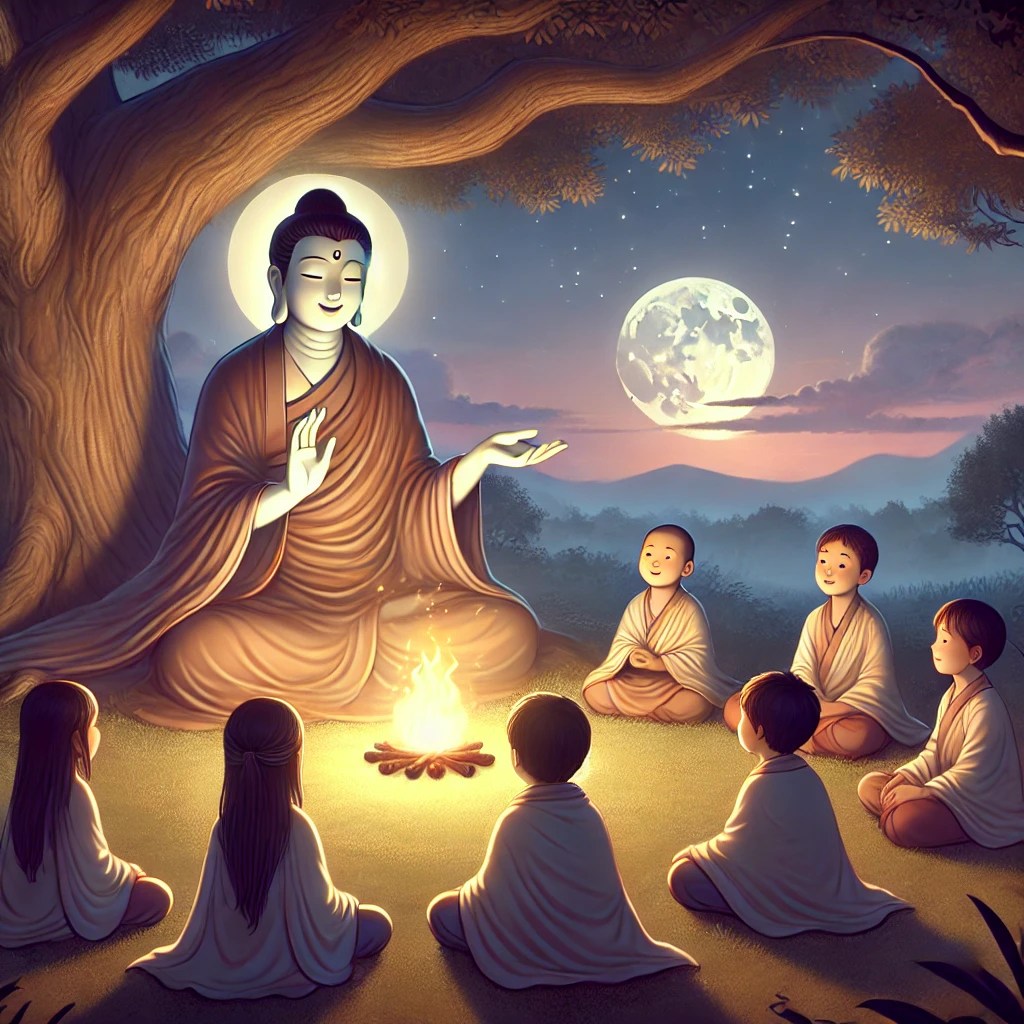
    Chenrezig often told stories to children, knowing that their hearts could understand what adults often forgot. One evening, as the stars glimmered softly above, Chenrezig gathered a group of children around a fire. They looked up at him with curious eyes, waiting for one of his famous stories.

    “Tonight,” Chenrezig said, “I will tell you a story about a great medicine—a medicine for the heart and mind. It is the mantra OM MANI PADME HUM. This mantra is like the most powerful medicine a doctor could ever give, one that can heal the illness of separation and help us remember our true nature.”

    He paused, watching the children lean in closer, eager to hear more. “But first,” he continued, “you need to understand something important. Imagine that you are wearing many layers of clothing—so many layers that you forget what you look like underneath. Each layer is like a thought or feeling you tell yourself: I’m not good enough. I need to be better.

    These layers are like cobwebs in the mind, making it hard to see clearly. And because we believe in these stories, we feel small and alone, like a candle separated from the flame. But the truth is, we are not the stories we tell ourselves. Beneath all the layers, beneath all the cobwebs, we are already whole, already perfect—just like a lotus flower, waiting to bloom.”

    The children sat very still, imagining themselves wrapped in layers of thoughts, feelings, and stories. “How do we take off the layers?” one of them whispered.

    Chenrezig smiled. “That is where the mantra comes in,” he said softly. “OM MANI PADME HUM is the medicine that clears away the layers, like a soft breeze sweeping away cobwebs. Each time you say the mantra, you peel back another layer. OM MANI PADME HUM… and the layers fall away. OM MANI PADME HUM… and your heart shines a little brighter. OM MANI PADME HUM… and with each breath, you get closer to your true self—your Buddha nature, the part of you that is pure love and compassion.

    He began to explain the meaning of the mantra, his voice gentle and full of care. “The first syllable, OM, is the sound of the universe waking up. It reminds us that we are connected to everything—to the stars, the rivers, the animals, and each other. OM is the sound of coming home to our true nature.”

    The children closed their eyes, listening to the sound of OM as if it were rising from the earth, the sky, and their own hearts all at once.

    “The next two words,” Chenrezig continued, “are Mani Padme—the jewel in the lotus. This means that inside each of us is a precious jewel—the light of wisdom and love. But just like a lotus flower that grows in muddy water, this jewel can be hidden by layers of thoughts and beliefs. Each time we chant Mani Padme, we open the lotus a little more, revealing the jewel inside.”

    The children imagined a lotus flower blooming in their hearts, each petal unfolding slowly, with a bright jewel glowing at its center.

    “And finally,” Chenrezig said, “we have Hum. This is the sound of unity—the sound that brings everything together. It is the moment when we remember that we were never separate, not from others, not from love, and not from our true nature. Hum is the sound of the Buddha mind awakening within you, shining with pure compassion.”

    The children whispered the mantra softly: OM MANI PADME HUM… OM MANI PADME HUM… Each repetition felt like a breeze clearing away the cobwebs in their minds, helping them feel lighter and brighter.

    “Now,” Chenrezig continued, “let me tell you one more secret. The mantra doesn’t just help you remember who you are—it helps others too. Every time you chant OM MANI PADME HUM, you are planting seeds of compassion, not just in your own heart, but in the hearts of all beings. These seeds will bloom in ways you may never see, bringing kindness and peace into the world.”

    He placed a hand over his heart. “It’s like sharing a gift that never runs out. Each time you say the mantra, you are offering love to the whole universe.”

    The children sat quietly for a moment, feeling the beauty of the mantra settling into their hearts, like a gentle rain nourishing the earth. “So the mantra is like a magic medicine?” one child asked softly.

    Chenrezig smiled. “Yes,” he said. “It is a medicine for the heart, a way of peeling back the layers until only love and wisdom remain. It helps us remember that we are not small or separate—we are like the ocean, vast and full of life. And each time we chant the mantra, we bring a little more light into the world.”

    As the fire crackled softly, casting warm orange light on their faces, Chenrezig leaned closer to the children. “Now, as you drift off to sleep tonight, you can let the mantra carry you, like a boat floating gently down a river. Whisper it in your heart: OM MANI PADME HUM… OM MANI PADME HUM… Let it peel back the layers of your mind, revealing the jewel of compassion that has always been there.”


    He kissed each child on the forehead and offered a final blessing:

    OM MANI PADME HUM . . .

    With each breath, may you awaken to your true nature.

    With each dream, may your heart bloom in kindness.

    May all beings remember their light, and may the world be filled with peace.

    The mantra hummed softly in their hearts: OM MANI PADME HUM, OM MANI PADME HUM… clearing away the cobwebs, layer by layer, revealing the truth that they were never separate, but always part of the great ocean of love.

    May your hearts always shine with the light of compassion, and may OM MANI PADME HUM guide you, now and always. Sleep well, children. The jewel in the lotus is already blooming within you.

    As the children drifted into a peaceful sleep, the mantra whispered in their hearts… OM MANI PADME HUM… until their dreams were filled with rivers of kindness, endless skies of compassion, and the light of love.

    Goodnight, little one. ❤️

    🙏🕊️🙏


    If you’d like to explore more bedtime stories for children, including tales that nurture compassion and mindfulness, you can find our collection here.

  • Post 8: The Importance of Discipline: Patanjali’s Sutras 1.13 and 1.14

    Post 8: The Importance of Discipline: Patanjali’s Sutras 1.13 and 1.14

    As we have seen in the previous sutras, Patanjali emphasizes the nature of mental events—fluctuations that arise in the mind—which can either distract us or be observed with clarity. Now, in Sutras 1.13 and 1.14, Patanjali shifts our attention to the importance of disciplined practice, showing us how consistent effort is essential in gaining mastery over the mind.

    1.13: The practice of yoga is the effort to remain steady in the awareness of the Seer.
    1.14: This practice becomes firmly grounded when pursued for a long time, without interruption, and with sincerity.

    These two sutras bring into focus the essential qualities of discipline in yoga: persistence, consistency, and sincerity. Patanjali emphasizes that mastery over the mind is not achieved through occasional effort but through sustained, dedicated practice over time.

    The Effort to Remain Steady

    Sutra 1.13 defines the practice of yoga as the effort to remain steady in the awareness of the Seer. This is where discipline truly comes into play. In our day-to-day life, the mind is constantly drawn into the fluctuations of thoughts, emotions, and external distractions. The practice of yoga, as Patanjali teaches, is the ongoing effort to maintain our awareness of the Seer—the true self—amid these fluctuations.

    This is not a passive state of relaxation but an active practice of mindfulness. Each time we notice a mental event, we have the opportunity to reaffirm our awareness of the Seer. Using the phrase “Neti, Neti. I am the witness. I am the Seer,” we can gently return to the present moment, reminding ourselves that we are not the fluctuations of the mind but the one who observes them.

    The effort here is not about forcefully suppressing thoughts or emotions, but about gently bringing the mind back to stillness each time it becomes distracted. Over time, this practice strengthens our ability to remain steady and centered, even in the face of mental events.

    The Power of Consistency

    Patanjali elaborates further in Sutra 1.14, reminding us that this practice becomes firmly grounded only when it is pursued for a long time, without interruption, and with sincerity. Consistency is key in yoga. The mind’s fluctuations are relentless, and it takes sustained effort to cultivate the steadiness of the Seer.

    Patanjali’s emphasis on long-term practice is important. Mastery over the mind doesn’t happen overnight, nor is it achieved through sporadic practice. The discipline of yoga requires us to show up again and again, each time renewing our commitment to remain present. Over time, this consistency bears fruit, allowing us to experience greater clarity, peace, and self-awareness.

    This is why sincerity is also essential. It’s not just about going through the motions of meditation or mindfulness; it’s about truly committing to the practice with an open heart. When we practice sincerely, we develop a deep sense of trust in the process, knowing that each moment of mindfulness strengthens our ability to remain in the awareness of the Seer.

    Bringing It Into Practice: Building a Steady Practice

    In practical terms, this means making space in our daily lives for consistent practice. Whether it’s through meditation, mindful breathing, or simply taking moments throughout the day to return to the awareness of the Seer, the key is to remain dedicated.

    When distractions arise, and they inevitably will, gently bring your awareness back with “Neti, Neti. I am the witness. I am the Seer.” This simple phrase helps you cultivate the steadiness that Patanjali describes, allowing you to witness the mind’s activity without becoming entangled in it.

    The power of this practice lies in its repetition. The more we engage with the process, the more natural it becomes to return to stillness. Over time, we develop a firm foundation of mindfulness that can weather even the most persistent mental events.

    Maintaining Discipline Through Sincerity

    As we practice, it’s essential to approach the discipline with sincerity. This doesn’t mean pushing ourselves harshly or becoming frustrated when the mind wanders. Instead, it’s about maintaining a gentle, loving commitment to the process. Each time we bring the mind back to the Seer, we do so with a sense of gratitude for the opportunity to deepen our awareness.

    In this way, discipline becomes less of a burden and more of an act of devotion. We are not forcing the mind into stillness; we are guiding it, with patience and sincerity, toward a deeper connection with our true nature. Over time, this practice becomes a source of joy, as we witness the mind’s fluctuations without becoming attached to them, remaining steady in the awareness of the Seer.

    Coming Up Next:

    In the next post, we will explore Sutras 1.15 and 1.16, where Patanjali introduces the concept of detachment and deeper levels of non-attachment. We will reflect on how this practice of detachment can free us from the grip of desires and aversions, allowing us to remain centered in the Seer. Join me as we continue this journey toward mastery over the mind and deeper self-awareness.

    🙏🕊️🙏

  • Verse 3: The Mirror of True Knowledge — Insights from Ramana Maharshi

    Verse 3: The Mirror of True Knowledge — Insights from Ramana Maharshi

    “Having known the Self, which is awareness, there is nothing more to know. That which is, is consciousness itself. To seek it elsewhere is to wander far away.”

    — Ramana Maharshi, Forty Verses on Reality

    There comes a moment in each of our lives when the questions that have followed us, haunting our thoughts, cease to carry the same weight. It is as though we have been wandering through a vast wilderness, searching endlessly for something, only to realize that it has been with us all along. This, Ramana tells us, is the moment of true knowledge—the moment when we recognize the Self, and in doing so, find that there is nothing more to seek.

    This knowledge is not like the knowing of facts or the gathering of worldly wisdom. It is the unveiling of the very essence of awareness, that which sees all, yet remains unseen. To touch this awareness is to come home, to realize that the search has always been for ourselves.

    And how often we search elsewhere! How often we cast our gaze into the far distance, imagining that the truth lies in some distant land, or hidden in the words of another. But Ramana reminds us that to seek it elsewhere is to wander further from the source. The truth we seek does not live in far-off places; it lives in the heart of our own being, as close as breath, as present as this very moment.

    Like a mirror reflecting all without judgment, true knowledge is the simple, clear awareness of what is. When we come to see that all that exists is consciousness itself, we are no longer captivated by the shadows on the wall. We see, instead, the light—the steady, unwavering light of awareness, which has been with us from the beginning.

    To know the Self is to realize that there is nowhere else to go. The seeking ends, and in its place arises a quiet, unshakable peace. It is not the end of curiosity or wonder, but the end of searching outside ourselves for what can only be found within.

    To know that there is nothing more to seek is not to say there is nothing more to do. In the realization that the Self has always been present, there is still the practice of abiding, of resting in the gentle awareness that is always here. It is this abiding, this quiet discipline of being, that becomes the ongoing practice.

    Yes, the search has ended, but the journey of returning, over and over again, to the pristine mind continues. For in this ordinary mind—this space filled with distractions, thoughts, and the pull of the world—there is the temptation to forget, to stray from the simplicity of awareness. And so, we practice. Not as seekers anymore, but as those who have touched the truth and wish to live in its light.

    The practice now is not one of effortful striving, but of allowing—of surrendering into the effortless effort, the gentle doing of non-doing. This is where the paradox lives: to rest in what is, and yet remain disciplined in that rest. It is not that there is nothing more to do, but rather that what is to be done is a continual letting go, a surrendering to the ever-present awareness that requires nothing from us but our willingness to be with it.

    And so, we abide. With each breath, with each passing moment, we return—not to search, but to rest. And though the Self needs no searching, the practice of staying with it remains. In this, there is the dance of wu-wei, the graceful action of inaction, the peaceful unfolding of all that is.

    Perhaps one day the effort, too, will fall away, and only the abiding will remain.

    Coming Up Next: Verse 4

    In the next verse, we will reflect on the nature of thought and the root of all actions. How do our thoughts shape our reality, and what lies at the core of true understanding? Join us as we continue this journey through the depths of Ramana Maharshi’s teachings.

    🙏🕊️🙏

  • 8: Gently Building Strength with Compassion: The Converging Chest Press for Post-Viral ME/CFS


    The journey toward mindful movement when living with Post-Viral ME/CFS is deeply personal, one that requires patience, gentleness, and, above all, self-compassion. Today, as we continue this path of self-care and mindful strength-building, we’re going to explore the Converging Chest Press Machine—a tool that, when used thoughtfully, can help us nurture our upper body strength in a safe and supportive way.

    In a world where fitness is often about “pushing harder” or “doing more,” it’s so important to honor where you are today and approach movement with an attitude of acceptance and compassion. For those of us navigating life with Post-Viral ME/CFS, the goal is not to push ourselves beyond our limits but to explore gentle movements that respect our current energy levels and capacity. The Converging Chest Press allows us to do just that.

    Why This Exercise is Special

    The Converging Chest Press offers a chance to connect with the chest, shoulders, and arms in a gentle and controlled way. Unlike exercises that demand high energy or force, this machine allows for mindful, deliberate movement—the kind of movement that supports your body without over-exerting it.

    What makes this particular exercise so beneficial for those managing Post-Viral ME/CFS is the ability to set your own pace. You can adjust the weight to the lightest setting or even use no weight at all, focusing instead on the quality of movement, breathing deeply and staying present with your body. It’s not about the number of reps or the amount of weight—it’s about making a small connection with your muscles, respecting where you are, and letting go of any pressure to do more.

    Preparing to Use the Converging Chest Press Machine

    When you first approach the Converging Chest Press, take a moment to center yourself. This isn’t just about physical movement—it’s about mental and emotional connection, too. Begin by setting the machine to its lightest setting. Even if you’re working with the bare minimum of resistance, remember that each movement, no matter how small, has value.

    Take a seat, allowing your back to rest comfortably against the support, and place your feet flat on the ground. Feel your body settle into the machine, taking a moment to adjust so that you feel grounded and supported.

    Finding Your Breath

    Before you begin, take a few moments to breathe deeply. As you inhale, feel the air fill your lungs, expanding your chest, and as you exhale, let go of any tension you may be holding. This exercise is as much about engaging with your breath as it is about engaging your muscles. Allow your breath to guide your movements, letting it bring you into the present moment.

    Beginning the Movement

    With your hands on the handles, your elbows bent comfortably at a 90-degree angle, take another deep breath in. As you exhale slowly, begin to press the handles forward. There’s no need to rush—move slowly and gently, letting the motion feel smooth and controlled.

    Feel the muscles of your chest, shoulders, and arms engage softly as you extend your arms. Notice the sensation of your body working in harmony, and as you reach the end of the movement, take a moment to pause and breathe.

    Returning with Mindfulness

    As you inhale, slowly bring the handles back to the starting position. Stay connected to your breath, letting it guide the movement, allowing the machine to return gently. There is no need to push yourself—allow each motion to be fluid, gentle, and relaxed.

    Even if you only complete one or two repetitions, that is enough. Celebrate the fact that you’ve engaged with your body in this mindful way. It’s not about quantity—it’s about quality of connection, about being present with yourself in the moment.

    Resting and Reflecting

    After each press, take a moment to rest. Ask yourself how you feel—both physically and emotionally. Is your body asking for more, or is it asking for rest? With Post-Viral ME/CFS, listening to your body is the most important aspect of any movement practice. If you feel that one or two presses were enough for today, honor that. Rest is part of the process, and there is no need to do more than what feels right for you in this moment.

    Why It Matters: Gentle Movement as Healing

    When you engage with the Converging Chest Press in this way, you’re not just building physical strength—you’re also building a deeper sense of trust and connection with your body. Living with Post-Viral ME/CFS means we often have to navigate the complexities of energy levels and balance, and this machine provides a way to explore movement with grace, awareness, and compassion.

    Every time you engage in this exercise, even for just a minute or two, you are rebuilding confidence in your body’s ability to move. You are reconnecting with your muscles, your breath, and the present moment, and in doing so, you are cultivating a sense of peace and acceptance.

    Moving Forward with Compassion

    It’s important to remember that there is no rush, no pressure, and no expectation. The path of gentle movement is not about striving for more or achieving a specific outcome. It’s about showing up for yourself, being present with your body, and offering yourself the care and compassion you deserve.

    Each press, no matter how small or how brief, is a step forward—a step toward healing, toward connection, and toward finding peace in movement. As we continue this journey together, I invite you to approach each exercise with the same gentleness and openness that you bring to this practice today.


    Next in the Series: Gentle Lower Body Engagement with the Leg Press Machine

    In our next post, we’ll explore the Leg Press Machine, discovering how to gently engage the lower body while continuing to honor your energy levels and practice with compassion. As always, we will focus on slow, mindful movements that respect the unique needs of those living with Post-Viral ME/CFS.

    🙏🕊️🙏