Month: October 2024

  • Ramayana No. 12: Caravan of Love: The Evolution of Divine Worship and the Universal Teachings of Compassion

    In the spiritual journey of humanity, there has always been a deep yearning to connect with the divine. This connection has evolved across cultures and religions, shaping how people perceive and relate to the sacred. Two profound examples of this evolution can be found in Hinduism and Christianity, where the abstract, formless concept of the divine transformed into more personal, relatable forms.

    From the Formless to the Personal Divine

    In the early traditions of Judaism, the divine was perceived as Ein Sof—the infinite, boundless, and unknowable aspect of God. This understanding was so sacred that God’s name was considered unpronounceable, representing the divine’s absolute transcendence. The Jewish tradition emphasized a God beyond form and comprehension, which led to a strict prohibition against idolatry.

    Similarly, in the ancient Vedic traditions of India, the divine was seen as Brahman, the ultimate, formless reality that underlies all existence. Brahman was understood as the essence of everything, but its abstract nature made it difficult for people to relate to on a personal level.

    Over time, both traditions saw a shift. In Christianity, this shift occurred with the introduction of Jesus Christ, who represented the divine in human form. Jesus made the infinite more accessible, embodying the love, compassion, and righteousness that God wished to share with humanity. The doctrine of the Trinity—Father, Son, and Holy Spirit—further personalized the divine, allowing followers to connect with God as a loving parent, a guiding spirit, and a compassionate savior.

    In Hinduism, this transformation took shape through the worship of deities like Vishnu, Shiva, and Devi, who are seen as manifestations of Brahman. These deities, along with their avatars such as Rama and Krishna, made the divine more relatable. They embodied virtues that humans could aspire to—righteousness, devotion, and compassion. Through stories and teachings, these deities became accessible guides for those seeking a path to the divine.

    The Universal Teachings of Love and Righteousness

    Despite the differences in form and expression, a common thread runs through these traditions: the teaching of love, compassion, and righteousness. In Christianity, Jesus’s teachings emphasized love for one’s neighbor, forgiveness, and a life lived in service to others. He taught that the greatest commandment is to love God with all one’s heart and to love one’s neighbor as oneself.

    In Hinduism, the teachings of Dharma—righteousness and duty—are central. The lives of the avatars, like Rama, exemplify adherence to Dharma even in the face of great personal sacrifice. The Bhagavad Gita, a cornerstone of Hindu philosophy, teaches the importance of selfless action, devotion, and the pursuit of truth.

    These teachings, though expressed differently, guide followers toward a life of virtue. They remind us that to walk the path of the divine is to live with compassion, to act with righteousness, and to treat all beings with love and respect.

    A Call for Interfaith Harmony

    In a world often divided by differences in belief and practice, these teachings remind us of our shared spiritual heritage. Whether one follows Jesus, Rama, or another path to the divine, the call to love, righteousness, and compassion is universal. These values are the true markers of discipleship, transcending the boundaries of culture and religion.

    The Caravan of Love invites all to reflect on these common values, to see the divine in the hearts of all people, and to strive for a world where love and compassion reign. In the end, the path to the divine—whether walked through Christianity, Hinduism, or any other tradition—is a path of love, a journey toward the light that shines in every heart.

    A Prayer for Universal Peace and Harmony

    O Divine Source of all creation,
    The One who is known by many names,
    And who dwells in every heart,
    We come before you with humble hearts,
    Seeking your blessing of peace and harmony.

    May your love flow through us like a river,
    Washing away all hatred, division, and fear,
    And filling our hearts with compassion for all beings.

    Teach us to see beyond our differences,
    To honor the divine in every person,
    And to live as instruments of your peace in this world.

    May we all walk the path of righteousness,
    Guided by your wisdom and grace,
    So that our actions may bring healing and unity
    To a world that so deeply longs for peace.

    Let all nations and peoples come together,
    In a spirit of understanding and respect,
    Embracing the truth that we are all your children,
    And that in your eyes, we are one family.

    Grant us the courage to forgive,
    The strength to love without condition,
    And the wisdom to seek justice and mercy
    For every living being.

    May your light shine in our hearts,
    And may we carry that light into the world,
    Bringing hope to the weary,
    And peace to all who suffer.

    In your holy name, we pray,
    For goodwill on earth, and peace among all beings.

    Amen.
    Om Shanti Shanti Shanti.
    Salaam.
    Shalom.

    🙏🕊️🙏

  • Verse 2: The Deathless Ones — Insights from Ramana Maharshi

    “Deathless are they who know the Self. Those who know intense fear of death seek refuge only at the feet of the Lord who has neither death nor birth. Dead to themselves and their possessions, can the thought of death occur to them again? Deathless are they.”

    — Ramana Maharshi, Forty Verses on Reality

    In the silent expanse of existence, a profound truth emerges: those who truly know themselves are untouched by the shadow of death. Their awareness transcends the fleeting nature of the physical, awakening them to a reality where the Self shines eternally, free from the confines of birth and demise.

    Fear, that primal instinct which grips the emotional self, leads many to seek solace at the feet of the Divine. Here, in surrender, they find refuge in the Lord—the embodiment of timelessness, the one who remains unscathed by the cycle of life and death. In the presence of such love, the urgency of worldly attachments falls away, revealing the deeper essence of being. I look forward to resting in the presence of such love, revealed within our mind—our true heart—where all attachments dissolve into the stillness of pure awareness. To realize this ever-present pure love is to know the deeper essence of what we are, the part of us that remains untouched by the fears and desires of the world.

    As one becomes “dead” to the clamor of possessions and the incessant desires that bind the soul, the thought of death loses its power. No longer a specter to be feared, it becomes a mere whisper, an echo of a past long forgotten. In this state of liberation, the deathless heart pulsates with the rhythm of life, embracing the eternal now.

    To know the Self is to awaken to the infinite, to dance beyond the duality of existence, where life and death are but two sides of the same coin. In this awakening, we find the courage to let go—to release the chains of identification with the transient and embrace the essence of who we truly are. Here lies the secret of the deathless ones, an invitation to live fully, unencumbered by the fears that often confine us.

    And yet, when we speak of the deathless state, we do not turn our gaze away from the undeniable truth of death. The body, like all things that come into being, will one day return to the earth. Those we love will pass, as will we. But the wisdom of this teaching beckons us to look beyond the visible horizon, beyond the fragile shell of the physical.

    Death, as we know it, is but a passage in the realm of form. What truly passes? Not the Self. Not the essence of who we are. This teaching whispers to us that the grasping after what is fleeting—the desires, the aversions, the worldly attachments—these are the threads that weave the illusion of permanence where there is none.

    In the letting go, in the softening of our hands from the things we thought we needed to hold so tightly, there is a kind of renunciation. But not a renunciation of life itself, rather, a release from the belief that life’s changing faces can define us. We release, not into emptiness, but into fullness—the fullness of the pristine mind, the quiet, undisturbed expanse of the deathless.

    To recognize this is to taste the sweetness of a deeper truth: the Self is untouched by the passing of days, by the birth and death of forms. This is where we find our liberation—not by denying the body’s end, but by resting in the awareness that transcends it.

    And so, in this gentle abiding, we come to understand: death may touch what is temporal, but it cannot lay a finger on what is eternal. Here, in the heart of this realization, there is peace—a peace that no worldly circumstance can steal away, for it is woven into the very fabric of our being.

    Coming Up Next: Verse 3

    In our next exploration, we will turn our attention to the third verse, where we will reflect on the nature of true knowledge and how it reveals the interconnectedness of all beings, inviting us into a deeper understanding of existence.

    🙏🕊️🙏

  • Neti Neti Series No. 4: Finding Relaxation and Clarity in the Practice of “Not This, Not This

    Question:

    Why does the mantra Neti Neti feel more relaxing and effective compared to other mantras like “Who am I?” or “What is this?” and how does it help in negating both subject and object without stimulating a desire for answers?

    Dear friend,

    It brings me great joy to hear that you have found a mantra that resonates so deeply with your heart and mind. The simplicity and profound wisdom of “Not This, Not This” are indeed a balm for the soul, especially for one who has journeyed far in search of answers. In this mantra, you have discovered a path that requires no seeking, no striving—only the gentle negation of all that arises.Let me share with you some reflections that may deepen your understanding and ease your way as you continue with this practice.

    In the practice of “Not This, Not This,” there is no need to engage in the endless search for answers. Unlike the questions “Who am I?” or “What is this?”—which can stir the mind into seeking—this mantra offers a different approach. It does not ask you to solve a riddle or uncover a hidden truth. Instead, it invites you to simply let go, to recognize that whatever arises—whether it appears as a thought, an emotion, or even an answer—is not the ultimate reality. By gently negating each thought or feeling, you are led beyond the confines of the mind, into a space where true peace and stillness reside.

    As you continue with this practice, you may find moments of clarity where you can distinctly see both the subject and the object—the observer and the observed. This is a crucial insight, for it shows you that what you are perceiving, what you are witnessing, is still within the realm of duality. The mantra “Not This, Not This” serves as a reminder that neither the subject nor the object is the true self, the Atman. The duality that appears so real is, in fact, just another layer to be gently set aside, leading you deeper into the heart of non-dual awareness.

    One of the great gifts of this mantra is the relaxation it brings. When you are no longer compelled to search for answers, the mind can rest. There is a profound release that comes from knowing that you do not need to grasp at anything—whether it be a thought, an experience, or an identity. Each time you repeat “Not This,” you are allowing yourself to let go of the burdens of the mind, to release the tension of trying to understand or control. In this letting go, you find a deep and abiding peace, a state of being where you are free from the demands of the ego and the constant chatter of the mind.

    This practice is gently guiding you toward a state of non-dual awareness, where the distinctions between self and other, subject and object, begin to dissolve. As you continue with “Not This, Not This,” you may notice that the boundaries you once perceived are fading away, leaving you in a space of pure being. In this space, there is nothing to seek, nothing to achieve—only the simple, profound experience of existence itself, free from all labels, judgments, and identities. This is the true essence of Atman, the pure awareness that is your deepest self.

    As you walk this path, my dear friend, know that you are not alone. The wisdom of the ages supports you, and the truth of your being is always present, waiting patiently for you to recognize it. Continue with your practice, allowing the mantra to guide you ever deeper into the heart of silence and stillness. And remember, there is no rush, no destination—only the journey, unfolding moment by moment.

    May your practice bring you peace, clarity, and the deep joy of simply being.

    🙏🕊️🙏

  • Post 6: Navigating Imagination and Sleep: Patanjali’s Sutras 1.9 and 1.10

    In our previous posts, we explored the nature of right knowledge and wrong knowledge as mental events, recognizing them as fluctuations of the mind that can distract us from the clarity of the Seer. Now, Patanjali takes us further into the types of mental events, focusing on imagination and sleep.

    1.9: Imagination is the mental event that arises when words or concepts are not based on reality.
    1.10: Sleep is the mental event that occurs when there is an absence of awareness.

    These two sutras reveal important aspects of the mind’s activity that can either lead to further distraction or be witnessed with clarity. Both imagination and sleep are natural, but without mindfulness, they can obscure our ability to remain in the awareness of the Seer.

    Imagination: The Mind’s Tendency to Create

    Imagination (vikalpa) is the mind’s ability to create images, scenarios, or concepts that are not rooted in actual experience. This can be a powerful tool for creativity, but when we become entangled in imaginative thoughts, they pull us away from the present moment and the reality of what is. Imagination is a type of mental event that can lead to confusion when we mistake it for truth.

    For instance, how often do we find ourselves lost in a daydream or a scenario that has no bearing on reality? Whether it’s imagining a future outcome or reliving a past experience, imagination can easily become a source of distraction. Yet, when we recognize imagination as just another mental event, we can let it pass without getting caught up in it. The key is to observe it without judgment or engagement, remembering that we are the Seer, not the mental event.

    Sleep: Absence of Awareness—and the Potential for Lucid Dreaming

    Interestingly, Patanjali includes sleep (nidra) as a mental event. While sleep is essential for physical and mental rejuvenation, it is still a state of mind where awareness is typically absent. In the context of yoga, sleep represents a gap in our mindfulness—a temporary state where the mind is not engaged with external reality but is still present in a subtle way.

    However, there’s another dimension to sleep that Patanjali may be pointing toward: the practice of remaining aware even while dreaming. This is known as lucid dreaming, where the dreamer becomes conscious of the fact that they are dreaming. Just as we practice mindfulness in waking life, it’s possible to cultivate awareness during dreams, allowing us to witness the dream without becoming absorbed in the content.

    In dreams, we are often fully engaged in the mental events that arise, much like we are in our waking life. Yet, with practice, we can maintain a sense of the Seer—the witness of the dream itself. Neti Neti can become a spontaneous practice even in the dream world, reminding us that we are the dreamer, not the dream. For those who are interested, this practice can be cultivated over time, offering a deeper level of awareness during the state of sleep.

    Bringing It Into Practice: Staying Present Amid Mental Events

    As with the other mental events we’ve discussed, both imagination and sleep can be observed without judgment. Rather than getting caught up in the content of our imaginations or losing ourselves in unconscious moments, we can use the practice of Neti, neti to return to the present. By simply acknowledging these as mental events, we free ourselves from their pull.

    When you find yourself lost in an imaginative thought, you can gently remind yourself, “Neti, Neti. I am the witness. I am the Seer.” This allows you to return to a place of stillness and clarity, observing the imagination without engaging with it. Similarly, if you notice moments of mindlessness or dullness creeping in during your day—or even in the dream state—the same practice can bring you back into awareness, helping you stay present.

    This practice doesn’t require us to suppress imagination or fight against sleep; instead, we recognize these mental events as temporary and return to the awareness of the pristine mind. By observing these fluctuations without attachment, we maintain the discipline necessary to cultivate equanimity and inner stillness.

    Maintaining Discipline in Mindfulness

    As we’ve seen before, discipline plays a crucial role in this process. The mind naturally drifts toward imaginative scenarios and moments of dullness. But through disciplined practice, we strengthen our ability to remain anchored in the awareness of the Seer. Each time we recognize imagination or mindlessness and return to stillness, we reinforce the clarity of the pristine mind.

    Over time, this discipline allows us to witness mental events without becoming distracted by them, no matter how subtle or engaging they may be. By maintaining this mindfulness, we can rest in the simplicity of awareness, untouched by the mind’s fluctuations.

    Coming Up Next:

    In our next post, we will explore Sutras 1.11 and 1.12, where Patanjali continues to describe mental events, focusing on memory and the practice of non-attachment. We’ll reflect on how memory shapes our perception of the present and how cultivating non-attachment frees us from the patterns of the past. Join me as we continue this journey toward deeper self-awareness and peace.

    🙏🕊️🙏

  • Ramayana No. 11: The Beginning and the End—Understanding the First Canto of the Gita Press Ramayana

    As I begin my journey through the Gita Press edition of the Ramayana, I find myself immediately struck by the structure of the first canto. Within just a few verses, the entire epic is laid out before the reader—Rama’s exile, his defeat of Ravana, the rescue of Sita, and his triumphant return to Ayodhya where he reigns as king. It’s a “happily ever after” summary that seems to condense the entire narrative into a brief prologue. But why start a story this way? What is the purpose of summarizing the entire epic right at the beginning?

    This approach, common in ancient epics, serves multiple purposes. First, it provides readers with a roadmap, offering a glimpse of the destination before embarking on the journey. In the context of the Ramayana, it reminds us that the ultimate outcome of the story is not in question—Rama, the embodiment of dharma, will triumph, righteousness will be restored, and order will prevail. Knowing this from the outset allows readers to focus not on the suspense of what will happen, but on the lessons to be learned along the way.

    The first canto functions as both an introduction and a promise. It assures us that despite the trials, battles, and moments of despair that will inevitably follow, the story ends in the victory of good over evil. It also invites us to consider the deeper meaning behind these events. By presenting the conclusion first, the text suggests that the journey is just as important—if not more so—than the destination.

    As I continue reading, it’s clear that the richness of the Ramayana lies not just in its grand narrative, but in the details, the interactions between characters, the challenges they face, and the decisions they make. The first canto’s summary is just the beginning—a way to frame the epic and to prepare us for the moral and spiritual lessons that will unfold in the subsequent chapters.

    In the Gita Press version, the simplicity and directness of this introduction serve to draw the reader in, setting the stage for a deeper exploration of dharma, devotion, and the complexities of human life. It is an invitation to not only read the story but to reflect on its teachings and apply them to our own lives.

    As I delve deeper into the Ramayana, I am reminded that the true value of this epic lies in its capacity to guide us on our own spiritual journey, offering insights that are as relevant today as they were thousands of years ago.

    For those interested in exploring this epic themselves, the Gita Press edition, along with the detailed Debroy translation, is embedded in this blog post. You can access them and embark on your own journey through the Ramayana, discovering the layers of wisdom and truth that this ancient text has to offer.

    🙏🕊️🙏

  • Verse 1: The Heart of Reality — Insights from Ramana Maharshi

    “Reality exists as the Heart, your very Being. If Reality did not exist, could there be any knowledge of existence? Free from all thoughts, Reality abides in the Heart, the Source of all thoughts. It is, therefore, called the Heart. How then is one to contemplate it? To be as it is in the Heart, is Its contemplation.”

    — Ramana Maharshi, Forty Verses on Reality

    The Heart of Reality

    In the stillness of our being, where thoughts dissolve like mist under the sun, we come upon the essence of reality—the Heart, our very existence. This Heart is not a distant concept, a mere abstraction; it pulses with the life that courses through us, inviting us to recognize that our true nature is intricately woven into the fabric of all that is.

    What if reality, in its purest form, did not exist? Could we then grasp the very notion of existence, the flicker of awareness that dances in our minds? Each thought, each fleeting moment of recognition, springs forth from this source, the Heart, which abides in silence beyond the noise of our incessant chatter.

    To contemplate this truth is not to embark on a journey of the mind but rather to return home, to dwell as we are in the Heart itself. Here, in this sacred space, contemplation transforms into a state of being, a surrender to the profound simplicity of what is. We find ourselves not as separate seekers but as the very essence of the inquiry—a realization that calls us to rest in the Heart, to know ourselves as we truly are.

    For many years, I carried a fog of confusion around the word “heart,” a tangle of meanings that seemed to obscure more than they revealed. I remember being in circles where people would say, “Come from your heart,” and I would listen, trying to grasp the depth of what they meant. Often, it seemed to point toward emotion, to some form of deeper truth that was still bound in the personal—an authentic expression of ego, perhaps a sincerity in feeling, but still caught in the dualities of love and pain, fear and longing.

    But what did it mean, really, to come from the heart?

    In the midst of this confusion, Ramana’s words come like a gentle clearing of the fog. The heart, as he speaks of it, is not the emotional center we so often equate with the word. It is not the place of fluctuating feelings, nor is it simply a retreat from the mind’s logical discourse. What Ramana points to is something far deeper: the heart as the essence, the source of pure awareness itself.

    This reminds me of the self as Carl Jung describes it—not just the conscious mind, but the unconscious, and not just those personal aspects, but everything, the entire universe and reality. Jung’s idea of the Self expands far beyond the individual, reaching into the totality of existence itself, much like Ramana’s use of the word heart. In this sense, Reality, the Self, and the Heart all point to the same fundamental truth—the essence that underlies both duality and non-duality, the very nature of what is.

    In both Jung and Ramana’s teachings, we see that the self, or reality, is not something to be sought outside of ourselves or separated from the world. As Jesus says, we are to be in the world but not of the world. This aligns perfectly with the non-dual teaching: there is no need to escape the dualities of life to realize non-duality. Instead, we are invited to recognize that the essence of duality itself is non-dual.

    To come from the heart, then, is not merely to speak from personal truth or emotion, but to rest in the deeper awareness that embraces all experience without attachment. It is to be anchored in the non-dual essence of Reality, knowing that even in the world of forms and opposites, the underlying truth remains whole, undivided.

    And yet, how often we use the word “heart” to point to something else—something closer to our personal feelings or opinions, mistaking emotional honesty for the deeper truth of our being. But here, in this teaching, the heart is revealed as the true source of non-dual clarity, the place from which true forgiveness, compassion, and love naturally arise—not as personal qualities, but as emanations of our most pure self.

    As I reflect on this teaching in, it becomes clear that the heart Ramana speaks of is not a center of personal feelings or emotion, but the eternal essence that transcends the body and mind. This heart, or true Self, is the witness that remains even when personal identity fades. In some ways, this description feels similar to the concept of the Holy Spirit or God, which abides within and beyond us.

    When we speak of the heart as Ramana does, we are pointing to the essence of pure awareness, the unchanging “I” that exists beyond the temporary forms of the body and ego. This teaching invites us to recognize the heart as the source of non-dual awareness, a presence that continues even when the personal self dissolves.

    Coming Up Next: Verse 2

    In the next reflection, we will explore how those who know the Self are deathless, transcending the fear of mortality. We’ll delve into the liberation found in surrendering to the Divine, awakening to the eternal nature of existence beyond the physical realm.

    🙏🕊️🙏

  • 6: Gentle Movement and Stretching in the Gym: Reconnecting with Your Body

    Now that you’ve taken the significant step of entering the gym without the pressure to exercise, you might feel ready to begin exploring gentle movement. For people living with Post-Viral ME/CFS, this phase requires a delicate balance—respecting your energy levels while slowly reconnecting with your body through light movement and stretching.

    In this blog post, we’ll look at how to introduce gentle movement and stretching into your gym experience, all while keeping the principles of mindfulness, self-compassion, and energy conservation at the forefront.

    Why Gentle Movement Matters

    Even the smallest movements can have profound benefits for those living with Post-Viral ME/CFS. Gentle stretches and slow, deliberate movements help re-establish your connection with your body, providing a sense of mobility and flexibility that can often feel lost. More than that, gentle movement stimulates blood flow, promotes relaxation, and helps to gradually build confidence in your ability to engage in physical activity.

    It’s crucial to remember that this is not about pushing limits or forcing your body beyond its capacity. Instead, it’s about nurturing your body, gently reminding it of what it can do—without overwhelming your system or triggering post-exertional malaise (PEM).

    How to Approach Gentle Movement in the Gym

    1. Set an Intention for the Session: Before you even begin, set a gentle intention for your session. This could be something as simple as, “I’m here to move with awareness and kindness.” By setting an intention, you shift your focus from achievement to presence. You’re here to care for yourself, not to push.
    2. Focus on Breath: As you start with gentle stretches or slow movement, focus on your breathing. This practice anchors you in the present moment and helps to ensure that your movements remain slow, controlled, and within your energy envelope. Breathing in deeply and exhaling fully can also support your body’s natural relaxation response.
    3. Start with Basic Stretches: You might want to begin with basic seated stretches. If your gym has a stretching area or a yoga mat, this can be a comfortable and supportive space to gently move your body. Here are a few movements to try:
    • Seated Forward Bend: Sit on a mat with your legs extended forward. Slowly reach toward your feet, allowing your hands to rest on your shins, ankles, or toes. Remember to focus on the sensation, not the stretch itself. Breathe into any areas of tightness or tension.
    • Gentle Neck Rolls: Sit comfortably with your spine straight. Slowly tilt your head to one side, bringing your ear toward your shoulder. Hold for a few breaths, then slowly roll your head forward, bringing your chin toward your chest, before moving to the opposite side. This can help release tension in the neck and shoulders.
    • Seated Side Stretch: Sit with your legs crossed. Reach your right arm over your head and lean gently to the left, creating a stretch along the right side of your body. Hold for a few breaths before switching sides.
    1. Mindful Walking or Light Activity: If you’re comfortable, you might try slow walking on a treadmill or even just walking around the gym. The key is to stay mindful of how your body feels. Walk at a slow pace and focus on each step, noticing how your feet connect with the ground. Keep the session short and stay tuned to your energy levels. If you feel tired, pause immediately and return to a seated position.
    2. Use Light Weights for Gentle Resistance: If you feel ready, introducing light resistance can be a wonderful way to engage your muscles without straining your system. Consider using very light dumbbells or resistance bands (which you can even bring with you if your gym doesn’t have them). The focus here is on smooth, controlled movements, keeping everything slow and deliberate.
    • Seated Bicep Curl with Light Dumbbells: Sit on a bench with a very light dumbbell in each hand. With your arms at your sides, slowly curl the dumbbells toward your shoulders, keeping the movement smooth and controlled. Lower the weights just as slowly. Repeat only a few times to start.
    • Resistance Band Shoulder Stretch: Sit or stand with a resistance band in both hands. Hold it in front of you with your arms shoulder-width apart. Slowly stretch the band outward by pulling your hands apart, engaging your shoulders and upper back. Breathe deeply and slowly return to the starting position.
    1. Listen to Your Body’s Signals: One of the most crucial aspects of any exercise with Post-Viral ME/CFS is listening closely to your body’s signals. Your body will tell you when it’s time to stop or slow down. Don’t wait until you’re exhausted—end your session at the first sign of fatigue or discomfort. Always honor your energy envelope.

    A Mindful Approach to Movement

    Remember, the goal is not to push your limits but to reconnect with your body in a gentle and compassionate way. With Post-Viral ME/CFS, you are working within a different framework—one that requires self-awareness and a focus on sustainable, restorative practices. Be kind to yourself, and understand that even the simplest movements can offer profound benefits.

    Here’s what to keep in mind as you explore gentle movement:

    • Embrace Small Wins: If you stretch for 5 minutes and feel good afterward, that’s a success. Celebrate these small wins, as they are stepping stones to building a sustainable relationship with your body.
    • Pace Yourself: Rest before you feel fatigued. It’s better to stop early than to overextend and risk PEM. The slow, deliberate approach is key to protecting your energy levels.
    • Feel Your Breath: Your breath is your guide. If your breath becomes strained or you notice any discomfort, it’s time to stop. Let your breath stay smooth and calm throughout your session.
    • Savor the Experience: Make your gym session a sensory experience. Notice how your body feels in each stretch, how your breath moves through you, and how the space around you feels. The more mindful you are, the more connected you’ll feel to each small movement.

    Psychological and Emotional Benefits

    Just as with the earlier steps of entering the gym or sitting in the parking lot, engaging in light movement and stretching can have tremendous psychological and emotional benefits:

    • Restores a Sense of Connection: Light movement helps you to feel more connected to your body. You begin to trust that your body can move, however gently, and that you can care for it without fear of over-exertion.
    • Promotes Relaxation and Presence: Focusing on gentle movements and mindful breathing helps to activate the relaxation response in your body. It’s an opportunity to let go of stress and feel more present.
    • Builds Confidence: Each session—no matter how brief or simple—builds confidence in your ability to re-engage with movement. You’re taking important steps toward creating a sustainable practice that fits your body’s current needs.

    Final Thoughts: Gentle Movement as an Act of Kindness

    Reconnecting with your body through gentle movement and stretching is a powerful act of self-kindness. In a world where exercise is often equated with intensity and performance, your approach is different. You are choosing to move in a way that respects your limits, nourishes your body, and honors where you are right now.

    As you continue with these mindful movements, remember that progress is not measured by how much you do, but by how connected you feel. Each stretch, each breath, each step in the gym is a way to rebuild your relationship with your body, one moment at a time.


    Next in the Series: Exploring Gentle Shoulder Engagement with the Lat Pulldown Machine

    In our next post, we’ll explore the Lat Pulldown Machine, finding ways to gently engage the muscles of the shoulders and back in a mindful, energy-sensitive way. As always, we’ll focus on small movements, deep breaths, and compassionate awareness as we continue to build a practice that supports those living with Post-Viral ME/CFS. We’ll discuss how to use the machine with minimal weight and how to adapt it for a Post-Viral ME/CFS approach.

    🙏🕊️🙏

  • Experimenting with Sound Therapy: A Journey Toward Relaxation and Healing while Living with Post Viral ME/CFS

    As we navigate the challenges of Chronic Fatigue Syndrome (CFS), we often seek methods to enhance our well-being and support our bodies in finding balance. Recently, I’ve begun experimenting with sound therapy, specifically focusing on the frequency of 261.63 Hz, associated with the note C4 (middle C). My intention is not to find a cure—rather, I’m exploring ways to promote relaxation and stimulate the parasympathetic nervous system, which can often feel elusive for those of us living with CFS.

    I’m eager to hear from others in our community who have tried sound therapy or similar practices. What has your experience been like? Have you found any particular sounds or techniques helpful?

    The Benefits of Sound Therapy

    Sound therapy has been studied for its potential benefits in promoting relaxation, reducing stress, and enhancing overall well-being. Research indicates that sound can influence the autonomic nervous system, helping to activate the parasympathetic response, which is crucial for healing and recovery.

       •   Relaxation Response: Exposure to soothing sounds, like those produced in sound therapy, can lower heart rate, reduce blood pressure, and promote a state of calm.
       •   Stress Reduction: Studies have shown that listening to calming frequencies can significantly reduce levels of cortisol, the stress hormone, thus alleviating anxiety and promoting a sense of peace.
       •   Improved Sleep: Sound therapy can enhance sleep quality by creating a tranquil environment, allowing the body to enter restorative sleep states more easily.

    Incorporating Sound Therapy into Daily Life

    Here are some ways to integrate sound therapy into your daily routine:

    1. Listening Sessions: Consider setting aside time each day to listen to your chosen frequency. You can use headphones or speakers to create an immersive experience.
    2. Meditation and Mindfulness: Incorporate sound into your meditation practice by focusing on the sound while breathing deeply. Allow the vibrations to fill your awareness.
    3. Personal Soundtrack: Use apps that allow you to customize your experience. I personally enjoy using an app that provides a variety of frequencies and waveforms, including the sine wave, which I find particularly soothing.
    4. Background Ambience: Let the sound play gently in the background while you work, relax, or engage in other activities to create a calming atmosphere throughout the day.

    Choosing 261.63 Hz and the Sine Wave

    I specifically chose the frequency of 261.63 Hz for its calming and harmonizing properties, often associated with the note C4 (middle C). This frequency resonates well with the heart chakra, promoting feelings of love, compassion, and emotional balance, which can be particularly beneficial for those of us dealing with the emotional toll of CFS. Additionally, I favor the sine wave waveform for its pure, smooth tone that creates a gentle and soothing auditory experience. The sine wave’s simplicity and lack of harsh overtones allow for deep relaxation, making it an excellent choice for meditation and sound therapy. By immersing myself in this frequency and waveform, I hope to support my journey toward greater relaxation, emotional healing, and overall well-being.

    Conclusion

    As we share our experiences and insights, I hope to foster a conversation around sound therapy as a supportive tool for managing CFS. Your feedback and stories are invaluable as we explore these practices together.

    If you’re interested in trying sound therapy, I encourage you to check out the app I’m using but I found on the Google play store called, “Frequency Sound Generator” which offers a customizable frequencies and waveforms tailored to your needs and desires..

    Let’s continue this journey together, supporting one another as we seek out new ways to enhance our well-being.

    🙏🕊️🙏

  • Neti Neti Series No. 3: Seeking to Understand the True Nature of the Self

    Question:

    As I continue with the mantra “Not This, Not This,” a new layer of understanding has begun to unfold. I realize that even what I have thought of as Witness Consciousness is not the ultimate truth. The Witness, as I experience it, seems to be the cultivation of equanimity—a state of being not distracted or disturbed by whatever arises.

    But even this Witness, this sense of “I” that observes with equanimity, is still not the Atman, is it? It is a step in the right direction, a refinement of awareness, but it is still an identification, a subtle form of ego that remains.

    It occurs to me that the mantra “Not This, Not This” could continue indefinitely, as long as there is an “I” who is meditating, an “I” who witnesses. For even this witnessing, even this equanimity, is not the ultimate reality. The mantra, I think, would stop on its own when the meditator dissolves into the natural state of non-dual awareness. And then, as soon as the sense of “I” returns—as in the awareness of being a meditator—the mantra would begin again naturally.

    Is this understanding correct? How should I continue with my practice, knowing that even the Witness is “Not This”?

    Dear friend,

    Your reflections are filled with a deep and subtle wisdom, and it is clear that your practice is guiding you ever closer to the heart of truth. You are right to recognize that even the Witness Consciousness, the state of equanimity where one observes without being disturbed, is not the ultimate realization. It is a significant step, yes—a refinement of the mind that allows for greater clarity and peace—but it is still within the realm of duality.

    The Witness, as you experience it, is still a form of identification. It is the “I” that watches, the “I” that remains calm in the face of arising thoughts and sensations. But as long as there is an “I” who observes, there is still a subtle separation between the observer and the observed, between the subject and the object. This is why your mantra, “Not This, Not This,” continues even here.

    Indeed, the mantra serves to negate everything that arises, even the most refined states of awareness. It is a tool that guides you to see that the true self, Atman, is beyond all states, beyond all experiences—even beyond the experience of witnessing.

    You are correct in thinking that the mantra would naturally stop on its own when the sense of “I” dissolves into the natural state. In this state, there is no longer a subject who perceives and an object that is perceived—there is only pure being, pure awareness, which is Atman. This state is non-dual; it is beyond the distinctions of self and other, beyond the need for a mantra, beyond the need for any practice at all.

    But until this dissolution occurs, until the “I” fully merges with the infinite, the mantra serves as your faithful guide. It may continue in the background, a gentle whisper that affirms “Not This, Not This,” as you move closer to the realization of your true nature. And yes, as you so insightfully noted, the mantra may begin again whenever the sense of “I” returns, whenever duality reappears.

    This is the natural ebb and flow of practice, dear traveler. The mantra is not something you force to stop; it stops when there is no longer an “I” to sustain it. And when the “I” re-emerges, the mantra resumes, continuing its sacred work of leading you back to the stillness, the silence, the undivided whole that is your true self.

    Continue with this understanding, with patience and trust in the process. The path of “Not This, Not This” is one of deepening subtlety, where even the most refined states are ultimately seen as steps along the way to the infinite. Your journey is leading you ever closer to the realization of Atman, where the distinctions of self and other dissolve into the pure, unchanging awareness that is your true essence.

    May your practice bring you peace and clarity, and may you continue to walk this path with grace and humility.

    🙏🕊️🙏


  • Calling All Beings to Send Love and Peace: A Message for Our Community

    Harnessing Inner Peace: A Pacing Toolkit Tool for Those Living with ME/CFS or Long Covid


    As I reflect on the approaching Hurricane Milton, I’m reminded of the powerful moment when Jesus calmed the storm on the Sea of Galilee. His disciples, gripped by fear, watched as He simply said: “Peace! Be still!” and the storm settled. In this moment, I feel called to do the same—to access the peace of God within me and speak to the storm, “Peace! Be still.” I truly believe this is what Jesus asks of us, to practice this promise, and to remember that even faith the size of a mustard seed can move mountains.

    But this call to peace and stillness isn’t just about the external storm. As someone who lives with chronic fatigue, I know how much of a difference it makes to calm the storms within as well. The mental and emotional stress can often intensify symptoms like post-exertional malaise (PEM). So, I remind myself to relax my mind and heart, to let go of worry and concern, and to give my body the space it needs to heal.

    One of the tools I turn to in these moments is Pristine Mind Meditation, as taught by Orgyen Chowang in his book Pristine Mind: Journey to Unconditional Happiness. Pristine Mind is the pure, natural awareness that exists within all of us, untouched by thoughts or emotional turmoil. By resting in this space, I find that it helps me manage my symptoms, reduce stress, and pace myself more effectively. It’s an essential part of my pacing toolkit, allowing me to not only physically rest, but also calm my mind and emotions, preventing flare-ups of PEM and other symptoms.

    In this moment, I invite us all to join together in saying to the storm—whether it’s the physical hurricane or the inner storms we face—“Peace! Be still.” Let’s tap into the divine promise that’s always been ours and use the tools we have to cultivate peace, clarity, and healing within ourselves.

    Let us, from a place of faith and trust, send love to this storm and say to it: “Peace, be still.”


    🙏🕊🙏

  • Post 5: Simplifying the Mental Events: Patanjali’s Sutras 1.7 and 1.8

    In our previous post, we explored how the mind fluctuates through five different types of mental events, or vrittis, as outlined in Sutras 1.5 and 1.6. These mental fluctuations—whether based on right knowledge, wrong knowledge, imagination, sleep, or memory—are all part of the mind’s natural activity. Patanjali now dives deeper into two specific categories of these mental events: right knowledge and wrong knowledge.

    1.7: Right knowledge is based on direct perception, inference, or the testimony of others.
    1.8: Wrong knowledge is a false understanding that is not based on reality.

    Patanjali’s distinction between right and wrong knowledge is important in understanding how our mind interprets the world. However, while this distinction is helpful, it can also lead us into a dualistic mindset, where we feel the need to evaluate every thought and determine whether it is “right” or “wrong.” This process can quickly become a source of confusion and further mental activity, pulling us away from the simplicity of recognizing the mind’s fluctuations for what they are: just mental events.

    The Trap of Over-Analyzing Mental Events

    When we begin to engage with thoughts, trying to categorize them as true or false, we lose sight of the purpose of yoga: to quiet the mind and return to the awareness of the Seer. It’s easy to get caught up in evaluating whether our perception is accurate or if our thoughts align with reality. However, in doing so, we fall back into the mind’s natural tendency to analyze, categorize, and divide. This keeps us stuck in the fluctuations rather than witnessing them from the calm, steady place of the Seer.

    This is where the teachings of Pristine Mind, as shared by Orgyen Chowang, become helpful. Instead of evaluating each thought, we can view all of these fluctuations—whether based on right or wrong knowledge—as simple mental events. When a thought arises, we don’t need to engage with it or analyze its validity. Instead, we gently recognize, “Ah, a mental event,” and return to the awareness of the pristine mind. This allows us to maintain a simpler, more manageable practice, without getting lost in the content of the thought itself.

    Bringing It Into Practice: The Power of Simplicity

    When thoughts arise during practice—whether they seem to be accurate or inaccurate—there is no need to judge or engage with them. By labeling them as mental events, we create space between the mind’s activity and our true nature, the Seer. This space allows us to witness the thoughts without becoming involved in them, reminding us that we are not our thoughts.

    However, there may be times when certain mental events are more distracting or persistent. In these moments, you can use the phrase, “Neti, neti. I am the Seer. I am the witness.” This simple yet powerful affirmation not only helps you negate the mental event but also affirms the truth of your being. It is not a mechanical mantra, but a tool to guide you back to a state of equanimity and mindful observance.

    When subtle mental events arise and pass away without distracting you, there’s no need to engage with the phrase. You can simply rest in the stillness of your mind, observing without interference. But when the mind becomes entangled in a particularly strong mental event, repeating “Neti, neti. I am the Seer. I am the witness” can help you return to the awareness of the Seer, allowing the mental event to dissolve and stillness to re-emerge.

    This flexible approach honors the flow of your practice—allowing you to respond when needed, while maintaining a light touch when the mind is naturally calm.

    Maintaining Discipline in the Face of Mental Events

    Just as we discussed in earlier posts, this approach requires discipline. The mind will always want to evaluate, engage, and label, but the practice of yoga teaches us to observe these mental events without getting drawn into them. Discipline is what allows us to consistently return to the stillness of the Seer, untouched by the mind’s activity. The more we practice this discipline, the easier it becomes to remain present and unaffected by the fluctuations of the mind.

    By adopting this simpler approach, we give ourselves the freedom to experience the pristine mind more frequently, without the need to overanalyze or categorize every thought. This shift in perspective allows us to experience the deeper peace that yoga offers, moving us closer to the realization of our true nature.

    Coming Up Next:

    In our next post, we will explore Sutras 1.9 and 1.10, where Patanjali continues his exploration of mental events, focusing on imagination and sleep. We will see how these mental events, too, can either distract us from the Seer or be witnessed with clarity. Join me as we continue this journey toward a deeper understanding of the mind and the peace that comes from recognizing all thoughts as just mental events.

    🙏🕊️🙏

  • Ramayana No. 10: Narada: The Celestial Sage and Divine Messenger of the Ramayana

    As I continue my journey through the Ramayana, I’ve chosen to explore this epic using multiple versions: the abridged Valmiki translation, the comprehensive Gita Press edition, and the detailed Debroy translation. This approach allows me to compare different interpretations and uncover nuances that might otherwise go unnoticed. For those interested in exploring these different versions, both the Gita Press edition and the Debroy translation are embedded in the blog post below.

    Through this exploration, one figure has emerged as particularly significant in the opening of the Ramayana: the celestial sage Narada.

    Narada is one of the most revered sages in Hindu mythology, known for his deep wisdom, musical talent, and his role as a divine messenger. He is often depicted as a traveling sage who moves freely between the earthly realm and the divine, carrying messages from the gods to humans and vice versa. Narada is also renowned for his ability to incite action and prompt change—sometimes through his seemingly mischievous behavior, earning him the title of the “Divine Troublemaker.” However, his actions are always aimed at upholding dharma, or righteousness, even if they appear unconventional.

    Narada’s importance extends far beyond the Ramayana. He is a prominent figure in several other Hindu texts, including the Mahabharata, the Bhagavata Purana, and various Upanishads. In these texts, Narada is often seen guiding kings, sages, and even the gods themselves, providing counsel and sometimes challenging them to reflect on their actions. His role as a teacher and guide makes him a central figure in the transmission of spiritual knowledge and the preservation of dharma.

    Narada is also credited with the composition of the Narada Bhakti Sutra, a foundational text on the practice of bhakti, or devotion to God. This further underscores his role as a spiritual guide and a beacon of divine love and wisdom.

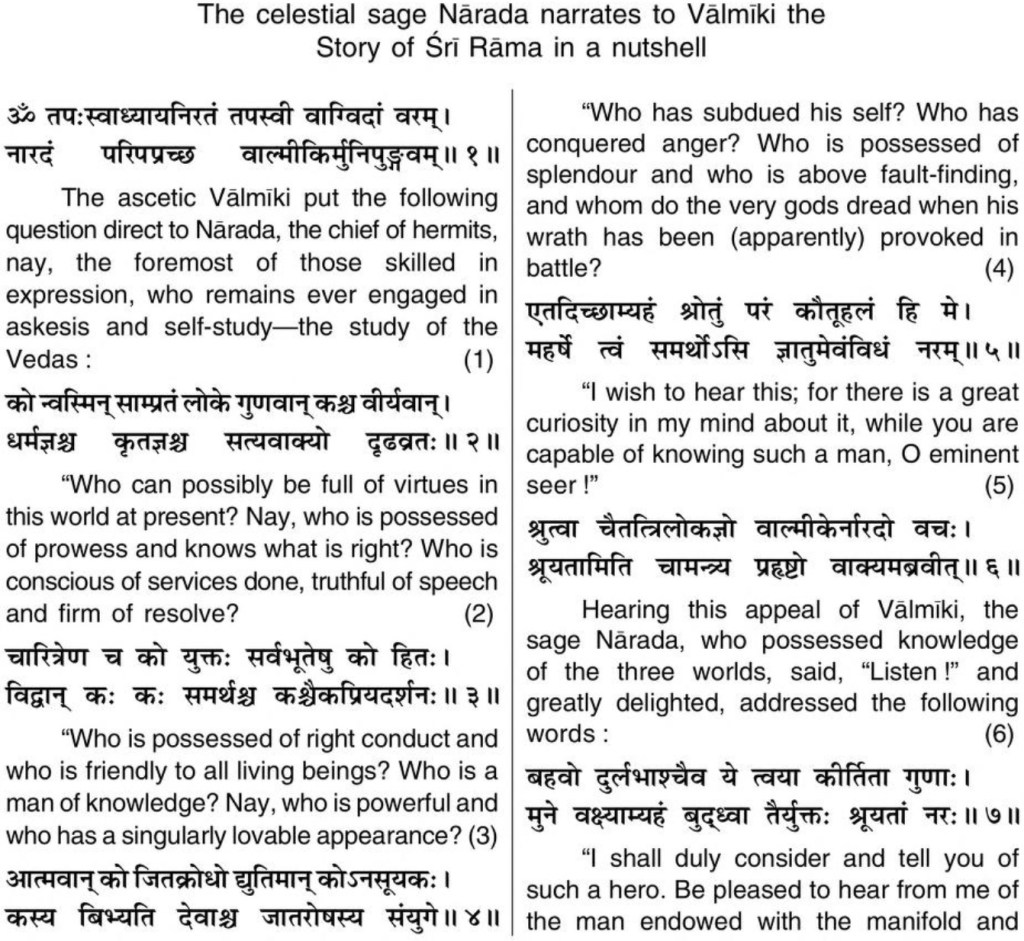
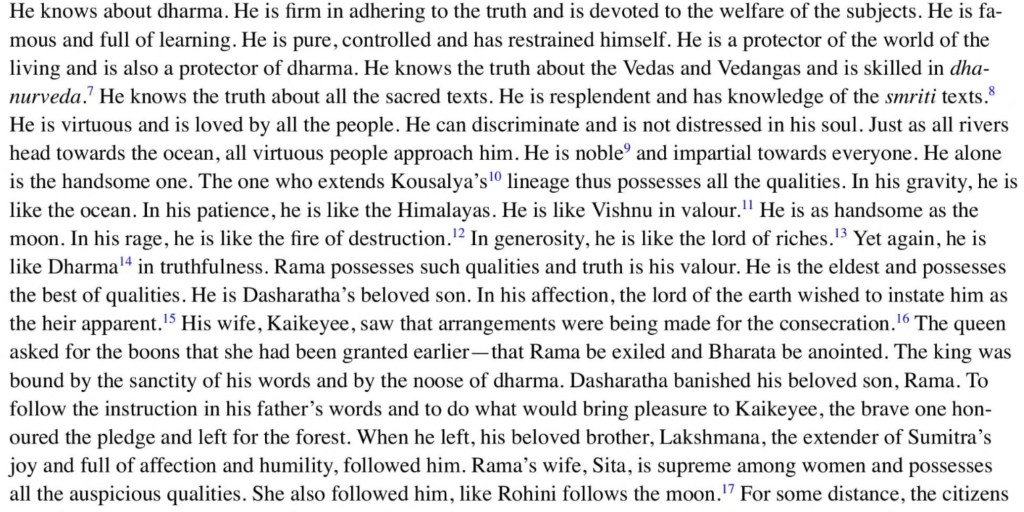
    The Ramayana opens with Narada narrating the story to Valmiki. This is a significant moment, as it frames the Ramayana not just as a historical or mythological account, but as a divine narrative passed down from the gods to humans through a trusted sage. Narada’s role here is that of a divine mediator, ensuring that the wisdom and teachings of the Ramayana are preserved and passed on to future generations.

    Narada’s presence in the Ramayana reminds us that spiritual teachings often come through intermediaries who carry the weight of divine authority. His involvement in the story underscores the importance of dharma and the divine order, which are central themes in the Ramayana.

    As we explore Narada’s role in the Ramayana, it’s essential to recognize the broader implications of his presence. Narada is not just a character in the story; he is a symbol of divine wisdom, a bridge between the mortal world and the divine, and a guide for those seeking to live a life of righteousness. His actions, teachings, and guidance are a reminder that the path of dharma is always within reach, no matter the challenges we face.

    🙏🕊️🙏

    If you’re interested in exploring the Ramayana in greater depth, you can find the Gita Press and Debroy versions below.

    Below is an image from the Gita Press version, where Narada’s wisdom begins to unfold:

    Screenshot

    Below is an image from the Debroy version, where Narada’s wisdom also begins to unfold:

    Screenshot