Embracing the ME/CFS Crash: A Journey of Pacing, Overdoing, and the Practice of Witnessing. Or, Non-duality Rocks!

Reminder: If reading this post becomes tiring, remembert to pause and rest. Pacing applies to all activities, even the ones we love, like reading and learning. Come back to this post later if you need to. Practicing pacing, even in small moments, is an essential part of living well with chronic fatigue syndrome.

Introduction

There’s a rhythm to living with chronic fatigue syndrome (CFS), one that demands a delicate balance of energy. Most of us who live with this condition become intimately familiar with pacing—learning how to manage our energy, smoothing out the hills and valleys of our strength. Through pacing, I’ve learned to minimize the crashes that come when I push myself too far. But even with this practice, there are moments when I consciously decide to overdo it.

Sometimes, there’s a powerful desire to break out of the limits that CFS imposes. It’s a rebellion, a brief escape. I know when I’m pushing too far, but I choose to embrace life fully for a day or two. I let myself feel that temporary energy, even though I know I’ll crash later. It’s a conscious decision to say, “I’m going to enjoy this moment, and I’m willing to pay the price.”

For anyone with CFS, this might sound familiar. We know pacing is vital to managing our condition, but there are times when the joy of overdoing it feels worth the consequences. And yet, when the crash comes—and it always does—the body demands recovery. This is where the real work begins, not just physically, but mentally and emotionally.

The Second Arrow: Witnessing the Mind’s Reactions

When I crash, the body does what it needs to do to heal, and I’m forced to stop. But I’ve learned over time that what really intensifies suffering isn’t just the crash itself—it’s the mental and emotional turmoil that can follow. This is where the teachings of vrittis and pratyayas have been so transformative for me.

In simple terms, vrittis are the fluctuations of the mind—the rising and falling thoughts and emotions. Pratyayas are the seeds that drive these mental fluctuations, often based on past experiences, memories, or attachments. Together, these create the mental chatter that, when left unchecked, can deepen the suffering of any crash.

Buddhist teachings describe this extra layer of suffering as the “second arrow.” The first arrow is the unavoidable pain—whether physical, emotional, or otherwise. But the second arrow is the mental suffering we add on top of that pain: the self-criticism, the frustration, the inner dialogue that says, “Why did I overdo it? I knew better.” This second arrow is where much of the suffering lies.

But by the yogic practice of witnessing the vrittis and pratyayas, I’ve learned to avoid that second arrow. I observe the mental fluctuations as they come and go, without attaching to them, without allowing them to define my experience. I become the seer—the witness—and in doing so, I find that even during a crash, there is peace to be found.

Pacing and the Conscious Decision to Overdo It

Pacing remains the cornerstone of managing chronic fatigue syndrome. It’s about knowing your limits and respecting them, smoothing out the ups and downs of energy. But what happens when pacing fails? What happens when you make the conscious decision to overdo it, knowing full well that you’ll pay for it later?

For me, the key has been integrating this practice of witnessing into every stage of the process. I allow myself to live fully in those moments of overindulgence, embracing the joy of activity and connection, knowing that a crash will follow. But when the crash comes, I don’t add layers of mental suffering by blaming myself. Instead, I use the crash as an opportunity to practice witnessing—the vrittis and pratyayas are just thoughts and mental patterns, not realities. By observing them, I stay free of the second arrow.

This approach allows me to live with chronic fatigue syndrome in a way that feels less restrictive. Yes, I pace myself. Yes, I’m mindful of my energy. But even when I choose to push past those limits, I know that I can find peace in the aftermath through this practice.

The Impulse to Finish, the Practice of Letting Go

As I write this post, I feel the strong desire to finish it, to post it immediately so that it can be available to those who may benefit from it. It’s an impulse I recognize well—a pratyaya, a desire that drives me to push beyond my limits, even when I know it’s not in my best interest.

But just as I practice witnessing during a crash, I also practice witnessing this impulse. I see it for what it is—just a thought, just Mara, just another fluctuation of the mind. I don’t have to follow it. I don’t have to act on it. Instead, I can pause, rest, and come back to this post when my body is ready.

In the same way, I encourage you, as a reader, to pace yourself. This post is long, and if you find yourself feeling tired, take a break. Reading is an activity that requires energy, and pacing applies here, too. Come back to it later if you need to. Take care of your energy, just as I am doing with mine.

A Soft Rebellion, a Path to Growth

There is something liberating about the moments when we choose to overdo it, to embrace life fully despite knowing we’ll crash later. It’s a soft rebellion, a decision to live in the moment, even when we know the consequences. But with the right mindset, even those crashes can become opportunities for growth and practice.

The teachings of witnessing the vrittis and pratyayas have shown me that even the difficult moments—the crashes, relapses, pain, dysfunction, and discomfort of those moments, days, or weeks of low energy—are fertile ground for inner growth. By avoiding the second arrow, and simply observing my mind without attaching to the fluctuations, I can find peace even in the midst of discomfort.

For anyone living with chronic fatigue syndrome, I hope this reflection offers some comfort and guidance. There is no perfect way to navigate this condition, but there are practices that can help us find peace, even in the most challenging times. Whether it’s through pacing, or through the practice of witnessing, or simply by being gentle with ourselves, especially in moments of overdoing it, we can find a way to live with greater ease and acceptance.

Take your time, pace yourself, and remember that every crash, every moment of overdoing it, is a new opportunity to practice and grow. We are all on this path together, and in that, there is a kind of peace.

Facing the Storm: An Urgent Reminder to Pace and Witness

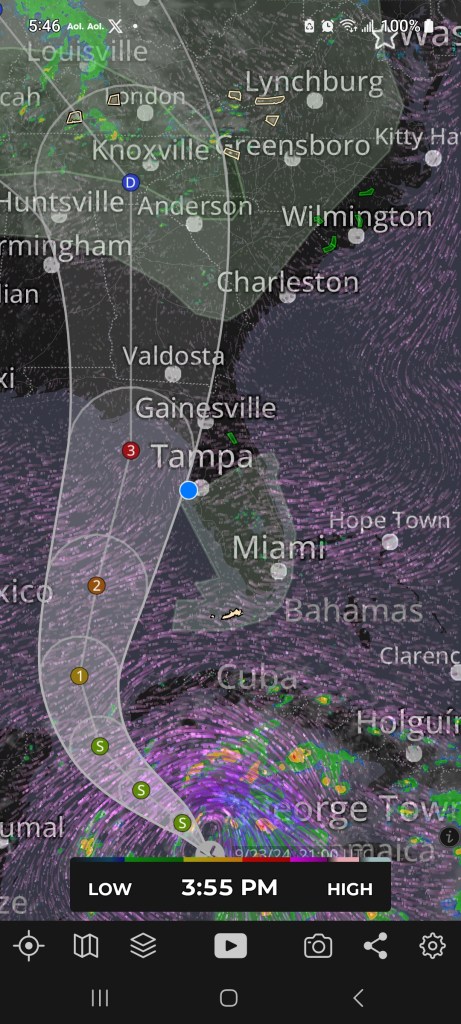
As I write this, there is a real storm brewing, both within and without. The image below is a weather map of the hurricane that may soon hit my area, forcing me to evacuate. As someone living in an RV, evacuation is usually mandatory in situations like this, and so I find myself facing the possibility of having to leave my bed in the middle of a crash caused by overdoing it.

The threat is very real, and so the importance of pacing is now at a level that I can’t ignore. I must prioritize rest and recovery immediately, because no matter what state I’m in, I’ll have to get out of bed and go to the hurricane shelter at the church next door if an evacuation order comes.

This situation has made it even clearer to me how crucial the practice of witnessing vrittis and pratyayas is. Without that practice, I would be overwhelmed by anxiety and fear right now. The mind wants to run wild with worst-case scenarios and worries, but I have been training myself to simply witness these thoughts as they arise. They are just thoughts—just mental fluctuations. They do not have to define my experience. I can stay present, calm, and clear, ready to deal with whatever comes.

So, after I finish writing this post, I’m going into massive rest and be prepared mode. The practice of pacing has never been more critical. This is an extreme red-flag situation, and I hope it serves as a reminder to all of us with chronic fatigue syndrome: sometimes, the urgency of rest is not just about avoiding a crash; it’s about survival.

Take a look at the image below—it’s a reminder to me, and hopefully to you as well, that life can throw storms at us both literally and metaphorically. But with the right practices, we can remain centered and grounded, ready to face what comes with a steady mind and a rested body.

As we face the storms within and around us, may we find peace in the stillness of our hearts. May all beings be free from suffering and the causes of suffering. May all beings experience happiness and the causes of happiness. May we all find safety, strength, and well-being on our journeys, no matter how turbulent the path. May we be guided by wisdom, anchored in compassion, and find harmony in the unfolding of each moment. And in these times of uncertainty, may we remember our interconnectedness, and may we all be held in grace and peace.
🙏🕊️🙏

Comments

10 responses to “Embracing the ME/CFS Crash: A Journey of Pacing, Overdoing, and the Practice of Witnessing. Or, Non-duality Rocks!”

  1. Richard Silverman Avatar

    RESPONSE FROM FACEBOOK COMMUNITY:

    M.E./CFS POSITIVITY 

    https://m.facebook.com/groups/187153394962510/?ref=share

    Such a wonderful truth this illness has brought into this Life. Thank you for your Heart-Centered energies in sharing this, Richard.

    May all go as smoothly as possible in regards to the coming weather forecast. 💜✨

    MY REPLY:

    Thank you, This journey with illness truly does reveal deep truths, ones that often come wrapped in challenges, yet unfold into such tender understanding. I’m grateful to share this space of reflection with you.

    And thank you for your kind wishes regarding the weather. I trust that, whatever unfolds, we’ll be held in grace. I’m saving up my spoons in case I have to evacuate. It’s a wonderful opportunity to practice mindfulness, equanimity and staying calm in the storm of vrittis and pratyayas.

    May you also find peace and calm in your own journey, wherever it leads. 💜✨

    Like

  2. Richard Silverman Avatar

    RESPONSE FROM FACEBOOK COMMUNITY:

    M.E./CFS POSITIVITY 

    https://m.facebook.com/groups/187153394962510/?ref=share

    There is an excellent Buddhist equivalent to this teaching. Check out Toni Bernhard’s book, “How to Be Sick”. Also, Cognitive Behavioral Therapy has distilled this for us Westerners, and I have found it to be an excellent tool. Remember “pain is inevitable – suffering is optional” and avoid those second arrows!🥰

    MY REPLY:

    Thank you so much for sharing this! I wholeheartedly agree—Toni Bernhard’s “How to Be Sick” is an excellent resource, and it was truly a turning point in my own life. I highly recommend it to anyone navigating chronic illness or challenging circumstances. Cognitive Behavioral Therapy (CBT) is also a wonderful tool, and it beautifully distills these timeless teachings for us in the West.

    I love the reminder, “pain is inevitable—suffering is optional.” It’s such a powerful way to stay mindful and avoid those second arrows. I encourage everyone to explore these recommendations, as they can be life-changing. Thank you again for your thoughtful contribution! 🥰

    HER REPLY:

    It was life changing for me in 2011. I reread it once a year, that and “how to live well”. It gave me such a sense of peace and the ability to start accepting what is and understand new normal.

    MY REPLY:

    Reading Tony Bernhard for me was the first time I had ever heard anybody talk in such a way that I knew that they knew what I was going through and up until that point it was just being denied as a garbage pail diagnosis of something that didn’t exist, so it was such a huge relief Not only to get affirmation of my situation but actionable guidance and advice. God bless Tony Bernhard. 🙏🕊️🙏

    Like

  3. Richard Silverman Avatar

    RESPONSE FROM FACEBOOK COMMUNITY:

    M.E./CFS POSITIVITY

    https://m.facebook.com/groups/187153394962510/?ref=share

    This is so well written, there is such flow to it that it nade reading it a pleasure.

    I have a question, how do you actually observe the chatter of the mind, and not let yourself get drawn into the hole? I find my defenses are so low when I’m crashing, that these thoughts are overwhelming. I’m totally in the line of fire (and getting struck!) by those second arrows!

    MY REPLY:

    When the defenses are low, and we feel entirely exposed to the second arrows—those relentless waves of mental chatter, self-criticism, and frustration—it can seem almost impossible not to get swept away. I’ve been there, many times, in that tender place where everything feels raw and overwhelming. The key, I’ve found, is not to fight the chatter or push it away, but to approach it with a soft curiosity, like one would approach a wild animal in the forest.

    Imagine the thoughts as clouds passing through the sky of your mind. They may come thick and fast, stormy even, but the sky itself is vast, open, and untouched by them. You, the witness, are that sky. The thoughts are not you; they are visitors, and you have the power to watch them without giving them the authority to define your reality.

    In moments when the second arrows feel like they’re hitting hard, gently remind yourself that it’s okay to feel overwhelmed. You don’t have to resist or try to be “better” at managing it in that moment. Simply notice the overwhelm. Take a breath. And another. Let yourself rest in the awareness that it’s okay to just witness. You don’t need to fix or change the thoughts. Instead, imagine yourself taking a step back from them, like watching a play on a stage. You’re in the audience, not on the stage, and the thoughts are the actors performing.

    During a crash, when energy is so scarce, the mind will try to fill in the gaps with noise. This is its way of trying to keep you engaged, to make sense of the sensations in your body. But you don’t need to engage with every thought. Sometimes, simply sitting with a thought, letting it exist without feeding it with more energy, is enough. You can say to yourself, “Ah, there’s that old thought again. I see you.” By acknowledging it without judgment, you take away some of its power.

    In this practice of witnessing, it’s not about perfection. It’s about returning again and again to the seat of the observer, even when you feel lost in the chatter. Each time you notice you’ve been pulled into the spiral, that’s a victory. Gently guide yourself back to the breath, back to your body, back to the present moment. Over time, you’ll find that the thoughts begin to lose their intensity, and even when they come, they pass more easily.

    Remember, dear one, you are not alone in this practice. We all get struck by those second arrows, and sometimes, they hit deep. But every moment is a new opportunity to soften, to observe, and to rest in the quiet space behind the thoughts. Be gentle with yourself as you navigate this, and know that with each breath, you are cultivating the strength to witness without getting lost in the storm.

    In the stillness of your heart, there is always peace to be found, even amidst the chatter.

    To support this journey of witnessing, I’d like to offer a simple mindfulness meditation that can help cultivate the ability to rest in awareness:

    1. Find a comfortable place to sit or lie down where you won’t be disturbed for a few minutes.
    2. Close your eyes, and take a few slow, deep breaths, letting the body soften with each exhale.
    3. Bring your attention to your breath—the gentle rise and fall of your chest or belly. There’s no need to change your breathing, just observe it as it is.
    4. Notice the sensation of the breath as it enters and leaves the body, letting each breath anchor you in the present moment.
    5. When your mind inevitably wanders—because it will—gently guide your awareness back to the breath without judgment. Just return to the simple act of breathing, over and over again.
    6. Do this for just five minutes. Let the experience be what it is, whether peaceful or distracted, without needing it to be perfect.

    You can return to this practice several times a day, even if just for a few moments. Over time, this gentle awareness of the breath will help build the ability to rest in the present, and not be swept away by the fluctuations of the mind.

    Like learning any skill this takes time and practice. The more you practice, the more skillful you become.

    Self- compassion and patience are key. Treat yourself the way you would a cherished friend.

    🙏🕊️🙏

    Like

  4. Richard Silverman Avatar

    RESPONSE FROM FACEBOOK COMMUNITY:

    #MEAction Living with ME Support Group

    https://m.facebook.com/groups/211058135999671/?ref=share

    Thank you for sharing this!! These concepts sound very familiar to disconnected “lessons” I’ve been exposed to with different terminology, from the worlds of cognitive behavioral therapy and trauma healing programs. But you’ve managed to put into beautiful and simple language, from your worldview and mindful practices, how it applies to the specific experience of having MECFS. I find this all immediately helpful and relatable. Thank you. Thank you. Thank you. 🙏 💙

    MY REPLY:

    Thank you so much for your kind words. There is no greater compliment for a writer than knowing that the message resonates deeply with another’s experience. I’m truly grateful that you found the post helpful and relatable, and that it connected with you in such a meaningful way.

    The creator of CBT, Aaron Beck, was actually influenced by Eastern traditions, particularly mindfulness practices. That connection between observing thoughts and recognizing them as just thoughts—without becoming entangled in them—echoes deeply in both CBT and the mindfulness approach I wrote about in the post.

    As for the “disconnected lessons” you mentioned, it’s amazing how these teachings often come to us in different forms. Sometimes, it takes hearing them in a different language or context—like in this case, relating them directly to life with ME/CFS—for them to fully click. I’m so grateful that the post helped bridge those gaps for you.

    Wishing you continued strength and peace as you move forward. Thank you for reading and sharing your thoughts.

    🙏🕊️🙏

    HER REPLY

    You’re most welcome. I printed it out for myself to reread well into the future to truly practice my version of it. I also printed and handed it to a wise and humble person facilitating a community group discussion on mental suffering, who will also recognize the value of cultivating a heart of compassion for ourselves—even if we do have one for others. It was good to see there are people out there trying to learn how to honor not just their own but others’ mental suffering that goes along with illness or traumas or grief or whatever life difficulties, that people feel they need to wear masks to hide or not be vulnerable sharing about and being able to hold space for. I used up all my spoons and went far beyond pacing points attending, but I believe it was no accident I happened to read your post the day I felt it important to attend this little event with safe people, and will for sure crash tomorrow for a week probably, but will observe and appreciate and not condemn myself, with your words right where I can see them. I am glad I got myself out: I got some more evidence there are people worth meeting still, and connected with someone quickly for whom I could provide compassion and validate her experience. I signed up for next book discussion night a month from now. It will be good for me.
    Sending care to you and as a person who prays, I’m praying for your various needs as you watch hurricane evacuation orders. I was raised in FL and lived there into my mid twenties. I’ve been through several big hurricanes so I have a good idea what you’re going through pre-during-and post-storm. 🌀 I will check back here to see how you fare whether good, neutral, or bad—or a mix of all. If you think or it and are able, share an update what happens. 🙂

    MY REPLY:

    Thank you for your beautiful and heartfelt words. It moves me deeply to know that the post found its way to you at just the right moment, and that it became a source of strength and connection as you navigated such a meaningful event. There is something so profound about the way we can offer compassion to one another, even when we are running on empty. It’s in those moments of shared vulnerability that we truly see the heart of our humanity.

    I’m grateful for the prayers and care you’ve sent my way, especially as I prepare for the storm ahead. I, too, will hold you in my thoughts as you recover from your crash, knowing that with each moment of rest and stillness, there is room for both grace and growth. You’ve reminded me once again how important it is to stay connected with those who walk a similar path.

    I would love to stay in touch with you and others who are navigating these deep waters. If you feel called, I invite you to subscribe to my blog, where I share most of my reflections and writing. It would be wonderful to continue sharing this journey with like-minded souls.

    https://globalwellbeing.blog

    🙏🕊️🙏

    Like

  5. Richard Silverman Avatar

    RESPONSE FROM FACEBOOK COMMUNITY:

    #MEAction Living with ME Support Group

    https://m.facebook.com/groups/211058135999671/?ref=share

    Thank you for this thoughtful and helpful post Richard. Wishing you the best as you weather this storm.

    REPLY:

    Thank you! 💖

    Like

  6. Richard Silverman Avatar

    RESPONSE FROM FACEBOOK COMMUNITY:

    #MEAction Living with ME Support Group

    https://m.facebook.com/groups/211058135999671/?ref=share

    Beautifully expressed. Insightful, reassuring and eloquent. Feeling deep gratitude. May you be safe. May you stay peaceful. May you be blessed.

    ♥️🙏🏻♥️

    REPLY:

    Thank you, your prayers are warmly received, and greatly appreciated.
    🙏🕊️🙏

    Like

  7. Richard Silverman Avatar

    RESPONSE FROM FACEBOOK COMMUNITY:

    #MEAction Living with ME Support Group

    https://m.facebook.com/groups/211058135999671/?ref=share

    I’m sorry but I can’t read this. But, I became aware the other night that I can still love life and be a happy, loving person in my sick body.

    REPLY:

    I’m so sorry to hear that you’re unable to read it right now. I completely understand, especially given how overwhelming things can be with ME/CFS. Please know that it’s okay to step back and rest as much as you need.

    It’s so powerful to recognize that even in the midst of illness, we can still hold love for life and embody happiness and kindness. That awareness is such a gift—it shows the deep strength of your spirit, even when your body is struggling.

    I hope you continue to nurture that sense of love and joy, and that in time, you’ll find moments where your capacity to engage grows. Until then, resting and honoring where you are right now is such a beautiful act of self-compassion.

    Wishing you peace and strength on this journey. 💙

    🙏🕊️🙏

    HER REPLY:

    before I had the realization, I was considering suicide but now, I’m just happy to be alive. Thank you for your reply 🥰

    MY REPLY:

    Sue Holeman

    Thank you for sharing that with me. I completely understand where you’re coming from, and I can deeply relate to your journey. For many years, I too struggled with suicidal thoughts, but things began to shift for me after I encountered “How to Be Sick” by Tony Bernhard and “The Pristine Mind” by Orgen Chowang. Those books, along with an online meditation class, helped me come to a place of appreciating the new normal of my life. It’s a gradual process, but finding that realization made a profound difference for me, and I’m glad to hear that you’ve found peace and happiness in your own way too.

    🙏🕊️🙏

    Like

  8. Richard Silverman Avatar

    RESPONSE FROM FACEBOOK COMMUNITY:

    ME/CFS Neuroplasticity and nervous system regulation

    https://m.facebook.com/groups/650139118792993/?ref=share

    This is incredible thank you. I will be back to finish reading it, but spot on and so helpful.

    REPLY:

    You’re so welcome! I’m really glad it resonated with you and was helpful. Take your time, and I’m here whenever you’re ready to continue! 🙏🕊️🙏

    Like

  9. Richard Silverman Avatar

    RESPONSE FROM FACEBOOK COMMUNITY:

    #MEAction Living with ME Support Group

    https://m.facebook.com/groups/211058135999671/?ref=share

    You have extraordinary insight into the roots of our suffering. I have been studying the same principles and I am applying what I learn in baby steps. I wish I could transform my old way of being in an instant but it’s so contrary to the many years I have dealt with my existence. The old ways keep drawing me back. In fact. today I am completely engulfed in the saturation of self. I appreciate your post very much. The words came to me when I needed a reminder. It is hell inside myself only because I am saturated in self.

    REPLY

    I truly understand how challenging it can be to take these baby steps toward change, especially when the old ways of being are so deeply ingrained. It’s such a slow, patient process, and I think many of us wish we could transform everything in an instant. But in reality, even small steps are profound—they build a foundation for a new way of being, even when it feels like the old patterns are pulling us back.

    I hear you when you talk about feeling engulfed and saturated in self. I’ve been there, too, and it can feel like being trapped inside a storm of our own making. But I want to gently remind you that simply recognizing this state is already a step toward shifting out of it. Just by noticing that you’re saturated in self, you’re practicing that mindful witnessing we talked about—seeing the patterns, without letting them completely define you.

    It’s not easy, and there are days when we’re all drawn back into those familiar patterns. But the fact that you’re applying what you’re learning, even in small steps, is a testament to your strength and growth. And the beauty of this path is that it meets us exactly where we are, offering us gentle reminders just when we need them.

    On that note, I thought you might find additional support from The Pristine Mind by Orgen Cho-Wang, which really explores becoming more identified with our natural state—the pristine mind—rather than the ordinary mind. Here’s a link to a review we did of the book, which might resonate with you as you continue on this journey:

    https://globalwellbeing.blog/category/bridging-hearts-and-minds/book-reviews-summaries-and-reflections/the-pristine-mind-by-orgyen-chowang/

    Please be kind to yourself as you move through this—transformation is a gradual, often non-linear process, and every step counts. I’m glad the post came to you as a reminder in a tough moment, and I’m holding space for you as you continue to move forward with grace.

    Wishing you moments of peace amidst the storm.

    🙏🕊️🙏

    Like

  10. Richard Silverman Avatar

    RESPONSE FROM FACEBOOK COMMUNITY:

    #MEAction Living with ME Support Group

    https://m.facebook.com/groups/211058135999671/?ref=share

    Thanks for your encouragement. I see you have made good use of Buddhist teachings. Sometime if you have time I would like your thoughts about how to adjust to a world without “concept”. It is so frightening. The observer is the one who let’s go of it. I was so frightened I went into panic and I had to back away. If you have the energy to share that would be wonderful but please take care of yourself.

    REPLY:

    Thank you for sharing this profound experience. I understand how unsettling and even frightening it can be to approach that space where not only concepts, but even the observer, seem to dissolve. It’s often in the letting go of the seer—the part of us that still holds a subtle sense of self—that the deepest fears can arise. The emptiness can feel like a vast unknown, where the usual markers of identity and control fall away.

    What I’ve found helpful in navigating this is to remember that while the seer provides equanimity and non-judgment, beyond even the seer lies a deeper, more expansive peace. It’s a kind of surrender that is difficult to describe but, when met with openness, can offer a profound sense of freedom. However, it’s perfectly natural to feel fear or even panic when confronted with this vast emptiness—it’s a new frontier for the mind.

    When fear arises, it’s okay to step back and re-anchor yourself in what feels safe. You don’t need to rush into these experiences. Gently easing into the letting go, while holding compassion for yourself, can help create a sense of trust in the process. And even when the seer dissolves, what remains is not nothingness in a negative sense, but rather a spacious, loving awareness that’s always present.

    If you ever feel ready to explore more, I’d be happy to share my thoughts as energy allows. But for now, know that you’re not alone in navigating this fear. Take it at your own pace, and trust that even in these moments of stepping back, growth and peace are unfolding.

    Wishing you courage and peace as you continue this journey.

    https://globalwellbeing.blog/category/bridging-hearts-and-minds/caravan-of-love-interfaith-healing-harmony/intothemystic/

    Like

Feel free to leave a comment below.