Category: “The Pristine Mind” by Orgyen Chowang

“The Pristine Mind” by Orgyen Chowang Rinpoche is a profound exploration of the innate clarity and purity of the mind, drawing from the Dzogchen tradition of Tibetan Buddhism. This category is dedicated to reviewing and reflecting on this transformative book, which offers practical guidance on how to access and sustain the natural state of Pristine Mind—an unclouded, ever-present awareness that lies beneath the surface of our everyday thoughts and emotions.

In “The Pristine Mind,” Orgyen Chowang Rinpoche presents ancient wisdom in a way that is accessible and applicable to modern life, showing readers how to move beyond the mental habits that obscure our true nature. Through a combination of teachings, meditative practices, and relatable examples, the book guides us toward a direct experience of this pure state of being, which is characterized by peace, clarity, and joy.

This category offers in-depth reviews, discussions, and insights into the key themes of “The Pristine Mind.” We explore how Orgyen Chowang Rinpoche’s teachings can help us transform our relationship with our thoughts, emotions, and the world around us, leading to a more grounded and fulfilling life. Whether you are new to the concepts of Dzogchen or seeking to deepen your understanding of the mind’s true nature, this category provides valuable perspectives and reflections on this essential work.

Join us as we delve into the wisdom of “The Pristine Mind,” discovering how to tap into the natural, unblemished awareness that is always available to us, and how to cultivate a life of greater inner peace and freedom.

  • Wisdom Dreams: Whispers of the Divine, Carried Through the Language of Sleep

    Wisdom Dreams: Whispers of the Divine, Carried Through the Language of Sleep

    Some dreams are only echoes of the day, the mind releasing its burdens. But now and then, a dream arrives with a different fragrance—clear, luminous, and quietly instructive. Tibetan teacher Namkhai Norbu called these wisdom dreams.

    Across traditions, people have spoken of dreams as a place where the veil grows thin: Jacob dreaming of angels ascending and descending, the Buddha receiving signs beneath the stars, mystics and poets waking with verses on their lips. Whether one calls it the Holy Spirit, pristine mind, or the still small voice, wisdom dreams remind us that the Divine speaks in many tongues, including the language of sleep.

    In this space, I will gather such dreams as they come. They are not explanations, but blessings—reminders of innocence, renewal, and the beauty that is always near. For those of us living with illness and limitation, these rare visitations are nourishment, like sunlight stored in the heart.


    Wisdom Dream — September 5, 2025

    Dream Narrative:
    I was among a group of people, and a young girl was awakening to God—not through doctrine, but through her own direct experience of pristine mind. I felt called to support her in understanding what she was encountering. Later, a young boy appeared with a similar experience. I spoke with him and with his father, who at first was concerned, but came to understanding. I tried to connect the father with the girl so the children might share with one another.

    “Truly I tell you, unless you change and become like little children, you will never enter the kingdom of heaven.” — Matthew 18:3 (NIV)

    As the day waned, the father turned my attention to the sunset, encouraging me to see its beauty. We were heading toward a hotel, a place of rest, as the sun lowered into gold.

    Feeling on Waking:
    Unlike yesterday’s dream of anger and grief, this dream carried lightness, excitement, and joy. It felt rare and precious, a visitation of the wisdom dream rather than the karmic. I awoke with a sense of renewal, as though something had been affirmed deep within.

    Reflection:
    The children embody innocence and directness, showing a way of knowing God beyond belief systems. My role was not to teach, but to encourage. The father represents care and responsibility, learning to trust what he does not yet understand. His pointing to the sunset was a transmission of beauty: the Divine is always before us if we look.

    Living with ME/CFS:
    So often my nights bring restlessness or dreams weighted with fatigue, anger, or sorrow. To receive a dream of joy is no small thing. With ME/CFS, the waking world can feel heavy, each day a lesson in endurance and pacing. This dream felt like a gift that reached across the veil of illness—reminding me that the wellspring of wisdom and beauty is still alive in me, even when my body is weary. It nourishes me for the time being, like sunlight stored in the heart.

    Poetic Distillation:
    Two children touched the sky within,
    untouched by creed or claim;
    I walked beside their quiet flame,
    and found my heart the same.

    Further Reading:
    For those interested in exploring the teachings that inspired this reflection, Orgyen Chowang’s Our Pristine Mind provides a gentle introduction to the concept of Pristine Mind—the pure, luminous awareness that lies beneath ordinary thought and emotion. Namkhai Norbu’s Dream Yoga offers guidance on using dreams as a path to recognize this awareness, cultivating insight and clarity while asleep. Together, these works illuminate how wisdom can arise in everyday life and in dreams, offering tools to recognize the Divine beyond dogma.

    For more information, you can find these books here: Our Pristine Mind and Dream Yoga.

    “And afterward, I will pour out my Spirit on all people. Your sons and daughters will prophesy, your old men will dream dreams, your young men will see visions.” — Joel 2:28 (NIV)

    🙏✨️💛✨️🙏

  • A Glimpse of Rigpa: The True Nature of Our Mind

    A Glimpse of Rigpa: The True Nature of Our Mind

    Yesterday Rinpoche gave me the simple instruction: to keep my thoughts in the room.
    As I practiced, the winds of memory and worry fell quiet, and what remained was a stillness like a pond untouched by breeze. In that moment I glimpsed the unity of ordinary and pristine mind—waves arising, yet nothing but ocean.

    Beloved Rinpoche,

    I write with gratitude for the instruction you gave yesterday, which opened a new door for me into the experience of Rigpa. Your words were simple, yet carried such profound kindness: to keep my thoughts in the room.

    As I sat in meditation, I followed your guidance. Thoughts about the ceiling, the plants, the breath, even the quiet pulse of tinnitus—all of these belonged to the room. They could be held gently within awareness without struggle. But when thoughts drifted toward memories of the past, or worries of the future, or stories beyond this room, I could see them clearly as outside. And so, with care, I let them go and returned to what was here.

    This way of practicing felt so different—so much more tender. Instead of wrestling with ordinary mind, I could simply remain rooted in this space, in this moment. And in that resting, the movements of the mind, the vrittis and pratyayas, began to settle of their own accord. Like a pond no longer stirred by wind, a natural stillness revealed itself. Within that stillness, I began to glimpse what you have pointed to again and again: the open clarity of pure awareness.

    In that glimpse, awareness shone with very little disturbance. An “I” was still present, but the usual fluctuations of thought were momentarily quiet, allowing the stillness of pure awareness to appear directly. To rest, even briefly, in that clarity was both humbling and wondrous.

    I could sense then that ordinary mind and pristine mind are not two separate realities, but two sides of the same coin. The waves of thought arise, yet they are nothing other than ocean. The ordinary shines as the pristine. To realize this in a living way, even if for only a moment, fills me with wonder and gratitude.

    Rinpoche, I bow in thanks for this precious instruction. It has shown me that Rigpa is not distant or hidden, but present in the immediacy of the room, in the simple presence of what is. May I return to this again and again, and may this glimpse ripen into lasting recognition.

    And may whatever merit arises from this glimpse and this practice be dedicated to the benefit of all beings everywhere. May it ease suffering, open hearts, and become a cause for the enlightenment of all sentient beings throughout time and space.

    With devotion and gratitude,
    Richard

    🙏✨️💛✨️🙏

    If you would like to learn more about the teachings of Orgyen Chowang Rinpoche and explore Dzogchen practice in greater depth, you can visit his website at pristinemind.org.


    In this talk at Google, Rinpoche offers instruction and a guided meditation based on his book Our Pristine Mind: A Practical Guide to Unconditional Happiness. He introduces a unique form of meditation called Pristine Mind meditation and explains how cultivating a Pristine Mind can transform every aspect of our lives.


    By resting gently in the fullness of the present moment, allowing the mind to settle naturally, and recognizing its luminous, pristine nature, one opens to profound serenity and enduring contentment.


  • Letters to Rinpoche: Reflections on Ngöndro

    Letters to Rinpoche: Reflections on Ngöndro

    The following is a personal reflection written during my practice of Dzogchen Ngöndro, shared here as part of my ongoing journey with these teachings.


    I am very new to studuing and learning Orgyen Chowang Rinpoche and his teachings. My first introduction was through reading Our Pristine Mind a few years ago, which proved extremely helpful. The way ordinary mind and mental events are described brought clarity, resolving many years of confusion I had about sems and sems nyid.

    I have been studying and practicing Tibetan Buddhism as a lay practitioner since 1985–1986, after receiving the Kalachakra initiation with His Holiness the Dalai Lama in Bodhgaya, India. At this stage, I am not sure I can yet call myself Rinpoche’s student, as I understand that in the Tibetan tradition there is often a period of mutual discernment, where teacher and student come to know one another. For now, I am simply following his request to practice Ngöndro, and through this I am seeking to cultivate the beginnings of a student–teacher relationship, should that become appropriate.


    Insight from Contemplating the Eight Freedoms

    “The hungry ghost is not merely a being with desire, but a being entirely without contentment.”

    While reflecting on the Ngöndro contemplations, I focused on the second freedom—not born as a hungry ghost.

    As a human, I also experience desire, but I have the capacity for contentment. Even small moments—a quiet breath, the peace of stillness—remind me that not everything is consumed by craving.

    This insight brought me to a thought: perhaps it is not desire itself that causes suffering, but rather the inability to rest in contentment. Contentment softens desire, transforms it, and allows the heart to rest.

    Contemplative pause:
    Take a moment to notice where contentment may already exist in your life, even amid desire or difficulty.

    I am deeply grateful that such insights arise through the Ngöndro practice, and I wanted to record and share this reflection as part of my ongoing journey.


    Updates on Practice and Retreat Plans

    Although I had registered for the five-day Dzogchen retreat in August, I was not aware of the Ngöndro prerequisite and will therefore be withdrawing. I am now following Rinpoche’s guidance by studying and practicing the online Dzogchen Ngöndro program.

    I look forward to seeing him on October 11th at the one-day online Dzogchen retreat.


    Living with My Practice in Daily Life

    I have been living with a chronic illness called myalgic encephalomyelitis for many years. At first it brought great suffering, but over time I have come to see it as a powerful teacher on the path—almost like a spiritual friend.

    Because of this condition I am mostly homebound, and so I am deeply grateful for the opportunity to study and practice with Rinpoche through the modern blessing of online communication.

    Even when our circumstances feel limiting, spiritual connection and insight can arise through patience, presence, and accessible practices.

    🙏✨️💛✨️🙏

    If you would like to learn more about the teachings of Orgyen Chowang Rinpoche and explore Dzogchen practice in greater depth, you can visit his website at pristinemind.org.


    In this talk at Google, Rinpoche offers instruction and a guided meditation based on his book Our Pristine Mind: A Practical Guide to Unconditional Happiness. He introduces a unique form of meditation called Pristine Mind meditation and explains how cultivating a Pristine Mind can transform every aspect of our lives.


    By resting gently in the fullness of the present moment, allowing the mind to settle naturally, and recognizing its luminous, pristine nature, one opens to profound serenity and enduring contentment.


  • 🌌 Where All Directions Bow to Stillness

    🌌 Where All Directions Bow to Stillness

    A Gaze Beyond the Gaze: In the spirit of sky-gazing


    Lie back beneath the vaultless dome,
    Let clouds drift by like thoughts unknown.
    Release the mind, release the name,
    No watcher here, no self to claim.

    Let sky be sky, and mind be wide,
    No grasping hand, no need to guide.
    Just openness, so vast, so clear—
    What you are looking from is here.

    Into the Mystic

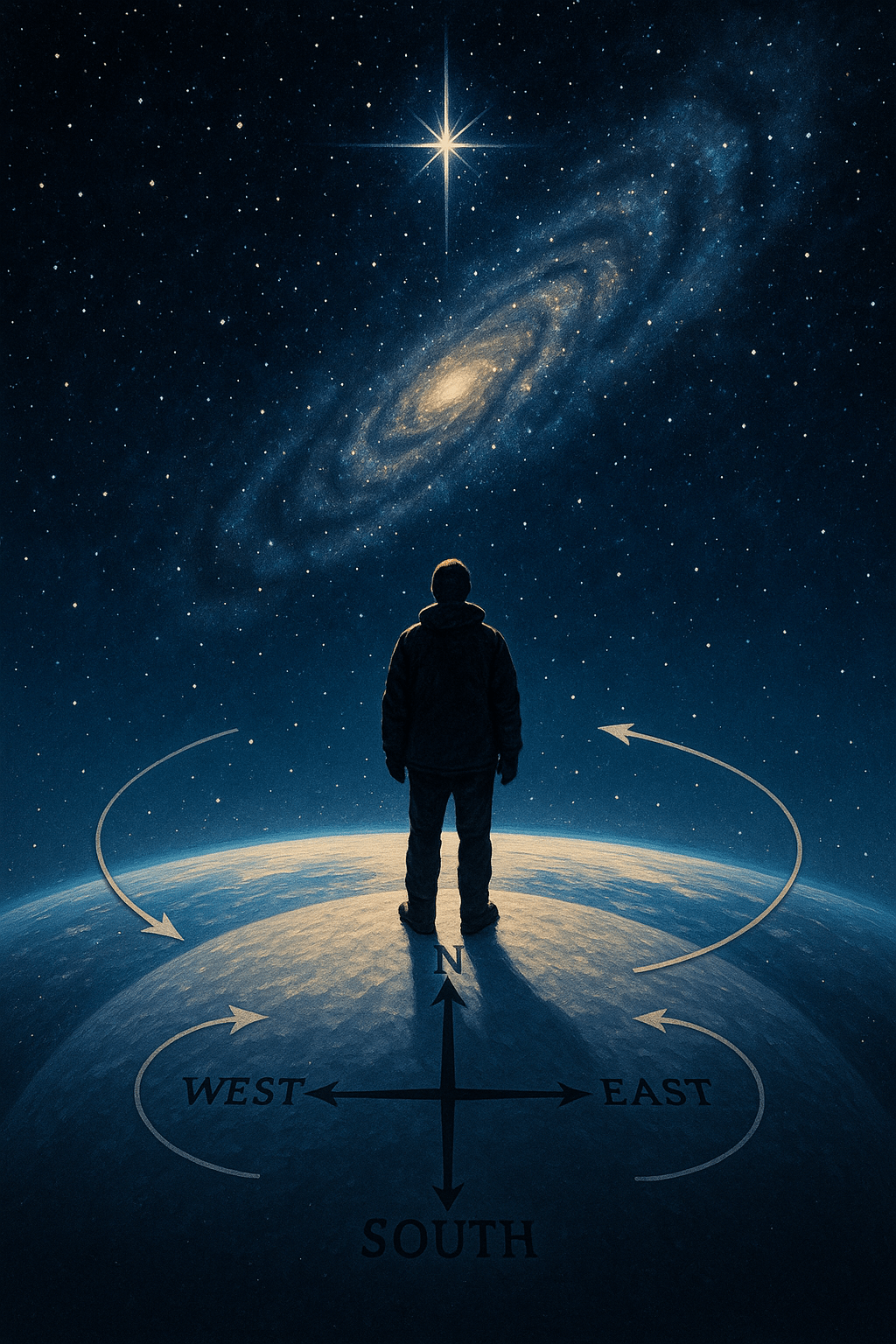
    At the very top of the world, if one were to sit in silence at the North Pole, something curious happens. The compass loses its ordinary song. North, so long held as our guide, vanishes beneath your feet. South radiates in every direction. East and West dissolve—not into chaos, but into the poetry of motion. Clockwise becomes East, counterclockwise becomes West. And you, the still point, are held at the axis where meaning begins to soften.

    This is not just a geographic curiosity. It is a mirror of the mind.

    In the Dzogchen tradition, we are invited to rest not merely in the knowing mind (sems), but in that which knows mind itself—sems nyid, the nature of mind. It is not something we manufacture through effort, nor something distant to be attained. It is nearer than near, always already present—like Polaris in the night sky, unmoving, while all else revolves.

    To sit at the North Pole and gaze upward is to dwell at a kind of worldly axis mundi, a symbol of rigpa, the primordial knowing that does not grasp, does not fabricate. From this point, every direction—every thought, every emotion, every arising—moves outward as “South”: the play of relative reality (kun rdzob), full of beauty, full of sorrow, full of form. But the upward gaze, the still recognition of what-is, lifts us toward don dam, the ultimate view.

    It is not about choosing one over the other. Dzogchen does not ask us to abandon the world or reject the compass. Rather, it invites us to see clearly—to understand that East and West only appear when we begin to walk. That what we call “direction” arises with perception. That what we call “self” arises with identification. And when we rest, utterly still, not pushing, not naming—we begin to recognize what has always been there.

    The pristine mind

    Pure like the Pole Star. Silent like the snow. Empty of essence, yet luminous with love.

    Here, the relative view—the dance of thoughts and roles and rotating worlds—becomes the compassionate display of awareness itself. And the absolute view is not elsewhere. It is this, ungrasped, unspoiled, ever-present.

    The moment we stop insisting on where we are going, we arrive.

    And from that still place, compassion flows—not as a moral stance, but as a natural warmth. Wisdom arises—not as accumulation, but as clarity. Loving-kindness becomes the language of space itself. We begin to see, not through the eyes of effort, but through the vision of what the Tibetans call lhun grub: spontaneously present, effortless, free.

    Let us walk, then, not to reach a place, but to circle gently like the sun, like the stars, around the stillness at the center. Let us live our days as if the compass rose were etched in light upon our hearts. Let us love without needing direction, forgive without needing map.


    At Earth’s bright peak where compass spins,
    “Up” becomes where silence begins.
    Polaris keeps her vigil there—
    a lantern hung in starry air.

    And you, dear traveler, have never been far from it.
    Even now, it calls you home.

    🙏🕊🙏


  • Exploring Pristine Mind Meditation for Chronic Fatigue Syndrome: A Path to Effortless Rest

    Exploring Pristine Mind Meditation for Chronic Fatigue Syndrome: A Path to Effortless Rest

    “Discover how pristine mind meditation may offer a gentle, restorative state of awareness without the energy costs that often come with post-exertional malaise.”

    Living with Chronic Fatigue Syndrome means every action, every exertion, has a cost. For many, even a few minutes of focus or effort can lead to post-exertional malaise—a profound worsening of symptoms that can last for days. But what if there was a way to rest deeply, to allow the mind to settle in a way that doesn’t deplete but actually nourishes? This is where the practice of pristine mind meditation comes in, offering an effortless awareness that exists beyond thought, beyond strain, and without the toll of traditional exertion.

    Pristine mind meditation is rooted in the idea of simply being. Rather than trying to clear the mind or enter a specific state, it invites you to rest in pure, unaltered awareness. This isn’t an act of concentration or focus, but a gentle allowing—a way to let thoughts and sensations come and go without attaching or resisting. The experience of resting in the pristine mind is often described as spacious, calm, and effortlessly open. For someone with ME/CFS, this could mean a path to real rest without the demand on physical energy that so often comes with other practices.

    Theoretically, because pristine mind meditation is free from physical or mental strain, it offers a way to access peace and stillness without triggering the kind of post-exertional fatigue that can worsen symptoms. It’s an invitation to explore a new way of being with chronic fatigue, where healing is not about doing but about resting in the quiet awareness that’s already within you.

    This journey is a gentle experiment, a compassionate practice of meeting yourself exactly as you are. Whether you experience even a few moments of pristine awareness or simply rest in the intention, the practice becomes a way of honoring the body’s limits and nourishing the mind. Take this path slowly, with openness, knowing that each step is its own quiet gift.

    If you’re curious, I invite you to join in this exploration, allowing yourself to simply rest in the pristine mind, noticing what it brings without expectation or need for change. This is a practice of ease, not of effort—a resting place for the soul amidst the demands of daily life with Chronic Fatigue Syndrome.

    For those interested in going deeper, much of this understanding is inspired by the teachings in Our Pristine Mind by Orgyen Chowang Rinpoche. His book provides a profound exploration of this approach to awareness, offering guidance on accessing the clear, effortless state of the pristine mind. If this resonates with you, I’ll leave a link below to help you find the book and discover more about this gentle, transformative practice.

    In the name of honoring my chronic fatigue syndrome, I’m experimenting with a different approach to healing. I’m trying out the idea that it doesn’t have to be complicated or effortful—that maybe simplicity and gentle choices can be enough. By tending to myself in this way, I’m exploring what it means to honor both my needs and my limitations, and I’m finding that this, too, might be a path to healing.

    I don’t know all the answers, but I’m noticing that healing isn’t always about pushing or doing more. Sometimes, it’s about making a quiet, deliberate choice to conserve energy, to rest, and to be. This journey toward simplicity and ease feels like a step toward well-being, and I’m curious to see where it leads.

    🙏🕊️🙏

    <!– /wp:spacer →

    🙏🕊️🙏

  • The Sacred Shift: From Seeking to Being

    Following the path of meditation can feel like a gradual unraveling of the known—a shedding of what we once held onto, leading us into the mystery of contemplation. As I continue reflecting on the works of St. John of the Cross, this sacred shift from meditation into contemplation becomes clearer. It is not a step we take with effort but a grace that gently unfolds when the time is right.

    St. John speaks of this transition as a call to surrender, but it is not the kind of surrender we can will into existence. Instead, it is a letting go that happens when we stop striving, when we allow ourselves to simply rest in the presence of the Divine. This is where the familiar practices of meditation—focused attention, mental inquiry, or breath awareness—fall away, giving space for something more profound to emerge.

    Today, I felt this shift more deeply, not as an intellectual understanding, but as a living experience. The pratyayas—the thoughts, sensations, and memories that rise and fall—became like whispers, their pull softening in the presence of curiosity. This curiosity is not the kind that seeks answers, but one that witnesses, without needing anything to happen. In that gentle witnessing, something new emerged: a spaciousness, a quiet stillness that felt like home.

    This experience is not unique to Christian mysticism. In Advaita Vedanta, the practice of self-inquiry often begins with a repetitive questioning—”Who am I?”—an active search for truth. But, as with St. John’s teachings, there comes a time when even the inquiry must dissolve into silence. The seeker steps back, not into a place of knowing, but into a place of being. In that being, all effort falls away, and we are left with the pristine awareness that has always been there.

    In silence, love calls,

    No longer through words or thought,

    But in quiet grace.

    This is the threshold between seeking and being, a place where the Divine does its quiet work in us. It is no longer about striving or yearning for a deeper experience; it is about trusting in the unfolding of love, which asks only that we rest in its presence.

    For those of us on this journey, may we continue to trust this sacred shift—moving from meditation into contemplation, from seeking into being. In this silent surrender, we come closer to the essence of who we truly are.

    🙏🕊️🙏

  • Into the Mystic: The Journey from Meditation to Contemplation

    As I re-read the works of St. John of the Cross, I have become more attuned to the threshold of transition—the dryness and emptiness that so often precede the invitation to move from meditation into contemplation. This is not unique to St. John; it is something pointed to by many of the great teachers. Whether it’s Namkhai Norbu, Ramana Maharshi, Thich Nhat Hanh, the Dalai Lama, or Orgyen Chowang in Pristine Mind, they all plant the seeds of meditative absorption, which only take root when the time is right. Now, it seems, those seeds are beginning to bloom, not as intellectual concepts, but as a living, unfolding experience.

    Today, I found myself drawn into this quiet transformation. As I lay in stillness, the pratyayas—those passing thoughts, sensations, and memories—began to rise and fall, like waves on a distant shore. Curiosity, that soft and patient witness, guided me deeper, not into understanding but into presence.

    The breath came of its own accord, a deep release from somewhere beyond my conscious will, as if the body itself knew what needed to unfold. And then, an awareness—a spaciousness—arose. It was not something I had summoned, nor could I hold it in place. It was simply there, naked and pure, like a clear blue sky.

    St. John of the Cross speaks of this as a kind of surrender, but not the kind we can choose. It is a grace bestowed, not earned. In the stillness, I realized that my role was not to force this shift but to allow it to happen. To remain as the observer, the witness, as the Divine unfolded in its own time.

    What struck me most deeply was the paradox of this surrender. The very act of trying to let go becomes an obstacle. Instead, it is curiosity that opens the door to pure awareness—curiosity that has no desire, no need for something to happen, but simply observes what is.

    Today, in this unfolding, I realized that even the longing for deeper experience can become a barrier. The path is not one of striving but of witnessing. And in that witness, the Divine does its quiet work, purifying what needs to be released, and bringing us ever closer to the essence of who we truly are.

    As I reflect on my own journey today, it is my hope, and the shared intention (Sankalpa) behind all of this work, that by sharing these reflections, insights, and experiences, they may serve as a guide, a comfort, or a spark of inspiration to those who come across them.

    🙏🕊️🙏

    Book Recommendation: St. John of the Cross, Dark Night of the Soul

    Dark Night of the Soul by St. John of the Cross is a spiritual masterpiece that explores the transformative power of suffering and the journey toward union with the Divine. This work describes the profound spiritual experience of being stripped of all attachments, both inner and outer, as a necessary process for purification and deeper connection with God. For those experiencing a time of spiritual dryness or emptiness, St. John’s words offer hope and guidance through the darkness, illuminating the path to deeper faith and surrender. The Dark Night is not a time of despair, but of ultimate transformation, where we are invited to let go of our limited understanding and trust in the unfolding of the Divine. This book serves as a timeless companion for anyone navigating the challenges of the contemplative path, especially those who feel drawn to the shift from meditation to deeper contemplation.

    Book Recommendation: Orgyen Chowang, Our Pristine Mind

    In The Pristine Mind, Orgyen Chowang offers profound teachings on accessing our natural state of mind—a state of clarity, openness, and peace. He draws from the Dzogchen tradition, emphasizing that our true nature is already pure and perfect, and that through practice, we can return to this unconditioned state. For those on a contemplative journey, Chowang’s words provide a practical path for moving beyond mental noise and distractions, guiding us back to the inherent stillness of the mind. This book is especially helpful for those who wish to deepen their meditation practice or shift from intellectual understanding to living experience. The Pristine Mind invites readers to discover the profound joy and serenity that arises when we rest in the awareness of our true nature.

  • Exploring Dzogchen’s Transformative Path: A Journey into Our Pristine Mind

    Exploring Dzogchen’s Transformative Path: A Journey into Our Pristine Mind

    Reflections on Pristine Awareness, Dzogchen, and Finding Clarity in Challenging Times

    As I sit with Our Pristine Mind in my hands, I am aware that I am not merely reading a book. I am entering a silent conversation with an ancient wisdom, one that gently unfolds its layers with each page, as if lifting the veils of my own mind. In the quiet of early morning or beneath the faint glow of a reading lamp at night, the words begin to sink into the places where thought usually moves too quickly, too restlessly.

    Dzogchen—a word I’ve heard in passing, sometimes as an exotic echo from distant mountains, sometimes as an answer whispered through stories of sages and scholars—is not simply an idea here. It emerges like a breath I have almost forgotten to take, a reminder that within my mind lies a pure, boundless awareness untouched by the cycles of confusion, emotion, or distraction. Dzogchen does not demand; it simply reveals.

    The teacher, Orgyen Chowang Rinpoche, through his voice in Our Pristine Mind, speaks to the essential nature of awareness with a softness that does not impose but invites. I am reminded of Rilke, who once spoke of patience and of growing quietly in one’s own way, like a tree. Here, too, the practice of Dzogchen is like that tree, patient and grounded, yet ever-revealing. It asks nothing from me but presence, a willingness to recognize that what I have been searching for has always been here, beneath the surface of my rushing thoughts.

    Rinpoche speaks to our current world—the difficulties, the fractures, the relentless march of modern life. Dzogchen, he says, has come forward in these times not because it is new, but because we are perhaps ready to see its simplicity. To see that the vastness of pristine awareness is not somewhere far away or reserved for saints and sages. It is here, in the quiet pause between breaths, in the stillness that accompanies an unfiltered experience of now.

    The metaphor of the “brilliant moon in dark times” comes alive as I read, a reminder that even in moments when life feels overcast and filled with turmoil, there exists within us a clear, illuminating presence. Dzogchen does not banish the darkness; rather, it reveals a light that has been hidden within it all along.

    This practice, this profound teaching, calls us to approach life differently—to walk, speak, even think with the awareness that we are not separate from each other, from the world, or from the mind that perceives it all. It is an invitation to cultivate what Rinpoche calls “pristine awareness” in daily life, and this awareness transforms not only how we experience joy but also how we engage with suffering. Even anger, fear, and sorrow are welcomed as parts of the unfolding dance, teachers in their own right.

    The path of Dzogchen, I am learning, is not about leaving this world behind or aspiring to some distant perfection. Instead, it is an opening into a fuller, clearer life here and now—a kind of blossoming from the cold winter of searching into the warm spring of presence.

    If you feel the weight of the world’s challenges or the heaviness of inner obstacles, there is a softness, a kindness in Dzogchen that may resonate. As I explore these teachings, I feel them steadying me, offering a compass to navigate the storms of distraction and disconnection that modern life so often brings.

    And so, I share these reflections with the hope that you, too, may find something here that speaks to your own journey—a word, a phrase, a quiet reminder of the freedom that rests quietly within, waiting to be seen.

    🙏🕊️🙏

    If you’re interested in exploring this transformative approach further, I highly recommend Orgyen Chowang’s book The Pristine Mind. His teachings provide a clear, compassionate path toward uncovering the inherent purity of our mind, offering a source of deep fulfillment and lasting peace.

  • Navigating Pristine Mind: A Journey into Orgyen Chowang’s Teachings on Meditation

    Navigating Pristine Mind: A Journey into Orgyen Chowang’s Teachings on Meditation

    I came upon Orgyen Chowang’s teachings and his book, Our Pristine Mind, like discovering an unexpected window that offers a clearer, quieter view. Chowang, a revered meditation master, speaks about our minds with a simplicity that is both gentle and profound. In his words, I felt an invitation to find not just peace, but a deep, clear stillness—an untouched clarity we each hold within. He calls this the “pristine mind,” a mind unclouded by habitual thoughts and emotions.

    Reading his words, I was struck by the thought: Just as we clean our homes and spaces, how often do we take care of our minds? In this world of constant motion and distraction, it seems almost revolutionary to pause, to clear away what is unneeded. Chowang suggests that mental well-being is like tending a garden, pulling weeds of anger, stress, or anxiety that choke the growth of joy and ease. It reminded me how these “weeds” can cover our true nature, clouding how we experience life and others.

    But what he describes as the “pristine mind” is always there, like a clear sky behind clouds. Our thoughts, emotions, and beliefs pass through like clouds, momentary and shifting, yet we often cling to them, mistaking them for who we are. Chowang encourages us to release this attachment and begin to experience our natural clarity—our inherent, pristine mind.

    In practice, Chowang’s meditation technique is beautifully simple. There are four steps:

    1. Do not follow the past.

    2. Do not anticipate the future.

    3. Remain present in this moment.

    4. And lastly, leave the mind alone.

    When I first tried these steps, I felt a quiet rebellion within—a part of me wants to solve, to plan, to chase. But following his steps brings a profound lightness. As I resist chasing past memories or future anxieties, I notice the mental noise softening. There is no need to control; simply resting in the moment, letting thoughts come and go like wind through an open window, the mind clears on its own.

    With practice, I have glimpsed moments of this “pristine mind”—a state that Chowang says brings unconditional happiness. This is not happiness that depends on outward conditions, but rather a steady presence that finds peace no matter what is happening outside of us. Conditional happiness, reliant on the fleeting promises of the world, becomes less important, as if the yearning subsides in the face of something more whole. Paradoxically, with this inner stillness, I feel able to experience the world more richly, with a fuller heart.

    Chowang speaks of “yoga,” the union of body and mind, which pristine mind meditation makes possible. When my mind settles, the usual tug-of-war within me ceases, bringing calm to my body as well. It is as if my body and mind are finally in harmony, no longer struggling but instead moving together.

    The journey is ongoing. Chowang uses a beautiful analogy: our minds are like a fog globe. When we shake it, the fog swirls, obscuring the clarity inside. But if we simply let it be, leaving it alone, the fog slowly settles, and the clear globe is revealed. With each meditation, I feel as if I am letting that fog settle, trusting that beneath lies a still, clear presence.

    For anyone curious about exploring their own pristine mind, there may be moments of doubt or distraction; our minds naturally gravitate toward patterns, just as they would with any new practice. Yet the gentle return to the present, with patience and kindness, becomes the practice itself. There is no perfect silence, no need to force anything; it is enough simply to come back to this moment and leave the mind to rest in its natural state.

    In this journey, I continue to return to Chowang’s teachings and to practice his four simple steps. I am still learning, but each time I sit, I feel closer to the clear sky within, and it is changing how I live, love, and see the world. I hope, as Chowang teaches, that a pristine mind is possible for each of us, and that by cultivating it, we might each find our way to a steadier, more joyful presence.

    🙏🕊️🙏

    Much of the inspiration for this reflection and practice comes from Our Pristine Mind by Orgyen Chowang Rinpoche. His teachings have deepened my understanding of resting in clear, effortless awareness. If you feel drawn to explore this path further, I highly recommend his book. I’ll leave a link below for those interested in diving deeper into the practice of pristine mind and discovering the peaceful spaciousness it offers.

  • Pristine Mind and the Cosmos: Shifting the Center of Gravity in Consciousness

    Pristine Mind and the Cosmos: Shifting the Center of Gravity in Consciousness

    How Metaphors from Dark Energy, Black Holes, and Cosmic Radiation Illuminate the Path to a Spacious, Peaceful Mind

    Pristine Mind and the Cosmos: An Exploration of Inner and Outer Space

    In the silent expanse of the cosmos, where galaxies drift through the vast sea of space, an invisible force—dark energy—stretches the fabric of existence. It is quiet, unseen, and yet its presence allows everything to move, to expand, to be. What if this spaciousness, this invisible presence holding the stars, has a counterpart within us?

    There exists, too, a space within the mind—pristine, vast, a place untouched by thought yet embracing it all. This awareness is like a black hole at the center of our consciousness, pulling mental events into its silent center, offering them a place to dissolve and return to peace. It is the quiet gravity within, a center that we may come to know as our own foundation.

    And, like the Cosmic Microwave Background—a faint glow of the universe’s beginning—this pristine mind is always here, a background presence, quietly radiating through each moment.

    Just as dark energy permeates the universe, allowing galaxies to move freely in their dance, so too does our inner awareness create space within us. It is a quiet spaciousness, an openness that does not cling or control. This pristine mind, unbound by the weight of thought, exists not as a concept or idea, but as a subtle, pervasive presence that allows every thought, every feeling, to arise and dissolve.

    The Gravity of Awareness: Pristine Mind as the Center of Consciousness

    Imagine this awareness as a black hole, yet unlike any we can know with our eyes or measure with instruments. It is the center of our gravity, dense with a stillness so profound that it draws everything into its core. Mental events—thoughts, emotions, worries—spin in orbit around this center, momentarily flaring like particles brought into existence by sheer movement, only to dissolve back into silence.

    This awareness has its own pull, a gentle gravity that asks us to return, to let go of the fleeting content and rest in what is always present. Each thought, like cosmic dust drawn toward the heart of a galaxy, moves toward this stillness, meeting it and dissolving in an instant of peace. The mind, in its natural state, holds everything without attachment—boundless yet grounded, expansive yet rooted in its own profound silence.

    Dark Energy and Spacious Awareness: The Vastness Within

    To recognize this presence, one need only pause. In the pause, there is an echo, like the Cosmic Microwave Background—an ever-present reminder of a beginning beyond memory, a quiet hum that permeates all. This is the pristine mind, a background hum of consciousness that has been here long before the first thought and will remain when all thoughts have drifted away. It is neither past nor future, neither gain nor loss. It is simply here, holding all things within itself as effortlessly as the universe holds the stars.

    To rest in this awareness is to find ourselves in the infinite. For just as the universe is held in the fabric of space, so are we held in the space of awareness. Every thought, every sensation, is like a star appearing briefly before it fades, leaving behind only the spaciousness that allowed it to shine.

    The Cosmic Background of Consciousness: Pristine Mind as Ever-Present

    Within this awareness, we find a spaciousness that mirrors the universe itself. Like the dark energy that allows galaxies to drift apart, our pristine mind creates a field where every thought, every feeling, is given room to move, to soften, and to dissolve. “Flow with whatever may happen,” Chuang Tzu reminds us, “and let your mind be free. Stay centered by accepting whatever you are doing. This is the ultimate.”

    Each experience, then, is like a star in the sky of awareness, appearing briefly, offering its light, and then fading back into the vastness. And just as stars arise from cosmic dust, so do our thoughts arise from the silent core of pristine mind, that spacious center in which all things come to rest. “Just as a snake sheds its skin,” the Buddha said, “we must shed our past over and over again.” This gentle shedding, this soft release, is the nature of awareness—it does not cling but allows each moment to pass, revealing the quiet freedom beneath.

    Becoming the Witness: Resting in the Silent Center of Awareness

    For pristine mind is a presence that does not hold or bind; it is a space that welcomes all and lets all go. In resting here, we come to understand what Lao Tzu meant when he said, “Empty yourself of everything. Let the mind become still. The ten thousand things rise and fall while the Self watches their return.” To rest in this awareness is to become the witness, the silent center, where all thoughts arise and fall without struggle, without effort.

    And in this stillness, we find ourselves woven into the very fabric of the cosmos. Carl Sagan reminds us, “The cosmos is within us. We are made of star-stuff. We are a way for the universe to know itself.” To rest in pristine mind is to touch this knowing, to experience the universe’s boundless nature within us, and to realize that we, too, are spacious, that we, too, are made of light, held in the infinite quiet of awareness.

    Here, in the boundless presence of pristine mind, we find a peace that transcends both the movement of thoughts and the quiet between them. For as Nisargadatta Maharaj said, “Wisdom tells me I am nothing. Love tells me I am everything. Between the two, my life flows.” In this flow, in this balance of presence and spaciousness, we find ourselves both as the space and the stars, the silence and the song, resting in the harmony of the universe itself.

    Returning to Peace: Shifting the Center of Gravity to Pristine Mind

    As we reflect on these metaphors, the vastness of the cosmos, and the boundless presence of awareness, there is an invitation here—to sense, even for a moment, where our own center of gravity lies. Does it feel that our awareness orbits around the fleeting mental events, letting thoughts, emotions, and sensations pull us into their gravity? Or can we, with gentleness, shift our narrative center of gravity back to pristine mind, that spacious and steady presence, which remains ever-present and unchanging?

    This journey into pristine mind invites us to rest in the stillness beneath the passing thoughts, to find our true center in the vastness of awareness itself. And perhaps, as we come to recognize this quiet presence, we allow it to become the true gravity within us—a place of peace, of openness, and of infinite freedom. May we each find our way to rest in this boundless awareness, where the mind can finally let go, held in the quiet embrace of the universe itself.

    🙏🕊️🙏

    Orgyen Chowang’s Our Pristine Mind: A Practical Guide to Unconditional Happiness is a profound, accessible work that offers readers an experiential understanding of “pristine mind”—a state of inner clarity, peace, and freedom from the turbulence of thoughts and emotions. Chowang draws on Dzogchen, an ancient Tibetan Buddhist teaching, to guide readers toward recognizing the mind’s natural state, free from the conditioning of mental events. This book aligns beautifully with the themes in Pristine Mind and the Cosmos, illuminating how we can shift our awareness from transient thoughts to the unchanging center of consciousness. Our Pristine Mind serves as both a companion and a guide for readers inspired to deepen their journey into spacious awareness, making it an ideal complement to the cosmic metaphors and contemplations in this article.

    🙏🕊️🙏

    If you enjoyed this article and would like to explore more on these themes, you can find a collection of related posts in the category Metaphysics and Modern Science: Dark Energy, Awareness, and Expansion.

  • Building a Temple Across Lifetimes: A Spiritual Journey

    Building a Temple Across Lifetimes: A Spiritual Journey


    The photograph above shows Tiger’s Nest Monastery in Bhutan, a powerful symbol of unwavering spiritual dedication across lifetimes. Perched high on a cliff, this sacred site has been home to many monks and spiritual practitioners, including Dilgo Khyentse Rinpoche, who spent many, many years meditating here.


    In the Tibetan tradition, there’s a story of a monk whose life’s work was to build a temple in a remote area. It was an enormous and solitary task, and though people mocked his aspirations, the monk remained steadfast in his dedication. But the temple was never finished in his lifetime. And so, the story goes, he reincarnated—returning again and again, each time picking up where he left off, continuing to work on the temple until, many lifetimes later, it was finally complete.

    This story speaks to a deep spiritual truth: some work cannot be accomplished in a single lifetime. Whether it’s the construction of a temple or the transformation of the heart, these endeavors require dedication that spans across time—an unbroken thread of aspiration that remains, even when the body changes. This sense of continuity is at the heart of many spiritual traditions, particularly the Tibetan belief in tulkus, enlightened beings who return to continue their work for the benefit of all beings.

    The Tulku Tradition: Continuing Spiritual Work Through Reincarnation

    One such tulku is Dilgo Khyentse Yangsi Rinpoche, the recognized reincarnation of the great master Dilgo Khyentse Rinpoche. His reincarnation serves as a living example of how the work of wisdom, compassion, and teaching carries on through lifetimes. From a young age, Yangsi Rinpoche received transmissions from his elders—wisdom that he himself had imparted to them in a previous life—so that he could continue his path of service in this life. This conscious continuation of spiritual work can also be seen in the 14th Dalai Lama, who, from the age of two or three, was recognized and trained to carry on his responsibilities from previous incarnations.

    These stories show the power of aspiration, clarity, and dedication in shaping not just one life but many.

    Aspiration for Future Lives: Carrying Dharma Practice Forward

    Reflecting on the tradition of tulkus, I find myself drawn to the idea that the momentum of my Dharma practice in this life could carry forward into the next. While I may not possess the level of realization that allows a tulku to consciously choose their parents and circumstances, I hold the aspiration that my practice—my dedication to understanding and embodying the Dharma—will create conditions in a future life that allow me to encounter the teachings early and continue this work. My hope is that the clarity I seek now will guide me then, like spiritual breadcrumbs leading me back to the path I walk today.

    The 500-Year Plan: A Vision Beyond One Lifetime

    But the idea of building something greater than ourselves doesn’t apply only to spiritual practice. Many years ago, while at a Zen monastery, I heard a young environmentalist speak about his dedication to protecting the earth. He spoke of his work in terms of what he called “The 500-Year Plan.” He understood that the efforts he was making—writing books, building networks, raising awareness—might not bear fruit in his lifetime. It could take 200 years just to turn the corner on some of the environmental issues he was addressing. Yet, that didn’t deter him. His vision extended far beyond his immediate circumstances. His short-term thinking was, in fact, a 500-year plan.

    This kind of perspective echoes the long view held in the Tibetan tradition: that the work we do—whether it’s spiritual or in service to the planet—reaches beyond a single lifetime. It’s about planting seeds, knowing that we may not live to see them grow into trees, but trusting that others—or perhaps even our future selves—will benefit from the roots we lay today.

    Spiritual Breadcrumbs: Leaving a Trail for Future Selves

    What’s fascinating about the tulku tradition, and perhaps even about my own hope for reincarnation, is that we’re not only thinking about the next generation or the next few decades. We’re thinking about how the seeds of wisdom, compassion, and right action planted today might guide us—even across lifetimes—toward a more awakened and compassionate world.

    By sharing these reflections and writings online, the work is not confined to this moment in time. In fact, the beauty of the Internet is that these teachings can continue to be discovered, even hundreds of years from now. And who knows—perhaps, dear reader, you are the reincarnation of myself, encountering these words 100 or even 500 years into the future. The paradox here is that I may not remember writing these words, but I may feel a deep connection with them—an ignition of something within that tells me I’ve walked this path before. It’s an interesting thought: someone reading this years from now could be my future self, rediscovering the teachings I left behind.

    The Power of Dedication: Planting Seeds for Future Generations

    Whether it’s a temple that takes centuries to complete, an environmental movement that spans generations, or the continued unfolding of a Dharma practice across lifetimes, there is a deep truth here: some work is bigger than one life, but that doesn’t diminish its value. Instead, it enhances it. The dedication to something greater than ourselves, something that transcends the limitations of time, is the foundation upon which lasting transformation is built.

    For myself, I may not see the fruits of my practice fully in this lifetime. But I trust that the work I do now—the clarity I cultivate, the wisdom I seek—will carry me forward. Perhaps in a future life, I’ll stumble upon this very blog, and it will be a reminder of the path I’ve already walked, the aspirations I’ve already set. In that moment, I’ll recognize the steps I need to take, not as new, but as familiar—part of a journey I’ve been on for lifetimes.

    Poem: A Trail of Light Across Time

    If I return to this world again,
    may I stumble upon these words,
    left like footprints in soft sand,
    to remind me of who I once was
    and all I once knew.

    A lighthouse on a distant shore,
    my own hand building the beacon,
    so when the fog of forgetting settles,
    I will find my way back
    to the heart I’ve always known.

    For what is wisdom
    but a note written in the margins of life,
    waiting patiently for another reader
    to understand the truth
    that has always been theirs?

    Closing Reflection: The Power of Aspiration

    The power of our aspirations is immense. Whether we are building temples, protecting the environment, or cultivating wisdom, the dedication we offer today echoes through time. We may not see the completion of our work in this life, but we trust that it will continue—through future generations, or even our own future selves. The seeds we plant now will bear fruit in ways we cannot yet imagine, and perhaps, like the monk or the tulkus, we’ll return to complete the work we began long ago.

    I invite you to watch this beautiful and moving documentary on Dilgo Khyentse Yangsi Rinpoche, which explores the life of a reincarnated spiritual leader, the wisdom he continues to impart, and the profound power of his practice.

    🙏🕊️🙏

    This video is a documentary about the life of Dilgo Khyentse Yangsi Rinpoche, a Tibetan Buddhist monk who is considered to be one of the most important spiritual figures of our time. The film follows Rinpoche from his childhood, when he was recognized as the reincarnation of the great master Dilgo Khyentse, through his years of study and practice, to his present day role as a spiritual leader and teacher.

    The video provides a fascinating glimpse into the life of a Tibetan Buddhist monk. We see Rinpoche as a young boy, struggling to adjust to his new life in a monastery. We watch him as he grows into a wise and compassionate teacher, who is able to connect with people from all walks of life. And we witness the incredible power of his spiritual practice, which allows him to heal the sick, help people overcome their suffering, and even communicate with the dead.

    The video is beautifully shot and edited, and the music is both haunting and uplifting. The interviews with Rinpoche’s friends, family, and students provide a rich and nuanced portrait of this extraordinary man. If you are interested in learning more about Tibetan Buddhism or the life of a spiritual leader, this video is a must-see.

    Overall, this video is a powerful and inspiring documentary that will leave you with a sense of wonder and awe. It is a testament to the power of the human spirit, and a reminder that it is possible to live a life of compassion, wisdom, and enlightenment.

  • Metaphysics and Modern Science: Dark Energy, Awareness, and Expansion

    Metaphysics and Modern Science: Dark Energy, Awareness, and Expansion

    How the Mysterious Forces Shaping Our Cosmos Reflect the Boundless Potential of Awareness, Transformation, and Free Will in the Mind

    In the vast reaches of the cosmos, scientists have discovered a force they call dark energy. It is a mystery, one that baffles and intrigues, for it behaves in a way that defies everything we know about matter and gravity. Dark energy doesn’t pull things together; rather, it creates space. This elusive force opens up the cosmos, expanding it, pushing galaxies apart, allowing for movement and growth. And yet, in calling it “dark,” we perhaps miss its true essence. What if, instead, we saw it as a spaciousness, a boundlessness that allows the universe to breathe and evolve?

    Much like this cosmic spaciousness, there exists within us a similar vastness—a pristine awareness that holds everything we experience. This awareness is not the “content” of our minds—our thoughts, emotions, or memories. It is the space in which these mental events arise, dance, and dissolve, as naturally as stars come to life and fade in the night sky. Just as dark energy creates the room for galaxies to move, our awareness creates a space within for our thoughts to drift, soften, and eventually find peace.

    Gravity and Dark Energy: The Yin and Yang of the Cosmos

    In the universe, gravity and dark energy perform a subtle dance, each one essential to the other. Gravity, with its contractive force, brings form and structure to matter, pulling stars and planets into familiar orbits, giving shape to galaxies. It is the cosmic yang—a force of density and cohesion. Without it, there would be no structure, no foundation upon which the stars could shine.

    And yet, if there were only gravity, the universe would collapse into itself, bound and heavy. Enter dark energy—the cosmic yin, a spacious force that does not bind but liberates, that does not constrict but expands. Together, gravity and dark energy form a balance, a yin-yang of contraction and expansion, holding the cosmos in a delicate equilibrium that allows both stability and growth.

    The Pristine Mind: Inner Spaciousness as Anti-Gravity

    So, too, in our inner world, we find a similar duality. Within each of us lies a set of patterns, habits, and conditioning—our own inner gravity, drawing our minds into familiar cycles and reactive patterns, binding us to repetitive thoughts and emotions. These are the mental sanskaras, the engrained impressions and reactions that pull us toward familiar paths. This inner gravity, like its cosmic counterpart, shapes our minds, creating a certain order but often at the cost of freedom and flexibility.

    And yet, there is also an anti-gravitational force within us—a spacious awareness that holds everything without attachment, without pulling or pushing. When we rest in this pristine mind, we create inner space, an ether-like quality that softens our attachments, loosening the pull of our conditioned thoughts. Here, our minds expand, just as the universe expands through dark energy. This inner spaciousness allows our mental patterns to dissolve naturally, creating room for compassion, wisdom, and kindness to arise in place of habitual reactivity.

    The Element of Ether and the Throat Chakra: Creating Space in the Inner Cosmos

    In the traditional chakra system, this expansive force is represented by the Throat Chakra, or Vishuddha, often associated with ether—the element of space. Yet, the Throat Chakra isn’t about the physical throat; it’s a placeholder for this concept of inner spaciousness, a bridge between the tangible and the intangible, the material and the immaterial. Here, at the level of ether, the mind gains the freedom to open, allowing thoughts and emotions to move apart and breathe.

    When we cultivate this spacious awareness, we’re touching into the vastness of ether, where mental events no longer feel crowded or heavy. Instead, they float within a boundless inner field, much like galaxies drifting in an expansive universe. In this space, we rest not in the content of our thoughts but in the openness that holds them—a quiet, liberating freedom.

    Rethinking Dark Energy as Cosmic Spaciousness

    What if we thought of dark energy not as something “dark” but as cosmic spaciousness? Rather than framing it as a mysterious force, we could see it as a liberating presence, a space-creating force that mirrors the quality of the spacious mind. Perhaps it would be more fitting to call it cosmic ether or the space-generating force, something that emphasizes its role in making room for movement, for expansion, for the ongoing dance of creation.

    In both the universe and our inner world, this spaciousness allows for freedom and growth. Just as dark energy creates space for galaxies to drift apart and evolve, our own inner spaciousness allows our thoughts and emotions to expand and transform, to loosen their grip and settle into peace. This, perhaps, is the true gift of dark energy—not as a mystery but as a reminder of the boundless spaciousness available to us when we rest in awareness.

    The Inner Dance of Yin and Yang—Balancing Gravity and Spaciousness

    As we embrace this inner spaciousness, we find a balance between the structured and the unstructured, the contracted and the expansive. Gravity and dark energy, yin and yang, remind us that true harmony comes from both grounding and freedom, both stability and fluidity. Within our minds, this means holding space for our thoughts while remaining unattached, creating room for compassion and wisdom to arise naturally.

    In both the outer universe and our inner cosmos, spaciousness and gravity dance together. We find our true nature in this balance—rooted yet open, structured yet boundless. By resting in awareness, in this inner anti-gravity, we touch into a field of freedom that allows us to let go of old patterns, to expand into our fullest potential, and to rest in the peace and spaciousness of our boundless minds.

    A Final Thought on Humor and Cosmic Spaciousness

    As we reflect on the spacious forces of the cosmos and our minds, perhaps we can see dark energy as the universe’s own sense of humor. Humor, after all, creates space where there was none before, loosening our grip, lightening our load, and opening us to the vastness of possibility. In the same way, the spaciousness within us allows thoughts and emotions to dissolve, to spread out, to be seen with a gentler perspective.

    Maybe humor is the subtle spaciousness woven into the fabric of everything—a reminder that even the cosmos knows how to laugh, expanding ever outward with a boundless spirit. And in that spirit, may we each find the freedom to rest in our own spaciousness, meeting life’s patterns and cycles with a little more lightness and joy.

    Related Quotes on Spaciousness, Awareness, and the Universe

    Rainer Maria Rilke

    “I live my life in widening circles that reach out across the world. I may not complete this last one, but I give myself to it.”

    Rilke’s words remind us of life’s expansive nature, a continuous unfolding that mirrors the boundlessness of awareness.

    Chuang Tzu

    “Flow with whatever may happen and let your mind be free. Stay centered by accepting whatever you are doing. This is the ultimate.”

    This quote speaks to the fluidity that arises when we rest in spacious awareness, letting each experience come and go without attachment.

    The Buddha

    “Just as a snake sheds its skin, we must shed our past over and over again.”

    Like the spaciousness of dark energy that allows for expansion, this quote reflects the spacious quality of mind that allows us to release and grow, unburdened by old patterns.

    Albert Einstein

    “The most beautiful thing we can experience is the mysterious. It is the source of all true art and all science.”

    Einstein’s words celebrate the mystery of the universe, reminding us of the wonder that arises when we embrace the unknown, much like dark energy or spacious awareness.

    Nisargadatta Maharaj

    “Wisdom tells me I am nothing. Love tells me I am everything. Between the two, my life flows.”

    This profound reflection mirrors the balance between spaciousness (nothingness) and the content of our experience (everything), held together in the dance of awareness.

    Lao Tzu

    “Empty yourself of everything. Let the mind become still. The ten thousand things rise and fall while the Self watches their return.”

    Lao Tzu captures the essence of resting in spacious awareness, where thoughts, like stars, arise and dissolve in an infinite, open space.

    Rumi

    “You are not a drop in the ocean. You are the entire ocean in a drop.”

    Rumi’s words point to the boundless quality of awareness, where each of us holds the whole of existence within, reflecting the spaciousness of both mind and cosmos.

    Dōgen Zenji

    “To study the self is to forget the self. To forget the self is to be enlightened by all things.”

    Dōgen’s teaching invites us into the spacious mind that sees beyond individual identity, resting in the vast, interconnected awareness that holds all experience.

    Carl Sagan

    “The cosmos is within us. We are made of star-stuff. We are a way for the universe to know itself.”

    Sagan’s words capture the interconnectedness between the universe and consciousness, hinting at the idea of spaciousness as both a cosmic and inner truth.

    Thich Nhat Hanh

    “Breathing in, I calm my body and mind. Breathing out, I smile. Dwelling in the present moment, I know this is the only moment.”

    This quote beautifully reflects the simplicity of resting in awareness, where each moment opens into the spaciousness of now.

    🙏🕊️🙏

    If you enjoyed this article and would like to explore more on these themes, you can find a collection of related posts in the category Metaphysics and Modern Science: Dark Energy, Awareness, and Expansion.