A Gaze Beyond the Gaze: In the spirit of sky-gazing
Lie back beneath the vaultless dome,
Let clouds drift by like thoughts unknown.
Release the mind, release the name,
No watcher here, no self to claim.
Let sky be sky, and mind be wide,
No grasping hand, no need to guide.
Just openness, so vast, so clear—
What you are looking from is here.
Into the Mystic
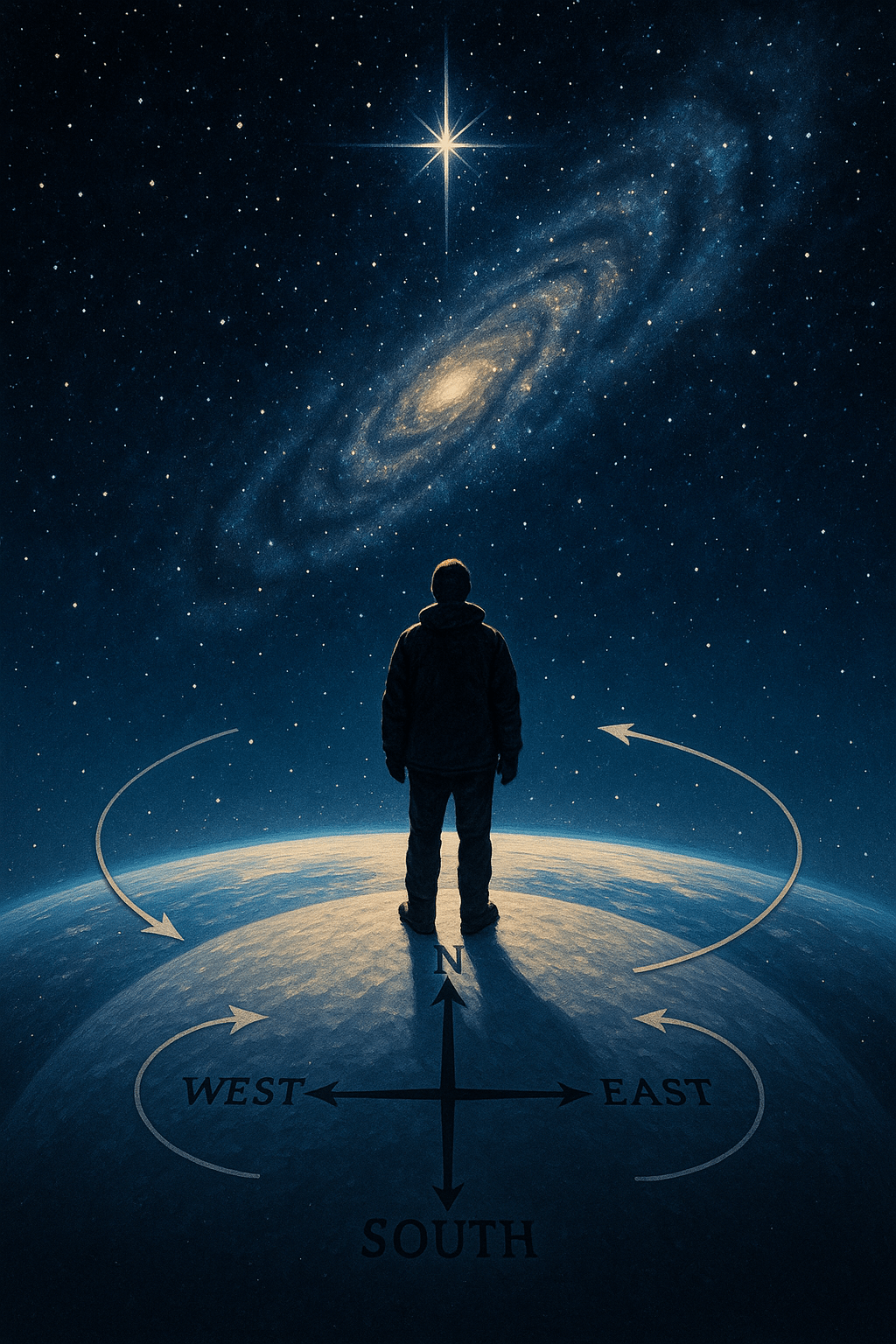
At the very top of the world, if one were to sit in silence at the North Pole, something curious happens. The compass loses its ordinary song. North, so long held as our guide, vanishes beneath your feet. South radiates in every direction. East and West dissolve—not into chaos, but into the poetry of motion. Clockwise becomes East, counterclockwise becomes West. And you, the still point, are held at the axis where meaning begins to soften.
This is not just a geographic curiosity. It is a mirror of the mind.
In the Dzogchen tradition, we are invited to rest not merely in the knowing mind (sems), but in that which knows mind itself—sems nyid, the nature of mind. It is not something we manufacture through effort, nor something distant to be attained. It is nearer than near, always already present—like Polaris in the night sky, unmoving, while all else revolves.
To sit at the North Pole and gaze upward is to dwell at a kind of worldly axis mundi, a symbol of rigpa, the primordial knowing that does not grasp, does not fabricate. From this point, every direction—every thought, every emotion, every arising—moves outward as “South”: the play of relative reality (kun rdzob), full of beauty, full of sorrow, full of form. But the upward gaze, the still recognition of what-is, lifts us toward don dam, the ultimate view.
It is not about choosing one over the other. Dzogchen does not ask us to abandon the world or reject the compass. Rather, it invites us to see clearly—to understand that East and West only appear when we begin to walk. That what we call “direction” arises with perception. That what we call “self” arises with identification. And when we rest, utterly still, not pushing, not naming—we begin to recognize what has always been there.
The pristine mind
Pure like the Pole Star. Silent like the snow. Empty of essence, yet luminous with love.
Here, the relative view—the dance of thoughts and roles and rotating worlds—becomes the compassionate display of awareness itself. And the absolute view is not elsewhere. It is this, ungrasped, unspoiled, ever-present.
The moment we stop insisting on where we are going, we arrive.
And from that still place, compassion flows—not as a moral stance, but as a natural warmth. Wisdom arises—not as accumulation, but as clarity. Loving-kindness becomes the language of space itself. We begin to see, not through the eyes of effort, but through the vision of what the Tibetans call lhun grub: spontaneously present, effortless, free.
Let us walk, then, not to reach a place, but to circle gently like the sun, like the stars, around the stillness at the center. Let us live our days as if the compass rose were etched in light upon our hearts. Let us love without needing direction, forgive without needing map.
At Earth’s bright peak where compass spins,
“Up” becomes where silence begins.
Polaris keeps her vigil there—
a lantern hung in starry air.
And you, dear traveler, have never been far from it.
Even now, it calls you home.
🙏🕊🙏
 Home Page: Inspirations of Love and Hope
Feel free to leave a comment below.