As we navigate the challenges of Chronic Fatigue Syndrome (CFS), we often seek methods to enhance our well-being and support our bodies in finding balance. Recently, I’ve begun experimenting with sound therapy, specifically focusing on the frequency of 261.63 Hz, associated with the note C4 (middle C). My intention is not to find a cure—rather, I’m exploring ways to promote relaxation and stimulate the parasympathetic nervous system, which can often feel elusive for those of us living with CFS.
I’m eager to hear from others in our community who have tried sound therapy or similar practices. What has your experience been like? Have you found any particular sounds or techniques helpful?
The Benefits of Sound Therapy
Sound therapy has been studied for its potential benefits in promoting relaxation, reducing stress, and enhancing overall well-being. Research indicates that sound can influence the autonomic nervous system, helping to activate the parasympathetic response, which is crucial for healing and recovery.
• Relaxation Response: Exposure to soothing sounds, like those produced in sound therapy, can lower heart rate, reduce blood pressure, and promote a state of calm. • Stress Reduction: Studies have shown that listening to calming frequencies can significantly reduce levels of cortisol, the stress hormone, thus alleviating anxiety and promoting a sense of peace. • Improved Sleep: Sound therapy can enhance sleep quality by creating a tranquil environment, allowing the body to enter restorative sleep states more easily.
Incorporating Sound Therapy into Daily Life
Here are some ways to integrate sound therapy into your daily routine:
Listening Sessions: Consider setting aside time each day to listen to your chosen frequency. You can use headphones or speakers to create an immersive experience.
Meditation and Mindfulness: Incorporate sound into your meditation practice by focusing on the sound while breathing deeply. Allow the vibrations to fill your awareness.
Personal Soundtrack: Use apps that allow you to customize your experience. I personally enjoy using an app that provides a variety of frequencies and waveforms, including the sine wave, which I find particularly soothing.
Background Ambience: Let the sound play gently in the background while you work, relax, or engage in other activities to create a calming atmosphere throughout the day.
Choosing 261.63 Hz and the Sine Wave
I specifically chose the frequency of 261.63 Hz for its calming and harmonizing properties, often associated with the note C4 (middle C). This frequency resonates well with the heart chakra, promoting feelings of love, compassion, and emotional balance, which can be particularly beneficial for those of us dealing with the emotional toll of CFS. Additionally, I favor the sine wave waveform for its pure, smooth tone that creates a gentle and soothing auditory experience. The sine wave’s simplicity and lack of harsh overtones allow for deep relaxation, making it an excellent choice for meditation and sound therapy. By immersing myself in this frequency and waveform, I hope to support my journey toward greater relaxation, emotional healing, and overall well-being.
Conclusion
As we share our experiences and insights, I hope to foster a conversation around sound therapy as a supportive tool for managing CFS. Your feedback and stories are invaluable as we explore these practices together.
If you’re interested in trying sound therapy, I encourage you to check out the app I’m using but I found on the Google play store called, “Frequency Sound Generator” which offers a customizable frequencies and waveforms tailored to your needs and desires..
Let’s continue this journey together, supporting one another as we seek out new ways to enhance our well-being.
There is something about preparing for a storm that feels like a dance with the Divine—both a surrender and a determined act of mindfulness. As I sit here in the quiet hours before evacuation, I realize that this has been more than just a physical process of gathering what I need. It has been an intimate spiritual journey, one that stretches my capacity to trust, to let go, and to deepen into the lived experience of the present moment.
Living with chronic fatigue syndrome (CFS) means that every action I take must be intentional. Every task requires careful pacing, every moment of activity balanced with long periods of rest. There is a delicate art to navigating this kind of preparation, especially during a post-exertional malaise (PEM) crash. Yet, somehow, this storm has become a mirror—reflecting back the inner landscape of my spiritual practice, calling me into a deeper relationship with contemplation, with surrender, and with faith.
The Importance of Pacing I began the preparations by gathering what I would take with me: clothes, medications, bedding, and electronics—just enough to fill a small suitcase and backpack. For most, this might seem like a simple task. For me, it was an act of delicate pacing. I worked in small bursts, then returned to rest, mindful of the balance I needed to maintain in order to avoid worsening my symptoms. Each step of preparation became a meditation on pacing, on honoring the limitations of my body while trusting in my ability to persevere.
In these moments of rest, I found myself returning again and again to the practice of contemplation. I lit a candle, not only for myself but for all those who are suffering—for all sentient beings in the path of this storm and beyond. There is a peace that arises in this kind of surrender. A quiet knowing that, no matter how much preparation is done, the outcome rests in God’s hands. And that, somehow, is enough.
A Shift from Meditation to Contemplation This journey has been more than just practical preparation. It has been a spiritual unfolding. For years, I have studied the teachings of Advaita Vedanta and Dzogchen, exploring the ways in which these paths guide us beyond intellectual understanding and into a direct experience of the Divine. In the midst of preparing for this hurricane, I felt a deepening—a shift from meditation to contemplation.
Contemplation is not about thinking or striving. It is about resting in the space of the witness, in the awareness of what is, without grasping or resisting. As the storm approaches, I find myself leaning more into this practice. Each moment becomes an invitation to let go of control, to allow the Divine to move through me, and to trust that whatever happens, it is part of a greater unfolding.
Mindful Eating and Body Awareness Even the simple act of eating became a mindful practice. I prepared a spontaneous meal—scrambled eggs with garlic and cayenne, rich in healthy fats and protein to fuel me through the day. As I ate, I focused on each bite, slowing down, tasting, being fully present with the nourishment my body needed.
In the midst of so much uncertainty, these small acts of mindfulness brought me back to center. They reminded me that, even as the world outside seemed to spin with chaos, I could find peace within the present moment. I could honor my body’s needs, even as I prepared to enter an unfamiliar shelter and face whatever lay ahead.
Pacing the Preparation of the RV As I packed my belongings, I also prepared my RV, the place I call home. I moved slowly, bringing frozen food to the clubhouse, unplugging the RV, securing what needed to be secured. I paced myself, taking each step with intention, aware that my energy was limited and precious.
There is something sacred about these practical tasks, when approached with mindfulness. They become a part of the spiritual practice, a way of aligning the outer world with the inner. In unplugging the RV, I was also unplugging from the need to control. In securing my belongings, I was also securing my faith—trusting that whatever happens, I am held by something greater than myself.
Karma Yoga: Offering and Receiving Prayers During this time, I also turned to the practice of Karma Yoga—offering prayers for the world, while asking for prayers in return. I posted a prayer request on Facebook, asking my community to hold me, and all those in the storm’s path, in their hearts. The response was overwhelming. The outpouring of love, of people offering their prayers and well wishes, became a source of strength for me. It reminded me that, even in times of uncertainty, we are never alone. We are held by the compassion of others, by the grace of the Divine, by the interconnectedness of all life.
Surrender and Trust And so, I surrender. I surrender to whatever will be, knowing that I have done all I can to prepare—both physically and spiritually. I surrender to the wisdom of the Divine, trusting that, in the midst of this storm, there is a deeper unfolding happening. There is a lesson in the letting go, in the release of control, in the peace that comes from trusting that God’s will is always unfolding in ways that we may not understand, but can still embrace.
To those who read this, who are also navigating life with chronic fatigue syndrome or facing similar challenges, I hope this reflection offers you some sense of peace. We cannot always control the storms that come our way, but we can choose how we prepare, how we respond, and how we anchor ourselves in the presence of the Divine.
May you be safe. May you be held. May you find peace in the midst of the storm.
Reminder: If reading this post becomes tiring, remembert to pause and rest. Pacing applies to all activities, even the ones we love, like reading and learning. Come back to this post later if you need to. Practicing pacing, even in small moments, is an essential part of living well with chronic fatigue syndrome.
Introduction
There’s a rhythm to living with chronic fatigue syndrome (CFS), one that demands a delicate balance of energy. Most of us who live with this condition become intimately familiar with pacing—learning how to manage our energy, smoothing out the hills and valleys of our strength. Through pacing, I’ve learned to minimize the crashes that come when I push myself too far. But even with this practice, there are moments when I consciously decide to overdo it.
Sometimes, there’s a powerful desire to break out of the limits that CFS imposes. It’s a rebellion, a brief escape. I know when I’m pushing too far, but I choose to embrace life fully for a day or two. I let myself feel that temporary energy, even though I know I’ll crash later. It’s a conscious decision to say, “I’m going to enjoy this moment, and I’m willing to pay the price.”
For anyone with CFS, this might sound familiar. We know pacing is vital to managing our condition, but there are times when the joy of overdoing it feels worth the consequences. And yet, when the crash comes—and it always does—the body demands recovery. This is where the real work begins, not just physically, but mentally and emotionally.
The Second Arrow: Witnessing the Mind’s Reactions
When I crash, the body does what it needs to do to heal, and I’m forced to stop. But I’ve learned over time that what really intensifies suffering isn’t just the crash itself—it’s the mental and emotional turmoil that can follow. This is where the teachings of vrittis and pratyayas have been so transformative for me.
In simple terms, vrittis are the fluctuations of the mind—the rising and falling thoughts and emotions. Pratyayas are the seeds that drive these mental fluctuations, often based on past experiences, memories, or attachments. Together, these create the mental chatter that, when left unchecked, can deepen the suffering of any crash.
Buddhist teachings describe this extra layer of suffering as the “second arrow.” The first arrow is the unavoidable pain—whether physical, emotional, or otherwise. But the second arrow is the mental suffering we add on top of that pain: the self-criticism, the frustration, the inner dialogue that says, “Why did I overdo it? I knew better.” This second arrow is where much of the suffering lies.
But by the yogic practice of witnessing the vrittis and pratyayas, I’ve learned to avoid that second arrow. I observe the mental fluctuations as they come and go, without attaching to them, without allowing them to define my experience. I become the seer—the witness—and in doing so, I find that even during a crash, there is peace to be found.
Pacing and the Conscious Decision to Overdo It
Pacing remains the cornerstone of managing chronic fatigue syndrome. It’s about knowing your limits and respecting them, smoothing out the ups and downs of energy. But what happens when pacing fails? What happens when you make the conscious decision to overdo it, knowing full well that you’ll pay for it later?
For me, the key has been integrating this practice of witnessing into every stage of the process. I allow myself to live fully in those moments of overindulgence, embracing the joy of activity and connection, knowing that a crash will follow. But when the crash comes, I don’t add layers of mental suffering by blaming myself. Instead, I use the crash as an opportunity to practice witnessing—the vrittis and pratyayas are just thoughts and mental patterns, not realities. By observing them, I stay free of the second arrow.
This approach allows me to live with chronic fatigue syndrome in a way that feels less restrictive. Yes, I pace myself. Yes, I’m mindful of my energy. But even when I choose to push past those limits, I know that I can find peace in the aftermath through this practice.
The Impulse to Finish, the Practice of Letting Go
As I write this post, I feel the strong desire to finish it, to post it immediately so that it can be available to those who may benefit from it. It’s an impulse I recognize well—a pratyaya, a desire that drives me to push beyond my limits, even when I know it’s not in my best interest.
But just as I practice witnessing during a crash, I also practice witnessing this impulse. I see it for what it is—just a thought, just Mara, just another fluctuation of the mind. I don’t have to follow it. I don’t have to act on it. Instead, I can pause, rest, and come back to this post when my body is ready.
In the same way, I encourage you, as a reader, to pace yourself. This post is long, and if you find yourself feeling tired, take a break. Reading is an activity that requires energy, and pacing applies here, too. Come back to it later if you need to. Take care of your energy, just as I am doing with mine.
A Soft Rebellion, a Path to Growth
There is something liberating about the moments when we choose to overdo it, to embrace life fully despite knowing we’ll crash later. It’s a soft rebellion, a decision to live in the moment, even when we know the consequences. But with the right mindset, even those crashes can become opportunities for growth and practice.
The teachings of witnessing the vrittis and pratyayas have shown me that even the difficult moments—the crashes, relapses, pain, dysfunction, and discomfort of those moments, days, or weeks of low energy—are fertile ground for inner growth. By avoiding the second arrow, and simply observing my mind without attaching to the fluctuations, I can find peace even in the midst of discomfort.
For anyone living with chronic fatigue syndrome, I hope this reflection offers some comfort and guidance. There is no perfect way to navigate this condition, but there are practices that can help us find peace, even in the most challenging times. Whether it’s through pacing, or through the practice of witnessing, or simply by being gentle with ourselves, especially in moments of overdoing it, we can find a way to live with greater ease and acceptance.
Take your time, pace yourself, and remember that every crash, every moment of overdoing it, is a new opportunity to practice and grow. We are all on this path together, and in that, there is a kind of peace.
Facing the Storm: An Urgent Reminder to Pace and Witness
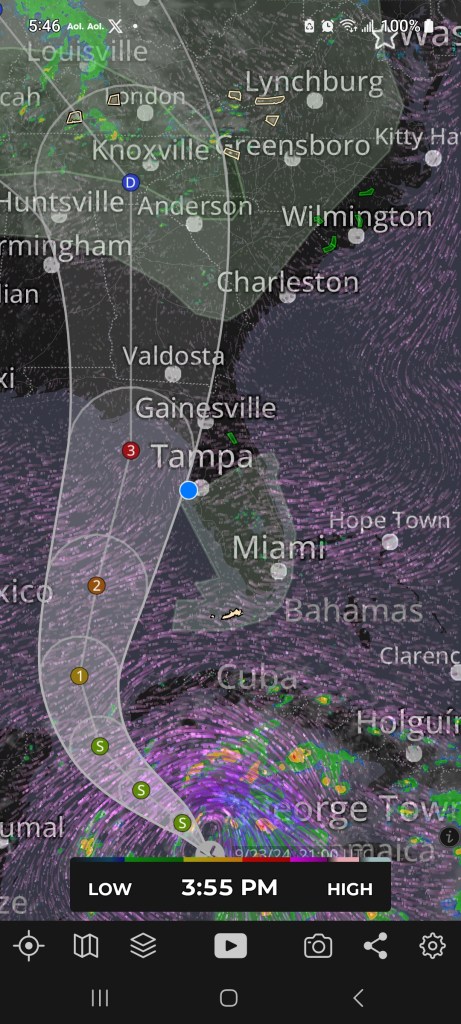
As I write this, there is a real storm brewing, both within and without. The image below is a weather map of the hurricane that may soon hit my area, forcing me to evacuate. As someone living in an RV, evacuation is usually mandatory in situations like this, and so I find myself facing the possibility of having to leave my bed in the middle of a crash caused by overdoing it.
The threat is very real, and so the importance of pacing is now at a level that I can’t ignore. I must prioritize rest and recovery immediately, because no matter what state I’m in, I’ll have to get out of bed and go to the hurricane shelter at the church next door if an evacuation order comes.
This situation has made it even clearer to me how crucial the practice of witnessing vrittis and pratyayas is. Without that practice, I would be overwhelmed by anxiety and fear right now. The mind wants to run wild with worst-case scenarios and worries, but I have been training myself to simply witness these thoughts as they arise. They are just thoughts—just mental fluctuations. They do not have to define my experience. I can stay present, calm, and clear, ready to deal with whatever comes.
So, after I finish writing this post, I’m going into massive rest and be prepared mode. The practice of pacing has never been more critical. This is an extreme red-flag situation, and I hope it serves as a reminder to all of us with chronic fatigue syndrome: sometimes, the urgency of rest is not just about avoiding a crash; it’s about survival.
Take a look at the image below—it’s a reminder to me, and hopefully to you as well, that life can throw storms at us both literally and metaphorically. But with the right practices, we can remain centered and grounded, ready to face what comes with a steady mind and a rested body.
As we face the storms within and around us, may we find peace in the stillness of our hearts. May all beings be free from suffering and the causes of suffering. May all beings experience happiness and the causes of happiness. May we all find safety, strength, and well-being on our journeys, no matter how turbulent the path. May we be guided by wisdom, anchored in compassion, and find harmony in the unfolding of each moment. And in these times of uncertainty, may we remember our interconnectedness, and may we all be held in grace and peace.
Reflections on Chronic Fatigue Syndrome aka ME/CFS
Solitude and the Key In silence, I find a refuge from the chaos of my mind. In the tender embrace of the night, I travel inward for comfort and grace.
Chronic fatigue, my silent companion, taught me the art of patient resignation. In the depths of silence I carefully kept my key, where I repaired. Like a phoenix rising from the ashes of doubt, I embrace the night without shouting.
For in the embrace of solitude I discern the lessons of the soul and long to learn them. In this quiet refuge, I find strength again, and my spirit is full.
With every gentle breath and careful sigh, I recapture my light beneath the sky. So I rest in my lonely cocoon, gathering spoons by moonlight. Learning to dance with shadow and light, embracing the journey, embracing the night.
Finding Solace in Solitude: A Poem for Our ME/CFS Journey
In the quiet of solitude, I find, A refuge from the chaos of the mind. Amidst the dark night’s gentle embrace, I journey inward, seeking solace and grace.
Chronic Fatigue, my silent companion, Teaches me the art of patient abandon. To conserve my spoons with mindful care, In the depths of stillness, I repair.
Like a phoenix rising from ashes of doubt, I embrace the dark night, without a shout. For in solitude’s embrace, I discern, The lessons of the soul, I eagerly learn.
In this sacred space of quiet retreat, I find strength anew, my spirit replete. With each tender breath and mindful sigh, I reclaim my light beneath the sky.
So here I rest, in solitude’s cocoon, Gathering spoons beneath the silver moon. Learning to dance with shadows and light, Embracing the journey, embracing the night.
In the tapestry of time, woven with threads of understanding, empathy, and love, I extend my hand to you, a fellow traveler in the realm of chronic fatigue syndrome. It’s not just a condition; it’s a journey, a complex dance with our bodies and minds. You are not a hypochondriac; you are a warrior navigating the intricate landscape of your own existence.
Having walked the same path, I resonate with the words, “After a lifetime of living with chronic fatigue syndrome, you’d think I’d be better at it now.” Each day, a new chapter unfolds, revealing the resilience within us. It’s not about perfection or mastery; it’s about learning, adapting, and discovering the strength that resides within, often unnoticed.
Embrace the wisdom your journey has bestowed upon you. You’ve acquired an intimate knowledge of your body and mind, a profound understanding that defies the misconceptions others may hold. You are not defined by the fatigue that courses through your veins; you are defined by the courage with which you face each day.
In this shared experience, let love be the balm that soothes the weariness, understanding the salve that heals the wounds unseen. As you unravel the layers of your existence, remember that every nuance of your journey contributes to the masterpiece of who you are.
Encourage yourself to practice self-compassion daily. Recognize the victories, no matter how small, and celebrate the resilience that continues to blossom within. You are not alone in this intricate dance; we move together, step by step, navigating the ebb and flow of chronic fatigue syndrome.
May your days be adorned with moments of understanding, empathy, and love – the pillars that support you on this remarkable journey.
May your journey continue to be filled with peace, wisdom, and compassion. 🙏
May we all embrace our journey with a compassionate and open heart, finding solace in the present moment on our path with ME/CFS.