Tag: Spiritual Awakening

  • Book Review: Forty Verses on Reality by Ramana Maharshi

    Ramana Maharshi, one of the most revered spiritual teachers of modern times, has left an indelible mark on the landscape of non-dual philosophy. Among his profound contributions is a text known as the “Forty Verses on Reality”, or “Ulladu Narpadu”, originally composed in Tamil. These verses are a deep exploration of the nature of existence and the true Self, offering guidance on the direct path to self-realization.

    The “Forty Verses on Reality” are not just poetic expressions but are a concise roadmap to understanding the essence of the Self, as taught by Ramana Maharshi. They delve into the illusion of the ego, the ultimate reality of non-dual existence, and the importance of self-inquiry as the path to realizing one’s true nature.

    In these verses, Ramana Maharshi addresses the central theme of his teachings: the illusion of the ego. He emphasizes that the sense of ‘I’—which we often associate with our thoughts, emotions, and bodily identity—is not the true Self. This ego, or false sense of individuality, creates a veil that obscures the unchanging, eternal reality that is the Self.

    Ramana encourages seekers to engage in self-inquiry, particularly through the practice of asking “Who am I?” This simple yet profound question is designed to lead one back to the source of the ‘I’ thought, tracing it to its origin in pure consciousness. It is in this inquiry that the mind begins to dissolve into the deeper awareness, where the illusory nature of the ego is revealed, and the true Self is recognized.

    The essence of these verses is the understanding that the Self is the only reality, and everything else is transient, merely an appearance in the vast expanse of consciousness. Ramana’s teaching points to the realization that the Self is beyond all dualities, beyond subject and object, beyond mind and matter. The Self is the underlying reality, the substratum upon which all experiences arise and subside.

    For those who are new to Ramana Maharshi’s teachings, the “Forty Verses on Reality” serve as a gateway to understanding his approach to non-duality and the path of self-inquiry. Each verse offers a unique insight into the nature of existence, gently guiding the reader toward a direct experience of the Self.

    Consider, for example, the first verse, where Ramana states: “If Reality did not exist, could there be any knowledge of existence? Free from all thoughts, Reality abides in the Heart, the Source of all thoughts. It is, therefore, called the Heart. How then is one to contemplate It? To be as It is in the Heart, is Its contemplation.” Here, he points to the central truth that Reality—our true nature—is beyond thought and can only be known by abiding as the Self in the Heart, the source of all thoughts.

    Or take verse twenty, where he asks: “By what light do you see? If you say ‘by the light of the sun,’ the moon, etc., then by what light do you see these lights? The light of the eye makes all these lights visible. But the mind makes the eyes shine. The ultimate source of all lights is the Self.” This verse illustrates the idea that all forms of perception ultimately point back to the Self, the pure awareness that illuminates all experiences.

    Perhaps one of the most poignant verses is verse twenty-six: “The body does not say ‘I’. The Self does not say ‘I’. Between the two, something arises, saying ‘I’. This phantom is the ego. Find out where from this arises. Then everything will subside into the Self.” Ramana succinctly captures the essence of self-inquiry here, pointing to the ego as a phantom that dissolves when one traces it back to its origin.

    The “Forty Verses on Reality” provide a rich tapestry of wisdom that can lead seekers to a direct realization of their true nature. These verses are a testament to Ramana Maharshi’s profound understanding of the non-dual reality and offer a timeless guide for those on the spiritual path.

    If you are inspired to delve deeper into these teachings, I encourage you to seek out a complete edition of these verses, where you can explore them in their entirety. Their depth and simplicity offer a powerful tool for self-inquiry and spiritual awakening.

    🙏🕊️🙏

    Richard Clarke’s version of the “Forty Verses on Reality” is a concise and accessible entry point into Ramana Maharshi’s teachings. Spanning just 78 pages, this edition focuses on presenting the verses in a clear and straightforward manner, making it an excellent choice for those who are new to self-inquiry and non-duality. Clarke’s approach is to let the power of Ramana’s words speak for themselves, offering readers a direct and undiluted experience of the teachings.

    The version introduced by Michael James and authored by Sandra Derksen provides an in-depth exploration of the “Forty Verses on Reality”, expanding the text to 422 pages with extensive commentary and analysis. This edition delves deeply into each verse, unpacking the layers of meaning and offering a comprehensive understanding of Ramana Maharshi’s philosophy. Ideal for serious students and those with a deep interest in Advaita Vedanta, this book offers a richly detailed interpretation that guides the reader through the nuances of self-inquiry and non-dual realization.

  • Caravan of Love: The Universal Path of Righteousness Across All Traditions

    In the vast tapestry of world religions, certain values transcend cultural and doctrinal differences, weaving together a shared vision of what it means to live a righteous and compassionate life. These values—purity, righteousness, kindness, forgiveness, and compassion—are cornerstones of what many traditions aspire to cultivate in their followers. Whether it’s the Sadhu Dharma in Hinduism, the concept of Tzaddikim in Judaism, or the pursuit of being a Mensch, these ideals serve as beacons of light in our shared human journey.

    Sadhu Dharma, the path of the holy person, is a life dedicated to truth, simplicity, and non-attachment. The Sadhus, through their renunciation and ascetic practices, embody a life that seeks to transcend the material and focus entirely on the spiritual. Their lives are marked by a commitment to Dharma—righteousness and moral order—a principle that resonates deeply in Hindu philosophy. This dedication to purity of mind and heart is not just about personal enlightenment but about embodying virtues that uplift society as a whole.

    In Judaism, the concept of Tzaddikim refers to the righteous ones, those whose lives are marked by a deep commitment to justice, kindness, and integrity. The Tzaddik, much like the Sadhu, is someone who has dedicated their life to the service of others and to the fulfillment of divine commandments. They are seen as pillars of the world, their righteousness serving as a foundation for the spiritual and moral health of the community.

    Similarly, the idea of being a Mensch, which in Yiddish refers to a person of integrity and honor, is highly valued in Jewish culture. A Mensch is someone who embodies the values of kindness, responsibility, and decency in their daily life. This concept, though rooted in Jewish tradition, has universal appeal, as it speaks to the importance of living a life that others can look up to and respect.

    In Christianity, the teachings of Jesus Christ offer a profound example of a life dedicated to love, compassion, and forgiveness. Jesus’s Sermon on the Mount is a timeless guide to living a life of righteousness. His call to love one’s neighbor as oneself, to forgive endlessly, and to seek peace in all things, aligns beautifully with the teachings of Sadhu Dharma and the principles of Tzaddikim. Jesus’s life is a testament to the power of living with an open heart, free from the shackles of anger, greed, and judgment.

    Islam also emphasizes the importance of righteousness and moral conduct. The Quran and Hadith provide guidance on how to live a life that is pleasing to God, through acts of charity, honesty, and justice. The concept of Taqwa, often translated as God-consciousness or piety, encourages Muslims to live in constant awareness of God’s presence, guiding them to act with integrity and compassion. The Prophet Muhammad’s life is filled with examples of humility, kindness, and dedication to the welfare of others, setting a high standard for ethical conduct.

    Buddhism, with its emphasis on the Noble Eightfold Path, also encourages a life of right conduct, right speech, and right livelihood. The Buddha’s teachings on compassion (Karuna) and loving-kindness (Metta) offer a path to purifying one’s mind and living in harmony with others. The simplicity of the Buddha’s advice to “Be good, do good, purify your mind” resonates across all these traditions, offering a succinct summary of the universal path to spiritual awakening.

    Despite the diversity of religious expressions, these examples highlight a shared commitment to cultivating a life of virtue. Whether it’s through the renunciation of a Sadhu, the righteousness of a Tzaddik, the integrity of a Mensch, the compassion of Christ, the piety of a Muslim, or the mindfulness of a Buddhist, the underlying message is clear: to live a life that reflects the highest values of humanity.

    In today’s world, where division and discord often seem to dominate the narrative, these teachings remind us of the importance of unity and the power of virtue. They encourage us to rise above our differences and to see in each other the same divine spark that guides our own path. By embracing these universal principles, we contribute to a more harmonious and compassionate world—a world where peace and righteousness are not just ideals but lived realities.

    As we continue our journey through the sacred stories and teachings of various traditions, may we carry these lessons with us, allowing them to shape our actions and our hearts. In doing so, we honor the diversity of spiritual paths while recognizing the common ground that unites us all.

    🙏🕊️🙏

  • Exploring the Origins of Thought: A Synthesis of Jung, Ramana Maharshi, Kabbalah, and Tibetan Buddhism

    In our journey to understand the nature of thoughts and the Self, we find ourselves drawing from the wisdom of various traditions—Jungian psychology, Vedanta as taught by Ramana Maharshi, the mystical insights of Kabbalah, and the profound teachings of Tibetan Buddhism. These perspectives, though rooted in different cultural and philosophical backgrounds, converge in fascinating ways, offering a profound understanding of where thoughts come from and where they go.

    The Self: A Jungian Perspective

    Carl Jung’s concept of the Self is expansive, encompassing both the conscious and unconscious aspects of the psyche. In Jungian thought, the Self is not just the sum of our conscious awareness but also includes the vast, often hidden, realm of the unconscious. Yet, Jung’s Self goes even further—it includes the totality of our being, which can be seen as connected to the divine. In this view, the Self is also God, the Infinite, the Eternal—encompassing everything, with nothing excluded.

    Ein Sof and the Infinite Source

    In Kabbalistic tradition, this concept of the Infinite is referred to as Ein Sof, meaning “without end.” Ein Sof represents the boundless, formless aspect of God, from which all creation emerges. It is the source of all existence, the primordial void from which thoughts and realities arise.

    When we combine this with Jung’s understanding, we see that thoughts can be considered as arising from Ein Sof—the infinite potential. They emerge from the stillness, the formless void, moving first into the unconscious mind. From there, they bubble up into conscious awareness, manifesting in a way that we can perceive and reflect upon.

    The Vedantic View: Ramana Maharshi on the Self

    Ramana Maharshi’s teachings on the Self resonate deeply with these ideas. He teaches that the true Self is pure awareness, beyond both the conscious and unconscious mind. The thoughts that arise within us, whether they seem to come from the unconscious or are immediately conscious, are all manifestations within this pure awareness.

    In Ramana’s framework, the conscious mind and the unconscious mind are both part of the egoic self—the sense of individual identity that is ultimately an illusion. However, by engaging in self-inquiry, we can trace our thoughts back to their true origin—the pure, infinite awareness that Ramana equates with the Self or Atman. This is the same awareness that Jung might refer to as the totality of the Self, and that Kabbalists understand as arising from Ein Sof.

    The Tibetan Buddhist Perspective: All Phenomena as Ornaments of the Dharmakaya

    Tibetan Buddhism offers a similar understanding but expresses it through the rich metaphor of the Dharmakaya, the truth body of the Buddha. According to these teachings, everything that arises—every thought, every perception, every experience—is an ornament of the Dharmakaya. This means that all phenomena are expressions of the ultimate reality, which is pure, unconditioned awareness or Buddha nature.

    There is a common saying in Tibetan Buddhism: “All phenomena are the ornaments of the Dharmakaya,” or “All sound is the sound of Dharma; all sight is the display of Dharma.” This view suggests that everything we perceive, everything we experience, is not separate from the ultimate reality but is a manifestation of it. Just as thoughts arise from and dissolve back into Ein Sof or the Self, in Tibetan Buddhism, they are seen as temporary displays of the Dharmakaya, arising from the vastness of Buddha nature.

    Buddha’s Enlightenment: Recognizing Mara as the Self

    This understanding is beautifully illustrated in the story of Buddha’s enlightenment under the Bodhi tree. As Siddhartha Gautama sat in deep meditation, Mara—the personification of illusion and desire—appeared to tempt him and distract him from his path to enlightenment. Mara represented all the fears, desires, and illusions that arise within the mind.

    However, instead of engaging with Mara as an external force, the Buddha recognized that Mara was not separate from himself. He famously said to Mara, “I know you. You are a creation of my own mind.” In that moment, by recognizing that Mara was merely a projection of his own thoughts, the Buddha disempowered Mara completely. Mara dissolved, and with that, Siddhartha Gautama achieved enlightenment, becoming the Buddha.

    This moment is a powerful example of self-realization. By recognizing that thoughts, desires, and fears are not external realities but manifestations of the mind, the Buddha transcended them. In the same way, we can see that our thoughts, no matter how powerful they may seem, arise from and dissolve back into the infinite Self, the ultimate reality.

    The Quantum Nature of Thought

    In many ways, this understanding is mirrored in the discoveries of quantum physics. Particles, which seem solid and real, are actually 99.99% empty space. They appear and disappear from the quantum field so rapidly that they seem solid and continuous, much like how thoughts arise and dissolve within our consciousness. The solidity of our thoughts—or indeed our reality—is an illusion, a fleeting manifestation from the infinite potential that is the true Self.

    Practical Application: Self-Inquiry and Meditation

    Understanding thoughts as arising from Ein Sof or as ornaments of the Dharmakaya, and recognizing them as internal projections like Mara, can profoundly inform our practice of self-inquiry and meditation. When a thought arises, we can trace it back, not just through the layers of consciousness and unconsciousness but beyond, into the infinite source. This practice can help us see the impermanence and illusory nature of thoughts and, by extension, of the ego itself.

    Through this inquiry, we can begin to experience the Self not just as a concept but as a living reality—the infinite awareness from which all arises and to which all returns.

    Conclusion

    This synthesis of Jungian psychology, Ramana Maharshi’s Vedanta, Kabbalistic mysticism, Tibetan Buddhism, and the story of Buddha’s enlightenment offers a rich, multifaceted understanding of the nature of thought and the Self. It invites us to see beyond the surface of our thoughts and experiences, recognizing them as temporary manifestations of the infinite. Whether through self-inquiry, meditation, or contemplation of these ideas, we are invited to explore the deeper reality of the Self—an exploration that can lead to profound spiritual awakening and insight.

    🙏🕊️🙏

  • Neti Neti Series No. 1: Embracing the Practice of “Not This, Not This

    Question:

    How should I approach the practice of “Neti Neti” and what can I expect as I continue with it?


    Dear friend,

    “Neti Neti” is a path that is both ancient and profound, one that requires patience, a quiet heart, and a gentle perseverance. I’d like to share with you some thoughts and reflections that may guide you as you journey further into this sacred practice.

    The phrase “Neti Neti” translates simply as “not this, not this.” It is a mantra, yes, but it is also much more than that—it is a doorway to the understanding what lies beyond the confines of our ordinary thoughts and perceptions. When we repeat “Neti Neti,” we are not merely uttering words; we are engaging in a process of negation that strips away the layers of illusion and false identification, leading us closer to the core of our being.

    You may find that as you begin your practice, thoughts arise incessantly, like waves upon the shore. This is natural, my friend, and there is no need for concern. The mind, after all, is accustomed to constant movement. But as you sit in stillness and repeat “Neti Neti,” you are training your awareness to recognize that these thoughts—however persistent they may seem—are not who you are.

    In those moments when the mind is quiet, even for a brief instant, you may feel a sense of peace, a spaciousness that is untouched by the comings and goings of thoughts and emotions. This is the silence in which your true self resides. When you touch this silence, allow yourself to rest in it. Do not seek to hold on to it too tightly, for it is like a delicate breeze—best experienced by simply being present with it.

    And yet, if thoughts begin to stir again—and they often will—there is no need to worry or to chastise yourself. Simply return to the mantra, “Neti Neti,” with the understanding that what you are negating is not just the thought itself, but the identification with it. Each time you say “not this,” you are affirming that your true self is not these fleeting mental activities but something much deeper and more enduring.

    As you continue with this practice, you may begin to notice subtle changes in your inner landscape. The mind, once so restless, may start to settle more easily. You may find that the gaps between thoughts grow wider, and the stillness within you becomes more familiar, like a dear friend who visits often. This is the beginning of a profound transformation.

    In time, my friend, you may come to a place where the need to repeat the mantra diminishes, where silence and stillness are your natural state, and where the mind rests in its true home, free from the distractions that once held it captive. This is not a state to be forced or grasped at—it will come in its own time, as you continue to practice with patience and love.

    Remember, the journey of “Neti Neti” is not about eradicating thoughts or achieving some distant goal. It is about returning, again and again, to the awareness that lies beyond all concepts and forms. It is about recognizing that you are not the thoughts that arise, nor the emotions that ebb and flow. You are the awareness in which all these things occur, and this awareness is vast, infinite, and untouched by the passing of time.

    So, dear friend, as you continue with your practice, I encourage you to approach it with gentleness and an open heart. Trust in the process, even when it feels challenging. Trust in the silence that you find within, and know that this silence is the truest reflection of who you are.

    I look forward to hearing about your experiences as you deepen in this practice. May it bring you the peace and understanding that your soul seeks.

    🙏🕊️🙏

  • Patterns of Wonder: A Connection to the Cosmos

    As I gaze upon yet another crop circle formation, I am struck by the sheer complexity and precision of its design. The intricate patterns woven into the fields are more than just a visual spectacle—they are a doorway into the profound mysteries of the universe. Each curve and line seems to pulse with an energy that is both ancient and timeless, stirring within me a deep sense of amazement and awe. These formations are not merely patterns in the earth, but symbols that connect us to something far greater than ourselves. They remind us of the vastness of the cosmos and the intelligence that lies beyond our comprehension, inviting us to step into the unknown with curiosity and reverence. In these moments, I feel an undeniable connection to the mysteries that shape our existence, a connection that fills me with both wonder and a comforting assurance that we are part of a grander design. The crop circles serve as a gentle nudge from the universe, reminding us to stay open to the possibilities that lie beyond the visible, to trust in the unseen forces that guide us, and to find peace in the knowledge that we are never truly alone.


  • Who is Ramana Maharshi?

    Discovering the Self: Ramana Maharshi’s Guide to Self-Inquiry and True Realization

    Ramana Maharshi is one of the most revered spiritual teachers of the 20th century, known for his profound teachings on self-realization and non-duality. Born in 1879 in Tamil Nadu, India, he experienced a spontaneous awakening at the age of 16, during which he became acutely aware of the impermanence of the body and the eternal nature of the Self. Following this experience, he left his home and spent the rest of his life on the sacred mountain of Arunachala, where he became a guiding light for spiritual seekers from around the world.

    Ramana’s teachings are centered around the practice of Atma Vichara, or self-inquiry, which he considered the most direct path to realizing one’s true nature. Unlike other spiritual practices that involve rituals or external observances, Ramana emphasized turning inward to investigate the true nature of the ‘I’—the sense of individual self that we all experience.

    The Essence of Self-Inquiry

    Ramana Maharshi’s core teaching can be encapsulated in the question, “Who am I?” He taught that the sense of ‘I’ or ego, which we often associate with our thoughts, emotions, and bodily identity, is merely a superficial layer that veils our true Self, which is pure consciousness or awareness.

    The process of self-inquiry involves directing your attention inward, asking yourself where this sense of ‘I’ originates. Ramana explained that by persistently asking this question and observing the ‘I’ thought, one can trace it back to its source. This source is the true Self, the unchanging awareness that underlies all experience.

    If One Watches Whence the ‘I’ Arises

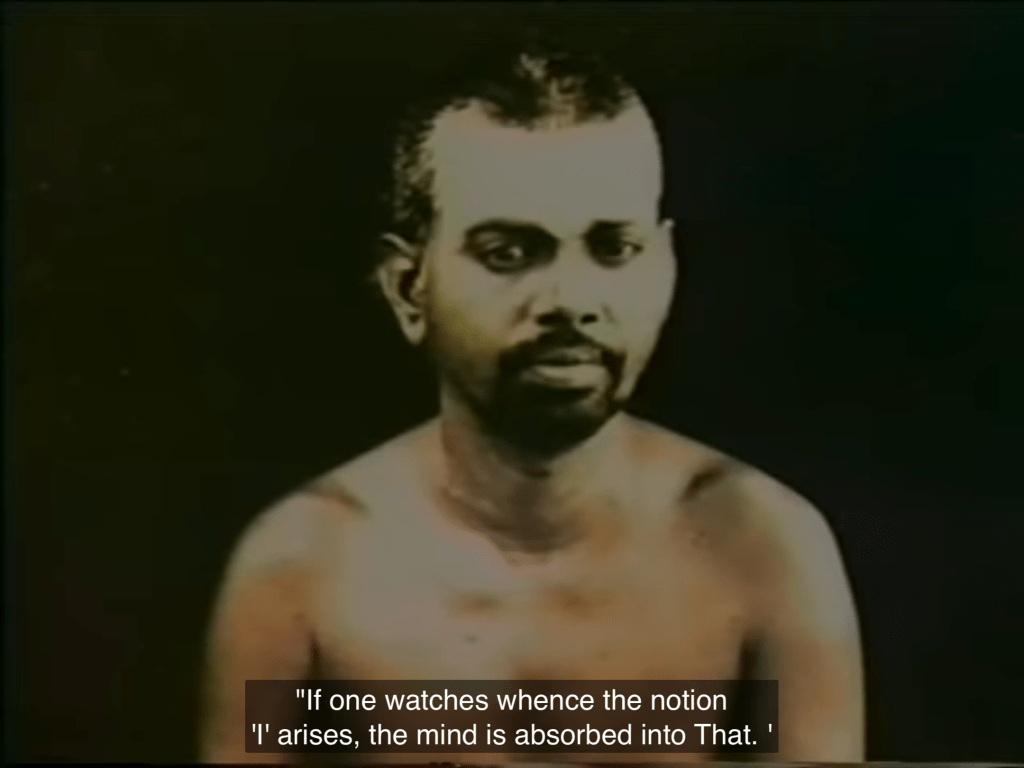
    In one of his teachings, Ramana Maharshi stated, “If one watches whence the notion ‘I’ arises, the mind is absorbed into That.” This teaching points to a subtle yet profound practice. The ‘I’ thought is the root of all mental activity and the sense of individuality. By turning attention to this root, rather than being entangled in the branches of thoughts and feelings, the mind can naturally dissolve into its source—pure awareness, which Ramana refers to as “That.”

    How to Practice Self-Inquiry

    If you find yourself puzzled by this teaching or struggle to sense “That” from which the ‘I’ arises, know that this is a common experience on the path of self-inquiry. The mind, accustomed to focusing outward, finds it challenging to turn inward and settle into stillness.

    Here’s how you can approach this practice:

    1. Sit Quietly: Begin by sitting quietly, with your eyes closed if that feels comfortable. Take a few deep breaths and allow your body and mind to relax.
    2. Turn Inward: Gently bring your attention to the sense of ‘I’. This ‘I’ could be a thought, a feeling, or simply the awareness that you exist.
    3. Ask the Question: Silently ask yourself, “Who am I?” or “Where does this ‘I’ arise from?” Don’t seek an intellectual answer. Instead, let the question be a pointer that guides your awareness inward.
    4. Observe: As you focus on the ‘I’, observe its nature. Does it have a shape, a location? Can you find its origin? Be curious, but not analytical.
    5. Rest in the Awareness: As you continue this enquiry, allow the mind to settle. If thoughts arise, simply notice them and gently bring your attention back to the feeling of ‘I’. Over time, the mind may begin to merge with the deeper awareness that is always present.

    Realizing the Self

    Through persistent practice, you may come to realize that the ‘I’ you have always identified with is not your true Self. The ‘I’ arises and dissolves in the vast expanse of pure awareness—‘That’ which Ramana Maharshi points to. This realization is not something to grasp intellectually, but a direct experience that brings about a profound inner peace and freedom.

    Ramana Maharshi’s teachings are a beacon for those seeking to transcend the ego and discover their true nature. The path of self-inquiry, though simple in its approach, can lead to the ultimate realization of the Self—the awareness that is ever-present, unchanging, and beyond all notions of individuality.

    🙏🕊️🙏

  • Book Review: The Pristine Mind: Embracing the Nature of Thoughts

    In the vast sky of our consciousness, thoughts are like clouds—ephemeral, shifting, and ever-changing. Guru Rinpoche, Padmasambhava, once said, “Your thoughts naturally occur and naturally dissipate like clouds in the sky. To see for yourself if this is true, look into your own mind.” This profound teaching invites us to directly experience the nature of our thoughts, not as obstacles or distractions but as natural occurrences that reveal the underlying clarity of the mind.

    The Nature of Thoughts: Clouds in the Sky

    Our minds are often busy, filled with an endless stream of thoughts, emotions, and sensations. These mental activities can feel overwhelming, leading us to believe that they define who we are. However, just as clouds in the sky come and go without altering the vastness of the sky itself, our thoughts are transient, arising from nothing and dissolving back into nothing.

    When we closely observe our thoughts without attachment or aversion, we begin to see their impermanent nature. Each thought, no matter how intense or insignificant, arises, lingers for a moment, and then fades away, making room for the next. This process happens naturally, without any effort on our part.

    Looking into the Mind: A Path to Clarity

    Guru Rinpoche’s instruction to “look into your own mind” is an invitation to practice mindfulness and meditation. By turning our attention inward and observing our thoughts, we can witness their natural ebb and flow. This practice does not require us to stop thinking or to eliminate thoughts; rather, it encourages us to watch them with a gentle curiosity.

    As we continue this practice, we might notice that between the thoughts, there are moments of stillness—gaps where the mind is clear and undisturbed. These gaps reveal the pristine nature of the mind, untouched by the comings and goings of thoughts. This pristine mind is our true essence, a state of pure awareness that is always present, even when we are caught up in the whirlwind of our thoughts.

    The Pristine Mind: Our True Nature

    Recognizing the impermanent nature of thoughts and the underlying clarity of the mind leads to a profound shift in our understanding of ourselves. We begin to see that we are not our thoughts; rather, we are the space in which thoughts arise and dissipate. This space, the pristine mind, is vast, boundless, and inherently peaceful.

    By resting in this awareness, we can experience a sense of freedom and spaciousness, even in the midst of life’s challenges. The more we practice, the more we realize that this pristine mind is always accessible, like the clear sky that remains unchanged regardless of the clouds that pass through it.

    Embracing the Reality of Thoughts

    Guru Rinpoche’s teaching encourages us to directly experience the nature of our thoughts, revealing the pristine mind that lies beneath. Through mindfulness and meditation, we can cultivate the ability to observe our thoughts without getting entangled in them, allowing us to rest in the clarity and peace of our true nature.

    As we deepen our understanding of this reality, we can approach life with greater equanimity and compassion, knowing that, like clouds in the sky, our thoughts naturally occur and naturally dissipate, leaving the pristine mind untouched and ever-present. Pristine mind meditation involves resting in this type of awareness, allowing us to return to our innate state of clarity, spaciousness, and inner peace.

    The Benefits of Reconnecting with the Pristine Mind

    Reconnecting with the ever-present stillness and wisdom within us through pristine mind meditation brings profound benefits to our daily lives. As we practice resting in this awareness, we begin to experience a greater sense of calm and stability. The storms of life, once overwhelming, become less daunting as we learn to view our thoughts and emotions as passing phenomena, rather than something to be feared or controlled. This inner calm allows us to navigate stress and anxiety with more ease, providing a stable foundation from which we can respond to life’s challenges.

    In addition to this newfound tranquility, our mental clarity and focus also improve. With a mind less cluttered by constant, often distracting thoughts, we can approach our daily tasks with a sharper focus and a clearer perspective. This heightened clarity not only makes us more effective in our personal and professional lives, but it also allows us to make decisions with greater confidence and insight.

    As we continue to engage with the practice of pristine mind meditation, we naturally cultivate a deeper sense of compassion and understanding toward others. Recognizing the transient nature of our own thoughts leads to a profound empathy for the shared human experience. We begin to see that others, too, are navigating their own internal landscapes, which fosters more meaningful and compassionate relationships.

    Moreover, the stillness of the pristine mind is a source of boundless wisdom and creativity. When we rest in this awareness, we open ourselves to insights and solutions that might not be accessible through ordinary thinking. This connection to our inner wisdom enriches our creative processes and allows us to approach problems with fresh perspectives, often leading to innovative solutions and deeper understanding.

    Finally, the practice of pristine mind meditation strengthens our emotional resilience. By regularly connecting with the deep-rooted stillness within us, we develop an inner strength that enables us to face difficulties with grace and composure. This resilience is born from the understanding that our true nature remains untouched by the temporary storms of life, allowing us to move through challenges with greater ease and confidence.

    Incorporating this practice into our daily lives helps us live with a sense of balance, insight, and joy, enriching our experience of life in every moment. As we reconnect with the ever-present stillness and wisdom within, we find ourselves more deeply attuned to the world around us, able to face life’s challenges with equanimity, and to embrace its beauty with an open heart.

    🙏🕊️🙏

    If you’re interested in exploring this transformative approach further, I highly recommend Orgyen Chowang’s book The Pristine Mind. His teachings provide a clear, compassionate path toward uncovering the inherent purity of our mind, offering a source of deep fulfillment and lasting peace.

  • Crop Circles: Signs of Hope and Spiritual Guardianship

    In a world often filled with uncertainty and challenges, it is easy to overlook the subtle signs that remind us we are not alone. One such sign is the enigmatic and intricate phenomenon of crop circles. Far from the dismissive explanations often presented in mainstream media, these formations stir something deeper in those who take the time to truly observe them—a sense of wonder, hope, and the presence of a higher intelligence.

    As I watch the latest crop circles that have appeared in 2024, I am filled with a profound sense of reassurance. These patterns, with their symmetrical beauty and complexity, seem to speak of an intelligence far beyond our current understanding—an intelligence that is both benign and beneficial. There is a feeling that these designs are not random, but deliberate, as if they are messages or symbols from a higher consciousness that cares for the well-being of our world.

    For many years, I have heard stories that resonate with this idea—that if humanity were ever to face the ultimate crisis of nuclear war, these higher beings would intervene, rendering the weapons unusable before they could ever be deployed. This belief in spiritual guardians, watching over us and guiding us, is reinforced by the crop circles. They are a tangible reminder that there may be forces in the universe committed to our survival, peace, and enlightenment.

    The presence of crop circles invites us to look beyond the mundane and embrace the mystery of the cosmos. They offer a glimpse into the possibility that we are part of a much larger, interconnected web of existence, where higher powers are constantly at work, protecting and guiding us. The feeling that these formations evoke in me—a sense of being watched over by spiritual guardians—is not one of fear, but of deep comfort and hope.

    In a time when the world seems increasingly chaotic, these crop circles provide a sense of spiritual guardianship, a reminder that there is a higher order that transcends our immediate concerns. They invite us to trust in the benevolence of the universe and the unseen forces that work tirelessly to ensure that humanity does not lose its way.

    As I continue to reflect on these beautiful and mysterious formations, I am reminded of the importance of staying connected to the greater forces at play in our lives. The crop circles are not just anomalies to be explained away, but symbols of hope, protection, and the possibility of a brighter future. They remind us that even in our darkest moments, there is a higher intelligence guiding us, one that is deeply invested in the well-being of our planet and all who inhabit it.

    Let us embrace the mystery and beauty of crop circles, not with skepticism or fear, but with the understanding that they may be a sign that we are never truly alone. They are a beacon of hope, a reminder that in the vastness of the cosmos, there is a loving intelligence watching over us, guiding us toward a more enlightened and peaceful existence.

    🙏🕊️🙏


  • A Christian Mystic is Also a Yogi: Bridging the Spiritual Traditions

    In the quiet corners of monasteries, amidst the echo of chanting monks, and within the solitude of wilderness hermitages, Christian mystics have, for centuries, sought to experience a profound union with the Divine. They have traveled inward, transcending the boundaries of ego, and have entered into a sacred communion with God. Their journey is one of deep contemplation, marked by an ascetic discipline that reflects a yearning to touch the eternal. Though these mystics arise from the Christian tradition, their spiritual pursuits bear a striking resemblance to those of yogis—a title traditionally reserved for practitioners within the vast spiritual traditions of India.

    At first glance, the practices and language of Christian mysticism and yoga might seem worlds apart. One speaks in the tongue of Christ, the saints, and the Holy Spirit, while the other chants the names of Shiva, Krishna, and the universal Brahman. However, beneath these differing expressions lies a shared journey—a journey toward the ultimate goal of spiritual union, self-realization, and the direct experience of the Divine.

    The Quest for Union

    The essence of yoga is captured in its very name, which means “union.” Traditionally, this union is understood as the merging of the individual soul with the Divine consciousness—a state of oneness where the separation between self and the cosmos dissolves. This echoes the Christian mystic’s pursuit of “divine union,” a state described by luminaries like St. John of the Cross, where the soul is united with God, experiencing a profound and intimate communion that transcends all earthly understanding.

    Both the yogi and the Christian mystic understand that this union is not merely a metaphorical concept but a lived reality, achievable through dedicated practice, surrender, and grace. It is an experience of the heart’s deepest longing fulfilled, where the seeker and the sought become one.

    The Path of Inner Transformation

    To reach this union, both traditions emphasize the necessity of inner transformation. For the yogi, this often involves practices like meditation, breath control, and ethical living, which purify the mind and body, allowing the practitioner to transcend the ego and experience the true Self. Similarly, Christian mystics speak of a transformative journey often described in stages: purgation (the cleansing of the soul), illumination (receiving divine light and insight), and union (the final, blissful merging with God).

    This transformation is not an easy path; it is marked by trials, tests of faith, and the dissolution of old identities. Yet, both the yogi and the Christian mystic embrace these challenges, understanding that they are necessary steps in the journey toward spiritual maturity and enlightenment.

    Contemplation and Stillness

    Central to both yoga and Christian mysticism is the practice of contemplation—a deep, meditative stillness where the divine can be encountered directly. Yogis engage in dhyana, or meditation, as a means of quieting the mind and opening the heart to the infinite. Christian mystics, too, seek this stillness through contemplative prayer, where words fall away, and one rests in the silent presence of God.

    In these moments of stillness, both the yogi and the mystic move beyond the distractions of the world, entering into a space where the divine presence is felt intimately, where God is not a distant figure but a living, breathing reality within.

    The Role of Love

    For both traditions, love is the highest expression of spiritual attainment. In the Christian mystical tradition, figures like St. Teresa of Avila and St. Francis of Assisi exemplify a life overflowing with divine love, a love that embraces all of creation as a reflection of God. This mirrors the path of bhakti yoga, where devotion and love for the divine are seen as the most direct route to spiritual awakening.

    This love is not just a feeling but a transformative force that purifies the heart and mind, drawing the soul closer to its source. It is an all-encompassing love that transcends personal desires, embracing the entirety of existence with compassion and grace.

    A Universal Journey

    The paths of the Christian mystic and the yogi, though outwardly different, converge at their deepest levels. Both seek to transcend the limitations of the ego, to experience the divine presence in its fullness, and to live a life that reflects this profound spiritual truth. Whether through the sacred silence of a monastery or the disciplined practice of asanas, the goal is the same: to know God, to become one with the Divine, and to embody the sacred in every aspect of life.

    In this light, we can see that a Christian mystic is, indeed, a yogi—a practitioner of union, a seeker of divine truth, and a traveler on the path of spiritual awakening. Their journey reminds us that the quest for the divine is a universal one, transcending boundaries of culture and religion, and uniting all seekers in their shared pursuit of the ultimate reality.

    🙏🕊️🙏

  • Poem: The Lightness of Letting Go

    We chase the air and call it solid ground,
    A path to walk, yet never to be found.
    Enlightenment, it dances in the breeze,
    A dream we seek, but slips with gentle ease.

    Like floaters in the eye, it drifts away,
    Each time we think we’ve found it for a day.
    And angels laugh, for they can take to flight,
    By knowing not to hold their burden tight.

    The mind’s a joke, it tries to make its stand,
    While life just moves the pieces out of hand.
    So let us fly and let the effort go,
    For lightness is the only truth to know.

    🙏🕊️🙏

  • Meditation Practice: A Journey Beyond the Beyond

    Discovering Inner Peace and Infinite Awareness

    Introduction

    Meditation is more than a practice; it’s a journey into the depths of our consciousness. In this meditation, we explore the idea of transcending the known and the familiar, moving “beyond, beyond, beyond altogether beyond.” This practice invites us to step into a space of unity and interconnectedness, where all forms, names, and divisions dissolve into the infinite.

    1. Find a Comfortable Position

    Begin by finding a position that allows your body to relax fully. Whether you are seated or lying down, the key is to be comfortable yet alert. The body’s comfort is crucial because it sets the stage for the mind to settle. Feel your body connecting with the earth beneath you, anchoring you in the present moment.

    1. Settle into Breath Awareness

    Once settled, bring your attention to your breath. Start with a few deep breaths, inhaling deeply through the nose and exhaling through the mouth, to release any tension. As your breath naturally begins to flow, let it become your anchor, guiding you into a state of calm. Notice the rhythm of each inhalation and exhalation, the gentle rise and fall of your chest. The breath is your gateway to inner peace, a simple yet profound anchor in your meditation practice.

    1. Contemplative Focus

    With your breath steady and your mind calm, gently introduce the phrase, “beyond, beyond, beyond altogether beyond.” Let this phrase echo softly in your mind, like a mantra guiding you into deeper states of awareness. This phrase is not just words but a call to move beyond the ordinary, beyond all limitations and conceptual boundaries. Allow it to expand your awareness, leading you into a space where the mind begins to release its grip on form and definition.

    1. Reflect on Unity

    As you repeat the phrase, allow yourself to contemplate the idea of unity. In this space, visualize transcending all names, forms, and divisions. Imagine moving beyond the confines of any single belief system or identity. Here, in the vast expanse of awareness, all boundaries fade away, leaving only a sense of interconnectedness with all that is. You are part of the infinite, boundless space of consciousness, where the true nature of reality reveals itself as one seamless whole.

    1. Let Go

    During this meditation, thoughts, images, or sensations will naturally arise. This is the mind’s nature. When they do, simply acknowledge them with gentle awareness and let them pass. There is no need to engage or judge these experiences. Instead, return to the contemplation of the “beyond.” Rest in the spaciousness of this awareness, allowing yourself to float in the infinite, beyond the reach of the thinking mind.

    1. Return to Breath

    If your mind begins to wander or gets caught in specifics, gently return to your breath. The breath is your constant companion, always available to guide you back to the present. Use it as a tool to refocus, bringing your attention back to the contemplation of the infinite. Each breath is a reminder of the endless cycle of life, a microcosm of the infinite within you.

    1. Rest in Awareness

    As your meditation session draws to a close, let go of the contemplation and simply rest in the awareness you’ve cultivated. In this space, there is no need to strive or seek; just be. Allow yourself to experience the peaceful, unified space beyond thoughts and concepts. This is the essence of meditation—a state of pure being, where the mind is quiet, and the heart is open.

    1. Gently Close the Session

    When you feel ready, slowly bring your awareness back to the present moment. Take a few deep breaths, feeling the air fill your lungs and the life force within you. Gently open your eyes, carrying with you the sense of unity and expansiveness that you’ve cultivated. As you move into your day, let this experience inform your actions, your thoughts, and your interactions with others. Let the sense of interconnectedness and peace be a guiding light in all that you do.

    Conclusion

    This meditation practice is an invitation to explore the boundless nature of your being. By going beyond the ordinary, beyond the known, we touch the essence of who we truly are—unbounded, limitless, and one with the infinite. As you continue this practice, may you find deeper peace, greater clarity, and a profound sense of unity with all that is.

    Embracing the Beyond Meditation ( Concise )

    1. Find a Comfortable Position: Sit or lie down comfortably, allowing your body to relax and settle.
    2. Settle into Breath Awareness: Begin with a few deep breaths to center yourself. Allow your breath to become your anchor, focusing on the gentle rhythm of inhalation and exhalation.
    3. Contemplative Focus: As you continue to breathe, bring your awareness to the concept of going “beyond, beyond, beyond altogether beyond.” Let this phrase echo in your mind, guiding you toward a sense of expansiveness.
    4. Reflect on Unity: Contemplate the idea of transcending all names, forms, and divisions. Visualize yourself moving beyond the confines of any single belief system or identity, into a vast, boundless space of unity and interconnectedness.
    5. Let Go: As thoughts, images, or sensations arise, simply acknowledge them and let them pass, returning to the contemplation of the “beyond.” Allow yourself to rest in the spaciousness of this awareness.
    6. Return to Breath: If your mind begins to wander or get caught in specifics, gently bring your focus back to the breath and the contemplation of the infinite.
    7. Rest in Awareness: As you reach the end of your session, let go of the contemplation and simply rest in the open awareness you’ve cultivated. Allow yourself to experience the peaceful, unified space beyond thoughts and concepts.
    8. Gently Close the Session: When you’re ready, slowly bring your awareness back to the present moment. Take a few deep breaths and gently open your eyes, carrying the sense of unity and expansiveness with you as you go about your day.

    In meditation, “beyond” isn’t necessarily a place or an image, but a state of being where you let go of all mental constructs and just rest in awareness. It’s like floating in a boundless ocean without needing to know where you are or where you’re going—just being, in the infinite space that surrounds you.

    Take your time with this meditation, and when you’re ready, feel free to share your experience.


    Consider “beyond” as the silence after a sound, the stillness after a thought.

    The stillness after a thought is a profound concept in meditation and spirituality, and it offers a doorway into the experience of “beyond.” Here’s an expanded reflection:

    The Nature of Thought:

    Thoughts are like ripples on the surface of a pond. They arise, move across the mind, and eventually fade away. When we are caught up in these thoughts, it’s like being tossed around by waves, unable to find a moment of calm. Thoughts are often tied to past experiences, future expectations, or the labels and identities we’ve constructed. They create movement and activity within the mind, filling it with noise.

    The Stillness After a Thought:

    When a thought subsides, there’s a moment—perhaps just an instant—of pure stillness. This stillness is the space where no thought exists, and in that space, there’s a sense of peace, silence, and vastness. It’s like the surface of the pond becoming completely still and clear after the ripple has passed.

    In this stillness, you are no longer engaged with the content of the mind. You aren’t thinking, analyzing, or identifying with any particular idea. Instead, you are simply aware. This awareness is unbound by the limits of thought and is vast, open, and spacious. It’s a state of pure being, where you’re not defined by your thoughts, emotions, or any other mental activity.

    Experiencing the Beyond:

    This stillness is where the “beyond” begins to reveal itself. In the absence of thought, you touch a space that is not constrained by the usual boundaries of the mind. It’s beyond names, forms, and identities. In this space, you can sense a deeper presence—a presence that is always there but often obscured by the constant flow of thoughts.

    In this stillness, you might notice a subtle awareness, a quiet aliveness that is beyond words. This is the essence of “beyond”—a space where the mind rests, and the true nature of reality begins to shine through. It’s a place of infinite potential, where the sense of self dissolves, and you feel connected to something much larger, much more profound.

    Resting in the Stillness:

    In meditation, when you notice a thought has passed, instead of immediately seeking the next thought or getting caught in the narrative, simply rest in the stillness that follows. Allow yourself to soak in the silence, to be fully present in that quiet space. Over time, this stillness can expand, and the gaps between thoughts can become more pronounced, revealing more of the “beyond” each time.

    As you practice, you may find that this stillness becomes more familiar, more accessible. It’s a doorway to deeper states of consciousness, where the sense of self begins to dissolve into the unity of all things. Here, in the stillness after a thought, you begin to experience the true nature of “beyond”—an experience of pure, unbounded awareness.

    This process is not about forcing the mind into silence but gently allowing it to settle, like the pond returning to calm after a disturbance. Each moment of stillness is an opportunity to touch the infinite, to experience a glimpse of the “beyond” that lies just beyond the edge of thought.


    The Long-Term Benefits of Regular Practice

    Engaging in this meditation regularly can bring transformative benefits to your life. As you deepen your practice, you may notice an increase in inner peace, as the mind gradually learns to settle into the stillness after each thought. This stillness can become a sanctuary, offering refuge from the stresses of daily life and helping you cultivate a sense of calm that extends beyond your meditation sessions.

    Over time, this practice can also lead to greater clarity of mind. As you become more familiar with the spaciousness that lies beyond thoughts, your ability to discern what truly matters in life may sharpen. Decisions may come with more ease, as the noise of the mind quiets and you connect with your deeper wisdom.

    Perhaps most importantly, this meditation fosters a deepened sense of unity. By transcending the boundaries of the self, you may begin to experience a profound interconnectedness with all of life. This sense of unity can inspire compassion, empathy, and a more harmonious way of being in the world.

    As you make this meditation a regular part of your life, may these benefits unfold naturally, enriching your inner world and your connections with others. Remember, the journey “beyond” is not a destination but an ongoing process of discovery and growth. Each session is a step on this path, bringing you closer to the limitless potential within.

    Whether it’s your first time exploring the concept of “beyond” or you’ve been on this journey for a while, your insights can inspire others. Share your thoughts, challenges, and any moments of clarity in the comments below. Let’s create a supportive community where we can learn and grow together on this path of inner peace and unity.

    “Gone, gone, gone beyond, gone altogether beyond,
    oh, what an awakening! All hail!”


    — Heart Sutra

    🙏🕊️🙏
  • Balancing Ego and Atman: A Path to Inner Harmony

    In the journey of personal growth and spiritual awakening, one of the most profound challenges we face is understanding the relationship between our ego and Atman. The ego, often seen as the source of our individual identity, is the part of us that interacts with the world, makes decisions, and defines who we think we are. Yet, beneath the surface, there exists a deeper, more authentic aspect of our being—what nondual traditions refer to as Atman.

    Balancing the demands of the ego with the wisdom of Atman is essential for living a life of greater peace, compassion, and fulfillment. In this post, we will explore how to recognize these different aspects of ourselves, the importance of integrating them, and practical steps to harmonize our inner experience.

    Understanding the Ego: A Necessary Part of the Self

    In nondual teachings, the ego is not seen as a false self but as a necessary aspect of our human experience. The ego helps us navigate the world, providing a sense of individuality, self-preservation, and the ability to make decisions. It shapes our identities and our interactions with others.

    However, challenges arise when the ego becomes the sole focus of our identity. When we overly identify with our ego, we may become trapped in patterns of fear, insecurity, and attachment. The ego’s natural desire for control and validation can lead to suffering, as we cling to external circumstances and outcomes for our sense of self-worth.

    By recognizing the ego as an important part of the self, rather than the whole, we can begin to balance it with the deeper wisdom of Atman, the true essence of who we are.

    Rediscovering Atman: The Source of Inner Wisdom

    When we are overly identified with the ego, it’s as though we are living in a trance, confined to a limited sense of self. This identification restricts our awareness, causing us to lose access to the greater resources that are always available to us. Atman, the true essence of our being, represents these untapped resources—the wisdom, peace, and compassion that reside within us.

    By loosening the grip of the ego, we begin to rediscover Atman. This process doesn’t involve rejecting the ego, but rather expanding our awareness to include the deeper layers of our consciousness. As we reconnect with Atman, we find that we are not isolated, limited beings, but part of a vast, interconnected reality. This realization allows us to navigate life with greater wisdom and resilience, drawing upon the innate qualities of Atman.

    Practices like mindfulness, meditation, and self-reflection can help us cultivate this awareness, gently shifting our focus from the narrow confines of the ego to the expansive wisdom of Atman, and ultimately, even beyond Atman. As the Heart Sutra reminds us, we move beyond, beyond, beyond—into the infinite.

    Conclusion: Beyond the Ego and Atman, Into the Infinite

    As we explore the balance between the ego and Atman, we begin to see that our true nature is expansive, infinite, and beyond all definitions. This journey of self-discovery is one of continual unfolding, where we move beyond the limitations of the ego, reconnect with the wisdom of Atman, and ultimately, transcend even that, embracing the boundless nature of existence.

    For a musical reflection on this theme, listen to Van Morrison’s “Into the Mystic,” a song that beautifully captures the spirit of this journey.

    Listen to “Into the Mystic” by Van Morrison