Tag: Spiritual Awakening

  • Neti Neti Series No. 7: Deepening Practice Through Breath and Mantra Coordination

    Neti Neti Series No. 7: Deepening Practice Through Breath and Mantra Coordination

    Question:

    How does coordinating the Neti Neti mantra with the breath—such as repeating it during the inhale, pause, exhale, and pause—enhance the practice and contribute to deeper relaxation and mindfulness?

    Dear friend,

    It is a delight to hear of your latest insight, where you have begun to coordinate the mantra with the breath. This practice, so simple and yet so profound, brings together the rhythms of the body and the mind in a harmonious dance, guiding you ever deeper into the stillness that lies at the heart of all being.

    When you synchronize the mantra “Not This, Not This” with your breath, you are creating a unified rhythm that anchors you in the present moment. The mind, which so often wanders, finds a steady focus in the regularity of the breath, and this focus is reinforced by the repetition of the mantra. Each inhale, each pause, each exhale becomes a part of the sacred cycle, a cycle that quiets the mind and brings it into alignment with the natural flow of life.

    The pattern you have described—three repetitions of the mantra on the inhale, three on the pause, three on the exhale, and three on the pause—establishes a gentle, balanced rhythm. This regulation of the breath not only deepens your relaxation but also enhances your ability to remain present. The breath, in its quiet regularity, becomes a soothing presence, guiding you back to the center each time the mind begins to drift.

    In this practice, concentration becomes almost effortless. The mind, drawn into the rhythm of the breath and the mantra, finds a natural focus. The distractions that once seemed so persistent begin to fade, replaced by a calm, steady awareness. This concentration is not forced but arises naturally from the coordination of breath and mantra, leading you deeper into the silence and stillness that are your true nature.

    As you continue with this practice, you may find that your awareness expands to include both the body and the mind. The breath, as it flows in and out, becomes a bridge between the two, creating a sense of wholeness and integration. In this state, the mind is no longer separate from the body but is experienced as part of the larger rhythm of existence. This integration brings a deep sense of presence, a presence that is both peaceful and powerful.

    My dear friend, this practice you have discovered is a beautiful and effective way to deepen your meditation. Continue with it, allowing the breath and the mantra to guide you ever deeper into the stillness that lies within. Trust in the rhythm of the breath, and let the mantra carry you beyond the thoughts and distractions of the mind, into the infinite peace of your true self.

    🙏🕊️🙏

  • The Radiance of the White AH: A Buddhist Bedtime Story of Guru Yoga

    The Radiance of the White AH: A Buddhist Bedtime Story of Guru Yoga

    On a quiet night, beneath a sky filled with shimmering stars, little Tenzin lay nestled under his blanket. The soft glow of the hearth flickered across the room, and beside him sat his grandmother, whose voice was as soothing as the wind moving through prayer flags on the mountaintop.

    “Tonight, my little one,” she whispered, “I will tell you a very special story. It is about a practice called the Guru Yoga of the White AH—a practice that can help us remember the deepest truth of who we are. It is the most beautiful of all practices, because it leads us back to the light that has always been inside us, the light of our true nature.”

    Tenzin snuggled deeper into his blanket, his heart already softening. He knew that whenever his grandmother told a story, it carried not just words, but a magic that could be felt deep in the heart.

    “Long ago,” Grandmother began, “there was a wise teacher named Namkhai Norbu, who understood that many people felt lost on their spiritual paths. They tried to follow many practices, each one like a step on a long staircase, but the more steps they climbed, the more tired they became. Namkhai Norbu smiled kindly and said, ‘You do not need to climb endless steps. There is a single path that leads directly to your true nature—the Guru Yoga of the White AH.’

    ‘This practice,’ he said, ‘is like a single, bright thread that weaves through all the other teachings. By chanting the sound AH, you connect directly with the heart of all wisdom, all love, and all peace. It is the simplest practice, and yet it contains everything.’”

    Tenzin listened quietly, his breath soft and steady. “Grandmother,” he whispered, “what does AH mean?”

    Her eyes twinkled as she answered. “AH is the sound of pure being,” she said. “It is the sound of resting deeply in your true self—beyond thoughts, beyond worries, beyond trying to be something you are not. When you chant AH, it is like opening a door into a vast, open sky. There, you discover that you are not separate from anything. You are already one with the light of the universe, just as a wave is never separate from the ocean.”

    Grandmother leaned closer, her voice becoming soft as a lullaby. “Imagine, little Tenzin, a soft white light glowing gently in your heart, like the light of the moon reflected on a still lake. This light is the essence of your true nature—pure, peaceful, and radiant. Now, imagine chanting the sound AH from deep within your heart. As you chant, the white light begins to grow, filling your chest with warmth and joy.”

    Tenzin closed his eyes, imagining the soft white light blooming in his heart. He took a gentle breath and whispered, AH… He felt a small sense of peace spreading through him, like a breeze carrying the scent of flowers.

    “And now,” Grandmother continued, “imagine that with every chant of AH, the light in your heart radiates outward, filling your whole body. Your head, your hands, your feet—all are filled with this soft, white light. And as you chant AH again, the light begins to shine beyond your body, flowing out in all directions, like beams of sunlight reaching every corner of the world.”

    Tenzin smiled, feeling the light inside him growing brighter, as if his heart were shining like a little sun.

    “Each time you chant AH,” Grandmother whispered, “the light spreads farther and farther—into the sky, over the mountains, through the rivers, and into the hearts of every being. But here is the most wonderful secret: The light does not come from outside you. It is already within you, waiting to be remembered. Chanting AH simply helps you see the truth that has always been there—that you are already one with the light, the love, the peace of the universe.”

    Tenzin imagined the white light flowing through the entire world, like water filling every stream, every river, every ocean. And as the light touched the hearts of others, he saw that it sparked new lights in them, too. One light became two, and two became many, until the whole universe was glowing with the same soft radiance.

    “This is the essence of Guru Yoga,” Grandmother said tenderly. “It is the practice of remembering that you are not separate from the light, not separate from love, not separate from anything. When you chant AH, you awaken to the truth that you are already whole, already free. And each time you remember this, the light within you shines a little brighter, helping others remember their light too.”

    Tenzin felt a deep warmth in his chest, as if the white light were wrapping him in a soft embrace. He whispered the sound again: AH… AH… With each repetition, he felt more peaceful, more connected to everything around him, as if the boundaries between himself and the world were melting away.

    “Grandmother,” he whispered, “is this light always with me, even when I forget?”

    “Yes, my little one,” she said with a smile. “The light is always there, like the sun shining behind the clouds. Even on days when you feel sad, tired, or lost, the light never leaves you. And each time you chant AH, you clear away the clouds, letting the light shine once again.”

    Grandmother kissed Tenzin’s forehead and offered a final blessing:
    “AH… May your heart always remember its light.
    AH… May your breath carry peace to every corner of the world.
    AH… May you rest in the truth of who you are—boundless, radiant, and free.”

    And with that, Tenzin drifted into a deep, peaceful sleep, carried by the gentle rhythm of the mantra. In his dreams, he saw white light flowing from his heart, spreading across the sky, touching every star, and filling every heart with peace. He dreamed that with every whisper of AH, more lights appeared, until the whole universe shone with the same boundless love.

    May the sound of AH guide you always, helping you remember the light that lives within you and within all beings. Sleep well, knowing that you are already one with the truth, the peace, and the love of the universe. The light is always here.

    Goodnight, little one. ❤️

    🙏🕊️🙏


    If you’d like to explore more bedtime stories for children, including tales that nurture compassion and mindfulness, you can find our collection here.


  • Neti Neti Series No. 6: Guiding the Ego and Approaching Rig-pa with “Not This, Not This”

    Neti Neti Series No. 6: Guiding the Ego and Approaching Rig-pa with “Not This, Not This”

    Question:

    How does the mantra Neti Neti help the ego by constantly negating experiences, and how does this practice relate to moments of rig-pa or the experience of deep relaxation without a sense of self?

    Dear friend,

    It brings a quiet joy to hear of your continued practice with the mantra “Not This, Not This.” There is a deep wisdom in the way you have approached this mantra, almost as if you have gently given the ego a new role—one that is not about grasping or achieving, but simply letting go. By assigning the ego the task of negation, you are engaging it in a way that transforms its usual tendencies, guiding it to release its hold on whatever arises in your mind.

    Imagine, if you will, the ego as a diligent worker, tirelessly trying to define and control your experience. But now, you have given it a simpler, more profound task: to say “Not This, Not This” to whatever appears before it. In doing so, the ego no longer needs to dominate or possess; instead, it becomes an instrument of release, of gentle detachment. This redirection of its energy allows you to experience a profound relaxation—a state of being that is free from the usual burdens of identification and striving.

    You mentioned Rig-pa, the pure, pristine awareness described in Tibetan Buddhism. This state, as you know, is one of complete clarity and non-duality, where there is no separation between observer and observed, no “I” to claim the experience. It is true that when one is fully in Rig-pa, there is no one there to say, “I have experienced Rig-pa.” It is simply the natural state, beyond all dualistic notions of self.

    Perhaps you have touched upon moments of this awareness in your practice, moments so simple and clear that they passed by without fanfare. This is often the way of such states—they do not announce themselves with grandiosity but arrive in the quiet spaces of the mind. The fact that you find this mantra particularly relaxing might suggest that you are indeed drawing nearer to this natural state, even if it is not fully apparent to the ordinary mind.

    The relaxation you feel is not just a fleeting sense of comfort—it is a deep, existential ease that arises when the mind is no longer tasked with searching or solving. “Not This, Not This” allows you to set aside the need to be anything other than what you are in this moment. It is a relaxation that goes beyond the physical or mental, touching the core of your being. This is a sign that you are moving in the right direction, toward a state of pure being, where the entanglements of the ego are gently unraveled.

    Continue with this mantra, my dear friend, for it seems to be guiding you beautifully on your journey. Trust in the relaxation you feel, for it is not merely a sign of peace, but a deepening into the essence of who you truly are. Whether or not you recognize moments of Rig-pa, know that you are cultivating the conditions for this awareness to arise naturally, in its own time and in its own way.

    Your path is unfolding with grace, and this mantra is becoming a trusted companion, leading you ever closer to the stillness and clarity that lies at the heart of all being. Continue with gentle persistence, and allow the simplicity of “Not This, Not This” to carry you further into the depths of your own true nature.

    🙏🕊️🙏

  • The Medicine of the Mantra: A Bedtime Story of Chenrezig and OM MANI PADME HUM

    The Medicine of the Mantra: A Bedtime Story of Chenrezig and OM MANI PADME HUM


    Chenrezig shares the story of OM MANI PADME HUM with children, guiding them to uncover their inner compassion and wisdom. A perfect bedtime story filled with peace, warmth, and unity.


    Long ago, in a beautiful land where the mountains touched the sky and rivers flowed like silver ribbons, there lived a wise and compassionate teacher named Chenrezig. He had a twinkle in his eye, as if he knew a great secret, and his heart was so full of love that just being near him made people feel lighter. But Chenrezig knew that many beings in the world carried an invisible burden—an illness of the mind, one that made them forget who they truly were.

    This illness, Chenrezig explained, was a kind of forgetting. “We have all mistaken ourselves for something we are not,” he said gently. “Like a dreamer who believes the dream is real, we have forgotten our true nature—the vast, boundless love and wisdom that live in our hearts. Instead, we believe we are small and separate, like waves forgetting they belong to the ocean.”

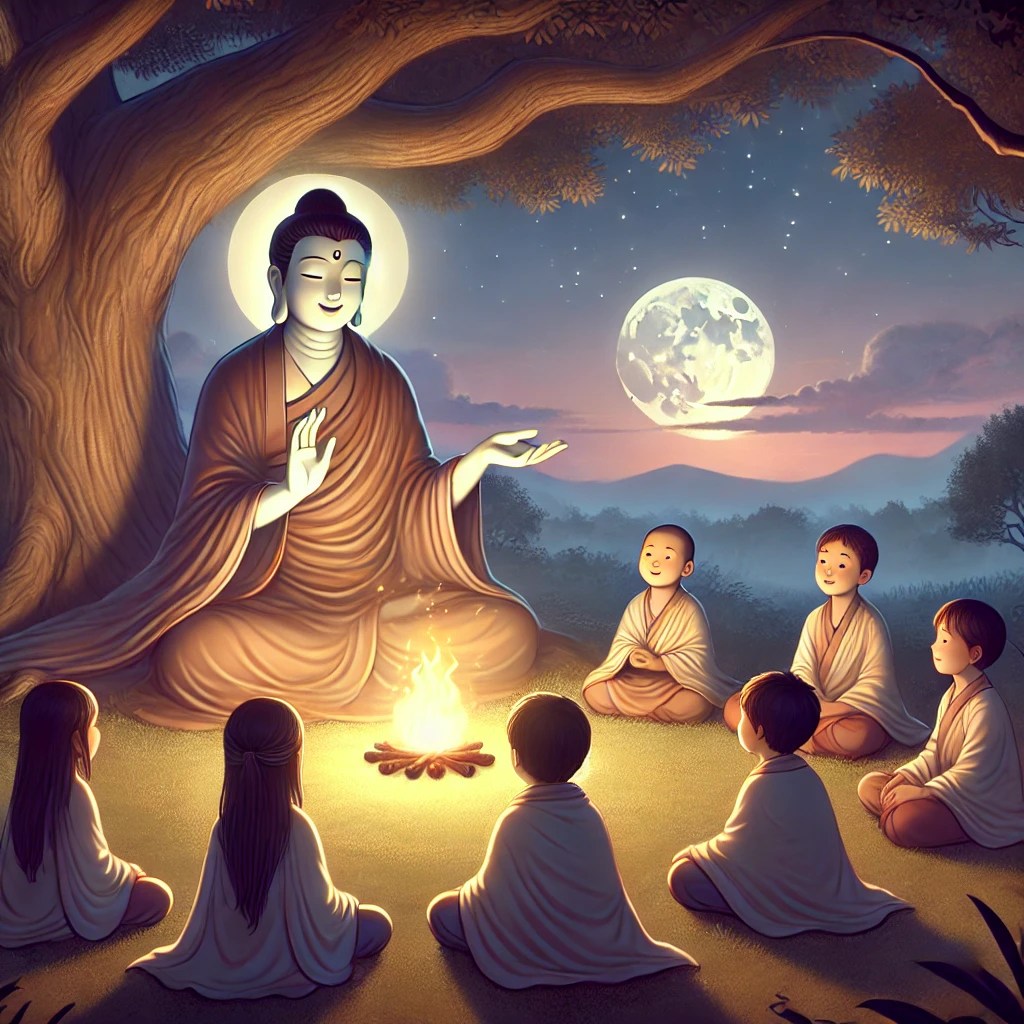
    Chenrezig often told stories to children, knowing that their hearts could understand what adults often forgot. One evening, as the stars glimmered softly above, Chenrezig gathered a group of children around a fire. They looked up at him with curious eyes, waiting for one of his famous stories.

    “Tonight,” Chenrezig said, “I will tell you a story about a great medicine—a medicine for the heart and mind. It is the mantra OM MANI PADME HUM. This mantra is like the most powerful medicine a doctor could ever give, one that can heal the illness of separation and help us remember our true nature.”

    He paused, watching the children lean in closer, eager to hear more. “But first,” he continued, “you need to understand something important. Imagine that you are wearing many layers of clothing—so many layers that you forget what you look like underneath. Each layer is like a thought or feeling you tell yourself: I’m not good enough. I need to be better.

    These layers are like cobwebs in the mind, making it hard to see clearly. And because we believe in these stories, we feel small and alone, like a candle separated from the flame. But the truth is, we are not the stories we tell ourselves. Beneath all the layers, beneath all the cobwebs, we are already whole, already perfect—just like a lotus flower, waiting to bloom.”

    The children sat very still, imagining themselves wrapped in layers of thoughts, feelings, and stories. “How do we take off the layers?” one of them whispered.

    Chenrezig smiled. “That is where the mantra comes in,” he said softly. “OM MANI PADME HUM is the medicine that clears away the layers, like a soft breeze sweeping away cobwebs. Each time you say the mantra, you peel back another layer. OM MANI PADME HUM… and the layers fall away. OM MANI PADME HUM… and your heart shines a little brighter. OM MANI PADME HUM… and with each breath, you get closer to your true self—your Buddha nature, the part of you that is pure love and compassion.

    He began to explain the meaning of the mantra, his voice gentle and full of care. “The first syllable, OM, is the sound of the universe waking up. It reminds us that we are connected to everything—to the stars, the rivers, the animals, and each other. OM is the sound of coming home to our true nature.”

    The children closed their eyes, listening to the sound of OM as if it were rising from the earth, the sky, and their own hearts all at once.

    “The next two words,” Chenrezig continued, “are Mani Padme—the jewel in the lotus. This means that inside each of us is a precious jewel—the light of wisdom and love. But just like a lotus flower that grows in muddy water, this jewel can be hidden by layers of thoughts and beliefs. Each time we chant Mani Padme, we open the lotus a little more, revealing the jewel inside.”

    The children imagined a lotus flower blooming in their hearts, each petal unfolding slowly, with a bright jewel glowing at its center.

    “And finally,” Chenrezig said, “we have Hum. This is the sound of unity—the sound that brings everything together. It is the moment when we remember that we were never separate, not from others, not from love, and not from our true nature. Hum is the sound of the Buddha mind awakening within you, shining with pure compassion.”

    The children whispered the mantra softly: OM MANI PADME HUM… OM MANI PADME HUM… Each repetition felt like a breeze clearing away the cobwebs in their minds, helping them feel lighter and brighter.

    “Now,” Chenrezig continued, “let me tell you one more secret. The mantra doesn’t just help you remember who you are—it helps others too. Every time you chant OM MANI PADME HUM, you are planting seeds of compassion, not just in your own heart, but in the hearts of all beings. These seeds will bloom in ways you may never see, bringing kindness and peace into the world.”

    He placed a hand over his heart. “It’s like sharing a gift that never runs out. Each time you say the mantra, you are offering love to the whole universe.”

    The children sat quietly for a moment, feeling the beauty of the mantra settling into their hearts, like a gentle rain nourishing the earth. “So the mantra is like a magic medicine?” one child asked softly.

    Chenrezig smiled. “Yes,” he said. “It is a medicine for the heart, a way of peeling back the layers until only love and wisdom remain. It helps us remember that we are not small or separate—we are like the ocean, vast and full of life. And each time we chant the mantra, we bring a little more light into the world.”

    As the fire crackled softly, casting warm orange light on their faces, Chenrezig leaned closer to the children. “Now, as you drift off to sleep tonight, you can let the mantra carry you, like a boat floating gently down a river. Whisper it in your heart: OM MANI PADME HUM… OM MANI PADME HUM… Let it peel back the layers of your mind, revealing the jewel of compassion that has always been there.”


    He kissed each child on the forehead and offered a final blessing:

    OM MANI PADME HUM . . .

    With each breath, may you awaken to your true nature.

    With each dream, may your heart bloom in kindness.

    May all beings remember their light, and may the world be filled with peace.

    The mantra hummed softly in their hearts: OM MANI PADME HUM, OM MANI PADME HUM… clearing away the cobwebs, layer by layer, revealing the truth that they were never separate, but always part of the great ocean of love.

    May your hearts always shine with the light of compassion, and may OM MANI PADME HUM guide you, now and always. Sleep well, children. The jewel in the lotus is already blooming within you.

    As the children drifted into a peaceful sleep, the mantra whispered in their hearts… OM MANI PADME HUM… until their dreams were filled with rivers of kindness, endless skies of compassion, and the light of love.

    Goodnight, little one. ❤️

    🙏🕊️🙏


    If you’d like to explore more bedtime stories for children, including tales that nurture compassion and mindfulness, you can find our collection here.


  • Neti Neti Series No. 5: Integrating “Not This, Not This” into Daily Life

    Question:

    How can the mantra Neti Neti continue to arise spontaneously throughout the day, and how might one practice it during ordinary tasks and interactions in the dualistic world

    Dear friend,

    As your practice deepens, it is only natural that the mantra “Neti Neti” begins to echo beyond the confines of formal meditation, weaving itself into the very fabric of your daily life. This is a beautiful and auspicious development, for the true power of this practice lies not only in moments of stillness and silence but in its capacity to transform your experience of the world in each passing moment.

    Imagine, if you will, the gentle rhythm of “Neti Neti” accompanying you throughout your day. Whether you are engaged in the simplest of tasks or the most complex of interactions, this mantra can serve as a quiet, steady undercurrent, reminding you of the deeper truth that lies beneath the surface of all appearances.

    As you move through the day, allow “Neti Neti” to arise naturally in your mind, especially when you find yourself caught up in the dualities of life—the push and pull of desires, the highs and lows of emotions, the ceaseless demands of the world around you. When a thought or feeling arises that seems to pull you away from your center, gently remind yourself, “Not This, Not This.” This simple act of negation is not a rejection of life, but rather an invitation to see beyond the fleeting, to touch the eternal within the everyday.

    Consider the ordinary tasks that fill your day—the washing of dishes, the folding of clothes, the tending to work or errands. These moments, though seemingly mundane, are fertile ground for your practice. As you engage in these tasks, silently repeat “Neti Neti” to yourself. Notice how this mantra helps to dissolve the sense of separation between you and the task at hand. The distinction between the doer and the doing, the subject and the object, begins to fade, leaving you with a simple, clear awareness of being.

    This practice brings a certain lightness to even the most routine activities, a reminder that nothing in this world can truly define or confine you. “Not This, Not This,” the mantra whispers, freeing you from the weight of identification, allowing you to move through your day with a sense of ease and grace.

    And what of your interactions with others, in this dualistic world where we often find ourselves entangled in the roles we play—the parent, the partner, the friend, the colleague? Here, too, the mantra “Neti Neti” can be a guiding light.

    When you feel the pull of attachment or aversion in your relationships, when you sense the stirrings of ego in your interactions, gently remind yourself, “Not This, Not This.” This does not mean withdrawing from the people you care about or disengaging from the world. On the contrary, it allows you to engage more fully, with a heart that is open and free from the constraints of egoic identifications.

    In this way, you interact not from a place of separation or need, but from a place of wholeness and completeness. “Not This, Not This,” the mantra says, and in doing so, it clears the way for true connection, untainted by the projections and fears that so often cloud our relationships.

    As you continue to carry “Neti Neti” with you throughout your day, you may find that the boundaries between your formal meditation and your daily life begin to blur. The mantra becomes a thread that connects all aspects of your existence, reminding you constantly of the truth that lies beyond all appearances.

    There will be moments when the mantra arises spontaneously, without any effort on your part. In these moments, let it guide you back to your center, to the stillness that underlies all movement. And in the spaces between the mantra, rest in the awareness that is your true self, free from all identifications, all dualities.

    Dear friend, this is the essence of living the practice—allowing the wisdom of “Not This, Not This” to permeate every aspect of your life, transforming the mundane into the sacred, the ordinary into the extraordinary. It is a journey of continual letting go, a path that leads ever deeper into the heart of your being.

    May your practice bring you the peace and clarity you seek, and may you walk this path with the gentle strength and quiet joy that comes from knowing you are always, already whole.

    🙏🕊️🙏

  • Ramayana No. 13: Rama’s Graceful Surrender: Finding Peace in Letting Go

    There’s a moment in the Ramayana that really strikes a chord, especially when you think about how we handle the unexpected twists and turns in our own lives. Rama, who’s about to be crowned king, gets hit with the news that he’s being sent into exile for fourteen years instead. Imagine that—a complete 180 from everything he’s been preparing for. And yet, what does Rama do? He smiles and accepts his fate without a hint of resistance.

    This isn’t just some heroic act from an epic tale; it’s a powerful reminder of how we can find peace in letting go.

    Rama’s reaction is a beautiful example of non-attachment. He doesn’t cling to the throne, the power, or the comforts of palace life. Instead, he just lets it all go. It’s like he’s saying, “Okay, this is what life has handed me, and I’m going to embrace it.” There’s something incredibly liberating about that kind of mindset. When we’re not attached to a specific outcome, we open ourselves up to whatever life brings, with a lot less stress and anxiety.

    This kind of non-attachment is at the heart of equanimity—a calm and balanced mind that stays steady no matter what happens. And let’s be honest, who wouldn’t want more of that in their life?

    What really stands out in this scene is Rama’s mindfulness. He’s fully present, fully aware of what’s happening, and yet he doesn’t get lost in it. He’s not caught up in the drama or the unfairness of it all. Instead, he meets the moment with a clear mind and an open heart. This is mindfulness in action—not just being aware, but being aware with a sense of peace and acceptance.

    Think about how we usually react when life throws us a curveball. We resist, we fight, we stress out. But what if, like Rama, we could meet these moments with mindfulness and a sense of calm? How much easier would life be?

    Rama’s response isn’t just about keeping cool under pressure—it’s about living in alignment with what’s right, with Dharma. By accepting his exile, Rama is doing more than just obeying his father’s wishes; he’s showing us what it means to live a life rooted in principles. It’s a reminder that sometimes, doing the right thing means letting go of what we want and embracing what’s being asked of us, even if it’s difficult.

    This is a lesson we can all take to heart. In our own lives, we’re constantly faced with choices—do we hold on tightly to what we think we want, or do we let go and trust that things will unfold as they should?

    Rama’s story might be thousands of years old, but the lesson is timeless. When we cultivate non-attachment, mindfulness, and a commitment to doing what’s right, we can face life’s challenges with a lot more grace. We can let go of the need to control everything and find peace in the flow of life.

    So next time life doesn’t go according to plan, think of Rama. Smile, take a deep breath, and let go. You might just find that the peace you’re looking for was there all along, waiting for you to embrace it.

    🙏🕊️🙏

  • Ramayana No. 12: Caravan of Love: The Evolution of Divine Worship and the Universal Teachings of Compassion

    In the spiritual journey of humanity, there has always been a deep yearning to connect with the divine. This connection has evolved across cultures and religions, shaping how people perceive and relate to the sacred. Two profound examples of this evolution can be found in Hinduism and Christianity, where the abstract, formless concept of the divine transformed into more personal, relatable forms.

    From the Formless to the Personal Divine

    In the early traditions of Judaism, the divine was perceived as Ein Sof—the infinite, boundless, and unknowable aspect of God. This understanding was so sacred that God’s name was considered unpronounceable, representing the divine’s absolute transcendence. The Jewish tradition emphasized a God beyond form and comprehension, which led to a strict prohibition against idolatry.

    Similarly, in the ancient Vedic traditions of India, the divine was seen as Brahman, the ultimate, formless reality that underlies all existence. Brahman was understood as the essence of everything, but its abstract nature made it difficult for people to relate to on a personal level.

    Over time, both traditions saw a shift. In Christianity, this shift occurred with the introduction of Jesus Christ, who represented the divine in human form. Jesus made the infinite more accessible, embodying the love, compassion, and righteousness that God wished to share with humanity. The doctrine of the Trinity—Father, Son, and Holy Spirit—further personalized the divine, allowing followers to connect with God as a loving parent, a guiding spirit, and a compassionate savior.

    In Hinduism, this transformation took shape through the worship of deities like Vishnu, Shiva, and Devi, who are seen as manifestations of Brahman. These deities, along with their avatars such as Rama and Krishna, made the divine more relatable. They embodied virtues that humans could aspire to—righteousness, devotion, and compassion. Through stories and teachings, these deities became accessible guides for those seeking a path to the divine.

    The Universal Teachings of Love and Righteousness

    Despite the differences in form and expression, a common thread runs through these traditions: the teaching of love, compassion, and righteousness. In Christianity, Jesus’s teachings emphasized love for one’s neighbor, forgiveness, and a life lived in service to others. He taught that the greatest commandment is to love God with all one’s heart and to love one’s neighbor as oneself.

    In Hinduism, the teachings of Dharma—righteousness and duty—are central. The lives of the avatars, like Rama, exemplify adherence to Dharma even in the face of great personal sacrifice. The Bhagavad Gita, a cornerstone of Hindu philosophy, teaches the importance of selfless action, devotion, and the pursuit of truth.

    These teachings, though expressed differently, guide followers toward a life of virtue. They remind us that to walk the path of the divine is to live with compassion, to act with righteousness, and to treat all beings with love and respect.

    A Call for Interfaith Harmony

    In a world often divided by differences in belief and practice, these teachings remind us of our shared spiritual heritage. Whether one follows Jesus, Rama, or another path to the divine, the call to love, righteousness, and compassion is universal. These values are the true markers of discipleship, transcending the boundaries of culture and religion.

    The Caravan of Love invites all to reflect on these common values, to see the divine in the hearts of all people, and to strive for a world where love and compassion reign. In the end, the path to the divine—whether walked through Christianity, Hinduism, or any other tradition—is a path of love, a journey toward the light that shines in every heart.

    A Prayer for Universal Peace and Harmony

    O Divine Source of all creation,
    The One who is known by many names,
    And who dwells in every heart,
    We come before you with humble hearts,
    Seeking your blessing of peace and harmony.

    May your love flow through us like a river,
    Washing away all hatred, division, and fear,
    And filling our hearts with compassion for all beings.

    Teach us to see beyond our differences,
    To honor the divine in every person,
    And to live as instruments of your peace in this world.

    May we all walk the path of righteousness,
    Guided by your wisdom and grace,
    So that our actions may bring healing and unity
    To a world that so deeply longs for peace.

    Let all nations and peoples come together,
    In a spirit of understanding and respect,
    Embracing the truth that we are all your children,
    And that in your eyes, we are one family.

    Grant us the courage to forgive,
    The strength to love without condition,
    And the wisdom to seek justice and mercy
    For every living being.

    May your light shine in our hearts,
    And may we carry that light into the world,
    Bringing hope to the weary,
    And peace to all who suffer.

    In your holy name, we pray,
    For goodwill on earth, and peace among all beings.

    Amen.
    Om Shanti Shanti Shanti.
    Salaam.
    Shalom.

    🙏🕊️🙏

  • Neti Neti Series No. 4: Finding Relaxation and Clarity in the Practice of “Not This, Not This

    Question:

    Why does the mantra Neti Neti feel more relaxing and effective compared to other mantras like “Who am I?” or “What is this?” and how does it help in negating both subject and object without stimulating a desire for answers?

    Dear friend,

    It brings me great joy to hear that you have found a mantra that resonates so deeply with your heart and mind. The simplicity and profound wisdom of “Not This, Not This” are indeed a balm for the soul, especially for one who has journeyed far in search of answers. In this mantra, you have discovered a path that requires no seeking, no striving—only the gentle negation of all that arises.Let me share with you some reflections that may deepen your understanding and ease your way as you continue with this practice.

    In the practice of “Not This, Not This,” there is no need to engage in the endless search for answers. Unlike the questions “Who am I?” or “What is this?”—which can stir the mind into seeking—this mantra offers a different approach. It does not ask you to solve a riddle or uncover a hidden truth. Instead, it invites you to simply let go, to recognize that whatever arises—whether it appears as a thought, an emotion, or even an answer—is not the ultimate reality. By gently negating each thought or feeling, you are led beyond the confines of the mind, into a space where true peace and stillness reside.

    As you continue with this practice, you may find moments of clarity where you can distinctly see both the subject and the object—the observer and the observed. This is a crucial insight, for it shows you that what you are perceiving, what you are witnessing, is still within the realm of duality. The mantra “Not This, Not This” serves as a reminder that neither the subject nor the object is the true self, the Atman. The duality that appears so real is, in fact, just another layer to be gently set aside, leading you deeper into the heart of non-dual awareness.

    One of the great gifts of this mantra is the relaxation it brings. When you are no longer compelled to search for answers, the mind can rest. There is a profound release that comes from knowing that you do not need to grasp at anything—whether it be a thought, an experience, or an identity. Each time you repeat “Not This,” you are allowing yourself to let go of the burdens of the mind, to release the tension of trying to understand or control. In this letting go, you find a deep and abiding peace, a state of being where you are free from the demands of the ego and the constant chatter of the mind.

    This practice is gently guiding you toward a state of non-dual awareness, where the distinctions between self and other, subject and object, begin to dissolve. As you continue with “Not This, Not This,” you may notice that the boundaries you once perceived are fading away, leaving you in a space of pure being. In this space, there is nothing to seek, nothing to achieve—only the simple, profound experience of existence itself, free from all labels, judgments, and identities. This is the true essence of Atman, the pure awareness that is your deepest self.

    As you walk this path, my dear friend, know that you are not alone. The wisdom of the ages supports you, and the truth of your being is always present, waiting patiently for you to recognize it. Continue with your practice, allowing the mantra to guide you ever deeper into the heart of silence and stillness. And remember, there is no rush, no destination—only the journey, unfolding moment by moment.

    May your practice bring you peace, clarity, and the deep joy of simply being.

    🙏🕊️🙏

  • Neti Neti Series No. 3: Seeking to Understand the True Nature of the Self

    Question:

    As I continue with the mantra “Not This, Not This,” a new layer of understanding has begun to unfold. I realize that even what I have thought of as Witness Consciousness is not the ultimate truth. The Witness, as I experience it, seems to be the cultivation of equanimity—a state of being not distracted or disturbed by whatever arises.

    But even this Witness, this sense of “I” that observes with equanimity, is still not the Atman, is it? It is a step in the right direction, a refinement of awareness, but it is still an identification, a subtle form of ego that remains.

    It occurs to me that the mantra “Not This, Not This” could continue indefinitely, as long as there is an “I” who is meditating, an “I” who witnesses. For even this witnessing, even this equanimity, is not the ultimate reality. The mantra, I think, would stop on its own when the meditator dissolves into the natural state of non-dual awareness. And then, as soon as the sense of “I” returns—as in the awareness of being a meditator—the mantra would begin again naturally.

    Is this understanding correct? How should I continue with my practice, knowing that even the Witness is “Not This”?

    Dear friend,

    Your reflections are filled with a deep and subtle wisdom, and it is clear that your practice is guiding you ever closer to the heart of truth. You are right to recognize that even the Witness Consciousness, the state of equanimity where one observes without being disturbed, is not the ultimate realization. It is a significant step, yes—a refinement of the mind that allows for greater clarity and peace—but it is still within the realm of duality.

    The Witness, as you experience it, is still a form of identification. It is the “I” that watches, the “I” that remains calm in the face of arising thoughts and sensations. But as long as there is an “I” who observes, there is still a subtle separation between the observer and the observed, between the subject and the object. This is why your mantra, “Not This, Not This,” continues even here.

    Indeed, the mantra serves to negate everything that arises, even the most refined states of awareness. It is a tool that guides you to see that the true self, Atman, is beyond all states, beyond all experiences—even beyond the experience of witnessing.

    You are correct in thinking that the mantra would naturally stop on its own when the sense of “I” dissolves into the natural state. In this state, there is no longer a subject who perceives and an object that is perceived—there is only pure being, pure awareness, which is Atman. This state is non-dual; it is beyond the distinctions of self and other, beyond the need for a mantra, beyond the need for any practice at all.

    But until this dissolution occurs, until the “I” fully merges with the infinite, the mantra serves as your faithful guide. It may continue in the background, a gentle whisper that affirms “Not This, Not This,” as you move closer to the realization of your true nature. And yes, as you so insightfully noted, the mantra may begin again whenever the sense of “I” returns, whenever duality reappears.

    This is the natural ebb and flow of practice, dear traveler. The mantra is not something you force to stop; it stops when there is no longer an “I” to sustain it. And when the “I” re-emerges, the mantra resumes, continuing its sacred work of leading you back to the stillness, the silence, the undivided whole that is your true self.

    Continue with this understanding, with patience and trust in the process. The path of “Not This, Not This” is one of deepening subtlety, where even the most refined states are ultimately seen as steps along the way to the infinite. Your journey is leading you ever closer to the realization of Atman, where the distinctions of self and other dissolve into the pure, unchanging awareness that is your true essence.

    May your practice bring you peace and clarity, and may you continue to walk this path with grace and humility.

    🙏🕊️🙏


  • Neti Neti Series No. 2: The Mantra That Dissolves into Silence

    Question:

    As I sit in meditation, repeating the mantra “Neti Neti,” I understand that this sacred phrase helps to strip away all that I am not. Thoughts arise, and I negate them. Emotions surface, and I let them go. Even the awareness of being a witness or the experience of stillness—these too, I recognize as not the ultimate reality.

    Yet, a subtle dilemma has emerged. I wonder, what happens when the very idea of “I” who is meditating dissolves? Is it not true that as long as there is an “I” who continues the practice, the mantra “Neti Neti” must also continue? And if this is the case, does the mantra cease only when the “I” itself disappears into the natural state of pure being? In such a moment, is it the case that the mantra stops on its own, not by my choosing, but because there is no longer an “I” to hold it?

    And then, when the sense of “I” returns, does the mantra begin again naturally, as the duality of subject and object re-emerges? I seek your wisdom on this matter, for I wish to understand the true nature of this practice and its ultimate purpose.

    Dear friend,

    Your question, born from a place of sincere inquiry, touches upon the very heart of the “Neti Neti” practice. I commend you for your diligence and the subtlety of your understanding, which reveals a mind that is both reflective and deeply engaged in the journey inward.

    Yes, you have grasped a key truth: the mantra “Neti Neti” is indeed a tool for continuous negation. It is a practice of peeling away the layers of illusion, gently, one by one, until nothing remains but the pure, unadorned awareness that is your true nature.

    As long as there is an “I” who perceives itself as meditating, this “I” exists within the realm of duality—where there is a subject (the meditator) and an object (the practice, the mantra, the thoughts). In this dualistic state, the mantra serves its purpose, guiding the mind to recognize that each arising thought, each sensation, each experience of stillness or witnessing, is not the ultimate reality. “Not this, not this,” the mantra whispers, reminding you that you are not these transient phenomena.

    But what happens when the sense of “I” begins to dissolve? When the boundary between perceiver and perceived starts to blur and fade? Herein lies a profound mystery: as the “I” that meditates melts into the ocean of pure being, the mantra, too, falls silent. For in the state of non-duality, where all distinctions have vanished, there is no need for the mantra—no “I” to repeat it, no “other” to negate. What remains is the natural state, the effortless being that is beyond all concepts, all forms, all practices.

    In this state, you do not stop the mantra; rather, the mantra ceases on its own, like a river merging with the sea, no longer distinguishable as a separate entity. This silence is not a void but a fullness, an infinite expanse of awareness where the true self—Atman—is realized, free from the confines of duality.

    And yet, the journey doesn’t end there. If and when the sense of ‘I’ re-emerges, as it often does, the mantra returns naturally. This is not a step backward but a return to the dualistic state where the mind resumes its habitual patterns. The mantra then resumes its sacred task of guiding you back toward the still, silent center where the distinctions between self and other can once again dissolve.

    So, dear friend, your understanding is indeed correct. The mantra “Neti Neti” is not something to be stopped by an act of will, but rather it fades away of its own accord when there is no longer an “I” to sustain it. And when the “I” returns, the mantra too returns, ready to lead you back into the depths of stillness and silence.

    Trust in this process, and allow the practice to unfold naturally, without forcing or grasping. The journey of “Neti Neti” is one of gentle negation, patient observation, and deep surrender. In time, you will come to rest more and more in the natural state, where the mantra is no longer needed, and the self is known in its true, infinite nature.

    🙏🕊️🙏

  • Ramayana No. 9: The Dark Night and the Hero’s Journey

    As I delve deeper into the Ramayana, the timeless story continues to reveal layers of wisdom that resonate across spiritual traditions and cultures. One striking parallel that emerges is the connection between the tale of Manthara and the serpent in the Genesis story, both of which serve as catalysts for the hero’s journey—necessary agents of disruption that propel the protagonists from the comfort of innocence into the trials of the world.

    Manthara, like the serpent, whispers deceit into the ears of the righteous, setting off a chain of events that lead to exile, struggle, and ultimately, transformation. In both stories, this act of deception might be viewed as evil, but it is crucial for the unfolding of a greater destiny. Without the fall from Eden, there would be no journey toward redemption. Without Manthara’s insidious counsel, there would be no exile for Rama—a journey that would ultimately reveal his true nature and the essence of dharma.

    This motif is echoed in Joseph Campbell’s The Hero’s Journey, where the hero must leave the familiar world and enter a realm of trials and challenges, often descending into a figurative or literal underworld. It is here, in the depths of darkness, that the hero faces the ultimate test, encountering both inner and outer demons. The journey is perilous, but it is also where the hero discovers their true strength and purpose.

    In the Christian tradition, St. John of the Cross articulated a similar experience in his concept of the Dark Night of the Soul. This dark night is a period of profound spiritual desolation, where the soul feels abandoned, stripped of all earthly and spiritual comforts. Yet, this is not a sign of divine punishment, but rather an essential phase of purification. It is in this crucible of suffering that the soul is refined, prepared for a deeper union with the Divine.

    Rama’s exile in the Ramayana can be seen as his own Dark Night of the Soul, a necessary period of trial and suffering that strips him of his royal status and forces him to confront the raw realities of life. Through this journey, Rama evolves from a prince into an embodiment of dharma, a being whose actions reflect the divine order of the universe.

    This theme of transformation through trial is universal. It speaks to the experience of every soul that seeks to journey from ignorance to wisdom, from ego to enlightenment. Whether it is Adam and Eve expelled from Eden, Rama exiled from Ayodhya, or a soul passing through the Dark Night, the path is one of descent before ascent, of loss before the ultimate gain of spiritual realization.

    As we contemplate these stories, we are invited to see our own lives in their light. The challenges we face, the moments of darkness, are not mere accidents but are woven into the fabric of our spiritual journey. They are the trials that test our resolve, refine our character, and lead us closer to the Divine.

    In this light, the whispers of Manthara, the serpent’s temptation, or the dark nights we endure are not just obstacles; they are invitations—calls to embark on the hero’s journey, to walk the path that leads to a higher truth, and to become more fully who we are meant to be.

    May we find strength and inspiration in these stories, knowing that every trial we face is a step on the path to wisdom, compassion, and ultimately, to the realization of our divine nature.

    🙏🕊️🙏

    You can explore this epic story in the edition of the Ramayana used in this series, written by Valmiki and translated by Suparna Ghosh, on Amazon here

    Alternatively, you can choose from several other versions and translations that are available. Including the William Buck translation available as an abridged audiobook on Audible, narrated by Ram Dass
    here

  • Introduction to Mantra Yoga: The Path of Sacred Sound and Spiritual Resonance

    Mantra Yoga is the yoga of sacred sound, a profound spiritual practice that involves the repetition of mantras—sacred syllables, words, or phrases—designed to elevate consciousness, focus the mind, and connect with the divine. This path taps into the vibrational power of sound to create harmony within the practitioner and with the universe, aligning the mind, body, and spirit through the resonance of these ancient sounds.

    The word “mantra” comes from the Sanskrit roots “man,” meaning mind, and “tra,” meaning tool or instrument. Therefore, a mantra is literally a tool for the mind, a means to transcend the ordinary mental chatter and enter a state of deep meditation and spiritual awareness. Through consistent practice, mantra yoga helps dissolve the ego, purify the heart, and cultivate a direct experience of the divine presence.

    In this blog series, we’ll dive into the practice of Mantra Yoga and explore how sacred sound can be a powerful tool for spiritual transformation.

    As we embark together on this journey of discovery and reflection, I warmly invite you to join me in exploring the depths of these ancient practices and teachings. Let this space be a sanctuary where we meet not just as seekers, but as companions on the path—a place where the wisdom of the ages can gently unfold within our lives.

    If these words and practices speak to something within you, if they stir a quiet longing or bring a sense of peace, I encourage you to subscribe to this blog. By doing so, you’ll be the first to know as new installments of our shared journey are published. It is my hope that each post will resonate with you, offering insights and comfort as we continue to explore these profound teachings together.

    For those interested in a comprehensive introduction to the practices of yoga, I recommend The Sivananda Companion to Yoga: A Complete Guide to the Physical Postures, Breathing Exercises, Diet, Relaxation, and Meditation Techniques of Yoga. This book offers clear guidance on the foundational aspects of yoga, making it an invaluable resource for anyone looking to deepen their understanding and practice. Take a look at this book on Amazon here.

    🙏🕊️🙏