Category: ME/CFS Self-Compassion: Embracing Healing and Understanding

This subcategory offers a compassionate exploration of self-care and emotional well-being for individuals living with ME/CFS (Myalgic Encephalomyelitis/Chronic Fatigue Syndrome). Discover practical strategies, personal reflections, and supportive resources aimed at cultivating self-compassion, managing challenges, and nurturing resilience. Join us in fostering a space of empathy, healing, and empowerment on the journey towards greater well-being and quality of life.

  • 🌿 Today, I wholeheartedly embrace adaptability, finding strength in my inherent flexibility.

    🌿 Today, I wholeheartedly embrace adaptability, finding strength in my inherent flexibility.

    In navigating the complex journey of life with chronic illness, I discover the potential to thrive amidst change. Each shift becomes an opportunity to adapt gracefully. As I navigate uncertainties, I embrace resilience. Understanding and flexibility is not a compromise but an integral part of my path. Today, I understand that my daily challenges can lead to a deeper experience of resilience and adaptability.

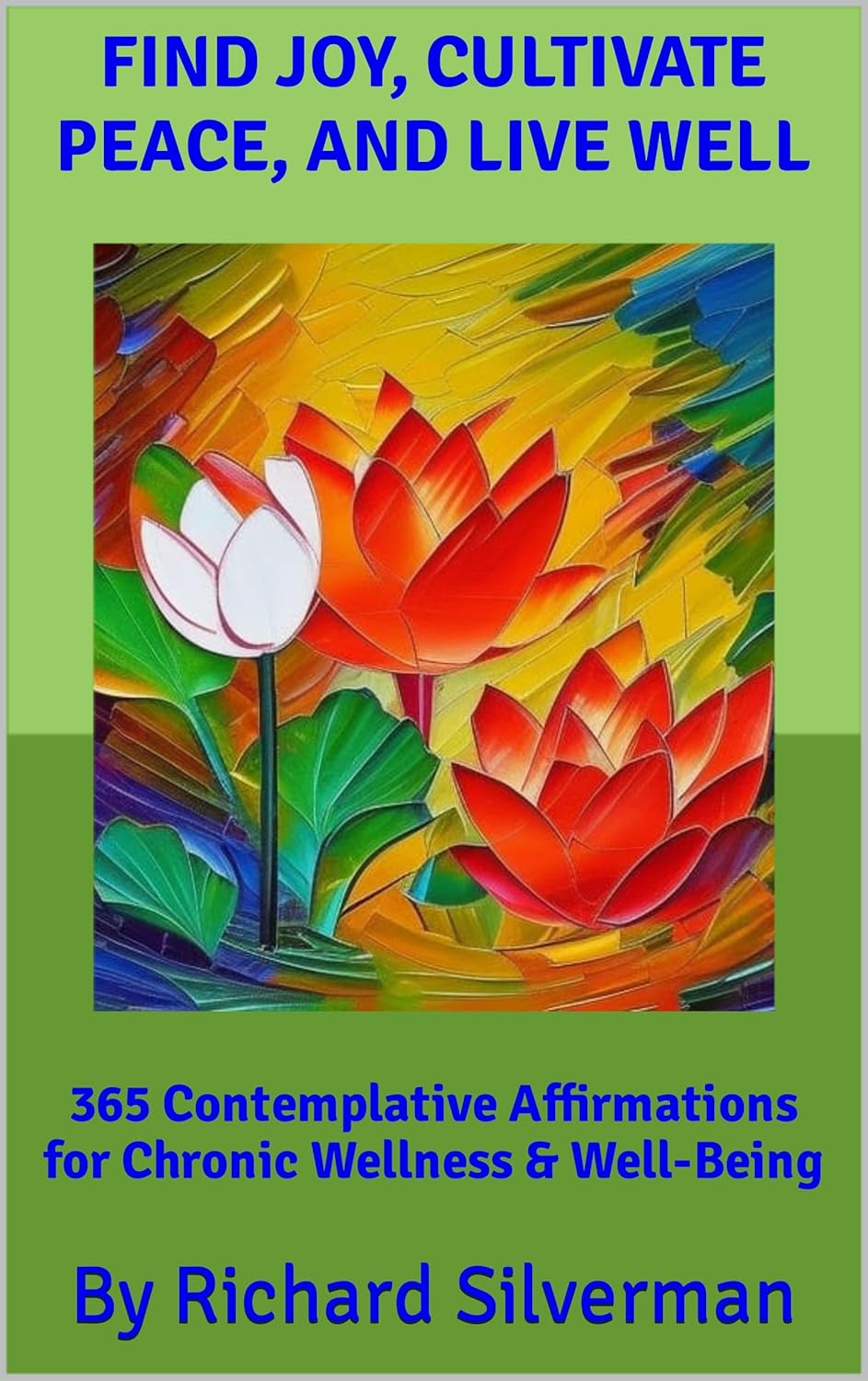
    ~ From affirmation day 3: “Find Joy, Cultivate Peace, and Live Well : 365 Contemplative Affirmations for Chronic Wellness & Well-Being”

    https://amzn.to/3F0od6E

    🙏🕊🙏

  • 🙂 Turning Music into a Gentle, Adaptive Practice While Living with Chronic Fatigue (ME/CFS)

    🙂 Turning Music into a Gentle, Adaptive Practice While Living with Chronic Fatigue (ME/CFS)

    🌿A Gentle Reminder Before Reading

    This post contains 38 sentences. If you have brain fog or limited energy, please take your time. You don’t need to read it all at once—just absorb what you can, when you can. If you find something helpful, pause and rest before continuing. There’s no rush. This is meant to be supportive, not overwhelming. 💙

    Turning Music into a Gentle, Adaptive Practice

    Lately, I’ve been reflecting on how much my body has been changing. For a long time, I spent most of my time in bed, and simply sitting up felt like a challenge. But recently, I’ve started to feel just a little stronger, and that’s why I feel drawn to incorporating more sitting and standing into my day. The muscles involved in standing and sitting had atrophied from so much time in bed, so this shift—this ability to stand, even for short moments—feels like a miracle.

    As part of this, I’ve been exploring a way to bring music into my life in a way that supports my body instead of draining it.

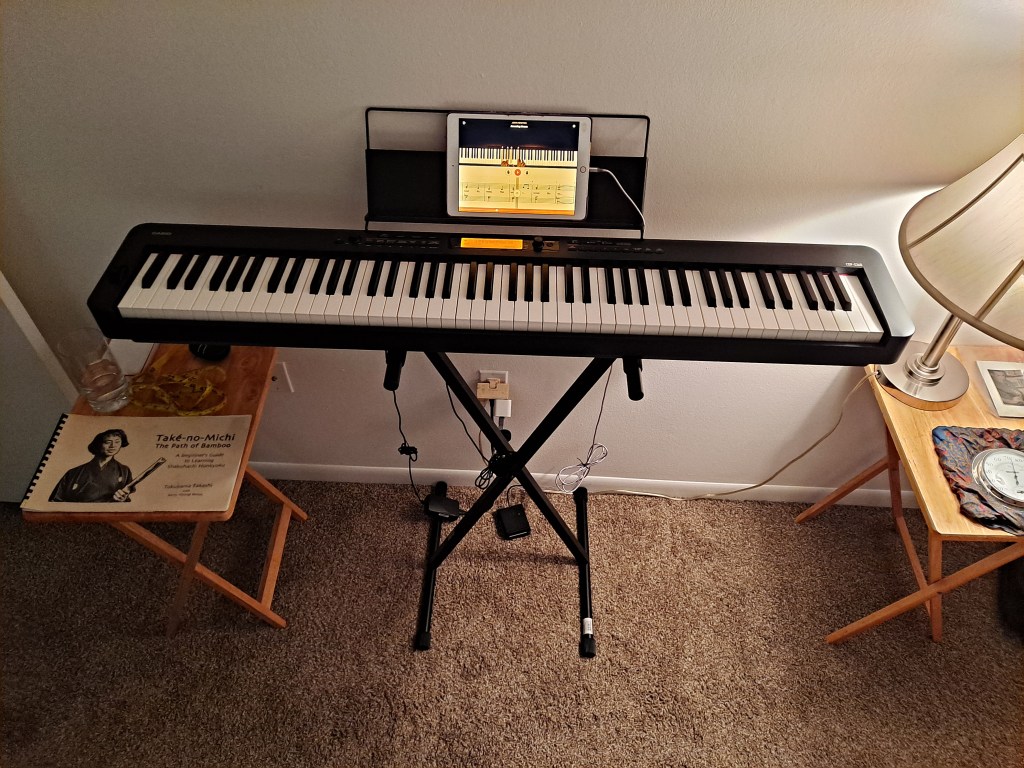
    Like many of you, I find that sitting for long periods is uncomfortable, so I decided to raise my keyboard stand to standing height. What I’ve found is that standing while playing allows for gentle movement—I can shift my weight, circle my hips, and let my breath flow naturally, almost like Tai Chi at the keyboard.

    But the most important shift has been learning how to relax. I’ve realized that when I play, I tend to hold my breath and tense up, which drains my energy. So my new focus is breathing and playing with as little tension as possible, using a 4-note breathing pattern:
    ✔ Inhale: A → C → E → C
    ✔ Exhale: A → C → E → C
    This simple rhythm helps me stay grounded, present, and relaxed.

    Another key part of this setup is having my keyboard at the end of my bed. This means I can lay down to rest anytime, and when I feel ready, I can stand for just a minute or two to play, then lay back down again. There’s no pressure, no need to push myself—just a gentle cycle of music and rest.

    Options for Engaging with Music at Any Energy Level

    I know that not everyone has the ability to stand or sit for long, so I wanted to share a few ways to incorporate music at any stage—always prioritizing relaxation and staying within your pacing envelope to avoid PEM.

    🎵 Lying in Bed: When I was primarily bedridden and didn’t have a keyboard, I Velcroed my iPad about a foot and a half above my head. This let me lay flat and play simple notes with an app, without any strain. It worked beautifully.

    🎵 Small Keyboard for Bed Use: On Facebook Marketplace, you can find very small, lightweight keyboards that you can keep in bed with you. You don’t need a full-size keyboard to start—just something simple to play a few notes when you feel able.

    🎵 Seated or Standing with an Adjustable Keyboard: If sitting for long is difficult, you can use a keyboard stand that adjusts in height so you can switch between sitting and standing, allowing for movement and rest as needed.

    🎵 Completely Resting & Humming (Minimal Effort Required): For those who need to lay flat and remain mostly inactive, music can still be part of your healing. Some keyboards or apps allow you to automatically play simple notes (like A → C → E → C) very, very slowly. Instead of physically playing, you can simply breathe in rhythm with the notes and gently hum along—only if it feels comfortable. Even this small engagement should be done within your energy limits, ensuring it stays restorative rather than draining.

    🎵 Music Visualization (No Physical Effort Required): If even humming feels like too much, you can still experience music through visualization. I used this method when I realized I couldn’t go to the beach anymore—I would simply imagine walking along the shore, and it was surprisingly powerful. In the same way, you can lay in bed and visualize yourself sitting at a piano, pressing one note at a time, hearing the sound in your mind, and breathing gently. You don’t have to hum or move at all—just allow the imagery and imagined sound to soothe you.

    The Primary Goal: Relaxation & Parasympathetic Activation

    The most important thing is to find the simplest, most relaxing way to engage with music—one that matches your current energy levels and does not trigger PEM. Whether that’s playing, humming, breathing, or simply visualizing, the goal is to activate the parasympathetic nervous system and promote deep rest and healing.

    Having a piano that moves with me rather than forcing me to adjust to it has been life-changing. I just wanted to share this in case it helps anyone else looking for a way to bring music into their life—with gentleness, breath, and ease. 💙

  • When the Body Speaks: A Letter on ME/CFS and Forgiveness

    When the Body Speaks: A Letter on ME/CFS and Forgiveness

    Today, I felt it coming—a noxious wave rising from deep within. A bright, warning orange sliding straight into red, and before long, a full-blown crash. The heaviness in my limbs like wet sand, my mind fogged and thick. The weight of having done too much, more than my body could tolerate, more than it could carry.

    I knew this would happen. I overrode my limits packing, moving into a new apartment, settling in when my body was already whispering, slow down. But I kept going. And now, here I am.

    This morning, in a PEM-crazed state of mind, I did something else I knew wasn’t wise—I ate an entire loaf of bread. I reached for it like it might offer some relief, some fleeting comfort, slice by slice until it was all gone. But now I just feel worse: bloated, sick, heavy in a way that no food could fix. And of course, the familiar wave of guilt followed: Why did I do that? I can’t believe I did that. I know this pattern—how PEM twists my mind, makes cravings louder, decision-making foggier. And yet, here I am again.

    But here’s the thing. This doesn’t mean I’ve lost my way. It doesn’t mean I’ve failed. It just means I’m human—living in a body that doesn’t follow predictable rules. A body that sometimes rebels, sometimes collapses under the weight of what life demands.

    At some point, reason kicks back in. The first step, as always, is acceptance. Not resignation, but a soft compassion: This is where I am right now. It’s uncomfortable, yes. It’s frustrating, absolutely. But fighting it only adds another layer of exhaustion. So finally, after feeling terrible—and feeling terrible about feeling terrible—I plugged in my heating pad, got into bed, and let the warmth settle over my belly. I let it offer some small comfort to my sore muscles, as I let myself be.

    I know this will pass. The intensity will soften. My body will find its rhythm again. And when it does, I’ll carry this experience with me—not as a failure, but as another piece of the story. Another reminder that healing isn’t linear, and self-compassion is the only constant I can truly lean on.

    If you’ve found yourself here too—in the middle of a crash, tangled in frustration or guilt—I hope you know you’re not alone. We all override our limits sometimes. We all make choices that don’t feel wise in hindsight. But none of that means we’re failing. It just means we’re living, doing the best we can in bodies that ask for more patience than most people can imagine.

    So here’s to resting when we need to. To forgiving ourselves when we falter. To remembering that even in the hardest moments, there is still space for gentleness.

    With warmth and understanding,

    Richard

    🙏🕊🙏

  • Can you help me rest in awareness and discover inner-peace?

    Can you help me rest in awareness and discover inner-peace?

    Yes. Take a moment to settle, feeling the body where it is. Let your attention gently turn inward. Notice any sensations in the body, any thoughts passing through the mind, or emotions present right now. Just observe them, without trying to change or control anything.

    Now, quietly ask yourself: Who is aware of these sensations, these thoughts, these emotions?

    Don’t look for an answer in words. Let the question open a quiet space within you. Rest in that still, silent awareness—the place from which everything arises and into which everything fades.

    Stay with this gentle noticing, and see what naturally unfolds.

    InnerPeace

    Self-inquiry

    LoveAndRespect

    Compassion

    🙏🕊🙏

  • A Refuge That’s Never Truly Out of Reach

    A Refuge That’s Never Truly Out of Reach

    For those of us living with chronic fatigue syndrome (ME/CFS), finding peace can often feel like an elusive dream. The body aches, the mind fogs, and even the simple act of resting can feel like a challenge.

    But beneath the surface of our struggles—beneath the exhaustion, frustration, and the endless cycle of unfinished stories—there is a refuge that has never left us. A place within that remains untouched, waiting patiently to be noticed.

    Across traditions, this inner sanctuary is described in many ways. In Christianity, it is the peace that passeth understanding, the quiet presence of the Holy Spirit that calms the heart. In Buddhism, it is our Buddha nature, the still, pristine mind that shines beneath our thoughts. In Jewish practice, Shabbat offers a sacred pause from the world’s demands, a time to rest in the presence of the I AM. Whether through Vipassana’s gentle observation, Samatha’s calming focus, or the surrender of “Let go and let God,” the invitation is the same: to rest in the peace that is always there, even if just for a moment.

    But here’s the truth that many of us don’t expect—when we set the intention to relax, to find that peace, it’s common for our minds to do the exact opposite. The very moment we try to slow down, all the unsettled thoughts, worries, and frustrations rise to the surface. It’s like sitting down to meditate and suddenly realizing just how noisy the mind really is. For those of us with ME/CFS, this can feel especially overwhelming. Our bodies are already weighed down by fatigue, and now our minds seem unwilling to give us the rest we crave.

    But this isn’t a sign of failure—it’s part of the process. Just as clouds drift across the sky without altering the vastness behind them, our thoughts come and go without touching the deeper peace within us. The key is not to fight these thoughts, not to grow frustrated or discouraged, but to witness them with gentle curiosity. To let them rise and fall, trusting that underneath the noise, the stillness remains.

    This practice takes more than just patience—it requires self-compassion. We have to be kind to ourselves, especially when the mind feels restless or when peace feels far away. Forgiveness becomes a part of the journey: forgiving ourselves for not feeling better, for being frustrated, for wishing things were different. And most of all, it requires surrender. To let go of the need to control how or when peace arrives, and to trust that it will reveal itself in its own time.

    Over the past month, I’ve faced one challenge after another—the sale of my RV, packing up a home that had been my refuge for over 30 years, and the physical demands of moving into a new apartment. Each step of the process required me to push beyond my body’s natural limits, triggering post-exertional malaise. There were moments I had to override the signals of fatigue just to get through the next task, knowing full well the cost it would bring later. And yet, I approached it as mindfully as I could, listening when possible, resting when needed, and trusting that I would eventually return to the gentle rhythm of proper pacing.

    Now, as I settle into this new space, I look forward to reclaiming that mindful practice of pacing—of finding the balance between effort and rest, between doing and simply being. Even though my body is still recovering, I know that the peace I’m seeking is not dependent on my circumstances. It’s always there, beneath the surface, waiting for me to slow down, to breathe, and to notice.

    And so, I offer this to you—whether you live with ME/CFS, face chronic challenges, or are simply navigating the complexities of life. The path to peace isn’t always smooth, and the mind may resist at first. But beneath the noise, the frustration, and the exhaustion, there is a refuge that has never left you. It’s not something you have to create or chase—it’s already there, waiting to be noticed.

    Let go. Be kind to yourself. Trust the process.

    And when you least expect it, that peace—the one that passeth understanding, that shines with the light of your Buddha nature, that whispers with the breath of the Holy Spirit—will rise to meet you.

    Because the truth is, that refuge is never truly out of reach.

    🙏🕊🙏

  • Cultivating the Witness: A Gentle Approach to Living with Myalgic Encephalomyelitis: The Body as a Landscape of Storm and Stillness 🙏

    Cultivating the Witness: A Gentle Approach to Living with Myalgic Encephalomyelitis: The Body as a Landscape of Storm and Stillness 🙏

    To live with myalgic encephalomyelitis is to carry a body that moves like weather—one moment heavy with fog, another scattered by electric storms. The limbs, once steady, now whisper of exhaustion; the nervous system hums and flickers like distant lightning. And yet, within all of this, there is a quiet place—one untouched by fatigue, by pain, by the ever-changing tides of illness. This is the witness, the silent presence that watches, feels, but does not struggle.

    The Power of Witnessing Consciousness

    When the body is weary, and the world presses in with its demands, the mind often follows—entangled in frustration, longing, grief. Yet, there is another way to meet this experience. Instead of battling exhaustion, we can turn toward it, gently, with curiosity. Instead of resisting discomfort, we can learn to hold it, like cradling a trembling bird in our hands.

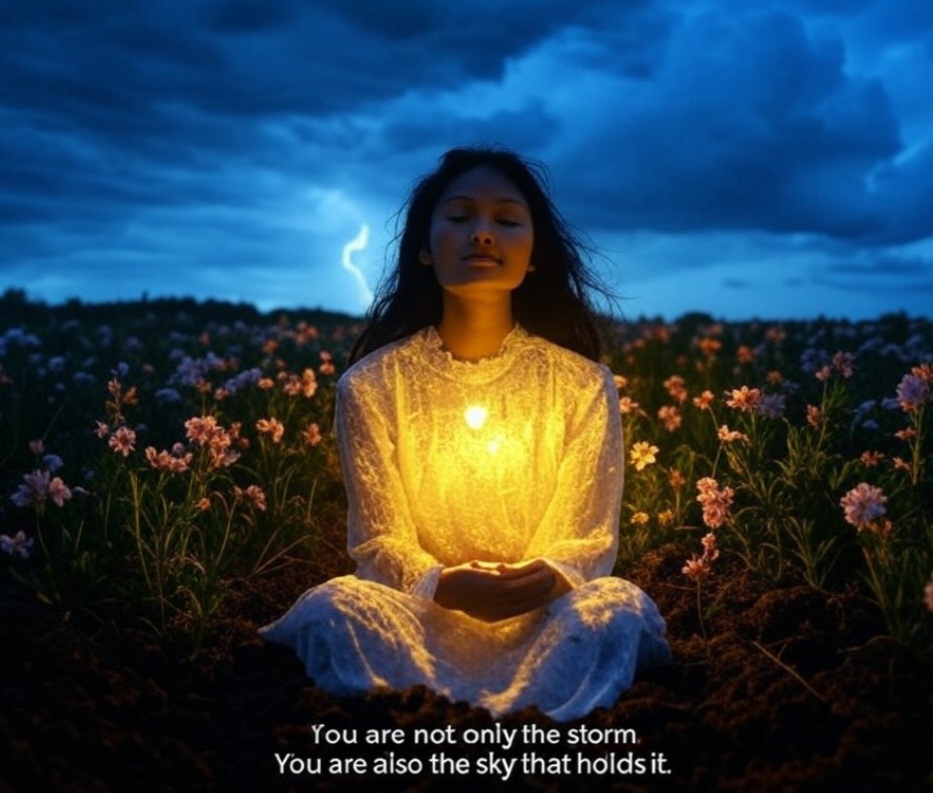
    Witnessing is not about escaping pain but about changing our relationship to it. It is the art of standing at the edge of the storm and seeing not just the thunder, but the vast sky that holds it.

    A Simple Self-Contemplation Practice

    1. Grounding in the Present
      Find a quiet moment. You don’t need perfect stillness—only a willingness to pause. Notice your body, the way it rests against the surface beneath you. Feel the breath, moving in, moving out, like waves against the shore.
    2. Observing Without Resistance
      Turn your attention inward. What is present? Fatigue like heavy earth? A nervous system like sparking wires? A mind that spins, restless and longing? Whatever it is, let it be here. Do not push it away or name it as the enemy. Simply notice.
    3. Holding with Compassion
      Imagine that each sensation is a visitor—arriving, staying for a time, and eventually leaving. What happens if you do not chase them away? What if, instead, you offer a quiet seat at your table?

    Even pain, even exhaustion, when met with this gentle witnessing, begins to soften. Not disappear, but shift—like wind through the trees, no longer trapped, no longer feared.

    How This Practice Supports ME/CFS Symptoms

    This is not a cure, nor a promise of relief, but a way of being with what is. When we meet our experience with openness:

    The nervous system settles; the fight against the body lessens.

    The mind uncoils from frustration and rests in the simple act of seeing.

    The emotional burden lightens, as we stop identifying with suffering and begin to witness it instead.

    Closing Thoughts: The Sky Holds It All

    If today your body feels like a storm, know that you are not only the storm—you are also the sky that holds it. The witness that watches, the stillness beneath the waves.

    And on days when you cannot sit in silence, when exhaustion presses too hard, let even that be witnessed with kindness. The practice is not in perfect stillness, but in the quiet turning toward whatever is here, again and again.

    Rest when you must, breathe when you can, and know that you are not alone.

    🙏🕊🙏

  • Kapalabhati Pranayama: The Shining Forehead Breath

    Kapalabhati Pranayama: The Shining Forehead Breath


    Dear Friend,

    There is a practice in yoga known as Kapalabhati, the “Shining Forehead Breath.” The very name carries with it a sense of poetry and mystery. “Kapala” means forehead, and “Bhati” means light or radiance. Together, they evoke an image of clarity, brightness, and inner illumination. This is no mere exercise but an invitation to cleanse not only the breath but also the mind and spirit, polishing the very space from which insight and intuition arise.

    In ancient times, practitioners likened this breath to polishing a mirror so that it might reflect the light of the divine. Each exhalation sweeps away impurities, and each inhalation invites the brilliance of life itself. To engage in this practice is to embark on a journey into your own radiant stillness.

    Here is how you may begin:

    1. Find Your Seat: Sit comfortably, with your spine straight and your hands resting gently on your knees. Feel the earth beneath you, steady and supportive.
    2. Breathe to Center Yourself: Take 5–7 slow, deep breaths. Let these breaths settle your thoughts and prepare you for the journey ahead.
    3. Engage the Shining Breath:
      • Take a full, deep inhale to begin.
      • Begin a series of sharp, active exhalations through your nose, allowing the inhalations to come naturally and passively.
      • Focus on the rhythm, like the steady beat of a drum, as your abdominal muscles contract with each exhalation.
      Start with 20–30 breaths per round, letting the breath carry you into its natural rhythm.
    4. Pause and Hold: At the end of the round, take a deep inhale. Hold the breath for a moment, feeling the stillness that arises, as if the universe itself has paused with you.
    5. Return to Natural Breathing: Exhale gently and let your breath return to its natural flow. Rest here, simply observing the quiet within.

    This is the essence of Kapalabhati. It is not about striving or achieving but about clearing away what obscures the light already present within you.

    As you continue to practice, you may notice the effects: a sharper mind, a lighter body, and a heart more attuned to the subtle rhythms of life. The breath becomes not just a function but a bridge—connecting you to the luminous self that watches over all.

    In the modern world, where distractions abound and our minds are pulled in countless directions, Kapalabhati offers a sanctuary. It invites you to return to simplicity, to the purity of breath, and to the stillness that holds all things. In this way, it is both a practice for the moment and a gift to carry with you into all moments.

    Dedication of Merit

    At the conclusion of this practice, let us dedicate whatever merit has arisen for the benefit of all sentient beings:

    May whatever merit has been accumulated in this practice flow outward, boundless and unending, for the benefit of all sentient beings.

    May all beings be free from suffering and the causes of suffering.

    May all beings experience happiness and the causes of happiness.

    May all beings awaken to enlightenment and the causes of enlightenment.

    May this moment of intention ripple through the universe, bringing peace, harmony, and light to all.

    Namo Buddhaya, Namo Dharmaya, Namo Sanghaya.

    I leave you with this reflection: Each breath you take is an opportunity to renew, to let go, and to shine. May this practice bring you clarity, lightness, and peace. And may it remind you of the brilliance that has always been yours.

    🙏🕊🙏


  • Exploring Pristine Mind Meditation for Chronic Fatigue Syndrome: A Path to Effortless Rest

    Exploring Pristine Mind Meditation for Chronic Fatigue Syndrome: A Path to Effortless Rest

    “Discover how pristine mind meditation may offer a gentle, restorative state of awareness without the energy costs that often come with post-exertional malaise.”

    Living with Chronic Fatigue Syndrome means every action, every exertion, has a cost. For many, even a few minutes of focus or effort can lead to post-exertional malaise—a profound worsening of symptoms that can last for days. But what if there was a way to rest deeply, to allow the mind to settle in a way that doesn’t deplete but actually nourishes? This is where the practice of pristine mind meditation comes in, offering an effortless awareness that exists beyond thought, beyond strain, and without the toll of traditional exertion.

    Pristine mind meditation is rooted in the idea of simply being. Rather than trying to clear the mind or enter a specific state, it invites you to rest in pure, unaltered awareness. This isn’t an act of concentration or focus, but a gentle allowing—a way to let thoughts and sensations come and go without attaching or resisting. The experience of resting in the pristine mind is often described as spacious, calm, and effortlessly open. For someone with ME/CFS, this could mean a path to real rest without the demand on physical energy that so often comes with other practices.

    Theoretically, because pristine mind meditation is free from physical or mental strain, it offers a way to access peace and stillness without triggering the kind of post-exertional fatigue that can worsen symptoms. It’s an invitation to explore a new way of being with chronic fatigue, where healing is not about doing but about resting in the quiet awareness that’s already within you.

    This journey is a gentle experiment, a compassionate practice of meeting yourself exactly as you are. Whether you experience even a few moments of pristine awareness or simply rest in the intention, the practice becomes a way of honoring the body’s limits and nourishing the mind. Take this path slowly, with openness, knowing that each step is its own quiet gift.

    If you’re curious, I invite you to join in this exploration, allowing yourself to simply rest in the pristine mind, noticing what it brings without expectation or need for change. This is a practice of ease, not of effort—a resting place for the soul amidst the demands of daily life with Chronic Fatigue Syndrome.

    For those interested in going deeper, much of this understanding is inspired by the teachings in Our Pristine Mind by Orgyen Chowang Rinpoche. His book provides a profound exploration of this approach to awareness, offering guidance on accessing the clear, effortless state of the pristine mind. If this resonates with you, I’ll leave a link below to help you find the book and discover more about this gentle, transformative practice.

    In the name of honoring my chronic fatigue syndrome, I’m experimenting with a different approach to healing. I’m trying out the idea that it doesn’t have to be complicated or effortful—that maybe simplicity and gentle choices can be enough. By tending to myself in this way, I’m exploring what it means to honor both my needs and my limitations, and I’m finding that this, too, might be a path to healing.

    I don’t know all the answers, but I’m noticing that healing isn’t always about pushing or doing more. Sometimes, it’s about making a quiet, deliberate choice to conserve energy, to rest, and to be. This journey toward simplicity and ease feels like a step toward well-being, and I’m curious to see where it leads.

    🙏🕊️🙏

    <!– /wp:spacer →

    🙏🕊️🙏

  • Into the Mystic: The Universal Presence Behind All Paths

    Into the Mystic: The Universal Presence Behind All Paths

    There is a timeless pull within the human heart, a pull that mystics across the ages have followed into realms beyond words. At the heart of their journeys, in every tradition, is a shared glimpse of something infinite and intimate, an essence that defies borders or labels. It’s been called by many names—Naked Awareness, Pure Presence, the Kingdom of Heaven within, and simply, I am. Despite the variations, the core is always the same: an invitation to touch the stillness at the center of our being, where all sense of separation quietly dissolves.

    Mystics across traditions—whether Buddhists, Christians, Sufis, or followers of Advaita—have left clues for us, each one pointing back to this same universal awareness. Tibetan Dzogchen, for instance, speaks of Naked Awareness, a mind so utterly clear and open that nothing need be added or removed. In this view, awareness is naturally luminous, like an open sky, vast and untouched by thoughts or concepts. The practice, if it can be called that, is simply to rest—free from striving, free from the need to grasp anything. It is awareness itself, just as it is.

    In the traditions of Advaita Vedanta, Ramana Maharshi posed the question, “Who am I?” Not to point to an answer but to turn us back to a sense of self beyond thoughts and identity. With each inquiry, the seeker’s attention is drawn back, away from thoughts and identities, into a place beyond all definition. This, he taught, is the Self, pure and indivisible—a silent, undivided presence.

    Christian mystics, too, found this universal ground within. “Be still and know that I am God,” whispers a line from the Psalms, urging a quieting of the mind so profound that the divine presence within each of us reveals itself. It is an invitation to encounter God not as an outside force, but as the very heart of our being—the unspoken “I am” beyond thought.

    Sufis describe this experience as a union with the Beloved, a love so profound that all sense of self dissolves. In Sufi poetry, God is the Beloved who lives within, waiting for the self to step aside so that the Divine can be known, not as separate, but as one with all that we are. Each of these traditions, in its way, guides us to an experience beyond the confines of self, into the space where awareness rests in itself, undivided.

    It is not so much a technique or practice as it is a gentle turning inward, a quieting, a surrendering into what has always been here. Let us pause for a moment. The words, after all, can only lead us to the door.

    Begin by finding a comfortable place to sit and close your eyes if that feels natural. Notice the rhythm of your breath and let yourself settle into the present moment. There is nothing to attain here, nothing to change. Let your breath rise and fall as it will, and simply allow yourself to be.

    Gradually, feel into your own presence, that simple sense of “I am.” Not your thoughts, not your sensations, but the awareness that notices them all. Rest in that sense of being here, alive, awake. There’s no need to go further than this. Let go of any sense of searching or effort; simply let your attention melt into the quiet space of awareness itself.

    If thoughts arise, there’s no need to push them away. You might notice them, perhaps softly wonder, “Who is aware of this thought?” Not to seek an answer, but to draw your attention back into the simple awareness that witnesses everything. Rest as that awareness, noticing how it is steady, quiet, and open, beyond anything the mind might hold onto.

    Here, in this openness, lies the mystery that mystics across all traditions have discovered. There is a silent presence here that does not come and go, even as everything else changes. It is the same presence that Dzogchen calls Naked Awareness, Advaita describes as the Self, and Christian mystics know as the divine within. This presence is universal, boundless, and utterly simple. It is the same awareness in everyone, untouched by belief or background.

    As you sit, allowing yourself to rest in this awareness, notice how it has no boundary, no form. It is the same in all beings, a shared presence connecting us all. In this stillness, you are already whole, already free, and deeply one with all. This is where all paths meet—an awareness, vast and simple, that is always here, waiting to be recognized as the essence of everything.

    And so, as we return to our day from this quiet place, we carry a reminder: that beyond every tradition and label, there is a shared, undivided presence—a timeless awareness that each of us holds within.

    🙏🕊️🙏
  • The Sacred Shift: From Seeking to Being

    Following the path of meditation can feel like a gradual unraveling of the known—a shedding of what we once held onto, leading us into the mystery of contemplation. As I continue reflecting on the works of St. John of the Cross, this sacred shift from meditation into contemplation becomes clearer. It is not a step we take with effort but a grace that gently unfolds when the time is right.

    St. John speaks of this transition as a call to surrender, but it is not the kind of surrender we can will into existence. Instead, it is a letting go that happens when we stop striving, when we allow ourselves to simply rest in the presence of the Divine. This is where the familiar practices of meditation—focused attention, mental inquiry, or breath awareness—fall away, giving space for something more profound to emerge.

    Today, I felt this shift more deeply, not as an intellectual understanding, but as a living experience. The pratyayas—the thoughts, sensations, and memories that rise and fall—became like whispers, their pull softening in the presence of curiosity. This curiosity is not the kind that seeks answers, but one that witnesses, without needing anything to happen. In that gentle witnessing, something new emerged: a spaciousness, a quiet stillness that felt like home.

    This experience is not unique to Christian mysticism. In Advaita Vedanta, the practice of self-inquiry often begins with a repetitive questioning—”Who am I?”—an active search for truth. But, as with St. John’s teachings, there comes a time when even the inquiry must dissolve into silence. The seeker steps back, not into a place of knowing, but into a place of being. In that being, all effort falls away, and we are left with the pristine awareness that has always been there.

    In silence, love calls,

    No longer through words or thought,

    But in quiet grace.

    This is the threshold between seeking and being, a place where the Divine does its quiet work in us. It is no longer about striving or yearning for a deeper experience; it is about trusting in the unfolding of love, which asks only that we rest in its presence.

    For those of us on this journey, may we continue to trust this sacred shift—moving from meditation into contemplation, from seeking into being. In this silent surrender, we come closer to the essence of who we truly are.

    🙏🕊️🙏

  • Resting in the Silence of Being: A Journey Into Stillness


    “The quieter you become, the more you can hear.”

    – Ram Dass

    There is a quiet truth that lives within each of us, a place that is untouched by the noise of the world, a stillness that is ever-present. It’s not reserved for moments of crisis or for the end of life. It’s here, now—waiting for us to settle into its embrace.

    Yet how often do we run from this stillness? We search for peace in the future, hoping it will come once we’ve completed our tasks, achieved our goals, or silenced our minds. But peace is already here, calling us back to the simplicity of being.

    The Practice:

    The practice begins with a simple mantra: “I am That.”

    When we say these words, we invite ourselves to rest in the truth of who we are. It’s not about searching or striving—it’s a return to the natural state, where we belong. Repeat the mantra aloud, or silently in your heart, and allow yourself to rest. After each repetition, sit in silence for as long as you like, letting the mantra echo softly within.

    And when you are ready, say it again: “I am That.”

    There is no rush, no goal, no expectation—just the simple unfolding of awareness.

    As thoughts arise, as distractions call, simply return to the mantra, letting it be like a lullaby for the restless mind.

    Reflections Along the Way:

    Follow the rhythm of the mantra, thoughts may come, feelings may arise. Let them pass like clouds, and rest beneath them, in the vast expanse of awareness.

    You are that light,
    shining through all things.
    Rest…
    in the knowing.

    Effortless and true,
    you return to what you are.
    Rest…
    in your nature.

    Like a drifting cloud,
    the ego searches in vain.
    Rest…
    beneath the sky.

    In quiet grace, he guides,
    showing the way back to self.
    Rest…
    in deep gratitude.

    Thoughts, desires, restlessness—all falls away when we stop chasing after them. Rest in the simplicity of being.

    In this way, dear reader, the mantra becomes not just words, but the very breath of being. So, rest in this mystic presence, this silence that is always there, gently touching the surface of awareness.

    In the dance of both,
    stillness and movement arise.
    Rest…
    in the balance.

    A passing thought, no more,
    like a ripple in still waters.
    Rest…
    in your knowing.

    Being is the truth felt,
    beyond what eyes can hold.
    Rest…
    in the knowing of being.

    Like seasons that turn,
    each step comes in its own time.
    Rest…
    and let it flow.

    Resting in Silence

    The journey, dear reader, is not about forcing the mind to be still or silent. It is about allowing the natural stillness and silence of our true self to be seen, felt and appreciated, unclouded by thought, unburdened by desire. By continuing to rest in this silence, we come to realize that the peace we seek has always been here. We become “Self-Realized.”

    The practice of resting in the silence is a gift we give ourselves while we are alive. It’s not reserved for the end of life; it is the way to live fully, in peace, right here, right now. The mantra is a guide, and the silence is the true teacher.

    Rest in silence. Rest in peace. Rest in your true nature. You are That.

    “The end of all wisdom is love, love, love.”

    – Ramana Maharshi

    🙏🕊️🙏

  • Exploring Dzogchen’s Transformative Path: A Journey into Our Pristine Mind

    Exploring Dzogchen’s Transformative Path: A Journey into Our Pristine Mind

    Reflections on Pristine Awareness, Dzogchen, and Finding Clarity in Challenging Times

    As I sit with Our Pristine Mind in my hands, I am aware that I am not merely reading a book. I am entering a silent conversation with an ancient wisdom, one that gently unfolds its layers with each page, as if lifting the veils of my own mind. In the quiet of early morning or beneath the faint glow of a reading lamp at night, the words begin to sink into the places where thought usually moves too quickly, too restlessly.

    Dzogchen—a word I’ve heard in passing, sometimes as an exotic echo from distant mountains, sometimes as an answer whispered through stories of sages and scholars—is not simply an idea here. It emerges like a breath I have almost forgotten to take, a reminder that within my mind lies a pure, boundless awareness untouched by the cycles of confusion, emotion, or distraction. Dzogchen does not demand; it simply reveals.

    The teacher, Orgyen Chowang Rinpoche, through his voice in Our Pristine Mind, speaks to the essential nature of awareness with a softness that does not impose but invites. I am reminded of Rilke, who once spoke of patience and of growing quietly in one’s own way, like a tree. Here, too, the practice of Dzogchen is like that tree, patient and grounded, yet ever-revealing. It asks nothing from me but presence, a willingness to recognize that what I have been searching for has always been here, beneath the surface of my rushing thoughts.

    Rinpoche speaks to our current world—the difficulties, the fractures, the relentless march of modern life. Dzogchen, he says, has come forward in these times not because it is new, but because we are perhaps ready to see its simplicity. To see that the vastness of pristine awareness is not somewhere far away or reserved for saints and sages. It is here, in the quiet pause between breaths, in the stillness that accompanies an unfiltered experience of now.

    The metaphor of the “brilliant moon in dark times” comes alive as I read, a reminder that even in moments when life feels overcast and filled with turmoil, there exists within us a clear, illuminating presence. Dzogchen does not banish the darkness; rather, it reveals a light that has been hidden within it all along.

    This practice, this profound teaching, calls us to approach life differently—to walk, speak, even think with the awareness that we are not separate from each other, from the world, or from the mind that perceives it all. It is an invitation to cultivate what Rinpoche calls “pristine awareness” in daily life, and this awareness transforms not only how we experience joy but also how we engage with suffering. Even anger, fear, and sorrow are welcomed as parts of the unfolding dance, teachers in their own right.

    The path of Dzogchen, I am learning, is not about leaving this world behind or aspiring to some distant perfection. Instead, it is an opening into a fuller, clearer life here and now—a kind of blossoming from the cold winter of searching into the warm spring of presence.

    If you feel the weight of the world’s challenges or the heaviness of inner obstacles, there is a softness, a kindness in Dzogchen that may resonate. As I explore these teachings, I feel them steadying me, offering a compass to navigate the storms of distraction and disconnection that modern life so often brings.

    And so, I share these reflections with the hope that you, too, may find something here that speaks to your own journey—a word, a phrase, a quiet reminder of the freedom that rests quietly within, waiting to be seen.

    🙏🕊️🙏

    If you’re interested in exploring this transformative approach further, I highly recommend Orgyen Chowang’s book The Pristine Mind. His teachings provide a clear, compassionate path toward uncovering the inherent purity of our mind, offering a source of deep fulfillment and lasting peace.