Tag: self-compassion

  • Looking Back: 30 Years of Shame and Finally Understanding My Experience

    Looking Back: 30 Years of Shame and Finally Understanding My Experience

    I’ve lived with this illness for over 30 years, and for most of that time I was ashamed of it.

    Doctors kept telling me it was all in my head.

    They said I was depressed, anxious, or that I just didn’t want to work hard enough. They usually prescribed antidepressants and anti-anxiety medications, claiming these drugs would fix me. While the medication may have helped my emotional state somewhat, it did nothing to fix the physical symptoms.

    Thankfully, I eventually stopped letting them gaslight me into taking more and different medications.

    Every time I tried to explain how my body would completely crash after doing normal things, I was met with skepticism or pity.

    So I started doubting myself.

    I felt weak.
    I felt crazy.
    I carried a lot of shame for something I couldn’t control.

    The fatigue and exhaustion that comes with this illness is crushing.

    It’s not normal tiredness. It’s a deep, heavy exhaustion that sleep doesn’t fix. Even the smallest activities can leave me completely wiped out for days.

    My sleep tracker consistently shows that I get adequate deep sleep and REM sleep, yet I still wake up exhausted. That helped me understand something important:

    The problem isn’t simply how much I sleep.

    It’s that my dysautonomia prevents the sleep from being restorative.

    In the early years, the emotional side of it felt a lot like PMS — that same sudden emotional dysregulation, irritability, and feeling completely off — except instead of happening once a month, it could hit at any time.

    Only recently have I finally understood what’s really happening.

    What I have is dysautonomia.

    My autonomic nervous system doesn’t regulate properly anymore.

    That’s why I can suddenly feel freezing cold in a warm room. That’s why I’m much more comfortable lying down than sitting or standing. And that’s why even mild activity can make my whole system short-circuit — suddenly bringing on intense brain fog, overwhelming exhaustion, headaches, insomnia, anxiety, and sometimes depression all at once.

    ME/CFS always felt like an incomplete label to me.

    Yes, I crash after exertion.
    Yes, sleep doesn’t fix it.
    Yes, my body has never functioned the way people expect it to.

    But understanding it as dysautonomia finally explains the day-to-day reality of living in a body whose nervous system breaks down so easily.

    The only thing that actually helps is pacing — staying within my energy envelope.

    I try to live as close to the edge as I can, but carefully. Migraines and tinnitus have become warning signs for me. If I respect those early signals, I can often avoid triggering insomnia, which is far worse than a regular crash and completely throws me off balance.

    After 30 years, I’ve finally stopped blaming myself.

    That alone has been healing.

    I’m sharing this journal entry in case it gives someone else a little more language for their own experience.

    And for family members, friends, and doctors: please know that when we keep turning down invitations, or seem withdrawn, or disappear for long stretches of time, it’s not because we don’t want to be around you.

    Our energy is extremely limited.

    We have to be very careful to avoid crashes.

    Even now, I keep a little journal between doctor visits so I can clearly communicate what I’ve been experiencing. If you’re struggling to explain this illness during appointments, writing things down and bringing it with you can be incredibly helpful.

    Sometimes understanding does not cure the body.

    But it can begin to release the shame.

    And after so many years of being misunderstood, that matters.

  • Transforming a Cold Into a Healing Practice 🌿

    Transforming a Cold Into a Healing Practice 🌿

    Sometimes life slows us down in unexpected ways. A few sneezes, a scratchy throat, and a whisper of fatigue can become a quiet teacher. In these moments, even a cold can transform into a practice of compassion, patience, and awareness—inviting us to rest, to pace ourselves, and to see every ache as a doorway to deeper connection with our own hearts and all beings.

    I haven’t had a cold in at least fifteen years. Perhaps it came with the change of season, or perhaps it’s simply my body’s way of realigning.

    At first, I felt a little discouraged. But then something shifted. I realized that even this — this full-body cold — could be a teacher. In the spirit of Tibetan Vajrayana, I began a practice that might sound unusual: as long as this virus has taken up residence in my body, I send it compassion.

    May you be enlightened and benefit all beings.

    If this virus must live through me, then may it awaken, may it transform, may it find liberation in the vast field of awareness. Perhaps it can even become an enlightened virus, one that serves the good of all beings.

    This gesture may sound fanciful, but to me it reflects a deeply tantric understanding of transformation — meeting what feels harmful or invasive not with fear or resistance, but with the boundless wish that even this, too, might awaken. It is the essence of lojong: turning adversity into the path of enlightenment.

    To send loving-kindness even to a virus invites an alchemy of consciousness. We recognize that all forms of life and energy, even those that cause suffering, can be included in the mandala of awakening. The simple act of saying, “May you be enlightened, may you benefit all beings,” dissolves separation and opens the field of compassion wider than the body’s borders.

    After such an invocation, I like to rest quietly and imagine the virus as tiny sparks of light, gradually shifting from agitation to luminosity, merging with the radiance of my own heart. This doesn’t deny illness — it reclaims the power of awareness within it.

    A cold can then become a form of prayer, a healing practice, a full-body meditation. In each breath, the body learns softness; in each ache, compassion ripens. Even in fever or fatigue, there can be a whisper of grace.

    And yet, this cold is teaching me something else, something profoundly practical: how to pace myself throughout the day. ME/CFS has always required careful attention to energy, but when I’m feeling better, I tend to push myself—to accomplish, to do, to engage—often beyond what my body can sustain. This full-blown cold is a reminder that true discipline is gentle, that honoring rest is not laziness but wisdom, and that the same careful pacing I practice now in illness is exactly what I need every day to live fully with ME/CFS.

    And so, as I move through these days of rest, tea, and light meals, I remind myself: every illness, every discomfort, every small limitation is also a door. A door that invites patience, kindness, and an intimate awareness of the profound interconnection of all beings.

  • Weaving the Breath of Hope: Inspired by Jacqueline

    Weaving the Breath of Hope: Inspired by Jacqueline

    I hold your small sparks, weaving hope in quiet hands— hearts may find their light.

    Each of us carries small sparks—quiet threads of hope, insight, and inspiration—that often wait patiently for our attention. Jacqueline reminded me of this truth: that the work of the heart, though unseen by many, holds profound power. In the silence, in the careful weaving of these strands, we create something that may touch not only our own minds and hearts but also the lives of others, in ways we cannot yet imagine.

    And so, let us step softly into this meditation on weaving hope.

    To the few strands waiting to be weaved, don’t abandon your work in favor of pleasing the boardroom. Let those words linger on your mind like a gentle bell, a call to honor the quiet, patient labor of the heart.

    In our world, it’s easy to measure value by recognition, by applause, by the visible rewards of others. Yet the most vital work—the work that heals, transforms, and nourishes—often takes place in silence, away from prying eyes and judgment. It is here, in this stillness, that the strands of hope gather, waiting to be woven.

    Weave silently into your hands the breath of hope. Let it saturate your mind’s eye, filling every corner with possibility. Like threads of light, they may seem small, fragile, almost invisible—but when allowed their quiet rhythm, they form a tapestry stronger than any boardroom mandate.

    This is the invitation: to honor the unseen, to nurture the work that matters most to you, and to trust that these quiet offerings have power. Perhaps they will touch others; perhaps they exist simply to teach you patience, reverence, and love. Either way, they are sacred.

    And as you weave, remember: each gentle motion, each thoughtful breath, is part of a larger design you may not yet see. You are co-creating with the universe itself, strand by strand, moment by moment, carrying hope in your hands and allowing it to bloom in the world.

    🌱

  • Awareness Remains Our Most Vital Ally

    Awareness Remains Our Most Vital Ally

    —A Tapestry of Heart Guidance from a Variety of World Teachers: Awareness remains our most vital ally—guiding us gently back to what is real, what is whole, and what is ours to reclaim.

    Each tradition, in its own sacred language, whispers this truth. Beneath the surface differences, a deeper unity calls us home. Here, we gather pith instructions—simple, distilled heart-guidance—from some of the great spiritual teachers, each inviting us to cultivate awareness as a path of return.

    The Buddha
    “Be mindful, O monks, of body, of feeling, of mind, of dharma.”
    The Buddha offered the Four Foundations of Mindfulness not as a doctrine but as a doorway—to observe without clinging, to witness without judgment. Awareness, he taught, is not a tool but a way of being, illuminating the path with each breath.

    Jesus of Nazareth
    “The kingdom of God is within you.”
    Jesus spoke not only of heaven but of presence—of turning inward, of being awake to the Spirit within. His pith instruction was love in awareness: to see the sacred in each face, to forgive with open eyes, to walk gently because we are never alone.

    Ramana Maharshi
    “Who is aware of this awareness?”
    Ramana, the silent sage of Arunachala, directed us not toward accumulating insights but toward returning—to the source of all seeing. Awareness, he said, is not something we practice but what we are. The true ‘I’ is ever awake.

    Thich Nhat Hanh
    “Feelings come and go like clouds in a windy sky. Conscious breathing is my anchor.”
    His way was simple, tender, and profoundly deep. Return to the breath. Feel your feet on the Earth. Bow to the moment. This is the miracle—not walking on water, but walking mindfully on dry ground.

    Rumi
    “Do you know what you are? You are a manuscript of a divine letter.”
    Rumi’s pith instruction was to listen to the inner music. Become the witness of your longing. Awareness is not a discipline but a dance—an intoxication with the Real, a turning toward the Beloved in every moment.

    Tenzin Palmo (Jetsunma)
    “We have to bring the Dharma into our hearts and make it real.”
    For those walking the mountain path of practice, she reminds us: awareness must be intimate. Not abstract, but embodied. Not somewhere else, but here—in how we rise, rest, and respond to life.

    Tony Bernhard
    “Be kind to yourself. This is your practice.”
    For those living with chronic illness or grief, Tony offers a heart-softening path: make awareness gentle. Let it hold you rather than interrogate you. This, too, is awakening.

    Each voice, each teaching, brings us back to the same sacred truth:

    Awareness is the ally that walks with us, even when we feel most lost.

    Not to fix, not to strive, but to be with.
    To illuminate the path that was always underfoot.
    To remember what we are.

    May we walk with these teachers in our hearts.
    And may our own awareness become a quiet blessing to the world.

    🙏🕊🙏

  • 🌿 A Poem of Strength & Renewal 🌿

    🌿 A Poem of Strength & Renewal 🌿

    ✨ English ✨
    The light of warmth shines through the long night, 🌙
    Though storms may rage, the heart’s lantern never fades. 🕯️
    Though mountains are high and waters far, a homebound boat remains, ⛰️🌊⛵
    After hardship, spring arrives, and the world is born anew. 🌿🌸

    ✨ Spanish / Español ✨
    La luz del alma brilla en la oscuridad, 🌙
    Aunque ruja la tormenta, la llama no se apaga. 🕯️
    Montañas y mares no detienen el regreso, ⛰️🌊⛵
    Tras la prueba, la primavera renace. 🌿🌸

    ✨ Italiano ✨
    La luce dell’anima illumina la notte, 🌙
    Anche nella tempesta, la fiamma non si spegne. 🕯️
    Monti e mari non fermano il ritorno, ⛰️🌊⛵
    Dopo il dolore, la primavera rinasce. 🌿🌸

    ✨ العربية / Arabic ✨
    نور الروح يضيء الظلام، 🌙
    مهما اشتدت العواصف، لا تنطفئ الشمعة. 🕯️
    الجبال والبحار لا تمنع العودة، ⛰️🌊⛵
    بعد المحن، يأتي الربيع ويولد العالم من جديد. 🌿🌸

    ✨ עברית / Hebrew ✨
    אור הנשמה זורח בלילה החשוך, 🌙
    גם בסערה, הנר אינו כבה. 🕯️
    ההרים והימים אינם עוצרים את השיבה, ⛰️🌊⛵
    לאחר הקושי, האביב מגיע והעולם נולד מחדש. 🌿🌸

    ✨ Русский / Russian ✨
    Свет души сияет сквозь ночь, 🌙
    Пусть бушует буря, но огонь не гаснет. 🕯️
    Горы и воды не остановят путь домой, ⛰️🌊⛵
    После невзгод приходит весна, и мир обновляется. 🌿🌸

    ✨ Українська / Ukrainian ✨
    Світло душі сяє крізь ніч, 🌙
    Хай шторм бушує, та вогонь не згасне. 🕯️
    Гори й води не зупинять дорогу додому, ⛰️🌊⛵
    Після труднощів настає весна, і світ відроджується. 🌿🌸

  • A Refuge That’s Never Truly Out of Reach

    A Refuge That’s Never Truly Out of Reach

    For those of us living with chronic fatigue syndrome (ME/CFS), finding peace can often feel like an elusive dream. The body aches, the mind fogs, and even the simple act of resting can feel like a challenge.

    But beneath the surface of our struggles—beneath the exhaustion, frustration, and the endless cycle of unfinished stories—there is a refuge that has never left us. A place within that remains untouched, waiting patiently to be noticed.

    Across traditions, this inner sanctuary is described in many ways. In Christianity, it is the peace that passeth understanding, the quiet presence of the Holy Spirit that calms the heart. In Buddhism, it is our Buddha nature, the still, pristine mind that shines beneath our thoughts. In Jewish practice, Shabbat offers a sacred pause from the world’s demands, a time to rest in the presence of the I AM. Whether through Vipassana’s gentle observation, Samatha’s calming focus, or the surrender of “Let go and let God,” the invitation is the same: to rest in the peace that is always there, even if just for a moment.

    But here’s the truth that many of us don’t expect—when we set the intention to relax, to find that peace, it’s common for our minds to do the exact opposite. The very moment we try to slow down, all the unsettled thoughts, worries, and frustrations rise to the surface. It’s like sitting down to meditate and suddenly realizing just how noisy the mind really is. For those of us with ME/CFS, this can feel especially overwhelming. Our bodies are already weighed down by fatigue, and now our minds seem unwilling to give us the rest we crave.

    But this isn’t a sign of failure—it’s part of the process. Just as clouds drift across the sky without altering the vastness behind them, our thoughts come and go without touching the deeper peace within us. The key is not to fight these thoughts, not to grow frustrated or discouraged, but to witness them with gentle curiosity. To let them rise and fall, trusting that underneath the noise, the stillness remains.

    This practice takes more than just patience—it requires self-compassion. We have to be kind to ourselves, especially when the mind feels restless or when peace feels far away. Forgiveness becomes a part of the journey: forgiving ourselves for not feeling better, for being frustrated, for wishing things were different. And most of all, it requires surrender. To let go of the need to control how or when peace arrives, and to trust that it will reveal itself in its own time.

    Over the past month, I’ve faced one challenge after another—the sale of my RV, packing up a home that had been my refuge for over 30 years, and the physical demands of moving into a new apartment. Each step of the process required me to push beyond my body’s natural limits, triggering post-exertional malaise. There were moments I had to override the signals of fatigue just to get through the next task, knowing full well the cost it would bring later. And yet, I approached it as mindfully as I could, listening when possible, resting when needed, and trusting that I would eventually return to the gentle rhythm of proper pacing.

    Now, as I settle into this new space, I look forward to reclaiming that mindful practice of pacing—of finding the balance between effort and rest, between doing and simply being. Even though my body is still recovering, I know that the peace I’m seeking is not dependent on my circumstances. It’s always there, beneath the surface, waiting for me to slow down, to breathe, and to notice.

    And so, I offer this to you—whether you live with ME/CFS, face chronic challenges, or are simply navigating the complexities of life. The path to peace isn’t always smooth, and the mind may resist at first. But beneath the noise, the frustration, and the exhaustion, there is a refuge that has never left you. It’s not something you have to create or chase—it’s already there, waiting to be noticed.

    Let go. Be kind to yourself. Trust the process.

    And when you least expect it, that peace—the one that passeth understanding, that shines with the light of your Buddha nature, that whispers with the breath of the Holy Spirit—will rise to meet you.

    Because the truth is, that refuge is never truly out of reach.

    🙏🕊🙏

  • Cultivating the Witness: A Gentle Approach to Living with Myalgic Encephalomyelitis: The Body as a Landscape of Storm and Stillness 🙏

    Cultivating the Witness: A Gentle Approach to Living with Myalgic Encephalomyelitis: The Body as a Landscape of Storm and Stillness 🙏

    To live with myalgic encephalomyelitis is to carry a body that moves like weather—one moment heavy with fog, another scattered by electric storms. The limbs, once steady, now whisper of exhaustion; the nervous system hums and flickers like distant lightning. And yet, within all of this, there is a quiet place—one untouched by fatigue, by pain, by the ever-changing tides of illness. This is the witness, the silent presence that watches, feels, but does not struggle.

    The Power of Witnessing Consciousness

    When the body is weary, and the world presses in with its demands, the mind often follows—entangled in frustration, longing, grief. Yet, there is another way to meet this experience. Instead of battling exhaustion, we can turn toward it, gently, with curiosity. Instead of resisting discomfort, we can learn to hold it, like cradling a trembling bird in our hands.

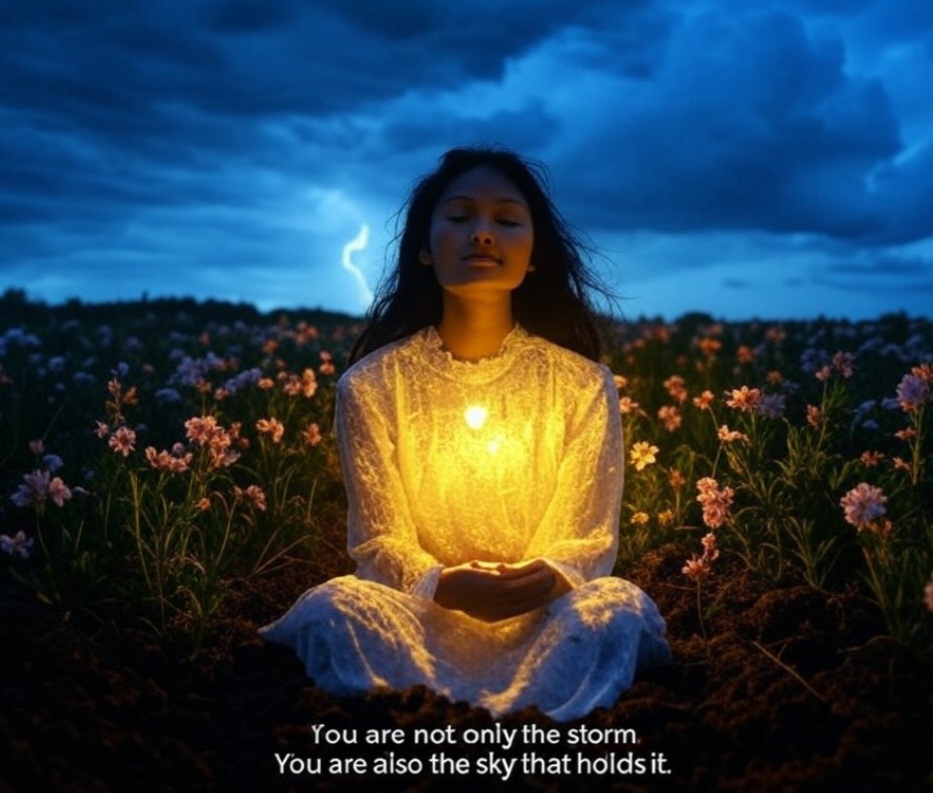
    Witnessing is not about escaping pain but about changing our relationship to it. It is the art of standing at the edge of the storm and seeing not just the thunder, but the vast sky that holds it.

    A Simple Self-Contemplation Practice

    1. Grounding in the Present
      Find a quiet moment. You don’t need perfect stillness—only a willingness to pause. Notice your body, the way it rests against the surface beneath you. Feel the breath, moving in, moving out, like waves against the shore.
    2. Observing Without Resistance
      Turn your attention inward. What is present? Fatigue like heavy earth? A nervous system like sparking wires? A mind that spins, restless and longing? Whatever it is, let it be here. Do not push it away or name it as the enemy. Simply notice.
    3. Holding with Compassion
      Imagine that each sensation is a visitor—arriving, staying for a time, and eventually leaving. What happens if you do not chase them away? What if, instead, you offer a quiet seat at your table?

    Even pain, even exhaustion, when met with this gentle witnessing, begins to soften. Not disappear, but shift—like wind through the trees, no longer trapped, no longer feared.

    How This Practice Supports ME/CFS Symptoms

    This is not a cure, nor a promise of relief, but a way of being with what is. When we meet our experience with openness:

    The nervous system settles; the fight against the body lessens.

    The mind uncoils from frustration and rests in the simple act of seeing.

    The emotional burden lightens, as we stop identifying with suffering and begin to witness it instead.

    Closing Thoughts: The Sky Holds It All

    If today your body feels like a storm, know that you are not only the storm—you are also the sky that holds it. The witness that watches, the stillness beneath the waves.

    And on days when you cannot sit in silence, when exhaustion presses too hard, let even that be witnessed with kindness. The practice is not in perfect stillness, but in the quiet turning toward whatever is here, again and again.

    Rest when you must, breathe when you can, and know that you are not alone.

    🙏🕊🙏

  • Exploring Pristine Mind Meditation for Chronic Fatigue Syndrome: A Path to Effortless Rest

    Exploring Pristine Mind Meditation for Chronic Fatigue Syndrome: A Path to Effortless Rest

    “Discover how pristine mind meditation may offer a gentle, restorative state of awareness without the energy costs that often come with post-exertional malaise.”

    Living with Chronic Fatigue Syndrome means every action, every exertion, has a cost. For many, even a few minutes of focus or effort can lead to post-exertional malaise—a profound worsening of symptoms that can last for days. But what if there was a way to rest deeply, to allow the mind to settle in a way that doesn’t deplete but actually nourishes? This is where the practice of pristine mind meditation comes in, offering an effortless awareness that exists beyond thought, beyond strain, and without the toll of traditional exertion.

    Pristine mind meditation is rooted in the idea of simply being. Rather than trying to clear the mind or enter a specific state, it invites you to rest in pure, unaltered awareness. This isn’t an act of concentration or focus, but a gentle allowing—a way to let thoughts and sensations come and go without attaching or resisting. The experience of resting in the pristine mind is often described as spacious, calm, and effortlessly open. For someone with ME/CFS, this could mean a path to real rest without the demand on physical energy that so often comes with other practices.

    Theoretically, because pristine mind meditation is free from physical or mental strain, it offers a way to access peace and stillness without triggering the kind of post-exertional fatigue that can worsen symptoms. It’s an invitation to explore a new way of being with chronic fatigue, where healing is not about doing but about resting in the quiet awareness that’s already within you.

    This journey is a gentle experiment, a compassionate practice of meeting yourself exactly as you are. Whether you experience even a few moments of pristine awareness or simply rest in the intention, the practice becomes a way of honoring the body’s limits and nourishing the mind. Take this path slowly, with openness, knowing that each step is its own quiet gift.

    If you’re curious, I invite you to join in this exploration, allowing yourself to simply rest in the pristine mind, noticing what it brings without expectation or need for change. This is a practice of ease, not of effort—a resting place for the soul amidst the demands of daily life with Chronic Fatigue Syndrome.

    For those interested in going deeper, much of this understanding is inspired by the teachings in Our Pristine Mind by Orgyen Chowang Rinpoche. His book provides a profound exploration of this approach to awareness, offering guidance on accessing the clear, effortless state of the pristine mind. If this resonates with you, I’ll leave a link below to help you find the book and discover more about this gentle, transformative practice.

    In the name of honoring my chronic fatigue syndrome, I’m experimenting with a different approach to healing. I’m trying out the idea that it doesn’t have to be complicated or effortful—that maybe simplicity and gentle choices can be enough. By tending to myself in this way, I’m exploring what it means to honor both my needs and my limitations, and I’m finding that this, too, might be a path to healing.

    I don’t know all the answers, but I’m noticing that healing isn’t always about pushing or doing more. Sometimes, it’s about making a quiet, deliberate choice to conserve energy, to rest, and to be. This journey toward simplicity and ease feels like a step toward well-being, and I’m curious to see where it leads.

    🙏🕊️🙏

    <!– /wp:spacer →

    🙏🕊️🙏

  • Exploring Dzogchen’s Transformative Path: A Journey into Our Pristine Mind

    Exploring Dzogchen’s Transformative Path: A Journey into Our Pristine Mind

    Reflections on Pristine Awareness, Dzogchen, and Finding Clarity in Challenging Times

    As I sit with Our Pristine Mind in my hands, I am aware that I am not merely reading a book. I am entering a silent conversation with an ancient wisdom, one that gently unfolds its layers with each page, as if lifting the veils of my own mind. In the quiet of early morning or beneath the faint glow of a reading lamp at night, the words begin to sink into the places where thought usually moves too quickly, too restlessly.

    Dzogchen—a word I’ve heard in passing, sometimes as an exotic echo from distant mountains, sometimes as an answer whispered through stories of sages and scholars—is not simply an idea here. It emerges like a breath I have almost forgotten to take, a reminder that within my mind lies a pure, boundless awareness untouched by the cycles of confusion, emotion, or distraction. Dzogchen does not demand; it simply reveals.

    The teacher, Orgyen Chowang Rinpoche, through his voice in Our Pristine Mind, speaks to the essential nature of awareness with a softness that does not impose but invites. I am reminded of Rilke, who once spoke of patience and of growing quietly in one’s own way, like a tree. Here, too, the practice of Dzogchen is like that tree, patient and grounded, yet ever-revealing. It asks nothing from me but presence, a willingness to recognize that what I have been searching for has always been here, beneath the surface of my rushing thoughts.

    Rinpoche speaks to our current world—the difficulties, the fractures, the relentless march of modern life. Dzogchen, he says, has come forward in these times not because it is new, but because we are perhaps ready to see its simplicity. To see that the vastness of pristine awareness is not somewhere far away or reserved for saints and sages. It is here, in the quiet pause between breaths, in the stillness that accompanies an unfiltered experience of now.

    The metaphor of the “brilliant moon in dark times” comes alive as I read, a reminder that even in moments when life feels overcast and filled with turmoil, there exists within us a clear, illuminating presence. Dzogchen does not banish the darkness; rather, it reveals a light that has been hidden within it all along.

    This practice, this profound teaching, calls us to approach life differently—to walk, speak, even think with the awareness that we are not separate from each other, from the world, or from the mind that perceives it all. It is an invitation to cultivate what Rinpoche calls “pristine awareness” in daily life, and this awareness transforms not only how we experience joy but also how we engage with suffering. Even anger, fear, and sorrow are welcomed as parts of the unfolding dance, teachers in their own right.

    The path of Dzogchen, I am learning, is not about leaving this world behind or aspiring to some distant perfection. Instead, it is an opening into a fuller, clearer life here and now—a kind of blossoming from the cold winter of searching into the warm spring of presence.

    If you feel the weight of the world’s challenges or the heaviness of inner obstacles, there is a softness, a kindness in Dzogchen that may resonate. As I explore these teachings, I feel them steadying me, offering a compass to navigate the storms of distraction and disconnection that modern life so often brings.

    And so, I share these reflections with the hope that you, too, may find something here that speaks to your own journey—a word, a phrase, a quiet reminder of the freedom that rests quietly within, waiting to be seen.

    🙏🕊️🙏

    If you’re interested in exploring this transformative approach further, I highly recommend Orgyen Chowang’s book The Pristine Mind. His teachings provide a clear, compassionate path toward uncovering the inherent purity of our mind, offering a source of deep fulfillment and lasting peace.

  • Quote: Thich Nhat Hanh, “In Love and Trust”

    Quote: Thich Nhat Hanh, “In Love and Trust”

    “If we know how to breathe, we will be able to generate the energy of mindfulness and recognize, embrace, and calm our painful feelings within a few minutes. These are essential, basic practices recorded in Buddhist sutras. If we only study the sutras in theory, we’ll never be able to master the practice.”

    ~ From: Thich Nhat Hanh, “In Love and Trust”

    👉 amzn.to/4hTT7fX

    🙏🕊🙏

  • Comforting the Ego Through Self-Inquiry: A Gentle Path into the Mystic

    The Tibetan teaching that the ego is a belief in a separate self with no inherent existence aligns perfectly with the process of self-inquiry. As we engage in the practice, the recognition that the ego has no independent reality allows it to gradually dissolve. What remains is the awareness that transcends the illusion of separation—the true nature of the Self.

    For many years, I’ve engaged in self-inquiry as a way to explore the deeper truth of who I am beyond the ordinary mind. The practice of asking, “Who am I?” or “Whose thoughts are these?” can lead to profound insights, but lately, I’ve realized there’s another layer to the practice that brings even greater depth—compassion for the ego.

    Instead of pushing the ego aside or forcing it into understanding, I’ve come to embrace the role of the comforter. When the ego resists, when it wants to play dumb or keep searching for answers, I gently reassure it:

    “It’s okay. You are That.”
    “Relax. You are That.”

    This approach transforms the practice into a more nurturing experience, where the ego is not an obstacle but a part of the journey toward resting in the truth of our being. By comforting the ego, I allow it to relax into the deeper awareness that is always present, the pristine mind that doesn’t need to figure anything out.

    Addressing the Ego: Creating Space

    What I’ve also discovered is that by addressing the ego as “you”—as though speaking to it in the third person—it creates a subtle but important space between the self and the ego. By saying, “You are That,” I create a gentle distance from the ego, which allows me to shift my identification toward the pristine mind, the awareness that simply knows. This practice helps me settle into the awareness of That, while gently guiding the ego to recognize its true nature.

    It’s a strange but profound feeling to begin identifying with the witness, the part of us that knows, rather than the ego itself. The distance allows the ego to relax, realizing it doesn’t need to figure things out—it just needs to rest in the knowing.

    Dissolving the Ego: Tibetan Insight

    In Tibetan teachings, the ego is understood as a belief in a separate self that has no inherent existence. It is the illusion of separateness that creates suffering, and it is through practices like self-inquiry that this illusion begins to dissolve. By comforting the ego and allowing it to rest in the awareness of That, the ego’s grip on the mind loosens, and its sense of separateness fades. As the ego dissolves, what remains is the truth of our being—unified, whole, and free from the illusion of duality.

    A Practice Rooted in Tradition: Tat Tvam Asi

    The phrase “Tat Tvam Asi”, which translates to “You are That”, is one of the most profound teachings from the Chandogya Upanishad. It comes from the dialogue between the sage Uddalaka and his son Svetaketu, where Uddalaka imparts the ultimate knowledge of the Self to his son.

    In this story, Uddalaka explains that the essence of the individual self (Atman) is identical to the essence of the entire universe (Brahman). He uses various examples from nature, like rivers merging into the ocean, to illustrate that all individual forms are ultimately one with the universal reality.

    The core teaching of “Tat Tvam Asi” is that the true nature of the self is not separate from the ultimate reality, Brahman. This insight is the foundation of Advaita Vedanta and points to the non-duality of existence. It’s a reminder that we are already That—we are not separate from the universal consciousness that pervades everything.

    A Path Forward

    If you’ve been engaging in self-inquiry and find that the ego often resists or overthinks, consider this approach. Become a gentle guide for the ego, allowing it to rest in the awareness of That without needing to figure everything out. With each step, you’re not only going deeper into the Mystic—you’re bringing the ego along in a spirit of kindness and unity.

    Offering the ego loving-kindness and compassion, rather than seeing it as an enemy, can transform the practice into something more nurturing and integrative. By embracing the ego with a Metta-Karuna mindset, we allow for deeper healing and connection, not just for ourselves but for others navigating similar paths.

    Today’s Practice of Self- Inquiry

    The core practice involves asking the question, “Who am I?” But for this practice, we’re using the mantra, “You are That,” to turn our attention inward and explore the space that neither comes nor goes—the pristine mind, our true nature. As we repeat the mantra, we gently direct it toward the space of the ego, with kindness and compassion. In doing so, we shift our identification away from the ego and toward the seer, the awareness that observes all. This process helps peel away layers of identification, bringing our ego closer to the essence of who we truly are.

    Guided Meditation: You are That

    Begin by finding a quiet and comfortable place to sit, where you won’t be disturbed. Close your eyes gently and take a few deep breaths. Feel the rise and fall of your chest, the air entering and leaving your body. With each exhale, let go of any tension in your muscles. Allow yourself to settle into the stillness of this moment, bringing your attention inward.

    Now, in the silence of your mind, introduce the mantra: “You are that.” Let the words flow gently, not as a thought to analyze but as a vibration that resonates within your being. “You are that.”

    As the mantra repeats in your mind, begin to observe the thoughts, sensations, and emotions that arise. Notice how they come and go like clouds passing through the sky. Without judgment, simply recognize them for what they are—temporary movements of the mind, just as waves rise and fall on the surface of the ocean.

    When thoughts or sensations arise, acknowledge them gently. With each arising, remind yourself, “This, too, is a movement in consciousness.” Then, return to “You are that.” Allow this rhythm to deepen your experience.

    When a thought or image captures your attention, gently remind yourself, “You are that.” This thought, too, is part of the vast consciousness in which you exist. Allow the mantra to guide you back, like an anchor to the present moment. “You are that.”

    With each repetition, feel the boundaries between yourself and the world begin to soften. The sense of separateness fades as you connect more deeply with the essence of the mantra. You are not the thoughts, not the body, not the emotions—you are that which is beyond them all. You are that—the awareness, the presence in which everything arises and falls away.

    If the mind wanders, or if any sensations in the body draw your attention, simply return to the mantra, “You are that.” There is no need to push anything away or force any particular state. Just notice, with kindness and patience, and return.

    In time, the mantra may begin to dissolve into the quiet presence that remains. Stay here, resting in the stillness. No effort is needed now—just a gentle awareness of being.

    You are that.

    When you are ready, take a few more deep breaths, feeling the connection between the mantra and the breath. Allow your awareness to expand, taking in the sounds and sensations around you, while keeping that sense of peace and spaciousness within. Slowly open your eyes, and as you return to your surroundings, carry with you the knowing: You are that. Always.

    🙏🕊️🙏

  • A New Beginning: Living with Peace, Chronic Illness, and Self-Compassion

    A New Beginning: Living with Peace, Chronic Illness, and Self-Compassion

    A Visualization and Aspiration for the Future: Creating a Sanctuary of Healing and Mindful Living in My New Apartment.

    As I imagine moving into my new apartment—a warm, inviting space filled with peace and promise—I picture each morning, sunlight streaming through the living room windows, where I’d sit with a cup of herbal tea and meditate, letting my heart rest in the stillness of the morning. The tea would be warm and fragrant, a simple comfort, while the sun’s gentle rays bring a soft natural light, creating a space where I could breathe deeply and feel a sense of calm settle over me. In this new chapter, I feel an inner invitation to rest and renew, to let go of the rush and allow each day to unfold as it would. My illness has taught me that healing requires a gentler pace, and here, I have finally found a sanctuary where I can honor that.

    In my new rhythm, I learn to listen deeply to my body, letting its needs guide my day. Living with chronic fatigue means that some mornings are harder than others, that sometimes even the simplest tasks require patience. Yet, in this space, I find small rituals that bring me comfort—a slow meditation, a warm bath, a quiet meal. Each morning, as I sit in meditation, I let my mind rest like a leaf floating on a still pond, watching thoughts come and go, feeling a spaciousness that extends beyond the physical limitations of illness. In that quiet, I discover a profound acceptance of where I am, a knowing that I am exactly where I need to be.

    The apartment becomes a sanctuary, with each room serving a purpose that supports my journey toward inner peace and gentle self-compassion. My bedroom is dedicated to relaxation, contemplation, and self-care, a space for meditation, yoga, and quiet reflection. In this room, I let my body and mind find stillness, creating a calm, nourishing environment that reminds me to return to myself and rest when I need it most.

    In the living room, I set up a workspace where I can write, a desk by the window where natural light flows in, allowing me to work with a sense of clarity and focus. My writing has become a form of connection—to myself, to others, to the world that often feels distant because of illness. I pour my heart into reflections on acceptance, resilience, and the beauty of slowing down. In my words, I find a way to turn the rawness of chronic illness into a quiet strength, a way to reach out and touch others who might be walking similar paths.

    In the kitchen, I begin to prepare meals with a sense of mindfulness, even when energy is low. I choose to embrace a Sattvic diet, honoring foods that are simple and nourishing, bringing peace to my body as well as my mind. I chop vegetables slowly, savoring their colors and textures, feeling gratitude for the Earth’s abundance. Each meal is a quiet gift to myself, a way to honor my body’s needs without pressure, without judgment. Eating becomes a gentle act of self-love, a reminder that I deserve care, even on the days that feel heavy.

    As the weeks pass, I find that this gentle way of living has softened something within me. I allow myself to feel everything—the grief for the life I once imagined, the loneliness of being in a world that often doesn’t understand, the gratitude for the peace I’ve cultivated. Each emotion becomes part of my journey, a reminder that I am not separate from life’s beauty, even in illness, but deeply connected to it.

    Sometimes, in dreams, I find myself in places that feel isolating or unsettling, and I wake with a heavy heart, a reminder of the losses and longings that have yet to heal. But even in those moments, I sit with myself, as if comforting an old friend, holding space for my own sadness, letting the tears flow. There is no rush to feel better, no need to push the feelings away. Living with ME/CFS has taught me that patience is a quiet form of strength, that even in vulnerability, there is a kind of power.

    Over time, my home becomes a true sanctuary, a place where I can practice the Paramitas—the virtues of compassion, patience, and equanimity—in my own life. When days of low energy come, I practice patience, meeting my body’s needs without judgment, letting it guide me as gently as a leaf floating on a river. Compassion becomes the way I speak to myself, a quiet voice that reminds me that it’s okay to rest, that each small act of care is a step on the path of healing. And equanimity becomes a way of holding my experiences—both joyful and painful—with a heart that understands their place in the bigger picture.

    My illness, though unchosen, has taught me the sacredness of small moments—the warmth of a cup of tea, the beauty of a single breath, the comfort of soft blankets on tired days. I come to see that healing isn’t a destination but a journey of self-compassion, of learning to live in harmony with the life I have, of finding joy in the little things that don’t require energy or grand plans.

    And so, each day, I rise to greet the morning with gratitude, feeling the warmth of sunlight on my face, the gentle pulse of life within me. I move through the day with the knowledge that I am creating a life of meaning, not by doing, but by being—by living each moment with a heart open to the beauty and fragility of existence. I have come to a place of quiet resilience, of finding grace in my limitations, of walking a path of peace that is my own.

    In this sanctuary of my new apartment, I know that I have found a way of living that is both gentle and true, a way of honoring both my strengths and my needs, a way of offering love to myself and the world, no matter how small the gestures. And each night, as I drift off to sleep, I send out a quiet wish for all beings to find the peace and compassion I have found, knowing that, in my own way, I am contributing to a world of kindness and understanding.

    🙏🕊️🙏