🌿A Gentle Reminder Before Reading
This post contains 38 sentences. If you have brain fog or limited energy, please take your time. You don’t need to read it all at once—just absorb what you can, when you can. If you find something helpful, pause and rest before continuing. There’s no rush. This is meant to be supportive, not overwhelming. 💙
Turning Music into a Gentle, Adaptive Practice
Lately, I’ve been reflecting on how much my body has been changing. For a long time, I spent most of my time in bed, and simply sitting up felt like a challenge. But recently, I’ve started to feel just a little stronger, and that’s why I feel drawn to incorporating more sitting and standing into my day. The muscles involved in standing and sitting had atrophied from so much time in bed, so this shift—this ability to stand, even for short moments—feels like a miracle.
As part of this, I’ve been exploring a way to bring music into my life in a way that supports my body instead of draining it.
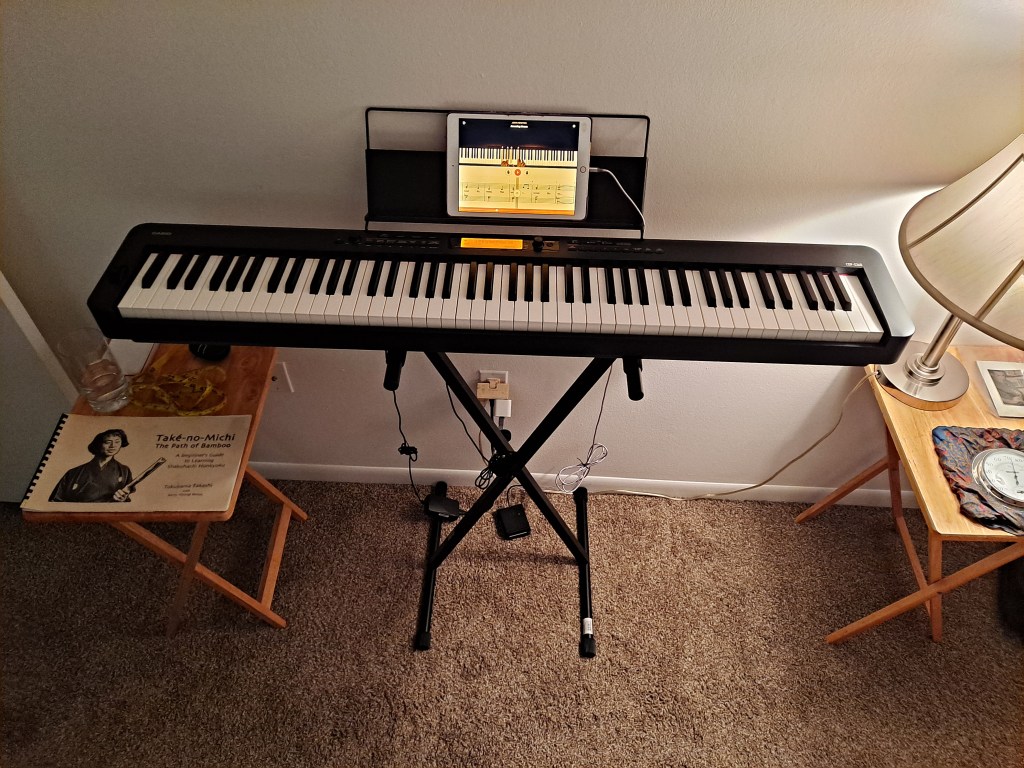
Like many of you, I find that sitting for long periods is uncomfortable, so I decided to raise my keyboard stand to standing height. What I’ve found is that standing while playing allows for gentle movement—I can shift my weight, circle my hips, and let my breath flow naturally, almost like Tai Chi at the keyboard.
But the most important shift has been learning how to relax. I’ve realized that when I play, I tend to hold my breath and tense up, which drains my energy. So my new focus is breathing and playing with as little tension as possible, using a 4-note breathing pattern:
✔ Inhale: A → C → E → C
✔ Exhale: A → C → E → C
This simple rhythm helps me stay grounded, present, and relaxed.
Another key part of this setup is having my keyboard at the end of my bed. This means I can lay down to rest anytime, and when I feel ready, I can stand for just a minute or two to play, then lay back down again. There’s no pressure, no need to push myself—just a gentle cycle of music and rest.
Options for Engaging with Music at Any Energy Level
I know that not everyone has the ability to stand or sit for long, so I wanted to share a few ways to incorporate music at any stage—always prioritizing relaxation and staying within your pacing envelope to avoid PEM.
🎵 Lying in Bed: When I was primarily bedridden and didn’t have a keyboard, I Velcroed my iPad about a foot and a half above my head. This let me lay flat and play simple notes with an app, without any strain. It worked beautifully.
🎵 Small Keyboard for Bed Use: On Facebook Marketplace, you can find very small, lightweight keyboards that you can keep in bed with you. You don’t need a full-size keyboard to start—just something simple to play a few notes when you feel able.
🎵 Seated or Standing with an Adjustable Keyboard: If sitting for long is difficult, you can use a keyboard stand that adjusts in height so you can switch between sitting and standing, allowing for movement and rest as needed.
🎵 Completely Resting & Humming (Minimal Effort Required): For those who need to lay flat and remain mostly inactive, music can still be part of your healing. Some keyboards or apps allow you to automatically play simple notes (like A → C → E → C) very, very slowly. Instead of physically playing, you can simply breathe in rhythm with the notes and gently hum along—only if it feels comfortable. Even this small engagement should be done within your energy limits, ensuring it stays restorative rather than draining.
🎵 Music Visualization (No Physical Effort Required): If even humming feels like too much, you can still experience music through visualization. I used this method when I realized I couldn’t go to the beach anymore—I would simply imagine walking along the shore, and it was surprisingly powerful. In the same way, you can lay in bed and visualize yourself sitting at a piano, pressing one note at a time, hearing the sound in your mind, and breathing gently. You don’t have to hum or move at all—just allow the imagery and imagined sound to soothe you.
The Primary Goal: Relaxation & Parasympathetic Activation
The most important thing is to find the simplest, most relaxing way to engage with music—one that matches your current energy levels and does not trigger PEM. Whether that’s playing, humming, breathing, or simply visualizing, the goal is to activate the parasympathetic nervous system and promote deep rest and healing.
Having a piano that moves with me rather than forcing me to adjust to it has been life-changing. I just wanted to share this in case it helps anyone else looking for a way to bring music into their life—with gentleness, breath, and ease. 💙
 Home Page: Inspirations of Love and Hope
Feel free to leave a comment below.