Tag: wellness

  • Looking Back: 30 Years of Shame and Finally Understanding My Experience

    Looking Back: 30 Years of Shame and Finally Understanding My Experience

    I’ve lived with this illness for over 30 years, and for most of that time I was ashamed of it.

    Doctors kept telling me it was all in my head.

    They said I was depressed, anxious, or that I just didn’t want to work hard enough. They usually prescribed antidepressants and anti-anxiety medications, claiming these drugs would fix me. While the medication may have helped my emotional state somewhat, it did nothing to fix the physical symptoms.

    Thankfully, I eventually stopped letting them gaslight me into taking more and different medications.

    Every time I tried to explain how my body would completely crash after doing normal things, I was met with skepticism or pity.

    So I started doubting myself.

    I felt weak.
    I felt crazy.
    I carried a lot of shame for something I couldn’t control.

    The fatigue and exhaustion that comes with this illness is crushing.

    It’s not normal tiredness. It’s a deep, heavy exhaustion that sleep doesn’t fix. Even the smallest activities can leave me completely wiped out for days.

    My sleep tracker consistently shows that I get adequate deep sleep and REM sleep, yet I still wake up exhausted. That helped me understand something important:

    The problem isn’t simply how much I sleep.

    It’s that my dysautonomia prevents the sleep from being restorative.

    In the early years, the emotional side of it felt a lot like PMS — that same sudden emotional dysregulation, irritability, and feeling completely off — except instead of happening once a month, it could hit at any time.

    Only recently have I finally understood what’s really happening.

    What I have is dysautonomia.

    My autonomic nervous system doesn’t regulate properly anymore.

    That’s why I can suddenly feel freezing cold in a warm room. That’s why I’m much more comfortable lying down than sitting or standing. And that’s why even mild activity can make my whole system short-circuit — suddenly bringing on intense brain fog, overwhelming exhaustion, headaches, insomnia, anxiety, and sometimes depression all at once.

    ME/CFS always felt like an incomplete label to me.

    Yes, I crash after exertion.
    Yes, sleep doesn’t fix it.
    Yes, my body has never functioned the way people expect it to.

    But understanding it as dysautonomia finally explains the day-to-day reality of living in a body whose nervous system breaks down so easily.

    The only thing that actually helps is pacing — staying within my energy envelope.

    I try to live as close to the edge as I can, but carefully. Migraines and tinnitus have become warning signs for me. If I respect those early signals, I can often avoid triggering insomnia, which is far worse than a regular crash and completely throws me off balance.

    After 30 years, I’ve finally stopped blaming myself.

    That alone has been healing.

    I’m sharing this journal entry in case it gives someone else a little more language for their own experience.

    And for family members, friends, and doctors: please know that when we keep turning down invitations, or seem withdrawn, or disappear for long stretches of time, it’s not because we don’t want to be around you.

    Our energy is extremely limited.

    We have to be very careful to avoid crashes.

    Even now, I keep a little journal between doctor visits so I can clearly communicate what I’ve been experiencing. If you’re struggling to explain this illness during appointments, writing things down and bringing it with you can be incredibly helpful.

    Sometimes understanding does not cure the body.

    But it can begin to release the shame.

    And after so many years of being misunderstood, that matters.

  • Slow-Cooked Brown Rice Congee for Gentle Strength

    Slow-Cooked Brown Rice Congee for Gentle Strength

    There are some foods that feel less like meals and more like companions. This congee is one of them. It doesn’t hurry. It doesn’t stimulate. It simply stays—warming, softening, and offering quiet nourishment to a body that may already be carrying more than its share.

    Slow-cooked over several hours, this brown rice congee is especially suited for times of fatigue, recovery, or convalescence. It is gentle on digestion, deeply hydrating, and built around ingredients long respected in Traditional Chinese Medicine for supporting Qi, Blood, and Essence without strain.


    Ingredients

    • ½ cup brown rice, rinsed
    • Plenty of water (approximately 8–10 cups, adding more as needed)
    • 1 tablespoon mung beans
    • 2 carrots, sliced
    • 2 shiitake mushrooms, sliced
    • Fresh ginger, a few thin slices (to taste)
    • 1-inch piece American ginseng
    • Black tree fungus (wood ear), soaked and sliced
    • Jujube (red dates), added toward the end
    • Goji berries, added toward the end
    • A small pinch of salt

    Optional Protein (about ¼ lb):

    • Tofu (soft or medium)
    • White fish
    • Chicken
    • Beef or other gently cooked meats

    Method

    Place the rinsed brown rice and mung beans into a large pot with plenty of water. Bring to a gentle boil, then reduce the heat to a very low simmer. Add the carrots, shiitake mushrooms, ginger, American ginseng, black tree fungus, and a small pinch of salt.

    If using a protein, add it now, choosing preparations that are simple and lightly cut. Cover loosely and allow the congee to cook slowly for about four hours, stirring occasionally and adding water as needed. The goal is a soft, porridge-like consistency, with the rice grains breaking down into a smooth, nourishing base.

    During the final 20–30 minutes of cooking, add the jujube and goji berries. This preserves their gentle sweetness and medicinal qualities without overcooking them.

    Taste and adjust seasoning if needed. Let the congee rest briefly before serving.


    A Quiet Reflection

    This is the kind of food that asks very little of you.

    While it cooks, you are free to rest. While you eat, there is nothing to solve or fix. Each spoonful feels like it arrives already listening, already aware of the body’s limits.

    Congee has long been considered a healing food not because it is powerful in the dramatic sense, but because it is willing to be humble. It meets weakness without judgment and strength without force.


    Nutritional Perspective (Western View)

    From a nutritional standpoint, this congee offers:

    • Complex carbohydrates from brown rice, providing slow, steady energy without blood sugar spikes
    • Dietary fiber to support gut health and gentle detoxification
    • Beta-carotene and antioxidants from carrots and goji berries
    • Immune-supportive compounds from shiitake mushrooms
    • Anti-inflammatory properties from fresh ginger
    • Hydration support, as the high water content aids circulation, digestion, and cellular repair

    Because it is soft and well-cooked, nutrients are easier to absorb—especially important for those with compromised digestion or low energy reserves.


    Traditional Chinese Medicine Perspective

    In TCM, congee is often prescribed when the Spleen and Stomach need support—particularly in cases of fatigue, deficiency, or post-illness recovery.

    • Brown rice strengthens the Spleen and provides stable Qi
    • Carrots gently tonify Blood and support digestion
    • Shiitake mushrooms support Wei Qi (defensive energy) and immune resilience
    • American ginseng nourishes Yin and Qi without overstimulation, making it especially suitable for chronic fatigue or heat-with-deficiency patterns
    • Black tree fungus supports Blood, moistens dryness, and benefits circulation
    • Jujube (red dates) harmonize the formula, nourish Blood, and calm the Spirit (Shen)
    • Goji berries nourish Liver and Kidney Yin, gently supporting vitality and vision
    • Ginger warms the middle burner, aiding digestion and preventing stagnation

    Taken together, this congee is balancing rather than forcing—supportive of long-term vitality rather than short-term energy spikes.


    A Final Note

    This dish can be eaten warm throughout the day, thinned with additional hot water if needed, and adapted gently over time. It is forgiving, flexible, and kind—qualities worth cultivating both in the kitchen and in ourselves.

    May it nourish not only the body, but also the quiet confidence that healing does not need to be rushed.

  • The Gentle Pour: A Yogurt-Making Meditation

    The Gentle Pour: A Yogurt-Making Meditation

    Cultivating Quiet Joy Through Simple, Homemade Nourishment

    There’s a quiet joy that comes from creating something nourishing with your own hands — not out of ambition or perfectionism, but out of love. This week, that joy arrived as a gallon of fresh, homemade yogurt: simple, creamy, and alive with the subtle tang of life unfolding in stillness.

    I began with just two ingredients — a gallon of whole, organic milk and a few spoonfuls of Siggi’s organic yogurt, rich with live cultures. Nothing complicated. Just what nature and time provide.

    The Process

    The milk was gently warmed to about 180°F, a soft simmering that whispers rather than boils — a point where the proteins prepare to transform. Then, I let it cool back to body temperature, around 110°F, the warmth of gentle touch.

    At that moment, I stirred in four tablespoons of Siggi’s yogurt, awakening the living cultures that would guide the milk’s slow metamorphosis.

    Instead of using an appliance or maintaining constant heat, I poured the warm mixture into a stainless steel Stanley XL wide-mouth thermos — a vessel that holds warmth the way a meditation cushion holds stillness. For seven undisturbed hours, the milk rested in silence, transforming quietly in its own rhythm.

    That night, it went into the refrigerator to settle and thicken. By morning, it was perfect — smooth, drinkable, and gently tangy. Not too thick, not too thin. A gentle pour, alive and refreshing.

    The Alchemy of Yogurt

    Yogurt’s origins trace back thousands of years — likely discovered by shepherds who carried milk in animal-skin pouches across the warm plains of Central Asia. Natural bacteria, always present in the air and milk, transformed the liquid into something thicker, tangier, and far more enduring. From there, it traveled across cultures — becoming dahi in India, mast in Persia, leben in Egypt, and yoghurt in the Balkans and beyond.

    Wherever it went, it carried the same truth: that with warmth, patience, and a little faith, life renews itself. Yogurt is, in essence, a relationship — between milk and microbe, human and nature.

    Nourishment and Benefits

    Homemade yogurt retains its vitality. It’s filled with live, active cultures that support digestion, calm inflammation, and replenish the microbiome — a living mirror of harmony within. Its natural balance of protein, fat, and probiotics offers steady, gentle nourishment without heaviness.

    For those of us who live with chronic illness or fluctuating energy, it is especially kind. Making it requires little effort, yet the result offers deep nutrition. Each sip feels restorative — a quiet companion for breakfast or a soothing evening drink before rest.

    The Gentle Practice

    Yogurt-making, like meditation, cannot be rushed. It happens when you step aside, when you allow warmth and time to do their subtle work. In that sense, it becomes more than food — it becomes a reminder: that healing and transformation unfold best in stillness, when we trust the process.

    This first batch will not be the last. Each new jar will carry a bit of the previous one, like a lineage of living kindness — simple, sustaining, and full of quiet joy.


    A Few Tips for Your Own Yogurt Journey

    🌿 Choose good ingredients. Whole milk (organic if possible) and a high-quality yogurt with live active cultures make all the difference. The better the beginning, the purer the result.

    🌡️ Mind the temperatures. Heat milk to around 180°F (82°C), then cool it gently to 110°F (43°C) before adding your starter. Too hot, and the cultures will perish; too cool, and they may not awaken.

    🥄 Add your starter with care. About 2–4 tablespoons per quart (liter) of milk is ideal. Stir gently — this is not a whisking, but a kind introduction.

    ☕ Keep it warm and undisturbed. A thermos, insulated jar, or even a cozy towel wrap keeps the temperature steady. Stillness is part of the process.

    ❄️ Chill before stirring. Once it sets, refrigerate for several hours to help it firm and develop flavor.

    💫 Save a little for next time. Before finishing your batch, set aside half a cup to use as your next starter. It will carry forward the living lineage of your yogurt.

    🥰 Trust your senses. If it smells clean and pleasantly tangy, it’s good. If it smells off or yeasty, it’s time to begin anew. Every batch teaches something.


    Perhaps this new category — Homemade, Nutritious, and Delicious — will become a sanctuary for simple recipes like this: foods that heal body and spirit, each one a meditation on patience, gratitude, and renewal.

    In the Spirit of Global Wellbeing

    At Global Wellbeing, we believe that every small act of mindful living contributes to the healing of our world. A bowl of homemade yogurt, lovingly prepared, becomes more than food — it becomes a gesture of peace. In making something simple, wholesome, and alive, we remind ourselves that nourishment begins with presence, and that caring for the body is inseparable from caring for the spirit.

    May this practice of gentle creation inspire others to rediscover the sacred in the ordinary — one quiet, nourishing moment at a time.

  • Introducing the ME/CFS Wellness Companion (A Work in Progress)

    Introducing the ME/CFS Wellness Companion (A Work in Progress)


    For those living with Myalgic Encephalomyelitis / Chronic Fatigue Syndrome (ME/CFS), Long COVID, or any energy-limiting illness, daily life can feel like an obstacle course without a map. Simple tasks become monumental. Rest becomes survival. And advice from the outside world often misses the mark entirely.

    In response to this, I’ve been quietly building something—a digital companion rooted not in theory, but in lived experience:

    The ME/CFS Wellness Companion

    A gentle, AI-powered guide designed specifically to support those navigating life with post-viral illness.


    What Is It?

    The Wellness Companion is a customized GPT (Generative AI) model, trained not on generic health advice, but on real-life tools, practices, recipes, and reflections from my living with ME/CFS for over 30 years.

    It doesn’t tell you to “push through.”
    It won’t ask you to “exercise more.”
    It does ask:
    “Are you in the RED, YELLOW, or GREEN today?”


    The Energy Color System

    This is the foundation of the Companion’s guidance:

    • RED Zone: Deep fatigue, post-exertional malaise, sensory overwhelm. The focus is full rest, breath, stillness, and nervous system support.
    • YELLOW Zone: Fragile stability. Gentle movement, light nourishment, and mindful pacing are encouraged—with regular check-ins.
    • GREEN Zone: A rare or improved state of function. Still careful, but open to creativity, light structure, or small projects.

    Every recommendation is tailored to your zone—so you’re never being pushed beyond your limits.


    What It Offers:

    • Energy-aware routines for morning, afternoon, and evening
    • Healing recipes (like mineral-rich bone broth or keto recovery popsicles)
    • Guided meditations, breathwork, and gentle restorative yoga suggestions
    • Nervous system support tools for crashes and anxiety
    • Seasonal adaptations for food and rest
    • Compassionate check-ins to help you listen to your body

    Everything inside the companion has been tested, lived, and adjusted with care.


    Why I’m Sharing This

    Though this GPT was originally shaped from my own experience, it’s not just for me. It’s for all of us—those whose lives have been reshaped by chronic illness, who often feel invisible or misunderstood.

    My Sankalpa (sacred intention) is to pass forward what has helped me, so others don’t have to start from scratch.


    How It Will Work

    The model is still in development. Eventually, it will be uploaded with a full file of routines, recipes, pacing guidance, and reflective practices.

    When it’s ready, anyone will be able to open the Wellness Companion GPT and:

    • Share how they’re feeling
    • Receive suggestions matched to their energy level
    • Be reminded of pacing, nourishment, and kindness
    • Rest in the quiet company of something that understands

    Would You Like to Help?

    If you have ideas, routines, tools, or practices that have supported you on your journey with ME/CFS, I’d love to hear from you. This is a living, growing project, and your voice could shape how the Wellness Companion serves others.

    Please feel free to reach out or leave a comment below. I’ll continue posting updates as the project unfolds.


    As we shape this Wellness Companion—may it always serve the highest good.

    May those who seek healing be met with gentleness.
    May those who carry invisible burdens find rest.
    May those who offer their wisdom help light the path.
    And may this work—rooted in care—
    help bring us closer to a world
    where technology honors tenderness,
    and presence becomes medicine.

    🙏🕊🙏


  • Healing Earth Tonic: A Golden Tea Blend for Gentle Restoration

    Healing Earth Tonic: A Golden Tea Blend for Gentle Restoration


    Category: Sacred Kitchen: Home Remedies from the Heart


    What follows is not medical advice, but a personal offering from my own experience with chronic illness, healing, and the quiet wisdom of traditional home remedies. Please listen to your body, and consult a healthcare provider as needed.


    Healing Earth Tonic

    A Golden Tea Blend for Gentle Restoration

    This tea came to life on a slow, quiet healing day. I was nursing a cold and moving gently through the rhythm of tea, soup, and rest. I found myself drawn to the golden light of turmeric, the warmth of ginger and cinnamon, the steadiness of coconut oil—and the quiet alchemy that comes when these ingredients are stirred with presence.

    What emerged is something I now call Healing Earth Tonic—a grounding, nourishing blend inspired by the ancient Ayurvedic traditions of India, and by the intuitive medicine of the home kitchen. It’s not a prescription—it’s a small act of care.


    The Recipe

    Ingredients:

    • 2 tbsp turmeric powder
    • 1 tbsp ground ginger
    • 1/4 tsp black pepper
    • 1 tsp cinnamon
    • 1/2 tsp cardamom
    • 1/2 tsp nutmeg
    • 2 tbsp coconut oil (optional, but enhances absorption and grounding) Note: the beauty of adding coconut oil. Turmeric’s active compound, curcumin, is fat-soluble, which means it absorbs much better in the body when consumed with a healthy fat like coconut oil or ghee. And since coconut oil is shelf-stable, adding just a little can help make it a soft, spoonable blend without risking spoilage—especially if everything else is dry.

    Instructions:

    1. Mix the dry ingredients in a clean glass jar.
    2. Add coconut oil and stir until the blend becomes soft and sand-like.
    3. Store sealed at room temperature.

    How to Use It

    • Stir ½ to 1 teaspoon into hot water or warm milk (dairy or plant-based).
    • Stir frequently as it cools, then sip slowly and mindfully.
    • Best enjoyed with food, especially if you’re sensitive to warming spices.
    • A gentle healing rhythm might be 1 to 2 cups a day.

    Why These Ingredients?

    This blend draws on centuries of Ayurvedic wisdom:

    • Turmeric (Haridra) – anti-inflammatory, immune-supportive, and purifying.
    • Black Pepper (Maricha) – enhances absorption of turmeric, kindles digestion.
    • Ginger (Shunthi) – supports circulation, relieves nausea, and clears stagnation.
    • Cinnamon & Cardamom – soothe the breath, calm the heart, and comfort the spirit.
    • Coconut Oil – grounding, nourishing, and helps the body absorb fat-soluble compounds.

    In Ayurveda, such blends are known as rasayanas—rejuvenating tonics that restore balance gently, through warmth, presence, and consistency.


    A Blessing for Your Cup

    May this tea bring warmth to my body, clarity to my mind, and gentleness to my heart.
    May it carry the memory of the earth’s wisdom and the care with which it was made.
    May I receive its healing fully, and offer that peace quietly into the world.


    If you try making this blend—or share it with a friend—I’d love to hear how it lands in your body and spirit. These small rituals connect us, not just to healing, but to one another.


    Living Tea: A Gentle Ritual of Reuse and Renewal

    One simple practice I’ve come to love is reusing herbal teabags throughout the day. Teas like Sleepytime, Bengal Spice, and Turmeric Vitality still hold healing qualities after their first steep. With each cup, the flavor softens, and a bit more of the herbs’ medicine is released. I call this living tea—a quiet, ongoing relationship with the herbs.

    As the flavor fades, I often add a small spoonful of Healing Earth Tonic to deepen the warmth and support. It’s a way of honoring what I’ve already brewed, and letting each cup carry forward something of the last. It’s simple, thrifty, and a small act of care for both body and planet.

  • 🙂 Turning Music into a Gentle, Adaptive Practice While Living with Chronic Fatigue (ME/CFS)

    🙂 Turning Music into a Gentle, Adaptive Practice While Living with Chronic Fatigue (ME/CFS)

    🌿A Gentle Reminder Before Reading

    This post contains 38 sentences. If you have brain fog or limited energy, please take your time. You don’t need to read it all at once—just absorb what you can, when you can. If you find something helpful, pause and rest before continuing. There’s no rush. This is meant to be supportive, not overwhelming. 💙

    Turning Music into a Gentle, Adaptive Practice

    Lately, I’ve been reflecting on how much my body has been changing. For a long time, I spent most of my time in bed, and simply sitting up felt like a challenge. But recently, I’ve started to feel just a little stronger, and that’s why I feel drawn to incorporating more sitting and standing into my day. The muscles involved in standing and sitting had atrophied from so much time in bed, so this shift—this ability to stand, even for short moments—feels like a miracle.

    As part of this, I’ve been exploring a way to bring music into my life in a way that supports my body instead of draining it.

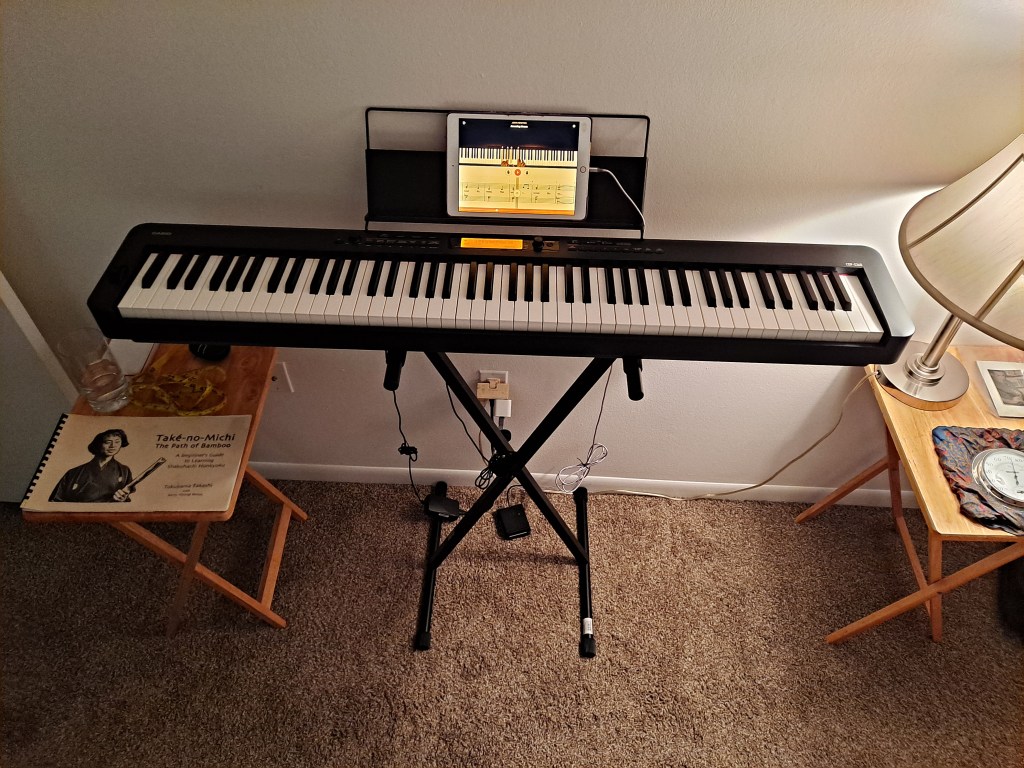
    Like many of you, I find that sitting for long periods is uncomfortable, so I decided to raise my keyboard stand to standing height. What I’ve found is that standing while playing allows for gentle movement—I can shift my weight, circle my hips, and let my breath flow naturally, almost like Tai Chi at the keyboard.

    But the most important shift has been learning how to relax. I’ve realized that when I play, I tend to hold my breath and tense up, which drains my energy. So my new focus is breathing and playing with as little tension as possible, using a 4-note breathing pattern:
    ✔ Inhale: A → C → E → C
    ✔ Exhale: A → C → E → C
    This simple rhythm helps me stay grounded, present, and relaxed.

    Another key part of this setup is having my keyboard at the end of my bed. This means I can lay down to rest anytime, and when I feel ready, I can stand for just a minute or two to play, then lay back down again. There’s no pressure, no need to push myself—just a gentle cycle of music and rest.

    Options for Engaging with Music at Any Energy Level

    I know that not everyone has the ability to stand or sit for long, so I wanted to share a few ways to incorporate music at any stage—always prioritizing relaxation and staying within your pacing envelope to avoid PEM.

    🎵 Lying in Bed: When I was primarily bedridden and didn’t have a keyboard, I Velcroed my iPad about a foot and a half above my head. This let me lay flat and play simple notes with an app, without any strain. It worked beautifully.

    🎵 Small Keyboard for Bed Use: On Facebook Marketplace, you can find very small, lightweight keyboards that you can keep in bed with you. You don’t need a full-size keyboard to start—just something simple to play a few notes when you feel able.

    🎵 Seated or Standing with an Adjustable Keyboard: If sitting for long is difficult, you can use a keyboard stand that adjusts in height so you can switch between sitting and standing, allowing for movement and rest as needed.

    🎵 Completely Resting & Humming (Minimal Effort Required): For those who need to lay flat and remain mostly inactive, music can still be part of your healing. Some keyboards or apps allow you to automatically play simple notes (like A → C → E → C) very, very slowly. Instead of physically playing, you can simply breathe in rhythm with the notes and gently hum along—only if it feels comfortable. Even this small engagement should be done within your energy limits, ensuring it stays restorative rather than draining.

    🎵 Music Visualization (No Physical Effort Required): If even humming feels like too much, you can still experience music through visualization. I used this method when I realized I couldn’t go to the beach anymore—I would simply imagine walking along the shore, and it was surprisingly powerful. In the same way, you can lay in bed and visualize yourself sitting at a piano, pressing one note at a time, hearing the sound in your mind, and breathing gently. You don’t have to hum or move at all—just allow the imagery and imagined sound to soothe you.

    The Primary Goal: Relaxation & Parasympathetic Activation

    The most important thing is to find the simplest, most relaxing way to engage with music—one that matches your current energy levels and does not trigger PEM. Whether that’s playing, humming, breathing, or simply visualizing, the goal is to activate the parasympathetic nervous system and promote deep rest and healing.

    Having a piano that moves with me rather than forcing me to adjust to it has been life-changing. I just wanted to share this in case it helps anyone else looking for a way to bring music into their life—with gentleness, breath, and ease. 💙

  • When the Body Speaks: A Letter on ME/CFS and Forgiveness

    When the Body Speaks: A Letter on ME/CFS and Forgiveness

    Today, I felt it coming—a noxious wave rising from deep within. A bright, warning orange sliding straight into red, and before long, a full-blown crash. The heaviness in my limbs like wet sand, my mind fogged and thick. The weight of having done too much, more than my body could tolerate, more than it could carry.

    I knew this would happen. I overrode my limits packing, moving into a new apartment, settling in when my body was already whispering, slow down. But I kept going. And now, here I am.

    This morning, in a PEM-crazed state of mind, I did something else I knew wasn’t wise—I ate an entire loaf of bread. I reached for it like it might offer some relief, some fleeting comfort, slice by slice until it was all gone. But now I just feel worse: bloated, sick, heavy in a way that no food could fix. And of course, the familiar wave of guilt followed: Why did I do that? I can’t believe I did that. I know this pattern—how PEM twists my mind, makes cravings louder, decision-making foggier. And yet, here I am again.

    But here’s the thing. This doesn’t mean I’ve lost my way. It doesn’t mean I’ve failed. It just means I’m human—living in a body that doesn’t follow predictable rules. A body that sometimes rebels, sometimes collapses under the weight of what life demands.

    At some point, reason kicks back in. The first step, as always, is acceptance. Not resignation, but a soft compassion: This is where I am right now. It’s uncomfortable, yes. It’s frustrating, absolutely. But fighting it only adds another layer of exhaustion. So finally, after feeling terrible—and feeling terrible about feeling terrible—I plugged in my heating pad, got into bed, and let the warmth settle over my belly. I let it offer some small comfort to my sore muscles, as I let myself be.

    I know this will pass. The intensity will soften. My body will find its rhythm again. And when it does, I’ll carry this experience with me—not as a failure, but as another piece of the story. Another reminder that healing isn’t linear, and self-compassion is the only constant I can truly lean on.

    If you’ve found yourself here too—in the middle of a crash, tangled in frustration or guilt—I hope you know you’re not alone. We all override our limits sometimes. We all make choices that don’t feel wise in hindsight. But none of that means we’re failing. It just means we’re living, doing the best we can in bodies that ask for more patience than most people can imagine.

    So here’s to resting when we need to. To forgiving ourselves when we falter. To remembering that even in the hardest moments, there is still space for gentleness.

    With warmth and understanding,

    Richard

    🙏🕊🙏

  • The Quiet Art of Pacing: Living with ME CFS

    The Quiet Art of Pacing: Living with ME CFS

    There is a kind of life that moves beneath the surface of what others might call living—a life that hums in the pauses, in the spaces where action halts and breath lingers. For those of us with Myalgic Encephalomyelitis/Chronic Fatigue Syndrome (ME CFS), life unfolds not in grand gestures but in the delicate negotiation between movement and stillness, between doing and being.

    It is a life measured in moments of energy so fleeting and precious that they slip through our fingers like water if we are not careful. And so, we learn to hold them gently. We learn the art of pacing—a quiet, intricate dance with the body, the mind, and time itself.


    Listening to the Whisper Beneath the Noise

    At first, pacing may seem like a restriction, a bridle holding you back from the gallop of life. But in time, if you listen closely—no, not just listen, but feel—you realize it is not a prison but a kind of language your body speaks. A whisper beneath the noise.

    There is a moment, just before the crash comes, when the body begins to murmur. A soft weight behind the eyes, a flicker of thought that stumbles, a breath that feels heavier than the last. These are the early signals, the body’s gentle plea: pause.

    It is in this space, between the whisper and the roar, that pacing lives.


    The Shape of a Day, Redrawn

    Pacing is not about doing less; it’s about doing differently. It is the re-imagining of time, the reshaping of how a day unfolds. Where once you might have filled your hours with tasks and plans, now you learn to weave rest into the rhythm of your day, like threads of gold through ordinary cloth.

    You might wash the dishes, but not all at once. You pause midway, let the water cool on your hands, and sit quietly, letting your breath find its rhythm again. You might write an email, but only after resting first, and you’ll rest again afterward—because even thinking, even hoping, takes energy you no longer have in abundance.


    Finding Rest in Unexpected Places

    And rest—ah, rest is not always what the world thinks it is. Rest is not just lying in bed, staring at the ceiling while the mind races ahead of the body’s capacity. Rest can be the soft drift of music filling the room, or the slow tracing of light as it moves across the wall in the late afternoon. Rest can be found in the spaces between thoughts, in the warmth of a cup of tea held in still hands.

    Rest becomes an art of presence, of being where you are without pushing against the boundaries of what is possible today.


    The Creative Dance of Energy

    Some days, you find new ways to move within these limits, like an artist working within the edges of a canvas. You might use technology as a bridge—a voice-activated assistant that changes the song when you’re too tired to lift a finger, or a reminder app that gently nudges you when it’s time to pause.

    You might practice the delicate balance of task rotation: a bit of writing, then a moment watching the sky; folding laundry, but only after you’ve closed your eyes for a while. You discover the gift of delegation, the quiet courage in asking for help, and the grace in receiving it.

    Some days, even the lightest touch of movement—a stretch, a breath, the soft turning of your neck toward the window—feels like enough. And it is.


    The Emotional Currents Beneath It All

    But there is more than the body to tend to. There is the heart, too, learning to live with the grief of lost abilities. There are days when you long for the world you once knew, for the ease of spontaneity, for the thoughtless rush of energy that now feels like a distant memory.

    Yet, in the slowing down, in the careful pacing, you may find something unexpected: a deeper presence, a richer noticing of life’s quiet details. The way the morning light catches in the folds of your blanket. The softness in the voice of a friend who understands. The tender resilience that blooms in the space where struggle meets acceptance.


    Living Within, and Beyond, the Limits

    Pacing is not a giving up. It is a learning to live differently. It is an intimate conversation with yourself, a deep knowing of what you can do and when to stop. It’s about honoring the ebb and flow of your energy, like tides that you no longer fight but learn to move with.

    And in this dance, in this art of balancing effort and ease, you find that life still holds beauty—not in spite of the limits but sometimes because of them. The smallest joys become treasures, and the quiet moments shimmer with meaning.

    Because even within the narrowest confines, life finds a way to bloom.


    🙏🕊🙏

  • A Refuge That’s Never Truly Out of Reach

    A Refuge That’s Never Truly Out of Reach

    For those of us living with chronic fatigue syndrome (ME/CFS), finding peace can often feel like an elusive dream. The body aches, the mind fogs, and even the simple act of resting can feel like a challenge.

    But beneath the surface of our struggles—beneath the exhaustion, frustration, and the endless cycle of unfinished stories—there is a refuge that has never left us. A place within that remains untouched, waiting patiently to be noticed.

    Across traditions, this inner sanctuary is described in many ways. In Christianity, it is the peace that passeth understanding, the quiet presence of the Holy Spirit that calms the heart. In Buddhism, it is our Buddha nature, the still, pristine mind that shines beneath our thoughts. In Jewish practice, Shabbat offers a sacred pause from the world’s demands, a time to rest in the presence of the I AM. Whether through Vipassana’s gentle observation, Samatha’s calming focus, or the surrender of “Let go and let God,” the invitation is the same: to rest in the peace that is always there, even if just for a moment.

    But here’s the truth that many of us don’t expect—when we set the intention to relax, to find that peace, it’s common for our minds to do the exact opposite. The very moment we try to slow down, all the unsettled thoughts, worries, and frustrations rise to the surface. It’s like sitting down to meditate and suddenly realizing just how noisy the mind really is. For those of us with ME/CFS, this can feel especially overwhelming. Our bodies are already weighed down by fatigue, and now our minds seem unwilling to give us the rest we crave.

    But this isn’t a sign of failure—it’s part of the process. Just as clouds drift across the sky without altering the vastness behind them, our thoughts come and go without touching the deeper peace within us. The key is not to fight these thoughts, not to grow frustrated or discouraged, but to witness them with gentle curiosity. To let them rise and fall, trusting that underneath the noise, the stillness remains.

    This practice takes more than just patience—it requires self-compassion. We have to be kind to ourselves, especially when the mind feels restless or when peace feels far away. Forgiveness becomes a part of the journey: forgiving ourselves for not feeling better, for being frustrated, for wishing things were different. And most of all, it requires surrender. To let go of the need to control how or when peace arrives, and to trust that it will reveal itself in its own time.

    Over the past month, I’ve faced one challenge after another—the sale of my RV, packing up a home that had been my refuge for over 30 years, and the physical demands of moving into a new apartment. Each step of the process required me to push beyond my body’s natural limits, triggering post-exertional malaise. There were moments I had to override the signals of fatigue just to get through the next task, knowing full well the cost it would bring later. And yet, I approached it as mindfully as I could, listening when possible, resting when needed, and trusting that I would eventually return to the gentle rhythm of proper pacing.

    Now, as I settle into this new space, I look forward to reclaiming that mindful practice of pacing—of finding the balance between effort and rest, between doing and simply being. Even though my body is still recovering, I know that the peace I’m seeking is not dependent on my circumstances. It’s always there, beneath the surface, waiting for me to slow down, to breathe, and to notice.

    And so, I offer this to you—whether you live with ME/CFS, face chronic challenges, or are simply navigating the complexities of life. The path to peace isn’t always smooth, and the mind may resist at first. But beneath the noise, the frustration, and the exhaustion, there is a refuge that has never left you. It’s not something you have to create or chase—it’s already there, waiting to be noticed.

    Let go. Be kind to yourself. Trust the process.

    And when you least expect it, that peace—the one that passeth understanding, that shines with the light of your Buddha nature, that whispers with the breath of the Holy Spirit—will rise to meet you.

    Because the truth is, that refuge is never truly out of reach.

    🙏🕊🙏

  • This Simple Practice Could Transform Life with ME/CFS—Feel Free to Ask Questions or Share Your Thoughts! 👍

    This Simple Practice Could Transform Life with ME/CFS—Feel Free to Ask Questions or Share Your Thoughts! 👍

    Resting in the Stillness of Witness Consciousness:

    To rest in Witness Consciousness is to embrace the stillness that exists beneath the surface of all thoughts, sensations, and emotions. It is the quiet awareness that watches without judgment, attachment, or resistance. Begin by settling into a comfortable position and turning your attention inward. Notice the thoughts or feelings that arise, but instead of engaging with them, observe them as you would clouds passing through a vast, open sky. With each breath, allow yourself to sink deeper into the stillness that holds everything. In this state of spacious awareness, you can release striving and simply be, knowing that your true self—the witness—is always present, whole, and at peace. Rest here, in the gentle embrace of the present moment, where the burdens of the mind are lifted, and the essence of stillness is revealed.

    Living with chronic fatigue syndrome (ME/CFS) brings immense challenges, not only to the body but also to the mind. The limitations imposed by this debilitating illness—constant fatigue, pain, and reduced capacity—can lead to frustration, grief, and a restless mind struggling to accept a life that feels constrained. In such a reality, the practice of meditation and cultivating witness consciousness becomes a refuge. By training the mind to rest in stillness and observe thoughts, emotions, and sensations without attachment, we can find a sense of inner peace amidst the turbulence. Witness consciousness helps us step back from our suffering, creating a space where we can gently acknowledge our experiences without being consumed by them. This compassionate awareness offers not only relief but also a pathway to greater resilience, even in the face of profound physical challenges.

    For centuries, human beings have grappled with the challenges of their minds. In simpler times, free of today’s overwhelming distractions, people focused on surviving through work, relationships, and health. Yet, even then, the teachings of the Buddha recognized the mind as the source of both suffering and liberation, offering practices to cultivate awareness and find peace amidst life’s trials.

    Today, the challenges of the mind remain, but they are compounded by endless distractions—technology, entertainment, and the allure of constant stimulation. These temporary escapes may numb the restless mind, but they do not heal its core discontent. The wisdom of meditation and mindfulness remains vital, offering a path back to inner stillness, even as the modern world pulls us in countless directions. Whether in the quiet of ancient times or the noise of today, the path of presence and witness consciousness offers clarity, resilience, and peace to those who walk it.

    Conclusion: An Invitation to Explore Witness Consciousness

    Witness Consciousness offers a refuge for anyone seeking peace amidst the challenges of living with chronic fatigue syndrome (ME/CFS). By embracing this practice, we learn to release the grip of mental and emotional struggles, finding a stillness that can transform our relationship with illness and limitations. This journey of cultivating awareness and resting in the present moment is not only a path to inner peace but a way to reconnect with the profound resilience and wisdom already within us.

    I invite you to share your experiences or questions as you explore this practice. Whether you are new to meditation or looking to deepen your journey, your insights and reflections are invaluable. Let’s create a space of shared learning and support, where we can grow together in this practice of stillness and presence.

    Please feel free to share and let others know if you find this practice of cultivating a Witness Consciousness of benefit to your experience of living with ME/CFS.

    🙏🕊🙏

  • The Importance of Relaxation in Self-Inquiry: A Gentle Approach to Inner Discovery

    The Importance of Relaxation in Self-Inquiry: A Gentle Approach to Inner Discovery

    In the pursuit of self-inquiry, there is often a deep yearning to know oneself—to find the answers to the eternal questions that reside within the heart. Yet, the path of inquiry is not one of intellectual striving or relentless effort. Rather, it is the practice of deep relaxation, allowing us to meet ourselves with softness and patience, where the answers we seek are revealed in the quiet moments of being.

    Self-inquiry, often associated with the profound teachings of the great sages and mystics, invites us to turn inward. We ask, Who am I? What is the true nature of this self I call ‘me’ and ‘mine’? And yet, if we approach these questions with tension, force, or the urgency of a mind grasping at concepts, we may find that our search remains elusive. The answers are not hidden in the frantic flurry of thought, but in the stillness beneath the surface.

    It is here that relaxation becomes essential.

    When we think of relaxation, we often associate it with physical rest—lying back, releasing tight muscles, breathing deeply. But relaxation in self-inquiry reaches deeper. It is a surrender of effort, a letting go of the mind’s need to control, to seek, and to grasp. This surrender does not mean abandoning the inquiry; rather, it means approaching it with openness, trust, and a willingness to rest in the unknown. It is through relaxation that we create space for the heart to listen, for the mind to settle, and for the true self to emerge.

    The Role of the Body and Breath

    The body is an anchor in our journey of self-inquiry. If the body is tense, if the breath is shallow or hurried, it becomes almost impossible to touch the deeper layers of truth that lie beyond the surface of our thoughts. In such a state, we are disconnected from the present moment, caught in the cycle of striving, and far from the clarity that relaxation offers.

    When we relax the body, we invite the breath to become fuller, more natural, and more steady. This balance between body and breath is the foundation upon which the mind can find rest. As we settle into this gentle rhythm, we may begin to experience moments of insight that feel like a soft unfolding—revealing truths that are not forced or sought after but emerge as naturally as a flower blooming in the quiet of the dawn.

    Rainer Maria Rilke, in his profound meditations on life, often spoke of the need to quiet the heart in order to truly hear the call of the soul. In his letters, he urged his friend to find a place of stillness within: “You must change your life.” This change, however, is not one of striving, but of surrender. It is the willingness to step back and allow life to reveal itself without interference, to trust in the natural unfolding of the self.

    The Power of Relaxation in Self-Discovery

    It is in the quietude of relaxation that we can truly meet ourselves. We often think of self-inquiry as a process of uncovering, of seeking hidden truths, but in reality, it is much more about releasing—releasing the layers of expectation, identification, and distraction that obscure our true nature. As we relax, we allow ourselves to simply be. In this being, there is no judgment, no need to achieve or possess. There is only presence, and within that presence, all things are revealed.

    This process can be likened to gazing into a clear pool of water. When the water is disturbed, it is impossible to see clearly. But when the water is calm, the reflections are crisp and true. The same is true of our inner world. In the stillness, we see ourselves clearly—not as a collection of thoughts and emotions, but as an expression of the divine, a moment of pure consciousness.

    Relaxation as a Way of Life

    In the context of self-inquiry, relaxation is not merely a practice we engage in during meditation or prayer. It is a way of life—an approach to all aspects of our being. As we begin to recognize the value of relaxation, we can begin to apply it throughout our daily existence. In moments of stress or overwhelm, we can return to our breath, relaxing into the present moment. We can observe our thoughts without becoming entangled in them, letting them pass like clouds drifting across the sky.

    The practice of relaxation, then, becomes a reminder that we are not our thoughts or our struggles. We are the space in which they arise. It is through this recognition that we come to see the truth of who we are—not as individuals caught in the drama of life, but as witnesses to the unfolding of all things.

    Conclusion: The Gentle Path to the Self

    The path of self-inquiry is one of gentleness and openness. It is a path that requires us to relax into the unknown, to soften our grip on certainty, and to trust that the answers we seek are already within us. As we practice relaxation—both on the cushion and in life—we cultivate the inner space necessary to hear the subtle whispers of truth. And in this space, we discover that we are not separate from the life we seek to understand, but an integral part of its boundless unfolding.

    May we, in moments of stillness and relaxation, come to know our true nature—a nature that is boundless, peaceful, and free. Through this discovery, we find the greatest treasure: the deep and abiding peace that arises when we stop searching, and simply rest in the truth of who we are.

    🙏🕊🙏

  • Finding Healing in the Fires Within: Shifting from the Ordinary Mind to the Pristine Mind with Chronic Fatigue Syndrome

    Finding Healing in the Fires Within: Shifting from the Ordinary Mind to the Pristine Mind with Chronic Fatigue Syndrome

    Discover how the quiet fire of the pristine mind can soothe the restless blaze of chronic fatigue, offering a path to inner peace and gentle transformation.

    I sit here today, tenderly aware of a fire burning within me—not the feverish blaze of energy or ambition, but a fire that comes with chronic fatigue, a fire that seems to consume my energy, that feeds on thoughts of worry, longing, frustration. This fire has been with me for as long as I’ve known this illness, and for many years, it seemed the fire was all I had—scorching, demanding, leaving me exhausted.

    But in recent days, I’ve come to see a new way of being with this fire, a gentle shift. There are, I believe, two fires within: one that belongs to the ordinary mind and another that belongs to the pristine mind.

    The fire of the ordinary mind is a hungry, restless flame. It feeds on what we give it—thoughts, fears, the inner whisper of “not enough.” It clings to the past and worries for the future, each thought a piece of wood thrown into the blaze, each worry an ember reignited. It takes, and takes, and when I stay too long with this fire, I feel myself slipping into exhaustion, my strength given over to a fire that never settles, never finds rest.

    And yet, there is another fire. It is quieter, calmer, like the deep glow of coals after the flames have settled. This is the fire of the pristine mind. It does not demand fuel; it simply is. It does not need anything from me, nor does it take. Instead, it offers a kind of sacred purification. It allows the impressions, the pratyayas, those old echoes of worry, disappointment, expectation, to rise up, to be seen, and then to burn themselves out gently, naturally, leaving a clean, quiet space in their wake.

    When I find myself caught in the ordinary fire—my mind racing, my heart feeling heavy—I take a breath and remember that there is another way. I sit with my awareness, letting go of each thought, letting each worry pass without adding to it. I let the flames burn low, and, slowly, I shift to the fire of the pristine mind, where each thought that arises can dissolve without reaction. I do not need to hold on to any of it, nor fuel it. In this place, I am simply present, letting what arises pass without attachment.

    This is, I’ve come to believe, a healing fire. Not a fire that consumes, but one that illuminates. When I rest here, I feel myself soften, as though I am held in a vast quiet. The pratyayas, those ancient patterns, have no hold here. They are seen, and then they drift away like ashes.

    Perhaps, if you too feel that restless blaze within, you can find this other fire. Sit with yourself, as gently as you would sit with a friend, and watch each thought arise and drift away. Do not reach to hold it, to make it stay, or to change it. Let it come, and let it go. Rest in the calm glow of the pristine mind, where there is nothing to fuel and nothing to fear. In this quiet, you are enough, you are whole.

    This journey, I realize, is very much a work in progress. Shifting from the ordinary fire to the pristine fire is not a one-time practice but an ongoing exploration—a gentle unfolding that reveals itself with patience and time. I invite anyone who feels drawn to this process, who wishes to explore this gentle technology of the mind, to sit with it and see if it offers benefit. Let it be an experiment, a curiosity, a way of tending to your inner world.

    This understanding has been inspired by the teachings in Our Pristine Mind by Orgyen Chowang Rinpoche. His work offers a profound look into the nature of the mind and the potential for peace that lies within each of us. If you feel drawn to explore this practice further, I highly recommend his book. It provides both guidance and wisdom for those seeking to discover the healing light of their own pristine mind.

    🙏🕊️🙏

    <!– /wp:spacer →

    🙏🕊️🙏