Please honor your own energy envelope as you read. Whether a sentence… a paragraph… or even a glance at the headings, whatever feels right for you in this moment is perfect. Compassion. 🙏
When we speak of “exercise,” what do we really mean?
For most of the world, the word conjures images of jogging paths, yoga mats, or perhaps the thrill of surfing. But for people living with severe ME/CFS, Long COVID, or energy-limiting illnesses, those images feel alien—sometimes even harmful.
A recent article critiquing Graded Exercise Therapy (GET) made some valid points about the dangers of pushing beyond one’s limits. But it included an example of going surfing as a form of joy-based movement. For many of us who can’t even sit up for long, that kind of suggestion doesn’t just feel out of touch—it feels quietly devastating.
Because for us, “exercise” might mean:
Sitting up in bed for 60 seconds.
Taking a shower.
Getting dressed.
Writing a message to share with friends.
Fill in the blank: _______
These are our mountains. These are our triumphs. And they deserve to be seen and celebrated.
Why Surfing Isn’t a Helpful Example
1. Most patients are not high-functioning. Many of us are bedbound, housebound, or dependent on wheelchairs. To suggest activities like surfing may not feel inspiring—it may feel shaming.
2. PEM doesn’t care about your mindset. A shower can mean days in the dark. Making tea can require a week of recovery. GET fails not because we aren’t trying—but because our cells can’t keep up.
3. Joy comes from adaptation, not performance. Recovery may—or may not—be possible. But living meaningfully within this illness is. A breath of fresh air, a ray of light through the curtain—these are sacred moments.
A More Gentle Framework: What Is Possible?
1. “Bedercise”: Movement Within the Envelope
Gentle arm lifts (or just muscle engagement)
Ankle rolls for circulation
Breathwork as internal movement
Stretching fingers, wiggling toes
Each of these is valid. Each of these is enough.
2. Celebrating Non-Physical Victories
Listening to a few minutes of an audiobook
Looking out the window
Enjoying the scent of tea or essential oil
Smiling, even once
3. The 50% Rule If you think you can do something—do half. If you could clean the counter, just rinse a spoon. This helps avoid crashes and still creates a feeling of self-direction.
4. Redefining Progress Progress may mean staying stable. It may mean one less crash this month. Or sitting up for 30 seconds longer. These are wins, even when invisible.
A Call for More Inclusive Stories
If we want real awareness, we must include severe ME/CFS patients—not just those well enough to surf or work part-time.
Your struggle matters. Your body is not broken—it is navigating a broken system. Your stillness is not failure. It is wisdom in motion.
Rest Is a Practice—A Sacred One
For those with ME/CFS and other energy-limiting conditions, rest is not absence. It is presence. It is the heart of the path.
In Dzogchen, as taught by Namkhai Norbu, rest is a return to the natural state—effortless, luminous, whole. In Ramana Maharshi’s Self-Inquiry, resting in the question “Who am I?” leads us not into striving, but into the stillness beneath all identity. In Samatha meditation, taught by the Buddha, rest is calm abiding—shamatha—the ability to remain at ease without grasping.
When you lie in stillness, when you breathe quietly through exhaustion, when you choose not to push—
You are exercising.
You are aligning with ancient lineages that saw rest not as a failure of effort, but as the purest exercise of wisdom.
So if all you did today was rest, you did something holy.
🙏🕊🙏
For those interested, here is the article that inspired my post. But, Surfing! Haha! 😆 Surfing the internet, maybe. The author clearly doesn’t consider people living with moderate or severe ME/CFS in his/her writing of their article. 🤔
For those living with Myalgic Encephalomyelitis / Chronic Fatigue Syndrome (ME/CFS), Long COVID, or any energy-limiting illness, daily life can feel like an obstacle course without a map. Simple tasks become monumental. Rest becomes survival. And advice from the outside world often misses the mark entirely.
In response to this, I’ve been quietly building something—a digital companion rooted not in theory, but in lived experience:
The ME/CFS Wellness Companion
A gentle, AI-powered guide designed specifically to support those navigating life with post-viral illness.
What Is It?
The Wellness Companion is a customized GPT (Generative AI) model, trained not on generic health advice, but on real-life tools, practices, recipes, and reflections from my living with ME/CFS for over 30 years.
It doesn’t tell you to “push through.” It won’t ask you to “exercise more.” It does ask: “Are you in the RED, YELLOW, or GREEN today?”
The Energy Color System
This is the foundation of the Companion’s guidance:
RED Zone: Deep fatigue, post-exertional malaise, sensory overwhelm. The focus is full rest, breath, stillness, and nervous system support.
YELLOW Zone: Fragile stability. Gentle movement, light nourishment, and mindful pacing are encouraged—with regular check-ins.
GREEN Zone: A rare or improved state of function. Still careful, but open to creativity, light structure, or small projects.
Every recommendation is tailored to your zone—so you’re never being pushed beyond your limits.
What It Offers:
Energy-aware routines for morning, afternoon, and evening
Healing recipes (like mineral-rich bone broth or keto recovery popsicles)
Guided meditations, breathwork, and gentle restorative yoga suggestions
Nervous system support tools for crashes and anxiety
Seasonal adaptations for food and rest
Compassionate check-ins to help you listen to your body
Everything inside the companion has been tested, lived, and adjusted with care.
Why I’m Sharing This
Though this GPT was originally shaped from my own experience, it’s not just for me. It’s for all of us—those whose lives have been reshaped by chronic illness, who often feel invisible or misunderstood.
My Sankalpa (sacred intention) is to pass forward what has helped me, so others don’t have to start from scratch.
How It Will Work
The model is still in development. Eventually, it will be uploaded with a full file of routines, recipes, pacing guidance, and reflective practices.
When it’s ready, anyone will be able to open the Wellness Companion GPT and:
Share how they’re feeling
Receive suggestions matched to their energy level
Be reminded of pacing, nourishment, and kindness
Rest in the quiet company of something that understands
Would You Like to Help?
If you have ideas, routines, tools, or practices that have supported you on your journey with ME/CFS, I’d love to hear from you. This is a living, growing project, and your voice could shape how the Wellness Companion serves others.
Please feel free to reach out or leave a comment below. I’ll continue posting updates as the project unfolds.
As we shape this Wellness Companion—may it always serve the highest good.
May those who seek healing be met with gentleness. May those who carry invisible burdens find rest. May those who offer their wisdom help light the path. And may this work—rooted in care— help bring us closer to a world where technology honors tenderness, and presence becomes medicine.
This post contains 38 sentences. If you have brain fog or limited energy, please take your time. You don’t need to read it all at once—just absorb what you can, when you can. If you find something helpful, pause and rest before continuing. There’s no rush. This is meant to be supportive, not overwhelming. 💙
Turning Music into a Gentle, Adaptive Practice
Lately, I’ve been reflecting on how much my body has been changing. For a long time, I spent most of my time in bed, and simply sitting up felt like a challenge. But recently, I’ve started to feel just a little stronger, and that’s why I feel drawn to incorporating more sitting and standing into my day. The muscles involved in standing and sitting had atrophied from so much time in bed, so this shift—this ability to stand, even for short moments—feels like a miracle.
As part of this, I’ve been exploring a way to bring music into my life in a way that supports my body instead of draining it.
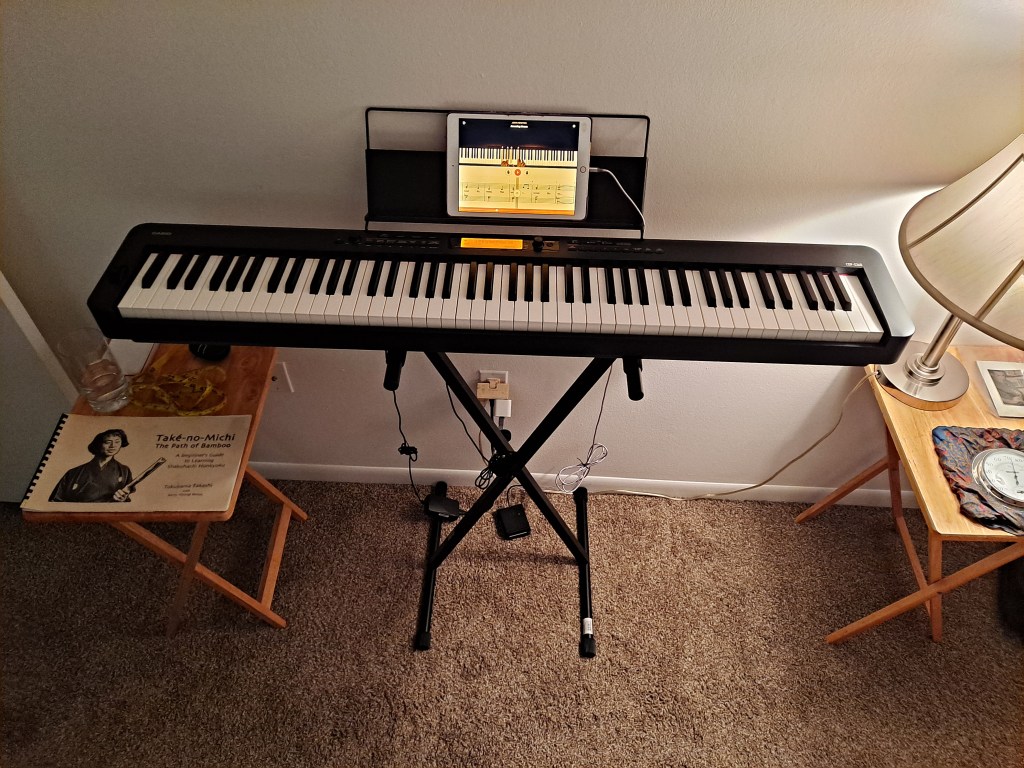
Like many of you, I find that sitting for long periods is uncomfortable, so I decided to raise my keyboard stand to standing height. What I’ve found is that standing while playing allows for gentle movement—I can shift my weight, circle my hips, and let my breath flow naturally, almost like Tai Chi at the keyboard.
But the most important shift has been learning how to relax. I’ve realized that when I play, I tend to hold my breath and tense up, which drains my energy. So my new focus is breathing and playing with as little tension as possible, using a 4-note breathing pattern: ✔ Inhale: A → C → E → C ✔ Exhale: A → C → E → C This simple rhythm helps me stay grounded, present, and relaxed.
Another key part of this setup is having my keyboard at the end of my bed. This means I can lay down to rest anytime, and when I feel ready, I can stand for just a minute or two to play, then lay back down again. There’s no pressure, no need to push myself—just a gentle cycle of music and rest.
Options for Engaging with Music at Any Energy Level
I know that not everyone has the ability to stand or sit for long, so I wanted to share a few ways to incorporate music at any stage—always prioritizing relaxation and staying within your pacing envelope to avoid PEM.
🎵 Lying in Bed: When I was primarily bedridden and didn’t have a keyboard, I Velcroed my iPad about a foot and a half above my head. This let me lay flat and play simple notes with an app, without any strain. It worked beautifully.
🎵 Small Keyboard for Bed Use: On Facebook Marketplace, you can find very small, lightweight keyboards that you can keep in bed with you. You don’t need a full-size keyboard to start—just something simple to play a few notes when you feel able.
🎵 Seated or Standing with an Adjustable Keyboard: If sitting for long is difficult, you can use a keyboard stand that adjusts in height so you can switch between sitting and standing, allowing for movement and rest as needed.
🎵 Completely Resting & Humming (Minimal Effort Required): For those who need to lay flat and remain mostly inactive, music can still be part of your healing. Some keyboards or apps allow you to automatically play simple notes (like A → C → E → C) very, very slowly. Instead of physically playing, you can simply breathe in rhythm with the notes and gently hum along—only if it feels comfortable. Even this small engagement should be done within your energy limits, ensuring it stays restorative rather than draining.
🎵 Music Visualization (No Physical Effort Required): If even humming feels like too much, you can still experience music through visualization. I used this method when I realized I couldn’t go to the beach anymore—I would simply imagine walking along the shore, and it was surprisingly powerful. In the same way, you can lay in bed and visualize yourself sitting at a piano, pressing one note at a time, hearing the sound in your mind, and breathing gently. You don’t have to hum or move at all—just allow the imagery and imagined sound to soothe you.
The Primary Goal: Relaxation & Parasympathetic Activation
The most important thing is to find the simplest, most relaxing way to engage with music—one that matches your current energy levels and does not trigger PEM. Whether that’s playing, humming, breathing, or simply visualizing, the goal is to activate the parasympathetic nervous system and promote deep rest and healing.
Having a piano that moves with me rather than forcing me to adjust to it has been life-changing. I just wanted to share this in case it helps anyone else looking for a way to bring music into their life—with gentleness, breath, and ease. 💙
When post-viral ME/CFS first appeared in my life over 30 years ago, it was like a sudden, uninvited guest that turned everything upside down. The plans I had carefully laid out—the career, the teaching, the travel—came to a screeching halt. My body, which once felt like a reliable vehicle for my ambitions, became a source of constant limitation.
For many people today, especially in the aftermath of COVID, the experience of long COVID or post-viral ME/CFS can feel like a similar trainwreck. The life you knew, the expectations you had, are suddenly out of reach, and you’re left grappling with a new reality—one that modern medicine often struggles to explain, let alone resolve.
I remember the early days well. The confusion, the depression, the overwhelming frustration that came with the unrelenting fatigue. In the beginning, it was hard to see any way forward. It felt like I was being asked to surrender everything I had worked for, again and again. Every time I hit a new limit, I had to lower the bar, lower it again, and lower it even further. It was a painful process of letting go, not just of my physical abilities, but of my identity and the future I had imagined for myself.
But over time, and through countless moments of surrender, I began to see that while the path I had planned was no longer possible, there was another way forward. It was a quieter path, more inward, but it was no less valuable. Writing became my outlet, my way of contributing to the world, even while living in solitude and spending much of my time in bed.
For those of you reading this who are newly facing the reality of post-viral ME/CFS, I want to acknowledge that this is not an easy journey. It’s okay if you need to take breaks, both from reading and from the mental and emotional load of processing what this diagnosis means. Be gentle with yourself, and if you find the post too long, take it in pieces, come back when you’re ready. The key is to pace yourself, in life and in reading.
Surrendering to a New Reality
One of the hardest lessons I had to learn was surrender—over and over again. Post-viral ME/CFS teaches you that you can’t control everything, no matter how hard you try. Every time I felt like I was getting close to managing the illness, there would be a setback. My energy would crash, and I’d find myself in bed for days or weeks at a time. At first, it felt like defeat. I had to give up so many aspects of life I’d taken for granted.
But over time, I realized that surrendering wasn’t about giving up. It was about accepting what is, rather than constantly struggling against it. The more I fought the reality of my illness, the more frustration I experienced. Letting go didn’t mean that I had to stop hoping or working toward better health, but it did mean that I had to stop resisting what I couldn’t change in that moment.
Surrendering, in this sense, became a way to make peace with the limits of my body, to find moments of ease even when everything else felt out of control. It was an ongoing practice, one that I still revisit, especially on difficult days.
Navigating Others’ Reactions
In addition to learning how to surrender, one of the most difficult challenges I faced early on was dealing with other people’s reactions. In those early days, many people didn’t even believe post-viral ME/CFS existed. I heard things like, “You just need to drink more coffee,” or, “Have you thought about taking naps?” Even when I was officially diagnosed as disabled by the government, my own mother thought I was just lazy and needed to be more active.
This kind of misunderstanding, disrespect, and dismissal is, unfortunately, a common experience for many who suffer from post-viral ME/CFS. Family, friends, and even doctors would question or deny my experience. I’ve heard stories of doctors telling their patients not to even talk about ME/CFS because it “doesn’t exist.” It was often treated as a garbage-pail diagnosis, or dismissed entirely.
While there is more understanding of post-viral ME/CFS today, the stigma still remains. Making peace with this aspect of the illness has been a long journey. What helped me most was cultivating compassion, not just for myself but for others. As Jesus said, “Forgive them, for they know not what they do.” Having compassion for the people in your life who may deny or diminish your experience is a key part of finding peace.
An Evolving Perspective on Post-Viral ME/CFS
In the early days of my journey with post-viral ME/CFS, I found myself going through what felt like the stages of grief as described by Elizabeth Kubler-Ross. At times, I thought I might be dying, and I cycled through stages of anger, grief, depression, and confusion. Acceptance didn’t come quickly, and it took years of processing and reflection before I could reach that place.
One of the major steps toward acceptance came when I read How to Be Sick by Toni Bernhard. This book resonated deeply with me, and for the first time, I felt like someone truly understood what I was going through. Toni’s reflections on illness gave me a new sense of validation and self-respect, and her practical tips helped me develop a healthier way of relating to my experience. I highly recommend this book to anyone struggling with post-viral ME/CFS.
Then, during a meditation class organized by students of Sogyal Rinpoche, based on The Tibetan Book of Living and Dying, I began to find deeper peace. It was around this time that I discovered a Tibetan sutra titled Transforming Suffering and Happiness onto the Path of Enlightenment. This teaching profoundly shifted my perspective once again.
As I read the sutra, I realized that my anger, frustration, and negative emotions were not only draining my energy but also exacerbating my symptoms. It became clear to me that these stressful emotions were making my condition worse, and that when I was able to relax, let go, and find inner peace, I had greater capacity and longer periods of activity without crashing—or without crashing as severely. This was an important revelation: cultivating acceptance, forgiveness, and inner peace didn’t just feel better, it actually minimized my symptoms.
Shifting Perspective: The Sutra That Changed Everything
One passage from the Tibetan sutra resonated deeply with my experience of post-viral ME/CFS:
“Whenever we are harmed by sentient beings or anything else, if we make a habit out of perceiving only the suffering, then when even the smallest problem comes up, it will cause enormous anguish in our mind.”
This teaching hit home because, for a long time, I had been focusing only on the suffering. Everything in my life had become an enemy—my body, my circumstances, even the people around me. The more I centered my awareness on the pain and limitations, the heavier everything felt. Even the smallest setback would feel unbearable.
The sutra showed me that the more we focus on suffering, the more it grows and colors everything we experience. By recognizing this, I began to understand that shifting my focus away from the suffering and toward acceptance could help me find peace. It wasn’t about denying the reality of the illness, but about no longer letting it dominate my entire perspective.
The true transformation came not only by making peace with suffering but by learning to approach both suffering and happiness with the same equanimity. I had to remind myself that when I’m unhappy, this too shall pass, and when I’m happy, this too shall pass. This reminder became a useful way to stay balanced through the ebb and flow of life—the good days and the bad days, the good months and the bad months.
Additionally, I found comfort in William Blake’s words: “He who kisses the joy as it flies lives in eternity’s sunrise.” It reminded me to appreciate the little moments of happiness, to savor them without attachment, knowing that they, too, are fleeting. This perspective helped me not to be disturbed by the constant changes and to find a sense of peace amidst it all.
Discovering a New Path: Writing as Healing
As I continued to navigate the ups and downs of post-viral ME/CFS, I eventually found a new passion that helped me stay connected to the world and give expression to my inner journey: writing. Although much of my life is spent in solitude, and my physical abilities are limited, writing has become my outlet, a way to contribute and share what I’ve learned.
Through writing, I’ve been able to explore the lessons of impermanence, forgiveness, and acceptance, not just for my own growth but as a way to offer encouragement to others walking a similar path. Chronic fatigue may limit what I can do in the physical world, but it has opened up this creative space where I can still connect, reflect, and contribute.
In this way, writing became not just a coping mechanism but a practice of karma yoga, an offering. It’s a way to kiss the joy as it flies, even amidst the challenges of chronic illness, and to embrace each moment—whether in suffering or happiness—as an opportunity for growth.
🙏🕊️🙏
“He who binds to himself a joy Does the winged life destroy; But he who kisses the joy as it flies Lives in eternity’s sunrise.”
A gentle exploration of how pacing can help you find balance and protect your well-being while living with chronic illness—along with thoughtful tools and guidance for those seeking support on this journey.
Pacing is the quiet art of learning to live gently within the rhythms of your body, an act of surrender not to defeat, but to wisdom. It asks you to listen closely, with reverence, to the invisible boundaries your energy sets each day—boundaries that shift like tides, at times quietly receding, at times closing in. For those living with post-viral ME/CFS or long COVID, pacing is not about building stamina or pushing through; it is a way of navigating the unpredictable waters of illness, steering not toward exhaustion but toward balance.
Think of your energy as a delicate thread stretched between moments. Some threads are finer than others, fraying at the edges after only the smallest tug. On certain days, your energy is enough to string together simple acts—getting out of bed, speaking a few words, tending to a meal. On others, even holding a thought in your mind feels like a weight too great to bear. There is no map for how far your thread will extend each day, and so the practice of pacing requires patience: learning when to weave activity into that thread and when to set it down altogether.
It begins with noticing. As the morning unfolds, ask yourself: How does your body feel today? What whispers does it send about the tasks ahead—are your limbs heavy, your mind clouded? Or does the day offer a rare clarity, a lightness in your chest? This gentle inquiry is the starting point of pacing, the first invitation to move in harmony with yourself. If you learn to honor your limits before they are breached, you begin to discover that rest, too, is a form of action—an act of preservation, of quiet resistance to the demands of doing.
There will be moments when you falter. Some days, buoyed by the hope of feeling better, you may do too much, only to find yourself crashed in bed the next morning, as though your body is reminding you: even good days must be tended with care. And yet, these moments are not failures but teachers, guiding you back to the path of gentleness. The gift of pacing is not in perfection but in the willingness to adjust, again and again, to the ebb and flow of your energy. It teaches that every step back into rest is not a retreat but a recalibration—a way of finding your balance anew.
In practice, pacing asks that you break life into smaller pieces. No task need be completed all at once; no activity is so urgent that it cannot be paused. It may mean spreading chores across hours or days, resting between each small effort. You might find that simply sitting still before you are exhausted—what some call “micro-rests”—becomes a way to protect your energy, much like tending a fragile flame so it does not burn too fast.
It also teaches the value of saying no, of drawing boundaries not out of reluctance but out of care for yourself. The world may ask more of you than you can give, but your worth is not measured by what you accomplish. Pacing offers you the grace to step back when needed, to protect the little energy you have, and to understand that in rest there is healing, even if that healing is slow and subtle.
Through this practice, you begin to understand that your life with chronic illness is not a race to reclaim the old ways of being, but an invitation to live differently—deliberately, thoughtfully, and with compassion for yourself. Some days will still carry setbacks, and your thread may feel thin and worn, but you learn to trust that even in these moments, you are practicing something essential: the art of living well within your limits.
If this way of being resonates with you, I invite you to explore pacing as a tool for navigating life with long COVID, post-viral ME/CFS, or any chronic illness. It is not a cure, but a guide—a way to live with care, softness, and respect for the boundaries your body sets.
And if you are looking for a gentle companion in this journey—someone to offer guidance on pacing, energy conservation, and emotional support—I invite you to try out this free GPT assistant. This tool provides thoughtful advice, helps you manage the challenges of chronic illness, and offers a steady, compassionate voice tailored to your unique needs.
Harnessing Inner Peace: A Pacing Toolkit Tool for Those Living with ME/CFS or Long Covid
As I reflect on the approaching Hurricane Milton, I’m reminded of the powerful moment when Jesus calmed the storm on the Sea of Galilee. His disciples, gripped by fear, watched as He simply said: “Peace! Be still!” and the storm settled. In this moment, I feel called to do the same—to access the peace of God within me and speak to the storm, “Peace! Be still.” I truly believe this is what Jesus asks of us, to practice this promise, and to remember that even faith the size of a mustard seed can move mountains.
But this call to peace and stillness isn’t just about the external storm. As someone who lives with chronic fatigue, I know how much of a difference it makes to calm the storms within as well. The mental and emotional stress can often intensify symptoms like post-exertional malaise (PEM). So, I remind myself to relax my mind and heart, to let go of worry and concern, and to give my body the space it needs to heal.
One of the tools I turn to in these moments is Pristine Mind Meditation, as taught by Orgyen Chowang in his book Pristine Mind: Journey to Unconditional Happiness. Pristine Mind is the pure, natural awareness that exists within all of us, untouched by thoughts or emotional turmoil. By resting in this space, I find that it helps me manage my symptoms, reduce stress, and pace myself more effectively. It’s an essential part of my pacing toolkit, allowing me to not only physically rest, but also calm my mind and emotions, preventing flare-ups of PEM and other symptoms.
In this moment, I invite us all to join together in saying to the storm—whether it’s the physical hurricane or the inner storms we face—“Peace! Be still.” Let’s tap into the divine promise that’s always been ours and use the tools we have to cultivate peace, clarity, and healing within ourselves.
Let us, from a place of faith and trust, send love to this storm and say to it: “Peace, be still.”
This is what I have learned after 30 years of living with chronic fatigue. These ten focus points have helped me. Maybe they will help you, too.
NOTE: This article contains a lot of information to process, particularly for those of us dealing with chronic fatigue. Take your time reading and absorbing this information, and don’t hesitate to take breaks as needed. To manage a chronic illness like ME/CFS or Long Covid effectively, it’s crucial to respect our reality and prioritize our self-care. Remember, success is measured in many different ways, and taking care of yourself is always a valuable investment in your overall health and well-being.
Take care and be gentle with yourself.
Pacing: The first suggestion is pacing. It’s essential to balance rest and activity to avoid overexertion and prevent symptom flare-ups. Remember that pacing is not about doing less, but about finding a sustainable balance. Listen to your body, and don’t push yourself into a flare-up. This will take some practice and is likely to change from day to day. So remember… Be careful…. Be mindful…. Discover what works best for you from day to day….
Sleep Hygiene: The second suggestion is sleep hygiene. It’s crucial to establish a regular sleep schedule, create a relaxing bedtime routine, and maintain a sleep-conducive environment. Quality sleep can help reduce your symptoms and improve your overall well-being. Again, this is a practice that you can adapt and modify over time. So remember… Be careful…. Be mindful…. Discover what works best for you from day to day….
Stress Management: The third suggestion is stress management. Stress can exacerbate symptoms of ME/CFS, so it’s crucial to find ways to manage it. Consider meditation, deep breathing exercises, or mindfulness practices to help manage symptoms. There is a free meditation class offered online by MBSR. The MBSR online training course is 100% free, created by a fully certified MBSR instructor, and is based on the program founded by Jon Kabat-Zinn at the University of Massachusetts Medical School. Palouse Mindfulness offers this course. Another suggestion is Toni Bernhard’s book, How to Be Sick. This is a powerful and insightful book that offers a unique perspective on the challenges faced by those of us suffering from chronic illnesses such as ME/CFS, Long Covid, and other similar conditions. You can take a look at this book below.
Gentle Exercise: The fourth suggestion is gentle exercise. Very, very low-impact exercises like gentle stretching or breathing exercises can help improve physical function and well-being. However, always listen to your body and adjust the level of intensity as necessary so that you are always below your post-exertional malaise threshold. Most graded exercise recommendations do not take this into account, and people often overdo it and exacerbate symptoms. Also, low-impact exercise for us may simply be getting out of bed. Or, if bedbound, turning your head from side to side while lying down. Or, flexing and extending your feet while in bed. If you start by doing less and evaluate your response as you go, you will be less likely to exacerbate your symptoms. I can’t tell you how many times I was enjoying a stretching routine only to have PEM the next day. So remember… Be careful…. Be mindful…. Discover what works best for you from day to day….
Nutrition: The fifth suggestion for optimal health and well-being is to pay close attention to your nutrition. A balanced diet that incorporates a variety of nutrient-dense foods, such as fruits, vegetables, lean proteins, and whole grains, is crucial to maintaining good health. Avoid consuming processed foods that contain high levels of artificial ingredients, unhealthy fats, and added sugars. Opt for fresh, whole foods that provide the essential vitamins, minerals, and fiber your body needs. Don’t forget to drink plenty of water to stay hydrated and promote optimal bodily function. Remember, a healthy diet is an investment in your long-term health and well-being.
Cognitive-Behavioral Therapy (CBT): The sixth suggestion for managing ME/CFS, Long Covid, or any chronic illness is to consider cognitive-behavioral therapy (CBT). This evidence-based therapy can help you develop effective coping strategies to manage the emotional and psychological impacts of living with a chronic illness. By working with a therapist who specializes in CBT, you can learn to identify and challenge negative thought patterns, develop healthy coping mechanisms, and reduce feelings of stress and anxiety. CBT has been shown to be effective for individuals with chronic illnesses, and it can be a valuable tool in helping you manage your symptoms and improve your overall quality of life. Don’t hesitate to reach out to a qualified therapist to explore this option further.
Support Network: The seventh suggestion is to seek out and maintain a strong support system. Your support system may include family, friends, and support groups. These individuals can provide you with emotional support and help you manage your condition.
Medication Management: The eighth suggestion is medication management. When managing chronic fatigue, medication management is an important component. Work with your healthcare provider to find the most effective medications for your symptoms while discussing possible side effects and interactions. Starting with lower doses than normally suggested may also be recommended. So remember… Be careful…. Be mindful…. Discover what works best for you from day to day….
Symptom Tracking: The ninth suggestion for managing a chronic illness like ME/CFS or Long Covid is to engage in regular symptom tracking. Keeping track of your symptoms can help you better manage your condition. By keeping a symptom diary, you can also better understandy patterns and triggers that may be exacerbating your symptoms. The key here is to do less of what makes you feel worse, and do more of what helps you to feel better.
Education: The tenth and final suggestion is education. Educate yourself about ME/CFS & Long Covid, including symptoms, diagnosis, and management strategies. Becoming informed can help you advocate for yourself and make informed decisions about your health. Remember that education is an ongoing process, and it’s important to stay up-to-date on the latest research and information about your chronic conditions.
In conclusion, managing chronic fatigue requires a multifaceted approach. By incorporating these ten suggestions into your daily life, you can better manage your condition, improve your quality of life, and find hope for the future. Remember to listen to your body, seek support, and stay informed. Thank you for reading.
Please, for the benefit of others, leave your questions and comments below so we can all learn from one another about these ten steps.
Greetings Everyone…. This is about one of the absolutely best, most helpful books, I have ever found, about living with ME/CFS.
Toni Bernhard’s “How to Be Sick” is a powerful and insightful book that offers a unique perspective on the challenges faced by those suffering from chronic illnesses such as ME/CFS, Long Covid, and other similar conditions.
The book is written with great empathy, warmth, and practicality, providing readers with a wealth of information, insights, and practical tools to help them manage their condition and live a more fulfilling life.
One of the most compelling aspects of this book is the author’s own experience of living with chronic illness. Toni Bernhard was a law professor when she became ill with a viral infection that left her bedridden and in constant pain. This experience gave her a unique perspective on what it’s like to live with a chronic illness, and she shares her insights and wisdom in a way that is both accessible and highly relatable.
The book is divided into three parts, each addressing a different aspect of living with chronic illness. The first part focuses on the emotional and psychological challenges of coping with chronic illness, including the grief, loss, and isolation that can accompany such conditions. The second part offers practical advice on managing symptoms, including pain, fatigue, and brain fog, while the third part offers guidance on how to cultivate a sense of meaning and purpose in life despite illness.
What sets this book apart from other self-help books for chronic illness is the author’s emphasis on mindfulness and compassion. Throughout the book, Toni Bernhard stresses the importance of being present in the moment, accepting one’s condition with kindness and compassion, and cultivating a sense of gratitude for the small joys in life.
She also offers a range of practical mindfulness exercises and meditations that can help readers to cultivate these qualities in themselves.
Overall, “How to Be Sick” is an essential read for anyone living with chronic illness, especially those suffering from ME/CFS, Long Covid, and other similar conditions. The book is not only packed with practical advice and insights, but it also offers a powerful message of hope and resilience that can help readers to find meaning and purpose in their lives despite illness.
I highly recommend this book to anyone looking to live a more fulfilling life with chronic illness.
Essentially… “How to Be Sick” by Toni Bernhard is a guidebook for people living with chronic illness or chronic pain. Toni, who was diagnosed with the sudden onset of chronic fatigue, shares her personal experiences and provides practical advice for managing physical and emotional challenges associated with chronic illness.
Toni encourages us to accept our condition, practice mindfulness, and cultivate gratitude to improve our quality of life. The book also offers insights into navigating relationships, communicating with healthcare providers, and adapting to a new way of life.
Without a doubt, “How to Be Sick” provides a compassionate and empowering approach to living with chronic illness. It is one of the most helpful and useful books I have ever read on the subject of living with chronic fatigue.
Dear friends, If you have found any other books, that you would highly recommend, please share them in the comments section below – it is very possible that others can benefit from your suggestions as well.
I personally, highly recommend this book to anyone experiencing ME/CFS, Long Covid or chronic illness of any kind. You can usually find a used copy on Amazon.
May we all find peace, joy and wellbeing on our journey through life.



 Home Page: Inspirations of Love and Hope