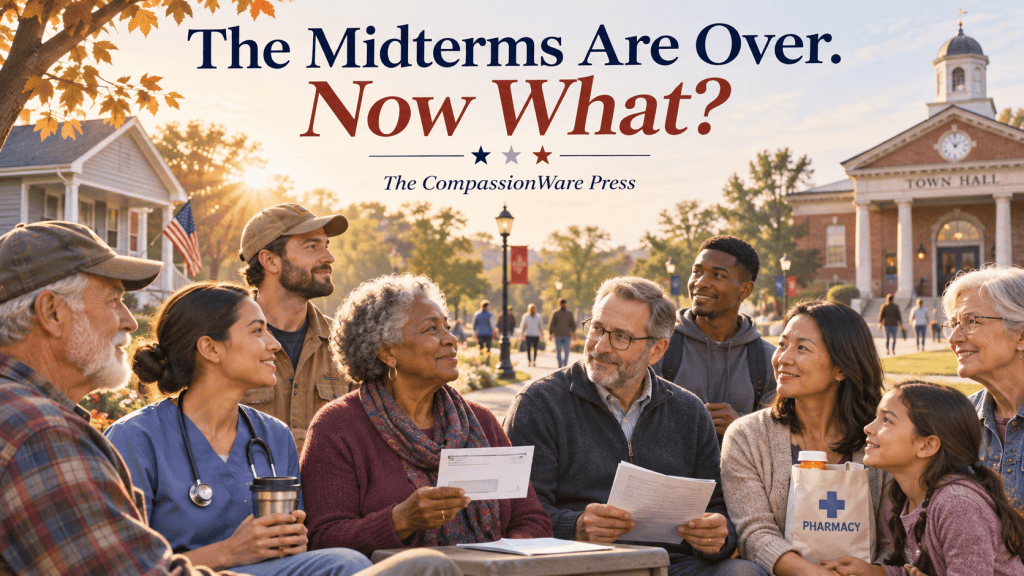
Inaugural editorial of The CompassionWare Press · November 2026
The morning after an election, a prescription still needs filling. A rent payment still comes due. Someone is waiting for a disability decision, someone for a safer neighborhood, someone for a government office to answer the phone.
This is where politics must eventually arrive: in the ordinary business of living.
An election tells us who has been entrusted with power. What happens afterward tells us what that trust was worth.
For those relieved by the results, the temptation may be to relax our scrutiny. For those disappointed, it may be to expect nothing good. Neither response has to become a permanent address.
We can begin somewhere more useful: What was promised, what will actually be done, and whose life will be different because of it?
The campaign ends. The responsibility continues.
Election Day is over; that does not mean every result is official. Counting, review and certification are distinct from election-night reporting, which the U.S. Election Assistance Commission describes as unofficial. Patience with that process is part of taking the result seriously.
Nor does a congressional election replace Congress overnight. Under the Twentieth Amendment, the terms of incoming representatives and senators begin at noon on January 3; Congress meets that day unless a law sets another date. Until the transition, the current Congress retains its responsibilities.
That interval deserves attention. So does what follows it.
A party’s victory is not an answer to the questions that sent people to the polls. It is an opportunity—and an obligation—to address them.
Follow the promise into the paperwork
Consider a candidate who promises to make housing more affordable. This is an illustrative example, not a finding about a particular official.
The next useful question is not whether the candidate repeats the promise convincingly. It is what action they propose: more homes, different financing, rental assistance, regulatory changes, or another approach. What can their office actually authorize? Who would qualify? Who might carry the cost? What evidence would show that people are better housed?
The same discipline applies to health care, public safety, taxes, immigration and the cost of living.
A bill introduced is not a law enacted. Passing one chamber is not completing the legislative process. The House and Senate must resolve differences before legislation can be presented to the president, as the Congressional Research Service explains.
Funding adds another question. Federal appropriations give agencies authority to incur obligations and make payments for specified purposes. An announcement about a program should therefore prompt us to ask what money and implementation authority actually stand behind it.
These distinctions can sound dry beside a campaign speech. They are also where a promise acquires substance—or remains a promise.
Fair accountability follows the whole chain: Promise → Authority → Action → Implementation → Outcome.
It also allows an honest explanation. An official may face a genuine legal limit, lose a vote, discover contrary evidence or revise a proposal for a defensible reason. We should ask what happened before deciding why. A changed position can deserve criticism, understanding, or both. The record should help us tell the difference.
We do not have to surrender our judgment to our vote
Supporting a candidate need not mean defending everything that person does. Opposing a candidate need not mean refusing to recognize something useful.
This is not a request to split every disagreement down the middle. Some claims are false. Some policies cause harm. Some explanations fail when examined. Fairness requires saying so when the evidence warrants it, with the same standards applied to people we hoped would succeed.
There is dignity in changing our minds. There is dignity, too, in allowing another person to reconsider without requiring a public humiliation first.
A country needs ways to correct itself that people can bear to participate in.
Let AI carry some of the reading
Here is a practical possibility for artificial intelligence: help people compare a campaign promise with the original proposal, the actual vote, the available funding and the eventual result.
Such a record should show its sources, dates, omissions and corrections. It should distinguish an official’s explanation from a verified fact, and leave people able to challenge its conclusions. These are requirements for a useful tool, not claims that AI already performs this work reliably.
The point would be to make participation less exhausting. AI should earn trust by making the evidence easier to examine, including evidence that contradicts its own account.
A smaller, steadier citizenship
Nobody should have to become a full-time political analyst to deserve a functioning government.
One issue followed carefully can be a meaningful contribution. Save the promise. Ask for the specific action. Return later to see what changed. Listen to someone affected whose experience differs from your own.
And allow room for an ordinary conversation that is not another election argument. Ask a neighbor what they hope will become easier in the coming year. You may disagree about the remedy and still learn something about the need.
Our public life needs scrutiny, and people need enough space to remain people while offering it.
The campaign signs will come down. The people they stood beside will still be here.
What happens to those people is the story now.
About The CompassionWare Press: The CompassionWare Press explores public life through truth, wisdom, loving-kindness, and compassion. We follow evidence wherever it leads, without allegiance to a political party. Our guiding question is whether public promises become actions that genuinely benefit the people they are meant to serve.
About the Author
Richard Silverman is an independent writer and the founder of CompassionWare Press. Drawing on decades of contemplative practice and lived experience with chronic illness, he explores how truth, wisdom, loving-kindness, and compassion can help us meet the challenges of public life. His writing is shared freely in the hope of encouraging thoughtful dialogue, mutual understanding, and greater accountability to the common good.
Support independent, compassionate journalism: If you value this project and would like to help sustain its research and writing, you are welcome to make a voluntary contribution through PayPal. Every article remains freely available, whether or not you donate. Thank you for reading and for being part of the conversation.


Feel free to leave a comment below.