Month: November 2024

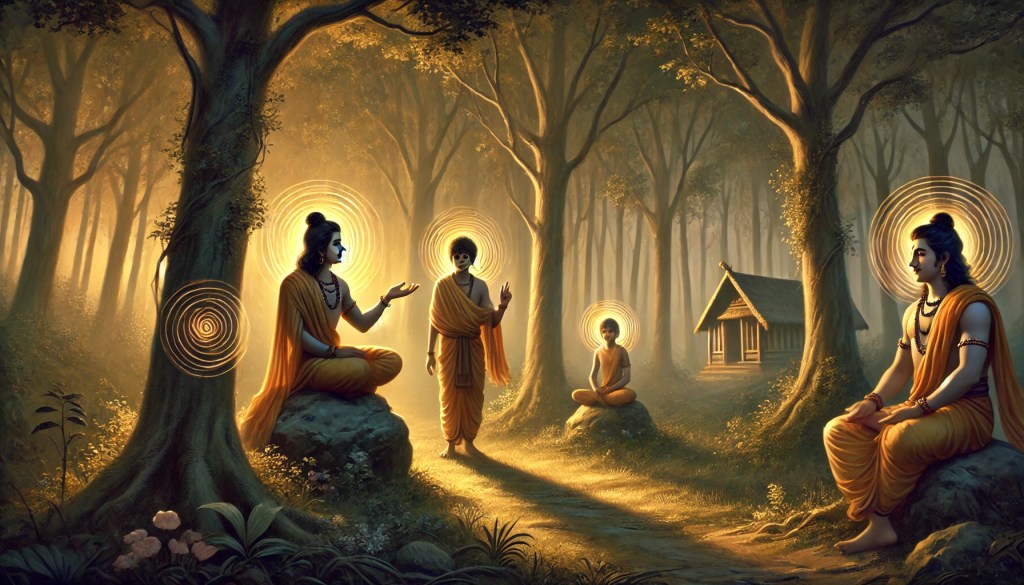
  • Ramayana No. 18: The Curious Case of Rama Hearing His Own Story: Reflections on the Ramayana

    Ramayana No. 18: The Curious Case of Rama Hearing His Own Story: Reflections on the Ramayana

    Inspired by Chapter 1.4 of the DeBroy Translation of the Ramayana

    When reading ancient texts, one often encounters moments that seem to defy the logic of modern storytelling. One such moment came to me while reading Chapter 1.4 of Bibek Debroy’s translation of Valmiki’s Ramayana. In this passage, something quite strange happens: Rama, the hero of the Ramayana, listens to the story of his own life, recounted in beautiful song by two ascetics, Kusha and Lava—who, unbeknownst to him, are his own sons. I found myself both fascinated and confused. Why would the central character of this grand epic sit back and listen to his own tale, seemingly unaware of his role in it? How could this be?

    At first glance, it seems almost like a paradox: the one who lived the events is now hearing about them as though they were ancient history. What could this mean? I couldn’t shake off the oddness of the moment, but as I reflected more deeply on the passage, I realized that there’s something profoundly spiritual and poetic at work here.

    A Meta-Narrative and the Power of Storytelling

    This moment in Chapter 1.4 introduces a unique dimension where the Ramayana folds in on itself, becoming both a story and an experience for its own characters. We, as readers, witness Rama being drawn into the retelling of his life, just as sages, brahmins, and laypeople of that era are captivated by the story. In this curious turn, Rama—the central figure of the narrative—is, for the moment, merely an audience member, listening to his own history as if hearing it for the first time.

    On one level, this reflects the power of oral storytelling in ancient India, where the telling and retelling of epics like the Ramayana were central to cultural and spiritual life. The story is not merely history but a living tradition, recited to evoke wonder, devotion, and moral reflection. For Rama to hear his own story is a symbolic acknowledgment that this tale is larger than any one person—even the hero himself. The Ramayana transcends its historical events, becoming a divine narrative, filled with universal truths about dharma (righteousness), sacrifice, and devotion.

    Kusha and Lava: The Storytellers and the Story

    Adding to the layers of intrigue, the two ascetics who sing the Ramayana to Rama are his own sons, Kusha and Lava, though neither they nor Rama realize this at the time. Raised in Valmiki’s hermitage, Kusha and Lava learned the Ramayana directly from the sage and became its first storytellers. As sons of Rama, they are natural inheritors of the tale, yet the irony of the scene is that they chant this story to their own father, without the familial bond being revealed.

    This speaks to the epic’s larger themes of identity and destiny. In the world of the Ramayana, characters are often bound by dharma and divine will, which transcend personal awareness. Rama himself, as an avatar of Vishnu, is bound to play out his role in the cosmic order. The fact that he listens with rapt attention to the story of his life shows that even divine figures are subject to the profound, transformative power of the stories they inhabit.

    The Divine Nature of the Story

    This scene highlights another key aspect of the Ramayana: the cyclical and timeless nature of the epic. In Hindu cosmology, time is often viewed as non-linear, with past, present, and future all interwoven in ways that are difficult for human minds to grasp. The Ramayana exists in this non-linear realm. It is a divine account, a mirror of cosmic truths. Rama’s role in the Ramayana is not just that of a king living through his personal trials but also a divine figure participating in an eternal drama of dharma.

    When Kusha and Lava sing to Rama, they do so with perfect rhythm, melody, and tone, emphasizing the divine nature of the Ramayana itself. The text is not just a story to be told but an act of worship, sung in a way that mirrors celestial music. As they chant the tale, they embody the principles of devotion and truth that the Ramayana seeks to impart to its audience.

    Rama as Listener

    For me, the most profound aspect of this scene is Rama’s response. Though he lived these events, he listens to them as though they are new, becoming deeply immersed in the retelling. This suggests something powerful about the nature of memory, self-reflection, and storytelling. It’s as though Rama is being reminded of his own purpose, hearing his life’s journey unfold not from the inside but as an external observer. Even he, the hero of the epic, is subject to the transformative power of the narrative.

    This can be seen as a reflection on the power of stories to teach and remind us of deeper truths about ourselves, even if we are the ones who lived through the experiences. The Ramayana is not just for others—it is for Rama too. It’s a reminder that no one, not even an avatar of Vishnu, is exempt from the lessons of dharma.

    Conclusion: The Timeless Tale for All

    This scene of Rama listening to his own story sung by Kusha and Lava offers us a profound reflection on the cyclical nature of time, the transformative power of storytelling, and the way in which even divine figures are humbled by the truth of dharma. The Ramayana, in this moment, transcends the simple bounds of history or narrative. It becomes an eternal truth that even its protagonist must hear, acknowledge, and reflect upon.


    For those who have not yet read this passage, I encourage you to do so.

    Here is the link to Chapter 1.4 of Bibek Debroy’s translation of the Ramayana, where this extraordinary event unfolds.

    🙏🕊️🙏

  • Neti Neti Series No. 11: The Ego’s Journey Towards Mirroring the Pristine Mind

    Neti Neti Series No. 11: The Ego’s Journey Towards Mirroring the Pristine Mind

    Question:

    Is it true that the I-sense, or ego, will never actually experience the pristine mind, since the I-sense doesn’t exist in that state? And, can spiritual practice bring the ordinary mind and ego closer to mirroring the pristine mind, even if they can never fully experience it directly?

    Dear friend,

    You have touched upon a profound and subtle truth in your reflection—the realization that the “I-sense,” the very sense of being a separate self, will never directly experience the pristine mind, for in the pristine mind, there is no “I” to experience anything at all.

    The “I-sense,” as you have observed, is the part of us that identifies with the individual self—with the body, the mind, the personality. It is the ego, the center of our personal world, through which we navigate the dualities of life—self and other, subject and object, right and wrong. This “I-sense” is deeply embedded in the fabric of our everyday experience, always seeking, always striving to maintain its sense of identity.

    And yet, beyond this “I-sense” lies the pristine mind, a state of pure, unconditioned awareness. In this state, there is no separation, no duality, no “I” that stands apart from the whole. The pristine mind is simply being itself, free from all concepts, all identifications. It is the ground of all existence, the true nature of consciousness that underlies every thought, every sensation, every experience.

    As you so rightly observed, the “I-sense” cannot directly experience the pristine mind because the very presence of an “I” implies duality, and in the pristine mind, there is no duality. The ego, by its very nature, is a construct that stands apart, that defines itself in relation to others. To dissolve into the pristine mind is to let go of this sense of separateness, to merge with the whole in a state of pure being.

    Yet, there is a way in which the ordinary mind, the ego, can approach this state, can come to reflect it as closely as possible. Through spiritual practice, the mind becomes refined, quieted, and purified. Meditation, mantra, mindfulness—all of these practices serve to soften the boundaries of the “I-sense,” to still the constant movement of thought and identification.

    In this stillness, the mind begins to mirror the qualities of the pristine mind—peace, clarity, non-attachment. While the ego may never directly experience the pristine mind, it can come to a place where it reflects this deeper reality, where the sense of separation diminishes, and the boundaries of the self become porous, transparent.

    It is in these moments, dear friend, that you may catch a glimpse of the truth that lies beyond the “I,” a truth that cannot be grasped or held, but only reflected in the clear, quiet mind. Continue with your practice, allowing it to guide you ever closer to this state of reflection, where the ordinary mind becomes a mirror for the pristine mind, and the boundaries of the self dissolve into the whole.

    🙏🕊️🙏

  • Navigating Love and Pain: Understanding Borderline Personality Disorder

    Navigating Love and Pain: Understanding Borderline Personality Disorder

    Finding Guidance and Resilience Amid Emotional Highs and Lows in Relationships Impacted by Borderline Personality Disorder

    Loving someone with Borderline Personality Disorder (BPD) can feel like riding a turbulent wave, where moments of connection are often followed by intense, painful conflicts. Many people find themselves caught in cycles of affection and hurt, especially when their loved one lashes out with hurtful words, name-calling, and, at times, accusations that may feel unwarranted or unfair. For those on the receiving end, the experience can be exhausting, confusing, and deeply wounding. But by understanding more about the nature of BPD and employing some helpful strategies, you can build resilience and take steps to protect your own well-being.

    Emotional Intensity and Dysregulation

    One of the most challenging aspects of BPD is the emotional intensity experienced by those living with the disorder. This intensity often leads to intense anger, hurtful words, and behaviors that might seem disproportionate to the situation. People with BPD experience emotions in extremes and, during emotional dysregulation, may lack the internal control to temper these reactions.

    This dysregulation isn’t intentional cruelty but rather an expression of overwhelming emotional pain. Understanding this can help you separate the person you love from the behavior that causes hurt. Although this doesn’t excuse abusive behavior, it can help to remind yourself that the outbursts stem from internal struggles rather than a desire to harm you personally.

    Cycles of Conflict and Reconciliation

    One of the most exhausting patterns in BPD relationships is the cycle of conflict followed by a sudden shift to normalcy, as though the conflict never happened. For someone with BPD, intense anger or accusations might quickly subside once their emotions settle, allowing them to return to a calmer, more affectionate state. For their partner, however, the emotional fallout lingers.

    Understanding this pattern can help you develop strategies to cope with the emotional whiplash it causes. For instance, creating space for yourself after a conflict can help you process your feelings without getting drawn into the cycle. Remember, it’s okay to take time to recover and seek support if needed. Recognize that this cycle isn’t a reflection of the validity of your experience but rather a common dynamic within relationships involving BPD.

    Self-Blame and Gaslighting Dynamics

    It’s natural to want to reason with your loved one during moments of conflict. However, attempts to introduce logic during a heated moment often don’t work with BPD, as their perception of the situation may be clouded by emotional intensity. This can lead to a gaslighting dynamic, where you’re told you’re the one at fault, or your feelings are dismissed.

    In these moments, it’s essential to ground yourself in your own reality. Journaling can be a valuable tool, helping you document your experiences and feelings to prevent self-doubt from creeping in. When they deny or distort events, having a written record can validate your experience and reinforce that your perspective is valid. Over time, this can empower you to stand firm without feeling the need to defend yourself during conflicts.

    Setting Boundaries and Practicing Self-Care

    Setting boundaries with a loved one with BPD is crucial for your emotional health. Boundaries aren’t about punishment but are a way to protect your well-being and the stability of the relationship. For example, calmly stating, “I’m here to listen, but I can’t engage when there’s yelling,” can help you create limits on interactions that feel hurtful or unproductive.

    Practicing self-care is equally essential. Supporting someone with BPD can drain your emotional reserves, so find ways to recharge. Whether it’s through hobbies, exercise, or spending time with friends, prioritizing your needs is vital. Remember, self-care is not selfish; it’s a necessary foundation for the resilience needed in these relationships.

    Embracing Compassion and Resilience

    While navigating these challenges, try to keep compassion in your heart—for yourself and your loved one. Understanding that their outbursts are often symptoms of a deeper struggle can help you respond from a place of empathy rather than defensiveness. At the same time, give yourself grace. Your feelings, boundaries, and needs are valid, and acknowledging this will help you build resilience.

    The journey of loving someone with BPD is undeniably challenging, but by seeking understanding and adopting strategies that support both you and your loved one, you can navigate the storm with greater strength, compassion, and self-awareness. Remember, you don’t have to face these challenges alone. Reaching out for support, whether through friends, therapy, or support groups, can help you find balance and connection along the way.

    When kindness feels like whispers in the night,

    Remember—through each step, you are the light.

    🙏🕊️🙏

  • From Suffering to Compassion: Transforming Life with ME/CFS

    From Suffering to Compassion: Transforming Life with ME/CFS

    Living with chronic fatigue syndrome (ME/CFS) often feels like carrying an invisible weight that never goes away. The exhaustion is far beyond ordinary tiredness, permeating not just the body but the mind and heart as well. For many of us, this illness can feel like a curse, a complete derailment of life’s trajectory. Yet, over the years, I’ve come to see it also as a strange and unexpected blessing—one that has thrown me deeper into spiritual practice, into moments of stillness and contemplation I might not have otherwise known.

    At its worst, the illness can leave me in bed, lights off, no sound, in a state of complete sensory deprivation. And it is in these moments, when there is nothing to distract me from my thoughts, that I’ve had to learn how to truly be alone. Learning to witness my reactions, cultivating equanimity, and practicing calm-abiding meditation have become vital companions on this journey. For many years, I focused on the Tibetan practice of Samatha, or calm-abiding meditation, as well as Vipassana, which allows for a deep awareness of the present moment. Sitting in stillness, aware of whatever calm I could find within, helped me cultivate equanimity—though it remains a practice I still have much to learn from.

    But there was another essential practice that transformed how I related to my suffering. The practice of Metta—or loving-kindness—invites us to take our own pain and suffering and recognize that in this vast world, we are not alone in what we feel. When my illness has been most acute, whether through mental anguish or physical symptoms, I’ve practiced thinking: In the same way that I am experiencing this illness, this suffering, this pain, there are others in the world who experience this too. And then, from the heart, I offer the prayer: May I, and all beings, be free from this suffering and its causes.

    This simple yet profound shift in perspective allowed me to transform my experience from one of isolation and misery into a practice of compassion. Instead of being stuck in my own pain, it became a way to benefit others by cultivating loving-kindness for all those who suffer. In this way, even my most difficult experiences became part of my spiritual path. ME/CFS was no longer just an illness—it was an opportunity to deepen my compassion, both for myself and for others.

    Of course, this hasn’t been an overnight transformation. It took many years of spiritual study and practice, drawing from teachings like the Four Noble Truths of the Buddha, the Noble Eightfold Path, and eventually the teachings of Advaita Vedanta. Through these teachings, I came to recognize the fluctuations of the mind, or vrittis, and learned to observe the content of my thoughts—pratyayas—without identifying with them. This practice of witnessing the mind has allowed me to find peace in the midst of the storm, much like the Dark Night of the Soul described by St. John of the Cross.

    For me, it has felt less like a dark night and more like twenty years of spiritual darkness, but nonetheless, this darkness has also been a teacher. Learning to be present with my suffering, rather than resisting it, has become an integral part of my life with ME/CFS. And while the illness has forced me to withdraw from many aspects of life, it has also drawn me into the heart of spiritual practice.

    To anyone living with this illness, or any chronic illness, I offer this: it’s okay to feel overwhelmed by the weight of it all. It’s okay to grieve the life you once had or the future you imagined. But there are also practices—like Metta, calm-abiding meditation, and witnessing the mind—that can transform this suffering into something that nourishes not only your soul but the souls of others as well.

    May you, and all beings, be free from suffering and its causes. May this invisible weight become a doorway into the mystic, where even in solitude, you find that you are never truly alone.

    🙏🕊️🙏

  • The Infinite Dance of Spirituality, God, and Creating God’s Spirituality

    The Infinite Dance of Spirituality, God, and Creating God’s Spirituality

    As seekers on the spiritual path, we often search for a deeper connection with the Divine, with God, and with the ultimate reality that transcends all form. Yet, as mystics and practitioners of various traditions have discovered, this relationship is not static. It is a dynamic, unfolding process—an infinite dance in which we, as conscious beings, are not only the seekers of God but also co-creators of our understanding of the Divine.

    Spirituality as a Dance

    In the mystic tradition, spirituality is often likened to a dance. Like the intricate movements of a dance, our relationship with God is fluid, evolving, and ever-changing. This dance between seeker and Divine reflects the nature of spirituality itself—an ongoing process of creation and dissolution, where each moment offers us the opportunity to deepen our awareness of the Divine within us and around us.

    Whether we approach God through prayer, meditation, or silent reflection, we are engaging in this dance of spirituality. The steps are not fixed; they change according to our understanding, our experiences, and our willingness to let go of preconceived notions. This is the nature of the infinite dance—always moving, always alive.

    Creating and Co-Creating Our Understanding of God

    One of the most profound insights of the mystic path is the realization that we are, in fact, co-creators of our understanding of God. In Advaita Vedanta, the distinction between the individual self (Atman) and the ultimate reality (Brahman) dissolves, revealing that the Divine and the self are not separate. Our exploration of God is, in truth, an exploration of our own true nature.

    As we awaken to this reality, we begin to see that the way we understand God is a reflection of our own inner journey. Each of us, through our unique experiences, shapes and reshapes our concept of the Divine. Just as we evolve, so too does our understanding of God. The sankalpa (intention) we bring to our spiritual practice influences how we perceive the Divine in our lives.

    We are not passive recipients of a fixed, unchanging God. Instead, we actively participate in the unfolding of the Divine, shaping our relationship with God based on our consciousness, actions, and awareness.

    The Infinite Nature of the Divine

    If there is one constant in this journey, it is that God, or the Divine, is infinite—beyond all form, concept, and human understanding. Yet, despite this infinity, we are invited to explore the Divine within the confines of our finite human experience. This paradox is at the heart of the mystic path: the finite interacting with the infinite.

    As we engage with the Divine, we come to realize that our perception of God is always expanding. The God we understood as children is different from the God we know today. And the God we know today will continue to evolve as our awareness deepens. This is not because God changes, but because our ability to understand the infinite expands.

    Spirituality as a Co-Creation

    In this dance with the Divine, we are both creators and participants. Our spiritual practices, reflections, and insights are part of a co-creative process with God. Just as we seek to understand God, the Divine seeks expression through us. Every prayer, every meditation, and every act of love becomes a way for God to manifest in the world.

    This idea can be challenging for some, particularly within religious traditions that hold to more fixed notions of God. However, mystic traditions across the world—including Sufism, Kabbalah, and Vedanta—acknowledge that the Divine is not separate from creation but interwoven with it. In this sense, God is not just something we seek but something we co-create through our spiritual journey.

    The Divine Dance of Union

    In the ultimate realization of this infinite dance, we come to understand that the distinction between God and self, between creator and creation, dissolves entirely. This is the experience of non-duality, where we no longer see ourselves as separate from the Divine. In the mystic experience, the dance continues, but the dancers—God and the seeker—are one.

    This realization is the culmination of the spiritual journey, yet it is not an end point. The infinite dance of spirituality is always unfolding. As we deepen our understanding of God, we simultaneously deepen our understanding of ourselves, and in doing so, we continue to participate in the creation of the Divine.

    Conclusion: Co-Creating God’s Spirituality

    As we navigate the mystical path, we come to see that our relationship with God is not static but a living, breathing, evolving process. Each step we take in our spiritual journey is part of the infinite dance of spirituality, where we are both seekers and co-creators of our understanding of the Divine.

    This co-creative process invites us to continuously expand our awareness, not only of God but also of our own true nature. In the end, the dance is not just about seeking God but about realizing that we are always participating in the creation of God’s spirituality in this world.

    May we continue to dance, to explore, and to co-create with the Divine, trusting that the infinite nature of God is unfolding in us and through us with every step we take.

    🙏🕊️🙏