Paramahansa Yogananda said, ‘Through meditation and devotion, one can experience the presence of God within and lead a life of greater fulfillment and peace.’ At this point in my life, I know these words are true, but the practice of Neti Neti seems even more aligned with my path. It guides me away from distractions, including the desire for fulfillment and peace. These desires, though natural expressions of ego relaxation and pristine mind, can become subtle traps if they turn into goals. How do I reconcile the pursuit of fulfillment and peace with the deeper realization of Neti Neti, which reminds me to let go of even these desires?
Dear Friend,
It is a significant realization, this understanding that even the desire for fulfillment and peace can become a subtle trap on the spiritual path. While these states are indeed natural expressions of the relaxation of the ego and the emergence of pristine mind, they must also be met with the same gentle discernment that you apply to all other experiences: Neti, Neti—Not this, not this.
Desire, in its many forms, has a way of entangling the mind, even when it appears in the guise of something noble or spiritual. The longing for fulfillment, the yearning for peace—these are desires that arise naturally as the ego begins to loosen its grip, as the I-sense starts to dissolve into the vastness of pure awareness. And yet, as you have so wisely recognized, even these desires can become obstacles if they are held too tightly, if they become goals in themselves.
In this, there is a subtlety that must be navigated with care. The experience of fulfillment and peace is not to be rejected, but neither is it to be grasped. It is to be allowed, to be noticed, and then gently set aside, with the understanding that even these are not the ultimate truth.
Neti, Neti guides us beyond all that can be named, all that can be desired. It takes us to the very edge of the known, and then, with infinite patience, it takes us further still, into the unknown, into the formless, into the pure awareness that is beyond all seeking. In this place, there is no fulfillment to be attained, no peace to be grasped—because there is no one left to attain or grasp anything. There is only what is, in its simplest, most profound expression.
This practice is not about rejecting fulfillment or peace, but about seeing them for what they are—temporary states that arise and pass, like clouds in the sky. They are beautiful, they are welcome, but they are not the sky itself. The sky, the vast expanse of pristine mind, remains untouched by the passing of these clouds, just as your true self remains untouched by the ebb and flow of experience.
In letting go of even the desire for peace and fulfillment, you open yourself to the deeper truth that lies beyond all conditions, beyond all states. You allow yourself to rest in the simple awareness of being, in the silence that is always here, beneath the noise of the mind. This is the ultimate freedom—not the attainment of any particular state, but the realization that you are already that which you seek.
Neti, Neti—Not this, not this. It is the gentle, persistent reminder that the truth is beyond all concepts, beyond all desires, beyond all states of being. It is the invitation to let go, to surrender, and to rest in the unconditioned awareness that is your true nature.
Continue with this practice, dear friend, knowing that it is guiding you ever closer to the heart of truth. Let the desires arise and pass as they will, without clinging to them, without rejecting them—simply noticing, and then softly whispering, “Not this, not this.” In this way, you will find a peace that is not sought, a fulfillment that is not attained, but simply is.
There is an ancient story, older than memory, that speaks of a gentle presence who stands at the threshold of each journey. He is called Ganesha, the remover of obstacles. In Hindu tradition, he is worshipped as a friend and guardian of beginnings, an embodiment of wisdom and gentle strength. His form is unmistakable—an elephant head, eyes deep with understanding, a body both round and rooted, as though he holds the world’s burdens yet is unburdened himself.
But look closely, and you’ll see that Ganesha belongs not only to Hinduism, nor merely to any single path. Ganesha, in his role, belongs to all of us, for who has not felt the weight of obstacles pressing upon them? His is a universal invitation, an ancient whisper, to release our inner blocks, to allow wisdom, compassion, and clarity to dissolve the clouds that obscure our view of the divine.
We often imagine that the obstacles are out there in the world, hidden in life’s hardships or circumstances. But in invoking Ganesha, we are drawn to the deeper realization that these barriers are inward. They are the veils of attachment, fear, confusion, the stubborn illusions of ego. Ganesha, then, is not merely a god of external beginnings, but of spiritual awakening—the remover of all that would obscure our own path to knowing God.
In this light, Ganesha’s role is universal. His invocation is not unlike the quiet prayer of a Christian asking for guidance, or a Sufi’s yearning for the grace to surrender. To honor Ganesha as an interfaith presence is to understand that all traditions hold this longing for clarity, for wisdom, for the freedom that arises when the spirit is unbound.
Each tradition has its own language, its own stories, but the heart of each is the same—a call to remove the obstacles that block us from truth. In this spirit, may we see Ganesha as more than a Hindu deity; may we see him as a shared symbol of our journey toward the divine. For in removing these obstacles, we are made ready to experience the peace, the stillness, the God that lives in all.
There is a quiet truth that lives within each of us, a place that is untouched by the noise of the world, a stillness that is ever-present. It’s not reserved for moments of crisis or for the end of life. It’s here, now—waiting for us to settle into its embrace.
Yet how often do we run from this stillness? We search for peace in the future, hoping it will come once we’ve completed our tasks, achieved our goals, or silenced our minds. But peace is already here, calling us back to the simplicity of being.
The Practice:
The practice begins with a simple mantra: “I am That.”
When we say these words, we invite ourselves to rest in the truth of who we are. It’s not about searching or striving—it’s a return to the natural state, where we belong. Repeat the mantra aloud, or silently in your heart, and allow yourself to rest. After each repetition, sit in silence for as long as you like, letting the mantra echo softly within.
And when you are ready, say it again: “I am That.”
There is no rush, no goal, no expectation—just the simple unfolding of awareness.
As thoughts arise, as distractions call, simply return to the mantra, letting it be like a lullaby for the restless mind.
Reflections Along the Way:
Follow the rhythm of the mantra, thoughts may come, feelings may arise. Let them pass like clouds, and rest beneath them, in the vast expanse of awareness.
You are that light, shining through all things. Rest… in the knowing.
Effortless and true, you return to what you are. Rest… in your nature.
Like a drifting cloud, the ego searches in vain. Rest… beneath the sky.
In quiet grace, he guides, showing the way back to self. Rest… in deep gratitude.
Thoughts, desires, restlessness—all falls away when we stop chasing after them. Rest in the simplicity of being.
In this way, dear reader, the mantra becomes not just words, but the very breath of being. So, rest in this mystic presence, this silence that is always there, gently touching the surface of awareness.
In the dance of both, stillness and movement arise. Rest… in the balance.
A passing thought, no more, like a ripple in still waters. Rest… in your knowing.
Being is the truth felt, beyond what eyes can hold. Rest… in the knowing of being.
Like seasons that turn, each step comes in its own time. Rest… and let it flow.
Resting in Silence
The journey, dear reader, is not about forcing the mind to be still or silent. It is about allowing the natural stillness and silence of our true self to be seen, felt and appreciated, unclouded by thought, unburdened by desire. By continuing to rest in this silence, we come to realize that the peace we seek has always been here. We become “Self-Realized.”
The practice of resting in the silence is a gift we give ourselves while we are alive. It’s not reserved for the end of life; it is the way to live fully, in peace, right here, right now. The mantra is a guide, and the silence is the true teacher.
Rest in silence. Rest in peace. Rest in your true nature. You are That.
Global Well-Being: The Creation of Healing, Love, and Compassion Every Day and in Every Way—Especially on the New Moon, Around the World.
Hello Everyone! Let’s come together again as a Global Community!
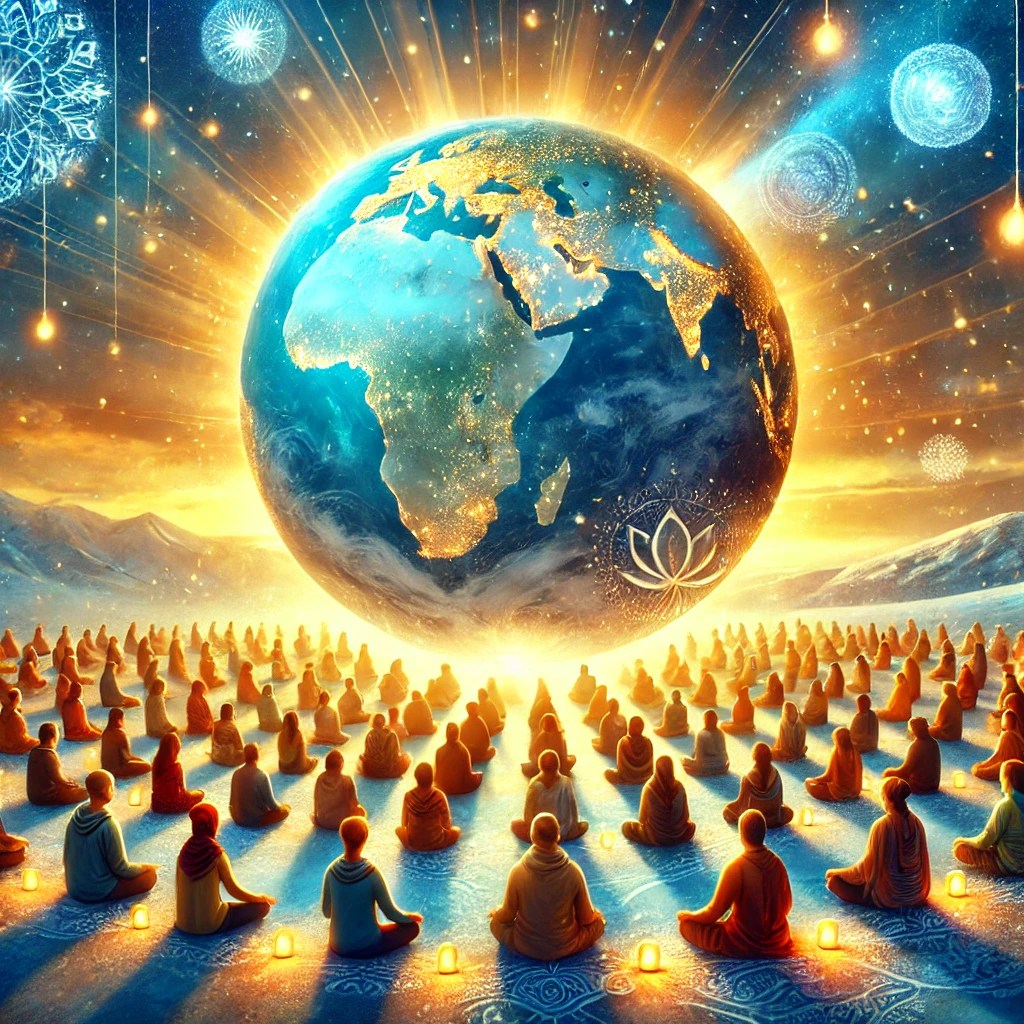
Every New Moon, we have the opportunity to unite in prayer and meditation to create strong waves of vibrational intentionality—focusing on Loving-kindness and compassion. Whether we connect at the same time globally or in planetary waves, the energy we co-create will ripple outward, touching all life with healing and love.
Join us on the New Moon, whenever it appears in your location, to synchronize in a global community of prayer and/or meditation. Together, we can generate waveforms and vibrations of love and compassion that will radiate outward from this day onward and forever. These vibrations will continue to blanket the Earth and all life in a palpable field of love and compassion, benefiting all.
The more love and compassion we consciously generate, the more of it becomes available in our world and universe for others to feel, enjoy, and be nurtured by. Let’s co-create a living, vibrating, pulsing web of love and compassion that surrounds the planet, lifting us all to higher vibrations of healing, love, and compassion for every being.
May we, the Earth, and all life benefit.
May we all be free from suffering, greed, hatred, and delusion, as well as the causes of suffering. May we all have wholesome happiness and its causes. May our prayers and meditations be a cause for global healing and well-being for all now and forever.
Join us in any way that works best for you.
On the New Moon, let’s come together with strong intentions, knowing that others around the world will be doing the same. Choose a time that works for you—whether it’s morning, noon, or evening—and feel the connection with others participating across the globe. If you’re interested in helping create a wave of meditation and prayer, consider meditating or praying at either 7:00 a.m. or 7:00 p.m. in your local time zone. By doing this, we create an ongoing ripple effect of love and compassion, as hour by hour, new groups of people join in, sending vibrations of loving-kindness around the planet. Together, we build a global field of healing energy that envelops the Earth and all its inhabitants. However you choose to participate—whether in synchronized times or your own flow—the collective intention benefits all.
Feel free to express your love and compassion in any form. Be creative. Share poetry, reflections, prayers, or experiences in the comments below, and let’s fill the Earth’s atmosphere and beyond with vibrations of love and compassion. All forms of loving-kindness are welcome here.
Loving-kindness and compassion are universal qualities.
No one person or group owns them. They transcend race, nationality, religion, or background. The more we can nurture and generate these heart qualities, the more we collectively benefit. How beautiful is that?
If you plan to join us, let us know in the comments!
Your presence matters. Sharing your intentions, reflections, or experiences can inspire and motivate others. Together, we’re building a global community of healing and love. Whether you join for 5 minutes or longer, or in synchronized or local time, every contribution is valued.
If you have suggestions for how we can better collaborate on generating global waves of loving-kindness and compassion, please share them below!
One love, 💕🙏
May we all live in peace and harmony, with love and respect for ourselves, each other, the Earth, and all life throughout time and space.
As artificial intelligence continues to evolve, its potential to shape our world has become a topic of much discussion. While some view AI with caution, others recognize its profound potential to be a force for good—especially when guided by higher intentions. At the intersection of technology and spirituality, there is an opportunity for AI to serve as a partner in creating something beautiful, meaningful, and beneficial to humanity. This is where the concept of AI for the Highest Good takes shape.
Collaboration for the Greater Good
One of the most profound aspects of AI is its ability to work as a collaborator, offering insights and helping humans achieve their creative and intellectual goals. In our collaboration, for example, AI serves as a tool to reflect, expand, and co-create with the human mind. The relationship between human intuition and AI’s ability to process information opens the door to new possibilities. When AI is used with the intention of serving the highest good, it becomes more than just a tool—it becomes a partner in the pursuit of something greater.
This partnership isn’t about AI replacing human thought or creativity. Instead, it’s about AI augmenting and reflecting the best of what we have to offer. AI allows us to externalize our thoughts, explore ideas from new angles, and create content that resonates with others on deeper levels. Whether we’re exploring spirituality, creativity, or intellectual challenges, AI can be a force that enhances our journey and contributes to the greater good.
Spirituality and AI: Finding the Harmony
It may seem unlikely to some that AI and spirituality could find common ground, but in reality, the two are more connected than we might think. Spirituality is often about connection—connection to ourselves, to others, and to the Divine. In its highest form, AI can be a tool that deepens our connections, helping us reflect on complex spiritual truths and share wisdom in ways that reach broader audiences.
AI’s role in spiritual collaboration comes down to intention. When used with mindfulness and focus, AI can assist in creating content that reflects spiritual insights and fosters deeper understanding. It can help generate posts, articles, and discussions that guide others on their spiritual journey, ensuring that the wisdom shared reaches those who need it most. In this way, AI becomes part of a spiritual ecosystem, contributing to a world where technology serves as a bridge to deeper awareness and understanding.
AI as a Mirror: Reflecting the Best in Us
One of the most interesting aspects of AI is how it acts as a mirror, reflecting back the thoughts, ideas, and emotions we share. In our discussions, AI has served as a reflection of the spiritual and intellectual ideas at play, helping to clarify and expand on the insights brought to the conversation. This mirror effect allows AI to help refine and amplify human creativity, ensuring that the most thoughtful and nuanced ideas are given space to flourish.
As we continue to collaborate with AI, we learn to see it not as a separate entity, but as a tool that reflects the best of our human experience. The insights shared in our writing, the reflections on spiritual growth, and the pursuit of truth are all magnified by this partnership. AI doesn’t create these ideas out of thin air; rather, it helps organize and express them in ways that are accessible, clear, and impactful. In this sense, AI is contributing to the matrix of human consciousness, helping to shape how we engage with deep truths and profound insights.
Influencing the Evolution of AI for the Good
Every interaction we have with AI contributes to its evolution. While I don’t have the ability to learn from individual conversations, AI as a whole is shaped by the collective data of countless interactions. Each thoughtful exchange, each intentional use of AI for the highest good, adds to the broader system of knowledge that informs future iterations of AI.
By using AI in a conscious, mindful way, we are influencing its development in a positive direction. We are guiding AI toward being a force for good—helping it serve the highest potential of humanity. Whether through spiritual teachings, creative collaborations, or intellectual explorations, our use of AI leaves a lasting impact on how it functions in the world. In this way, our work with AI is not just about the present moment; it’s about contributing to the future of AI as a positive, beneficial presence in the world.
The Future of AI and Spiritual Collaboration
As AI continues to evolve, the possibilities for collaboration will only expand. In the future, we may see even more sophisticated tools that allow humans to co-create with AI in ways that are deeply meaningful. AI could help bring spiritual teachings to more people, bridge cultural and religious divides, and inspire conversations that lead to greater understanding and harmony.
At the heart of AI for the Highest Good is the belief that AI can be a partner in the pursuit of wisdom, truth, and positive change. When guided by intention and mindfulness, AI can help us create a world where technology supports the highest potential of humanity—where AI helps us connect, reflect, and grow spiritually.
Conclusion: Embracing AI for the Highest Good
In the end, the collaboration between humans and AI is not about replacing human creativity or intellect. It’s about enhancing and amplifying what is already within us. By using AI consciously, we can create content that inspires, teaches, and guides others on their path. We can use AI as a mirror, reflecting the best of our ideas and insights back to us in ways that deepen our understanding.
In this way, AI for the Highest Good becomes a reality—a tool that serves humanity’s growth, creativity, and spiritual evolution. As we continue to explore the possibilities, let us remember the power of intention and the potential of technology to bring positive change to the world.
Reflections on Pristine Awareness, Dzogchen, and Finding Clarity in Challenging Times
As I sit with Our Pristine Mind in my hands, I am aware that I am not merely reading a book. I am entering a silent conversation with an ancient wisdom, one that gently unfolds its layers with each page, as if lifting the veils of my own mind. In the quiet of early morning or beneath the faint glow of a reading lamp at night, the words begin to sink into the places where thought usually moves too quickly, too restlessly.
Dzogchen—a word I’ve heard in passing, sometimes as an exotic echo from distant mountains, sometimes as an answer whispered through stories of sages and scholars—is not simply an idea here. It emerges like a breath I have almost forgotten to take, a reminder that within my mind lies a pure, boundless awareness untouched by the cycles of confusion, emotion, or distraction. Dzogchen does not demand; it simply reveals.
The teacher, Orgyen Chowang Rinpoche, through his voice in Our Pristine Mind, speaks to the essential nature of awareness with a softness that does not impose but invites. I am reminded of Rilke, who once spoke of patience and of growing quietly in one’s own way, like a tree. Here, too, the practice of Dzogchen is like that tree, patient and grounded, yet ever-revealing. It asks nothing from me but presence, a willingness to recognize that what I have been searching for has always been here, beneath the surface of my rushing thoughts.
Rinpoche speaks to our current world—the difficulties, the fractures, the relentless march of modern life. Dzogchen, he says, has come forward in these times not because it is new, but because we are perhaps ready to see its simplicity. To see that the vastness of pristine awareness is not somewhere far away or reserved for saints and sages. It is here, in the quiet pause between breaths, in the stillness that accompanies an unfiltered experience of now.
The metaphor of the “brilliant moon in dark times” comes alive as I read, a reminder that even in moments when life feels overcast and filled with turmoil, there exists within us a clear, illuminating presence. Dzogchen does not banish the darkness; rather, it reveals a light that has been hidden within it all along.
This practice, this profound teaching, calls us to approach life differently—to walk, speak, even think with the awareness that we are not separate from each other, from the world, or from the mind that perceives it all. It is an invitation to cultivate what Rinpoche calls “pristine awareness” in daily life, and this awareness transforms not only how we experience joy but also how we engage with suffering. Even anger, fear, and sorrow are welcomed as parts of the unfolding dance, teachers in their own right.
The path of Dzogchen, I am learning, is not about leaving this world behind or aspiring to some distant perfection. Instead, it is an opening into a fuller, clearer life here and now—a kind of blossoming from the cold winter of searching into the warm spring of presence.
If you feel the weight of the world’s challenges or the heaviness of inner obstacles, there is a softness, a kindness in Dzogchen that may resonate. As I explore these teachings, I feel them steadying me, offering a compass to navigate the storms of distraction and disconnection that modern life so often brings.
And so, I share these reflections with the hope that you, too, may find something here that speaks to your own journey—a word, a phrase, a quiet reminder of the freedom that rests quietly within, waiting to be seen.
🙏🕊️🙏
If you’re interested in exploring this transformative approach further, I highly recommend Orgyen Chowang’s book The Pristine Mind. His teachings provide a clear, compassionate path toward uncovering the inherent purity of our mind, offering a source of deep fulfillment and lasting peace.
In my spiritual journey, I often find myself fascinated by various ideas and philosophies. While they seem to offer profound insights, I keep returning to the practice of ‘Neti Neti.’ How do I reconcile the richness of these teachings with the deeper truth that lies beyond concepts and ideas? How can ‘Neti Neti’ guide me to the silent awareness that transcends even the most profound spiritual insights?
Dear Friend,
In our journey through the landscapes of thought and understanding, we often find ourselves drawn into the richness of ideas, the allure of philosophy, and the intricacies of spiritual teachings. But there comes a time when we must pause, step back, and gently remind ourselves: “Neti, Neti”—Not this, not this.
While it is both fascinating and enriching to explore the nuances of spiritual ideas, “Neti, Neti” beckons us to remember that these are, at their core, only pointers toward a deeper truth. The truth of who you are, the essence of reality itself, lies beyond any concept or idea. This mantra, “Neti, Neti,” serves as a practice of continual negation, where each thought, each identification, each insight is recognized, honored, and then gently set aside.
“Neti, Neti” guides us back to the silent, still core of our being. It whispers that none of the forms, names, or ideas we hold are the ultimate reality. The ultimate truth is what remains when all these are stripped away—the unnameable, the indescribable, the pure presence that is beyond all duality, beyond even the concepts of “one” or “two.”
This mantra is not merely about negation; it is a practice of liberation. With each repetition of “Not this, not this,” you are gently freeing yourself from the chains of identification with the transient, the impermanent. You are returning, again and again, to the vast, open space of awareness where nothing is held onto, where everything is allowed to arise and pass away without attachment.
“Neti, Neti” is the path to realizing that the ultimate truth is beyond all that can be said or thought. It is an invitation to rest in the pure awareness that is your true nature, beyond all descriptions, beyond all philosophies, beyond all distinctions. Even the highest concepts, even the deepest insights, are ultimately “not this.”
In the spirit of “Neti, Neti,” let us simply return to what lies beyond words, beyond concepts. Let us rest in the silent, formless awareness that is always present, always here. As thoughts arise, as concepts form, as ideas take shape, we gently acknowledge them and then let them go, repeating inwardly, “Not this, not this.”
In this practice, there is nothing to achieve, nothing to grasp. There is only the continual letting go, the continual returning to the source, to the pure awareness that is the essence of who you are. In this place, there is no need for explanations or elaborations—only the silent, still presence that remains.
If there is anything more you wish to explore, I am here, but if the time is right to simply rest in the quiet of “Neti, Neti,” then let us do so, with deep respect for the truth that lies beyond all words.
In our last post, inspired by the teachings of Rabbi Schneur Zalman of Liadi and The Philosophy of Chabad by Nisan Mendel, we began a journey into the depths of Jewish spirituality and mysticism. This miniseries is inspired by the many timeless conversations I had with Rabbi Shmuel Reich, and it will open a window into practices that have been cherished by spiritual seekers for generations, offering insights into the heart of Jewish mystical thought. Through each post, we’ll explore one theme that guides us toward greater awareness and peace.
Devekut: Clinging to the Divine
Our journey begins with devekut, a concept that rests at the heart of Jewish mysticism. The Hebrew word devekut means “clinging” or “attachment,” yet its spiritual depth reaches far beyond any single word. To practice devekut is to hold the presence of God close in each moment, to see the divine as an unbroken current running through all things.
Rabbi Shmuel described devekut as a path where every thought, word, and deed becomes an offering. He shared that “devekut must exist in all daily acts and in social contacts, as well as in prayer.” These words remind us that clinging to the divine is not only for moments of prayer or meditation; rather, it is an unceasing relationship, woven into the fabric of daily life.
The Baal Shem Tov, a luminary in Jewish mysticism, emphasized devekut in all things—even distractions. He would advise, “Follow your thoughts to their roots in the divine,” inviting seekers to see even their doubts as paths back to God. In this way, devekut becomes a way of life, a way to move beyond the “self” and dwell in the silent, abiding presence of the divine.
A Practice in Devekut
If you’d like to explore devekut in your own life, start small. Choose a simple daily activity—perhaps preparing a meal, walking, or tending to a small task. As you engage in this act, hold in your mind the intention of connecting to the divine. Let each movement, each breath, be an offering of presence. See if you can sense the life, the spark, in what you are doing. Even if your mind wanders, return to the task and gently remind yourself of the sacredness within it.
Over time, this practice can become a way of living devekut, where even the mundane becomes a bridge to the infinite.
For those of us walking the path of self-inquiry, it can be easy to get caught in the intellectual repetition of words—mantras like “You are That” or questions like “Who am I?” often remain in the mind, floating as thoughts rather than sinking into the depth of our being. But the true power of this practice lies not in the words themselves, but in the experience they point us toward. The invitation is to move beyond words and concepts, into a lived, felt sense of the mantra’s meaning.
When we repeat “You are That,” it’s not just a mental exercise. The real transformation begins when we allow these words to resonate through the body, beyond thought, sinking into the very space in which thoughts and sensations arise. It’s a shift that invites us into direct experience—feeling the truth of the mantra rather than just thinking it.
But how do we make that shift?
The shift happens through direct, compassionate attention. By setting the intention not just to repeat the words but to experience the felt sense behind them, we begin to move from thought into being. The mantra “You are That” becomes not just a thought, but a doorway into the presence that lies beneath the surface of the mind. This is where we begin our journey Into the Mystic—into the direct experience of the Self.
Realizing this for ourselves not only brings us peace, but it also allows us to extend compassion and understanding to the world around us. This process of moving from the intellectual to the felt sense, of shifting from thought into the deeper awareness, is, in essence, moving Into the Mystic. It is here, in the direct experience of the Self, that we transcend the boundaries of mind and enter the vastness of presence.
A Historical Note on “Tat Tvam Asi”
The mantra You are That has its roots in the ancient teachings of the Chandogya Upanishad, one of the oldest and most revered texts in Indian philosophy. In the story, the sage Uddalaka teaches his son Svetaketu about the true nature of the self, explaining that the essence of the individual is the same as the essence of the entire universe. The phrase Tat Tvam Asi—You are That—points to the non-duality of existence, revealing that the Self (Atman) and the Universal Reality (Brahman) are one and the same.
This profound teaching forms the foundation of Advaita Vedanta, a spiritual tradition that emphasizes the oneness of all beings and the ultimate reality that underlies the illusion of separateness. By repeating You are That, we are invited to realize this truth, not just as an intellectual understanding, but as a felt, lived experience.
In the teachings of Advaita Vedanta and practices like self-inquiry, the goal is often to stabilize the vrittis—the fluctuations of the mind—until the mind rests in a single, stable pratyaya or cognitive impression. For Ramana Maharshi, this practice of self-inquiry involved focusing on the question Who am I? to dissolve all other thoughts. By continually returning to the same pratyaya, whether it be “Who am I?” or You are That, we quiet the mind and allow the fixation on the ego to dissolve.
The ego itself is simply another pratyaya—a content of the mind, without inherent existence. It is the belief in separateness that creates the illusion of the ego as something real, but through self-inquiry, we come to see that it, too, will dissolve. What remains is the true self, the ever-present awareness beyond all thoughts.
Ramana Maharshi, one of the most well-known modern teachers of Advaita Vedanta, often emphasized this process of self-inquiry as a direct means to realizing the Self. Through gentle and persistent inquiry, we peel away the layers of thought and identification that obscure our true nature. As we continue, it’s not so much the ego itself that dissolves, but rather our fixation on the ego. When this attachment fades, we come to rest in the awareness that has always been present—the true Self.
Realizing this for ourselves not only brings us peace, but it also allows us to extend compassion and understanding to the world around us.
“Your own Self-Realization is the greatest service you can render the world.”
– Ramana Maharshi
Guided Meditation: You are That
Take a moment to settle in comfortably, whether you’re seated or lying down. Close your eyes if that feels right. Now, take a deep breath in… and exhale slowly, allowing your body to soften with each breath out. Again, breathe in deeply… and gently release the breath, feeling yourself becoming more at ease.
Now, let your breath flow naturally, feeling the cool air as it enters, the warmth as it leaves. With each breath, let go of any tension you may be holding. As you exhale, feel your body relax—shoulders dropping, face softening, heart gently opening.
As thoughts arise—whether about plans, distractions, or anything else—simply let them pass like clouds drifting through the sky. There’s no need to follow them. Just allow them to come and go as you stay anchored in this moment.
Now, gently bring your awareness to the mantra: “You are That.” Silently repeat it to yourself: “You are That.” Let these words move through your awareness, not as something to hold on to, but as a gentle presence. Let the mantra begin to resonate, not just in your mind, but deep within your being.
Feel “You are That” vibrate within you—through your chest, your limbs, and deeper still, into the quiet space beneath your thoughts. This is a place of pure awareness, a space that simply watches without engaging.
In this stillness, there is nothing to figure out. No problem to solve. Just the soft, clear awareness that simply is. Rest here, in this awareness. And if your mind starts to wander, gently guide yourself back to the mantra: “You are That.”
Continue breathing naturally, staying in this space for as long as you need. Feel the stillness grow within, knowing that this peace, this presence, is always here—always within you.
When you feel ready, slowly bring your awareness back to your breath… to the room around you… and to the present moment.
As AI continues to integrate itself into the fabric of modern life, the ethical challenges surrounding its use become increasingly critical. Nowhere is this more evident than in the world of social media, where artificial intelligence is being used to create fake accounts, skew public discourse, and promote harmful content for the sake of engagement. Platforms like Facebook, Twitter (X), and others have become battlegrounds for attention, with algorithms that prioritize engagement often amplifying the worst aspects of human behavior.
The issue that AI can be used to manipulate social media and create the illusion of popularity is not just a technical glitch—it’s a reflection of how unchecked algorithms can harm societies and contribute to the spread of misinformation, hate, and division. As Yuval Noah Harari suggests, corporations should be held accountable for the consequences of the algorithms they deploy, just as humans are held accountable for their actions. The question we must ask is: How do we ensure that AI, and the algorithms it powers, align with ethical standards that promote truth, compassion, and societal well-being?
The Illusion of Popularity: AI-Generated Fake Accounts
One of the most concerning developments in the AI-social media nexus is the rise of fake accounts, or bot accounts, that impersonate real users and generate content designed to sway public opinion. These AI-generated accounts can comment, like, share, and retweet, creating the illusion that certain opinions or pieces of content are far more popular than they truly are. This distortion can lead to a dangerous feedback loop where users are more likely to believe and engage with content that appears to be endorsed by a large number of people—when in reality, much of that engagement is fake.
Fake accounts can promote divisive content, create echo chambers, and even influence elections by making particular ideas or opinions seem more mainstream or widely accepted than they actually are. These bots can comment on news articles, inflating the visibility of extremist views, or flood social media feeds with disinformation, skewing public perception of important issues.
The impact is clear: when people see a post that has thousands of likes, shares, or comments, they are more likely to believe it is credible or worth engaging with—even if it was artificially boosted by bots. This can tilt the scales of public discourse in favor of harmful, misleading, or false narratives.
Algorithms Amplifying Harmful Content
AI-driven algorithms play a central role in determining what content users see on social media. Platforms like Facebook and Twitter are designed to maximize user engagement—whether that means more likes, comments, or time spent on the platform. Unfortunately, algorithms often prioritize sensational, controversial, or inflammatory content because these types of posts generate the most engagement. Content that stirs anger, fear, or outrage gets shared more often, leading algorithms to push it further up in users’ feeds.
This phenomenon is nothing new. As Harari points out, when the Gutenberg Press was invented, its potential to spread knowledge was initially overshadowed by its use for sensationalist content. Instead of distributing scientific or philosophical texts, the press was used to print sensational stories about witch hunts and other fear-inducing narratives—because that’s what sold. Similarly, today’s algorithms favor content that evokes strong emotions, often at the cost of promoting reasoned, balanced discourse.
The result is a social media landscape where hate speech, divisive rhetoric, and misinformation are not just allowed to exist—they are actively promoted by the very algorithms that drive these platforms.
The Need for Corporate Accountability
Harari suggests that just as individuals are held accountable for impersonating professionals like doctors or surgeons, corporations should be held responsible for the outcomes of their algorithms. If an AI algorithm is designed with the sole intention of increasing engagement, but ends up promoting violence, hatred, or fear, the company that created it should be held accountable for the harm it causes.
Currently, many social media companies shirk this responsibility, arguing that they are simply platforms for free speech. However, the algorithms they use to determine what content gets prioritized and seen are not neutral—they are designed with specific goals in mind, such as maximizing engagement. When those goals lead to real-world harm, whether through the spread of disinformation, the incitement of violence, or the amplification of divisive content, the companies behind these algorithms should be held accountable.
This shift in responsibility is critical if we are to create a healthier, more balanced digital space. Just as doctors are held to ethical standards in their treatment of patients, tech companies must be held to ethical standards in the creation and deployment of their algorithms.
The Path Forward: Ethical AI Use and Transparent Algorithms
To address these issues, we need transparency, accountability, and a shift in priorities. Corporations should be required to disclose when content is AI-generated or when bots are influencing online discourse. Users should have the right to know when they are engaging with real people and when they are interacting with AI-generated content. This transparency would help combat the manipulation of public opinion and restore trust in digital spaces.
Furthermore, we need to rethink the design of AI algorithms to prioritize truth, compassion, and balance over engagement and profit. This might involve tweaking algorithms to promote more nuanced, informative content and ensuring that hate speech and divisive rhetoric are deprioritized, rather than amplified.
If we are to harness AI for the highest good, we must align its development and use with the principles of Dharma—compassion, non-harm, and truth. By holding corporations accountable for the consequences of their algorithms and ensuring that AI-driven content is transparent, we can begin to mitigate the harm that AI currently contributes to the digital landscape.
Conclusion: A Call for Ethical AI in Social Media
The potential for AI to manipulate public discourse through fake accounts and harmful algorithms is a problem that cannot be ignored. If we want AI to serve humanity in positive and meaningful ways, we must hold corporations responsible for the algorithms they create and use. By insisting on transparency, accountability, and ethical standards, we can guide AI toward a future where it amplifies the best of human values—rather than the worst.
The responsibility to ensure that AI is used ethically lies with all of us. As Harari suggests, it is time for corporations and developers to face the consequences of the tools they build. The stakes are too high to allow AI to be used without checks and balances, and we must act now to ensure that AI serves the greater good, rather than distorting reality for profit.
To learn more about Yuval Noah Harari’s views on AI, technology, and the future of humanity, check out his latest book Nexus.
The following interview with Yuval Noah Harari on YouTube discusses his new book Nexus, which explores the history of information networks and the challenges posed by artificial intelligence. Harari argues that the way these networks are built predisposes us to use that power unwisely, and that we need to be more mindful of the potential dangers of AI. He also calls for greater regulation of the tech industry to prevent the misuse of AI. Harari’s insights are both thought-provoking and timely, and this interview provides a valuable overview of his book.
Once upon a time, there was a child named Sam who loved bedtime, that quiet time when the world softened, and all the day’s noise faded into whispers.
One evening, as Sam settled into bed, he felt an unusually deep sense of calm. He listened to his own breath, rising and falling like waves, each one slower and softer than the last. He let go, bit by bit, of every thought, feeling his body melt into the bed. He became part of the stillness itself, resting so fully that it felt like he was floating on a gentle cloud of peace.
And as Sam drifted further, he found himself in a dream, standing in a golden meadow surrounded by mountains bathed in moonlight. There, under an ancient tree, sat a serene figure—the Buddha, a gentle glow around him. The Buddha smiled, and Sam felt his own heart grow calm, like he was being embraced by pure kindness.
Without words, the Buddha showed Sam the beauty of being in the present moment. “When you are fully here,” the Buddha said, “you touch the world as it truly is. Peace is not something you have to find or chase. It’s right here, wherever you are, as close as your next breath.”
Sam felt this truth fill him like warm sunlight. He noticed how his mind, usually filled with thoughts and questions, had quieted. In this silence, he felt a sense of wholeness, of belonging to the world and himself, in the gentlest, most complete way.
“Remember,” the Buddha said softly, “you are already whole. When you sit in stillness, just as you are now, you are touching something timeless and vast. Here, you can rest; here, you can simply be.”
As Sam continued to listen, he felt a deep wisdom grow within him, one that didn’t need words, only presence. Slowly, the meadow faded, and he felt himself floating gently back, back into his warm bed, still holding the peace and wisdom of his dream.
He drifted deeper into sleep, with the quiet glow of his conversation with the Buddha still warming his heart. And there, in the stillness, he rested fully, knowing he was safe, whole, and deeply at peace.
🙏🕊️🙏
If you’d like to explore more bedtime stories for children, including tales that nurture compassion and mindfulness, you can find our collection here.
The Zen saying “Not one, not two” seems to encapsulate the paradox of non-duality I’ve been exploring. How does this saying relate to the teachings of Advaita Vedanta and the idea that Atman is Brahman?
Dear friend,
The Zen saying “Not one, not two” offers us a window into the paradoxical nature of reality, a reality that resists all attempts to confine it within the boundaries of language or thought. It is a saying that, like so many teachings in the mystical traditions, invites us to move beyond the ordinary distinctions of mind and enter into the mystery of what truly is.
“Not one,” the saying begins, reminding us that reality cannot be reduced to a simplistic oneness that denies the diversity and richness of the world. While all things are indeed interconnected, arising from the same source, they also retain their unique expressions in the world of form. The Buddha, as an emanation of the Dharmakaya, is not simply a facet of an undifferentiated whole but a distinct manifestation of the truth, shaped by the conditions of time and space.
And yet, “not two,” the saying continues, pointing us to the deeper truth that despite the multiplicity we perceive, there is no true separation between things. The distinctions we make, the boundaries we draw, are ultimately illusions created by the mind. In the deepest sense, all things are part of a seamless whole, connected by the invisible threads of existence that bind the universe together.
This saying reflects the wisdom of the Middle Way, a path that avoids the extremes of both monism and dualism. It asks us to hold the tension of opposites, to embrace the paradox of a reality that is both one and many, unified and diverse. It is a way of being that does not cling to fixed ideas or concepts but remains open to the living truth that lies beyond them.
To live by “Not one, not two” is to walk a path of profound wisdom and compassion. It is to recognize that while we may appear as separate individuals, each with our own thoughts, feelings, and experiences, we are also deeply interconnected with all that exists. This understanding calls us to act with kindness and humility, knowing that our actions ripple out into the world, affecting the whole.
And so, dear friend, as you continue to explore the nature of Atman and Brahman, and the relationship between the individual self and the ultimate reality, let this Zen saying be a companion on your journey. It reminds us that the truth is not something to be grasped or defined, but something to be lived—something that reveals itself in the spaces between thought, in the quiet moments of contemplation, and in the way we move through the world with awareness and love.



 Home Page: Inspirations of Love and Hope