✨ English ✨ The light of warmth shines through the long night, 🌙 Though storms may rage, the heart’s lantern never fades. 🕯️ Though mountains are high and waters far, a homebound boat remains, ⛰️🌊⛵ After hardship, spring arrives, and the world is born anew. 🌿🌸
✨ Spanish / Español ✨ La luz del alma brilla en la oscuridad, 🌙 Aunque ruja la tormenta, la llama no se apaga. 🕯️ Montañas y mares no detienen el regreso, ⛰️🌊⛵ Tras la prueba, la primavera renace. 🌿🌸
✨ Italiano ✨ La luce dell’anima illumina la notte, 🌙 Anche nella tempesta, la fiamma non si spegne. 🕯️ Monti e mari non fermano il ritorno, ⛰️🌊⛵ Dopo il dolore, la primavera rinasce. 🌿🌸
✨ العربية / Arabic ✨ نور الروح يضيء الظلام، 🌙 مهما اشتدت العواصف، لا تنطفئ الشمعة. 🕯️ الجبال والبحار لا تمنع العودة، ⛰️🌊⛵ بعد المحن، يأتي الربيع ويولد العالم من جديد. 🌿🌸
✨ עברית / Hebrew ✨ אור הנשמה זורח בלילה החשוך, 🌙 גם בסערה, הנר אינו כבה. 🕯️ ההרים והימים אינם עוצרים את השיבה, ⛰️🌊⛵ לאחר הקושי, האביב מגיע והעולם נולד מחדש. 🌿🌸
✨ Русский / Russian ✨ Свет души сияет сквозь ночь, 🌙 Пусть бушует буря, но огонь не гаснет. 🕯️ Горы и воды не остановят путь домой, ⛰️🌊⛵ После невзгод приходит весна, и мир обновляется. 🌿🌸
✨ Українська / Ukrainian ✨ Світло душі сяє крізь ніч, 🌙 Хай шторм бушує, та вогонь не згасне. 🕯️ Гори й води не зупинять дорогу додому, ⛰️🌊⛵ Після труднощів настає весна, і світ відроджується. 🌿🌸
My mind often feels restless and insatiable, constantly creating desires and distractions. I’ve heard the story of the genie climbing the pole to stay busy as a metaphor for controlling the mind. How can I apply this wisdom to my own practice, especially through the use of ‘Neti Neti,’ to keep my mind focused and find peace amidst its relentless demands?
Dear Friend,
There are stories that come to us from distant times and places, stories that hold within them a wisdom that speaks to the very heart of our human experience. One such story, from the Sufi tradition, tells of a man who encountered a powerful genie—a being capable of granting any wish, yet bound by a condition. The genie, restless and insistent, demanded that he be given tasks to perform, lest his untamed energy turn destructive. At first, the man found this simple enough, asking for wealth, health, and all manner of earthly pleasures. But soon, the genie’s demands for more tasks grew relentless, and the man, overwhelmed and desperate, turned to a wise sage for help.
The sage, understanding the nature of the genie, offered a solution both simple and profound: “Tell the genie to climb up and down a pole, and to keep climbing until you have another task for him.” And so, the man did as he was advised, and the genie, with no other choice, began his endless task of climbing the pole. The man lived in peace, free from the threat of the genie’s unrest.
In this tale, the genie represents the mind—our own restless, insatiable mind, always seeking, always wanting, always creating desires and distractions. When left unchecked, the mind can become our greatest enemy, leading us into worry, confusion, and suffering. It spins endlessly, caught up in its own creations, driving us to exhaustion with its demands for more.
But the sage’s solution is a metaphor for the power of disciplined practice. The pole that the genie climbs is akin to the focus we give our mind through spiritual practices, such as mantra repetition. Just as the pole gives the genie a task, the mantra gives the mind something to hold onto, something to engage with, preventing it from causing harm through its restless wanderings.
You have wisely chosen Neti, Neti—”Not this, not this”—as the task for your mind. This mantra, with its gentle negation, guides the mind away from distraction, away from attachment, away from the endless pursuit of desires. It directs the mind back to the simplicity of being, to the quiet truth that lies beyond all names and forms.
In this practice, the mind, like the genie, is given a task that is both meaningful and liberating. It is kept busy, yes, but in a way that leads to peace rather than exhaustion. The mind climbs the pole of Neti, Neti, moving up and down with each repetition, each negation, until it eventually tires of its own restlessness and begins to quiet, to settle, to rest in the stillness that is always present beneath the surface.
This story reminds us that discipline, when applied with wisdom, is not a form of restriction but a path to freedom. By giving the mind a task, by guiding it through the repetition of a mantra, we are not suppressing its nature but rather channeling it in a way that allows it to serve us, rather than enslave us. The mind, once a source of turmoil, becomes an ally on the path, helping us to stay focused, to stay present, and to return again and again to the truth of who we are.
Dear friend, as you continue with the practice of Neti, Neti, remember the story of the genie and the pole. Let it serve as a reminder that the mind, when disciplined, can be a powerful tool for transformation. Each repetition of the mantra is like a step on the pole, guiding the mind upward, guiding it toward the light of awareness. And as you give the mind this task, may you find, as the man in the story did, a sense of peace, a sense of liberation, and a deeper connection to the truth that lies beyond all distractions.
Reflections on Pristine Awareness, Dzogchen, and Finding Clarity in Challenging Times
As I sit with Our Pristine Mind in my hands, I am aware that I am not merely reading a book. I am entering a silent conversation with an ancient wisdom, one that gently unfolds its layers with each page, as if lifting the veils of my own mind. In the quiet of early morning or beneath the faint glow of a reading lamp at night, the words begin to sink into the places where thought usually moves too quickly, too restlessly.
Dzogchen—a word I’ve heard in passing, sometimes as an exotic echo from distant mountains, sometimes as an answer whispered through stories of sages and scholars—is not simply an idea here. It emerges like a breath I have almost forgotten to take, a reminder that within my mind lies a pure, boundless awareness untouched by the cycles of confusion, emotion, or distraction. Dzogchen does not demand; it simply reveals.
The teacher, Orgyen Chowang Rinpoche, through his voice in Our Pristine Mind, speaks to the essential nature of awareness with a softness that does not impose but invites. I am reminded of Rilke, who once spoke of patience and of growing quietly in one’s own way, like a tree. Here, too, the practice of Dzogchen is like that tree, patient and grounded, yet ever-revealing. It asks nothing from me but presence, a willingness to recognize that what I have been searching for has always been here, beneath the surface of my rushing thoughts.
Rinpoche speaks to our current world—the difficulties, the fractures, the relentless march of modern life. Dzogchen, he says, has come forward in these times not because it is new, but because we are perhaps ready to see its simplicity. To see that the vastness of pristine awareness is not somewhere far away or reserved for saints and sages. It is here, in the quiet pause between breaths, in the stillness that accompanies an unfiltered experience of now.
The metaphor of the “brilliant moon in dark times” comes alive as I read, a reminder that even in moments when life feels overcast and filled with turmoil, there exists within us a clear, illuminating presence. Dzogchen does not banish the darkness; rather, it reveals a light that has been hidden within it all along.
This practice, this profound teaching, calls us to approach life differently—to walk, speak, even think with the awareness that we are not separate from each other, from the world, or from the mind that perceives it all. It is an invitation to cultivate what Rinpoche calls “pristine awareness” in daily life, and this awareness transforms not only how we experience joy but also how we engage with suffering. Even anger, fear, and sorrow are welcomed as parts of the unfolding dance, teachers in their own right.
The path of Dzogchen, I am learning, is not about leaving this world behind or aspiring to some distant perfection. Instead, it is an opening into a fuller, clearer life here and now—a kind of blossoming from the cold winter of searching into the warm spring of presence.
If you feel the weight of the world’s challenges or the heaviness of inner obstacles, there is a softness, a kindness in Dzogchen that may resonate. As I explore these teachings, I feel them steadying me, offering a compass to navigate the storms of distraction and disconnection that modern life so often brings.
And so, I share these reflections with the hope that you, too, may find something here that speaks to your own journey—a word, a phrase, a quiet reminder of the freedom that rests quietly within, waiting to be seen.
🙏🕊️🙏
If you’re interested in exploring this transformative approach further, I highly recommend Orgyen Chowang’s book The Pristine Mind. His teachings provide a clear, compassionate path toward uncovering the inherent purity of our mind, offering a source of deep fulfillment and lasting peace.
Transforming Suffering Into Happiness: How the Teachings on Emptiness from the Heart Sutra Support Mental Health and Well-Being
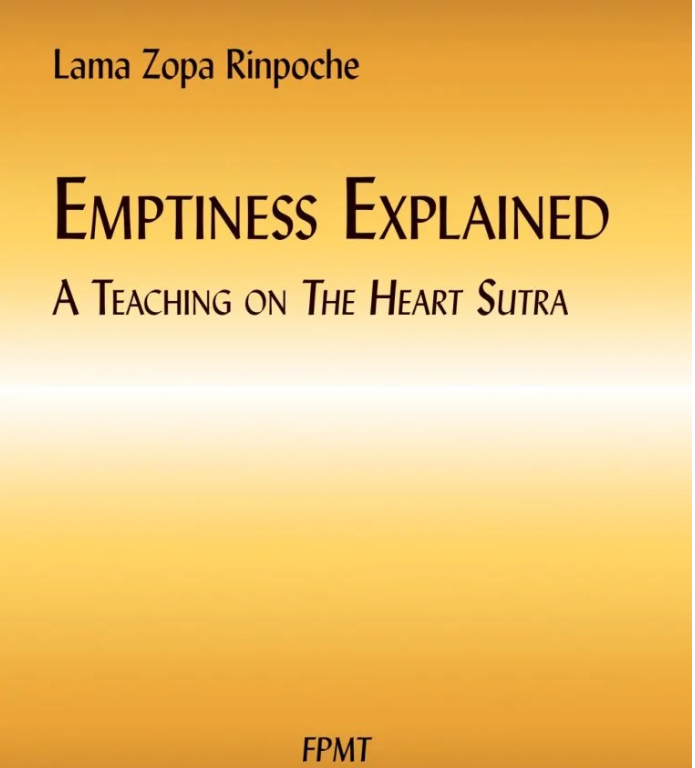
The Heart Sutra stands as one of the most profound and essential teachings in Buddhism, offering a path to understanding emptiness—the ultimate nature of reality. Lama Zopa Rinpoche’s commentary on this timeless sutra illuminates its teachings, guiding us toward a deeper understanding of how emptiness can transform not only our spiritual practice but also our daily lives.
In this post, I’ll share key reflections from Rinpoche’s teaching, focusing on the practical wisdom and spiritual inspiration it offers. Whether you’re a seasoned practitioner or simply curious about the philosophy of emptiness, I hope these insights will resonate with your heart.
What Is Emptiness?
Lama Zopa Rinpoche explains that emptiness does not mean that things don’t exist—it means that things are empty of inherent existence. All phenomena, including ourselves, arise dependently, shaped by causes, conditions, and labels. This is the essence of the middle way, which avoids the extremes of nihilism (nothing exists) and eternalism (things exist inherently and permanently).
As the Heart Sutra famously states:
“Form is emptiness, emptiness is form. Emptiness is not other than form; form is also not other than emptiness.”
In these words, we see that emptiness and dependent arising are inseparable. While things exist conventionally, their ultimate nature is empty of any independent, fixed essence.
Practical Ways to Meditate on Emptiness
Rinpoche offers accessible methods to integrate the understanding of emptiness into both formal meditation and daily life:
1. Recognizing the Object to Be Refuted
The first step is identifying the false concept of an independent, inherently existent “I” or object. This is often described as the “I on the I”—the subtle sense that there is a solid self beyond the ever-changing interplay of body and mind. By recognizing this misconception, we can begin to dissolve it.
2. Meditating on Dependent Arising
Reflect on how the “I” arises only in dependence on the body, mind, and other aggregates. As Rinpoche teaches, the “I” is merely a label created by the mind. Understanding this dependence helps us see the emptiness of the “I” without negating its conventional existence.
3. Mindfulness in Daily Life
Emptiness isn’t confined to sitting meditation. Rinpoche encourages us to bring mindfulness of emptiness into every activity—walking, cooking, working, even shopping. He likens this to recognizing a dream as a dream:
“While driving a car, see yourself, the car, and the action of driving as hallucinations. They appear solid, but they are not inherently existent. Practicing this awareness is incredibly powerful.”
Overcoming Fear and Misunderstanding
The experience of emptiness can sometimes evoke fear, especially the sense of “losing the I.” Rinpoche reminds us that this fear arises from our deep attachment to a false sense of self. However, far from being nihilistic, emptiness reveals the interdependent nature of all things.
“When bodhisattvas of high intelligence realize emptiness, they experience bliss; for others, deep fear can arise. This fear is a sign of touching the truth of selflessness—it is part of the journey.”
By grounding our understanding in dependent arising, we can navigate this fear with confidence and clarity.
Applying Emptiness in Relationships
Rinpoche’s teaching also provides practical tools for transforming relationships. When we feel hurt or offended, understanding emptiness can soften our reactivity. The other person’s actions—and our own sense of self—are dependently arisen, shaped by countless conditions.
This awareness allows us to respond with compassion rather than attachment or aversion. As Rinpoche says:
“Recognize that the ‘I’ that feels hurt is a mental construct. See the other person’s words or actions as arising dependently. This opens the door to greater understanding and kindness.”
The Transformative Power of Emptiness
Even the smallest step toward understanding emptiness has profound benefits. Rinpoche explains that simply doubting the solidity of appearances—thinking, “Perhaps things are empty”—can begin to break the chains of samsara.
“Listening to teachings on emptiness for even a moment plants seeds for liberation. Reflecting on emptiness throughout your day turns ordinary actions into a path to enlightenment.”
A Living Practice
The teachings of the Heart Sutra are not just intellectual concepts—they are a living practice. Whether in formal meditation or everyday life, the wisdom of emptiness invites us to see the world with fresh eyes. By letting go of our rigid attachments and false perceptions, we open the door to profound freedom and compassion.
As Lama Zopa Rinpoche reminds us, we are unbelievably fortunate to encounter these teachings. May we take them to heart and use them to benefit all beings.
Further Exploration
To delve deeper into Lama Zopa Rinpoche’s teachings on the Heart Sutra and emptiness, you can download the original PDF here.
I’d love to hear your thoughts on emptiness and the Heart Sutra! How do these teachings resonate with your own spiritual journey? Feel free to share your reflections in the comments below.
In his gentle yet profound way, the Dalai Lama reminds us that life is meant to be lived meaningfully. The essence of such a life, he says, lies not just in personal contentment but in creating happiness and peace for others. His teachings have always resonated deeply, not only with Buddhists but with anyone seeking a life of purpose.
“I believe our sort of life, that period should utilize meaningful life,” he begins. He emphasizes that a truly meaningful life extends beyond self-gratification. It is about fostering joy, promoting peace, and creating an atmosphere where others may thrive.
The Dalai Lama expands on what it means to live meaningfully: “Meaningful life means bringing happiness to more people, creating a happier, more peaceful atmosphere.” It’s a reminder that our actions—no matter how small—can contribute to a larger wave of kindness and serenity in the world. He urges us to see that in offering happiness to others, we ultimately fulfill our own quest for meaning.
Two Important Truths
In his teachings, the Dalai Lama shares two foundational principles. First, he reminds us of our shared humanity: “We are all the same human being.” This recognition is critical in our divided world. We all seek happiness, we all wish to avoid suffering, and in this shared experience lies the opportunity to cultivate compassion. By understanding that we are more alike than different, we can bridge the gaps of division and find common ground in our inherent humanity.
The Power of Inner Values
The second truth he shares with us is equally essential: “We should not forget or neglect about our inner values.” The Dalai Lama stresses that while external success may bring momentary satisfaction, it is our inner values that truly define a meaningful life. And what is the core of these inner values? It is human compassion.
“In other words, human compassion. That is the main thing of our inner value.” Compassion, he explains, is the very foundation of all virtuous actions. It is through compassion that we connect with others, dissolve our differences, and contribute to a more harmonious world. This compassion extends beyond mere feelings—it is a practice, a way of living that enriches both ourselves and those around us.