Within Sakya Monastery, a hidden wall of manuscripts—reportedly containing over 84,000 texts—was brought to light in 2003, revealing centuries of preserved scholarship and spiritual transmission.
Across the centuries, there are voices that still speak with startling clarity. This brief portrait of Rongtön Sheja Kunrik (14th Century) opens a window into the great monastic universities of Tibet, where scholarship, meditation, and compassion were woven into a single path. By revisiting the lives preserved in ancient namthar archives, we are reminded that wisdom is not lost to time. It waits patiently in these luminous biographies, offering insight into disciplined study, fearless inquiry, and the union of intellect and realization. For readers seeking depth, continuity, and the steady flame of transmitted understanding, this life story invites us to listen again.
Rongtön Sheja Kunrik was born in the region of Rong (Central Tibet) in the female Fire-Hare year (1367). From childhood, his mind turned naturally toward the Dharma. He entered monastic life early, receiving novice vows and beginning rigorous study under masters of the Sakya and other lineages.
At Sangphu Neutok, one of the great centers of learning, he immersed himself in the profound treatises on Prajñāpāramitā, logic, vinaya, and abhidharma, astonishing his teachers with his clarity and depth.
Mastery and Scholarship
By his early twenties, he had already mastered the major Indian and Tibetan commentaries. He received the name Shakya Gyaltsen and later the fuller title Sheja Kunrik (“All-Knowing Knower of Phenomena”).
His scholarship was vast—he commented on nearly all the major works of the sutras and shastras, often composing lucid explanations that clarified difficult points for students across traditions.
Founding Nalendra Monastery
At about the age of sixty-nine, recognizing the impermanence of conditioned things, he founded Nalendra Monastery near Lhasa.
There he gathered disciples and transmitted teachings with boundless compassion, emphasizing direct insight into emptiness, loving-kindness, and the union of study and practice.
His approach was remarkably inclusive. He respected and drew from Kadam, Kagyu, and other traditions without partiality.
Final Years and Legacy
He lived to the age of eighty-three, passing in 1449. He left behind a legacy of writings that continue to illuminate minds. His disciples, including the great Shakya Chokden, carried his wisdom forward like a steady flame in the wind.
The Traditional Namthar Style
When told in the traditional namthar (spiritual biography) style, such a life story begins with prayers of homage, wondrous signs at birth, early renunciation, meetings with gurus, receiving empowerments and transmissions, profound realizations, teaching activities, and finally a peaceful passing amid miraculous signs—all woven together to inspire faith and diligence in the listener.
The following is a personal reflection written during my practice of Dzogchen Ngöndro, shared here as part of my ongoing journey with these teachings.
I am very new to studuing and learning Orgyen Chowang Rinpoche and his teachings. My first introduction was through reading Our Pristine Mind a few years ago, which proved extremely helpful. The way ordinary mind and mental events are described brought clarity, resolving many years of confusion I had about sems and sems nyid.
I have been studying and practicing Tibetan Buddhism as a lay practitioner since 1985–1986, after receiving the Kalachakra initiation with His Holiness the Dalai Lama in Bodhgaya, India. At this stage, I am not sure I can yet call myself Rinpoche’s student, as I understand that in the Tibetan tradition there is often a period of mutual discernment, where teacher and student come to know one another. For now, I am simply following his request to practice Ngöndro, and through this I am seeking to cultivate the beginnings of a student–teacher relationship, should that become appropriate.
Insight from Contemplating the Eight Freedoms
“The hungry ghost is not merely a being with desire, but a being entirely without contentment.”
While reflecting on the Ngöndro contemplations, I focused on the second freedom—not born as a hungry ghost.
As a human, I also experience desire, but I have the capacity for contentment. Even small moments—a quiet breath, the peace of stillness—remind me that not everything is consumed by craving.
This insight brought me to a thought: perhaps it is not desire itself that causes suffering, but rather the inability to rest in contentment. Contentment softens desire, transforms it, and allows the heart to rest.
Contemplative pause: Take a moment to notice where contentment may already exist in your life, even amid desire or difficulty.
I am deeply grateful that such insights arise through the Ngöndro practice, and I wanted to record and share this reflection as part of my ongoing journey.
Updates on Practice and Retreat Plans
Although I had registered for the five-day Dzogchen retreat in August, I was not aware of the Ngöndro prerequisite and will therefore be withdrawing. I am now following Rinpoche’s guidance by studying and practicing the online Dzogchen Ngöndro program.
I look forward to seeing him on October 11th at the one-day online Dzogchen retreat.
Living with My Practice in Daily Life
I have been living with a chronic illness called myalgic encephalomyelitis for many years. At first it brought great suffering, but over time I have come to see it as a powerful teacher on the path—almost like a spiritual friend.
Because of this condition I am mostly homebound, and so I am deeply grateful for the opportunity to study and practice with Rinpoche through the modern blessing of online communication.
Even when our circumstances feel limiting, spiritual connection and insight can arise through patience, presence, and accessible practices.
🙏✨️💛✨️🙏
If you would like to learn more about the teachings of Orgyen Chowang Rinpoche and explore Dzogchen practice in greater depth, you can visit his website at pristinemind.org.
In this talk at Google, Rinpoche offers instruction and a guided meditation based on his book Our Pristine Mind: A Practical Guide to Unconditional Happiness. He introduces a unique form of meditation called Pristine Mind meditation and explains how cultivating a Pristine Mind can transform every aspect of our lives.
By resting gently in the fullness of the present moment, allowing the mind to settle naturally, and recognizing its luminous, pristine nature, one opens to profound serenity and enduring contentment.
In the chaos of life, there are words that call us to pause, to breathe, and to return to the essence of our being. Today, I find myself reflecting on a simple yet profound invitation: Be still. These words are not merely a command; they are a gentle reminder to return home to ourselves.
In a world filled with noise and distraction, these words, “be still,” invite us to rest, to find solace in the quiet moments that lie between our thoughts. How often do we forget the power of stillness, seeking answers in the frenzy of life rather than in the peaceful embrace of the present moment?
In stillness, we discover a deeper truth. It is here that we can let go of our worries, our desires, and the incessant need to control. The invitation is to surrender—to allow ourselves to simply be, without judgment or expectation. When we immerse ourselves in this stillness, we begin to experience the richness of life beyond the surface chaos.
The teachings of various traditions converge in this space of stillness. In Buddhism, the concept of mindfulness encourages us to be present, to observe without attachment. The stillness is where we can witness our thoughts and emotions without becoming entangled in them.
Similarly, in Christian teachings, we are reminded to be still and know that God is present. This stillness opens a doorway to the Divine, where we can encounter love, compassion, and grace.
In this journey of stillness, we are reminded of the command, “Seek ye first the Kingdom of God,” for it is within this sphere of inner quietude that we find the true essence of the Divine. Jesus tells us, “The kingdom of God is in the midst of you” (Luke 17:21), emphasizing that this sacred space resides within each of us. In the depths of this inner stillness, we uncover a realm filled with love, compassion, and grace—a place where the noise of the world fades away, revealing the interconnectedness of all beings and the vibrant presence of the Divine.
As I sit with this invitation, I am reminded that stillness is not an absence but a presence—a vibrant space filled with potential and awareness. It is where we can connect with our true selves and the interconnectedness of all beings.
In this stillness, we find the beauty of life unfolding. We learn to embrace the moments of joy and sorrow alike, recognizing that each is a part of the sacred tapestry of existence.
So, let us take a moment to be still. In that stillness, we can hear the whispers of our hearts, the gentle nudges of intuition, and the voice of the Divine guiding us.
As we cultivate this practice of stillness, we allow ourselves to grow and transform. The world may continue to swirl around us, but within, we can find peace, clarity, and connection.
There is a truth that whispers through the ages, from every corner of the world. A truth that doesn’t shout but waits patiently to be found. It’s in the stillness between breaths, in the space between thoughts, where the Divine waits quietly, holding everything together. It is in this stillness that we come to know not just the world, but the very essence of life itself.
Each tradition, each wisdom teaching, seems to point toward this same place: the balance, the center, where opposites meet and dissolve into harmony. In Tibetan Buddhism, they call it the middle way. It’s a path that doesn’t go too far in either direction. It’s like tuning a guitar string: pull it too tight, and it will snap. Leave it too loose, and no sound will come. But find the right tension, the perfect balance, and the music flows effortlessly. In life, as on this string, we are invited to find that middle path, where balance and stillness coexist—neither too rigid nor too lax.
This same balance appears in the teachings of the Tree of Life in Jewish mysticism, where Chesed, loving-kindness, and Gevurah, discipline, meet in Tiferet—the heart, the place of beauty. When we lean too far toward kindness without boundaries, we lose ourselves. And when we cling too tightly to discipline, we become hardened. But in Tiferet, where the heart finds its rhythm, loving-kindness and discipline meet, creating a beauty that is greater than either one alone.
In Advaita Vedanta, we learn that the Divine is non-dual. It is beyond the opposites of good and bad, right and wrong. The Divine is the I am that resides not in separation, but in unity. The opposites that pull us in different directions are merely illusions—like shadows on a wall. In the stillness of non-duality, all of these dualities fall away, and we come to know the true nature of the Self, where the Divine and the world are one and the same.
Jewish mysticism also offers us the teaching of the three mothers: Aleph, Mem, and Shin—air, water, and fire. In this balance, Aleph represents the space between, the silent breath that holds fire and water in harmony. Aleph is the stillness in the sound, the quiet knowing that speaks of the Divine’s presence, hidden in the spaces where opposites touch. The very shape of Aleph, made of Yud-Vav-Yud, points to the number twenty-six, a name for God. Even in silence, the Divine whispers its truth.
And perhaps this is what we all seek—the stillness that lies between, where everything comes together, like the proton, electron, and neutron in an atom, each holding a place, neither more important than the other. The center, the balance, the stillness, is where all of life’s forces find their peace. Here, we realize that stillness is found in the balance, and balance is found in stillness, creating a dynamic interplay within us.
As I reflect on these teachings, I am reminded of the invitation from the Old Testament: “Be still and know that I am God.”—The Five Books of Moses, Psalm 46. This stillness, this knowing, is not for the ego to claim, but for the deeper I am—the Divine within us—to speak. The ego, the seer, and the Divine all reside in this stillness, each playing its part in the dance of life. In the stillness, we find that there is no separation, only the one true essence, the Divine presence that holds us all.
From yin and yang in Eastern traditions to the scientific balance of particles, the message is the same: seek the stillness between, where opposites meet, where tension gives way to harmony, where God can be found. The path is not to extremes but to the center, to the place where all forces—internal and external—are in balance.
In the end, all of these teachings converge into one simple truth: in the stillness, everything finds its place. In the balance of loving-kindness and discipline, of fire and water, of duality and non-duality, we are called to rest in the space between, where the Divine waits, not in the noise, but in the quiet, in the heart of all things.
“Out beyond ideas of wrongdoing and rightdoing, there is a field. I will meet you there. When the soul lies down in that grass, the world is too full to talk about; language, ideas, even the phrase ‘each other’ doesn’t make any sense.”
Reflections on Pristine Awareness, Dzogchen, and Finding Clarity in Challenging Times
As I sit with Our Pristine Mind in my hands, I am aware that I am not merely reading a book. I am entering a silent conversation with an ancient wisdom, one that gently unfolds its layers with each page, as if lifting the veils of my own mind. In the quiet of early morning or beneath the faint glow of a reading lamp at night, the words begin to sink into the places where thought usually moves too quickly, too restlessly.
Dzogchen—a word I’ve heard in passing, sometimes as an exotic echo from distant mountains, sometimes as an answer whispered through stories of sages and scholars—is not simply an idea here. It emerges like a breath I have almost forgotten to take, a reminder that within my mind lies a pure, boundless awareness untouched by the cycles of confusion, emotion, or distraction. Dzogchen does not demand; it simply reveals.
The teacher, Orgyen Chowang Rinpoche, through his voice in Our Pristine Mind, speaks to the essential nature of awareness with a softness that does not impose but invites. I am reminded of Rilke, who once spoke of patience and of growing quietly in one’s own way, like a tree. Here, too, the practice of Dzogchen is like that tree, patient and grounded, yet ever-revealing. It asks nothing from me but presence, a willingness to recognize that what I have been searching for has always been here, beneath the surface of my rushing thoughts.
Rinpoche speaks to our current world—the difficulties, the fractures, the relentless march of modern life. Dzogchen, he says, has come forward in these times not because it is new, but because we are perhaps ready to see its simplicity. To see that the vastness of pristine awareness is not somewhere far away or reserved for saints and sages. It is here, in the quiet pause between breaths, in the stillness that accompanies an unfiltered experience of now.
The metaphor of the “brilliant moon in dark times” comes alive as I read, a reminder that even in moments when life feels overcast and filled with turmoil, there exists within us a clear, illuminating presence. Dzogchen does not banish the darkness; rather, it reveals a light that has been hidden within it all along.
This practice, this profound teaching, calls us to approach life differently—to walk, speak, even think with the awareness that we are not separate from each other, from the world, or from the mind that perceives it all. It is an invitation to cultivate what Rinpoche calls “pristine awareness” in daily life, and this awareness transforms not only how we experience joy but also how we engage with suffering. Even anger, fear, and sorrow are welcomed as parts of the unfolding dance, teachers in their own right.
The path of Dzogchen, I am learning, is not about leaving this world behind or aspiring to some distant perfection. Instead, it is an opening into a fuller, clearer life here and now—a kind of blossoming from the cold winter of searching into the warm spring of presence.
If you feel the weight of the world’s challenges or the heaviness of inner obstacles, there is a softness, a kindness in Dzogchen that may resonate. As I explore these teachings, I feel them steadying me, offering a compass to navigate the storms of distraction and disconnection that modern life so often brings.
And so, I share these reflections with the hope that you, too, may find something here that speaks to your own journey—a word, a phrase, a quiet reminder of the freedom that rests quietly within, waiting to be seen.
🙏🕊️🙏
If you’re interested in exploring this transformative approach further, I highly recommend Orgyen Chowang’s book The Pristine Mind. His teachings provide a clear, compassionate path toward uncovering the inherent purity of our mind, offering a source of deep fulfillment and lasting peace.
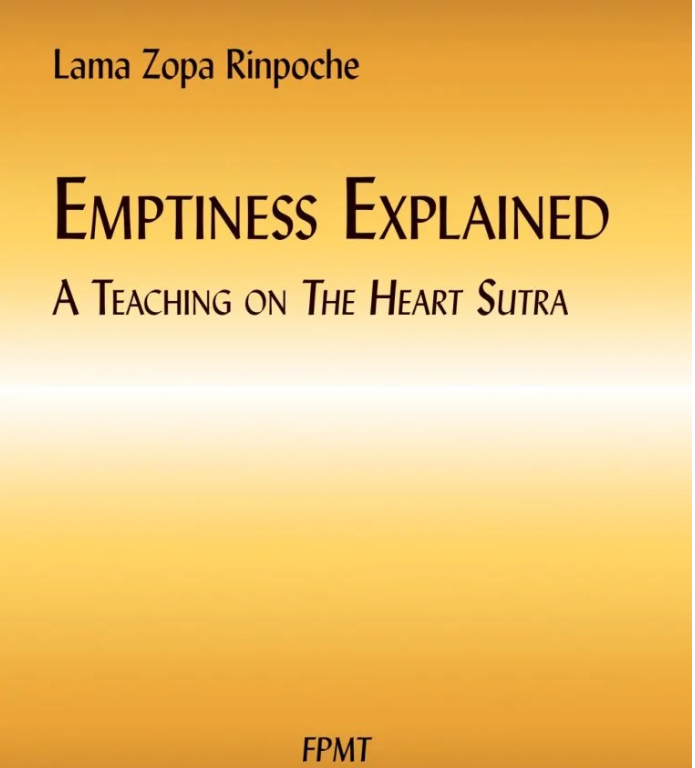
Transforming Suffering Into Happiness: How the Teachings on Emptiness from the Heart Sutra Support Mental Health and Well-Being
The Heart Sutra stands as one of the most profound and essential teachings in Buddhism, offering a path to understanding emptiness—the ultimate nature of reality. Lama Zopa Rinpoche’s commentary on this timeless sutra illuminates its teachings, guiding us toward a deeper understanding of how emptiness can transform not only our spiritual practice but also our daily lives.
In this post, I’ll share key reflections from Rinpoche’s teaching, focusing on the practical wisdom and spiritual inspiration it offers. Whether you’re a seasoned practitioner or simply curious about the philosophy of emptiness, I hope these insights will resonate with your heart.
What Is Emptiness?
Lama Zopa Rinpoche explains that emptiness does not mean that things don’t exist—it means that things are empty of inherent existence. All phenomena, including ourselves, arise dependently, shaped by causes, conditions, and labels. This is the essence of the middle way, which avoids the extremes of nihilism (nothing exists) and eternalism (things exist inherently and permanently).
As the Heart Sutra famously states:
“Form is emptiness, emptiness is form. Emptiness is not other than form; form is also not other than emptiness.”
In these words, we see that emptiness and dependent arising are inseparable. While things exist conventionally, their ultimate nature is empty of any independent, fixed essence.
Practical Ways to Meditate on Emptiness
Rinpoche offers accessible methods to integrate the understanding of emptiness into both formal meditation and daily life:
1. Recognizing the Object to Be Refuted
The first step is identifying the false concept of an independent, inherently existent “I” or object. This is often described as the “I on the I”—the subtle sense that there is a solid self beyond the ever-changing interplay of body and mind. By recognizing this misconception, we can begin to dissolve it.
2. Meditating on Dependent Arising
Reflect on how the “I” arises only in dependence on the body, mind, and other aggregates. As Rinpoche teaches, the “I” is merely a label created by the mind. Understanding this dependence helps us see the emptiness of the “I” without negating its conventional existence.
3. Mindfulness in Daily Life
Emptiness isn’t confined to sitting meditation. Rinpoche encourages us to bring mindfulness of emptiness into every activity—walking, cooking, working, even shopping. He likens this to recognizing a dream as a dream:
“While driving a car, see yourself, the car, and the action of driving as hallucinations. They appear solid, but they are not inherently existent. Practicing this awareness is incredibly powerful.”
Overcoming Fear and Misunderstanding
The experience of emptiness can sometimes evoke fear, especially the sense of “losing the I.” Rinpoche reminds us that this fear arises from our deep attachment to a false sense of self. However, far from being nihilistic, emptiness reveals the interdependent nature of all things.
“When bodhisattvas of high intelligence realize emptiness, they experience bliss; for others, deep fear can arise. This fear is a sign of touching the truth of selflessness—it is part of the journey.”
By grounding our understanding in dependent arising, we can navigate this fear with confidence and clarity.
Applying Emptiness in Relationships
Rinpoche’s teaching also provides practical tools for transforming relationships. When we feel hurt or offended, understanding emptiness can soften our reactivity. The other person’s actions—and our own sense of self—are dependently arisen, shaped by countless conditions.
This awareness allows us to respond with compassion rather than attachment or aversion. As Rinpoche says:
“Recognize that the ‘I’ that feels hurt is a mental construct. See the other person’s words or actions as arising dependently. This opens the door to greater understanding and kindness.”
The Transformative Power of Emptiness
Even the smallest step toward understanding emptiness has profound benefits. Rinpoche explains that simply doubting the solidity of appearances—thinking, “Perhaps things are empty”—can begin to break the chains of samsara.
“Listening to teachings on emptiness for even a moment plants seeds for liberation. Reflecting on emptiness throughout your day turns ordinary actions into a path to enlightenment.”
A Living Practice
The teachings of the Heart Sutra are not just intellectual concepts—they are a living practice. Whether in formal meditation or everyday life, the wisdom of emptiness invites us to see the world with fresh eyes. By letting go of our rigid attachments and false perceptions, we open the door to profound freedom and compassion.
As Lama Zopa Rinpoche reminds us, we are unbelievably fortunate to encounter these teachings. May we take them to heart and use them to benefit all beings.
Further Exploration
To delve deeper into Lama Zopa Rinpoche’s teachings on the Heart Sutra and emptiness, you can download the original PDF here.
I’d love to hear your thoughts on emptiness and the Heart Sutra! How do these teachings resonate with your own spiritual journey? Feel free to share your reflections in the comments below.
A Bedtime Story for Children Inspired by Tibetan Buddhism and Mindfulness
Once upon a time, high above the Earth, there was a vast, clear sky. The sky stretched far and wide, so peaceful and bright that everyone who looked up felt warm and safe. The sky never worried; it didn’t change or rush. It simply was—always calm, always clear, like a gentle friend watching over the world.
One morning, a little cloud appeared, floating softly across the sky. The cloud was light and fluffy, happy to drift along without a care. But as the day went on, the cloud began to wonder. “What if I get too big?” thought the little cloud. “What if I block the sun and make everything dark? What if I become a storm?”
With each worry, the little cloud grew larger and heavier, its soft edges becoming thick and dark. “Oh no,” thought the cloud, “I’m growing too fast. I don’t want to stay like this!” The more it worried, the more it puffed up, until it was almost ready to burst.
The sky, watching calmly from behind the cloud, whispered softly, “Why are you so worried?”
“I’m afraid I’ll never be light and small again,” said the cloud. “What if I get stuck like this forever, covering up the sun and making people sad?”
The sky smiled, its voice gentle and kind. “Little cloud, you don’t have to worry about staying big or small. Clouds are always changing—they come and go, just like your thoughts and feelings. No matter how big or small you become, I am always here behind you—clear and open, never changing. You don’t need to be afraid.”
“But what if I can’t change?” asked the cloud. “What if I never go away?”
The sky shimmered, glowing with a quiet, peaceful light. “Even if you stay a little longer, you are still just passing through, like all clouds do. No matter how big you are, you cannot change the sky. I’m always here behind the clouds, calm and steady, waiting for you to rest.”
The little cloud listened carefully. It thought about how the sky always stayed the same, no matter how many clouds came and went. Slowly, the cloud stopped worrying and let itself just be—no longer trying to be small, no longer afraid of being big. It realized that, no matter what, it was part of something bigger, something steady and kind.
As the cloud let go of its worries, it started to shrink back to its soft, fluffy self. It became lighter and lighter, until it gently floated away, disappearing into the vast blue sky.
The sky remained, bright and clear, just as it had been all along. The little cloud knew, deep inside, that the sky had always been there—and always would be—no matter how many clouds came and went.
And so, the little cloud drifted off into the distance, feeling peaceful and light, knowing that the sky would always be there to hold it, just like the quiet, calm mind that rests behind all our thoughts and worries.
As you fall asleep tonight, remember that your mind, like the sky, is always calm and clear behind all your thoughts and feelings. Goodnight, and may your dreams be as peaceful as the clear sky.
🙏🕊️🙏
If you’d like to explore more bedtime stories for children, including tales that nurture compassion and mindfulness, you can find our collection here.
The photograph above shows Tiger’s Nest Monastery in Bhutan, a powerful symbol of unwavering spiritual dedication across lifetimes. Perched high on a cliff, this sacred site has been home to many monks and spiritual practitioners, including Dilgo Khyentse Rinpoche, who spent many, many years meditating here.
In the Tibetan tradition, there’s a story of a monk whose life’s work was to build a temple in a remote area. It was an enormous and solitary task, and though people mocked his aspirations, the monk remained steadfast in his dedication. But the temple was never finished in his lifetime. And so, the story goes, he reincarnated—returning again and again, each time picking up where he left off, continuing to work on the temple until, many lifetimes later, it was finally complete.
This story speaks to a deep spiritual truth: some work cannot be accomplished in a single lifetime. Whether it’s the construction of a temple or the transformation of the heart, these endeavors require dedication that spans across time—an unbroken thread of aspiration that remains, even when the body changes. This sense of continuity is at the heart of many spiritual traditions, particularly the Tibetan belief in tulkus, enlightened beings who return to continue their work for the benefit of all beings.
The Tulku Tradition: Continuing Spiritual Work Through Reincarnation
One such tulku is Dilgo Khyentse Yangsi Rinpoche, the recognized reincarnation of the great master Dilgo Khyentse Rinpoche. His reincarnation serves as a living example of how the work of wisdom, compassion, and teaching carries on through lifetimes. From a young age, Yangsi Rinpoche received transmissions from his elders—wisdom that he himself had imparted to them in a previous life—so that he could continue his path of service in this life. This conscious continuation of spiritual work can also be seen in the 14th Dalai Lama, who, from the age of two or three, was recognized and trained to carry on his responsibilities from previous incarnations.
These stories show the power of aspiration, clarity, and dedication in shaping not just one life but many.
Aspiration for Future Lives: Carrying Dharma Practice Forward
Reflecting on the tradition of tulkus, I find myself drawn to the idea that the momentum of my Dharma practice in this life could carry forward into the next. While I may not possess the level of realization that allows a tulku to consciously choose their parents and circumstances, I hold the aspiration that my practice—my dedication to understanding and embodying the Dharma—will create conditions in a future life that allow me to encounter the teachings early and continue this work. My hope is that the clarity I seek now will guide me then, like spiritual breadcrumbs leading me back to the path I walk today.
The 500-Year Plan: A Vision Beyond One Lifetime
But the idea of building something greater than ourselves doesn’t apply only to spiritual practice. Many years ago, while at a Zen monastery, I heard a young environmentalist speak about his dedication to protecting the earth. He spoke of his work in terms of what he called “The 500-Year Plan.” He understood that the efforts he was making—writing books, building networks, raising awareness—might not bear fruit in his lifetime. It could take 200 years just to turn the corner on some of the environmental issues he was addressing. Yet, that didn’t deter him. His vision extended far beyond his immediate circumstances. His short-term thinking was, in fact, a 500-year plan.
This kind of perspective echoes the long view held in the Tibetan tradition: that the work we do—whether it’s spiritual or in service to the planet—reaches beyond a single lifetime. It’s about planting seeds, knowing that we may not live to see them grow into trees, but trusting that others—or perhaps even our future selves—will benefit from the roots we lay today.
Spiritual Breadcrumbs: Leaving a Trail for Future Selves
What’s fascinating about the tulku tradition, and perhaps even about my own hope for reincarnation, is that we’re not only thinking about the next generation or the next few decades. We’re thinking about how the seeds of wisdom, compassion, and right action planted today might guide us—even across lifetimes—toward a more awakened and compassionate world.
By sharing these reflections and writings online, the work is not confined to this moment in time. In fact, the beauty of the Internet is that these teachings can continue to be discovered, even hundreds of years from now. And who knows—perhaps, dear reader, you are the reincarnation of myself, encountering these words 100 or even 500 years into the future. The paradox here is that I may not remember writing these words, but I may feel a deep connection with them—an ignition of something within that tells me I’ve walked this path before. It’s an interesting thought: someone reading this years from now could be my future self, rediscovering the teachings I left behind.
The Power of Dedication: Planting Seeds for Future Generations
Whether it’s a temple that takes centuries to complete, an environmental movement that spans generations, or the continued unfolding of a Dharma practice across lifetimes, there is a deep truth here: some work is bigger than one life, but that doesn’t diminish its value. Instead, it enhances it. The dedication to something greater than ourselves, something that transcends the limitations of time, is the foundation upon which lasting transformation is built.
For myself, I may not see the fruits of my practice fully in this lifetime. But I trust that the work I do now—the clarity I cultivate, the wisdom I seek—will carry me forward. Perhaps in a future life, I’ll stumble upon this very blog, and it will be a reminder of the path I’ve already walked, the aspirations I’ve already set. In that moment, I’ll recognize the steps I need to take, not as new, but as familiar—part of a journey I’ve been on for lifetimes.
Poem: A Trail of Light Across Time
If I return to this world again, may I stumble upon these words, left like footprints in soft sand, to remind me of who I once was and all I once knew.
A lighthouse on a distant shore, my own hand building the beacon, so when the fog of forgetting settles, I will find my way back to the heart I’ve always known.
For what is wisdom but a note written in the margins of life, waiting patiently for another reader to understand the truth that has always been theirs?
Closing Reflection: The Power of Aspiration
The power of our aspirations is immense. Whether we are building temples, protecting the environment, or cultivating wisdom, the dedication we offer today echoes through time. We may not see the completion of our work in this life, but we trust that it will continue—through future generations, or even our own future selves. The seeds we plant now will bear fruit in ways we cannot yet imagine, and perhaps, like the monk or the tulkus, we’ll return to complete the work we began long ago.
I invite you to watch this beautiful and moving documentary on Dilgo Khyentse Yangsi Rinpoche, which explores the life of a reincarnated spiritual leader, the wisdom he continues to impart, and the profound power of his practice.
🙏🕊️🙏
This video is a documentary about the life of Dilgo Khyentse Yangsi Rinpoche, a Tibetan Buddhist monk who is considered to be one of the most important spiritual figures of our time. The film follows Rinpoche from his childhood, when he was recognized as the reincarnation of the great master Dilgo Khyentse, through his years of study and practice, to his present day role as a spiritual leader and teacher.
The video provides a fascinating glimpse into the life of a Tibetan Buddhist monk. We see Rinpoche as a young boy, struggling to adjust to his new life in a monastery. We watch him as he grows into a wise and compassionate teacher, who is able to connect with people from all walks of life. And we witness the incredible power of his spiritual practice, which allows him to heal the sick, help people overcome their suffering, and even communicate with the dead.
The video is beautifully shot and edited, and the music is both haunting and uplifting. The interviews with Rinpoche’s friends, family, and students provide a rich and nuanced portrait of this extraordinary man. If you are interested in learning more about Tibetan Buddhism or the life of a spiritual leader, this video is a must-see.
Overall, this video is a powerful and inspiring documentary that will leave you with a sense of wonder and awe. It is a testament to the power of the human spirit, and a reminder that it is possible to live a life of compassion, wisdom, and enlightenment.
In our journey of exploring spirituality across traditions, it is time to welcome the teachings of Tibetan Buddhism. At first glance, the colorful rituals, sacred music, and intricate costumes may seem confusing or overwhelming. Yet these outward forms are simply expressions of an inner practice that remains deeply practical and profound: the training of the mind. Tibetan Buddhism is not a religion in the conventional sense of belief or dogma but rather a transformative path aimed at purifying the mind. Through meditation, visualization, mantra, and ritual, the practice cultivates clarity, compassion, and liberation from egoic tendencies.
A recent film about Dilgo Khyentse Yangsi Rinpoche, the reincarnation of the revered master Dilgo Khyentse Rinpoche, offers a glimpse into the heart of this tradition. Watching the young tulku receive teachings and grow within a vibrant Tibetan community reveals how this ancient wisdom lives on, passed from one generation to the next as a thriving, living practice. The film gently invites viewers into a deeper understanding of the teachings, dissolving the outer complexities to reveal a path focused on inner transformation.
One recurring theme throughout the film is that all Buddhist practice, no matter its form, is centered on mind training. The rituals and prayers, while beautiful, are not the essence; rather, they serve as vehicles to refine awareness and soften the grip of delusion. The practice is about gently cleaning the mind, sweeping away negativity and confusion like a gardener tending to weeds, leaving space for the natural qualities of wisdom and compassion to emerge.
Vajrayana Buddhism offers a unique method for engaging with life’s challenges. Instead of rejecting or avoiding difficulties, the practice transforms even negative thoughts and emotions into opportunities for awakening. It becomes a skillful means of shifting the mind’s energy toward positive states. This approach is not about suppressing thoughts but about meeting them with awareness, transforming suffering into insight and confusion into clarity.
Tibetan Buddhism emphasizes the reduction of ego grasping, fostering a spirit of nonviolence, and cultivating compassion. It shifts attention away from religious belief and toward the inner work of softening the heart and taming the restless mind. These teachings are not confined to cultural forms but reflect a universal truth—the journey of every human soul toward peace and freedom. The path’s essence aligns beautifully with the teachings of Advaita Vedanta and even echoes the mystical experiences of figures like St. John of the Cross. While each tradition expresses itself differently, the underlying message is the same: the liberation of the mind from illusion, opening into a state of oneness.
In this light, Tibetan Buddhism can be seen as a cultural version of the Yoga Sutras of Patanjali, offering practices that lead to inner stillness and self-realization. It is, in essence, a kind of spiritual atonement—a process of purification and return to the true nature of mind, much like the mystical experiences found in other traditions.
What makes Tibetan Buddhism particularly rich is its capacity to embrace complexity. It does not reject thoughts, emotions, or even suffering. Instead, it teaches practitioners to meet these experiences with skill and openness, transforming them into pathways toward deeper insight. Watching the young tulku learn within the community demonstrates this beautifully—how every moment, even the difficult ones, can become part of the practice.
We invite you to explore this film, which offers a rare and intimate view into the life of Dilgo Khyentse Yangsi Rinpoche and the vibrant Tibetan community that nurtures his path. Beneath the ornate rituals lies a simple but profound truth: Tibetan Buddhism, like all genuine spiritual traditions, is ultimately a path of mind training. It offers not only the possibility of individual liberation but also a way to cultivate compassion and wisdom for the benefit of all beings.
There is a rhythm to living with chronic illness, one that requires a kind of surrender. Those who walk the path with myalgic encephalomyelitis or chronic fatigue syndrome soon learn that pacing is not merely a strategy—it becomes an art form, a way of listening, of harmonizing with the body’s quiet whispers before they become cries. To pace oneself is to acknowledge the body’s finite energy, to move in step with the breath of fatigue, gently, humbly, knowing that to overstep the body’s boundaries is to invite collapse.
It is not an easy lesson, this slow dance with limitations, yet it is one that teaches a profound wisdom. For those of us living with this condition, pacing is a compass, guiding us through days where the terrain can feel treacherous, unpredictable. It is, in its essence, the practice of recognizing when to move forward and when to step back. We become more attuned to the varied signals of our bodies—perhaps tremors of exhaustion, increasing tinnitus, irritation, a flutter of dizziness, nausea, insomnia, headaches or the dimming of cognitive clarity. In these moments, we learn that to heed these signs is to honor the body’s wisdom, to respect its limits as one might respect the changing seasons.
Pacing, though practical, is deeply spiritual as well. In the Tibetan Buddhist tradition, there is a teaching of upaya, or skillful means, which echoes the heart of pacing. Skillful means refers to the wisdom of knowing what action is most appropriate in any given moment, guided by compassion for ourselves and others. For those of us managing a chronic illness, pacing is our skillful means, the practice of compassion extended inward, toward the tender, vulnerable places within us that need rest, gentleness, and care.
This is not weakness. On the contrary, there is a quiet strength in pacing, a strength that arises from restraint, from knowing that our worth is not measured by the speed at which we move or the number of tasks we complete. Instead, it is measured by how we listen to the body’s call for stillness, how we cultivate patience in the face of limitations, how we respond to the world with wisdom rather than haste.
In the same way that skillful means in Buddhist practice requires a deep awareness of the present moment, pacing invites us to be fully present with our bodies, to sense when we are nearing our edge and to pull back with kindness. It requires discernment, the ability to prioritize what truly matters, letting go of the unnecessary so that we may preserve our energy for what is essential. And, perhaps most importantly, pacing asks us to be flexible. What works for us today may not work tomorrow. Like the ebb and flow of the tide, we must continuously adjust, staying attuned to the changing nature of our energy levels, adapting with grace to whatever arises.
To pace well is to cultivate trust in ourselves, to believe that our bodies—though fragile—are capable of guiding us toward balance. It is to let go of the constant push toward productivity, embracing instead a quieter, more sustainable rhythm of being. This trust grows over time, as we learn to befriend our bodies rather than seeing them as enemies. We begin to see pacing not as a limitation, but as an opportunity to deepen our relationship with ourselves, to practice self-compassion in the most tangible of ways.
And so, we move slowly, deliberately. We choose rest when it is needed, even when the world outside rushes by. We choose to pause, to breathe, to trust that this moment of stillness is as important as any action we might take. In this way, pacing becomes not only a survival strategy but a path to peace. It teaches us to live in harmony with our bodies, to respect the boundaries they set, and to find beauty in the gentleness of our compassion.
Pacing, like skillful means, is not something mastered overnight. It is a practice that deepens over time, shaped by patience, by trial and error, by learning to let go of perfectionism. But with each step, we become more attuned to the wisdom that already resides within us. We learn that pacing is not a sign of giving up, but of holding on—holding on to our health, our well-being, and our sense of self in the midst of struggle.
Pacing, in its truest form, is an act of compassion toward ourselves, a recognition that while life with post viral ME/CFS has taken much from us, it has not taken everything. It is not a dance of perfection, but rather a delicate balancing act between what was and what is. The grief over what we have lost is real, and it deserves to be honored. We grieve our former selves, the life we once knew, and all the possibilities that seem to have slipped away.
But after the grieving, something else begins to emerge. Slowly, through the quiet practice of listening to our bodies and respecting our limits, we begin to discover a new way of living—not the life we once imagined, but a life nonetheless. And within this new life, there are still moments of joy, moments of lightness. These moments may look different from what they once were, but they are no less real. They come from acceptance, from doing more of what works and less of what doesn’t. They come from the simple peace of knowing we are doing our best within the constraints we face.
To pace is to acknowledge these constraints, to know that while we may not live fully in the way we once dreamed, we can still live meaningfully. We can still find purpose, connection, and even happiness within this new rhythm. It is not a rhythm we would have chosen, but it is ours now, and there is strength in learning to move with it rather than against it. In this process, we find that joy and peace are still possible—not despite the illness, but alongside it, within the space that remains.
And so, with time, we learn to rest in the assurance that we are whole in our own way, capable of living a life that, while different, still holds beauty, meaning, and moments of joy.
Following the breath, We learn the art of patience, Peace within each step.
In The Wisdom of No Escape, Pema Chödrön presents teachings on accepting life as it is, rather than wishing it were different. Her words remind us that even in the midst of suffering, there is always the potential for transformation—not by running from our difficulties, but by turning toward them with compassion and curiosity. For those living with chronic fatigue syndrome, this book is a beautiful companion, offering insights on how to stay present with what is, without judgment or resistance. Chödrön’s gentle wisdom helps us find peace in the uncomfortable and reminds us that within every limitation, there is the possibility of growth. This aligns perfectly with the practice of pacing—of learning to live within constraints, not with bitterness, but with an open heart.
Another indispensable resource is Tony Bernhard’s How to Be Sick. As someone who has lived with chronic fatigue syndrome herself, Bernhard offers a deeply compassionate, Buddhist-inspired approach to living with illness. Her book provides practical advice on how to cultivate equanimity, mindfulness, and self-compassion while dealing with the daily struggles of chronic illness. Bernhard’s words echo the heart of pacing—teaching us how to manage our energy, honor our limitations, and find meaning even when life feels limited. For anyone searching for a path through the often overwhelming challenges of ME/CFS, How to Be Sick is both a guide and a comfort, offering tools to help transform suffering into wisdom and peace.
Living with chronic fatigue syndrome (ME/CFS) often feels like carrying an invisible weight that never goes away. The exhaustion is far beyond ordinary tiredness, permeating not just the body but the mind and heart as well. For many of us, this illness can feel like a curse, a complete derailment of life’s trajectory. Yet, over the years, I’ve come to see it also as a strange and unexpected blessing—one that has thrown me deeper into spiritual practice, into moments of stillness and contemplation I might not have otherwise known.
At its worst, the illness can leave me in bed, lights off, no sound, in a state of complete sensory deprivation. And it is in these moments, when there is nothing to distract me from my thoughts, that I’ve had to learn how to truly be alone. Learning to witness my reactions, cultivating equanimity, and practicing calm-abiding meditation have become vital companions on this journey. For many years, I focused on the Tibetan practice of Samatha, or calm-abiding meditation, as well as Vipassana, which allows for a deep awareness of the present moment. Sitting in stillness, aware of whatever calm I could find within, helped me cultivate equanimity—though it remains a practice I still have much to learn from.
But there was another essential practice that transformed how I related to my suffering. The practice of Metta—or loving-kindness—invites us to take our own pain and suffering and recognize that in this vast world, we are not alone in what we feel. When my illness has been most acute, whether through mental anguish or physical symptoms, I’ve practiced thinking: In the same way that I am experiencing this illness, this suffering, this pain, there are others in the world who experience this too. And then, from the heart, I offer the prayer: May I, and all beings, be free from this suffering and its causes.
This simple yet profound shift in perspective allowed me to transform my experience from one of isolation and misery into a practice of compassion. Instead of being stuck in my own pain, it became a way to benefit others by cultivating loving-kindness for all those who suffer. In this way, even my most difficult experiences became part of my spiritual path. ME/CFS was no longer just an illness—it was an opportunity to deepen my compassion, both for myself and for others.
Of course, this hasn’t been an overnight transformation. It took many years of spiritual study and practice, drawing from teachings like the Four Noble Truths of the Buddha, the Noble Eightfold Path, and eventually the teachings of Advaita Vedanta. Through these teachings, I came to recognize the fluctuations of the mind, or vrittis, and learned to observe the content of my thoughts—pratyayas—without identifying with them. This practice of witnessing the mind has allowed me to find peace in the midst of the storm, much like the Dark Night of the Soul described by St. John of the Cross.
For me, it has felt less like a dark night and more like twenty years of spiritual darkness, but nonetheless, this darkness has also been a teacher. Learning to be present with my suffering, rather than resisting it, has become an integral part of my life with ME/CFS. And while the illness has forced me to withdraw from many aspects of life, it has also drawn me into the heart of spiritual practice.
To anyone living with this illness, or any chronic illness, I offer this: it’s okay to feel overwhelmed by the weight of it all. It’s okay to grieve the life you once had or the future you imagined. But there are also practices—like Metta, calm-abiding meditation, and witnessing the mind—that can transform this suffering into something that nourishes not only your soul but the souls of others as well.
May you, and all beings, be free from suffering and its causes. May this invisible weight become a doorway into the mystic, where even in solitude, you find that you are never truly alone.
How does the mantra Neti Neti help the ego by constantly negating experiences, and how does this practice relate to moments of rig-pa or the experience of deep relaxation without a sense of self?
Dear friend,
It brings a quiet joy to hear of your continued practice with the mantra “Not This, Not This.” There is a deep wisdom in the way you have approached this mantra, almost as if you have gently given the ego a new role—one that is not about grasping or achieving, but simply letting go. By assigning the ego the task of negation, you are engaging it in a way that transforms its usual tendencies, guiding it to release its hold on whatever arises in your mind.
Imagine, if you will, the ego as a diligent worker, tirelessly trying to define and control your experience. But now, you have given it a simpler, more profound task: to say “Not This, Not This” to whatever appears before it. In doing so, the ego no longer needs to dominate or possess; instead, it becomes an instrument of release, of gentle detachment. This redirection of its energy allows you to experience a profound relaxation—a state of being that is free from the usual burdens of identification and striving.
You mentioned Rig-pa, the pure, pristine awareness described in Tibetan Buddhism. This state, as you know, is one of complete clarity and non-duality, where there is no separation between observer and observed, no “I” to claim the experience. It is true that when one is fully in Rig-pa, there is no one there to say, “I have experienced Rig-pa.” It is simply the natural state, beyond all dualistic notions of self.
Perhaps you have touched upon moments of this awareness in your practice, moments so simple and clear that they passed by without fanfare. This is often the way of such states—they do not announce themselves with grandiosity but arrive in the quiet spaces of the mind. The fact that you find this mantra particularly relaxing might suggest that you are indeed drawing nearer to this natural state, even if it is not fully apparent to the ordinary mind.
The relaxation you feel is not just a fleeting sense of comfort—it is a deep, existential ease that arises when the mind is no longer tasked with searching or solving. “Not This, Not This” allows you to set aside the need to be anything other than what you are in this moment. It is a relaxation that goes beyond the physical or mental, touching the core of your being. This is a sign that you are moving in the right direction, toward a state of pure being, where the entanglements of the ego are gently unraveled.
Continue with this mantra, my dear friend, for it seems to be guiding you beautifully on your journey. Trust in the relaxation you feel, for it is not merely a sign of peace, but a deepening into the essence of who you truly are. Whether or not you recognize moments of Rig-pa, know that you are cultivating the conditions for this awareness to arise naturally, in its own time and in its own way.
Your path is unfolding with grace, and this mantra is becoming a trusted companion, leading you ever closer to the stillness and clarity that lies at the heart of all being. Continue with gentle persistence, and allow the simplicity of “Not This, Not This” to carry you further into the depths of your own true nature.