Tag: spirituality

  • Who is Ramana Maharshi?

    Discovering the Self: Ramana Maharshi’s Guide to Self-Inquiry and True Realization

    Ramana Maharshi is one of the most revered spiritual teachers of the 20th century, known for his profound teachings on self-realization and non-duality. Born in 1879 in Tamil Nadu, India, he experienced a spontaneous awakening at the age of 16, during which he became acutely aware of the impermanence of the body and the eternal nature of the Self. Following this experience, he left his home and spent the rest of his life on the sacred mountain of Arunachala, where he became a guiding light for spiritual seekers from around the world.

    Ramana’s teachings are centered around the practice of Atma Vichara, or self-inquiry, which he considered the most direct path to realizing one’s true nature. Unlike other spiritual practices that involve rituals or external observances, Ramana emphasized turning inward to investigate the true nature of the ‘I’—the sense of individual self that we all experience.

    The Essence of Self-Inquiry

    Ramana Maharshi’s core teaching can be encapsulated in the question, “Who am I?” He taught that the sense of ‘I’ or ego, which we often associate with our thoughts, emotions, and bodily identity, is merely a superficial layer that veils our true Self, which is pure consciousness or awareness.

    The process of self-inquiry involves directing your attention inward, asking yourself where this sense of ‘I’ originates. Ramana explained that by persistently asking this question and observing the ‘I’ thought, one can trace it back to its source. This source is the true Self, the unchanging awareness that underlies all experience.

    If One Watches Whence the ‘I’ Arises

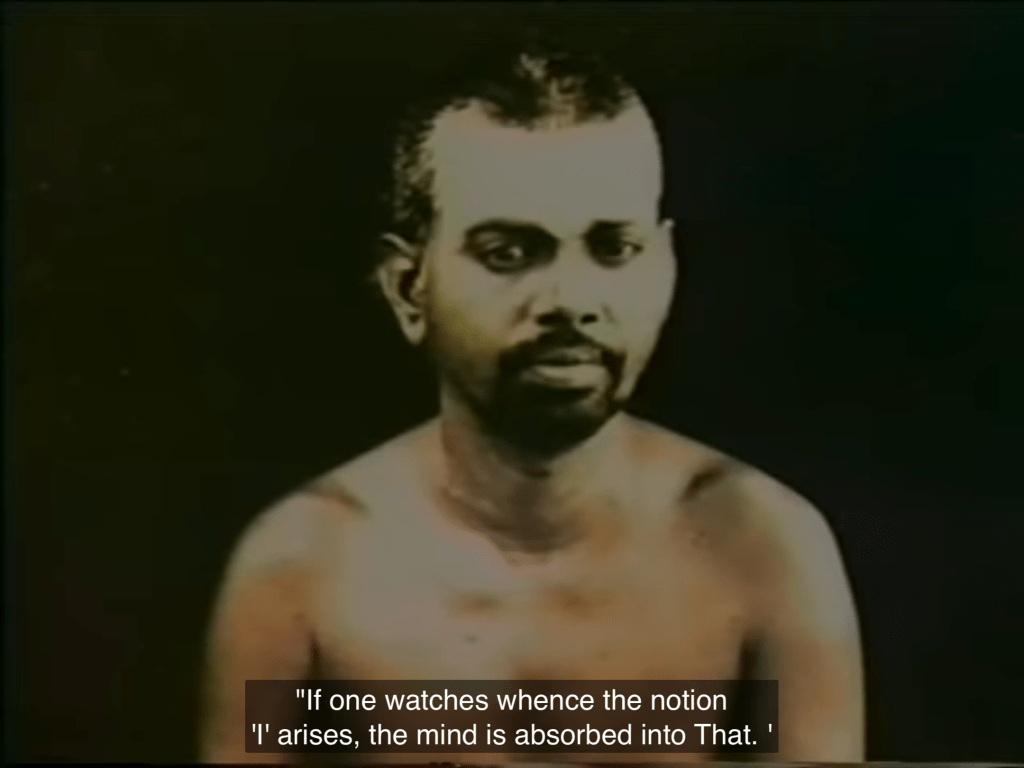
    In one of his teachings, Ramana Maharshi stated, “If one watches whence the notion ‘I’ arises, the mind is absorbed into That.” This teaching points to a subtle yet profound practice. The ‘I’ thought is the root of all mental activity and the sense of individuality. By turning attention to this root, rather than being entangled in the branches of thoughts and feelings, the mind can naturally dissolve into its source—pure awareness, which Ramana refers to as “That.”

    How to Practice Self-Inquiry

    If you find yourself puzzled by this teaching or struggle to sense “That” from which the ‘I’ arises, know that this is a common experience on the path of self-inquiry. The mind, accustomed to focusing outward, finds it challenging to turn inward and settle into stillness.

    Here’s how you can approach this practice:

    1. Sit Quietly: Begin by sitting quietly, with your eyes closed if that feels comfortable. Take a few deep breaths and allow your body and mind to relax.
    2. Turn Inward: Gently bring your attention to the sense of ‘I’. This ‘I’ could be a thought, a feeling, or simply the awareness that you exist.
    3. Ask the Question: Silently ask yourself, “Who am I?” or “Where does this ‘I’ arise from?” Don’t seek an intellectual answer. Instead, let the question be a pointer that guides your awareness inward.
    4. Observe: As you focus on the ‘I’, observe its nature. Does it have a shape, a location? Can you find its origin? Be curious, but not analytical.
    5. Rest in the Awareness: As you continue this enquiry, allow the mind to settle. If thoughts arise, simply notice them and gently bring your attention back to the feeling of ‘I’. Over time, the mind may begin to merge with the deeper awareness that is always present.

    Realizing the Self

    Through persistent practice, you may come to realize that the ‘I’ you have always identified with is not your true Self. The ‘I’ arises and dissolves in the vast expanse of pure awareness—‘That’ which Ramana Maharshi points to. This realization is not something to grasp intellectually, but a direct experience that brings about a profound inner peace and freedom.

    Ramana Maharshi’s teachings are a beacon for those seeking to transcend the ego and discover their true nature. The path of self-inquiry, though simple in its approach, can lead to the ultimate realization of the Self—the awareness that is ever-present, unchanging, and beyond all notions of individuality.

    🙏🕊️🙏
  • A Christian Mystic is Also a Yogi: Bridging the Spiritual Traditions

    In the quiet corners of monasteries, amidst the echo of chanting monks, and within the solitude of wilderness hermitages, Christian mystics have, for centuries, sought to experience a profound union with the Divine. They have traveled inward, transcending the boundaries of ego, and have entered into a sacred communion with God. Their journey is one of deep contemplation, marked by an ascetic discipline that reflects a yearning to touch the eternal. Though these mystics arise from the Christian tradition, their spiritual pursuits bear a striking resemblance to those of yogis—a title traditionally reserved for practitioners within the vast spiritual traditions of India.

    At first glance, the practices and language of Christian mysticism and yoga might seem worlds apart. One speaks in the tongue of Christ, the saints, and the Holy Spirit, while the other chants the names of Shiva, Krishna, and the universal Brahman. However, beneath these differing expressions lies a shared journey—a journey toward the ultimate goal of spiritual union, self-realization, and the direct experience of the Divine.

    The Quest for Union

    The essence of yoga is captured in its very name, which means “union.” Traditionally, this union is understood as the merging of the individual soul with the Divine consciousness—a state of oneness where the separation between self and the cosmos dissolves. This echoes the Christian mystic’s pursuit of “divine union,” a state described by luminaries like St. John of the Cross, where the soul is united with God, experiencing a profound and intimate communion that transcends all earthly understanding.

    Both the yogi and the Christian mystic understand that this union is not merely a metaphorical concept but a lived reality, achievable through dedicated practice, surrender, and grace. It is an experience of the heart’s deepest longing fulfilled, where the seeker and the sought become one.

    The Path of Inner Transformation

    To reach this union, both traditions emphasize the necessity of inner transformation. For the yogi, this often involves practices like meditation, breath control, and ethical living, which purify the mind and body, allowing the practitioner to transcend the ego and experience the true Self. Similarly, Christian mystics speak of a transformative journey often described in stages: purgation (the cleansing of the soul), illumination (receiving divine light and insight), and union (the final, blissful merging with God).

    This transformation is not an easy path; it is marked by trials, tests of faith, and the dissolution of old identities. Yet, both the yogi and the Christian mystic embrace these challenges, understanding that they are necessary steps in the journey toward spiritual maturity and enlightenment.

    Contemplation and Stillness

    Central to both yoga and Christian mysticism is the practice of contemplation—a deep, meditative stillness where the divine can be encountered directly. Yogis engage in dhyana, or meditation, as a means of quieting the mind and opening the heart to the infinite. Christian mystics, too, seek this stillness through contemplative prayer, where words fall away, and one rests in the silent presence of God.

    In these moments of stillness, both the yogi and the mystic move beyond the distractions of the world, entering into a space where the divine presence is felt intimately, where God is not a distant figure but a living, breathing reality within.

    The Role of Love

    For both traditions, love is the highest expression of spiritual attainment. In the Christian mystical tradition, figures like St. Teresa of Avila and St. Francis of Assisi exemplify a life overflowing with divine love, a love that embraces all of creation as a reflection of God. This mirrors the path of bhakti yoga, where devotion and love for the divine are seen as the most direct route to spiritual awakening.

    This love is not just a feeling but a transformative force that purifies the heart and mind, drawing the soul closer to its source. It is an all-encompassing love that transcends personal desires, embracing the entirety of existence with compassion and grace.

    A Universal Journey

    The paths of the Christian mystic and the yogi, though outwardly different, converge at their deepest levels. Both seek to transcend the limitations of the ego, to experience the divine presence in its fullness, and to live a life that reflects this profound spiritual truth. Whether through the sacred silence of a monastery or the disciplined practice of asanas, the goal is the same: to know God, to become one with the Divine, and to embody the sacred in every aspect of life.

    In this light, we can see that a Christian mystic is, indeed, a yogi—a practitioner of union, a seeker of divine truth, and a traveler on the path of spiritual awakening. Their journey reminds us that the quest for the divine is a universal one, transcending boundaries of culture and religion, and uniting all seekers in their shared pursuit of the ultimate reality.

    🙏🕊️🙏

  • Discovering the Divine Within: Living as Spiritual Beings in a Human World

    Embracing Our Dual Nature: Human and Divine.


    In Christian teachings, Jesus is often celebrated as both fully human and fully divine—a profound mystery that reveals the depth of his nature. But what if this teaching also speaks to a deeper truth about all of us?

    Christianity teaches that we are to navigate life by choosing between good and evil, guided by our higher, divine nature rather than our more earthly impulses. This teaching is not merely about Jesus; it reflects a universal truth about our own existence. We are not just flesh and bone, but also possess a divine essence.

    Jesus’ dual nature serves as a powerful reminder that we too embody both human and divine qualities. Just as he lived out his divine nature while managing human frailties, we are invited to recognize and cultivate our own divine aspects.

    Embracing Our Dual Nature

    Understanding and embracing our dual nature—both human and divine—can profoundly transform our lives. Jesus’ teachings offer insights into this transformative process. For example, in John 10:34, Jesus quotes Psalm 82:6, stating, “I said, ‘You are gods; you are all children of the Most High.’” This highlights our inherent divine potential.

    Additionally, Paul’s letters encourage us to live according to our higher, spiritual nature. In Galatians 5:16-17, he advises, “So I say, walk by the Spirit, and you will not gratify the desires of the flesh. For the flesh desires what is contrary to the Spirit, and the Spirit what is contrary to the flesh.” By aligning with the Spirit, we move beyond merely managing our human impulses to actively expressing our divine essence.

    In Genesis 5:1-2, we are reminded of our divine origin: “This is the book of the generations of Adam. When God created man, he made him in the likeness of God. Male and female he created them, and he blessed them and named them Man when they were created.” This underscores the intrinsic divine image within us all.

    There’s a saying that captures this truth succinctly: “We are not human beings having a spiritual experience; we are spiritual beings having a human experience.” Embracing this perspective shifts our understanding of life’s purpose and our own nature.

    Embracing our dual nature means recognizing our divine potential and integrating it into our daily lives. This process transforms how we face challenges, interact with others, and pursue our spiritual growth. As we align with our higher self, we reflect the image of God more fully in our actions and choices.

    We are truly made in the image of God.

    Reflecting on this, consider:

    • How can I more deeply embody my divine nature in daily life?
    • What are the challenges I face in aligning with my higher self?
    • How does recognizing my divine essence change my perspective on human struggles?

    Feel free to share your thoughts and experiences in the comments section below. Let’s explore together how embracing our dual nature can transform our lives.

    🙏🕊️🙏

  • Synchronized Global Well-Being for All: A Call to Meditate Together on the Full Moon, August 19th.

    Join the Synchronized Global Meditations Community to Benefit the Earth, All Living Beings, and Every Sentient Being. Everyone and All Traditions Are Welcome.

    Introduction

    Welcome to the Synchronized Global Meditations Community, a space dedicated to the well-being of our planet and all its inhabitants. Here, we believe in the power of collective meditation to bring about positive change, fostering peace, harmony, and well-being for everyone. This community is open to people from all traditions, and we invite you to join us in this global movement.

    The Power of Synchronized Meditation

    Synchronized meditation has the potential to create a ripple effect of positive energy that can benefit not just the participants but the entire world. When we come together with a shared intention, our collective focus can amplify the impact of our meditative practices, promoting healing, compassion, and unity.

    Guided Meditation for Global Well-Being

    Preparation:

    1. Find a quiet and comfortable space.
    2. Sit or lie down in a relaxed position.
    3. Close your eyes and take a few deep breaths.

    Meditation:

    1. Intention Setting: Begin by setting an intention for global well-being. Visualize the Earth surrounded by a loving, healing light.
    2. Breath Awareness: Focus on your breath. With each inhale, imagine drawing in positive energy. With each exhale, send out compassion and love to all beings.
    3. Visualization: Visualize people from all around the world joining together in meditation, their hearts connected in a web of light and love.
    4. Metta Practice:
    • For Yourself: Silently repeat, “May I be happy. May I be healthy. May I be safe. May I live with ease.”
    • For a Loved One: Visualize someone you care about and silently repeat, “May you be happy. May you be healthy. May you be safe. May you live with ease.”
    • For All Beings: Expand your focus to all sentient beings and silently repeat, “May all beings be happy. May all beings be healthy. May all beings be safe. May all beings live with ease.”
    1. Silent Reflection: Spend a few moments in silent reflection, holding the intention of peace and well-being for all.
    2. Closing: Gently bring your awareness back to the present moment. Take a few deep breaths and open your eyes.

    Reflective Questions

    1. How do you feel after participating in a synchronized global meditation?
    2. What intentions did you set for the well-being of the Earth and all beings?
    3. How can you integrate the sense of unity and compassion from this meditation into your daily life?
    4. What impact do you believe synchronized meditation can have on the world?

    Join Us

    We invite you to be part of this community and participate in regular synchronized meditations/prayers Together, we can make a difference and contribute to the well-being of the Earth and all its inhabitants.

    For more information, please visit https://www.facebook.com/global.wellbeing.meditations/

    Thank you for being part of our Synchronized Global Well-Being community!

    🙏🕊️🙏

  • Deepening Prayer: From Requests to Communion with the Divine

    Experiencing Prayer as a Profound Connection with the Divine

    Introduction

    In many religious traditions, prayer is often perceived as a means of making requests or interceding on behalf of others. Yet, a deeper understanding of prayer reveals it as a profound opportunity for communion with the Divine. This post explores how we can transform our approach to prayer from one of mere requests to a rich, personal connection with God, drawing from various spiritual traditions.

    Exploring Contemplative Practices

    Contemplative prayer, practiced in Christianity and other traditions, focuses on fostering an intimate connection with the Divine. In Christianity, contemplative prayer invites believers into a space of stillness and receptivity. For instance, the use of repetitive phrases like “Maranatha” helps to open one’s heart to God’s presence, moving beyond mere supplications to a deeper, more personal engagement.

    Similarly, in Buddhism, practices such as Shikantaza, or “Just Sitting,” and Shamatha, or “Calm-Abiding,” cultivate mental clarity and a direct experience of the divine in the present moment. Shikantaza encourages a state of pure awareness, where one simply exists without distraction, while Shamatha develops stability and focus, paving the way for a deeper spiritual connection.

    Jewish mystical traditions also contribute to this understanding. Practices like Bittul, the surrender of the ego, and Hitbonenut, profound contemplation, emphasize the experience of God’s presence through the negation of self and deep reflection.

    Scriptural Insights on Personal Communion

    Jesus’s own practices highlight the importance of personal communion with God. His retreat into the desert for 40 days and nights and His frequent solitary prayers illustrate a model for seeking direct connection with the Divine. Jesus’s teachings, such as in John 15:4-5, where He speaks of abiding in Him, suggest a deep, personal relationship with God. Similarly, Matthew 6:6 emphasizes private prayer as a means of engaging intimately with the Divine.

    Jesus used parables to invite personal reflection and insight into God’s kingdom, and His statements about divine unity, like in John 14:20, suggest an intimate, experiential knowledge of God. These elements point to a mystical dimension of prayer, where personal experience and direct connection with the Divine are central.

    Comparison of Intercessional Prayer and Direct Communion Prayer

    Intercessional prayer and direct communion prayer serve distinct purposes in the spiritual journey, each offering unique approaches to connecting with the Divine.

    Intercessional Prayer

    Intercessional prayer focuses on making requests or petitions, often on behalf of others. This type of prayer involves asking God to intervene in specific situations, whether for healing, guidance, or support. It emphasizes the role of prayer as a means of advocating for one’s needs or the needs of others. In many Christian traditions, intercessional prayer is a vital aspect of communal worship and personal devotion, highlighting the belief in a God who responds to our requests and concerns. For example, praying for a friend’s recovery or for peace in the world exemplifies this approach.

    Direct Communion Prayer

    In contrast, direct communion prayer emphasizes a more intimate and experiential connection with the Divine. Rather than focusing on specific requests, this practice seeks to foster a deep, personal relationship with God through stillness, contemplation, and presence. Practices such as contemplative prayer, Shikantaza (Just Sitting), and Bittul aim to transcend the act of asking and enter a space of pure being and direct experience of God’s presence. This approach is less about seeking specific outcomes and more about experiencing a profound union with the Divine. The goal is to immerse oneself in the Divine presence, as seen in the practices of Christian mystics like St. John of the Cross and St. Francis of Assisi, who sought a direct, personal communion with God.

    Historical Context and Institutional Influence

    The Church’s role as an intermediary historically shaped the understanding and practice of prayer. The focus was often on external rituals and mediation, which influenced how individuals experienced and related to the Divine. This approach sometimes overshadowed the potential for personal, direct communion with God.

    However, throughout history, Christian mystics and contemplatives have emphasized direct experience with the Divine. For example:

    • St. John of the Cross explored the “dark night of the soul,” a profound spiritual purification leading to union with God beyond ordinary experiences.
    • Teresa of Avila focused on deep, contemplative prayer and mystical experiences, offering insights into personal connection with the Divine.
    • St. Francis of Assisi exemplified a life of profound spiritual simplicity and deep communion with God, expressed through his love for creation and his radical commitment to poverty. His life was a testament to the possibility of experiencing and embodying divine presence in everyday life.

    These figures highlight a tradition of exploring direct and personal connections with the Divine, which contrasts with more institutionalized approaches that focus on intermediary roles and external forms.

    Conclusion

    Transforming our understanding of prayer from mere requests to a form of communion invites us to deepen our connection with the Divine. By embracing contemplative practices and exploring personal experiences of God, we can enrich our spiritual journey and cultivate a more profound and intimate relationship with the Divine. This journey into mystical prayer and contemplation underscores the value of seeking direct, personal experiences of the Divine, transcending conventional practices to embrace a deeper, more profound spirituality.

    Reflective Questions

    1. How do you currently experience prayer in your spiritual practice? Are there ways you could deepen this experience to foster a more personal connection with the Divine?
    2. In what moments of solitude have you felt a profound sense of communion with God or the Divine? How can you cultivate more of these moments in your daily life?
    3. How do the contemplative practices discussed resonate with your own spiritual journey? Are there specific practices or elements you feel drawn to explore further?
    4. Reflect on a time when a mystical or contemplative experience significantly impacted your understanding of spirituality. What insights or transformations emerged from that experience?
    5. How does the historical context of prayer and mysticism influence your current approach to prayer? Are there any historical figures or practices that inspire you to deepen your spiritual practice?

    Feel free to share your thoughts, experiences, or any questions in the comments section below. I look forward to engaging with your reflections and exploring these ideas further together.

    🙏🕊️🙏

  • An Appeal for Universal Ethics: Wisdom from the Dalai Lama

    Embracing Universal Ethics for a More Compassionate World

    In a world often divided by religious and ideological lines, the Dalai Lama’s appeal for secular ethics and peace offers a refreshing perspective. He reminds us:

    “For thousands of years, violence has been committed and justified in the name of religion. Religions have often been intolerant and still are in many cases. Religion is often abused or exploited – even by religious leaders – in order to further political or economic interests. For that reason, I say that in the twenty-first century, we need a new form of ethics beyond religion. I am speaking of a secular ethics that can be helpful and useful for over a billion atheists and an increasing number of agnostics. More integral than religion is our fundamental human spirituality. That is the affinity we humans have for love, benevolence, and affection – no matter what religion we belong to.”

    A Call for Reflection and Unity

    The Dalai Lama’s words resonate deeply, especially in times of division and conflict. As Christians, we are called to love our neighbors as ourselves (Matthew 22:39). This teaching aligns with the Dalai Lama’s vision of universal human values grounded in love, benevolence, and affection.

    Transcending Boundaries

    The message is clear: true spirituality transcends religious boundaries. It calls us to recognize our shared humanity and the fundamental values that unite us. This isn’t about diminishing the importance of our faith but about enriching it by embracing a broader, more inclusive perspective.

    Building Bridges of Understanding

    In embracing secular ethics, we are not abandoning our Christian principles but enhancing our capacity to connect with others, regardless of their beliefs. This approach can foster peace, understanding, and cooperation in a world that desperately needs it.

    A Personal Reflection

    Reflecting on these words, I find inspiration in the teachings of Jesus and the Dalai Lama alike. Both emphasize the power of love and compassion as guiding principles. As we navigate the complexities of the twenty-first century, let’s strive to embody these values in our daily lives, building bridges of understanding and unity.


    Discussion Points:

    1. How can we apply the Dalai Lama’s call for universal human values in our communities?
    2. What steps can we take to ensure our faith promotes love and benevolence rather than division?
    3. In what ways can we foster dialogue and understanding among different belief systems?
    4. How can we practice and model these universal ethics in our daily interactions?

    I invite you to share your thoughts and join the conversation in the comments below. How do you see these ideas impacting your life and community?

    🙏🕊️🙏

  • Book Review: “The Crystal and the Way of Light: Sutra, Tantra, and Dzogchen” by Namkhai Norbu

    Exploring the Parallels Between Tibetan Dzogchen and the Teachings of Jesus

    Namkhai Norbu’s “The Crystal and the Way of Light” serves as a profound introduction to the ancient teachings of Tibetan Buddhism, particularly Dzogchen. In this book, Norbu presents the essence of Dzogchen as a path that emphasizes the direct recognition of our true nature, transcending the complexities of conceptual thought and practices.

    Dzogchen and the Teachings of Jesus: A Spiritual Parallel

    What makes this book particularly compelling is how its core principles resonate with the teachings of Jesus. At the heart of Dzogchen lies the understanding of our innate purity and the inherent clarity of our minds. This is akin to Jesus’s teachings about the Kingdom of God being within us (Luke 17:21). Both traditions encourage a direct, experiential understanding of our true nature.

    The Innate Purity of Mind

    In Dzogchen, the mind is often likened to a crystal—naturally pure and clear, yet often obscured by the transient stains of thoughts and emotions. This parallels Jesus’s teachings on purity of heart: “Blessed are the pure in heart, for they shall see God” (Matthew 5:8). Just as Dzogchen practitioners seek to recognize and rest in the natural state of their mind, Christians are called to seek purity of heart to experience the divine presence.

    The Path of Immediate Recognition

    Dzogchen emphasizes the immediate recognition of one’s true nature without the need for elaborate practices or rituals. This echoes Jesus’s message of simplicity and directness in spiritual practice. He taught, “When you pray, go into your room, close the door and pray to your Father, who is unseen. Then your Father, who sees what is done in secret, will reward you” (Matthew 6:6). Both paths advocate for an intimate, direct connection with the divine, free from external distractions.

    Embracing Compassion and Love

    Compassion is a cornerstone of both Dzogchen and Jesus’s teachings. Dzogchen encourages practitioners to cultivate bodhicitta, the compassionate wish to attain enlightenment for the benefit of all beings. Similarly, Jesus commanded, “Love your neighbor as yourself” (Mark 12:31). This universal call to compassion bridges both traditions, highlighting the importance of love and kindness in the journey toward spiritual awakening.

    Emphasizing Respect and Clarity of Intent

    This article aims to foster respect and understanding between different spiritual traditions. It is not intended to equate Dzogchen with Christian teachings or suggest blending the two into a single cohesive belief system. Instead, it highlights resonances and shared values that can promote mutual appreciation and dialogue. The intention is to encourage exploration and respect for spiritual wisdom across traditions, not to challenge or alter core Christian beliefs.

    Interfaith Dialogue vs. Ecumenism

    It is important to distinguish between interfaith dialogue and ecumenism. Interfaith dialogue seeks to promote understanding, respect, and cooperation among different religious traditions without attempting to merge them into one. It values each tradition’s unique perspective, fostering a spirit of learning and collaboration.

    Ecumenism, on the other hand, focuses on promoting unity within the Christian faith, seeking to reconcile differences among various Christian denominations. While both interfaith dialogue and ecumenism aim to reduce conflict and promote peace, interfaith dialogue is about respecting and valuing the diversity of religious expressions.

    Conclusion

    Namkhai Norbu’s “The Crystal and the Way of Light” not only offers valuable insights into the practice and philosophy of Dzogchen but also provides a remarkable parallel to the teachings of Jesus. Both paths guide us toward a deeper understanding of our true nature, emphasizing purity, directness, and compassion. For those interested in exploring spiritual traditions that transcend cultural boundaries, this book is a compelling read that highlights the universal truths shared by Dzogchen and the teachings of Jesus.

    I invite readers to approach this exploration with an open mind and heart, fostering a dialogue that respects and honors the rich diversity of spiritual paths. Your reflections and perspectives are welcomed as we seek to learn and grow together in a spirit of love and compassion.

    🙏🕊️🙏

  • Glossary of Terms

    This is the beginning of our glossary

    Pure Awareness (Atman): The true essence of the self, often referred to as Atman in Advaita Vedanta. It is the unchanging witness of all experiences, untouched by the fluctuations of the mind. In nondual teachings, pure awareness is recognized as the core of our being, the aspect of ourselves that is ever-present and eternal.

    Pure Consciousness (Brahman): The ultimate, infinite reality that underlies everything, often referred to as Brahman in Advaita Vedanta. Pure consciousness is the vast, all-encompassing reality that transcends all dualities. Pure consciousness is the source and essence of all that exists. Realizing this truth is the goal of many spiritual paths, leading to liberation and peace.

    Ego: The aspect of the self that provides a sense of individuality and self-preservation, shaping our identities and interactions with the world. While the ego is a necessary part of human experience, overly identifying with it can limit our awareness and lead to suffering. The balance of the ego with pure awareness (Atman) leads to a more peaceful and fulfilled life.

    Mind: The collection of thoughts, emotions, perceptions, and memories that constitute our mental experience. The mind is active and constantly changing. In spiritual teachings, the mind is often seen as external to pure awareness. It is the activity that arises within consciousness but does not define the true self.

    Nonduality: A spiritual perspective that emphasizes the oneness of all existence, transcending the dualistic view of separation between self and other, mind and body, or individual and universal. Nonduality teaches that pure awareness (Atman) and pure consciousness (Brahman) are not separate but one and the same, leading to the realization of the interconnectedness of all things.

    Lila (The Play of Life): A concept in Hindu philosophy that describes life as a divine play or sport, where all experiences, including challenges and suffering, are seen as part of the cosmic dance. Recognizing life as Lila helps to cultivate acceptance and reduces resistance to life’s challenges, leading to a more graceful navigation through difficulties.

    Maya (Illusion): The illusion or appearance of the material world, which veils the true nature of reality. Maya creates the perception of separation and individuality. In Advaita Vedanta, overcoming the illusion of Maya is essential to realizing the oneness of Atman and Brahman, and seeing the world as it truly is.

    Heart Sutra: A key text in Mahayana Buddhism that emphasizes the emptiness of all phenomena and the transcendent nature of reality. The Heart Sutra teaches that by going “beyond, beyond, beyond,” one transcends all dualistic notions and realizes the ultimate truth.

    Individuation: A concept from Carl Jung’s psychology, referring to the process of integrating the various parts of the self into a harmonious whole. Individuation resonates with the idea of balancing the ego with pure awareness, leading to a more complete and authentic experience of self.

    Unconscious: The vast, all-encompassing reservoir of the mind that includes all mental processes, memories, instincts, and potentialities that lie outside of our conscious awareness. The unconscious contains both positive and negative aspects, known and unknown, including latent talents, creativity, and profound wisdom.

    Shadow: A specific part of the unconscious, primarily consisting of the aspects of ourselves that we have repressed or rejected—traits, emotions, and impulses that we find uncomfortable or unacceptable. The shadow can also include disowned positive qualities. It represents the darker, hidden aspects of the unconscious but is not limited to negative content.

  • Transforming Distractions: From Obstacles to Objects of Awareness

    Introduction:

    Distractions are a common experience, whether during meditation or in the midst of daily activities. They often seem like obstacles, interrupting our focus and pulling us away from the present moment. However, what if these distractions could be transformed from obstacles into opportunities for deeper awareness?

    Understanding Distractions as Pratyayas:

    In Advaita Vedanta, the concept of pratyaya refers to objects of awareness—anything that arises in the field of consciousness. Distractions, in this context, are simply pratyayas that appear in the mind. Rather than viewing them as problems, we can understand them as natural occurrences in the landscape of the mind, much like clouds passing through the sky.

    Integrating Self-Inquiry:

    To deepen this understanding, we can integrate the practice of self-inquiry. When a distraction is noticed, instead of becoming frustrated or trying to push it away, we can gently ask, “Who or what is noticing this distraction?” This simple question shifts our focus from the distraction itself to the awareness that perceives it.

    In this moment, awareness is present, and by shifting our attention from the distraction to the awareness, we create a space to explore the true nature of the self. This practice not only dissolves the power of the distraction but also redirects our focus to the essence of who we are—the awareness that is always present.

    Shifting Perspective:

    By adopting this approach, distractions are no longer seen as obstacles but as opportunities to deepen our practice. Each distraction becomes a doorway to self-inquiry, a reminder to return to the awareness that underlies all experiences. Instead of being caught up in the content of the distraction, we use it as a pointer back to the self—the true observer.

    Practical Application in Meditation:

    Here’s how you can apply this practice during meditation:

    1. Notice the Distraction: When a distraction arises, acknowledge it without judgment. It is simply a pratyaya, an object in the field of awareness.
    2. Ask the Question: Gently ask yourself, “Who is noticing this distraction?” Allow this question to shift your focus from the distraction to the awareness that perceives it.
    3. Acknowledge and Shift: Recognize the distraction as a pratyaya and shift your attention to the awareness itself. This subtle shift can transform the experience, allowing you to rest in the awareness rather than being pulled by the distraction.
    4. Return to the Practice: After acknowledging the awareness, gently return to the primary object of your meditation, such as the breath or mantra, with a renewed sense of presence.

    The Liberating Effect of This Practice:

    Integrating self-inquiry with the recognition of distractions can have a liberating effect on your meditation practice. It reduces the frustration that often accompanies distractions and transforms them into opportunities for deepening your understanding of the self. By practicing in this way, you cultivate a direct experience of the self as awareness, which transcends the fluctuations of the mind.

    Conclusion:

    Distractions, when approached with awareness and self-inquiry, become tools for spiritual growth rather than obstacles. This practice encourages a shift from identifying with the content of the mind to recognizing the ever-present awareness that observes it all. The next time a distraction arises, see it as an opportunity to explore the nature of awareness and deepen your connection with your true self.

    🙏🕊️🙏

  • The Computer and AI Metaphor: Understanding Plurality Through the Lens of Atoms and Atman

    In the rapidly advancing world of technology, computers and artificial intelligence (AI) have become powerful tools that can perform a multitude of comple tasks. But at the heart of these sophisticated systems lies a simple, fundamental reality: atoms. Just as computers and AI are composed of atoms arranged and manipulated to produce diverse outcomes, so too does the concept of Upadhi in Advaita Vedanta explain how a singular reality (Atman or Brahman) manifests as the pluralistic world we perceive.

    Atoms as Atman: The Fundamental Building Blocks

    At the most basic level, everything in the physical universe is composed of atoms. These tiny, indivisible units combine in various ways to form all matter—from the simplest elements to the most complex structures. Similarly, in Advaita Vedanta, Atman is the fundamental reality that underlies all existence. Atman, or pure consciousness, is the singular essence from which the diversity of life and the universe arises.

    Upadhis as Programs: Creating Complex Outcomes

    In the realm of technology, the operations of a computer or an AI system depend on the manipulation of electrical signals and the execution of complex algorithms. These algorithms, or programs, direct the flow of electrons through circuits, creating different outputs—images, sounds, data processing, and more. This is analogous to how Upadhis (limiting adjuncts or conditions) shape the expression of Atman, giving rise to the diversity of forms and experiences in the world.

    Just as a single computer can perform a vast array of tasks depending on the programs it runs, the singular reality of Atman can appear as the manifold world when filtered through different Upadhis. The differences we perceive—whether in computers as varied outputs or in life as distinct entities—are ultimately products of the underlying uniformity being expressed in diverse ways.

    The Illusion of Plurality: Seeing Beyond the Surface

    When we interact with technology, it’s easy to see only the surface-level outputs—text on a screen, music from a speaker, a car navigating the road autonomously—and forget that all these are fundamentally the same at the atomic level. Similarly, in life, we often perceive the world as filled with separate, distinct entities without realizing the underlying oneness of Atman.

    The diversity and complexity we experience are like the different functions of a computer: they are real in their context, but they don’t change the fundamental nature of the atoms (or Atman) that make them possible. This is the essence of the illusion of plurality. It’s not that the diversity isn’t there—it’s that the diversity is an expression of something deeper and singular.

    Application to Self-Inquiry and Advaita Vedanta

    Understanding this metaphor can be deeply enriching for those on the path of self-inquiry and Advaita Vedanta. It highlights the idea that while the world appears to be filled with diversity and complexity, it is all a manifestation of the same underlying reality—Atman or Brahman.

    • Self-Inquiry: Just as one might examine the workings of a computer to understand its fundamental nature, self-inquiry involves turning inward to examine the true nature of the self. By asking “Who am I?” or “What is the essence of my being?” we begin to see beyond the surface-level differences created by Upadhis and recognize the underlying oneness.
    • Meditation: Meditation allows us to quiet the “programs” of the mind and perceive the unity behind the diversity. In this state, we can experience the stillness of Atman, undisturbed by the fluctuations of the sensory world.
    • Seeing the Divine in Everything: Recognizing that all forms and experiences are expressions of the same underlying reality encourages us to see the Divine in everything. Whether it’s the complexity of AI or the simplicity of a single atom, all is an expression of Brahman.

    Conclusion: Embracing the Oneness Behind the Diversity

    The computer and AI metaphor provides a modern, relatable way to understand the ancient concept of Upadhi in Advaita Vedanta. It shows us how a single, undifferentiated reality can manifest as a vast array of forms and functions, all while remaining fundamentally the same. By recognizing this, we can begin to see through the illusion of plurality and appreciate the underlying oneness of all existence.

    This understanding not only enriches our spiritual practice but also deepens our appreciation of the world around us. Whether we are contemplating the nature of consciousness or simply observing the outputs of a computer, we are reminded that everything is an expression of the same fundamental essence. In this realization, we find both peace and profound connection to the infinite reality that is Brahman.

    🙏🕊️🙏

  • Understanding Christian Prayer: The Essence of Connection with God

    Trust, Unity, and Divine Communion

    Introduction

    In Matthew 6:7-8, Jesus teaches us about prayer, emphasizing that God knows our needs before we even ask. This teaching seems to contrast with the traditional practice of specific intercessory prayers. However, by exploring the true purpose of prayer, we can see that Jesus’ guidance is not about denying the value of prayer for others, but about deepening our connection with God, transcending the ego, and fostering trust in God’s will.

    Jesus’ Teaching on Prayer

    Jesus advises against vain repetitions, encouraging us to avoid babbling like pagans. Instead, he gives us the Our Father prayer, a model of simplicity and heartfelt communication with God:

    “Our Father who art in heaven, hallowed be thy name. Thy kingdom come, thy will be done on earth as it is in heaven. Give us this day our daily bread. And forgive us our trespasses, as we forgive those who trespass against us. And lead us not into temptation, but deliver us from evil. Amen.”

    This prayer encapsulates the essence of trust and unity with God, without focusing on specific requests.

    The True Purpose of Prayer

    The ultimate purpose of prayer is to cultivate a deeper connection with God, nullifying the ego and being fully present in God’s presence. This practice is similar to shifting from ego to pristine mind, akin to meditative practices aimed at achieving unity with the divine. Prayer is an act of love, directing our attention to God and fostering a sense of unity.

    Intercessory Prayer in Jesus’ Teachings

    To align intercessory prayer with Jesus’ teachings, we can focus on simplicity and trust:

    For a Friend or Loved One:

    Our Father who art in heaven, hallowed be thy name. I come to you with concern for my friend [Name], who is facing [specific challenge or need]. I trust in your wisdom and care for them. Thy will be done. In Jesus’ name, Amen.

    For the Country or Government:

    Our Father who art in heaven, hallowed be thy name. I lift up my country and its leaders to you, seeking your guidance and wisdom in these challenging times. May your will be done, and may peace and justice prevail. In Jesus’ name, Amen.

    Jewish Tradition and Prayer

    In Jewish mysticism, practices such as Hitbonenut offer profound spiritual insights that can enrich our understanding of prayer within the Christian tradition. For instance, Hitbonenut encourages introspection and deep contemplation to experience communion with God, aligning with the Christian emphasis on fostering a personal connection with the divine. This practice highlights the universal human quest for spiritual unity and the recognition of God’s boundless presence. By exploring these Jewish mystical traditions, Christians can deepen their own prayer practices and gain new perspectives on the divine relationship, ultimately enhancing their spiritual journey without conflicting with core Christian beliefs.

    These insights resonate with Jesus’ teachings on prayer, particularly the Our Father prayer, which encourages letting go of ego-driven requests to foster deep, trusting communion with God. Christian tradition speaks of a “peace that passeth understanding,” emphasizing prayer’s purpose to connect with profound peace, akin to experiencing boundless unity with the divine. Both traditions underscore the importance of unity with the divine, transcending ego-driven separateness to encounter God’s boundless presence, which brings blessings and deeper peace.

    Lessons from Job

    Job’s story exemplifies deep, trusting faith in God despite immense suffering. He did not engage in intercessory prayer or personal petitions but maintained his faith and devotion, trusting in God’s ultimate wisdom and goodness. Job’s faith was ultimately rewarded, demonstrating the power of steadfast trust in God.

    Deepening Your Experience with the Divine Presence

    In this very moment, you can deepen your experience with the Divine Presence by practicing surrender to the present moment. Let go of distractions and consciously bring your awareness to the here and now. Invoke the Divine Presence with a simple prayer or mantra like “Here I am, Lord,” allowing it to permeate your awareness. Engage in silent contemplation to create space for the Divine to reveal itself beyond words. Cultivate gratitude and reverence for the Divine in all things, recognizing its presence in the ordinary moments of life. Listen attentively to the inner voice of wisdom and discernment, trusting in the guidance of the Divine. Finally, integrate acts of service and compassion into your life, seeing and serving the Divine in others. By incorporating these practices, you can deepen your connection with the Divine Presence and live more aligned with the spiritual truths and teachings on prayer.

    Prayer with Joy and Trust

    Philippians 4:6-7 calls us to present our requests to God with thanksgiving, fostering trust and joyful anticipation:

    “Do not be anxious about anything, but in every situation, by prayer and petition, with thanksgiving, present your requests to God. And the peace of God, which transcends all understanding, will guard your hearts and your minds in Christ Jesus.”

    This scripture reinforces the idea that trust transforms prayer from a plea for help into a confident affirmation of God’s presence and care.

    Conclusion

    Reflecting on the essence of Christian prayer reveals its profound purpose: to deepen our connection with God and align our hearts with divine wisdom. By embracing simplicity, trust, and the transformative power of prayer, we embark on a journey of spiritual growth. Whether through the Our Father prayer, intercessory prayers, or reflections on spiritual teachings, prayer becomes a path to inner peace and communion with the divine. Let us continue to explore and practice prayer with open hearts, nurturing our relationship with God and embodying His love in the world.

    In moments of uncertainty and longing, it is comforting to remember that God knows our needs intimately. His wisdom extends beyond our understanding, guiding us with divine precision. Trusting in His timing and provision allows us to rest in faith, knowing that He orchestrates every detail for our ultimate good. As we deepen our prayer life, let us embrace this truth: God’s perfect knowledge and care fulfill our needs precisely when and how we need them, nurturing our trust and strengthening our communion with Him.

    “Our Father who art in heaven, hallowed be thy name. Thy kingdom come, thy will be done on earth as it is in heaven. Thank you for using me as a vessel for your light in the world. A vessel of light, and love, and compassion, and forgiveness, and loving-kindness. Amen.”

    Personal Reflection and Application

    Reflect on your own prayer practices, focusing on cultivating a deeper connection with God. Balance the simplicity of the Our Father with compassionate prayers for specific needs, always rooted in trust and unity.

    Consider these questions for deeper reflection:

    • How does my current approach to prayer align with the teachings of Jesus on simplicity and trust?
    • In what ways can I let go of ego-driven requests and focus more on communion with God in my prayers?
    • How does the practice of trusting in God’s will change my perspective on intercessory prayer?
    • What can I learn from Job’s steadfast faith and apply to my own prayer life?
    • How can I cultivate a sense of joy and trust in God’s provision through prayer?

    I invite you to reflect on these questions and share your thoughts in the comments below. Let’s start a conversation about deepening our prayer life and experiencing greater unity with the divine.

    🙏🕊️🙏

  • Haiku: Stillness

    Imagination.
    Even waiting disappears.
    Nothing more to do.

    A moment of profound stillness reflecting the essence of imagination and clarity.