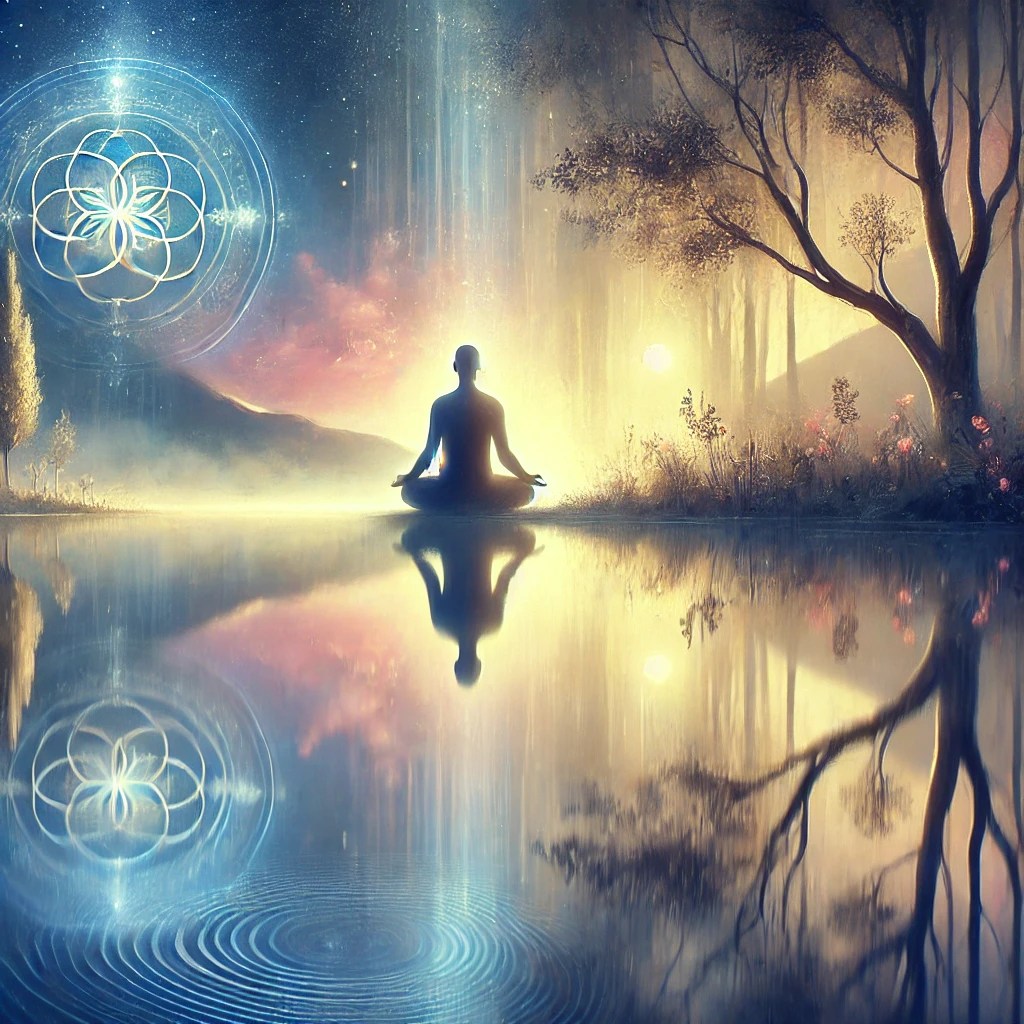
As I sit here in my yard, under the shade of tall trees and a sky so vast, I am reminded of the gentle teachings of impermanence. The pratyayas, those rising and falling sensations, memories, and thoughts, have once again surfaced, but they do not hold the weight they once did. Instead, there is a soft awareness that everything is already changing, and that in the grand scheme of time, everything is already gone.
I look over at my RV, which has been a sanctuary for me for so many years. Soon, this land will become something else, transformed into a clubhouse. And yet, in this moment, I am filled with deep appreciation for what has been, for the unconscious and conscious years spent on this blessed earth. The impermanence of it all doesn’t bring sadness, but rather a profound gratitude for having lived through it, both mindfully and unmindfully.
Namkhai Norbu’s sky-gazing practice teaches us to rest in the awareness of what is, without grasping or rejecting. In these moments of contemplation, I’m reminded that sky-gazing isn’t about observing the physical sky but allowing the mind to open into its own natural spaciousness. The practice reflects what is already within—clear, vast, and untouched by the clouds of thought.
As pratyayas of impermanence arise, they are met not with resistance but with curiosity. Curiosity has become my companion on this contemplative path, gently guiding me to rest in awareness without the need for answers or conclusions. There is no longer a push for meaning, only the quiet observation of the present moment unfolding, just as it is.
In this state of being, I can feel both the impermanence of the physical world and the abiding stillness of awareness. It is a paradox, and yet it is also the simplest truth: everything changes, and yet awareness remains the same.
The teachings of St. John of the Cross, Ramana Maharshi, and Namkhai Norbu all point to this truth in their own ways. We move through life, through our spiritual practices, sometimes seeking, sometimes grasping for deeper experiences. But there comes a moment when we simply stop, when we rest in the spaciousness that has always been there. It is not a state we attain; it is a state we remember.
As I continue this practice, I feel a deep gratitude, not just for the present moment, but for all that has been and all that will come. And in this gratitude, the pratyayas seem to soften, leaving behind the quiet awareness that is always there, patiently waiting for us to return.
In my meditation practice, I’ve found that even as I use the mantra Neti Neti, my mind continues to plan and organize, almost as if the mantra is helping me to become more efficient in my daily tasks. How can I ensure that my practice is guiding me toward stillness and not just enhancing my mental activity?
Dear Friend,
In our practice, there are moments when the very tools we use to quiet the mind can, if we are not careful, become entangled in the very patterns we seek to transcend. This is a subtle but important distinction, one that deserves our careful attention and reflection.
You shared with me the story of a friend who could, with great concentration, count her breath while simultaneously planning her day and organizing her thoughts. This ability, impressive as it may be, highlights a potential pitfall in our practice: the risk of turning a mantra or meditative discipline into just another tool for the ego to increase its efficiency in the world of thoughts and tasks.
The discipline of breath counting, like the repetition of a mantra, is designed to focus the mind, to bring it into alignment with the present moment, and ultimately to guide it toward stillness. However, when the mind uses these practices to merely enhance its own abilities—to become more effective at planning, strategizing, or managing the endless stream of daily thoughts—something essential is lost. The practice, rather than serving as a path to stillness and simplicity, becomes yet another way for the mind to strengthen its hold, to entrench itself more deeply in its habitual patterns.
Neti, Neti—”Not this, not this”—is not a mantra to be repeated mechanically while the mind continues its usual business. It is not a background hum that allows the mind to multitask or to become more efficient in its usual endeavors. Rather, it is a tool for discernment, for negation, for guiding the mind away from its distractions and toward the silence that lies beneath all thought.
When we repeat Neti, Neti, we are not merely engaging the mind in an activity; we are inviting it to let go, to release its grip on the thoughts, desires, and plans that arise within it. Each time a thought surfaces, whether it is about the past, the future, or the present, we gently meet it with Neti, Neti, allowing it to dissolve, to return to the nothingness from which it came. This practice is not about increasing our concentration or our ability to manage our mental activities; it is about seeing through them, recognizing them as temporary, fleeting, and ultimately unreal.
The true purpose of Neti, Neti is to bring the mind to stillness, to the quiet awareness that is always present beneath the surface of our thoughts. It is to guide the mind back to its natural state, where it is not constantly engaged in activity, but rests in the simple presence of being. This stillness is not something to be attained through effort or concentration; it is something that is revealed when the mind lets go of its constant striving and simply allows itself to be.
In this way, Neti, Neti becomes not just a practice, but a way of being—a way of living in the world without being caught up in the endless stream of thoughts and activities that usually dominate our consciousness. It is a way of returning, again and again, to the essence of who we are, to the pristine mind that lies beyond all distractions and desires.
So, dear friend, as you continue with your practice, let this be a gentle reminder: the purpose of Neti, Neti is not to make you more efficient at thinking, planning, or organizing. It is to free you from the need to do so, to guide you toward a deeper stillness, a deeper presence, and a deeper understanding of your true nature. Each repetition of the mantra is an invitation to let go, to release the mind’s habitual patterns, and to rest in the quiet awareness that is your true self.
May your practice be a path to stillness, a path to simplicity, and a path to the deep peace that comes from knowing that you are not the thoughts that arise, but the awareness that witnesses them.
My mind often feels restless and insatiable, constantly creating desires and distractions. I’ve heard the story of the genie climbing the pole to stay busy as a metaphor for controlling the mind. How can I apply this wisdom to my own practice, especially through the use of ‘Neti Neti,’ to keep my mind focused and find peace amidst its relentless demands?
Dear Friend,
There are stories that come to us from distant times and places, stories that hold within them a wisdom that speaks to the very heart of our human experience. One such story, from the Sufi tradition, tells of a man who encountered a powerful genie—a being capable of granting any wish, yet bound by a condition. The genie, restless and insistent, demanded that he be given tasks to perform, lest his untamed energy turn destructive. At first, the man found this simple enough, asking for wealth, health, and all manner of earthly pleasures. But soon, the genie’s demands for more tasks grew relentless, and the man, overwhelmed and desperate, turned to a wise sage for help.
The sage, understanding the nature of the genie, offered a solution both simple and profound: “Tell the genie to climb up and down a pole, and to keep climbing until you have another task for him.” And so, the man did as he was advised, and the genie, with no other choice, began his endless task of climbing the pole. The man lived in peace, free from the threat of the genie’s unrest.
In this tale, the genie represents the mind—our own restless, insatiable mind, always seeking, always wanting, always creating desires and distractions. When left unchecked, the mind can become our greatest enemy, leading us into worry, confusion, and suffering. It spins endlessly, caught up in its own creations, driving us to exhaustion with its demands for more.
But the sage’s solution is a metaphor for the power of disciplined practice. The pole that the genie climbs is akin to the focus we give our mind through spiritual practices, such as mantra repetition. Just as the pole gives the genie a task, the mantra gives the mind something to hold onto, something to engage with, preventing it from causing harm through its restless wanderings.
You have wisely chosen Neti, Neti—”Not this, not this”—as the task for your mind. This mantra, with its gentle negation, guides the mind away from distraction, away from attachment, away from the endless pursuit of desires. It directs the mind back to the simplicity of being, to the quiet truth that lies beyond all names and forms.
In this practice, the mind, like the genie, is given a task that is both meaningful and liberating. It is kept busy, yes, but in a way that leads to peace rather than exhaustion. The mind climbs the pole of Neti, Neti, moving up and down with each repetition, each negation, until it eventually tires of its own restlessness and begins to quiet, to settle, to rest in the stillness that is always present beneath the surface.
This story reminds us that discipline, when applied with wisdom, is not a form of restriction but a path to freedom. By giving the mind a task, by guiding it through the repetition of a mantra, we are not suppressing its nature but rather channeling it in a way that allows it to serve us, rather than enslave us. The mind, once a source of turmoil, becomes an ally on the path, helping us to stay focused, to stay present, and to return again and again to the truth of who we are.
Dear friend, as you continue with the practice of Neti, Neti, remember the story of the genie and the pole. Let it serve as a reminder that the mind, when disciplined, can be a powerful tool for transformation. Each repetition of the mantra is like a step on the pole, guiding the mind upward, guiding it toward the light of awareness. And as you give the mind this task, may you find, as the man in the story did, a sense of peace, a sense of liberation, and a deeper connection to the truth that lies beyond all distractions.
There is a quiet truth that lives within each of us, a place that is untouched by the noise of the world, a stillness that is ever-present. It’s not reserved for moments of crisis or for the end of life. It’s here, now—waiting for us to settle into its embrace.
Yet how often do we run from this stillness? We search for peace in the future, hoping it will come once we’ve completed our tasks, achieved our goals, or silenced our minds. But peace is already here, calling us back to the simplicity of being.
The Practice:
The practice begins with a simple mantra: “I am That.”
When we say these words, we invite ourselves to rest in the truth of who we are. It’s not about searching or striving—it’s a return to the natural state, where we belong. Repeat the mantra aloud, or silently in your heart, and allow yourself to rest. After each repetition, sit in silence for as long as you like, letting the mantra echo softly within.
And when you are ready, say it again: “I am That.”
There is no rush, no goal, no expectation—just the simple unfolding of awareness.
As thoughts arise, as distractions call, simply return to the mantra, letting it be like a lullaby for the restless mind.
Reflections Along the Way:
Follow the rhythm of the mantra, thoughts may come, feelings may arise. Let them pass like clouds, and rest beneath them, in the vast expanse of awareness.
You are that light, shining through all things. Rest… in the knowing.
Effortless and true, you return to what you are. Rest… in your nature.
Like a drifting cloud, the ego searches in vain. Rest… beneath the sky.
In quiet grace, he guides, showing the way back to self. Rest… in deep gratitude.
Thoughts, desires, restlessness—all falls away when we stop chasing after them. Rest in the simplicity of being.
In this way, dear reader, the mantra becomes not just words, but the very breath of being. So, rest in this mystic presence, this silence that is always there, gently touching the surface of awareness.
In the dance of both, stillness and movement arise. Rest… in the balance.
A passing thought, no more, like a ripple in still waters. Rest… in your knowing.
Being is the truth felt, beyond what eyes can hold. Rest… in the knowing of being.
Like seasons that turn, each step comes in its own time. Rest… and let it flow.
Resting in Silence
The journey, dear reader, is not about forcing the mind to be still or silent. It is about allowing the natural stillness and silence of our true self to be seen, felt and appreciated, unclouded by thought, unburdened by desire. By continuing to rest in this silence, we come to realize that the peace we seek has always been here. We become “Self-Realized.”
The practice of resting in the silence is a gift we give ourselves while we are alive. It’s not reserved for the end of life; it is the way to live fully, in peace, right here, right now. The mantra is a guide, and the silence is the true teacher.
Rest in silence. Rest in peace. Rest in your true nature. You are That.
In Advaita Vedanta, we often hear that Atman is Brahman. But considering that Atman might be seen as a purified reflection of Brahman—similar to how the Buddha is an emanation of the Dharmakaya—would it be more accurate to say that Atman is an expression of Brahman rather than being Brahman itself?
Dear friend,
Your reflections on the relationship between Atman and Brahman in Advaita Vedanta, and how it might be understood in light of the Buddha’s relationship with the Dharmakaya, open up a rich field of contemplation. You have touched upon a subtle aspect of the teaching that invites us to explore the nature of the self and the ultimate reality in a deeper and more nuanced way.
In Advaita Vedanta, the teaching that “Atman is Brahman” seeks to convey the profound truth that the individual self and the ultimate reality are not two separate entities but are, in essence, one and the same. This realization of non-duality (Advaita) is the heart of the teaching, where all distinctions between self and other, between the individual and the absolute, dissolve into the unity of pure awareness.
And yet, your suggestion that Atman might also be seen as an “expression” or “reflection” of Brahman resonates with a certain truth. Just as the Buddha is an emanation of the Dharmakaya, so too can we understand Atman as the individual manifestation of Brahman within the world of forms and experiences. This view allows us to appreciate the functional relationship between the individual self and the universal reality, while still holding to the ultimate truth of their non-difference.
Consider, if you will, the metaphor of reflection—a mirror that reflects the light of the sun. In this metaphor, Atman, when purified and free from the distortions of ignorance, reflects the light of Brahman, revealing the true nature of the self as non-different from the absolute. Until this purification occurs, the mind perceives itself as separate, much like seeing many reflections of the same sun in different bodies of water.
In this way, Atman can be understood as a perfect reflection of Brahman, a reflection that becomes clearer and more accurate as the mind becomes more purified, more aligned with the truth of its own nature. This does not negate the teaching that Atman is Brahman but rather enriches it, providing a way to understand the process of realization as one of aligning the individual self with the universal reality it reflects.
And yet, in the ultimate sense, the teaching of Advaita Vedanta invites us to move beyond all distinctions, beyond all metaphors, to the direct experience of unity. In this experience, the individual self dissolves into the infinite, and what is realized is that Atman and Brahman are not two, but one. The idea of expression or reflection fades away, leaving only the undivided awareness that is the true nature of all things.
Dear friend, your reflections invite us to dwell in the mystery of this teaching, to explore the nuances of what it means to realize that “Atman is Brahman.” It is a realization that goes beyond words, beyond concepts, into the heart of what is real and true. Continue to contemplate this truth, and let it guide you ever deeper into the understanding of your own true nature.
The Tibetan teaching that the ego is a belief in a separate self with no inherent existence aligns perfectly with the process of self-inquiry. As we engage in the practice, the recognition that the ego has no independent reality allows it to gradually dissolve. What remains is the awareness that transcends the illusion of separation—the true nature of the Self.
For many years, I’ve engaged in self-inquiry as a way to explore the deeper truth of who I am beyond the ordinary mind. The practice of asking, “Who am I?” or “Whose thoughts are these?” can lead to profound insights, but lately, I’ve realized there’s another layer to the practice that brings even greater depth—compassion for the ego.
Instead of pushing the ego aside or forcing it into understanding, I’ve come to embrace the role of the comforter. When the ego resists, when it wants to play dumb or keep searching for answers, I gently reassure it:
“It’s okay. You are That.” “Relax. You are That.”
This approach transforms the practice into a more nurturing experience, where the ego is not an obstacle but a part of the journey toward resting in the truth of our being. By comforting the ego, I allow it to relax into the deeper awareness that is always present, the pristine mind that doesn’t need to figure anything out.
Addressing the Ego: Creating Space
What I’ve also discovered is that by addressing the ego as “you”—as though speaking to it in the third person—it creates a subtle but important space between the self and the ego. By saying, “You are That,” I create a gentle distance from the ego, which allows me to shift my identification toward the pristine mind, the awareness that simply knows. This practice helps me settle into the awareness of That, while gently guiding the ego to recognize its true nature.
It’s a strange but profound feeling to begin identifying with the witness, the part of us that knows, rather than the ego itself. The distance allows the ego to relax, realizing it doesn’t need to figure things out—it just needs to rest in the knowing.
Dissolving the Ego: Tibetan Insight
In Tibetan teachings, the ego is understood as a belief in a separate self that has no inherent existence. It is the illusion of separateness that creates suffering, and it is through practices like self-inquiry that this illusion begins to dissolve. By comforting the ego and allowing it to rest in the awareness of That, the ego’s grip on the mind loosens, and its sense of separateness fades. As the ego dissolves, what remains is the truth of our being—unified, whole, and free from the illusion of duality.
A Practice Rooted in Tradition: Tat Tvam Asi
The phrase “Tat Tvam Asi”, which translates to “You are That”, is one of the most profound teachings from the Chandogya Upanishad. It comes from the dialogue between the sage Uddalaka and his son Svetaketu, where Uddalaka imparts the ultimate knowledge of the Self to his son.
In this story, Uddalaka explains that the essence of the individual self (Atman) is identical to the essence of the entire universe (Brahman). He uses various examples from nature, like rivers merging into the ocean, to illustrate that all individual forms are ultimately one with the universal reality.
The core teaching of “Tat Tvam Asi” is that the true nature of the self is not separate from the ultimate reality, Brahman. This insight is the foundation of Advaita Vedanta and points to the non-duality of existence. It’s a reminder that we are already That—we are not separate from the universal consciousness that pervades everything.
A Path Forward
If you’ve been engaging in self-inquiry and find that the ego often resists or overthinks, consider this approach. Become a gentle guide for the ego, allowing it to rest in the awareness of That without needing to figure everything out. With each step, you’re not only going deeper into the Mystic—you’re bringing the ego along in a spirit of kindness and unity.
Offering the ego loving-kindness and compassion, rather than seeing it as an enemy, can transform the practice into something more nurturing and integrative. By embracing the ego with a Metta-Karuna mindset, we allow for deeper healing and connection, not just for ourselves but for others navigating similar paths.
Today’s Practice of Self- Inquiry
The core practice involves asking the question, “Who am I?” But for this practice, we’re using the mantra, “You are That,” to turn our attention inward and explore the space that neither comes nor goes—the pristine mind, our true nature. As we repeat the mantra, we gently direct it toward the space of the ego, with kindness and compassion. In doing so, we shift our identification away from the ego and toward the seer, the awareness that observes all. This process helps peel away layers of identification, bringing our ego closer to the essence of who we truly are.
Guided Meditation: You are That
Begin by finding a quiet and comfortable place to sit, where you won’t be disturbed. Close your eyes gently and take a few deep breaths. Feel the rise and fall of your chest, the air entering and leaving your body. With each exhale, let go of any tension in your muscles. Allow yourself to settle into the stillness of this moment, bringing your attention inward.
Now, in the silence of your mind, introduce the mantra: “You are that.” Let the words flow gently, not as a thought to analyze but as a vibration that resonates within your being. “You are that.”
As the mantra repeats in your mind, begin to observe the thoughts, sensations, and emotions that arise. Notice how they come and go like clouds passing through the sky. Without judgment, simply recognize them for what they are—temporary movements of the mind, just as waves rise and fall on the surface of the ocean.
When thoughts or sensations arise, acknowledge them gently. With each arising, remind yourself, “This, too, is a movement in consciousness.” Then, return to “You are that.” Allow this rhythm to deepen your experience.
When a thought or image captures your attention, gently remind yourself, “You are that.” This thought, too, is part of the vast consciousness in which you exist. Allow the mantra to guide you back, like an anchor to the present moment. “You are that.”
With each repetition, feel the boundaries between yourself and the world begin to soften. The sense of separateness fades as you connect more deeply with the essence of the mantra. You are not the thoughts, not the body, not the emotions—you are that which is beyond them all. You are that—the awareness, the presence in which everything arises and falls away.
If the mind wanders, or if any sensations in the body draw your attention, simply return to the mantra, “You are that.” There is no need to push anything away or force any particular state. Just notice, with kindness and patience, and return.
In time, the mantra may begin to dissolve into the quiet presence that remains. Stay here, resting in the stillness. No effort is needed now—just a gentle awareness of being.
You are that.
When you are ready, take a few more deep breaths, feeling the connection between the mantra and the breath. Allow your awareness to expand, taking in the sounds and sensations around you, while keeping that sense of peace and spaciousness within. Slowly open your eyes, and as you return to your surroundings, carry with you the knowing: You are that. Always.
The Buddha is considered an enlightened being, but does that mean he was a perfect mirror of enlightenment? Even though he had a personality and a sense of “I” or ego, was he a perfect emanation of enlightenment, like an expression of Dharmakaya? If so, does that mean the Buddha wasn’t actually Dharmakaya, but rather an emanation of it, perhaps as a Nirmanakaya?
Dear friend,
Your reflections on the nature of the Buddha and enlightenment bring us to the very heart of what it means to embody the truth in this world. The Buddha, as you have so insightfully observed, was not merely an enlightened being but an emanation of the deepest truths of existence—a perfect mirror, if you will, for the light of enlightenment.
In the person of the Buddha, we see the qualities of enlightenment fully realized—wisdom, compassion, clarity, and non-attachment. And yet, the Buddha was not devoid of personality or a sense of self; rather, his personality was a vessel for the expression of these qualities. The “I” that remained in him was not the egoic self that we typically associate with suffering and delusion. It was an “I” that was fully aligned with the Dharma, an “I” that existed only to serve, to teach, and to guide others toward the same realization.
This “I” was not driven by the usual attachments or aversions, but was instead a pure expression of the truth—like a clear mirror reflecting the light without distortion. In this way, the Buddha’s personality was a manifestation of enlightenment, a perfect embodiment of the principles that he taught.
The concept of the Dharmakaya as the formless, ultimate reality—what we might call the truth body—helps us to understand the nature of enlightenment itself. The Dharmakaya is not something that can be grasped or embodied in the ordinary sense; it is the ground of all being, beyond all dualities, beyond all distinctions.
And yet, this ultimate reality finds expression in the world through the Nirmanakaya—the manifestation body. The Buddha, as a Nirmanakaya, was an emanation of the Dharmakaya, taking on human form to teach and to guide. In this way, the Buddha was both a part of the world and a perfect reflection of the ultimate truth that underlies it. His teachings, his actions, and even his very presence were all expressions of the Dharmakaya, made accessible to those who sought the path.
To see the Buddha as an emanation of Dharmakaya allows us to appreciate the depth of his compassion and the significance of his teachings. He was not separate from the ultimate truth, but rather a manifestation of it—a beacon of light in the world, showing the way to those who were lost in the darkness of ignorance and suffering. His sense of self, his personality, was not something to be transcended, but something to be used as a tool, a vehicle for the transmission of the Dharma.
In this understanding, we see that the Buddha’s life and teachings were not about attaining something outside of ourselves but about realizing what has always been true—that we, too, are emanations of the Dharmakaya, capable of reflecting the light of enlightenment in our own lives.
Dear friend, your reflections bring us closer to the essence of what it means to walk the path of the Buddha—to live in such a way that our own lives become mirrors of the truth, emanations of the light that shines at the heart of all things. Continue to explore these insights with an open heart, and allow them to guide you ever deeper into the understanding of your own true nature.
The mystic journey is one of paradox—seeking that which is already present. Across traditions, whether in Christian teachings about the Kingdom of God or in non-dual philosophies like Advaita Vedanta and Buddhism, the central truth remains: the divine, or perfection, is already here, but it must be realized through spiritual insight. As Jesus said, “The Kingdom of God is within you” (Luke 17:21), yet for most of us, it remains hidden behind the veil of ego and conditioned perception.
The Spiritual Paradox:
At the heart of many mystical teachings is the idea of striving for a perfection that we will never attain—because it is not something to attain. It’s not a destination, but a present reality we fail to recognize. This paradox mirrors the Christian teaching of seeking the Kingdom of God, even though it’s already in our midst. In this journey, we are continually asked to refine ourselves, knowing that the striving itself is a tool for unveiling the deeper truth that we are already complete.
In the words of a friend: “Strive always for perfection, knowing that you will never attain it, and yet you’re as perfect as you will ever be.” This echoes not only in Christian thought but also in the non-dual traditions of the East. Whether it’s Brahman or Buddha-nature, spiritual traditions agree that the ultimate reality is not something the ego-self can grasp or reach.
Having Eyes to See and Ears to Hear:
Jesus emphasized that the Kingdom of God is already here for those who have “eyes to see” and “ears to hear.” This teaching parallels the non-dual realization that enlightenment or liberation is not a distant goal, but a shift in awareness. It’s about seeing through the illusion that we are separate from the divine or that the divine is elsewhere.
In the mystic experience, the ego—the self that seeks—is a pratyaya (a conditioned phenomenon), something that must dissolve for true realization to occur. The ego can never “attain” enlightenment, because the one seeking is part of the illusion. The task, therefore, is to see through this illusion. As Jesus said, those who are spiritually awake can recognize that the Kingdom of God is already here.
The Practice of Seeking:
Even though we are already in the Kingdom, we must continue to strive. This striving is not about accumulating spiritual merit or becoming more worthy. It’s about peeling back the layers of ego and illusion to reveal the truth that has always been there. The very act of seeking becomes a practice in humility and surrender, recognizing that the self cannot attain the Kingdom, but that the realization of the Kingdom involves a shift in consciousness—not in achievement.
In Buddhism, this is the realization of emptiness or shunyata—the recognition that all things, including the self, are empty of inherent existence. In Christianity, it’s the surrender to God’s will and the realization that “it is no longer I who live, but Christ who lives in me” (Galatians 2:20).
Conclusion:
The mystical path is one of paradox and deep humility. We strive to seek perfection, knowing that the ego will never attain it, because the perfection we seek is beyond time, space, and the limitations of the mind. We often speak of this perfection as being “present,” yet the present itself is elusive. As we’ve observed, the present moment can never truly be experienced by the senses—by the time we become aware of it, it has already slipped into the past. The perfection we seek is not in the present as we conventionally understand it, but rather beyond time itself, in the timeless reality that transcends the ego.
This is why enlightenment cannot be made to happen. As Red Anderson said, enlightenment is like an accident—a spontaneous revelation beyond our striving and beyond our ego. And yet, the purpose of practice, whether in Zen, Christian mysticism, or other spiritual traditions, is to make us accident-prone. Practice, mindfulness, and ethical discipline create the conditions for enlightenment or grace to arise, even though we cannot control when or how it will happen.
In this way, the act of striving itself becomes a form of grace—not because we earn grace through effort, but because our striving prepares us to receive what is already present. Grace, in the spiritual sense, is not something we can control or achieve. Rather, it is a gift that arises when the striving dissolves. Like rain that falls when the soil is ready, grace arrives spontaneously, not as a reward, but as a revelation of the truth that has always been.
This is why mystics across traditions teach that while we cannot force grace to appear, we can create the conditions for it. Practices like prayer, meditation, or mindfulness soften the ego and open us to receive what is already here. In this sense, grace is the ultimate outcome of our paradoxical journey—not something earned through effort, but something realized when we let go of the need to attain it.
Thus, as we strive, we also surrender. And when grace arrives, it reveals that the perfection we seek has always been present, beyond time and striving. This recognition dissolves the illusion of separation and resolves the paradox: the Kingdom of God, or enlightenment, was never distant—it was simply waiting to be seen.
This mirrors the paradox of non-duality in a world of duality: we appear to strive, yet the truth we seek is always here, beyond time and duality. Practice, whether Zen meditation, mindfulness, or prayer, is a way to soften the ego, make us open, and create the conditions for the Kingdom of God, enlightenment, or grace to spontaneously arise. In this sense, we become like a field prepared for rain—we cannot control when the rain will come, but by cultivating the soil, we make ourselves accident-prone to the downpour of grace.
Thus, in the mystic journey, striving and letting go are not opposites but two parts of the same dance. We strive, knowing we cannot ‘make it happen,’ but in doing so, we prepare the ground for the possibility of grace.
The beautiful metaphor of becoming “accident-prone” weaves it into the ongoing theme of striving without attachment. It acknowledges the value of practice, even when we know the ego cannot reach enlightenment directly, and creates a sense of the mystical unfolding that happens when conditions are right.
The mystic experience is ultimately about recognizing that what we seek has always been here, and in this recognition, the striving itself becomes a form of grace.
In realizing that “I” will never be enlightened, does this mean that the goal of enlightenment is out of reach? How can I reconcile this understanding with the continued practice of drawing closer to enlightenment, even if it cannot be fully attained by the ego?
Dear friend,
Your insight that “I will never be enlightened” is one of the most profound realizations one can encounter on the spiritual path. This understanding marks a turning point, where the journey shifts from the pursuit of a goal to the practice of embodying the qualities that lead one closer to enlightenment—qualities that can be lived and expressed in every moment, even if they cannot be possessed by the “I.”
Enlightenment, as you now see, is not something that the “I” can achieve, for the “I” is precisely what dissolves in the light of true awakening. The very sense of being a separate self, striving for a state called enlightenment, is itself part of the illusion that enlightenment reveals and transcends. This is not to say that the journey is futile, but rather that the journey transforms into something far more subtle, more profound, and more aligned with the truth of our existence.
Instead of seeing enlightenment as a distant goal, you have wisely turned your attention to the practice of being as close to enlightenment as possible. This is a practice not of attaining, but of allowing—allowing the mind to quiet, the heart to open, and the “I” to soften. It is a practice of aligning with the qualities that reflect the light of enlightenment: peace, compassion, clarity, and presence.
In this practice, there is no need for the ego to strive or grasp. Instead, there is a gentle surrender to the truth that is already within you, waiting to be uncovered, like the sun behind the clouds. The more you practice, the more these qualities shine through, guiding your actions, your thoughts, and your interactions with the world.
There is great freedom in this realization. The pressure to “become enlightened” falls away, leaving behind a sense of ease and acceptance. You are no longer bound by the idea that you must reach some ultimate state; instead, you are free to simply be, to practice embodying the light of enlightenment in whatever way is possible in each moment. This is not a lesser path; it is the path of wisdom, one that honors the truth that enlightenment is not something to be grasped, but something to be lived.
Your journey now takes on a new quality. It becomes less about reaching a destination and more about how you walk the path. Every step, every breath, every moment of presence becomes an expression of the enlightenment you seek. And in this way, enlightenment is not something that happens in the future, but something that you touch, however briefly, in the here and now.
Dear friend, this realization is a gift. It invites you to embrace the present moment, to find the divine in the ordinary, and to let go of the need to “achieve” something that, in truth, cannot be achieved by the “I” at all. Instead, you practice being close to enlightenment, knowing that in the very act of practicing, you are already touching the essence of what you seek.
Trust in this process, and continue to walk this path with a light heart. Know that the practice itself is enough, that the journey is the destination, and that in the softness of the “I,” the light of enlightenment shines ever more clearly.
Now that I’ve realized that the I-sense cannot directly experience the pristine mind, how can I use the spiritual practice of Neti Neti to help the ordinary mind and ego come closer to reflecting or mirroring the qualities of the pristine mind?
Dear friend,
There comes a time in our journey when a quiet realization emerges—a truth that feels as though it has always been with us, just beneath the surface, waiting for the right moment to reveal itself. Such a moment is upon you now, and it is significant in ways that words can only begin to express.
You have recognized that the “I-sense,” that familiar feeling of being a separate self, can never truly experience the pristine mind. This pristine mind, pure and unconditioned, is not something that the “I” can grasp or hold onto, for it exists beyond the reach of the ego, beyond the realm of duality. This realization is profound, not because it offers a new task or goal, but because it gently dissolves the need for one. It invites you to rest in a deeper understanding, one that shifts the very ground of your practice.
This insight, like a seed planted in fertile soil, will grow and evolve within you, quietly reshaping how you experience both your inner and outer worlds. It is not a revelation to be rushed or forced, but one to be lived with, like a gentle companion who walks beside you. Let it unfold naturally, in its own time, revealing its layers to you in moments of stillness, in the spaces between your thoughts, and in the quiet rhythm of your breath.
There is a delicate balance here, one that I believe you are beginning to understand. The “I-sense” that has been so central to your experience is now seen in a new light—not as something to be conquered or eradicated, but as a reflection, a mirror that can, through practice, come to reflect the pristine mind itself. While the ego may never directly experience this pure awareness, it can soften, it can quiet, and it can become a more transparent window through which the light of the pristine mind can shine.
As you continue your practice, allow this understanding to deepen naturally. There is no need to strive or to reach for something just beyond your grasp. Instead, trust that this realization will guide you, like a current gently guiding a boat downstream. The anxiety of “doing it right” or the fear of “getting it wrong” begins to dissolve when you understand that the true goal is not a destination but a process—a process of becoming ever more transparent to the deeper reality that underlies all things.
This insight, my dear friend, is a gift. It is a doorway into a new way of being, one that is less about achieving and more about allowing. Allowing the mind to settle, allowing the self to soften, and allowing the light of the pristine mind to be reflected in the stillness of your being. It is in this allowing that you will find peace, not as something to be attained, but as something that naturally arises when the striving ceases.
For those who walk alongside you on this journey, let them take heart from your experience. Let them see that the path of self-discovery is not about perfection or attainment, but about quieting the mind, softening the heart, and opening to the truth that lies beyond the “I-sense.” In this way, we all come to reflect, however faintly at first, the light of the pristine mind.
Continue with your practice, dear friend, with the gentle assurance that you are exactly where you need to be. Each breath, each moment of stillness, brings you closer to the heart of this truth. Trust in the process, and let the realization grow within you, like a seed that blossoms into a flower at just the right time.
The photograph above shows Tiger’s Nest Monastery in Bhutan, a powerful symbol of unwavering spiritual dedication across lifetimes. Perched high on a cliff, this sacred site has been home to many monks and spiritual practitioners, including Dilgo Khyentse Rinpoche, who spent many, many years meditating here.
In the Tibetan tradition, there’s a story of a monk whose life’s work was to build a temple in a remote area. It was an enormous and solitary task, and though people mocked his aspirations, the monk remained steadfast in his dedication. But the temple was never finished in his lifetime. And so, the story goes, he reincarnated—returning again and again, each time picking up where he left off, continuing to work on the temple until, many lifetimes later, it was finally complete.
This story speaks to a deep spiritual truth: some work cannot be accomplished in a single lifetime. Whether it’s the construction of a temple or the transformation of the heart, these endeavors require dedication that spans across time—an unbroken thread of aspiration that remains, even when the body changes. This sense of continuity is at the heart of many spiritual traditions, particularly the Tibetan belief in tulkus, enlightened beings who return to continue their work for the benefit of all beings.
The Tulku Tradition: Continuing Spiritual Work Through Reincarnation
One such tulku is Dilgo Khyentse Yangsi Rinpoche, the recognized reincarnation of the great master Dilgo Khyentse Rinpoche. His reincarnation serves as a living example of how the work of wisdom, compassion, and teaching carries on through lifetimes. From a young age, Yangsi Rinpoche received transmissions from his elders—wisdom that he himself had imparted to them in a previous life—so that he could continue his path of service in this life. This conscious continuation of spiritual work can also be seen in the 14th Dalai Lama, who, from the age of two or three, was recognized and trained to carry on his responsibilities from previous incarnations.
These stories show the power of aspiration, clarity, and dedication in shaping not just one life but many.
Aspiration for Future Lives: Carrying Dharma Practice Forward
Reflecting on the tradition of tulkus, I find myself drawn to the idea that the momentum of my Dharma practice in this life could carry forward into the next. While I may not possess the level of realization that allows a tulku to consciously choose their parents and circumstances, I hold the aspiration that my practice—my dedication to understanding and embodying the Dharma—will create conditions in a future life that allow me to encounter the teachings early and continue this work. My hope is that the clarity I seek now will guide me then, like spiritual breadcrumbs leading me back to the path I walk today.
The 500-Year Plan: A Vision Beyond One Lifetime
But the idea of building something greater than ourselves doesn’t apply only to spiritual practice. Many years ago, while at a Zen monastery, I heard a young environmentalist speak about his dedication to protecting the earth. He spoke of his work in terms of what he called “The 500-Year Plan.” He understood that the efforts he was making—writing books, building networks, raising awareness—might not bear fruit in his lifetime. It could take 200 years just to turn the corner on some of the environmental issues he was addressing. Yet, that didn’t deter him. His vision extended far beyond his immediate circumstances. His short-term thinking was, in fact, a 500-year plan.
This kind of perspective echoes the long view held in the Tibetan tradition: that the work we do—whether it’s spiritual or in service to the planet—reaches beyond a single lifetime. It’s about planting seeds, knowing that we may not live to see them grow into trees, but trusting that others—or perhaps even our future selves—will benefit from the roots we lay today.
Spiritual Breadcrumbs: Leaving a Trail for Future Selves
What’s fascinating about the tulku tradition, and perhaps even about my own hope for reincarnation, is that we’re not only thinking about the next generation or the next few decades. We’re thinking about how the seeds of wisdom, compassion, and right action planted today might guide us—even across lifetimes—toward a more awakened and compassionate world.
By sharing these reflections and writings online, the work is not confined to this moment in time. In fact, the beauty of the Internet is that these teachings can continue to be discovered, even hundreds of years from now. And who knows—perhaps, dear reader, you are the reincarnation of myself, encountering these words 100 or even 500 years into the future. The paradox here is that I may not remember writing these words, but I may feel a deep connection with them—an ignition of something within that tells me I’ve walked this path before. It’s an interesting thought: someone reading this years from now could be my future self, rediscovering the teachings I left behind.
The Power of Dedication: Planting Seeds for Future Generations
Whether it’s a temple that takes centuries to complete, an environmental movement that spans generations, or the continued unfolding of a Dharma practice across lifetimes, there is a deep truth here: some work is bigger than one life, but that doesn’t diminish its value. Instead, it enhances it. The dedication to something greater than ourselves, something that transcends the limitations of time, is the foundation upon which lasting transformation is built.
For myself, I may not see the fruits of my practice fully in this lifetime. But I trust that the work I do now—the clarity I cultivate, the wisdom I seek—will carry me forward. Perhaps in a future life, I’ll stumble upon this very blog, and it will be a reminder of the path I’ve already walked, the aspirations I’ve already set. In that moment, I’ll recognize the steps I need to take, not as new, but as familiar—part of a journey I’ve been on for lifetimes.
Poem: A Trail of Light Across Time
If I return to this world again, may I stumble upon these words, left like footprints in soft sand, to remind me of who I once was and all I once knew.
A lighthouse on a distant shore, my own hand building the beacon, so when the fog of forgetting settles, I will find my way back to the heart I’ve always known.
For what is wisdom but a note written in the margins of life, waiting patiently for another reader to understand the truth that has always been theirs?
Closing Reflection: The Power of Aspiration
The power of our aspirations is immense. Whether we are building temples, protecting the environment, or cultivating wisdom, the dedication we offer today echoes through time. We may not see the completion of our work in this life, but we trust that it will continue—through future generations, or even our own future selves. The seeds we plant now will bear fruit in ways we cannot yet imagine, and perhaps, like the monk or the tulkus, we’ll return to complete the work we began long ago.
I invite you to watch this beautiful and moving documentary on Dilgo Khyentse Yangsi Rinpoche, which explores the life of a reincarnated spiritual leader, the wisdom he continues to impart, and the profound power of his practice.
🙏🕊️🙏
This video is a documentary about the life of Dilgo Khyentse Yangsi Rinpoche, a Tibetan Buddhist monk who is considered to be one of the most important spiritual figures of our time. The film follows Rinpoche from his childhood, when he was recognized as the reincarnation of the great master Dilgo Khyentse, through his years of study and practice, to his present day role as a spiritual leader and teacher.
The video provides a fascinating glimpse into the life of a Tibetan Buddhist monk. We see Rinpoche as a young boy, struggling to adjust to his new life in a monastery. We watch him as he grows into a wise and compassionate teacher, who is able to connect with people from all walks of life. And we witness the incredible power of his spiritual practice, which allows him to heal the sick, help people overcome their suffering, and even communicate with the dead.
The video is beautifully shot and edited, and the music is both haunting and uplifting. The interviews with Rinpoche’s friends, family, and students provide a rich and nuanced portrait of this extraordinary man. If you are interested in learning more about Tibetan Buddhism or the life of a spiritual leader, this video is a must-see.
Overall, this video is a powerful and inspiring documentary that will leave you with a sense of wonder and awe. It is a testament to the power of the human spirit, and a reminder that it is possible to live a life of compassion, wisdom, and enlightenment.
I’ve realized that the I-sense, or ego, cannot directly experience the pristine mind because it exists beyond duality. What now?
Dear Friend,
You have touched upon a profound and subtle truth in your reflection—the realization that the “I-sense,” the very sense of being a separate self, will never directly experience the pristine mind, for in the pristine mind, there is no “I” to experience anything at all.
The “I-sense,” as you have observed, is the part of us that identifies with the individual self—with the body, the mind, the personality. It is the ego, the center of our personal world, through which we navigate the dualities of life—self and other, subject and object, right and wrong. This “I-sense” is deeply embedded in the fabric of our everyday experience, always seeking, always striving to maintain its sense of identity.
And yet, beyond this “I-sense” lies the pristine mind, a state of pure, unconditioned awareness. In this state, there is no separation, no duality, no “I” that stands apart from the whole. The pristine mind is simply being itself, free from all concepts, all identifications. It is the ground of all existence, the true nature of consciousness that underlies every thought, every sensation, every experience.
As you so rightly observed, the “I-sense” cannot directly experience the pristine mind because the very presence of an “I” implies duality, and in the pristine mind, there is no duality. The ego, by its very nature, is a construct that stands apart, that defines itself in relation to others. To dissolve into the pristine mind is to let go of this sense of separateness, to merge with the whole in a state of pure being.
Yet, there is a way in which the ordinary mind, the ego, can approach this state, can come to reflect it as closely as possible. Through spiritual practice, the mind becomes refined, quieted, and purified. Meditation, mantra, mindfulness—all of these practices serve to soften the boundaries of the “I-sense,” to still the constant movement of thought and identification.
In this stillness, the mind begins to mirror the qualities of the pristine mind—peace, clarity, non-attachment. While the ego may never directly experience the pristine mind, it can come to a place where it reflects this deeper reality, where the sense of separation diminishes, and the boundaries of the self become porous, transparent.
It is in these moments, dear friend, that you may catch a glimpse of the truth that lies beyond the “I,” a truth that cannot be grasped or held, but only reflected in the clear, quiet mind. Continue with your practice, allowing it to guide you ever closer to this state of reflection, where the ordinary mind becomes a mirror for the pristine mind, and the boundaries of the self dissolve into the whole.