✨ English ✨ The light of warmth shines through the long night, 🌙 Though storms may rage, the heart’s lantern never fades. 🕯️ Though mountains are high and waters far, a homebound boat remains, ⛰️🌊⛵ After hardship, spring arrives, and the world is born anew. 🌿🌸
✨ Spanish / Español ✨ La luz del alma brilla en la oscuridad, 🌙 Aunque ruja la tormenta, la llama no se apaga. 🕯️ Montañas y mares no detienen el regreso, ⛰️🌊⛵ Tras la prueba, la primavera renace. 🌿🌸
✨ Italiano ✨ La luce dell’anima illumina la notte, 🌙 Anche nella tempesta, la fiamma non si spegne. 🕯️ Monti e mari non fermano il ritorno, ⛰️🌊⛵ Dopo il dolore, la primavera rinasce. 🌿🌸
✨ العربية / Arabic ✨ نور الروح يضيء الظلام، 🌙 مهما اشتدت العواصف، لا تنطفئ الشمعة. 🕯️ الجبال والبحار لا تمنع العودة، ⛰️🌊⛵ بعد المحن، يأتي الربيع ويولد العالم من جديد. 🌿🌸
✨ עברית / Hebrew ✨ אור הנשמה זורח בלילה החשוך, 🌙 גם בסערה, הנר אינו כבה. 🕯️ ההרים והימים אינם עוצרים את השיבה, ⛰️🌊⛵ לאחר הקושי, האביב מגיע והעולם נולד מחדש. 🌿🌸
✨ Русский / Russian ✨ Свет души сияет сквозь ночь, 🌙 Пусть бушует буря, но огонь не гаснет. 🕯️ Горы и воды не остановят путь домой, ⛰️🌊⛵ После невзгод приходит весна, и мир обновляется. 🌿🌸
✨ Українська / Ukrainian ✨ Світло душі сяє крізь ніч, 🌙 Хай шторм бушує, та вогонь не згасне. 🕯️ Гори й води не зупинять дорогу додому, ⛰️🌊⛵ Після труднощів настає весна, і світ відроджується. 🌿🌸
As we begin our exploration of the Ramayana through Venkatesananda’s version, it’s fascinating to revisit the early stages of this epic tale, particularly through the lens of Valmiki’s own transformation. In this version, we are reminded of how the sage first heard the Ramayana from Narada and later expanded upon it after a transformative experience with the hunter and his divine encounter with Brahma. This opening passage introduces us not only to the story of Rama but also to the profound personal growth of Valmiki, a theme that resonates deeply with our own spiritual journeys.
One particular quote stands out: “Yet, the mystery that even he could lose his temper and thus risk losing the merit of his asceticism intrigued him.”
This moment captures a crucial aspect of the human condition—our struggle to control our emotions, even after years of spiritual practice. For Valmiki, witnessing the hunter’s cruelty toward the birds brought forth both compassion and anger, leading him to curse the hunter. It’s a reminder that even great sages can lose their temper, risking their spiritual merit. For me, the Dalai Lama’s teachings on anger come to mind here—anger is often seen as the opposite of love, and when we give in to it, we lose touch with our pristine, true nature. But the important lesson is that we can always return to our senses, regain our inner peace, and continue on the path of righteousness.
This story, to me, also inspires compassion for ourselves. If even Valmiki, with all his ascetic discipline, could slip into anger, we too can forgive ourselves for the times we fall short. The key is recognizing these moments, learning from them, and using them as opportunities to realign with our higher purpose. Valmiki’s regret and his ability to transform his curse into a verse is a powerful reminder that even our missteps can lead to something greater, if approached with the right mindset.
In this retelling, Valmiki’s divine encounter with Brahma affirms the purpose of his story. Brahma reassures him that the verse he uttered, born out of both anger and compassion, is a blessing. From this moment of emotion, a profound epic was born—a story that would inspire righteousness, compassion, and wisdom for generations. This theme of duality—anger and compassion, curse and blessing—reflects the constant struggle humanity faces with its own dual nature.
What I find particularly compelling in this passage is how the Ramayana is positioned as medicine for a world in turmoil, a story that speaks to the heart of our modern struggles. Today, as in Valmiki’s time, people are often disconnected from their conscience, their true nature, and their pristine mind. This disconnect creates inner chaos, much like the mental fluctuations Valmiki experienced. The Ramayana, with its timeless wisdom, offers a path back to harmony with the divine. It reminds us that even in moments of anger or despair, there is always a way to transform that energy into something positive.
Valmiki’s transformation from anger to inspiration is a beautiful metaphor for our own lives. In the same way that he found his path through a moment of passion, we too can use our struggles as stepping stones toward greater understanding and compassion. The passion that Valmiki felt for the hunter’s cruelty was ultimately transformed into the creation of a story that would inspire righteousness and compassion for millennia.
As we continue this journey through the Ramayana, let us reflect on how we, too, can transform our moments of anger or frustration into opportunities for growth. The challenges we face—both internally and externally—are all part of our spiritual journey. Valmiki’s story is a powerful reminder that the path to self-realization is not without struggle, but each step along the way can lead us closer to our true selves.
In future posts, we’ll continue to explore the wisdom within this and other versions of the Ramayana, diving deeper into how these timeless stories offer guidance for our modern lives. Let’s stay open to the lessons each passage holds and, like Valmiki, allow our moments of weakness to be transformed into opportunities for growth and inspiration.
“In the twilight of life, God will not judge us on our earthly possessions and human successes, but rather on how much we have loved.”
— St. John of the Cross
There is a current of truth that runs beneath all the fragmented voices of humanity. From the sacred texts of ancient traditions to the discoveries of modern science, we find ourselves drawn again and again toward the same mystery, a nameless and formless reality that underlies all things. It is the silent presence in which every being, every atom, and every thought is held. We have called it by many names: God, Hashem, YHVH,Allah, Brahman, Ein Sof, Tao, the Implicate Order, and the Field to name just a few. Yet, no name can truly capture the infinite, formless source from which all that is arises.
In the stillness of Jewish mysticism, Ein Sof—the ungraspable, infinite One—calls to mind the same ineffability as the Tao in the East, the “way” that is beyond words, yet ever-present. In the traditions of the Vedas, Brahman echoes this eternal truth, a limitless ocean of being from which all forms emerge and into which they dissolve. It is a truth that cannot be contained by the human mind, but which the heart longs to know, to touch, and to become one with.
Modern science, too, peers into the depths of this mystery, sometimes not even realizing it. The discovery of the Higgs boson, the so-called God particle, though a triumph of physics, is only a step closer to understanding the field that makes existence possible. And what of the dark matter and dark energy that account for most of the universe’s substance, yet remain unseen? These forces remind us that what we know is but a glimmer of the vast, unmanifest reality that lies just beyond the limits of our senses.
There is a profound resonance here, a common ground where mysticism and science converge. In the hidden recesses of the quantum field, in the Implicate Order that David Bohm spoke of, we begin to glimpse the same boundless reality that the sages and poets have spoken of for millennia. The Pristine Mind of Buddhist thought, the Buddha Nature that resides in each of us, reveals this same underlying truth: that beneath the flux of the manifest world, there is a stillness, a wholeness, from which all arises.
We are all connected to this vast, unknowable field, whether we call it God, Brahman, or simply the mystery. The words and symbols we use are mere pointers, trying to evoke something beyond form and beyond thought. It is the source of all that was, is, and ever will be—the field from which life unfurls like a blossom and into which it returns.
And here is where our deepest unity lies. Whether you stand in the cool silence of a temple, gazing at the stars, or contemplating the equations of quantum physics, you are connected to this same reality. It binds all faiths and traditions, all discoveries and philosophies, not in opposition, but in harmony. The Tetragrammaton of Jewish mysticism—the ineffable name of God—is no different from the Brahman of Vedanta, which is no different from the Field in quantum theory. All of them point to the same ineffable mystery that gives rise to all things.
This is our shared ground, our common truth. We, as human beings, as seekers, as scientists, and as spiritual practitioners, all live in the radiance of this same underlying reality. It is within us, and around us. It is the thread that ties together the Tao of the East, the Ein Sof of Kabbalah, the Great Spirit of indigenous traditions, and the Unified Field that physicists pursue.
In our hearts, we know this. The boundaries we construct between religions, between science and spirituality, between self and other, are but veils drawn over the face of the infinite. If we could still ourselves for a moment, if we could release the need to name and categorize, we might catch a glimpse of this truth, shimmering just beneath the surface.
We are all made of the same cosmic dust, woven from the same quantum fabric, and bathed in the same mystery. Beneath the dualities that define our everyday lives, there is a oneness that holds us all—Brahman, Ein Sof, the Implicate Order, the Field. We need not divide ourselves over the different names we use for this reality. The divine is beyond name, beyond form, beyond comprehension, yet it permeates every aspect of existence. It is the space in which we unfold, and it is the silence that calls us home.
In recognizing this, we can come together—not just in tolerance, but in celebration. We can acknowledge the beauty and depth of every tradition, every path that points to the same infinite source. Whether you come from a place of prayer or from the study of the stars, whether you seek through silence or through science, we are all reaching toward the same truth. This truth is not distant. It is as close as your breath, as intimate as your own heartbeat. It is, in fact, what you are.
So, let us stand in awe of this great mystery. Let us honor the many ways it reveals itself to us—through science, through scripture, through silence. And let us know, deep in our hearts, that we are all bound together in this great unfolding. In this realization, we find the possibility for true interfaith harmony, for an enduring sense of unity, not just with one another, but with the entire fabric of existence.
For in the end, what is all this but a dance of the formless into form, of the infinite into the finite, of Brahman into the world—and back again? We are the expressions of this great mystery, each one of us a note in the song of creation, a ripple in the vast, timeless ocean. And in recognizing this, we are free.
🙏🕊️🙏
“The kingdom of God is within you.” — Luke 17:21
“Be still and know that I am God.” — Psalm 46:10
“God is the center of my soul. He is so profoundly hidden that I can neither see Him nor touch Him. But the closer we approach Him, the more He expands in us.” — St. John of the Cross
“It is love alone that gives worth to all things.” — St. Teresa of Avila
“At the center of our being is a point of nothingness which is untouched by sin and by illusion, a point of pure truth. This little point is the pure glory of God in us.” — Thomas Merton
“The infinite is concealed from all the living. It is not attained by the intellect, nor by any created thing, but only by the soul’s journey into the unknown.” — Kabbalistic Saying
“Wherever you turn, there is the face of God.” — Quran 2:115
“In some sense, man is a microcosm of the universe; therefore, what man is, is a clue to the universe. We are all in this together.” — David Bohm
“The Supreme Reality is beyond both the unmanifest and the manifest. It is eternal and all-pervading. Knowing this, the wise understand their true nature as the same.” — Bhagavad-Gita 8:20
“Your own Self-Realization is the greatest service you can render the world. The deeper you go into the Self, the more the world and the ego disappear, leaving only the formless reality.” — Ramana Maharshi
“There is only one truth—God. All the rest is a fleeting shadow. Fix your mind on the highest, and let the world go.” — Swami Sivananda
“You realize your true nature by casting off the little self and recognizing yourself as the vast Spirit, free from all limitations of form, thought, and time.” — Swami Paramahansa Yogananda
“What we think, we become. All that we are arises with our thoughts. With our thoughts, we make the world.” — The Buddha
“We are here to awaken from the illusion of our separateness.” — Thich Nhat Hanh
“Out beyond ideas of wrongdoing and rightdoing, there is a field. I’ll meet you there. When the soul lies down in that grass, the world is too full to talk about.” — Rumi
“The Tao that can be told is not the eternal Tao; the name that can be named is not the eternal name.” — Lao Tzu, Tao Te Ching
“The Great Spirit is in all things: he is in the air we breathe. The Great Spirit is our Father, but the Earth is our Mother. She nourishes us; that which we put into the ground, she returns to us.” — Big Thunder (Bedagi), Wabanaki Algonquin
These quotes bring together voices from various traditions, adding depth to the contemplation of unity and the infinite mystery that runs through the heart of existence.
In the vast expanse of spiritual literature, few texts carry the weight and significance of the Ramayana. This ancient epic, deeply embedded in Hindu culture, tells the story of Prince Rama, whose life is a testament to the principles of righteousness, duty, and the eternal struggle between good and evil. As we delve into its rich narrative, it’s easy to get caught up in the details of battles, relationships, and divine interventions. However, the essence of the Ramayana can be distilled into three simple yet profound lines, attributed to the Buddha:
Be good. Do good. Purify your mind.
Though these lines originate from the Buddhist tradition, they encapsulate the core teachings of the Ramayana and many other spiritual paths. These principles are not confined to one tradition alone; they are echoed in the teachings of Jesus Christ, who emphasized love, compassion, and inner purity as the path to spiritual fulfillment. Let’s explore how these simple instructions align with the lessons that Rama’s journey imparts, and how they resonate with the wisdom found in Christianity.
Be Good
At its heart, the Ramayana is a story about the importance of living a righteous life. Rama, as the embodiment of dharma (righteousness), consistently chooses the path of virtue, even when it leads to personal hardship. His unwavering commitment to goodness, whether in his role as a son, husband, or king, serves as a model for us all. Similarly, Jesus taught, “Blessed are the pure in heart, for they shall see God” (Matthew 5:8). To “be good” means to cultivate a character that is honest, kind, and just, following the path of love and integrity, regardless of the challenges we face.
Do Good
Righteous intentions must be matched by righteous actions. Throughout the Ramayana, Rama’s life is marked by deeds that reflect his inner goodness. He honors his father’s promise, protects the innocent, and fights against injustice. Jesus, too, emphasized the importance of action, teaching that “whatever you wish that others would do to you, do also to them” (Matthew 7:12). The Ramayana teaches us that our actions in the world—no matter how small—have the power to shape not only our own lives but the lives of others. “Doing good” is about translating our inner virtues into outward actions that contribute to the welfare of all beings, just as Jesus modeled through his life of service and compassion.
Purify Your Mind
The true journey of the Ramayana is as much internal as it is external. Rama’s equanimity, his ability to remain calm and detached in the face of joy and sorrow, reflects the importance of mental purity. Jesus also spoke of the need for inner transformation, saying, “The lamp of the body is the eye. If therefore your eye is good, your whole body will be full of light” (Matthew 6:22). Both teachings invite us to cleanse our minds of negative emotions like greed, anger, and delusion. In doing so, we can attain clarity, wisdom, and inner peace. To “purify your mind” is to embark on the path of self-mastery, where the ultimate victory is over our own inner obstacles.
Here, the “eye” can be understood not only as our physical sight but also as a metaphor for the “I”—our inner self and perception. If our inner vision—the way we perceive ourselves and the world—is good, then our entire being will be filled with the light of love and truth. Both teachings invite us to protect our minds from the influence of negative emotions like greed, anger, and delusion. In doing so, we can attain clarity, wisdom, and inner peace. To “purify your mind” is to embark on the path of self-mastery, where the ultimate victory is over our own inner obstacles and perceptions.
A Bridge Between Traditions
These three principles—“Be good, do good, purify your mind”—may come from the teachings of the Buddha, but they resonate deeply with the values upheld in the Ramayana and the teachings of Jesus. This reflects the universal nature of spiritual wisdom, which transcends specific traditions and speaks to the shared human quest for a life of meaning, integrity, and inner peace.
As we journey through the sacred stories of the Ramayana, the Bhagavad Gita, and other spiritual teachings, we find ourselves continually reminded of the timeless wisdom that resonates across these traditions. Rama’s equanimity in the face of life’s challenges, Krishna’s guidance to Arjuna in the pursuit of a disciplined mind, and the Buddha’s simple yet profound directive to “be good, do good, purify your mind”—all these teachings converge on a single truth.
This truth calls us to rise above the fluctuations of the world, to cultivate a mind that is serene, fearless, and unwavering. Whether we walk the path of dharma, engage in deep meditation, or simply strive to live with compassion and integrity, we are participating in this universal quest for peace and harmony.
These scriptures are not just stories of the past but living guides that illuminate our own paths. They remind us that no matter the challenges we face, the ultimate goal remains the same: to align our hearts and minds with the divine, to live with wisdom, and to contribute to a world where peace and righteousness prevail.
In embracing this wisdom, we not only honor the traditions from which these teachings arise but also participate in the creation of a more harmonious and enlightened world. Let us carry this timeless wisdom into our daily lives, striving to embody the virtues that lead to the ultimate realization of peace, both within ourselves and in the world around us.
As we continue our journey through the Ramayana, let these simple yet profound teachings serve as a guiding light. They remind us that, at its core, the spiritual path is not about grand gestures or complicated doctrines, but about living each moment with goodness, action, and a mind that is clear and pure.
As I continue my journey through the Ramayana, I’ve chosen to explore this epic using multiple versions: the abridged Valmiki translation, the comprehensive Gita Press edition, and the detailed Debroy translation. This approach allows me to compare different interpretations and uncover nuances that might otherwise go unnoticed. For those interested in exploring these different versions, both the Gita Press edition and the Debroy translation are embedded in the blog post below.
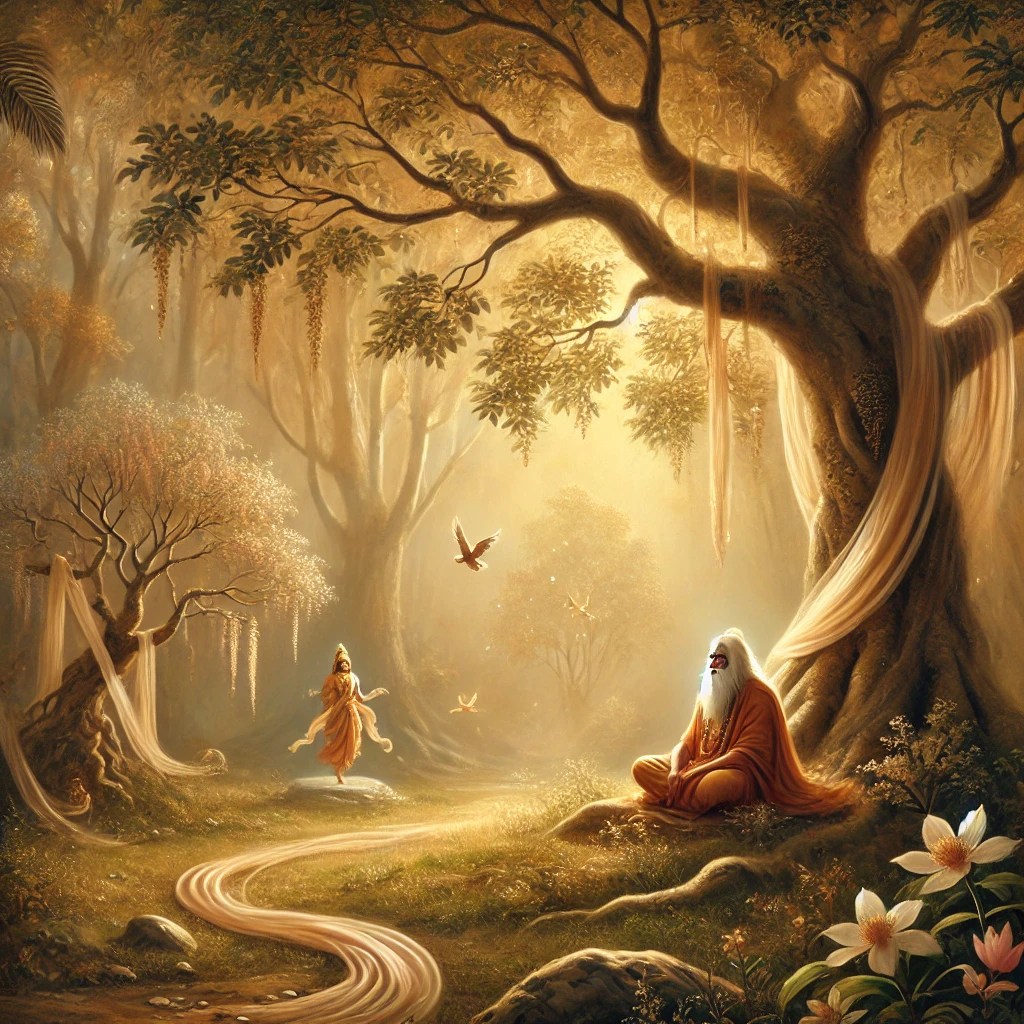
Through this exploration, one figure has emerged as particularly significant in the opening of the Ramayana: the celestial sage Narada.
Narada is one of the most revered sages in Hindu mythology, known for his deep wisdom, musical talent, and his role as a divine messenger. He is often depicted as a traveling sage who moves freely between the earthly realm and the divine, carrying messages from the gods to humans and vice versa. Narada is also renowned for his ability to incite action and prompt change—sometimes through his seemingly mischievous behavior, earning him the title of the “Divine Troublemaker.” However, his actions are always aimed at upholding dharma, or righteousness, even if they appear unconventional.
Narada’s importance extends far beyond the Ramayana. He is a prominent figure in several other Hindu texts, including the Mahabharata, the Bhagavata Purana, and various Upanishads. In these texts, Narada is often seen guiding kings, sages, and even the gods themselves, providing counsel and sometimes challenging them to reflect on their actions. His role as a teacher and guide makes him a central figure in the transmission of spiritual knowledge and the preservation of dharma.
Narada is also credited with the composition of the Narada Bhakti Sutra, a foundational text on the practice of bhakti, or devotion to God. This further underscores his role as a spiritual guide and a beacon of divine love and wisdom.
The Ramayana opens with Narada narrating the story to Valmiki. This is a significant moment, as it frames the Ramayana not just as a historical or mythological account, but as a divine narrative passed down from the gods to humans through a trusted sage. Narada’s role here is that of a divine mediator, ensuring that the wisdom and teachings of the Ramayana are preserved and passed on to future generations.
Narada’s presence in the Ramayana reminds us that spiritual teachings often come through intermediaries who carry the weight of divine authority. His involvement in the story underscores the importance of dharma and the divine order, which are central themes in the Ramayana.
As we explore Narada’s role in the Ramayana, it’s essential to recognize the broader implications of his presence. Narada is not just a character in the story; he is a symbol of divine wisdom, a bridge between the mortal world and the divine, and a guide for those seeking to live a life of righteousness. His actions, teachings, and guidance are a reminder that the path of dharma is always within reach, no matter the challenges we face.
🙏🕊️🙏
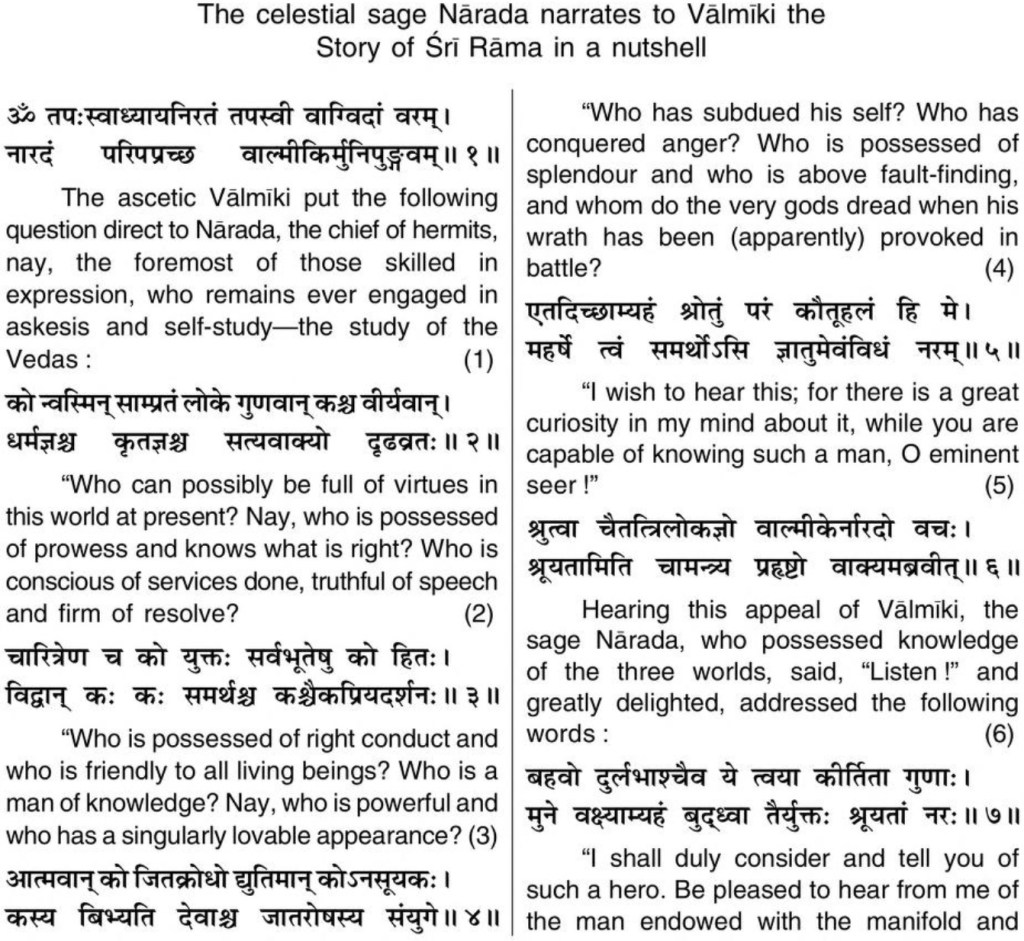
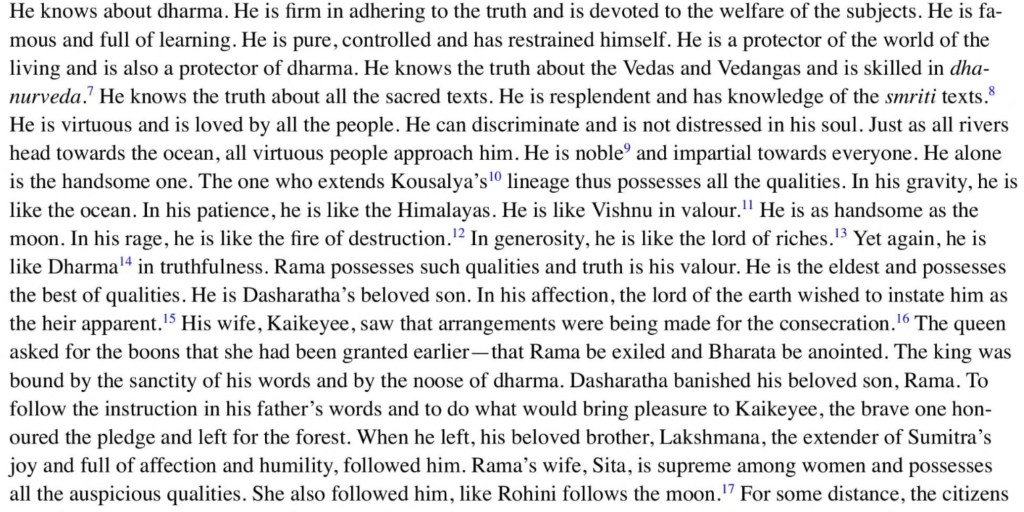
If you’re interested in exploring the Ramayana in greater depth, you can find the Gita Press and Debroy versions below.
Below is an image from the Gita Press version, where Narada’s wisdom begins to unfold:
Screenshot
Below is an image from the Debroy version, where Narada’s wisdom also begins to unfold:
In the ancient temples of India, where the scent of incense mingles with the murmurs of sacred hymns, there exists a timeless connection between the human soul and the divine. Recently, I found myself captivated by a simple yet profound moment: a video of Anandamayi Ma, the embodiment of divine love and wisdom, chanting the sacred names of Rama, Krishna, and Guru. The mantra, gentle yet powerful, seemed to call forth something deep within me—a longing to delve into the rich spiritual tapestry of these names and the stories that have been woven around them for millennia.
This moment of inspiration has led me to embark on a new journey, one that I hope will resonate with you as well. Together, we will explore the Ramayana, one of the greatest epics of ancient India, chapter by chapter. But this will not be a mere retelling of an old story; it will be a journey of reflection and contemplation, aspiring to the introspective and poetic style that resonates deeply within our souls.
The Ramayana is not just a tale of gods, demons, and heroes; it is a profound exploration of the human condition, a guide to living a life of virtue, courage, and devotion. At its heart lies the story of Rama, the embodiment of dharma, who journeys through the trials of life with unwavering righteousness. Alongside him are other divine figures—Sita, the epitome of purity and devotion; Hanuman, the faithful servant; and Krishna, whose playful wisdom and divine love illuminate the path of bhakti, or devotion.
Through this series of reflections, we will immerse ourselves in the Ramayana, allowing its teachings to speak to our own lives and spiritual journeys. Each post will be a meditation on the lessons of the Ramayana, drawing connections to the universal experiences of love, loss, duty, and divine connection.
This project is part of our broader interfaith exploration of spiritual experience and wisdom. We are not promoting any particular belief system, but rather, we are exploring the perennial wisdom found in this ancient teaching and considering how it can be applied to our lives, regardless of our religious background. The phrase “perennial wisdom,” as used by thinkers like Joseph Campbell, captures the timeless truths that transcend specific traditions and speak to the core of our shared humanity.
Inspired by the chant of “Hare Rama, Hare Krishna, Hare Guru,” this series invites us to explore the divine presence within, to reflect on the sacred amidst our daily lives, and to seek the eternal truths that the Ramayana offers. These reflections will aim to be both poetic and accessible, serving as a bridge between the ancient and the modern, the distant and the personal.
This series will unfold at its own pace, allowing us to journey through this epic story together with the time and care it deserves. If you would like to be notified when new posts are added, I invite you to subscribe to the blog. In doing so, you’ll receive updates as we continue this exploration, chapter by chapter, reflection by reflection.
As we embark on this journey, let us remember that the Ramayana is not merely a story from a distant past but a living scripture, a mirror to our own spiritual journeys. Each chapter offers a chance to reflect, to grow, and to connect more deeply with the divine essence that resides within all of us. Let us walk this path together, guided by the wisdom of the ages, and open to the light that transcends all boundaries of faith and culture.
In the vast expanse of India’s spiritual landscape, few figures shine as brightly as Anandamayi Ma. Revered as a saint and mystic, she was a living embodiment of divine grace, known for her profound wisdom and boundless compassion. Her life was a continuous flow of devotion and spiritual ecstasy, and her teachings centered on the realization of the Self and the practice of bhakti, or devotion to God.
It was while watching a video of her chanting “Hare Rama, Hare Krishna, Hare Guru” that I was inspired to delve deeper into the teachings of the Ramayana and to explore the wisdom contained within its verses. This series of reflections is born from that moment of inspiration, and it is with gratitude that I invite you to join me on this journey.
If you would like to witness the moment that sparked this exploration, you can watch the video below. In it, Anandamayi Ma’s serene presence and the heartfelt chant which accompanies the video, serve as a powerful reminder of the divine love that is ever-present, waiting to be discovered within each of us.
May the light of truth, loving-kindness and compassion guide us as we embark on this journey together.
“The more you develop love, devotion, and faith, the more will the Lord manifest in you. He alone knows the way to your deliverance. Surrender yourself completely to Him.”
— Anandamayi Ma
Understanding the Context of the Ramayana in a Broader Spiritual Perspective
As we embark on this journey through the Ramayana, it’s important to recognize the deep spiritual wisdom embedded within this ancient text, and how it resonates across different faith traditions. For those of us coming from monotheistic backgrounds, the concept of deity worship and the use of images in spiritual practice may seem unfamiliar, or even concerning. However, these practices in the Indian tradition carry a profound symbolism that transcends mere ritual.
In Hinduism, the deities such as Rama, Krishna, and others are not worshipped as gods in the way that might be understood in the Western sense, but rather as manifestations of the one infinite, formless reality. The images and stories of these deities serve as focal points for devotion, helping practitioners connect with the divine message they portray in a tangible way. Much like how icons or symbols might be used in other religious traditions to inspire devotion and focus, the deities in the Ramayana are revered as expressions of universal principles like righteousness (dharma), love, compassion and wisdom.
What is the Ramayana?
The Ramayana is an epic narrative that tells the story of Prince Rama, his wife Sita, and his battle against the demon king Ravana. It is a foundational text in Hindu culture, with deep religious, moral, and philosophical significance. Through this epic story, the Ramayana explores themes of duty, devotion, righteousness, and the eternal struggle between good and evil. It is not only a beloved story but also a spiritual guide that has shaped the values, behaviors and beliefs of billions of people for centuries.
The composition of the Ramayana is traditionally attributed to the sage Valmiki, with estimates placing its creation between 500 B.C. and 100 A.D. This epic became a cornerstone of Hindu literature and spiritual thought, profoundly shaping the religious and moral landscape of India.
The Ramayana became a vital text within Hinduism, deeply influencing Indian culture, art, literature, and religious practice. Its stories are told and retold in various forms throughout South and Southeast Asia, making it one of the most enduring spiritual epics in history.
The stories within the Ramayana offer allegories of the spiritual journey, providing guidance on how to live a life in harmony with the divine will. They are not about idol worship in the way that might be condemned in certain religious texts, but rather about understanding, loving and respecting the divine presence in all aspects of life. These teachings invite us to explore the deeper truths of existence, to reflect on the nature of righteousness, and to open our hearts to the universal love that transcends all forms.
The Power of Myth and Storytelling
The Ramayana is a mythic narrative that has evolved over centuries, taking on countless forms as it was passed down from generation to generation. These stories became the underlying fabric of a culture, deeply influencing the spiritual and moral landscape of India and beyond. In many spiritual traditions, including Hinduism, myths are symbolic representations of deeper truths, reflecting the inner journey of the soul and the universal struggle between good and evil. These narratives are living realities, woven into the consciousness of the people, guiding them on their spiritual paths. Through the lens of myth, the Ramayana provides not only moral and ethical guidance but also profound insights into the nature of existence and the divine. By engaging with this epic, we step into a world where the divine interacts with the human, and where every action, choice, and event carries cosmic significance.
The Diversity of Hinduism and the Ramayana
Hinduism itself is not a monolithic tradition but a vast collection of beliefs, practices, and philosophies. Different sects and communities may emphasize different aspects of the Ramayana or even different versions of the text. This diversity is one of the hallmarks of Hinduism, where multiple truths and perspectives can coexist. The Ramayana has inspired countless retellings, each one offering a unique lens through which to view the universal themes of duty, devotion, and the cosmic battle between good and evil.
Exploring the Ramayana Through Valmiki’s Original Version
As we embark on this journey through the Ramayana, we will be drawing inspiration from Valmiki’s original text, translated by Suparna Ghosh. Valmiki’s Ramayana is the traditional and authoritative version of this epic, offering a deep, cultural, and spiritual insight into the story of Rama. By engaging directly with this foundational text, we can explore the Ramayana in its most authentic form, allowing for a richer and more nuanced understanding of its teachings. This approach will enable us to appreciate the timeless wisdom of the Ramayana and reflect on its relevance in both historical and contemporary contexts.
By approaching the Ramayana with an open heart and a willingness to explore these spiritual teachings, we can find common ground between different faith traditions and deepen our understanding of the divine. This study is not about adopting new beliefs, but about engaging with the perennial wisdom that has guided countless diverse seekers throughout history. Together, we will explore these ancient teachings, finding their relevance and application in our lives today.
🙏🕊️🙏
You can find the edition of the Ramayana used in this series, written by Valmiki and translated by Suparna Ghosh, on Amazon here.



 Home Page: Inspirations of Love and Hope