How Mindful Observation of Emotions Brings Inner Peace and Clarity
Dear Diary,
I write to you today, not with answers, but with the tenderness that comes from watching the sky change, hour by hour, and wondering what it all means. Have you noticed, as I have, how emotions can rise like a storm? Sometimes, they begin softly—like a gray mist that hangs just above the earth—and at other times, they roll in like thunderclouds, filling the horizon. It is so tempting, in these moments, to reach out, to try and push them away, or to brace ourselves for the deluge we think must come. But what if, instead, we learned to be still?
I have come to realize that our emotions are not permanent; they are travelers, passing through. And though they demand our attention, we are not them. We are not the sadness or the frustration, nor are we the joy that sometimes feels so fleeting. We are the sky, vast and unshakable, watching with quiet patience as each cloud forms, darkens, and eventually dissipates.
To witness without judgment is a practice, one that asks of us not resistance, but gentleness. It is in this gentleness that we find our true strength—not in control, but in allowing. We can observe the emotions without being drawn into their storm. When anger swells, or grief lingers, we remind ourselves that they are like clouds: they have shape and form, but they will pass. And we remain, unbound, beneath it all.
I share this with you because I, too, am learning. Each day, I remind myself that I am not the shifting weather, but the sky itself. And I hope, in your own moments of storm and stillness, you might find comfort in this, knowing that the vastness within you remains untouched, no matter how strong the winds may blow.
“Having known the Self, which is awareness, there is nothing more to know. That which is, is consciousness itself. To seek it elsewhere is to wander far away.”
— Ramana Maharshi, Forty Verses on Reality
There comes a moment in each of our lives when the questions that have followed us, haunting our thoughts, cease to carry the same weight. It is as though we have been wandering through a vast wilderness, searching endlessly for something, only to realize that it has been with us all along. This, Ramana tells us, is the moment of true knowledge—the moment when we recognize the Self, and in doing so, find that there is nothing more to seek.
This knowledge is not like the knowing of facts or the gathering of worldly wisdom. It is the unveiling of the very essence of awareness, that which sees all, yet remains unseen. To touch this awareness is to come home, to realize that the search has always been for ourselves.
And how often we search elsewhere! How often we cast our gaze into the far distance, imagining that the truth lies in some distant land, or hidden in the words of another. But Ramana reminds us that to seek it elsewhere is to wander further from the source. The truth we seek does not live in far-off places; it lives in the heart of our own being, as close as breath, as present as this very moment.
Like a mirror reflecting all without judgment, true knowledge is the simple, clear awareness of what is. When we come to see that all that exists is consciousness itself, we are no longer captivated by the shadows on the wall. We see, instead, the light—the steady, unwavering light of awareness, which has been with us from the beginning.
To know the Self is to realize that there is nowhere else to go. The seeking ends, and in its place arises a quiet, unshakable peace. It is not the end of curiosity or wonder, but the end of searching outside ourselves for what can only be found within.
To know that there is nothing more to seek is not to say there is nothing more to do. In the realization that the Self has always been present, there is still the practice of abiding, of resting in the gentle awareness that is always here. It is this abiding, this quiet discipline of being, that becomes the ongoing practice.
Yes, the search has ended, but the journey of returning, over and over again, to the pristine mind continues. For in this ordinary mind—this space filled with distractions, thoughts, and the pull of the world—there is the temptation to forget, to stray from the simplicity of awareness. And so, we practice. Not as seekers anymore, but as those who have touched the truth and wish to live in its light.
The practice now is not one of effortful striving, but of allowing—of surrendering into the effortless effort, the gentle doing of non-doing. This is where the paradox lives: to rest in what is, and yet remain disciplined in that rest. It is not that there is nothing more to do, but rather that what is to be done is a continual letting go, a surrendering to the ever-present awareness that requires nothing from us but our willingness to be with it.
And so, we abide. With each breath, with each passing moment, we return—not to search, but to rest. And though the Self needs no searching, the practice of staying with it remains. In this, there is the dance of wu-wei, the graceful action of inaction, the peaceful unfolding of all that is.
Perhaps one day the effort, too, will fall away, and only the abiding will remain.
Coming Up Next: Verse 4
In the next verse, we will reflect on the nature of thought and the root of all actions. How do our thoughts shape our reality, and what lies at the core of true understanding? Join us as we continue this journey through the depths of Ramana Maharshi’s teachings.
When post-viral ME/CFS first appeared in my life over 30 years ago, it was like a sudden, uninvited guest that turned everything upside down. The plans I had carefully laid out—the career, the teaching, the travel—came to a screeching halt. My body, which once felt like a reliable vehicle for my ambitions, became a source of constant limitation.
For many people today, especially in the aftermath of COVID, the experience of long COVID or post-viral ME/CFS can feel like a similar trainwreck. The life you knew, the expectations you had, are suddenly out of reach, and you’re left grappling with a new reality—one that modern medicine often struggles to explain, let alone resolve.
I remember the early days well. The confusion, the depression, the overwhelming frustration that came with the unrelenting fatigue. In the beginning, it was hard to see any way forward. It felt like I was being asked to surrender everything I had worked for, again and again. Every time I hit a new limit, I had to lower the bar, lower it again, and lower it even further. It was a painful process of letting go, not just of my physical abilities, but of my identity and the future I had imagined for myself.
But over time, and through countless moments of surrender, I began to see that while the path I had planned was no longer possible, there was another way forward. It was a quieter path, more inward, but it was no less valuable. Writing became my outlet, my way of contributing to the world, even while living in solitude and spending much of my time in bed.
For those of you reading this who are newly facing the reality of post-viral ME/CFS, I want to acknowledge that this is not an easy journey. It’s okay if you need to take breaks, both from reading and from the mental and emotional load of processing what this diagnosis means. Be gentle with yourself, and if you find the post too long, take it in pieces, come back when you’re ready. The key is to pace yourself, in life and in reading.
Surrendering to a New Reality
One of the hardest lessons I had to learn was surrender—over and over again. Post-viral ME/CFS teaches you that you can’t control everything, no matter how hard you try. Every time I felt like I was getting close to managing the illness, there would be a setback. My energy would crash, and I’d find myself in bed for days or weeks at a time. At first, it felt like defeat. I had to give up so many aspects of life I’d taken for granted.
But over time, I realized that surrendering wasn’t about giving up. It was about accepting what is, rather than constantly struggling against it. The more I fought the reality of my illness, the more frustration I experienced. Letting go didn’t mean that I had to stop hoping or working toward better health, but it did mean that I had to stop resisting what I couldn’t change in that moment.
Surrendering, in this sense, became a way to make peace with the limits of my body, to find moments of ease even when everything else felt out of control. It was an ongoing practice, one that I still revisit, especially on difficult days.
Navigating Others’ Reactions
In addition to learning how to surrender, one of the most difficult challenges I faced early on was dealing with other people’s reactions. In those early days, many people didn’t even believe post-viral ME/CFS existed. I heard things like, “You just need to drink more coffee,” or, “Have you thought about taking naps?” Even when I was officially diagnosed as disabled by the government, my own mother thought I was just lazy and needed to be more active.
This kind of misunderstanding, disrespect, and dismissal is, unfortunately, a common experience for many who suffer from post-viral ME/CFS. Family, friends, and even doctors would question or deny my experience. I’ve heard stories of doctors telling their patients not to even talk about ME/CFS because it “doesn’t exist.” It was often treated as a garbage-pail diagnosis, or dismissed entirely.
While there is more understanding of post-viral ME/CFS today, the stigma still remains. Making peace with this aspect of the illness has been a long journey. What helped me most was cultivating compassion, not just for myself but for others. As Jesus said, “Forgive them, for they know not what they do.” Having compassion for the people in your life who may deny or diminish your experience is a key part of finding peace.
An Evolving Perspective on Post-Viral ME/CFS
In the early days of my journey with post-viral ME/CFS, I found myself going through what felt like the stages of grief as described by Elizabeth Kubler-Ross. At times, I thought I might be dying, and I cycled through stages of anger, grief, depression, and confusion. Acceptance didn’t come quickly, and it took years of processing and reflection before I could reach that place.
One of the major steps toward acceptance came when I read How to Be Sick by Toni Bernhard. This book resonated deeply with me, and for the first time, I felt like someone truly understood what I was going through. Toni’s reflections on illness gave me a new sense of validation and self-respect, and her practical tips helped me develop a healthier way of relating to my experience. I highly recommend this book to anyone struggling with post-viral ME/CFS.
Then, during a meditation class organized by students of Sogyal Rinpoche, based on The Tibetan Book of Living and Dying, I began to find deeper peace. It was around this time that I discovered a Tibetan sutra titled Transforming Suffering and Happiness onto the Path of Enlightenment. This teaching profoundly shifted my perspective once again.
As I read the sutra, I realized that my anger, frustration, and negative emotions were not only draining my energy but also exacerbating my symptoms. It became clear to me that these stressful emotions were making my condition worse, and that when I was able to relax, let go, and find inner peace, I had greater capacity and longer periods of activity without crashing—or without crashing as severely. This was an important revelation: cultivating acceptance, forgiveness, and inner peace didn’t just feel better, it actually minimized my symptoms.
Shifting Perspective: The Sutra That Changed Everything
One passage from the Tibetan sutra resonated deeply with my experience of post-viral ME/CFS:
“Whenever we are harmed by sentient beings or anything else, if we make a habit out of perceiving only the suffering, then when even the smallest problem comes up, it will cause enormous anguish in our mind.”
This teaching hit home because, for a long time, I had been focusing only on the suffering. Everything in my life had become an enemy—my body, my circumstances, even the people around me. The more I centered my awareness on the pain and limitations, the heavier everything felt. Even the smallest setback would feel unbearable.
The sutra showed me that the more we focus on suffering, the more it grows and colors everything we experience. By recognizing this, I began to understand that shifting my focus away from the suffering and toward acceptance could help me find peace. It wasn’t about denying the reality of the illness, but about no longer letting it dominate my entire perspective.
The true transformation came not only by making peace with suffering but by learning to approach both suffering and happiness with the same equanimity. I had to remind myself that when I’m unhappy, this too shall pass, and when I’m happy, this too shall pass. This reminder became a useful way to stay balanced through the ebb and flow of life—the good days and the bad days, the good months and the bad months.
Additionally, I found comfort in William Blake’s words: “He who kisses the joy as it flies lives in eternity’s sunrise.” It reminded me to appreciate the little moments of happiness, to savor them without attachment, knowing that they, too, are fleeting. This perspective helped me not to be disturbed by the constant changes and to find a sense of peace amidst it all.
Discovering a New Path: Writing as Healing
As I continued to navigate the ups and downs of post-viral ME/CFS, I eventually found a new passion that helped me stay connected to the world and give expression to my inner journey: writing. Although much of my life is spent in solitude, and my physical abilities are limited, writing has become my outlet, a way to contribute and share what I’ve learned.
Through writing, I’ve been able to explore the lessons of impermanence, forgiveness, and acceptance, not just for my own growth but as a way to offer encouragement to others walking a similar path. Chronic fatigue may limit what I can do in the physical world, but it has opened up this creative space where I can still connect, reflect, and contribute.
In this way, writing became not just a coping mechanism but a practice of karma yoga, an offering. It’s a way to kiss the joy as it flies, even amidst the challenges of chronic illness, and to embrace each moment—whether in suffering or happiness—as an opportunity for growth.
🙏🕊️🙏
“He who binds to himself a joy Does the winged life destroy; But he who kisses the joy as it flies Lives in eternity’s sunrise.”
There’s a moment in the Ramayana that really strikes a chord, especially when you think about how we handle the unexpected twists and turns in our own lives. Rama, who’s about to be crowned king, gets hit with the news that he’s being sent into exile for fourteen years instead. Imagine that—a complete 180 from everything he’s been preparing for. And yet, what does Rama do? He smiles and accepts his fate without a hint of resistance.
This isn’t just some heroic act from an epic tale; it’s a powerful reminder of how we can find peace in letting go.
Rama’s reaction is a beautiful example of non-attachment. He doesn’t cling to the throne, the power, or the comforts of palace life. Instead, he just lets it all go. It’s like he’s saying, “Okay, this is what life has handed me, and I’m going to embrace it.” There’s something incredibly liberating about that kind of mindset. When we’re not attached to a specific outcome, we open ourselves up to whatever life brings, with a lot less stress and anxiety.
This kind of non-attachment is at the heart of equanimity—a calm and balanced mind that stays steady no matter what happens. And let’s be honest, who wouldn’t want more of that in their life?
What really stands out in this scene is Rama’s mindfulness. He’s fully present, fully aware of what’s happening, and yet he doesn’t get lost in it. He’s not caught up in the drama or the unfairness of it all. Instead, he meets the moment with a clear mind and an open heart. This is mindfulness in action—not just being aware, but being aware with a sense of peace and acceptance.
Think about how we usually react when life throws us a curveball. We resist, we fight, we stress out. But what if, like Rama, we could meet these moments with mindfulness and a sense of calm? How much easier would life be?
Rama’s response isn’t just about keeping cool under pressure—it’s about living in alignment with what’s right, with Dharma. By accepting his exile, Rama is doing more than just obeying his father’s wishes; he’s showing us what it means to live a life rooted in principles. It’s a reminder that sometimes, doing the right thing means letting go of what we want and embracing what’s being asked of us, even if it’s difficult.
This is a lesson we can all take to heart. In our own lives, we’re constantly faced with choices—do we hold on tightly to what we think we want, or do we let go and trust that things will unfold as they should?
Rama’s story might be thousands of years old, but the lesson is timeless. When we cultivate non-attachment, mindfulness, and a commitment to doing what’s right, we can face life’s challenges with a lot more grace. We can let go of the need to control everything and find peace in the flow of life.
So next time life doesn’t go according to plan, think of Rama. Smile, take a deep breath, and let go. You might just find that the peace you’re looking for was there all along, waiting for you to embrace it.
“Deathless are they who know the Self. Those who know intense fear of death seek refuge only at the feet of the Lord who has neither death nor birth. Dead to themselves and their possessions, can the thought of death occur to them again? Deathless are they.”
— Ramana Maharshi, Forty Verses on Reality
In the silent expanse of existence, a profound truth emerges: those who truly know themselves are untouched by the shadow of death. Their awareness transcends the fleeting nature of the physical, awakening them to a reality where the Self shines eternally, free from the confines of birth and demise.
Fear, that primal instinct which grips the emotional self, leads many to seek solace at the feet of the Divine. Here, in surrender, they find refuge in the Lord—the embodiment of timelessness, the one who remains unscathed by the cycle of life and death. In the presence of such love, the urgency of worldly attachments falls away, revealing the deeper essence of being. I look forward to resting in the presence of such love, revealed within our mind—our true heart—where all attachments dissolve into the stillness of pure awareness. To realize this ever-present pure love is to know the deeper essence of what we are, the part of us that remains untouched by the fears and desires of the world.
As one becomes “dead” to the clamor of possessions and the incessant desires that bind the soul, the thought of death loses its power. No longer a specter to be feared, it becomes a mere whisper, an echo of a past long forgotten. In this state of liberation, the deathless heart pulsates with the rhythm of life, embracing the eternal now.
To know the Self is to awaken to the infinite, to dance beyond the duality of existence, where life and death are but two sides of the same coin. In this awakening, we find the courage to let go—to release the chains of identification with the transient and embrace the essence of who we truly are. Here lies the secret of the deathless ones, an invitation to live fully, unencumbered by the fears that often confine us.
And yet, when we speak of the deathless state, we do not turn our gaze away from the undeniable truth of death. The body, like all things that come into being, will one day return to the earth. Those we love will pass, as will we. But the wisdom of this teaching beckons us to look beyond the visible horizon, beyond the fragile shell of the physical.
Death, as we know it, is but a passage in the realm of form. What truly passes? Not the Self. Not the essence of who we are. This teaching whispers to us that the grasping after what is fleeting—the desires, the aversions, the worldly attachments—these are the threads that weave the illusion of permanence where there is none.
In the letting go, in the softening of our hands from the things we thought we needed to hold so tightly, there is a kind of renunciation. But not a renunciation of life itself, rather, a release from the belief that life’s changing faces can define us. We release, not into emptiness, but into fullness—the fullness of the pristine mind, the quiet, undisturbed expanse of the deathless.
To recognize this is to taste the sweetness of a deeper truth: the Self is untouched by the passing of days, by the birth and death of forms. This is where we find our liberation—not by denying the body’s end, but by resting in the awareness that transcends it.
And so, in this gentle abiding, we come to understand: death may touch what is temporal, but it cannot lay a finger on what is eternal. Here, in the heart of this realization, there is peace—a peace that no worldly circumstance can steal away, for it is woven into the very fabric of our being.
Coming Up Next: Verse 3
In our next exploration, we will turn our attention to the third verse, where we will reflect on the nature of true knowledge and how it reveals the interconnectedness of all beings, inviting us into a deeper understanding of existence.
“Reality exists as the Heart, your very Being. If Reality did not exist, could there be any knowledge of existence? Free from all thoughts, Reality abides in the Heart, the Source of all thoughts. It is, therefore, called the Heart. How then is one to contemplate it? To be as it is in the Heart, is Its contemplation.”
— Ramana Maharshi, Forty Verses on Reality
The Heart of Reality
In the stillness of our being, where thoughts dissolve like mist under the sun, we come upon the essence of reality—the Heart, our very existence. This Heart is not a distant concept, a mere abstraction; it pulses with the life that courses through us, inviting us to recognize that our true nature is intricately woven into the fabric of all that is.
What if reality, in its purest form, did not exist? Could we then grasp the very notion of existence, the flicker of awareness that dances in our minds? Each thought, each fleeting moment of recognition, springs forth from this source, the Heart, which abides in silence beyond the noise of our incessant chatter.
To contemplate this truth is not to embark on a journey of the mind but rather to return home, to dwell as we are in the Heart itself. Here, in this sacred space, contemplation transforms into a state of being, a surrender to the profound simplicity of what is. We find ourselves not as separate seekers but as the very essence of the inquiry—a realization that calls us to rest in the Heart, to know ourselves as we truly are.
For many years, I carried a fog of confusion around the word “heart,” a tangle of meanings that seemed to obscure more than they revealed. I remember being in circles where people would say, “Come from your heart,” and I would listen, trying to grasp the depth of what they meant. Often, it seemed to point toward emotion, to some form of deeper truth that was still bound in the personal—an authentic expression of ego, perhaps a sincerity in feeling, but still caught in the dualities of love and pain, fear and longing.
But what did it mean, really, to come from the heart?
In the midst of this confusion, Ramana’s words come like a gentle clearing of the fog. The heart, as he speaks of it, is not the emotional center we so often equate with the word. It is not the place of fluctuating feelings, nor is it simply a retreat from the mind’s logical discourse. What Ramana points to is something far deeper: the heart as the essence, the source of pure awareness itself.
This reminds me of the self as Carl Jung describes it—not just the conscious mind, but the unconscious, and not just those personal aspects, but everything, the entire universe and reality. Jung’s idea of the Self expands far beyond the individual, reaching into the totality of existence itself, much like Ramana’s use of the word heart. In this sense, Reality, the Self, and the Heart all point to the same fundamental truth—the essence that underlies both duality and non-duality, the very nature of what is.
In both Jung and Ramana’s teachings, we see that the self, or reality, is not something to be sought outside of ourselves or separated from the world. As Jesus says, we are to be in the world but not of the world. This aligns perfectly with the non-dual teaching: there is no need to escape the dualities of life to realize non-duality. Instead, we are invited to recognize that the essence of duality itself is non-dual.
To come from the heart, then, is not merely to speak from personal truth or emotion, but to rest in the deeper awareness that embraces all experience without attachment. It is to be anchored in the non-dual essence of Reality, knowing that even in the world of forms and opposites, the underlying truth remains whole, undivided.
And yet, how often we use the word “heart” to point to something else—something closer to our personal feelings or opinions, mistaking emotional honesty for the deeper truth of our being. But here, in this teaching, the heart is revealed as the true source of non-dual clarity, the place from which true forgiveness, compassion, and love naturally arise—not as personal qualities, but as emanations of our most pure self.
As I reflect on this teaching in, it becomes clear that the heart Ramana speaks of is not a center of personal feelings or emotion, but the eternal essence that transcends the body and mind. This heart, or true Self, is the witness that remains even when personal identity fades. In some ways, this description feels similar to the concept of the Holy Spirit or God, which abides within and beyond us.
When we speak of the heart as Ramana does, we are pointing to the essence of pure awareness, the unchanging “I” that exists beyond the temporary forms of the body and ego. This teaching invites us to recognize the heart as the source of non-dual awareness, a presence that continues even when the personal self dissolves.
Coming Up Next: Verse 2
In the next reflection, we will explore how those who know the Self are deathless, transcending the fear of mortality. We’ll delve into the liberation found in surrendering to the Divine, awakening to the eternal nature of existence beyond the physical realm.
As we navigate the challenges of Chronic Fatigue Syndrome (CFS), we often seek methods to enhance our well-being and support our bodies in finding balance. Recently, I’ve begun experimenting with sound therapy, specifically focusing on the frequency of 261.63 Hz, associated with the note C4 (middle C). My intention is not to find a cure—rather, I’m exploring ways to promote relaxation and stimulate the parasympathetic nervous system, which can often feel elusive for those of us living with CFS.
I’m eager to hear from others in our community who have tried sound therapy or similar practices. What has your experience been like? Have you found any particular sounds or techniques helpful?
The Benefits of Sound Therapy
Sound therapy has been studied for its potential benefits in promoting relaxation, reducing stress, and enhancing overall well-being. Research indicates that sound can influence the autonomic nervous system, helping to activate the parasympathetic response, which is crucial for healing and recovery.
• Relaxation Response: Exposure to soothing sounds, like those produced in sound therapy, can lower heart rate, reduce blood pressure, and promote a state of calm. • Stress Reduction: Studies have shown that listening to calming frequencies can significantly reduce levels of cortisol, the stress hormone, thus alleviating anxiety and promoting a sense of peace. • Improved Sleep: Sound therapy can enhance sleep quality by creating a tranquil environment, allowing the body to enter restorative sleep states more easily.
Incorporating Sound Therapy into Daily Life
Here are some ways to integrate sound therapy into your daily routine:
Listening Sessions: Consider setting aside time each day to listen to your chosen frequency. You can use headphones or speakers to create an immersive experience.
Meditation and Mindfulness: Incorporate sound into your meditation practice by focusing on the sound while breathing deeply. Allow the vibrations to fill your awareness.
Personal Soundtrack: Use apps that allow you to customize your experience. I personally enjoy using an app that provides a variety of frequencies and waveforms, including the sine wave, which I find particularly soothing.
Background Ambience: Let the sound play gently in the background while you work, relax, or engage in other activities to create a calming atmosphere throughout the day.
Choosing 261.63 Hz and the Sine Wave
I specifically chose the frequency of 261.63 Hz for its calming and harmonizing properties, often associated with the note C4 (middle C). This frequency resonates well with the heart chakra, promoting feelings of love, compassion, and emotional balance, which can be particularly beneficial for those of us dealing with the emotional toll of CFS. Additionally, I favor the sine wave waveform for its pure, smooth tone that creates a gentle and soothing auditory experience. The sine wave’s simplicity and lack of harsh overtones allow for deep relaxation, making it an excellent choice for meditation and sound therapy. By immersing myself in this frequency and waveform, I hope to support my journey toward greater relaxation, emotional healing, and overall well-being.
Conclusion
As we share our experiences and insights, I hope to foster a conversation around sound therapy as a supportive tool for managing CFS. Your feedback and stories are invaluable as we explore these practices together.
If you’re interested in trying sound therapy, I encourage you to check out the app I’m using but I found on the Google play store called, “Frequency Sound Generator” which offers a customizable frequencies and waveforms tailored to your needs and desires..
Let’s continue this journey together, supporting one another as we seek out new ways to enhance our well-being.
There’s a light within each of us—an undeniable, ever-present spark. This light, though sometimes hidden, is never truly absent. It may flicker when the winds of confusion blow or dim when the shadows of doubt creep in, but it is always there, quietly waiting to be noticed, nurtured, and allowed to grow.
For many, the journey toward that inner light is complicated by the noise of the world—by dogma, expectations, and the need to “belong” to a certain path. But the truth is, this light doesn’t belong to any one religion or tradition. It is the essence of all paths, the core of what it means to be human. And it is awake within you, even now, quietly glowing, waiting for your attention.
Beyond Dogma, Into the Heart of Spirituality
Perhaps you’ve felt it—this pull toward something deeper, something spiritual, but without the constraints of organized religion. Many feel this way, walking a fine line between the spiritual yearning within them and the weight of doctrines and beliefs that feel restrictive. The good news is that the essence of spirituality is not found in rigid dogma but in the spaciousness of the heart.
The great mystics of every tradition—whether Jewish, Christian, Buddhist, or others—have pointed to the same truth: the divine is already within us. Jewish mystical teachings speak of the divine spark within every soul, a reflection of God that can never be extinguished, no matter how much the world may try to cover it.
As we walk our own unique paths, there is no need to choose between spirituality and religious identity. You don’t have to subscribe to a particular belief system to nurture the light within you. All you need is a willingness to be present with yourself, to sit quietly with that spark, and give it space to breathe.
Fanning the Flame
When you feel that spark flicker, pay attention. You may not need to do anything grand. Simply acknowledge it, as you would the first sign of dawn, and let it unfold naturally. Like sunshine and water for a plant, the light within needs only a little attention, a little care, and it will grow.
This is not about seeking or striving. It’s about letting go of the distractions that pull you in different directions and coming back to that simple truth: you already have everything you need. The divine presence you seek is already alive within you, waiting for you to notice it.
Whether through moments of quiet reflection, connection with others, or simply being with the world around you, this light will grow. It doesn’t require the labels of religion or the boundaries of belief. It only asks for your awareness, for the quiet recognition that it is there—and that it has been all along.
A Shared Journey
Remember, you are not alone in this journey. Throughout history, countless others have walked the path of spiritual discovery, often feeling the same pull toward something deeper. The great mystics, the sages, the poets, and even those who quietly reflect on their own lives, have all touched this truth: that our essence is divine, that we are all connected, and that the light within us is the very light of the universe.
You have already felt this light. You have already seen it, even if just for a moment. Trust in that, and allow yourself to be curious, to explore it further without fear or hesitation. There is no rush. There is only the gentle unfolding of what has always been true: you are that light, and it is enough.
In today’s world, we often exchange greetings without much thought. Words like “How are you?” or, in Hebrew, “Ma Shalom Cha?”—which many now interpret as “How are you?”—slip past us with little depth or reflection. But Ma Shalom Cha is much more than just a casual greeting. In its original meaning, it asks, “How is your peace?”—“How is your inner peace? How is your connection with the divine?”
When I met Avi, a young man on his own spiritual journey, I looked into his eyes and asked him, “Ma Shalom Cha?” At first, it seemed to him like the casual phrase he’d heard a thousand times. But when I explained the true meaning, he paused. For perhaps the first time, he understood that I wasn’t just asking how he was doing, but how his peace was. How was his soul resting in the presence of the divine?
It was a moment of awakening, a recognition of something deeper. In that moment, Avi saw the light within himself, the divine spark that flickers beneath the surface, often hidden by the noise and distractions of modern life.
Beyond Dogma, Into the Heart of Spirituality
In a world where even deep questions like “Ma Shalom Cha?” have been reduced to casual greetings, it’s easy to feel pulled in different directions, confused by dogma or by what others expect us to believe. But the truth is, the essence of spirituality is not found in rigid rules or religious identities. It is found in the quiet, gentle presence of peace within each of us.
The great mystics of every tradition—from Jewish mysticism to the teachings of the East—all point to the same truth: the divine is already within us. The spark of God, the neshama, is already alive in each soul, and it doesn’t need labels or doctrines to be real. It only asks for our attention, for us to pause and reflect: How is my peace?
Fanning the Flame
The modern world often reduces “Ma Shalom Cha” to a simple “How are you?” and “Ma Nishma?” to “What’s up?”—losing the sacred depth these phrases once carried. But the light within you is not lost, and the questions themselves still hold power if we let them.
When we take the time to sit with these questions—How is my peace? How is my soul?—we give the divine spark within us space to breathe. It’s not about striving for enlightenment or seeking external answers. It’s about recognizing that the peace you seek is already there, waiting to be acknowledged. Like sunshine and water for a plant, this inner peace grows with care and awareness.
A Shared Journey
So I ask you, as I asked Avi: Ma Shalom Cha? How is your peace? Not as a casual greeting, but as an invitation to look inward, to nurture the light within you. And as we close, I’ll ask you a deeper question: Ma Nishma? How is your soul?
In a world that often reduces these profound questions to surface-level exchanges, let’s reclaim their depth. Let’s reconnect with the divine spark within us, the light that ties us all together. It’s there, waiting to be seen, to be nurtured, and to grow. The peace you seek, the light you long for—it’s already within you.
Adonai Echad—the Lord is One. It beautifully echoes the truth of oneness that transcends all divisions. In the heart of all traditions, we find this profound recognition that there is only one source, one truth, one Divine presence, no matter how we name or perceive it.
The unity of Adonai Echad reminds us that, despite the apparent differences in our paths, we are all connected, all part of that oneness. It’s a call to embrace the shared divinity in ourselves and others, to see beyond the surface and recognize the sacred unity that binds us all.
All you need is a willingness to be present with yourself, to sit quietly with that spark, and give it space to breathe.
Introduction: The Forty Rules of Love by Elif Shafak is a remarkable novel that intertwines two parallel stories: the modern-day journey of Ella Rubenstein, who is undergoing a personal transformation through her engagement with a novel about Rumi and his spiritual teacher, Shams Tabrizi, and the historical relationship between Rumi and Shams in 13th-century Anatolia. Through these interconnected narratives, the novel explores themes of divine love, spirituality, and personal awakening.
Background: At the heart of this novel is the transformative relationship between Shams Tabrizi and Jalal ad-Din Rumi. Shams, a wandering mystic known for his unconventional methods and profound wisdom, radically altered the course of Rumi’s life. Their bond became the source of Rumi’s spiritual awakening, leading him to write some of the most celebrated poetry in history.
Shams’ teachings were rooted in Sufi traditions, emphasizing the dissolution of the ego, the centrality of love in spiritual practice, and the path toward divine union. His Diwan-i Shams-i Tabrīzī, a collection of poems attributed to him, captures his deep understanding of divine love. Shams’ presence in Rumi’s life was both disruptive and enlightening, awakening the poet to a higher consciousness, which Rumi expressed through his prolific works, including the Masnavi.
The Forty Rules of Love: Elif Shafak’s novel is structured around the forty rules of love, which are teachings attributed to Shams. These rules serve as guideposts for navigating the human experience of love, both worldly and divine, and reflect key principles of Sufi mysticism. Shafak weaves these rules throughout the story, offering readers spiritual insights while engaging them in the personal struggles of her characters.
Themes Explored:
At the heart of The Forty Rules of Love lies a profound exploration of divine love, the kind of love that transcends the ordinary boundaries of human emotion. Through the lives of Rumi, Shams, and Ella, the novel delves deeply into the nature of love as both a mystical force and a transformative power. Shams’ teachings guide Rumi from a scholar and theologian into a poet of divine union, revealing love as a path that dissolves the ego and leads to spiritual awakening. This kind of love is not just a feeling but an illumination that binds the soul to the divine, guiding the seeker toward self-realization.
Rumi’s own awakening, catalyzed by his connection with Shams, reflects this dissolution of the ego. In Shams’ eyes, the ego is the greatest barrier to true enlightenment. The novel, much like Rumi’s poetry, calls us to surrender the smaller self, to let go of the illusions we hold about our identity, and to step into a deeper experience of being—one in which we recognize that separation from the divine is the root of all suffering.
Ella’s journey parallels Rumi’s in a modern context, as she begins to shed the constraints of her ordinary life, driven by a newfound understanding of love and spiritual depth. Her connection with the novel within the novel becomes a mirror to the relationship between Rumi and Shams, and she, too, is drawn into a process of inner transformation. The book masterfully illustrates how these timeless spiritual principles can apply to anyone, in any age, as they awaken to the deeper truths that exist beyond the confines of everyday existence.
Ultimately, the novel’s greatest teaching may be that love, in its purest form, is the force that bridges all dualities—the sacred and the mundane, the earthly and the divine. Through the eyes of Shams and Rumi, readers are invited to experience love as the highest form of spiritual practice, one that calls us to be both fully human and fully connected to the infinite.
Recommendation: For readers interested in spirituality, love, and personal growth, The Forty Rules of Love offers a rich, contemplative experience. Shafak’s storytelling, combined with the teachings of Shams Tabrizi, provides both entertainment and deep spiritual insight. Whether you’re a seasoned reader of Rumi’s works or new to Sufi mysticism, this novel is sure to leave a lasting impact.
The Forty Rules of Love remains on my list for deeper exploration. I plan to engage with each of the rules more fully in the future, and this review serves as a placeholder for that deeper dive.
The hero’s journey is a timeless narrative structure that resonates across cultures and spiritual traditions. Described in depth by Joseph Campbell, this journey represents the universal path of transformation that each individual must undertake. As we explore the Ramayana and the life of Milarepa, we find that both stories are deeply rooted in this archetypal journey, offering profound insights into the challenges and triumphs of the human spirit.
The Call to Adventure:
In the Ramayana, Rama is called to leave the comfort of his home in Ayodhya and embark on a journey that will test his strength, resolve, and righteousness. His exile marks the beginning of an epic struggle against the forces of chaos and evil. Similarly, Milarepa’s life begins with a call to adventure, though it is initially fueled by revenge and darkness. Both heroes are drawn out of their ordinary worlds and into a realm where their true character will be forged.
Trials and Challenges:
As they embark on their respective journeys, both Rama and Milarepa face significant trials and challenges. Rama must confront powerful demons, navigate the complexities of dharma, and protect his loved ones. Milarepa, on the other hand, struggles with the weight of his past misdeeds and the rigorous training imposed by his teacher, Marpa. These trials are essential to their growth, pushing them to confront their deepest fears and weaknesses.
Confrontation with Evil:
The hero’s journey often culminates in a confrontation with a great evil. In the Ramayana, this is embodied by Ravana, the powerful demon king who represents the forces of adharma (unrighteousness). For Milarepa, the confrontation is more internal—facing the darkness within himself and the karmic consequences of his earlier actions. Both heroes must overcome these forces to fulfill their destinies and bring about a restoration of order and righteousness.
Return and Transformation:
After their trials, both Rama and Milarepa undergo profound transformations. Rama returns to Ayodhya not just as a warrior, but as a symbol of dharma, ready to restore justice and harmony to his kingdom. Milarepa, having purified his karma and attained enlightenment, becomes a revered spiritual teacher, guiding others on the path to liberation. Their journeys highlight the transformative power of righteousness, compassion, and spiritual discipline.
The Hero’s Journey in Our Lives:
The hero’s journey is not just a mythic structure—it’s a reflection of the challenges and opportunities we all face in life. We are each called to our own adventure, to confront our inner and outer demons, and to emerge transformed. The Ramayana and Milarepa’s story remind us that this journey is universal, a path we all walk as we seek to align our lives with dharma.
The hero’s journey, as seen in the Ramayana and Milarepa’s life, is a powerful reminder of the transformative potential within each of us. By embracing the challenges we face and aligning our actions with dharma, we can emerge stronger, wiser, and more compassionate. May these stories inspire you on your own journey, guiding you toward the realization of your true self and the fulfillment of your highest potential.
🙏🕊️🙏
To delve deeper into Milarepa’s journey, you can watch Part One of the movie about his life here. This film offers an authentic portrayal of Milarepa’s early years, his misuse of mystical power, and his ultimate journey toward spiritual awakening and Dharma. It’s a powerful visual companion to the reflections shared in this post.
For those interested in exploring the hero’s journey more deeply, you can find Joseph Campbell’s The Hero’s Journey on Kindle below. This seminal work offers profound insights into the archetypal patterns that shape our stories and our lives, providing a framework to understand the transformative journeys of both Rama and Milarepa.
As we step further into the Ramayana, Chapter 2 presents us with a clear, timeless dichotomy—a choice point that reflects the world we live in today. On one side, we have a king driven by desire and ambition, his motivations clouded by attachment and greed. On the other, we have a sage, steadfast in his righteousness, his actions rooted in dharma and pure intention.
These two characters symbolize the fundamental choice we all face in life: to act with righteous motivation or to be driven by unrighteous desires. The king, despite his power and the boons he receives, finds himself frustrated. His motivations, being self-serving, lead him down a path that is ultimately unsatisfying and fraught with obstacles. The sage, however, remains aligned with dharma, embodying the strength and peace that come from acting with integrity and compassion.
This chapter doesn’t resolve the conflict between good and evil—it merely sets the stage, much like the world we find ourselves in. We live in an unfinished story, where the battle between righteousness and unrighteousness is ongoing. In our daily lives, we see the results of both paths, often interwoven in complex ways. The choice between these two paths is not just a one-time decision, but a series of choices we make continually, shaping the direction of our lives.
The Ramayana offers us a realistic portrayal of this struggle, one that is echoed in the world around us. It acknowledges that while righteous motivation does not guarantee a life free from hardship or betrayal, it does align us with a greater sense of purpose and peace. Unrighteous motivation, on the other hand, may lead to temporary gains but ultimately brings frustration and imbalance.
In reading this chapter, we are invited to reflect on our own motivations. Are our actions driven by a desire for power, control, or self-interest? Or are they rooted in a genuine intention to do good, to act in alignment with dharma? This is the choice point that the Ramayana places before us—a choice that is as relevant today as it was in ancient times.
As we continue through the Ramayana, let us keep this choice in mind. The sage and the king stand as symbols of the paths available to us all. Which path we choose, and the motivations that drive our actions, will shape our journey, both in this story and in the lives we lead.
🙏🕊️🙏
You can explore this epic story in the edition of the Ramayana used in this series, written by Valmiki and translated by Suparna Ghosh, on Amazon here
Alternatively, you can choose from several other versions and translations that are available. It is even available as an abridged audiobook on Audible, narrated by Ram Dass here
Discovering the Self: Ramana Maharshi’s Guide to Self-Inquiry and True Realization
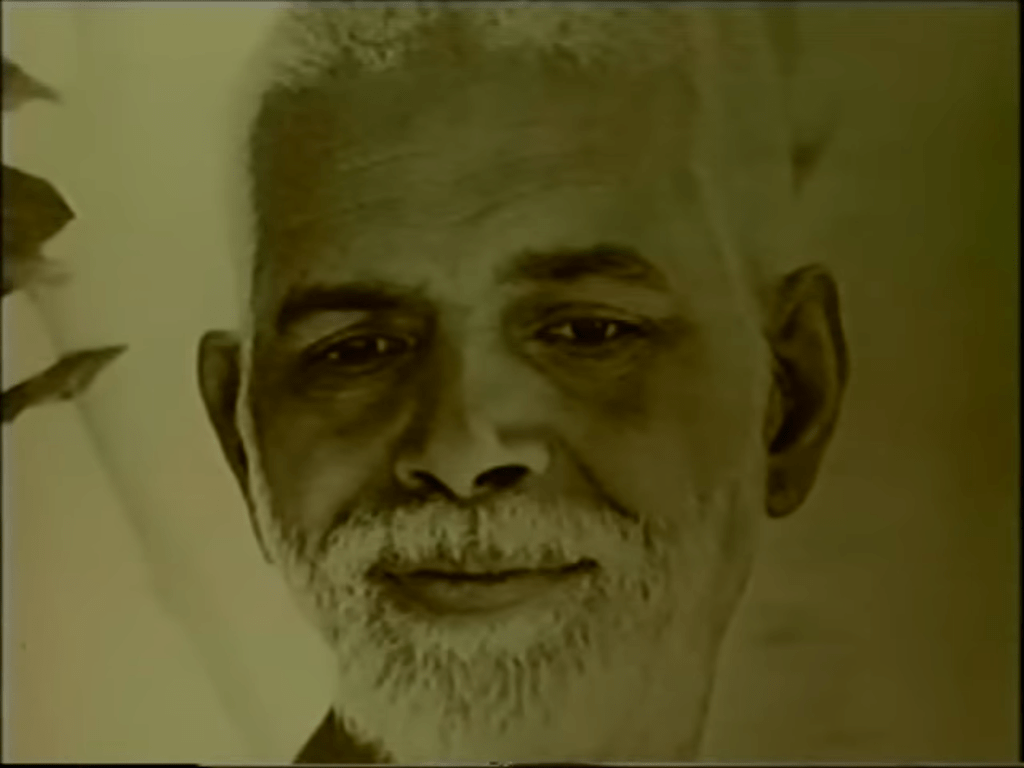
Ramana Maharshi is one of the most revered spiritual teachers of the 20th century, known for his profound teachings on self-realization and non-duality. Born in 1879 in Tamil Nadu, India, he experienced a spontaneous awakening at the age of 16, during which he became acutely aware of the impermanence of the body and the eternal nature of the Self. Following this experience, he left his home and spent the rest of his life on the sacred mountain of Arunachala, where he became a guiding light for spiritual seekers from around the world.
Ramana’s teachings are centered around the practice of Atma Vichara, or self-inquiry, which he considered the most direct path to realizing one’s true nature. Unlike other spiritual practices that involve rituals or external observances, Ramana emphasized turning inward to investigate the true nature of the ‘I’—the sense of individual self that we all experience.
The Essence of Self-Inquiry
Ramana Maharshi’s core teaching can be encapsulated in the question, “Who am I?” He taught that the sense of ‘I’ or ego, which we often associate with our thoughts, emotions, and bodily identity, is merely a superficial layer that veils our true Self, which is pure consciousness or awareness.
The process of self-inquiry involves directing your attention inward, asking yourself where this sense of ‘I’ originates. Ramana explained that by persistently asking this question and observing the ‘I’ thought, one can trace it back to its source. This source is the true Self, the unchanging awareness that underlies all experience.
If One Watches Whence the ‘I’ Arises
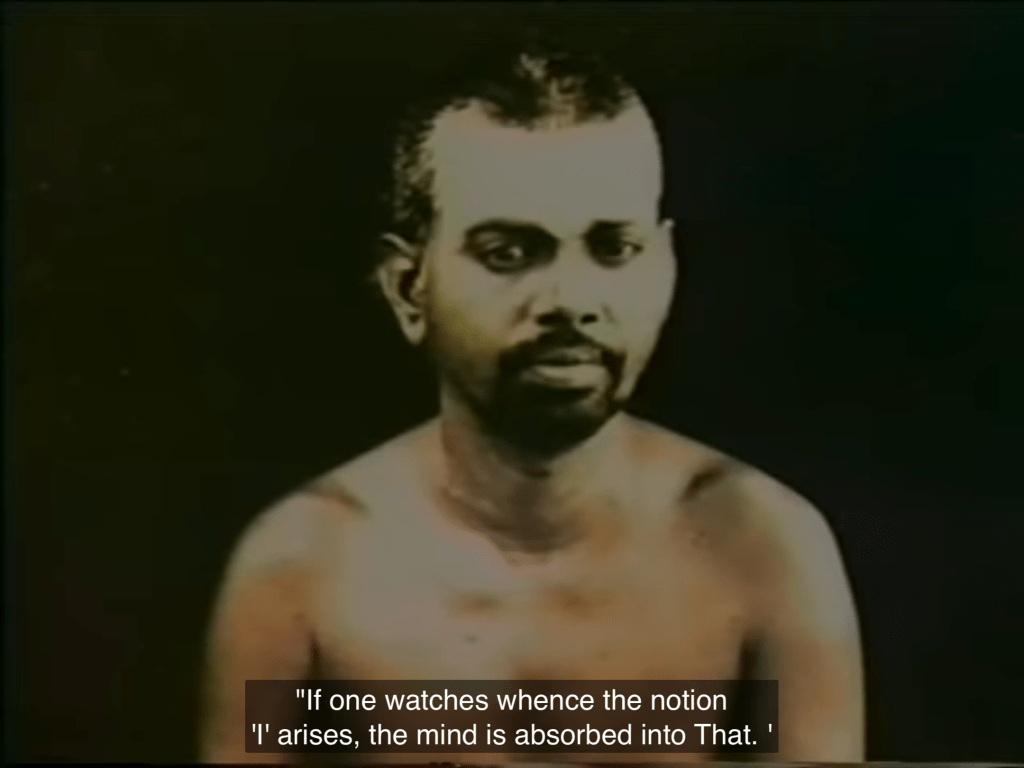
In one of his teachings, Ramana Maharshi stated, “If one watches whence the notion ‘I’ arises, the mind is absorbed into That.” This teaching points to a subtle yet profound practice. The ‘I’ thought is the root of all mental activity and the sense of individuality. By turning attention to this root, rather than being entangled in the branches of thoughts and feelings, the mind can naturally dissolve into its source—pure awareness, which Ramana refers to as “That.”
How to Practice Self-Inquiry
If you find yourself puzzled by this teaching or struggle to sense “That” from which the ‘I’ arises, know that this is a common experience on the path of self-inquiry. The mind, accustomed to focusing outward, finds it challenging to turn inward and settle into stillness.
Here’s how you can approach this practice:
Sit Quietly: Begin by sitting quietly, with your eyes closed if that feels comfortable. Take a few deep breaths and allow your body and mind to relax.
Turn Inward: Gently bring your attention to the sense of ‘I’. This ‘I’ could be a thought, a feeling, or simply the awareness that you exist.
Ask the Question: Silently ask yourself, “Who am I?” or “Where does this ‘I’ arise from?” Don’t seek an intellectual answer. Instead, let the question be a pointer that guides your awareness inward.
Observe: As you focus on the ‘I’, observe its nature. Does it have a shape, a location? Can you find its origin? Be curious, but not analytical.
Rest in the Awareness: As you continue this enquiry, allow the mind to settle. If thoughts arise, simply notice them and gently bring your attention back to the feeling of ‘I’. Over time, the mind may begin to merge with the deeper awareness that is always present.
Realizing the Self
Through persistent practice, you may come to realize that the ‘I’ you have always identified with is not your true Self. The ‘I’ arises and dissolves in the vast expanse of pure awareness—‘That’ which Ramana Maharshi points to. This realization is not something to grasp intellectually, but a direct experience that brings about a profound inner peace and freedom.
Ramana Maharshi’s teachings are a beacon for those seeking to transcend the ego and discover their true nature. The path of self-inquiry, though simple in its approach, can lead to the ultimate realization of the Self—the awareness that is ever-present, unchanging, and beyond all notions of individuality.