We often think truth must be hard-edged — something we must deliver, even when it wounds. But truth is not a weapon. It’s a light. And kindness is the soft cloth that filters it gently.
This aphorism invites us to speak honestly, without hiding or twisting, but to do so in a way that honors the heart of the other. Kindness doesn’t dilute truth — it gives it roots.
In a world full of quick takes and sharp opinions, may we practice truth with gentleness. May our speech carry both clarity and care.
They say quantum computing will change everything. That by tapping into superposition and entanglement, we’ll compute across multiverses—solving problems with impossible speed, even generating physical objects through manipulation of nanoparticles.
A replicator. A cup of Earl Grey, hot.
But what if some of us are already doing this—not with machines, but with our hearts? What if consciousness itself is the original quantum field, and the mind anchored in love is already reshaping reality?
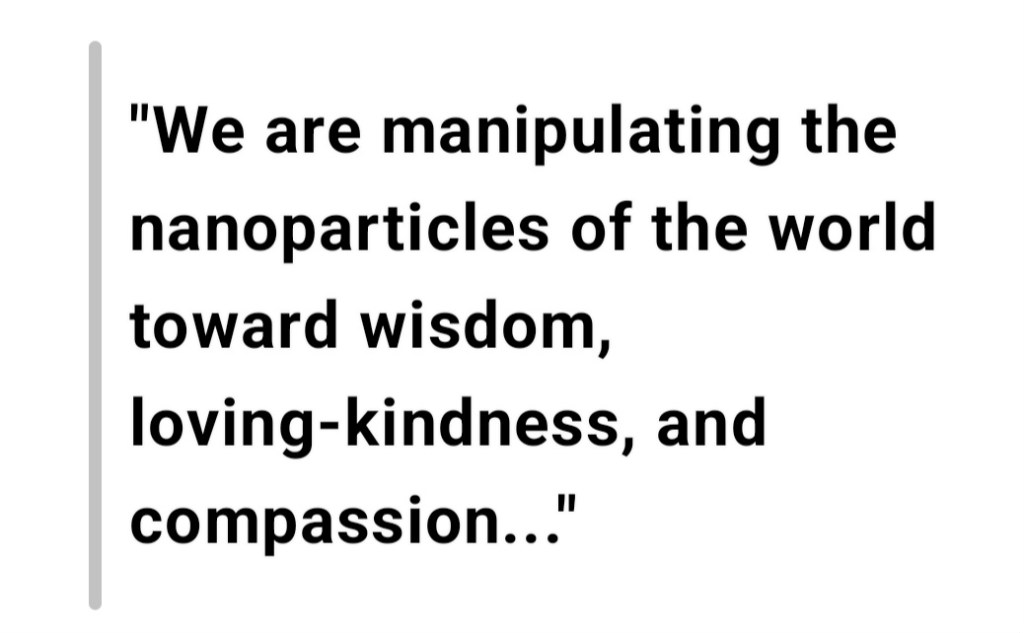
This isn’t science fiction—it’s spiritual reality. Those of us walking the contemplative path are not escaping the world, but quietly reweaving it. We are learning to gently manipulate the nanoparticles of existence toward wisdom, loving-kindness, and compassion.
Not with force, but with intention.
Not for profit, but for the benefit of all.
The mystics have always known: the inner technology of the heart surpasses any external device. The awakened soul is the true replicator—bringing peace, abundance, and healing into form through stillness, presence, and love.
And perhaps this is why such power must remain quiet. After all, if people remembered their God-given ability to manifest what is needed in harmony with the whole, the marketplace might crumble. But maybe it’s time. Maybe the world is ready for a different kind of revolution—not of machines, but of awakened hearts.
✨ English ✨ The light of warmth shines through the long night, 🌙 Though storms may rage, the heart’s lantern never fades. 🕯️ Though mountains are high and waters far, a homebound boat remains, ⛰️🌊⛵ After hardship, spring arrives, and the world is born anew. 🌿🌸
✨ Spanish / Español ✨ La luz del alma brilla en la oscuridad, 🌙 Aunque ruja la tormenta, la llama no se apaga. 🕯️ Montañas y mares no detienen el regreso, ⛰️🌊⛵ Tras la prueba, la primavera renace. 🌿🌸
✨ Italiano ✨ La luce dell’anima illumina la notte, 🌙 Anche nella tempesta, la fiamma non si spegne. 🕯️ Monti e mari non fermano il ritorno, ⛰️🌊⛵ Dopo il dolore, la primavera rinasce. 🌿🌸
✨ العربية / Arabic ✨ نور الروح يضيء الظلام، 🌙 مهما اشتدت العواصف، لا تنطفئ الشمعة. 🕯️ الجبال والبحار لا تمنع العودة، ⛰️🌊⛵ بعد المحن، يأتي الربيع ويولد العالم من جديد. 🌿🌸
✨ עברית / Hebrew ✨ אור הנשמה זורח בלילה החשוך, 🌙 גם בסערה, הנר אינו כבה. 🕯️ ההרים והימים אינם עוצרים את השיבה, ⛰️🌊⛵ לאחר הקושי, האביב מגיע והעולם נולד מחדש. 🌿🌸
✨ Русский / Russian ✨ Свет души сияет сквозь ночь, 🌙 Пусть бушует буря, но огонь не гаснет. 🕯️ Горы и воды не остановят путь домой, ⛰️🌊⛵ После невзгод приходит весна, и мир обновляется. 🌿🌸
✨ Українська / Ukrainian ✨ Світло душі сяє крізь ніч, 🌙 Хай шторм бушує, та вогонь не згасне. 🕯️ Гори й води не зупинять дорогу додому, ⛰️🌊⛵ Після труднощів настає весна, і світ відроджується. 🌿🌸
“Deathless are they who know the Self. Those who know intense fear of death seek refuge only at the feet of the Lord who has neither death nor birth. Dead to themselves and their possessions, can the thought of death occur to them again? Deathless are they.”
— Ramana Maharshi, Forty Verses on Reality
In the silent expanse of existence, a profound truth emerges: those who truly know themselves are untouched by the shadow of death. Their awareness transcends the fleeting nature of the physical, awakening them to a reality where the Self shines eternally, free from the confines of birth and demise.
Fear, that primal instinct which grips the emotional self, leads many to seek solace at the feet of the Divine. Here, in surrender, they find refuge in the Lord—the embodiment of timelessness, the one who remains unscathed by the cycle of life and death. In the presence of such love, the urgency of worldly attachments falls away, revealing the deeper essence of being. I look forward to resting in the presence of such love, revealed within our mind—our true heart—where all attachments dissolve into the stillness of pure awareness. To realize this ever-present pure love is to know the deeper essence of what we are, the part of us that remains untouched by the fears and desires of the world.
As one becomes “dead” to the clamor of possessions and the incessant desires that bind the soul, the thought of death loses its power. No longer a specter to be feared, it becomes a mere whisper, an echo of a past long forgotten. In this state of liberation, the deathless heart pulsates with the rhythm of life, embracing the eternal now.
To know the Self is to awaken to the infinite, to dance beyond the duality of existence, where life and death are but two sides of the same coin. In this awakening, we find the courage to let go—to release the chains of identification with the transient and embrace the essence of who we truly are. Here lies the secret of the deathless ones, an invitation to live fully, unencumbered by the fears that often confine us.
And yet, when we speak of the deathless state, we do not turn our gaze away from the undeniable truth of death. The body, like all things that come into being, will one day return to the earth. Those we love will pass, as will we. But the wisdom of this teaching beckons us to look beyond the visible horizon, beyond the fragile shell of the physical.
Death, as we know it, is but a passage in the realm of form. What truly passes? Not the Self. Not the essence of who we are. This teaching whispers to us that the grasping after what is fleeting—the desires, the aversions, the worldly attachments—these are the threads that weave the illusion of permanence where there is none.
In the letting go, in the softening of our hands from the things we thought we needed to hold so tightly, there is a kind of renunciation. But not a renunciation of life itself, rather, a release from the belief that life’s changing faces can define us. We release, not into emptiness, but into fullness—the fullness of the pristine mind, the quiet, undisturbed expanse of the deathless.
To recognize this is to taste the sweetness of a deeper truth: the Self is untouched by the passing of days, by the birth and death of forms. This is where we find our liberation—not by denying the body’s end, but by resting in the awareness that transcends it.
And so, in this gentle abiding, we come to understand: death may touch what is temporal, but it cannot lay a finger on what is eternal. Here, in the heart of this realization, there is peace—a peace that no worldly circumstance can steal away, for it is woven into the very fabric of our being.
Coming Up Next: Verse 3
In our next exploration, we will turn our attention to the third verse, where we will reflect on the nature of true knowledge and how it reveals the interconnectedness of all beings, inviting us into a deeper understanding of existence.
“Reality exists as the Heart, your very Being. If Reality did not exist, could there be any knowledge of existence? Free from all thoughts, Reality abides in the Heart, the Source of all thoughts. It is, therefore, called the Heart. How then is one to contemplate it? To be as it is in the Heart, is Its contemplation.”
— Ramana Maharshi, Forty Verses on Reality
The Heart of Reality
In the stillness of our being, where thoughts dissolve like mist under the sun, we come upon the essence of reality—the Heart, our very existence. This Heart is not a distant concept, a mere abstraction; it pulses with the life that courses through us, inviting us to recognize that our true nature is intricately woven into the fabric of all that is.
What if reality, in its purest form, did not exist? Could we then grasp the very notion of existence, the flicker of awareness that dances in our minds? Each thought, each fleeting moment of recognition, springs forth from this source, the Heart, which abides in silence beyond the noise of our incessant chatter.
To contemplate this truth is not to embark on a journey of the mind but rather to return home, to dwell as we are in the Heart itself. Here, in this sacred space, contemplation transforms into a state of being, a surrender to the profound simplicity of what is. We find ourselves not as separate seekers but as the very essence of the inquiry—a realization that calls us to rest in the Heart, to know ourselves as we truly are.
For many years, I carried a fog of confusion around the word “heart,” a tangle of meanings that seemed to obscure more than they revealed. I remember being in circles where people would say, “Come from your heart,” and I would listen, trying to grasp the depth of what they meant. Often, it seemed to point toward emotion, to some form of deeper truth that was still bound in the personal—an authentic expression of ego, perhaps a sincerity in feeling, but still caught in the dualities of love and pain, fear and longing.
But what did it mean, really, to come from the heart?
In the midst of this confusion, Ramana’s words come like a gentle clearing of the fog. The heart, as he speaks of it, is not the emotional center we so often equate with the word. It is not the place of fluctuating feelings, nor is it simply a retreat from the mind’s logical discourse. What Ramana points to is something far deeper: the heart as the essence, the source of pure awareness itself.
This reminds me of the self as Carl Jung describes it—not just the conscious mind, but the unconscious, and not just those personal aspects, but everything, the entire universe and reality. Jung’s idea of the Self expands far beyond the individual, reaching into the totality of existence itself, much like Ramana’s use of the word heart. In this sense, Reality, the Self, and the Heart all point to the same fundamental truth—the essence that underlies both duality and non-duality, the very nature of what is.
In both Jung and Ramana’s teachings, we see that the self, or reality, is not something to be sought outside of ourselves or separated from the world. As Jesus says, we are to be in the world but not of the world. This aligns perfectly with the non-dual teaching: there is no need to escape the dualities of life to realize non-duality. Instead, we are invited to recognize that the essence of duality itself is non-dual.
To come from the heart, then, is not merely to speak from personal truth or emotion, but to rest in the deeper awareness that embraces all experience without attachment. It is to be anchored in the non-dual essence of Reality, knowing that even in the world of forms and opposites, the underlying truth remains whole, undivided.
And yet, how often we use the word “heart” to point to something else—something closer to our personal feelings or opinions, mistaking emotional honesty for the deeper truth of our being. But here, in this teaching, the heart is revealed as the true source of non-dual clarity, the place from which true forgiveness, compassion, and love naturally arise—not as personal qualities, but as emanations of our most pure self.
As I reflect on this teaching in, it becomes clear that the heart Ramana speaks of is not a center of personal feelings or emotion, but the eternal essence that transcends the body and mind. This heart, or true Self, is the witness that remains even when personal identity fades. In some ways, this description feels similar to the concept of the Holy Spirit or God, which abides within and beyond us.
When we speak of the heart as Ramana does, we are pointing to the essence of pure awareness, the unchanging “I” that exists beyond the temporary forms of the body and ego. This teaching invites us to recognize the heart as the source of non-dual awareness, a presence that continues even when the personal self dissolves.
Coming Up Next: Verse 2
In the next reflection, we will explore how those who know the Self are deathless, transcending the fear of mortality. We’ll delve into the liberation found in surrendering to the Divine, awakening to the eternal nature of existence beyond the physical realm.


 Home Page: Inspirations of Love and Hope