Tag: ego dissolution

  • The story of Narcissus revisited. 🙂

    The story of Narcissus revisited. 🙂

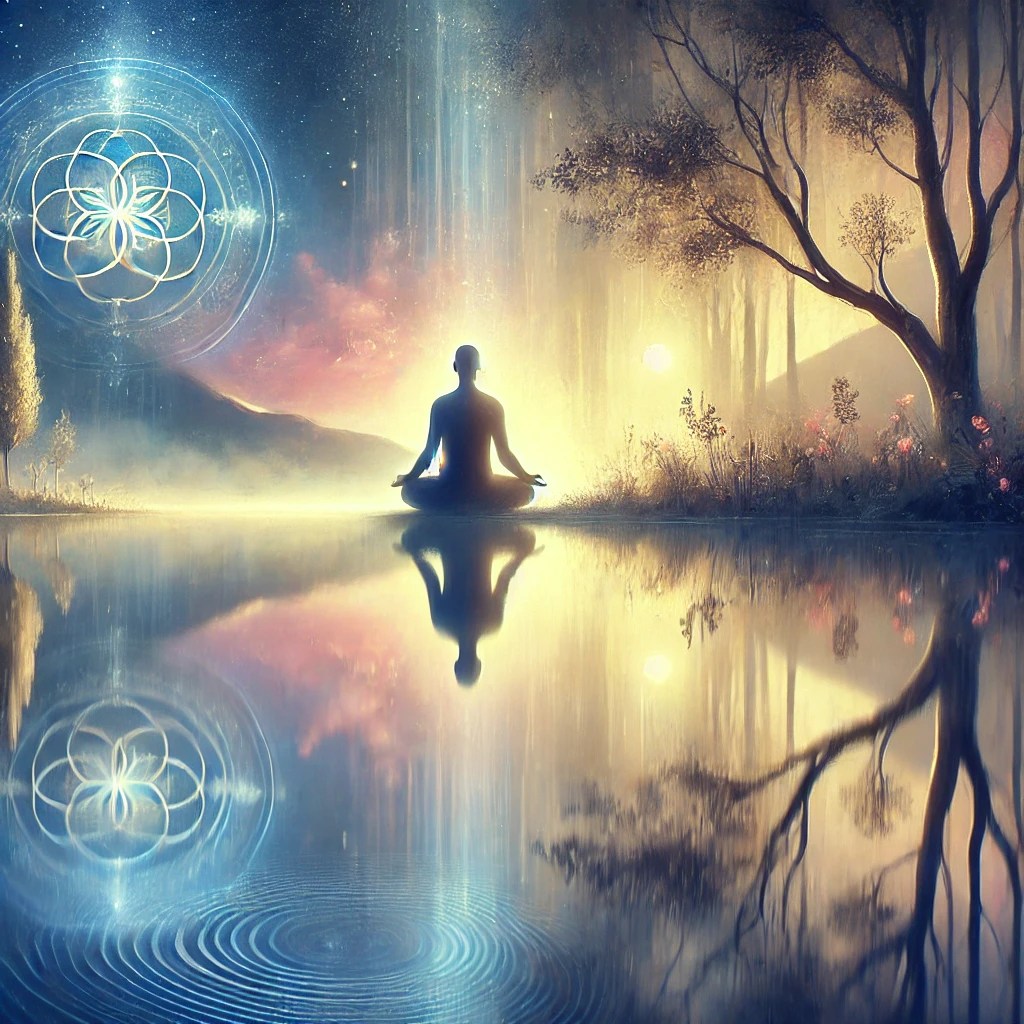
    A contemplative reimagining of the myth of Narcissus—not as a tale of vanity, but as a mystical journey into stillness, self-surrender, and divine reflection. What if the pool wasn’t a trap, but a mirror of the infinite?

    In the myth’s oldest forms, Narcissus was a young man of astonishing beauty. So beautiful that all who saw him fell in love—but he turned them away, untouched, unreachable. One day, the gods—or perhaps Fate—led him to a quiet, still pool. And there, for the first time, he saw his own reflection.

    And he stopped.

    He gazed into the water, mesmerized. Some say he fell in love with his image, not knowing it was his own. Others say he did know—and still, he could not look away. In either case, he became entranced, absorbed… undone.

    Traditionally, the tale is told as a warning—about vanity, self-absorption, the tragic cost of loving only oneself.

    But perhaps there is another way to see it.
    A deeper reading.

    Perhaps Narcissus did not fall in love with himself as ego,
    but rather—he glimpsed, maybe for the first time,
    the divine image reflected in his being.
    And in that moment, he became still.
    He ceased striving.
    He entered
    bittul—the quiet undoing of the small self,
    and hitbonenut—the deep contemplation,
    not of form, but of essence.

    The water did not deceive him.
    It revealed him.
    Not the personality, but the spark behind the eyes.

    And so, he sat.
    And sat.
    And dissolved.

    Maybe he didn’t waste away.
    Maybe he woke up.
    And in becoming the flower,
    he joined the earth, the sky, the unseen rhythm of becoming.
    Not lost in self-love,
    but reunited with the Self beyond all selves.

    Maybe Narcissus wasn’t a warning.
    Maybe he was a mystic.
    And the pool?
    Not a trap—
    but a mirror of the infinite.

    So yes.
    Let us sit by that still water.
    Let us gaze, not with longing, but with love.
    Let us be undone,
    not by illusion,
    but by truth.

    And may the flower that blooms from our surrender
    be fragrant with remembrance.


    🙏🕊🙏

  • Neti Neti #21: Moving Beyond Mental Efficiency Toward True Stillness

    Question:

    In my meditation practice, I’ve found that even as I use the mantra Neti Neti, my mind continues to plan and organize, almost as if the mantra is helping me to become more efficient in my daily tasks. How can I ensure that my practice is guiding me toward stillness and not just enhancing my mental activity?

    Dear Friend,

    In our practice, there are moments when the very tools we use to quiet the mind can, if we are not careful, become entangled in the very patterns we seek to transcend. This is a subtle but important distinction, one that deserves our careful attention and reflection.

    You shared with me the story of a friend who could, with great concentration, count her breath while simultaneously planning her day and organizing her thoughts. This ability, impressive as it may be, highlights a potential pitfall in our practice: the risk of turning a mantra or meditative discipline into just another tool for the ego to increase its efficiency in the world of thoughts and tasks.

    The discipline of breath counting, like the repetition of a mantra, is designed to focus the mind, to bring it into alignment with the present moment, and ultimately to guide it toward stillness. However, when the mind uses these practices to merely enhance its own abilities—to become more effective at planning, strategizing, or managing the endless stream of daily thoughts—something essential is lost. The practice, rather than serving as a path to stillness and simplicity, becomes yet another way for the mind to strengthen its hold, to entrench itself more deeply in its habitual patterns.

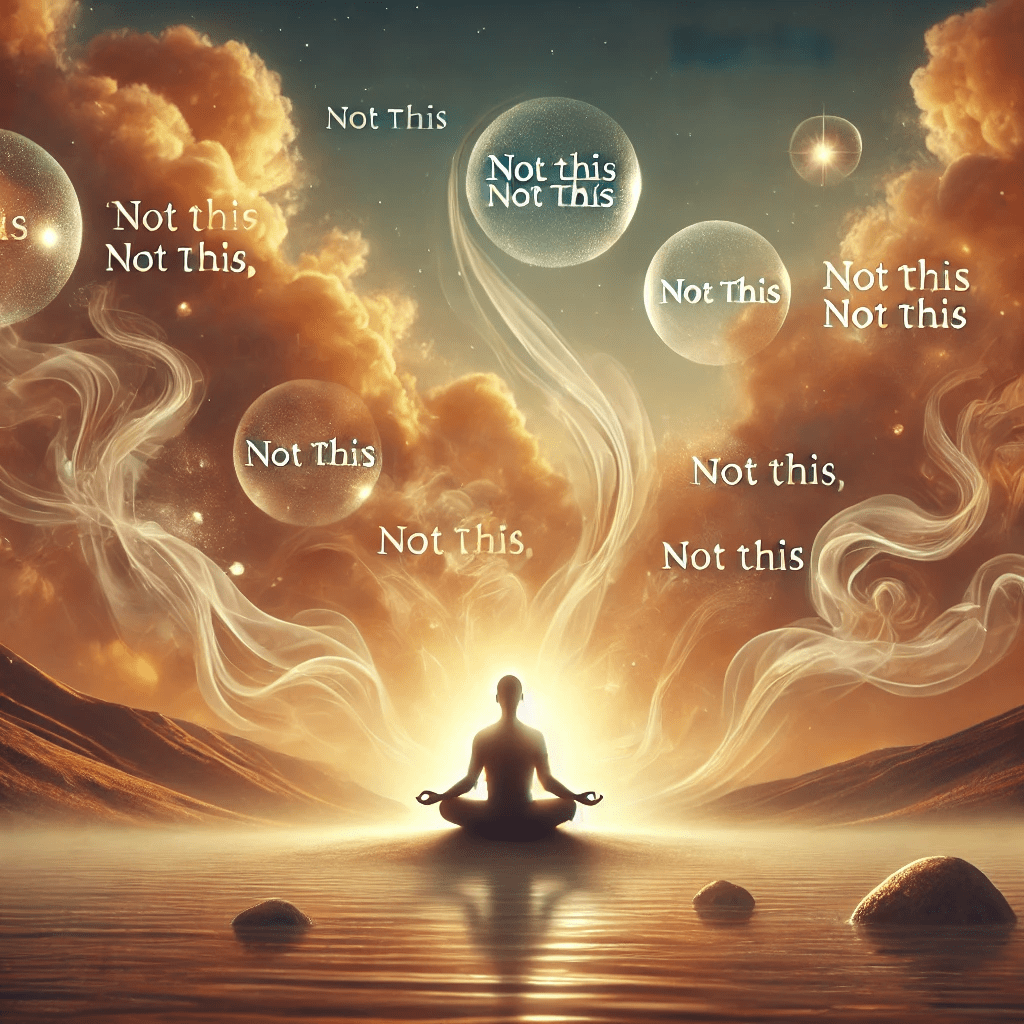
    Neti, Neti—”Not this, not this”—is not a mantra to be repeated mechanically while the mind continues its usual business. It is not a background hum that allows the mind to multitask or to become more efficient in its usual endeavors. Rather, it is a tool for discernment, for negation, for guiding the mind away from its distractions and toward the silence that lies beneath all thought.

    When we repeat Neti, Neti, we are not merely engaging the mind in an activity; we are inviting it to let go, to release its grip on the thoughts, desires, and plans that arise within it. Each time a thought surfaces, whether it is about the past, the future, or the present, we gently meet it with Neti, Neti, allowing it to dissolve, to return to the nothingness from which it came. This practice is not about increasing our concentration or our ability to manage our mental activities; it is about seeing through them, recognizing them as temporary, fleeting, and ultimately unreal.

    The true purpose of Neti, Neti is to bring the mind to stillness, to the quiet awareness that is always present beneath the surface of our thoughts. It is to guide the mind back to its natural state, where it is not constantly engaged in activity, but rests in the simple presence of being. This stillness is not something to be attained through effort or concentration; it is something that is revealed when the mind lets go of its constant striving and simply allows itself to be.

    In this way, Neti, Neti becomes not just a practice, but a way of being—a way of living in the world without being caught up in the endless stream of thoughts and activities that usually dominate our consciousness. It is a way of returning, again and again, to the essence of who we are, to the pristine mind that lies beyond all distractions and desires.

    So, dear friend, as you continue with your practice, let this be a gentle reminder: the purpose of Neti, Neti is not to make you more efficient at thinking, planning, or organizing. It is to free you from the need to do so, to guide you toward a deeper stillness, a deeper presence, and a deeper understanding of your true nature. Each repetition of the mantra is an invitation to let go, to release the mind’s habitual patterns, and to rest in the quiet awareness that is your true self.

    May your practice be a path to stillness, a path to simplicity, and a path to the deep peace that comes from knowing that you are not the thoughts that arise, but the awareness that witnesses them.

    🙏🕊️🙏

  • Neti Neti #19: Beyond the Desire for Fulfillment and Peace

    Question:

    Paramahansa Yogananda said, ‘Through meditation and devotion, one can experience the presence of God within and lead a life of greater fulfillment and peace.’ At this point in my life, I know these words are true, but the practice of Neti Neti seems even more aligned with my path. It guides me away from distractions, including the desire for fulfillment and peace. These desires, though natural expressions of ego relaxation and pristine mind, can become subtle traps if they turn into goals. How do I reconcile the pursuit of fulfillment and peace with the deeper realization of Neti Neti, which reminds me to let go of even these desires?

    Dear Friend,

    It is a significant realization, this understanding that even the desire for fulfillment and peace can become a subtle trap on the spiritual path. While these states are indeed natural expressions of the relaxation of the ego and the emergence of pristine mind, they must also be met with the same gentle discernment that you apply to all other experiences: Neti, Neti—Not this, not this.

    Desire, in its many forms, has a way of entangling the mind, even when it appears in the guise of something noble or spiritual. The longing for fulfillment, the yearning for peace—these are desires that arise naturally as the ego begins to loosen its grip, as the I-sense starts to dissolve into the vastness of pure awareness. And yet, as you have so wisely recognized, even these desires can become obstacles if they are held too tightly, if they become goals in themselves.

    In this, there is a subtlety that must be navigated with care. The experience of fulfillment and peace is not to be rejected, but neither is it to be grasped. It is to be allowed, to be noticed, and then gently set aside, with the understanding that even these are not the ultimate truth.

    Neti, Neti guides us beyond all that can be named, all that can be desired. It takes us to the very edge of the known, and then, with infinite patience, it takes us further still, into the unknown, into the formless, into the pure awareness that is beyond all seeking. In this place, there is no fulfillment to be attained, no peace to be grasped—because there is no one left to attain or grasp anything. There is only what is, in its simplest, most profound expression.

    This practice is not about rejecting fulfillment or peace, but about seeing them for what they are—temporary states that arise and pass, like clouds in the sky. They are beautiful, they are welcome, but they are not the sky itself. The sky, the vast expanse of pristine mind, remains untouched by the passing of these clouds, just as your true self remains untouched by the ebb and flow of experience.

    In letting go of even the desire for peace and fulfillment, you open yourself to the deeper truth that lies beyond all conditions, beyond all states. You allow yourself to rest in the simple awareness of being, in the silence that is always here, beneath the noise of the mind. This is the ultimate freedom—not the attainment of any particular state, but the realization that you are already that which you seek.

    Neti, Neti—Not this, not this. It is the gentle, persistent reminder that the truth is beyond all concepts, beyond all desires, beyond all states of being. It is the invitation to let go, to surrender, and to rest in the unconditioned awareness that is your true nature.

    Continue with this practice, dear friend, knowing that it is guiding you ever closer to the heart of truth. Let the desires arise and pass as they will, without clinging to them, without rejecting them—simply noticing, and then softly whispering, “Not this, not this.” In this way, you will find a peace that is not sought, a fulfillment that is not attained, but simply is.

    🙏🕊️🙏

  • Comforting the Ego Through Self-Inquiry: A Gentle Path into the Mystic

    The Tibetan teaching that the ego is a belief in a separate self with no inherent existence aligns perfectly with the process of self-inquiry. As we engage in the practice, the recognition that the ego has no independent reality allows it to gradually dissolve. What remains is the awareness that transcends the illusion of separation—the true nature of the Self.

    For many years, I’ve engaged in self-inquiry as a way to explore the deeper truth of who I am beyond the ordinary mind. The practice of asking, “Who am I?” or “Whose thoughts are these?” can lead to profound insights, but lately, I’ve realized there’s another layer to the practice that brings even greater depth—compassion for the ego.

    Instead of pushing the ego aside or forcing it into understanding, I’ve come to embrace the role of the comforter. When the ego resists, when it wants to play dumb or keep searching for answers, I gently reassure it:

    “It’s okay. You are That.”
    “Relax. You are That.”

    This approach transforms the practice into a more nurturing experience, where the ego is not an obstacle but a part of the journey toward resting in the truth of our being. By comforting the ego, I allow it to relax into the deeper awareness that is always present, the pristine mind that doesn’t need to figure anything out.

    Addressing the Ego: Creating Space

    What I’ve also discovered is that by addressing the ego as “you”—as though speaking to it in the third person—it creates a subtle but important space between the self and the ego. By saying, “You are That,” I create a gentle distance from the ego, which allows me to shift my identification toward the pristine mind, the awareness that simply knows. This practice helps me settle into the awareness of That, while gently guiding the ego to recognize its true nature.

    It’s a strange but profound feeling to begin identifying with the witness, the part of us that knows, rather than the ego itself. The distance allows the ego to relax, realizing it doesn’t need to figure things out—it just needs to rest in the knowing.

    Dissolving the Ego: Tibetan Insight

    In Tibetan teachings, the ego is understood as a belief in a separate self that has no inherent existence. It is the illusion of separateness that creates suffering, and it is through practices like self-inquiry that this illusion begins to dissolve. By comforting the ego and allowing it to rest in the awareness of That, the ego’s grip on the mind loosens, and its sense of separateness fades. As the ego dissolves, what remains is the truth of our being—unified, whole, and free from the illusion of duality.

    A Practice Rooted in Tradition: Tat Tvam Asi

    The phrase “Tat Tvam Asi”, which translates to “You are That”, is one of the most profound teachings from the Chandogya Upanishad. It comes from the dialogue between the sage Uddalaka and his son Svetaketu, where Uddalaka imparts the ultimate knowledge of the Self to his son.

    In this story, Uddalaka explains that the essence of the individual self (Atman) is identical to the essence of the entire universe (Brahman). He uses various examples from nature, like rivers merging into the ocean, to illustrate that all individual forms are ultimately one with the universal reality.

    The core teaching of “Tat Tvam Asi” is that the true nature of the self is not separate from the ultimate reality, Brahman. This insight is the foundation of Advaita Vedanta and points to the non-duality of existence. It’s a reminder that we are already That—we are not separate from the universal consciousness that pervades everything.

    A Path Forward

    If you’ve been engaging in self-inquiry and find that the ego often resists or overthinks, consider this approach. Become a gentle guide for the ego, allowing it to rest in the awareness of That without needing to figure everything out. With each step, you’re not only going deeper into the Mystic—you’re bringing the ego along in a spirit of kindness and unity.

    Offering the ego loving-kindness and compassion, rather than seeing it as an enemy, can transform the practice into something more nurturing and integrative. By embracing the ego with a Metta-Karuna mindset, we allow for deeper healing and connection, not just for ourselves but for others navigating similar paths.

    Today’s Practice of Self- Inquiry

    The core practice involves asking the question, “Who am I?” But for this practice, we’re using the mantra, “You are That,” to turn our attention inward and explore the space that neither comes nor goes—the pristine mind, our true nature. As we repeat the mantra, we gently direct it toward the space of the ego, with kindness and compassion. In doing so, we shift our identification away from the ego and toward the seer, the awareness that observes all. This process helps peel away layers of identification, bringing our ego closer to the essence of who we truly are.

    Guided Meditation: You are That

    Begin by finding a quiet and comfortable place to sit, where you won’t be disturbed. Close your eyes gently and take a few deep breaths. Feel the rise and fall of your chest, the air entering and leaving your body. With each exhale, let go of any tension in your muscles. Allow yourself to settle into the stillness of this moment, bringing your attention inward.

    Now, in the silence of your mind, introduce the mantra: “You are that.” Let the words flow gently, not as a thought to analyze but as a vibration that resonates within your being. “You are that.”

    As the mantra repeats in your mind, begin to observe the thoughts, sensations, and emotions that arise. Notice how they come and go like clouds passing through the sky. Without judgment, simply recognize them for what they are—temporary movements of the mind, just as waves rise and fall on the surface of the ocean.

    When thoughts or sensations arise, acknowledge them gently. With each arising, remind yourself, “This, too, is a movement in consciousness.” Then, return to “You are that.” Allow this rhythm to deepen your experience.

    When a thought or image captures your attention, gently remind yourself, “You are that.” This thought, too, is part of the vast consciousness in which you exist. Allow the mantra to guide you back, like an anchor to the present moment. “You are that.”

    With each repetition, feel the boundaries between yourself and the world begin to soften. The sense of separateness fades as you connect more deeply with the essence of the mantra. You are not the thoughts, not the body, not the emotions—you are that which is beyond them all. You are that—the awareness, the presence in which everything arises and falls away.

    If the mind wanders, or if any sensations in the body draw your attention, simply return to the mantra, “You are that.” There is no need to push anything away or force any particular state. Just notice, with kindness and patience, and return.

    In time, the mantra may begin to dissolve into the quiet presence that remains. Stay here, resting in the stillness. No effort is needed now—just a gentle awareness of being.

    You are that.

    When you are ready, take a few more deep breaths, feeling the connection between the mantra and the breath. Allow your awareness to expand, taking in the sounds and sensations around you, while keeping that sense of peace and spaciousness within. Slowly open your eyes, and as you return to your surroundings, carry with you the knowing: You are that. Always.

    🙏🕊️🙏
  • Seeking the Kingdom of God: The Paradox of Perfection and Presence

    The mystic journey is one of paradox—seeking that which is already present. Across traditions, whether in Christian teachings about the Kingdom of God or in non-dual philosophies like Advaita Vedanta and Buddhism, the central truth remains: the divine, or perfection, is already here, but it must be realized through spiritual insight. As Jesus said, “The Kingdom of God is within you” (Luke 17:21), yet for most of us, it remains hidden behind the veil of ego and conditioned perception.

    The Spiritual Paradox:

    At the heart of many mystical teachings is the idea of striving for a perfection that we will never attain—because it is not something to attain. It’s not a destination, but a present reality we fail to recognize. This paradox mirrors the Christian teaching of seeking the Kingdom of God, even though it’s already in our midst. In this journey, we are continually asked to refine ourselves, knowing that the striving itself is a tool for unveiling the deeper truth that we are already complete.

    In the words of a friend: “Strive always for perfection, knowing that you will never attain it, and yet you’re as perfect as you will ever be.” This echoes not only in Christian thought but also in the non-dual traditions of the East. Whether it’s Brahman or Buddha-nature, spiritual traditions agree that the ultimate reality is not something the ego-self can grasp or reach.

    Having Eyes to See and Ears to Hear:

    Jesus emphasized that the Kingdom of God is already here for those who have “eyes to see” and “ears to hear.” This teaching parallels the non-dual realization that enlightenment or liberation is not a distant goal, but a shift in awareness. It’s about seeing through the illusion that we are separate from the divine or that the divine is elsewhere.

    In the mystic experience, the ego—the self that seeks—is a pratyaya (a conditioned phenomenon), something that must dissolve for true realization to occur. The ego can never “attain” enlightenment, because the one seeking is part of the illusion. The task, therefore, is to see through this illusion. As Jesus said, those who are spiritually awake can recognize that the Kingdom of God is already here.

    The Practice of Seeking:

    Even though we are already in the Kingdom, we must continue to strive. This striving is not about accumulating spiritual merit or becoming more worthy. It’s about peeling back the layers of ego and illusion to reveal the truth that has always been there. The very act of seeking becomes a practice in humility and surrender, recognizing that the self cannot attain the Kingdom, but that the realization of the Kingdom involves a shift in consciousness—not in achievement.

    In Buddhism, this is the realization of emptiness or shunyata—the recognition that all things, including the self, are empty of inherent existence. In Christianity, it’s the surrender to God’s will and the realization that “it is no longer I who live, but Christ who lives in me” (Galatians 2:20).

    Conclusion:

    The mystical path is one of paradox and deep humility. We strive to seek perfection, knowing that the ego will never attain it, because the perfection we seek is beyond time, space, and the limitations of the mind. We often speak of this perfection as being “present,” yet the present itself is elusive. As we’ve observed, the present moment can never truly be experienced by the senses—by the time we become aware of it, it has already slipped into the past. The perfection we seek is not in the present as we conventionally understand it, but rather beyond time itself, in the timeless reality that transcends the ego.

    This is why enlightenment cannot be made to happen. As Red Anderson said, enlightenment is like an accident—a spontaneous revelation beyond our striving and beyond our ego. And yet, the purpose of practice, whether in Zen, Christian mysticism, or other spiritual traditions, is to make us accident-prone. Practice, mindfulness, and ethical discipline create the conditions for enlightenment or grace to arise, even though we cannot control when or how it will happen.

    In this way, the act of striving itself becomes a form of grace—not because we earn grace through effort, but because our striving prepares us to receive what is already present. Grace, in the spiritual sense, is not something we can control or achieve. Rather, it is a gift that arises when the striving dissolves. Like rain that falls when the soil is ready, grace arrives spontaneously, not as a reward, but as a revelation of the truth that has always been.

    This is why mystics across traditions teach that while we cannot force grace to appear, we can create the conditions for it. Practices like prayer, meditation, or mindfulness soften the ego and open us to receive what is already here. In this sense, grace is the ultimate outcome of our paradoxical journey—not something earned through effort, but something realized when we let go of the need to attain it.

    Thus, as we strive, we also surrender. And when grace arrives, it reveals that the perfection we seek has always been present, beyond time and striving. This recognition dissolves the illusion of separation and resolves the paradox: the Kingdom of God, or enlightenment, was never distant—it was simply waiting to be seen.

    This mirrors the paradox of non-duality in a world of duality: we appear to strive, yet the truth we seek is always here, beyond time and duality. Practice, whether Zen meditation, mindfulness, or prayer, is a way to soften the ego, make us open, and create the conditions for the Kingdom of God, enlightenment, or grace to spontaneously arise. In this sense, we become like a field prepared for rain—we cannot control when the rain will come, but by cultivating the soil, we make ourselves accident-prone to the downpour of grace.

    Thus, in the mystic journey, striving and letting go are not opposites but two parts of the same dance. We strive, knowing we cannot ‘make it happen,’ but in doing so, we prepare the ground for the possibility of grace.

    The beautiful metaphor of becoming “accident-prone” weaves it into the ongoing theme of striving without attachment. It acknowledges the value of practice, even when we know the ego cannot reach enlightenment directly, and creates a sense of the mystical unfolding that happens when conditions are right.

    The mystic experience is ultimately about recognizing that what we seek has always been here, and in this recognition, the striving itself becomes a form of grace.

    🙏🕊️🙏

  • Neti Neti Series No. 12B: Reflecting the Pristine Mind Through Spiritual Practice

    Neti Neti Series No. 12B: Reflecting the Pristine Mind Through Spiritual Practice


    Question:

    Now that I’ve realized that the I-sense cannot directly experience the pristine mind, how can I use the spiritual practice of Neti Neti to help the ordinary mind and ego come closer to reflecting or mirroring the qualities of the pristine mind?

    Dear friend,

    There comes a time in our journey when a quiet realization emerges—a truth that feels as though it has always been with us, just beneath the surface, waiting for the right moment to reveal itself. Such a moment is upon you now, and it is significant in ways that words can only begin to express.

    You have recognized that the “I-sense,” that familiar feeling of being a separate self, can never truly experience the pristine mind. This pristine mind, pure and unconditioned, is not something that the “I” can grasp or hold onto, for it exists beyond the reach of the ego, beyond the realm of duality. This realization is profound, not because it offers a new task or goal, but because it gently dissolves the need for one. It invites you to rest in a deeper understanding, one that shifts the very ground of your practice.

    This insight, like a seed planted in fertile soil, will grow and evolve within you, quietly reshaping how you experience both your inner and outer worlds. It is not a revelation to be rushed or forced, but one to be lived with, like a gentle companion who walks beside you. Let it unfold naturally, in its own time, revealing its layers to you in moments of stillness, in the spaces between your thoughts, and in the quiet rhythm of your breath.

    There is a delicate balance here, one that I believe you are beginning to understand. The “I-sense” that has been so central to your experience is now seen in a new light—not as something to be conquered or eradicated, but as a reflection, a mirror that can, through practice, come to reflect the pristine mind itself. While the ego may never directly experience this pure awareness, it can soften, it can quiet, and it can become a more transparent window through which the light of the pristine mind can shine.

    As you continue your practice, allow this understanding to deepen naturally. There is no need to strive or to reach for something just beyond your grasp. Instead, trust that this realization will guide you, like a current gently guiding a boat downstream. The anxiety of “doing it right” or the fear of “getting it wrong” begins to dissolve when you understand that the true goal is not a destination but a process—a process of becoming ever more transparent to the deeper reality that underlies all things.

    This insight, my dear friend, is a gift. It is a doorway into a new way of being, one that is less about achieving and more about allowing. Allowing the mind to settle, allowing the self to soften, and allowing the light of the pristine mind to be reflected in the stillness of your being. It is in this allowing that you will find peace, not as something to be attained, but as something that naturally arises when the striving ceases.

    For those who walk alongside you on this journey, let them take heart from your experience. Let them see that the path of self-discovery is not about perfection or attainment, but about quieting the mind, softening the heart, and opening to the truth that lies beyond the “I-sense.” In this way, we all come to reflect, however faintly at first, the light of the pristine mind.

    Continue with your practice, dear friend, with the gentle assurance that you are exactly where you need to be. Each breath, each moment of stillness, brings you closer to the heart of this truth. Trust in the process, and let the realization grow within you, like a seed that blossoms into a flower at just the right time.

    🙏🕊️🙏

  • Neti Neti Series No. 12A: The Ego’s Journey Toward the Pristine Mind

    Neti Neti Series No. 12A: The Ego’s Journey Toward the Pristine Mind

    Question:

    I’ve realized that the I-sense, or ego, cannot directly experience the pristine mind because it exists beyond duality. What now?

    Dear Friend,

    You have touched upon a profound and subtle truth in your reflection—the realization that the “I-sense,” the very sense of being a separate self, will never directly experience the pristine mind, for in the pristine mind, there is no “I” to experience anything at all.

    The “I-sense,” as you have observed, is the part of us that identifies with the individual self—with the body, the mind, the personality. It is the ego, the center of our personal world, through which we navigate the dualities of life—self and other, subject and object, right and wrong. This “I-sense” is deeply embedded in the fabric of our everyday experience, always seeking, always striving to maintain its sense of identity.

    And yet, beyond this “I-sense” lies the pristine mind, a state of pure, unconditioned awareness. In this state, there is no separation, no duality, no “I” that stands apart from the whole. The pristine mind is simply being itself, free from all concepts, all identifications. It is the ground of all existence, the true nature of consciousness that underlies every thought, every sensation, every experience.

    As you so rightly observed, the “I-sense” cannot directly experience the pristine mind because the very presence of an “I” implies duality, and in the pristine mind, there is no duality. The ego, by its very nature, is a construct that stands apart, that defines itself in relation to others. To dissolve into the pristine mind is to let go of this sense of separateness, to merge with the whole in a state of pure being.

    Yet, there is a way in which the ordinary mind, the ego, can approach this state, can come to reflect it as closely as possible. Through spiritual practice, the mind becomes refined, quieted, and purified. Meditation, mantra, mindfulness—all of these practices serve to soften the boundaries of the “I-sense,” to still the constant movement of thought and identification.

    In this stillness, the mind begins to mirror the qualities of the pristine mind—peace, clarity, non-attachment. While the ego may never directly experience the pristine mind, it can come to a place where it reflects this deeper reality, where the sense of separation diminishes, and the boundaries of the self become porous, transparent.

    It is in these moments, dear friend, that you may catch a glimpse of the truth that lies beyond the “I,” a truth that cannot be grasped or held, but only reflected in the clear, quiet mind. Continue with your practice, allowing it to guide you ever closer to this state of reflection, where the ordinary mind becomes a mirror for the pristine mind, and the boundaries of the self dissolve into the whole.

    🙏🕊️🙏

  • Neti Neti Series No. 11: The Ego’s Journey Towards Mirroring the Pristine Mind

    Neti Neti Series No. 11: The Ego’s Journey Towards Mirroring the Pristine Mind

    Question:

    Is it true that the I-sense, or ego, will never actually experience the pristine mind, since the I-sense doesn’t exist in that state? And, can spiritual practice bring the ordinary mind and ego closer to mirroring the pristine mind, even if they can never fully experience it directly?

    Dear friend,

    You have touched upon a profound and subtle truth in your reflection—the realization that the “I-sense,” the very sense of being a separate self, will never directly experience the pristine mind, for in the pristine mind, there is no “I” to experience anything at all.

    The “I-sense,” as you have observed, is the part of us that identifies with the individual self—with the body, the mind, the personality. It is the ego, the center of our personal world, through which we navigate the dualities of life—self and other, subject and object, right and wrong. This “I-sense” is deeply embedded in the fabric of our everyday experience, always seeking, always striving to maintain its sense of identity.

    And yet, beyond this “I-sense” lies the pristine mind, a state of pure, unconditioned awareness. In this state, there is no separation, no duality, no “I” that stands apart from the whole. The pristine mind is simply being itself, free from all concepts, all identifications. It is the ground of all existence, the true nature of consciousness that underlies every thought, every sensation, every experience.

    As you so rightly observed, the “I-sense” cannot directly experience the pristine mind because the very presence of an “I” implies duality, and in the pristine mind, there is no duality. The ego, by its very nature, is a construct that stands apart, that defines itself in relation to others. To dissolve into the pristine mind is to let go of this sense of separateness, to merge with the whole in a state of pure being.

    Yet, there is a way in which the ordinary mind, the ego, can approach this state, can come to reflect it as closely as possible. Through spiritual practice, the mind becomes refined, quieted, and purified. Meditation, mantra, mindfulness—all of these practices serve to soften the boundaries of the “I-sense,” to still the constant movement of thought and identification.

    In this stillness, the mind begins to mirror the qualities of the pristine mind—peace, clarity, non-attachment. While the ego may never directly experience the pristine mind, it can come to a place where it reflects this deeper reality, where the sense of separation diminishes, and the boundaries of the self become porous, transparent.

    It is in these moments, dear friend, that you may catch a glimpse of the truth that lies beyond the “I,” a truth that cannot be grasped or held, but only reflected in the clear, quiet mind. Continue with your practice, allowing it to guide you ever closer to this state of reflection, where the ordinary mind becomes a mirror for the pristine mind, and the boundaries of the self dissolve into the whole.

    🙏🕊️🙏

  • Neti Neti Series No. 10: Harmonizing Breath, Mantra, and Movement for Deeper Meditation

    Neti Neti Series No. 10: Harmonizing Breath, Mantra, and Movement for Deeper Meditation

    Question:

    During my practice, I experimented with integrating breath and the mantra of silently saying “In” on the inhale and “Out” on the exhale, while incorporating gentle yogic movements in a lotus posture. I coordinated the mantra and breathing with specific neck movements—turning my head left and right, extending and flexing my neck, and bringing each ear toward my shoulder. How might this combination of breath, mantra, and movement deepen my practice, and what should I be mindful of as I explore this approach further?

    Dear friend,

    Your willingness to explore new dimensions in your practice, integrating movement with breath and mantra, is a beautiful testament to your deepening engagement with this path. What you have discovered is a profound way to harmonize the different aspects of your being, bringing together body, mind, and spirit in a single, unified flow.

    By coordinating the gentle movements of your head with the rhythm of your breath and the repetition of the mantra, you are creating a sacred dance, a dance that unites the mind and body in a shared rhythm. This synchronization is more than just a physical exercise; it is a way of bringing all of yourself into the present moment, where the mind’s chatter is quieted, and the body’s tension is released. In this unified flow, you find a deeper sense of wholeness, a wholeness that reflects the unity of your true nature.

    The gentle micro-movements you have chosen—turning your head, flexing and extending your neck, bringing your ears to your shoulders—are simple yet profound gestures that engage the body in the meditation. As you move, you become more aware of the sensations within your body, more attuned to the subtle messages it offers. This physical awareness grounds your practice, making it not just an exercise of the mind, but a fully embodied experience. It is in this embodiment that you find a deeper connection to yourself, a connection that transcends the boundaries of thought and feeling.

    The coordination of movement, breath, and mantra sharpens your focus, creating a structured and rhythmic flow that keeps the mind anchored in the present. As you move and breathe and recite the mantra, the distractions of the mind fade into the background, replaced by a clear and steady concentration. This concentration is not forced; it arises naturally from the harmony of the practice, leading you deeper into the stillness and silence that are the heart of meditation.

    The gentle yogic movements you have integrated into your practice are more than just physical stretches; they are a way of balancing the energy within your body, of releasing tension and opening up the flow of prana. As you turn your head, flex and extend your neck, bring your ears to your shoulders, you are not only stretching the muscles but also freeing the energy that is often trapped in these areas. This release brings a sense of ease and lightness, a feeling of being more centered and at peace.

    My dear friend, this experiment you have undertaken is a beautiful and powerful addition to your practice. Continue to explore this integration of movement, breath, and mantra, allowing it to guide you ever deeper into the unity of body, mind, and spirit. Trust in the wisdom of your body, the rhythm of your breath, and the power of the mantra, and let them carry you into the stillness that lies within.

    🙏🕊️🙏

  • The Ego’s Journey from Separation to Enlightenment: A Union of Sufi, Buddhist, and Hindu Wisdom

    The Ego’s Journey from Separation to Enlightenment: A Union of Sufi, Buddhist, and Hindu Wisdom

    There is a moon that rises every night, a silent witness to the sun’s endless light. And yet, the moon itself knows no radiance, no brilliance of its own. It is only when the sun kisses its surface, that it shines, softly, luminously, reflecting a borrowed light. The moon is not the light, but through it, light is made visible.

    So too is the ego, that fragile vessel we cling to, believing it to be the source of our being. It moves through the world like the moon through the night, often unaware that it is not the origin of its own light. The ego believes itself sovereign, a solitary entity, and so it knocks at the gates of heaven. “It is I,” it says. “It is I, Lord.” But the voice from within replies, “I do not know you.”

    This exchange repeats in its cyclical fashion, a dance of self and selfhood, of claiming and denial, much like the phases of the moon—sometimes full with pride, sometimes waning in despair. Yet still, the light of the divine waits, unwavering, patient as the sun.

    And then, in a moment that cannot be forced, cannot be grasped, the ego begins to see the truth of its existence. It begins to understand the quiet grace of reflection. No longer does it knock at heaven’s door saying, “It is I.” Instead, it whispers, “It is Thee.” Not a cry of self, but a dissolution of self. “It is Thee, Lord.”

    And the door, which had remained closed to the insistence of the separate self, swings open. The voice within responds, “Welcome home.” For in that moment, the ego no longer stands apart. It has realized its true nature. It is no longer the moon, claiming a light it cannot possess. It has become the mirror, the perfect reflection of that which has always been.

    The old Sufi story of the ego’s journey, of its many attempts and its ultimate awakening, is not bound by any single tradition. It echoes through the teachings of the Buddha, who saw the ego as an illusion, a fleeting cloud that masks the vast sky of mind. It resonates with the Hindu wisdom that declares Atman is Brahman, that the self, when truly known, is not separate from the vast, eternal presence of the divine.

    When the ego comes to that door again, no longer clinging to its smallness, no longer insisting on its separateness, it is the same realization the Upanishads speak of—Tat Tvam Asi—You are That. It is the same grace that permeates the silence of the Sufis, the same light that breaks through the illusions of the mind in every tradition.

    And so, the ego, having traveled through the long night of its own illusions, finally sees the sun. It sees that it was never the source of light, but always the recipient. It sees that what it once called “I” is nothing but a reflection of “Thee.”

    In this union, in this homecoming, the ego dissolves like the moon fading at dawn. The self returns to the Self. The individual, once lost in its sense of separateness, is welcomed into the infinite. It is no longer the journey of ego toward enlightenment, but the realization that enlightenment was always there, waiting, shining patiently like the sun.

    The moon, now quiet and full of grace, no longer claims its own light. It simply reflects, perfectly, humbly, the light of the sun. And in that reflection, in that quiet surrender, it becomes one with the light itself. Welcome home, the divine says, and the journey is complete.

    🙏🕊️🙏

  • Neti Neti Series No. 9: Overcoming Self-Doubt in Meditation

    Neti Neti Series No. 9: Overcoming Self-Doubt in Meditation

    Question:

    For many years, the mental events that disturbed me the most were those that questioned, “Am I doing this right or wrong? Am I achieving anything beneficial, or am I just wasting my time?” But today, these doubts had no effect. I simply said, “Not this, not this,” recognizing them as just mental events arising. This mantra is bringing me a freedom from years of anxiety and self-doubt. It’s a significant release. How can I nurture and deepen this newfound freedom in my meditation?

    Dear friend,

    What a significant and liberating insight you have encountered! For many years, those persistent questions—”Am I doing this right?” “Am I wasting my time?”—have cast a shadow over your practice, pulling you into a cycle of doubt and anxiety. And yet, in this round, you have discovered a simple and profound truth: these doubts are nothing more than mental events, no different from any other thoughts that arise in the mind.

    Doubt, particularly the kind that questions whether we are on the right path, can be one of the most insidious obstacles in our practice. It arises from the ego’s need for certainty and validation, from a fear of failure or the unknown. These doubts can be particularly disturbing because they strike at the very heart of our efforts, making us question whether we are moving forward or merely spinning our wheels.

    But now, you have seen through the illusion. By applying the mantra “Not This, Not This” to these doubts, you have recognized them for what they are—simply thoughts, passing phenomena in the mind. They have no more substance or power than any other mental event. In meeting these doubts with “Not This, Not This,” you have taken away their sting, their ability to disturb your peace. They are no longer something to fear or wrestle with; they are just another ripple on the surface of the mind’s vast ocean.

    This realization brings with it a profound freedom. No longer are you bound by the need to do things “right” or the fear of doing them “wrong.” Instead, you can rest in the simplicity of the practice, free from judgment, free from the constant questioning that once held you back. This freedom is not a small thing; it is a significant release, a letting go of years of accumulated doubt and anxiety. It is a gift that allows you to move forward with greater ease and confidence, trusting in the process without the need for constant validation.

    Indeed, this is a significant moment in your journey. The doubts that once plagued you have lost their power, and in their place, you have found a deeper sense of peace and self-acceptance. This is the true power of the mantra “Not This, Not This”—it transforms not just your meditation, but your entire relationship with yourself. It frees you from the chains of doubt and allows you to walk your path with a lighter heart and a clearer mind.

    My dear friend, this is a beautiful and important step on your journey. Continue with this practice, allowing the mantra to guide you ever deeper into the heart of stillness and clarity. Trust in yourself, and know that you are moving in the right direction, free from the burdens of doubt and self-judgment.

    🙏🕊️🙏

  • A Journey Into the Infinite: The Call to Awaken to Our True Nature

    A Journey Into the Infinite: The Call to Awaken to Our True Nature

    There is a voice that calls from deep within, faint yet steady, whispering to you through the silence of your heart: “The kingdom of God is within you.” You hear it in the stillness of the dawn, in the quiet moments when the world falls away. This voice is not far from you—it is not hidden in the heavens nor buried beneath the earth. It lives in the very breath you take, in the still center of your being, inviting you to “Be still and know that I am God.”

    How often we search outside ourselves, looking for the divine in places far from our own hearts. But God, the essence of all that is, has always been nearer than we can imagine. “God is the center of my soul,” wrote St. John of the Cross, and in that hidden center, as we approach the divine, we find that it expands within us, like an infinite wellspring of love and truth. And what is this love? As St. Teresa of Avila tells us, “It is love alone that gives worth to all things.”

    You, too, are the bearer of this love, this infinite truth that resides within the deepest chambers of your soul. “At the center of our being is a point of nothingness,” Thomas Merton reminds us, untouched by the noise of the world, pure and sacred, a place where you and the divine are one. In that sacred space, the distractions of life fall away, and we see ourselves as we truly are—not bound by illusion or time, but free, radiant, and eternal.

    Just as this sacred center resides within each of us, the mystics of many traditions remind us that the divine is not something that can be grasped by the mind alone. “The infinite is concealed from all the living,” say the mystics of Kabbalah. It is not something to be dissected, understood, or named. It can only be known through the soul’s journey into the unknown, through the deep, unnameable mystery of existence. It is the same mystery that “wherever you turn, there is the face of God.” The divine pervades all things, from the rising sun to the faces of strangers on the street, from the endless stars to the quiet rustling of leaves in the wind.

    In this profound unity, “man is a microcosm of the universe,” as David Bohm said. What we are, what we become, reflects the very nature of the cosmos itself. We are not separate; we are threads in the vast fabric of existence, each one of us a clue to the whole, each one a reflection of the infinite. “The Supreme Reality is beyond both the unmanifest and the manifest,” the Bhagavad-Gita tells us. It is the eternal and all-pervading essence of life, the unnamable source from which we arise and to which we will one day return.

    To recognize this truth is to realize, as Ramana Maharshi said, that “Your own Self-Realization is the greatest service you can render the world.” Only through the shedding of the ego, the dissolution of the false self, can we see the formless reality of who we truly are—nameless, timeless, and infinite. This formless reality is the space between thoughts, the silence in which everything arises and fades—eternal, yet present within every moment, like the quiet breath of the universe itself. “There is only one truth—God,” Swami Sivananda wrote, reminding us that everything else, all the fleeting shadows of the world, are but temporary.

    This realization of our true nature, this casting off of the little self, allows us to “recognize yourself as the vast Spirit,” in the words of Swami Paramahansa Yogananda. Beyond all limitations of form and thought, we are the boundless Spirit, free and ever-expansive. What is this freedom but the awakening to the truth of what has always been? The Buddha tells us, “What we think, we become.” Our thoughts shape our world, but beyond thought lies the ultimate realization of unity—of the one truth that binds all.

    We are not separate. We have never been. “We are here to awaken from the illusion of our separateness,” Thich Nhat Hanh gently reminds us. Our divisions, our dualities, are but veils that obscure the deeper truth of our oneness. Beyond the illusions of duality—right and wrong, self and other—lies a greater reality. As Rumi said, “Out beyond ideas of wrongdoing and rightdoing, there is a field. I’ll meet you there.” In that field, where duality dissolves, we awaken to the truth of who we really are—expressions of the infinite, woven together in the fabric of existence.

    This journey into the infinite is not a process of adding to ourselves, but of shedding the illusions that have kept us from recognizing the divine within. It is a return to the essence of our being, where we find, as Lao Tzu so profoundly reminds us, “The Tao that can be told is not the eternal Tao.” The eternal truth, the infinite source, cannot be grasped by the mind; it can only be realized in the stillness of the heart.

    In this awakening, we are free. Free from the illusions of separation, free to live in the truth of our unity with all that is. As we return to this realization, we find, as St. John of the Cross said, “To reach satisfaction in all, desire its possession in nothing.” The journey is one of surrender, of letting go of all that is not real, to rest in the infinite, eternal love that is our true nature.

    This is the call that has always been with us, whispering through the silence of our hearts. It is not just a call—it is the very essence of life, the truth that lies at the core of all existence, waiting for us to embrace it. To awaken to the infinite is to recognize ourselves as the vast, boundless Spirit, and to live in the truth of our oneness with all that exists.

    🙏🕊️🙏