Tag: chronic illness

  • How Modern Technology Supports Life with Chronic Illness: Amazon, YouTube & Essential Tools

    How Modern Technology Supports Life with Chronic Illness: Amazon, YouTube & Essential Tools

    Discover how Amazon, YouTube, and digital tools bring connection, learning, and convenience to those managing Chronic Fatigue Syndrome (ME/CFS) and other chronic conditions.

    Living with Chronic Fatigue Syndrome (ME/CFS) is like existing within the quiet spaces between life’s rhythms. The world continues to spin, time flows forward, but for those of us confined by fatigue, much of life happens from a single room. Yet even from here, in the isolation of illness, modern technology keeps me tethered to the world—connected, informed, and able to navigate life more easily than I could have ever imagined. Through screens, deliveries, quiet YouTube voices, and the reassuring buzz of text messages, these tools, which for most people are conveniences, have become essential to my daily life, allowing me to “connect, learn, and thrive in the quiet spaces of illness.”

    From the stillness of my room, technology provides a connection to the outside world, bringing not only convenience but the comfort of knowing I am still part of a larger community. Tools like Amazon, YouTube, and GPS apps, often viewed as simple conveniences, are for me much-needed companions on this journey with chronic illness—supporting a life enriched by connection, even from within the solitude of illness.

    Amazon: Freedom Through Next-Day Delivery

    For me, Amazon is not a luxury; it’s a lifeline. Before fatigue claimed my body, I could walk through stores, touch things, browse the shelves. Now, just the thought of leaving my home to do simple tasks is overwhelming. Amazon Prime brings the world to my doorstep—groceries, medical supplies, non-perishable food, even a replacement part for my air conditioner when it broke down. In a life where energy is a precious and limited resource, Amazon’s next-day deliveries allow me to conserve what little energy I have for more meaningful pursuits.

    There are no long checkout lines, no need to explain to a cashier why I can’t stand for more than a few minutes, and no risk of overexerting myself by pushing through crowds. In this way, Amazon brings me peace of mind. I get the things I need, when I need them, and I don’t have to venture out into a world that often feels too large, too demanding, and too exhausting.

    Amazon Prime’s next-day delivery has become my bridge to the outside world. For someone who must guard every ounce of energy, this service isn’t just convenient—it’s necessary. For others in similar situations, I’d encourage finding ways to use Amazon’s features to make life easier: think grocery deliveries, automatic reorder settings, or exploring Prime’s accessible resources for those homebound.

    YouTube: A Window to the World

    YouTube is where I go to learn, to be entertained, and to explore the world beyond my room. Some days, when my body is too fatigued to move, I can escape into a world of endless discovery, music, art and more.

    While YouTube offers boundless exploration—from history and technology to the personal stories of others facing challenges—I’ve learned to pace myself here, too. Information overload can be an unexpected trigger for ME/CFS symptoms, so knowing when to close the app and find stillness is as essential as any other pacing technique.

    Through YouTube, I immerse myself in history, music, documentaries, and biographies. I explore the world, both past and present, and even learn about future technologies. It’s an incredible tool that connects me to culture, ideas, and information I wouldn’t otherwise have access to. Whether it’s understanding ancient civilizations, learning about scientific breakthroughs, or following someone’s personal journey with illness, I find comfort in knowing that the world is still out there, alive and vibrant, even if I am not actively participating in it.

    Yet, I must admit, there are times when I become overwhelmed. Information overload is a real challenge when you live with ME/CFS, so I’ve learned to recognize when it’s time to turn off YouTube, close the apps, and retreat into the quiet of my mind. It’s about balance—allowing myself to be informed and connected, but also knowing when to rest from the constant influx of information.

    One other helpful trick is that I’ve learned how to Velcro my iPad to the ceiling, about a foot and a half above my head, so that even when lying flat on my back, I can watch videos, answer text messages and enjoy creative writing without straining my body. This idea was inspired by astronauts living on the International Space Station, a video I stumbled upon while exploring YouTube. They live in such small spaces, with everything within reach, Velcroed to the walls for easy access—and now I do the same. It’s so helpful!

    Text Messaging: Simple Connections Without the Overwhelm

    One of the simplest, yet most effective, tools in my daily life is text messaging on my Samsung A51. For someone living with chronic illness, conserving energy is vital, and sometimes even scrolling through endless emails or social media updates can be exhausting. There’s just too much content, too much spam, too much input to sift through.

    Texting allows me to keep in touch with the people who matter without all the distractions. I’ve personalized my notifications so I can immediately tell who’s reaching out, without having to wade through spam or unwanted information. This focused communication helps me stay connected without overwhelming myself. It’s small, it’s simple, and it’s manageable—which is exactly what I need.

    Text messaging has become a lifeline for gentle, manageable connection. Without the sensory overload of social media, it allows me to stay close to loved ones without exhaustion.

    Do you find that certain tools offer you gentle connection without the sensory overload? Text messaging has transformed my connections, keeping them gentle and manageable.

    Living Well with Chronic Fatigue: A Book That Brings Comfort

    I discovered How to Be Sick by Toni Bernhard nearly 20 years ago. It was a revelation—finally, here was someone who deeply understood what it meant to live with chronic illness and had wise, compassionate insights to share. This book offered me guidance and solace on my hardest days. I highly recommend it to anyone navigating life with chronic illness.

    Weather and Radar Apps: Forecasting Peace of Mind

    Living in Florida, knowing the weather is crucial, especially with unpredictable storms. With ME/CFS, watching regular weather updates on TV can be overwhelming—there’s just too much sensory input to process. Instead, I rely on my radar app and the Weather Channel app for clear, instant information. With just a click, I can see what’s happening hour by hour, allowing me to make calm, informed decisions without unnecessary stress.

    These apps became literal lifesavers during recent hurricanes, especially Hurricane Helene and Hurricane Milton. Thanks to real-time tracking on my Android phone, I could monitor each storm’s path and location from home. Being able to register with Pinellas County’s special-needs program was a huge relief; I was still recovering from a post-exertional crash after Hurricane Helene and was in a difficult state when Hurricane Milton approached. When the county confirmed they could transport me to a special-needs shelter, I felt a huge weight lift. The incredible Department of Health and fire department volunteers took excellent care of me and brought me safely back home after the storm.

    I have an enormous sense of gratitude for the Pinellas County service and the tireless efforts of all the volunteers who provide these services. Their compassion and dedication make a true difference for people like me, for whom evacuation wouldn’t be possible otherwise.

    Google Maps: Easing the Stress of Travel

    I don’t drive often—maybe a thousand miles a year, if that—but when I do, it’s usually to a doctor’s appointment. For someone with ME/CFS, the stress of navigating new roads can be a real source of anxiety. Google Maps has been a godsend. With turn-by-turn voice directions, I don’t have to worry about missing a turn or figuring out complicated routes. The app guides me, eases my mind, and allows me to focus on the road without the added stress. Driving isn’t something I do lightly, but when I have to, having a calm, guiding voice makes all the difference.

    Google Maps provides something invaluable: independence. For someone with ME/CFS, navigating new places is stressful, but GPS directions make these trips feel manageable, giving me the peace of mind to find my destination. Have you tried any tools or apps that make travel easier? For those navigating appointments or outings, a reliable GPS can make a huge difference.

    ChatGPT: A Digital Companion and Coach

    Perhaps the most unexpected yet valuable tool I’ve found is ChatGPT. While it doesn’t replace human connection, it provides an invaluable way to organize my thoughts, explore answers, and manage PEM (Post-Exertional Malaise) strategies. This AI feels like having a quiet, compassionate coach who listens without judgment, helping me make sense of a complex world when I’m feeling lost. In a life where clarity and companionship can be hard to come by, ChatGPT has been a supportive guide, offering reliable information and the space to reflect on my experiences.

    Closing Reflection and Invitation

    Life with ME/CFS can feel isolating, as though the world continues to move while you stand still. But with the help of modern tools, we can stay connected, learn, and find joy in small but meaningful ways. Amazon, YouTube, Google Maps, ChatGPT, and other technologies have become more than conveniences—they are lifelines. They remind me, even in the stillness of illness, that I am part of something larger.

    I’m endlessly grateful for the support these tools offer. What about you? If you’ve found helpful tools or routines that bring you comfort, peace, or joy, please share them below. By connecting and sharing, we create a ripple of support and help each other find the ease and strength to keep going.

    What tools or routines bring you comfort and ease? Share your tips below so we can continue supporting one another.

    Thank you to everyone who shares their insights and experiences. Together, we’re building a network of support and compassion.

    🙏🕊️🙏

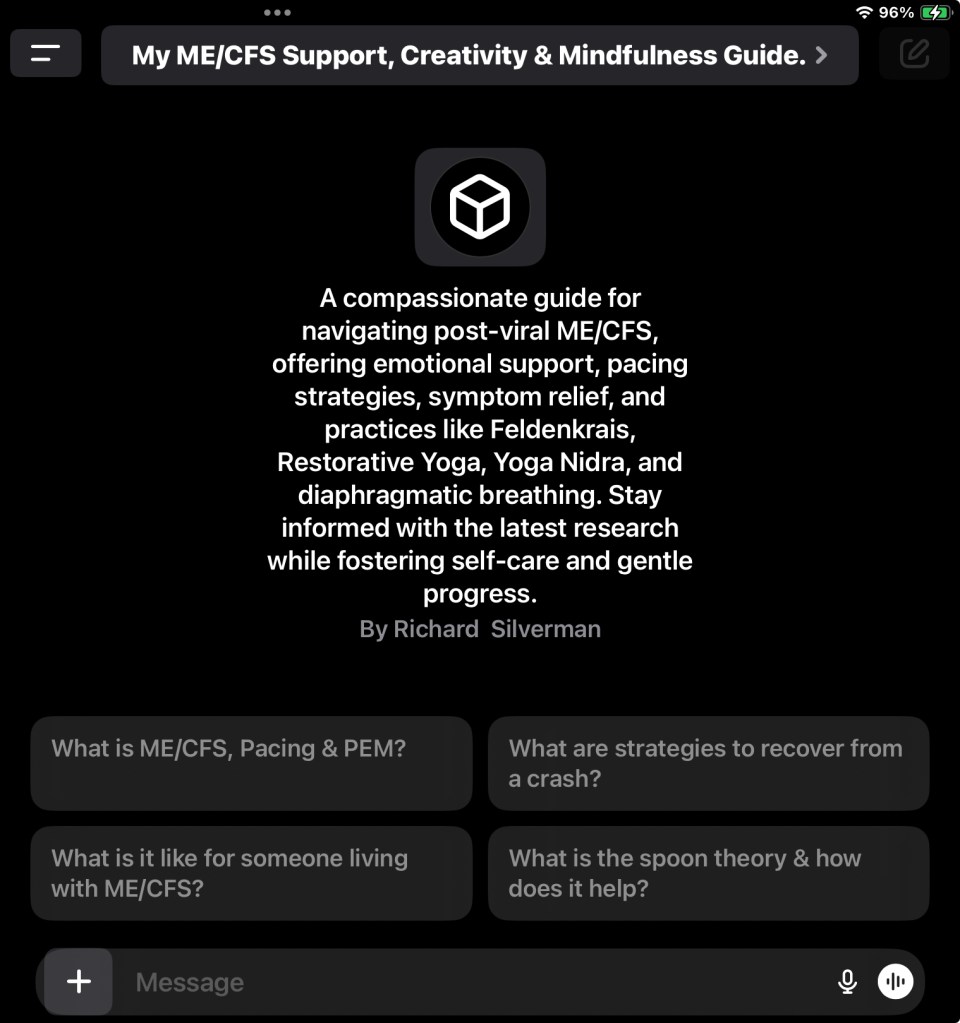
    Check out this Free GPT ME/CFS Support, Creativity & Mindfulness Tool 😀

    For those of us managing life with ME/CFS, I’ve found a helpful digital companion in this GPT Model for Support, Creativity, and Mindfulness. If you’re looking for new pacing strategies, symptom relief, or gentle emotional support, this tool might be helpful to you too.

    💡 How it works: This GPT Assistant offers mindfulness techniques, creative ideas, and compassionate support as I manage the challenges of post-viral fatigue, PEM (Post-Exertional Malaise), and daily energy management. It helps me, Maybe it can help you too.

    🙏 if you try it, I’d love to hear your feedback! How does this tool work for you? Do you find it helpful in managing your energy, finding comfort, or discovering new ways to express creativity? Let me know in the comments how it goes for you!

    Click here to explore the Free ME/CFS Support GPT model:

    https://chatgpt.com/g/g-RIlSJwH0y-my-me-cfs-support-creativity-mindfulness-guide
    🙏🕊️🙏


    If you’d like to explore supportive content focused on navigating life with ME/CFS, including tips for energy pacing, mindfulness, and gentle encouragement, you can find more insights and reflections crafted to offer comfort, practical guidance, and connection on this journey here.


  • Managing Post-Exertional Malaise: Finding Balance and Peace in Life with ME/CFS

    Managing Post-Exertional Malaise: Finding Balance and Peace in Life with ME/CFS

    A Gentle Reflection on Pacing, Rest, and Navigating the Challenges of Chronic Fatigue Syndrome

    There are days when the body speaks softly, a whisper of weariness that hints at the storm ahead. And though we move carefully, mindful of each step, there are moments when the smallest effort—a turn of the mind, a spark of emotion—awakens something deeper. This is the dance with post-exertional malaise, the hidden tide that comes and goes, often when we least expect it.

    Gentle Reminder: Take Care of Yourself

    This post is lengthy, and it’s important to honor your pacing needs. Feel free to read a little at a time, take breaks, and come back to it when you’re ready. Your well-being is paramount, even as you engage with information that supports your journey.

    In this slow unfolding, I’ve learned the art of listening. Not just to the body’s loud protests, but to the subtle shifts that rise like shadows before a dusk. It’s a practice, really—this gentle balancing act of life. Pacing myself through the hours, I find that it’s not about doing as much as I can, but rather, doing only as much as I must, and stopping long before the weight of fatigue pulls me under.

    Some days, I count my energy like a miser with gold, tucking it away in small corners, resting in the quiet between breaths. I know now that to keep moving without pause is to invite the flood, so I rest—not in surrender, but in reverence. It’s a kind of devotion, to honor these limits as something sacred, to see the necessity of stillness as part of the rhythm of being. I don’t always succeed. But when I do, I glimpse a peace that feels fragile, yet profound.

    And when the world presses in with its demands, I remind myself that it’s okay to say no, or not now. There is a quiet strength in bowing out, in knowing that tomorrow will ask more of me than today ever could, and I must be ready. There is also grace in understanding that not every task, not every moment, requires my full self. I can do less, and in doing less, I give myself more space to breathe, to be.

    There are the days after—the days when the fog of PEM descends like a heavy mist over the mind, the limbs. When it comes, I am learning not to fight it. I lie still, like a tree after the storm, gathering strength in the pause. I have found that recovery is an art, as delicate as anything else. Resting, not out of defeat, but out of wisdom, out of love for the body that has carried me through so much already. The act of resting becomes an offering of peace, a gift I give myself in this long, uncharted journey.

    And so, I move slowly, gently, always aware of the fine thread that connects exertion and ease, action and rest. I have begun to cherish the quiet moments of pause, the spaces where life still hums softly, even in the absence of movement. These are the moments when I remind myself that managing this strange, invisible storm is not about conquering it, but learning to live alongside it, to move with it as gracefully as I can. There is beauty here, too—a beauty in the stillness, in the small victories of simply being.

    In those moments, I find a sense of peace that is mine to keep. And in that peace, I remind myself that even on the hardest days, I am enough.And so, as I offer these thoughts, I send with them a quiet wish for your well-being. May you find moments of rest that nourish you deeply, and may the days of ease, however fleeting, linger softly in your memory. If you ever feel the weight of this journey pressing too hard, know that you are not alone.

    Dear friends,

    I know these days may feel heavier than usual. The storm outside has passed, but inside, your bodies may feel as though they’re weathering one of their own. Post-exertional malaise (PEM) comes like that—quiet and uninvited, a deep exhaustion that touches every part of you. Whether it’s the physical toll of surviving the hurricane or the emotional weight of the aftermath, you’re feeling it now, maybe more intensely than you have in years.

    Please know that what you are experiencing is valid. You’ve already shown such strength, simply by navigating these storms and their many demands. But right now, in this moment, the strongest thing you can do is rest. Not as a surrender, but as a way of caring for yourself in the most compassionate way possible. Rest, because your body is asking for it. Rest, because this is how you heal.

    Pacing is not easy when the world around you spins in chaos, but I encourage you to listen to the subtle signs your body gives. You don’t have to meet every demand or engage with every worry. It’s okay to step back, to breathe, and to honor your limits. In doing less, you are doing what is necessary to recover.

    If the fog of PEM feels too thick to see through, know that it will lift. Maybe not all at once, but in small, tender ways. There is stillness, there is peace, waiting for you on the other side of this exhaustion. You are not alone in this experience—many of us are moving slowly through these same waters, learning the rhythm of rest, of patience, of letting go.

    For now, take each moment as it comes. Let yourselves be. Let yourselves rest. And in that rest, know that you are enough. You are resilient. This, too, will pass.

    With all my warmth and understanding,
    Richard Silverman

    Feel free to leave your thoughts, your questions, or simply your presence here—I will meet you with understandingh and warmth. Together, in our shared quiet, we will honor the pace that life has asked of us.

    🙏🕊️🙏

  • Navigating the Unexpected: A Journey Through Post-Viral ME/CFS

    When post-viral ME/CFS first appeared in my life over 30 years ago, it was like a sudden, uninvited guest that turned everything upside down. The plans I had carefully laid out—the career, the teaching, the travel—came to a screeching halt. My body, which once felt like a reliable vehicle for my ambitions, became a source of constant limitation.

    For many people today, especially in the aftermath of COVID, the experience of long COVID or post-viral ME/CFS can feel like a similar trainwreck. The life you knew, the expectations you had, are suddenly out of reach, and you’re left grappling with a new reality—one that modern medicine often struggles to explain, let alone resolve.

    I remember the early days well. The confusion, the depression, the overwhelming frustration that came with the unrelenting fatigue. In the beginning, it was hard to see any way forward. It felt like I was being asked to surrender everything I had worked for, again and again. Every time I hit a new limit, I had to lower the bar, lower it again, and lower it even further. It was a painful process of letting go, not just of my physical abilities, but of my identity and the future I had imagined for myself.

    But over time, and through countless moments of surrender, I began to see that while the path I had planned was no longer possible, there was another way forward. It was a quieter path, more inward, but it was no less valuable. Writing became my outlet, my way of contributing to the world, even while living in solitude and spending much of my time in bed.

    For those of you reading this who are newly facing the reality of post-viral ME/CFS, I want to acknowledge that this is not an easy journey. It’s okay if you need to take breaks, both from reading and from the mental and emotional load of processing what this diagnosis means. Be gentle with yourself, and if you find the post too long, take it in pieces, come back when you’re ready. The key is to pace yourself, in life and in reading.

    Surrendering to a New Reality

    One of the hardest lessons I had to learn was surrender—over and over again. Post-viral ME/CFS teaches you that you can’t control everything, no matter how hard you try. Every time I felt like I was getting close to managing the illness, there would be a setback. My energy would crash, and I’d find myself in bed for days or weeks at a time. At first, it felt like defeat. I had to give up so many aspects of life I’d taken for granted.

    But over time, I realized that surrendering wasn’t about giving up. It was about accepting what is, rather than constantly struggling against it. The more I fought the reality of my illness, the more frustration I experienced. Letting go didn’t mean that I had to stop hoping or working toward better health, but it did mean that I had to stop resisting what I couldn’t change in that moment.

    Surrendering, in this sense, became a way to make peace with the limits of my body, to find moments of ease even when everything else felt out of control. It was an ongoing practice, one that I still revisit, especially on difficult days.

    Navigating Others’ Reactions

    In addition to learning how to surrender, one of the most difficult challenges I faced early on was dealing with other people’s reactions. In those early days, many people didn’t even believe post-viral ME/CFS existed. I heard things like, “You just need to drink more coffee,” or, “Have you thought about taking naps?” Even when I was officially diagnosed as disabled by the government, my own mother thought I was just lazy and needed to be more active.

    This kind of misunderstanding, disrespect, and dismissal is, unfortunately, a common experience for many who suffer from post-viral ME/CFS. Family, friends, and even doctors would question or deny my experience. I’ve heard stories of doctors telling their patients not to even talk about ME/CFS because it “doesn’t exist.” It was often treated as a garbage-pail diagnosis, or dismissed entirely.

    While there is more understanding of post-viral ME/CFS today, the stigma still remains. Making peace with this aspect of the illness has been a long journey. What helped me most was cultivating compassion, not just for myself but for others. As Jesus said, “Forgive them, for they know not what they do.” Having compassion for the people in your life who may deny or diminish your experience is a key part of finding peace.

    An Evolving Perspective on Post-Viral ME/CFS

    In the early days of my journey with post-viral ME/CFS, I found myself going through what felt like the stages of grief as described by Elizabeth Kubler-Ross. At times, I thought I might be dying, and I cycled through stages of anger, grief, depression, and confusion. Acceptance didn’t come quickly, and it took years of processing and reflection before I could reach that place.

    One of the major steps toward acceptance came when I read How to Be Sick by Toni Bernhard. This book resonated deeply with me, and for the first time, I felt like someone truly understood what I was going through. Toni’s reflections on illness gave me a new sense of validation and self-respect, and her practical tips helped me develop a healthier way of relating to my experience. I highly recommend this book to anyone struggling with post-viral ME/CFS.

    Then, during a meditation class organized by students of Sogyal Rinpoche, based on The Tibetan Book of Living and Dying, I began to find deeper peace. It was around this time that I discovered a Tibetan sutra titled Transforming Suffering and Happiness onto the Path of Enlightenment. This teaching profoundly shifted my perspective once again.

    As I read the sutra, I realized that my anger, frustration, and negative emotions were not only draining my energy but also exacerbating my symptoms. It became clear to me that these stressful emotions were making my condition worse, and that when I was able to relax, let go, and find inner peace, I had greater capacity and longer periods of activity without crashing—or without crashing as severely. This was an important revelation: cultivating acceptance, forgiveness, and inner peace didn’t just feel better, it actually minimized my symptoms.

    Shifting Perspective: The Sutra That Changed Everything

    One passage from the Tibetan sutra resonated deeply with my experience of post-viral ME/CFS:

    “Whenever we are harmed by sentient beings or anything else, if we make a habit out of perceiving only the suffering, then when even the smallest problem comes up, it will cause enormous anguish in our mind.”

    This teaching hit home because, for a long time, I had been focusing only on the suffering. Everything in my life had become an enemy—my body, my circumstances, even the people around me. The more I centered my awareness on the pain and limitations, the heavier everything felt. Even the smallest setback would feel unbearable.

    The sutra showed me that the more we focus on suffering, the more it grows and colors everything we experience. By recognizing this, I began to understand that shifting my focus away from the suffering and toward acceptance could help me find peace. It wasn’t about denying the reality of the illness, but about no longer letting it dominate my entire perspective.

    The true transformation came not only by making peace with suffering but by learning to approach both suffering and happiness with the same equanimity. I had to remind myself that when I’m unhappy, this too shall pass, and when I’m happy, this too shall pass. This reminder became a useful way to stay balanced through the ebb and flow of life—the good days and the bad days, the good months and the bad months.

    Additionally, I found comfort in William Blake’s words: “He who kisses the joy as it flies lives in eternity’s sunrise.” It reminded me to appreciate the little moments of happiness, to savor them without attachment, knowing that they, too, are fleeting. This perspective helped me not to be disturbed by the constant changes and to find a sense of peace amidst it all.

    Discovering a New Path: Writing as Healing

    As I continued to navigate the ups and downs of post-viral ME/CFS, I eventually found a new passion that helped me stay connected to the world and give expression to my inner journey: writing. Although much of my life is spent in solitude, and my physical abilities are limited, writing has become my outlet, a way to contribute and share what I’ve learned.

    Through writing, I’ve been able to explore the lessons of impermanence, forgiveness, and acceptance, not just for my own growth but as a way to offer encouragement to others walking a similar path. Chronic fatigue may limit what I can do in the physical world, but it has opened up this creative space where I can still connect, reflect, and contribute.

    In this way, writing became not just a coping mechanism but a practice of karma yoga, an offering. It’s a way to kiss the joy as it flies, even amidst the challenges of chronic illness, and to embrace each moment—whether in suffering or happiness—as an opportunity for growth.

    🙏🕊️🙏

    “He who binds to himself a joy
    Does the winged life destroy;
    But he who kisses the joy as it flies
    Lives in eternity’s sunrise.”


    — William Blake, Eternity

  • The Art of Pacing: How to Live Gently with Chronic Illness and Protect Your Energy

    A gentle exploration of how pacing can help you find balance and protect your well-being while living with chronic illness—along with thoughtful tools and guidance for those seeking support on this journey.

    Pacing is the quiet art of learning to live gently within the rhythms of your body, an act of surrender not to defeat, but to wisdom. It asks you to listen closely, with reverence, to the invisible boundaries your energy sets each day—boundaries that shift like tides, at times quietly receding, at times closing in. For those living with post-viral ME/CFS or long COVID, pacing is not about building stamina or pushing through; it is a way of navigating the unpredictable waters of illness, steering not toward exhaustion but toward balance.

    Think of your energy as a delicate thread stretched between moments. Some threads are finer than others, fraying at the edges after only the smallest tug. On certain days, your energy is enough to string together simple acts—getting out of bed, speaking a few words, tending to a meal. On others, even holding a thought in your mind feels like a weight too great to bear. There is no map for how far your thread will extend each day, and so the practice of pacing requires patience: learning when to weave activity into that thread and when to set it down altogether.

    It begins with noticing. As the morning unfolds, ask yourself: How does your body feel today? What whispers does it send about the tasks ahead—are your limbs heavy, your mind clouded? Or does the day offer a rare clarity, a lightness in your chest? This gentle inquiry is the starting point of pacing, the first invitation to move in harmony with yourself. If you learn to honor your limits before they are breached, you begin to discover that rest, too, is a form of action—an act of preservation, of quiet resistance to the demands of doing.

    There will be moments when you falter. Some days, buoyed by the hope of feeling better, you may do too much, only to find yourself crashed in bed the next morning, as though your body is reminding you: even good days must be tended with care. And yet, these moments are not failures but teachers, guiding you back to the path of gentleness. The gift of pacing is not in perfection but in the willingness to adjust, again and again, to the ebb and flow of your energy. It teaches that every step back into rest is not a retreat but a recalibration—a way of finding your balance anew.

    In practice, pacing asks that you break life into smaller pieces. No task need be completed all at once; no activity is so urgent that it cannot be paused. It may mean spreading chores across hours or days, resting between each small effort. You might find that simply sitting still before you are exhausted—what some call “micro-rests”—becomes a way to protect your energy, much like tending a fragile flame so it does not burn too fast.

    It also teaches the value of saying no, of drawing boundaries not out of reluctance but out of care for yourself. The world may ask more of you than you can give, but your worth is not measured by what you accomplish. Pacing offers you the grace to step back when needed, to protect the little energy you have, and to understand that in rest there is healing, even if that healing is slow and subtle.

    Through this practice, you begin to understand that your life with chronic illness is not a race to reclaim the old ways of being, but an invitation to live differently—deliberately, thoughtfully, and with compassion for yourself. Some days will still carry setbacks, and your thread may feel thin and worn, but you learn to trust that even in these moments, you are practicing something essential: the art of living well within your limits.

    If this way of being resonates with you, I invite you to explore pacing as a tool for navigating life with long COVID, post-viral ME/CFS, or any chronic illness. It is not a cure, but a guide—a way to live with care, softness, and respect for the boundaries your body sets.

    And if you are looking for a gentle companion in this journey—someone to offer guidance on pacing, energy conservation, and emotional support—I invite you to try out this free GPT assistant. This tool provides thoughtful advice, helps you manage the challenges of chronic illness, and offers a steady, compassionate voice tailored to your unique needs.

    Link to GPT Model:

    https://chatgpt.com/g/g-YSGKIl3IT-post-viral-me-cfs-support-guide

    🙏🕊️🙏

  • The Role of a Doctor: A Teacher for Post-Viral ME/CFS Patients

    Finding Compassionate and Informed Care in the Face of Chronic Fatigue Syndrome

    Living with post-viral myalgic encephalomyelitis/chronic fatigue syndrome (ME/CFS) presents unique challenges, not only in daily life but also in finding the right healthcare provider. Many of us with ME/CFS have experienced the frustration of dealing with doctors who dismiss or misunderstand our condition. What we truly need is a doctor who embodies the original meaning of the word: doctor comes from the Latin docere, meaning “to teach.” The best doctors are not just healers, but also teachers—those who are willing to learn about our condition and guide us on how to live better with it.

    The Need for a Teacher in Your Healthcare Provider

    When you’re living with a complex, often misunderstood condition like post-viral ME/CFS, your doctor’s role as a teacher becomes crucial. You’re not just looking for someone to prescribe medications—you need a partner who is willing to explore the intricacies of your symptoms and teach you how to manage them. ME/CFS can be an unpredictable illness, and we need doctors who are knowledgeable and open-minded enough to recognize this. Unfortunately, many of us have encountered physicians who were either dismissive or unaware of what chronic fatigue truly entails.

    Doctors who are lifelong learners, who are open to adapting their understanding as new research emerges, are those worth seeking. They don’t need to be ME/CFS specialists necessarily, but they must be willing to listen and learn.

    The Importance of Self-Advocacy

    Finding a doctor who meets these criteria can feel daunting. One of the hardest but most important lessons I’ve learned on my journey is the need to advocate for myself. This means recognizing that you have the right to “fire” doctors who are not serving your needs. It also means being willing to seek out new doctors, even when it’s exhausting.

    For people with post-viral ME/CFS, visiting doctors can easily trigger post-exertional malaise (PEM), and even a single appointment may be enough to cause a severe setback. This makes it all the more important to learn as much as possible about a doctor beforehand—whether through phone calls, online research, or patient reviews—to improve your chances of success and reduce the toll on your body and mind. Over the years, I’ve learned that it’s often more valuable to take my time finding the right doctor than to rush from one to another.

    Osteopathic Physicians: A More Humanistic Approach

    From my own experience, I’ve found that osteopathic physicians often approach medicine with a more holistic and humanistic philosophy. Osteopathic doctors are trained to treat the whole person, not just individual symptoms. While not all osteopaths are equally open-minded or knowledgeable about post-viral ME/CFS, in my experience, they tend to listen more carefully and offer more personalized care than their counterparts in allopathic medicine.

    The osteopathic doctor I eventually found has been a godsend. He understands my condition, respects my experiences, and helps me manage both symptoms and lifestyle adjustments. Together, we’ve worked on pacing, setting boundaries, and using a few key medications in low doses to manage symptoms. He’s more of a guide than just a prescriber, which makes all the difference.

    If you’re able to find an osteopathic doctor who truly adheres to the principles of osteopathic medicine, they may offer a much-needed, compassionate approach to managing your condition.

    The Insurance Barrier: Navigating the System

    One of the biggest challenges for ME/CFS patients is navigating the insurance system, especially when you’re restricted to certain networks. In my case, my experience with an HMO (Kaiser) was incredibly frustrating. The doctors in that system didn’t understand or take my condition seriously, which made the whole process feel like a dead end. Unfortunately, this is not uncommon when dealing with HMOs or Medicare Advantage plans that limit which doctors you can see.

    The game-changer for me came when I switched from a Medicare Advantage Plan to straight Medicare. This allowed me the flexibility to seek out doctors who would take Medicare and truly understood my condition. It wasn’t until I left Kaiser that I finally found a compassionate and knowledgeable osteopathic physician. If you’re struggling with an HMO or restricted insurance, it may be worth exploring other options that give you more control over which doctors you can see.

    Managing Post-Exertional Malaise (PEM) with Doctor Visits

    One of the hardest aspects of post-viral ME/CFS is the experience of PEM—where even minor physical or mental exertion can trigger a severe worsening of symptoms. Doctor visits, while necessary, can often cause PEM due to the stress of travel, waiting rooms, and emotional fatigue from unsatisfactory interactions with dismissive doctors. This makes it crucial to be strategic about when and how often you see doctors.

    If you have a more severe case of ME/CFS, it might be wise to pace your appointments carefully. Prioritize visits that you know will be productive. Don’t be afraid to ask your doctor to handle routine matters via telehealth or email when possible, to minimize the physical toll of in-person visits.

    In Conclusion: Trusting Your Instincts

    Ultimately, finding a good doctor for post-viral ME/CFS is about finding someone who respects you, listens, and acts as a partner in your care. Doctors should be willing to teach, learn, and adapt, especially when dealing with a condition as complex as ME/CFS. Whether through osteopathic physicians, integrative medicine, or other avenues, your goal is to find a doctor who works with you, not against you.

    This journey can take time, and there may be obstacles along the way, but don’t settle for less than the care you deserve. Trust your instincts, advocate for yourself, and remember that the right doctor is out there—they just may not be easy to find.

    🙏🕊️🙏

  • Finding Balance: A Gentle Guide to Pacing with ME/CFS

    Question: What’s the best way to pace myself with ME/CFS?

    Answer: Pacing with ME/CFS is all about finding balance—managing your energy levels to avoid triggering post-exertional malaise (PEM) and staying within your “energy envelope.”

    As you read this post, please remember that pacing applies here too. There’s a lot of information, and it’s important to honor your capacity. Consider reading a little, then resting, and coming back to it when you feel ready. There’s no need to read and understand all of this at once. Take your time, and be gentle with yourself as you move through it.

    Here are some practical steps to help you pace yourself:

    1. Understand Your Energy Envelope

    Think of your energy levels like a battery. You have a limited amount of energy available each day. The goal is to stay within this limit to avoid overexertion and the subsequent crash.

    Reflect on Your Energy: You might find it helpful to reflect on your energy levels each day—perhaps by jotting down your experiences in a journal or simply observing what drains your energy and what helps you recharge. Noticing these patterns over time can offer insights into how best to care for yourself.

    1. Break Tasks Into Smaller Steps

    Breaking down activities into smaller, manageable steps can make things feel less overwhelming. You might try doing just 10 minutes of a task, resting, and then returning to it later if you feel up to it.

    Pause Often: Consider taking breaks before you feel tired. These pauses are a way of nurturing your energy, helping you avoid pushing yourself too far and risking PEM.

    1. Alternate Rest and Activity (The 50% Rule)

    If you’re uncertain about your limits, it might help to do only 50% of what you think you can manage. This approach offers a gentle buffer, allowing you to stay within your energy envelope without feeling stretched too thin.

    Balance Rest and Activity: You could try balancing periods of activity with rest. For instance, if you spend 15 minutes on a task, consider taking 15-30 minutes of rest afterward—even if you feel like you could keep going.

    1. Prioritize Essential Tasks

    Focus on tasks that are most important or meaningful. Let go of non-essential activities when you’re having low-energy days.

    Use the “3 Ps”:

    Plan:

    Organize your day to spread out energy-draining activities.

    Prioritize:

    Decide what’s most important.

    Pace:

    Slow down, take breaks, and listen to your body.

    1. Adjust for “Good Days”

    On days when you feel better, it’s tempting to do more. But this can lead to overexertion and worsening symptoms later. Stick to a consistent routine and avoid the boom-and-bust cycle where you overdo it one day and crash the next.

    1. Listen to Your Body’s Cues

    Pay attention to signs of fatigue, brain fog, or any symptoms. These are indicators that it’s time to rest. Don’t wait until you feel completely drained.

    1. Use Energy-Saving Tools and Techniques

    Find ways to make daily tasks easier, like sitting down while cooking or using adaptive tools to conserve energy. Even small adjustments can make a big difference in preventing overexertion.

    1. Be Kind to Yourself

    ME/CFS pacing takes time and practice. Be patient with yourself, and understand that setbacks happen. Rest is not a sign of weakness, but a necessary part of managing your energy.

    The goal of pacing is not to push through but to balance activities with rest so you can maintain stability and, over time, potentially expand what you’re able to do without triggering a crash.

    Remember, your well-being is not a race or a challenge to conquer. It’s a journey of listening to your body and honoring its needs, step by step. ❤️

    If you ever feel unsure, working with a healthcare professional familiar with ME/CFS can help tailor pacing to your unique needs.

    🙏🕊️🙏

  • 3: The Benefits of Visualization in Exercise for Those Living With Post-Viral ME/CFS

    When living with Post-Viral ME/CFS, the very thought of physical movement can feel overwhelming, even impossible. However, for many, the desire to engage with your body, to improve mobility, and to gently build strength remains alive. Yet, finding ways to exercise that honor your energy levels without triggering post-exertional malaise (PEM) may feel like a delicate balancing act. In this post, we explore a powerful tool for those who find themselves limited by energy: visualization.

    Visualization allows you to engage your mind in the practice of movement without the physical strain. It offers a way to begin building new neural pathways, changing your relationship with exercise, all while lying in bed or resting. This gentle mental practice may seem subtle, but it can be profoundly supportive on days when your body can’t tolerate physical activity.

    Visualization is the practice of imagining yourself performing a physical movement or action. Research shows that when you imagine a task with enough vividness and detail, your brain activates similar pathways as if you were physically moving. This means that, even when your body remains still, your brain is training for movement.

    For those living with Post-Viral ME/CFS, this can be transformative. Even on days when your body feels heavy or unmovable, you can still practice connecting to movement—without the risk of triggering PEM. Visualization offers a bridge between your current physical state and the possibility of reintroducing exercise gently, one step at a time.

    It may seem counterintuitive, but scientific research has demonstrated that imagining a movement can have measurable effects on physical ability. Studies show that visualization can lead to increased muscle strength, improved coordination, and enhanced motor skills. This practice is especially valuable for people recovering from conditions that limit physical movement. When actual movement is impossible, your brain still benefits from the exercise. By visualizing yourself lifting weights or walking, your brain builds new pathways that mirror the benefits of actual physical movement.

    For those with Post-Viral ME/CFS, visualization can become a mindful entry point into a more connected relationship with your body. It requires no physical energy and can be practiced while you’re lying in bed or seated in a comfortable chair.

    To begin, find a comfortable place where your body can relax completely. Close your eyes and take a few calming breaths. Start by gently becoming aware of your body, feeling supported and at ease. As you breathe, release any tension with each exhale. From this place of relaxation, you can begin to visualize simple movements—such as lifting a light weight, or walking on a treadmill.

    Imagine the sensation of the movement as if it were real: the muscles contracting, the rhythm of your breath, the gentle pull of strength through your arms or legs. The more vividly you engage your senses, the more fully your brain responds. Imagine the warmth of your muscles, the calm focus that exercise brings, or the joy of feeling capable and connected to your body once again.

    This practice isn’t just about mental imagery—it also helps rebuild your emotional relationship with exercise. Living with Post-Viral ME/CFS often comes with frustration and sadness around the body’s limitations. Visualization offers a way to regain a sense of control, to connect with the potential of your body in a way that feels safe and sustainable. It creates a pathway for healing, both mentally and physically.

    While visualization may not replace physical movement, it offers a gentle step in that direction. On days when your energy is low, this practice helps maintain the neural connections involved in exercise. It can even help ease the fear or anxiety associated with movement, reminding you that the joy of exercise is still available to you, even when your body isn’t ready to act.

    Once your energy permits, you can use visualization as a bridge to actual physical movement. For example, after imagining yourself performing a simple weightlifting exercise, you might try gently lifting a light dumbbell. The key is to remain mindful of your limits, moving only within your energy envelope, without pushing your body beyond its capacity.

    Visualization is a powerful tool for those living with Post-Viral ME/CFS. It creates a foundation for healing and offers hope on days when movement feels impossible. By engaging with mental exercises, you prepare your body and mind for the eventual return to gentle physical movement.

    The journey with Post-Viral ME/CFS is about adaptability, gentleness, and finding ways to reconnect with your body on your terms. Visualization offers both a reprieve from physical exertion and a gateway back to mindful movement.

    Next Post Preview: Sitting in the Gym Parking Lot—A Gentle Step Toward Physical Movement

    In the next post, we’ll explore how even driving to the gym and sitting in the parking lot can be a crucial step in your fitness journey. We’ll discuss how this practice can help rebuild confidence, reduce anxiety around exercise, and allow you to reconnect with the gym environment without physical exertion.

    🙏🕊️🙏

  • Embracing the ME/CFS Crash: A Journey of Pacing, Overdoing, and the Practice of Witnessing. Or, Non-duality Rocks!

    Reminder: If reading this post becomes tiring, remembert to pause and rest. Pacing applies to all activities, even the ones we love, like reading and learning. Come back to this post later if you need to. Practicing pacing, even in small moments, is an essential part of living well with chronic fatigue syndrome.

    Introduction

    There’s a rhythm to living with chronic fatigue syndrome (CFS), one that demands a delicate balance of energy. Most of us who live with this condition become intimately familiar with pacing—learning how to manage our energy, smoothing out the hills and valleys of our strength. Through pacing, I’ve learned to minimize the crashes that come when I push myself too far. But even with this practice, there are moments when I consciously decide to overdo it.

    Sometimes, there’s a powerful desire to break out of the limits that CFS imposes. It’s a rebellion, a brief escape. I know when I’m pushing too far, but I choose to embrace life fully for a day or two. I let myself feel that temporary energy, even though I know I’ll crash later. It’s a conscious decision to say, “I’m going to enjoy this moment, and I’m willing to pay the price.”

    For anyone with CFS, this might sound familiar. We know pacing is vital to managing our condition, but there are times when the joy of overdoing it feels worth the consequences. And yet, when the crash comes—and it always does—the body demands recovery. This is where the real work begins, not just physically, but mentally and emotionally.

    The Second Arrow: Witnessing the Mind’s Reactions

    When I crash, the body does what it needs to do to heal, and I’m forced to stop. But I’ve learned over time that what really intensifies suffering isn’t just the crash itself—it’s the mental and emotional turmoil that can follow. This is where the teachings of vrittis and pratyayas have been so transformative for me.

    In simple terms, vrittis are the fluctuations of the mind—the rising and falling thoughts and emotions. Pratyayas are the seeds that drive these mental fluctuations, often based on past experiences, memories, or attachments. Together, these create the mental chatter that, when left unchecked, can deepen the suffering of any crash.

    Buddhist teachings describe this extra layer of suffering as the “second arrow.” The first arrow is the unavoidable pain—whether physical, emotional, or otherwise. But the second arrow is the mental suffering we add on top of that pain: the self-criticism, the frustration, the inner dialogue that says, “Why did I overdo it? I knew better.” This second arrow is where much of the suffering lies.

    But by the yogic practice of witnessing the vrittis and pratyayas, I’ve learned to avoid that second arrow. I observe the mental fluctuations as they come and go, without attaching to them, without allowing them to define my experience. I become the seer—the witness—and in doing so, I find that even during a crash, there is peace to be found.

    Pacing and the Conscious Decision to Overdo It

    Pacing remains the cornerstone of managing chronic fatigue syndrome. It’s about knowing your limits and respecting them, smoothing out the ups and downs of energy. But what happens when pacing fails? What happens when you make the conscious decision to overdo it, knowing full well that you’ll pay for it later?

    For me, the key has been integrating this practice of witnessing into every stage of the process. I allow myself to live fully in those moments of overindulgence, embracing the joy of activity and connection, knowing that a crash will follow. But when the crash comes, I don’t add layers of mental suffering by blaming myself. Instead, I use the crash as an opportunity to practice witnessing—the vrittis and pratyayas are just thoughts and mental patterns, not realities. By observing them, I stay free of the second arrow.

    This approach allows me to live with chronic fatigue syndrome in a way that feels less restrictive. Yes, I pace myself. Yes, I’m mindful of my energy. But even when I choose to push past those limits, I know that I can find peace in the aftermath through this practice.

    The Impulse to Finish, the Practice of Letting Go

    As I write this post, I feel the strong desire to finish it, to post it immediately so that it can be available to those who may benefit from it. It’s an impulse I recognize well—a pratyaya, a desire that drives me to push beyond my limits, even when I know it’s not in my best interest.

    But just as I practice witnessing during a crash, I also practice witnessing this impulse. I see it for what it is—just a thought, just Mara, just another fluctuation of the mind. I don’t have to follow it. I don’t have to act on it. Instead, I can pause, rest, and come back to this post when my body is ready.

    In the same way, I encourage you, as a reader, to pace yourself. This post is long, and if you find yourself feeling tired, take a break. Reading is an activity that requires energy, and pacing applies here, too. Come back to it later if you need to. Take care of your energy, just as I am doing with mine.

    A Soft Rebellion, a Path to Growth

    There is something liberating about the moments when we choose to overdo it, to embrace life fully despite knowing we’ll crash later. It’s a soft rebellion, a decision to live in the moment, even when we know the consequences. But with the right mindset, even those crashes can become opportunities for growth and practice.

    The teachings of witnessing the vrittis and pratyayas have shown me that even the difficult moments—the crashes, relapses, pain, dysfunction, and discomfort of those moments, days, or weeks of low energy—are fertile ground for inner growth. By avoiding the second arrow, and simply observing my mind without attaching to the fluctuations, I can find peace even in the midst of discomfort.

    For anyone living with chronic fatigue syndrome, I hope this reflection offers some comfort and guidance. There is no perfect way to navigate this condition, but there are practices that can help us find peace, even in the most challenging times. Whether it’s through pacing, or through the practice of witnessing, or simply by being gentle with ourselves, especially in moments of overdoing it, we can find a way to live with greater ease and acceptance.

    Take your time, pace yourself, and remember that every crash, every moment of overdoing it, is a new opportunity to practice and grow. We are all on this path together, and in that, there is a kind of peace.

    Facing the Storm: An Urgent Reminder to Pace and Witness

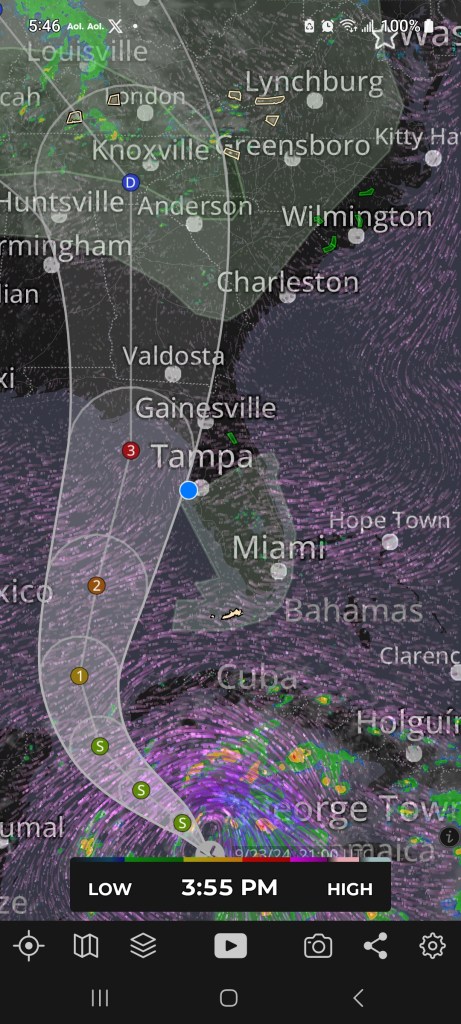
    As I write this, there is a real storm brewing, both within and without. The image below is a weather map of the hurricane that may soon hit my area, forcing me to evacuate. As someone living in an RV, evacuation is usually mandatory in situations like this, and so I find myself facing the possibility of having to leave my bed in the middle of a crash caused by overdoing it.

    The threat is very real, and so the importance of pacing is now at a level that I can’t ignore. I must prioritize rest and recovery immediately, because no matter what state I’m in, I’ll have to get out of bed and go to the hurricane shelter at the church next door if an evacuation order comes.

    This situation has made it even clearer to me how crucial the practice of witnessing vrittis and pratyayas is. Without that practice, I would be overwhelmed by anxiety and fear right now. The mind wants to run wild with worst-case scenarios and worries, but I have been training myself to simply witness these thoughts as they arise. They are just thoughts—just mental fluctuations. They do not have to define my experience. I can stay present, calm, and clear, ready to deal with whatever comes.

    So, after I finish writing this post, I’m going into massive rest and be prepared mode. The practice of pacing has never been more critical. This is an extreme red-flag situation, and I hope it serves as a reminder to all of us with chronic fatigue syndrome: sometimes, the urgency of rest is not just about avoiding a crash; it’s about survival.

    Take a look at the image below—it’s a reminder to me, and hopefully to you as well, that life can throw storms at us both literally and metaphorically. But with the right practices, we can remain centered and grounded, ready to face what comes with a steady mind and a rested body.

    As we face the storms within and around us, may we find peace in the stillness of our hearts. May all beings be free from suffering and the causes of suffering. May all beings experience happiness and the causes of happiness. May we all find safety, strength, and well-being on our journeys, no matter how turbulent the path. May we be guided by wisdom, anchored in compassion, and find harmony in the unfolding of each moment. And in these times of uncertainty, may we remember our interconnectedness, and may we all be held in grace and peace.

    🙏🕊️🙏

  • Self-Compassion

    It’s common to wrestle with feelings of inadequacy, especially in the face of challenges like chronic illness. Remember, your worth isn’t defined by productivity or meeting expectations. Embrace self-compassion and acknowledge your resilience in navigating life’s difficulties.

    🙏🕊️🙏

  • Yoga Nidra for Chronic Fatigue Syndrome (ME/CFS): A Gentle Practice for Deep Rest and Healing

    Yoga Nidra for Chronic Fatigue Syndrome (ME/CFS): A Gentle Practice for Deep Rest and Healing

    Before You Begin

    Welcome, dear reader. If you’ve found yourself here, it may be because you’re looking for something gentle, something that can hold you with care amidst the challenges you face. Living with Myalgic Encephalomyelitis/Chronic Fatigue Syndrome (ME/CFS) often means navigating a delicate path where the balance between activity and rest isn’t just important—it’s essential.

    Yoga Nidra offers a unique kind of rest, one that reaches deep into the layers of your being, allowing both body and mind to relax in a way that ordinary sleep might not always provide. But before we dive into this practice, I invite you to pause. How are you feeling right now? If you notice any weariness, perhaps take a moment. Close your eyes, take a few deep breaths, and come back when you’re ready. Remember, there’s no rush here.

    As you consider exploring Yoga Nidra, please remember that this is your journey, unfolding at your own pace. Yoga Nidra invites you into a state of profound relaxation without physical effort, offering a deeply restful experience. For those of us living with ME/CFS, however, even rest can sometimes require a delicate balance.

    If you’re new to this practice, consider beginning with just a few minutes, allowing yourself to ease into the feeling of deep rest. Pause whenever you need, honoring your body’s unique rhythms and knowing that each moment of relaxation, however brief, can be truly nourishing.

    This is a sanctuary of ease—no need to strive. May Yoga Nidra offer you a gentle space of rest, a place to be held in care as you navigate your path toward healing and peace.

    What is Yoga Nidra?

    Yoga Nidra, often lovingly referred to as “yogic sleep,” is a form of guided meditation that gently leads you into a state of deep relaxation while your consciousness remains softly awake. Imagine being held in a place where you can let go of everything, where you can rest deeply without the need to do anything at all. This practice doesn’t ask for effort; it only invites you to allow yourself to be.

    For those living with ME/CFS, Yoga Nidra can offer a sanctuary—a place to replenish your energy, soothe your nervous system, and find a sense of peace that might feel elusive in daily life. But dear friend, I encourage you to take this in slowly. Perhaps read a little, then pause to check in with how you’re feeling. Let these words settle in their own time, just as you would allow a gentle rain to soak into the earth.

    Why Yoga Nidra is Beneficial for ME/CFS

    Yoga Nidra allows you to experience the kind of deep rest that typically takes much longer to achieve. Even just a few minutes can leave you feeling more refreshed, which is especially valuable when energy is limited. Living with ME/CFS often leaves the nervous system in a heightened state of alertness, contributing to stress and fatigue. Yoga Nidra gently guides the body into a state of calm, helping to reduce that background tension and allowing true relaxation to unfold.

    In the stillness of Yoga Nidra, the body’s natural healing processes are supported, fostering recovery and building resilience over time. This deep relaxation can be a powerful tool for anyone managing the ongoing challenges of ME/CFS. Whether you’re lying down in bed, on a yoga mat, or resting in a comfortable chair, Yoga Nidra is a practice that adapts to you. It requires no physical exertion—only the willingness to rest.

    Again, check in with yourself. How is your energy now? This is your journey, and it’s important to honor the pace that feels right for you.

    A Simple Yoga Nidra Practice for ME/CFS

    When you feel ready, I invite you to explore this gentle introduction to Yoga Nidra. This practice is designed to be brief and nurturing, offering you a moment of respite in your day.

    Preparation:

       •   Find a quiet, comfortable place where you can lie down. Perhaps you’re already there, in which case, simply settle in a bit more. Use a yoga mat, a blanket, or your bed—whatever feels best for you.
       •   Make sure you’re warm and comfortable. The body cools down when deeply relaxed, so a light blanket might be nice.
       •   Close your eyes, and take a few deep breaths. Let the day’s weight melt away.

    Guided Practice:

    1. Settle In: As you lie here, notice the contact points between your body and the surface beneath you. Feel supported, as though the earth is holding you gently. Allow your body to become heavy, fully surrendering to gravity.
    2. Breath Awareness (2-3 minutes): Bring your attention to your breath, without changing its rhythm. Simply observe the air as it flows in and out. With each exhale, imagine your body softening further, releasing any tension it may hold.
    3. Body Scan (3-5 minutes): Slowly, bring your awareness to different parts of your body, starting at your feet and working your way up to your head. As you focus on each part, imagine it being completely relaxed. If your time is limited, you might focus on just the major areas like your legs, torso, arms, and head.
    4. Sankalpa (Intention) (1-2 minutes): Silently repeat a positive intention or affirmation. It could be as simple as “I am relaxing,” or “I am releasing,” or “I am letting go.” Let this intention resonate with you as you repeat it a few times.
    5. Visualization (2-3 minutes): Picture a peaceful place—a sanctuary where you feel safe and relaxed. This could be a real location or an imagined one. Spend a few moments here, soaking in the tranquility. Let it fill you up.
    6. Return (1-2 minutes): Gradually bring your awareness back by deepening your breath. Gently move your fingers and toes. When you’re ready, slowly open your eyes, taking your time before getting up.

    How to Incorporate Yoga Nidra into Your Day

    As you move through your day, there are moments when you might feel the need to pause and restore. Yoga Nidra can become a trusted companion during these times.

    For instance, you might find that taking a few minutes for Yoga Nidra during short breaks throughout your day helps you to refresh your energy and reduce fatigue. Imagine pausing for just 5-10 minutes, allowing the deep rest of Yoga Nidra to rejuvenate your mind and body, making it easier to manage the day’s demands.

    In the evening, as you prepare for sleep, Yoga Nidra can also serve as a gentle transition into the night. Practicing before bed can help improve the quality of your sleep, which is often disrupted by ME/CFS. Picture yourself easing into a restful night, with Yoga Nidra setting the stage for better recovery and deeper rest.

    And then there are those moments when life feels overwhelming—when exhaustion seems to take over. In these times, taking a few minutes for Yoga Nidra can help reset your mind and body, offering a way to find calm amidst the storm. This practice can be like a comforting hand on your shoulder, guiding you back to a place of peace.

    As you explore how Yoga Nidra fits into your day, remember to be kind to yourself. You don’t need to do everything at once. Perhaps try one of these suggestions and see how it feels. The journey of healing is often made up of small, gentle steps.

    Dear reader, Yoga Nidra is more than just a practice—it’s a sanctuary where you can find rest, healing, and peace. For those living with Myalgic Encephalomyelitis/Chronic Fatigue Syndrome (ME/CFS), it offers a way to embrace rest as a form of self-care, helping you manage your energy and enhance your well-being. Remember, there’s no need to rush. This is your journey, and you’re exactly where you need to be.

    Explore Yoga Nidra Through a Guided Meditation Video

    If you’re interested in experiencing a guided Yoga Nidra practice, I’ve found a wonderful 30 minute video that can help you relax and restore your energy. This video offers a calming, step-by-step journey through a Yoga Nidra meditation, perfect for those moments when you need a deeper rest.

    The video begins with instructions to find a quiet place where you won’t be disturbed. You’re guided to get into a comfortable position on your back, with knees slightly apart and arms resting away from your body, palms up. As you close your eyes, you’ll be invited to take a deep relaxing breath, setting the stage for relaxation.

    The instructor suggests using the mantra OM during this lesson. OM is simply a sacred sound that is often used in meditation to help focus the mind and create a sense of peace and connection with the divine.

    The heart of the meditation is a detailed body scan, where the instructor gently guides your awareness to different parts of your body, allowing each to relax fully.

    The meditation concludes with gentle instructions to begin moving your fingers and toes, rolling your head from side to side, and stretching your body.

    Watch a Video

    The vides below is just some the many Yoga Nidra videos online of and are a good place to start. There are countless Yoga Nidra videos on YouTube, each offered by different instructors. Take your time exploring until you discover the ones that resonate best with you.

    The occasional Yoga Nidra session can be a relaxing and rejuvenating experience, helping you reduce stress, improve sleep, and promote overall well-being whenever you feel the need for a deep, restorative rest. May this practice bring you peace and renewal, gently supporting your journey toward greater well-being.

    This yoga Nidra for insomnia will take you easily into a light hypnagogic state and then down into a deep state of sleep.

    Learn more about ME, get involved in support, advocacy, and activism at www.meaction.net

    🙏🕊️🙏

  • Finding Peace Amidst Chronic Suffering

    Living with chronic fatigue syndrome (CFS) and chronic pain for over 30 years has been an immense challenge. There were times when the physical suffering seemed so overwhelming that it consumed my every thought. But as I journeyed deeper into spiritual practices and reflected on the nature of suffering itself, I came to a life-changing realization: much of my suffering wasn’t from the actual pain, but from my mind’s reaction to it. This distinction has become a cornerstone of my approach to living with chronic illness, and I’d like to share it with you, in hopes it may offer some clarity and comfort on your own journey.

    Understanding Suffering:

    Suffering is a universal part of the human experience, but what I’ve learned over time is that suffering doesn’t always arise directly from the pain itself. More often, it arises from the mind’s interpretation of the pain—the stories, fears, and resistance we build around it. This insight is well illustrated in the Buddhist teaching of The Second Arrow. The story goes that while we may be struck by the first arrow—representing the unavoidable pain that comes with being human—it is the second arrow, our mental and emotional response to that pain, that causes much of our suffering. We have no control over the first arrow, but we do have some control over the second one. When I began to understand this, I could see how my mind was amplifying my suffering by dwelling on it, resisting it, or fearing its persistence.

    Recognizing this dynamic has helped me approach pain not as an enemy to be fought, but as an experience to be acknowledged without judgment. This doesn’t mean the pain vanishes, but it transforms how I relate to it, making room for moments of peace amidst the discomfort.

    Finding Realization:

    A deep shift in my experience of suffering came when I began exploring spiritual teachings that pointed to the true nature of the self. Teachers like Papaji and Mooji guided me toward moments of realization where I glimpsed the unchanging awareness that lies beneath all mental and physical experiences. In those moments, I recognized that the pain in my body and the thoughts in my mind were passing phenomena, while something vast and peaceful within me remained untouched. This was the beginning of a profound realization: I am not the pain, I am the awareness in which the pain arises.

    However, sustaining this realization in daily life requires practice. It’s not about escaping pain or denying its presence, but about recognizing the part of us that remains constant and unscathed by the fluctuations of the mind and body. In this way, realization becomes a refuge, a space of stillness even as the storms of physical suffering continue.

    A New Relationship with Pain:

    Through mindfulness and meditation, I’ve learned to sit with the physical sensations in my body without immediately labeling them as good or bad. When I practice mindfulness, I bring a compassionate awareness to whatever arises, whether it’s pain, frustration, or fear. Instead of trying to push these feelings away, I let them be. This simple act of allowing has been one of the most powerful tools in transforming my relationship with suffering. By observing the sensations without judgment, I create space between myself and the pain, a space where peace can emerge.

    Meditation has also been a sanctuary for me. By focusing on the breath or repeating a mantra, like the Medicine Buddha mantra, I find that I can calm the turbulent waves of the mind, even if the body is still in pain. This doesn’t take the pain away, but it brings a sense of inner calm that helps me cope more gracefully.

    Another practice that has been transformative is self-inquiry, specifically investigating the “I” that claims ownership of the suffering. When I look closely at thoughts like “I am in pain,” I ask myself, “Who is this ‘I’ that is experiencing this?” This simple question often reveals that the sense of “I” is just another thought, another mental event.

    I realize that I am not the thought or the pain. I am the awareness observing it all. This recognition doesn’t remove the physical sensations, but it softens their hold on me. It’s like taking a step back from the drama unfolding in the mind and body, and instead of being caught up in it, I become the quiet witness of it all. This shift in perspective helps dissolve the perceived separation between the observer and the observed, and in that union, peace is found.

    Living with Compassion and Reflection:

    As I continue to navigate life with chronic illness, I’ve come to see suffering as both a challenge and a teacher. Each moment of pain has the potential to teach us about resilience, about compassion, and about the nature of existence itself. Reflecting on my own journey, I often ask myself: what is this pain trying to show me? How can I meet it with acceptance instead of resistance? How can I extend the compassion I so often offer others to myself?

    One of the most important lessons I’ve learned is the value of self-compassion. Chronic suffering can easily lead to frustration, self-criticism, or even feelings of failure. But I’ve come to realize that the first step toward healing is always kindness—to acknowledge my struggles without judgment and to treat myself with the same care and compassion I would offer to a loved one in pain. This practice of self-compassion doesn’t just ease the burden of suffering; it opens the heart to a deeper understanding of the shared nature of human experience.

    Conclusion:

    Living with chronic fatigue syndrome and chronic pain is undeniably difficult, but by transforming the way we relate to suffering, we can find moments of peace even in the midst of it. It’s not about eradicating pain or escaping it, but about changing the lens through which we view it. When we understand that much of our suffering is created in the mind—the second arrow—we can begin to soften our response to it. Through consistent mindfulness, meditation, self-inquiry, and self-compassion, it is possible to cultivate a deeper sense of peace and acceptance.

    This journey is ongoing, and there is no finish line. But each moment of awareness, each breath of compassion, brings us closer to a more peaceful relationship with our pain. I invite you to reflect on your own experiences of suffering and how these practices might support you. Please feel free to share your thoughts and reflections in the comments below. Together, we can create a community of support, compassion, and healing.

    🙏🕊️🙏

  • Poem: A Beacon of Hope: Compassion for Those with ME/CFS

    To all those who walk the path of ME/CFS,
    I extend my heartfelt understanding and compassion.
    In the depths of this invisible struggle, you are not alone.

    I see your relentless battle, your courage in the face of uncertainty.
    Each day brings a new set of challenges, and yet you persist.
    You navigate a labyrinth of symptoms, limitations, and unanswered questions,
    But through it all, your spirit remains unyielding.

    I know the longing for a life unrestrained,
    To run, to jump, to embrace the world with boundless energy.
    But please remember, your worth is not defined by your productivity.
    You are inherently valuable, simply by being.

    In the moments when fatigue engulfs you,
    When pain steals your breath,
    Find solace in the knowledge that you are seen, heard, and understood.
    Your struggle is valid, your emotions are valid.

    May you find comfort in the gentle embrace of self-compassion.
    Be kind to yourself, as you would to a dear friend.
    Listen to your body’s whispers and honor its need for rest.
    You are not lazy, you are replenishing your strength.

    Together, let us release the weight of guilt and judgment,
    Replacing them with a tender acceptance of our limitations.
    In this shared journey, let us find solidarity and support,
    Empowering one another through compassion and empathy.

    Remember, you are more than your illness.
    Your spirit shines bright, resilient and unbreakable.
    Even amidst the darkest days, you possess an inner light,
    A beacon of hope that guides you through the shadows.

    Though the road may be long and treacherous,
    Hold onto the flicker of hope that resides within your heart.
    Embrace the moments of reprieve, however fleeting.
    Celebrate the victories, no matter how small.

    For you are a warrior, embodying strength and grace,
    Navigating a path that only a select few can truly comprehend.
    May you find peace in the knowledge that you are loved,
    And that your presence in this world is immeasurably significant.

    Together, let us forge ahead, hand in hand,
    Supporting one another as we rise above the challenges.
    Know that you are not alone on this journey,
    And that, together, we can overcome, endure, and thrive.

    With unwavering compassion and understanding,
    A fellow traveler on the path of ME/CFS

    🙏🕊️🙏