Category: Guiding Principles

In the “Guiding Principles” subcategory, you’ll find thoughtful reflections and practical insights designed to support your spiritual journey. Whether you are new to spiritual practice or have walked this path for many years, these articles offer timeless wisdom, compassionate guidance, and inspiring principles that can be applied across various traditions and practices. Explore ways to deepen your connection to your true self, navigate the complexities of life with greater clarity, and embrace the ongoing process of personal growth and transformation. This subcategory is dedicated to providing the foundational principles that nurture inner peace, resilience, and spiritual well-being.

  • Seeking a Sacred Home for My Spiritual Sanctuary

    For over 30 years, my RV has been a sanctuary for spiritual practice and deep contemplation. It has supported my journey through chronic fatigue syndrome (ME/CFS) and provided a peaceful retreat for mindfulness, prayer, and self-compassion. The RV has been more than just a vehicle—it has been a place that has nurtured my spirit in ways words cannot fully express.

    Now, I feel called to share this space with a broader community, where it can continue to offer refuge and sanctuary to others. Rather than selling the RV and watching it lose its essence, I have a vision of donating it to a spiritual community that shares these values. My hope is that it can be repurposed as a retreat cabin—a quiet place for seekers to find peace, rest, and solace amidst their spiritual journeys.

    I am seeking to partner with a spiritual community that would honor and care for the RV as a sacred space. Ideally, I would donate it while retaining a small percentage of ownership, allowing me to stay involved in its care and ensure that it continues to serve as a retreat for spiritual growth and healing. I deeply believe this RV can continue to be a sanctuary for those seeking peace, clarity, and connection in today’s busy world.

    If this vision resonates with you, or if you know of a spiritual community that might be interested, I would be honored to connect and explore how we can bring this idea to life.

    Additionally, I am considering creating a GoFundMe page to support this project if necessary, whether I pursue it independently or in collaboration with others. Your help, whether through connection, donation, or support, would be invaluable in bringing this vision to life.


    A Call to Action
    If you feel called, I invite you to share this vision with others in your community or spiritual circles. Together, we can find the right home where this RV can continue to serve its purpose—offering refuge, peace, and spiritual renewal to all who seek it.

    With gratitude,
    Richard Silverman
    Largo, Florida


    Exploratory Letter Number One: Reaching Out for Collaboration


    As part of my journey to find a new home for this sacred space, I’ve reached out to a few communities with the following letter. I’m sharing it here in hopes that it resonates with someone who may wish to collaborate or know of a community that aligns with this vision.


    Namaste everyone 🙏

    I’ve been practicing yoga and meditation consistently in my vintage Dodge American Clipper RV for the past 30 years. She has been my sanctuary and place of refuge, accompanying me to many monasteries and holy places along the way.

    I’m looking for someone who shares a passion for spiritual retreats, adventure, yoga, and meditation, and who might be interested in collaborating with me on a renovation project for this beloved RV. Whether you’re interested in becoming a co-owner or are looking to purchase, I’d love to hear from you!

    This vintage Dodge American Clipper RV has the potential to serve as an inspiring retreat vehicle for the yoga and meditation community. With the ability to sleep six people, she can also be a central location for group camping events, featuring a full kitchen, refrigerator, shower, water, heat, electricity, and air conditioning. I would love to see her restored and utilized as a community retreat vehicle, perfect for yoga and meditation retreats.

    If this resonates with you, please feel free to reach out. I look forward to connecting with fellow yogis and meditators!

    Love and Respect,
    Richard Silverman
    Largo, Florida
    Globalwellbeing.blog

    🙏🕊️🙏

    [Facebook Marketplace Link]


    Communities Currently Being Contacted
    To give you an idea of the types of communities I’m reaching out to, here’s a list of those I’ve already contacted. Each of these organizations aligns with my vision of creating a sacred space for yoga, meditation, and spiritual practice. I’m hopeful that one of them, or a future connection, will resonate with the vision for the RV.


    Communities Currently Being Contacted So Far:


    To give you an idea of the types of communities I’m reaching out to, here’s a list of those I’ve already contacted. Each of these organizations aligns with my vision of creating a sacred space for yoga, meditation, and spiritual practice. I’m hopeful that one of them, or a future connection, will resonate with the vision for the RV.

    Sacred Lands Preservation
    Located in St. Petersburg, Florida, Sacred Lands is a historic and spiritual site dedicated to the preservation of Native American culture and the protection of sacred spaces. The organization offers various cultural and educational events, promoting harmony with nature and respect for sacred traditions. It’s a peaceful refuge that aligns with the vision of creating sacred spaces for spiritual practice and reflection.

    Visit Sacred Lands Preservation

    Florida Community of Mindfulness
    The Florida Community of Mindfulness, based in Tampa, is a vibrant center for mindfulness and meditation practice. Rooted in the teachings of Thich Nhat Hanh, the community offers a range of programs designed to cultivate peace, compassion, and mindful living. Their offerings include meditation retreats, workshops, and mindfulness training, making it an ideal space for those seeking a deeper connection with themselves and the world.

    Visit Florida Community of Mindfulness

    Clearwater Zen Center
    The Clearwater Zen Center, located in Clearwater, Florida, offers a space for the study and practice of Zen Buddhism in the Soto tradition. The center provides regular meditation sessions, retreats, and Dharma teachings, all aimed at deepening mindfulness and awareness. It is a supportive community for those looking to cultivate inner peace and clarity through the practice of Zen.

    Visit Clearwater Zen Center

    Your Feedback, Comments, and Questions are Welcome 🙂

    Thank you for being part of this journey. Your support and shared vision mean the world to me.
    Please feel free to leave a comment below or reach out with any ideas, suggestions, questions, inspirations.

    🙏🕊️🙏


    🙏🕊️🙏

  • Transforming the Suffering of ME/CFS into a Path of Healing

    For those of us living with post-viral myalgic encephalomyelitis (ME/CFS), the experience of life often feels like moving through a landscape filled with unseen obstacles. There is the fatigue—so heavy, so relentless—that it can feel like a weight we will never shake. There are the moments when even the simplest tasks become insurmountable, and the pain becomes a constant companion, whispering in the background of every day.

    When I first encountered the teaching “Transforming Suffering and Happiness into Enlightenment” by Dodrupchen Jigme Tenpe Nyima, it felt like someone had gently opened a door I hadn’t known existed. At the time, I was entrenched in my own struggle—fighting the fatigue, resisting the pain, angry at the injustice of it all. I didn’t see it then, but my resistance, my frustration, and my desperate need for things to be different were only making me sicker. Each day felt like another battle against my body, and it was exhausting in every sense of the word.

    The teaching introduced me to an entirely different way of relating to my experience. It was an invitation, not to fight against my suffering, but to sit with it, to gently turn toward it with a kind of curiosity. At first, the idea seemed absurd—how could I welcome something that was robbing me of so much? But as I read further, I began to understand that the more I resisted, the more I labeled my suffering as the enemy, the stronger it became. Everything around me had started to feel like an enemy—my body, the illness, even the world itself.

    The first time I truly absorbed the idea that suffering, like anything else, grows stronger with the attention we give it, it was a revelation. I started to realize that I had been feeding my suffering through my resistance. In a way, I was making myself worse by constantly pushing against the reality of what I was experiencing. This was the first eye-opener: that my own mind was contributing to the intensity of my suffering.

    I remember vividly when I decided to start putting this teaching into practice. I had signed up for a meditation class, feeling both hopeful and uncertain, and around that time, I also came across Tony Bernhardt’s book How to Be Sick. Little by little, I began to change how I approached the fatigue and pain. It didn’t happen overnight. In fact, it felt like planting seeds in the darkest soil—there were days when nothing seemed to grow, and I wondered if this new approach would ever bear fruit. But gradually, something did begin to shift.

    The more I learned to observe my suffering without immediately pushing it away, the more space I created around it. It wasn’t that the fatigue disappeared—far from it—but my relationship to it began to change. Instead of seeing every wave of exhaustion as something to fight, I started to meet it with a kind of quiet acceptance. This didn’t mean I liked it, but I stopped resisting it quite so fiercely. In time, the constant anger and frustration began to soften.

    As I practiced more, something else began to emerge—equanimity. I began to realize that the less I resisted both the suffering and the rare moments of joy, the steadier I felt inside. Over the years, my confidence in my ability to face difficulties has grown. There’s a quiet knowing now, a calmness that wasn’t there before, that when challenges arise, I can meet them without being completely swept away.

    Of course, this is still a work in progress, and I expect it will be for the rest of my life. Some days are harder than others, but the difference is that I no longer see the hard days as failures. They are simply part of the ebb and flow. And in learning to embrace both the suffering and the moments of peace, I’ve discovered a kind of strength that doesn’t come from fighting but from surrendering—surrendering to the reality of my experience without letting it define me.

    This teaching has shown me that suffering, far from being something to avoid, can become a profound teacher. When we allow ourselves to meet it with openness, we can begin to transform it. It doesn’t mean the pain or the fatigue will disappear, but our relationship to it changes. We become less fragile, more resilient. Over time, the suffering no longer feels like something that has complete power over us.

    For those of us living with ME/CFS, this teaching offers a way to shift the narrative. Instead of seeing our illness as something that has taken everything from us, we can begin to see it as part of our path. By practicing mindfulness, by gently turning toward our suffering instead of away from it, we begin to cultivate a heart that is steady, a heart that can hold both the fatigue and the fleeting moments of ease without being shaken by either.

    It’s a slow process, and it requires patience—patience with ourselves and with the process of healing. But there is a quiet beauty in this work. Each time we meet our suffering with compassion, we are planting a seed. And while the fruits may take time to blossom, they do eventually grow.

    For those of you who are interested in exploring this teaching more deeply, I encourage you to take your time with it. Let it sit with you, and consider how it might apply to your own experience. And if you’d like to read the full teaching by Dodrupchen Jigme Tenpe Nyima, you can find it freely available online here.

    This journey isn’t easy, but together we can learn to transform our suffering into something that doesn’t just weigh us down but also lifts us toward a deeper understanding of ourselves and the world around us.

    🙏🕊️🙏

    Biography of Dodrubchen Jigme Tenpai Nyima

    Dodrubchen Jigme Tenpai Nyima, the Third Dodrubchen, was born in 1865 in the sacred Ma valley of Golok, Tibet, into a family deeply rooted in the spiritual lineage of his father, Dudjom Lingpa. From the very beginning, his life was marked by extraordinary recognition, with his teachers and mentors seeing in him the incarnation of profound wisdom. But his journey was not without struggle. As a young boy, he found study difficult, often frustrated to the point of tears. Yet, through perseverance and the support of his teachers, his understanding blossomed, revealing a deep capacity for spiritual insight.

    What makes Dodrubchen Jigme Tenpai Nyima so relatable is his humanity. Even as a master of Tibetan Buddhist teachings, he encountered challenges that shaped him into the teacher he became—a man of great compassion, who dedicated his life to training countless students in both Nyingma and Sarma traditions. His accomplishments were vast: he rebuilt his monastery, composed celebrated commentaries, and gave teachings tirelessly. And though he eventually retreated into seclusion due to his failing health, he continued to guide his closest disciples with unwavering dedication. His life, both ordinary and extraordinary, stands as a testament to the power of persistence, humility, and the profound depth of spiritual commitment.

    About Lotsawa House

    Lotsawa House is a rich and invaluable resource for those seeking authentic Tibetan Buddhist teachings. The website offers an extensive collection of translations from Tibetan texts, including teachings from many great masters such as Dodrubchen Jigme Tenpai Nyima. This is where the teaching “Transforming Suffering and Happiness into Enlightenment” can be found, along with countless other treasures, all freely available for anyone to access.

    Whether you are new to Tibetan Buddhism or have been practicing for years, Lotsawa House provides a space to explore the wisdom of these great teachings. The site is dedicated to making the profound texts of Tibetan Buddhism accessible to a global audience, offering translations in English and other languages, so that anyone, regardless of background, can benefit from these ancient spiritual insights. It’s a place where the wisdom of the Tibetan masters is preserved and shared, so that all who seek it may find the path to peace and understanding.

    You can explore the full collection of teachings and discover more about the great teachers who brought them to life by visiting Lotsawa House.

  • Embracing the ME/CFS Crash: A Journey of Pacing, Overdoing, and the Practice of Witnessing. Or, Non-duality Rocks!

    Reminder: If reading this post becomes tiring, remembert to pause and rest. Pacing applies to all activities, even the ones we love, like reading and learning. Come back to this post later if you need to. Practicing pacing, even in small moments, is an essential part of living well with chronic fatigue syndrome.

    Introduction

    There’s a rhythm to living with chronic fatigue syndrome (CFS), one that demands a delicate balance of energy. Most of us who live with this condition become intimately familiar with pacing—learning how to manage our energy, smoothing out the hills and valleys of our strength. Through pacing, I’ve learned to minimize the crashes that come when I push myself too far. But even with this practice, there are moments when I consciously decide to overdo it.

    Sometimes, there’s a powerful desire to break out of the limits that CFS imposes. It’s a rebellion, a brief escape. I know when I’m pushing too far, but I choose to embrace life fully for a day or two. I let myself feel that temporary energy, even though I know I’ll crash later. It’s a conscious decision to say, “I’m going to enjoy this moment, and I’m willing to pay the price.”

    For anyone with CFS, this might sound familiar. We know pacing is vital to managing our condition, but there are times when the joy of overdoing it feels worth the consequences. And yet, when the crash comes—and it always does—the body demands recovery. This is where the real work begins, not just physically, but mentally and emotionally.

    The Second Arrow: Witnessing the Mind’s Reactions

    When I crash, the body does what it needs to do to heal, and I’m forced to stop. But I’ve learned over time that what really intensifies suffering isn’t just the crash itself—it’s the mental and emotional turmoil that can follow. This is where the teachings of vrittis and pratyayas have been so transformative for me.

    In simple terms, vrittis are the fluctuations of the mind—the rising and falling thoughts and emotions. Pratyayas are the seeds that drive these mental fluctuations, often based on past experiences, memories, or attachments. Together, these create the mental chatter that, when left unchecked, can deepen the suffering of any crash.

    Buddhist teachings describe this extra layer of suffering as the “second arrow.” The first arrow is the unavoidable pain—whether physical, emotional, or otherwise. But the second arrow is the mental suffering we add on top of that pain: the self-criticism, the frustration, the inner dialogue that says, “Why did I overdo it? I knew better.” This second arrow is where much of the suffering lies.

    But by the yogic practice of witnessing the vrittis and pratyayas, I’ve learned to avoid that second arrow. I observe the mental fluctuations as they come and go, without attaching to them, without allowing them to define my experience. I become the seer—the witness—and in doing so, I find that even during a crash, there is peace to be found.

    Pacing and the Conscious Decision to Overdo It

    Pacing remains the cornerstone of managing chronic fatigue syndrome. It’s about knowing your limits and respecting them, smoothing out the ups and downs of energy. But what happens when pacing fails? What happens when you make the conscious decision to overdo it, knowing full well that you’ll pay for it later?

    For me, the key has been integrating this practice of witnessing into every stage of the process. I allow myself to live fully in those moments of overindulgence, embracing the joy of activity and connection, knowing that a crash will follow. But when the crash comes, I don’t add layers of mental suffering by blaming myself. Instead, I use the crash as an opportunity to practice witnessing—the vrittis and pratyayas are just thoughts and mental patterns, not realities. By observing them, I stay free of the second arrow.

    This approach allows me to live with chronic fatigue syndrome in a way that feels less restrictive. Yes, I pace myself. Yes, I’m mindful of my energy. But even when I choose to push past those limits, I know that I can find peace in the aftermath through this practice.

    The Impulse to Finish, the Practice of Letting Go

    As I write this post, I feel the strong desire to finish it, to post it immediately so that it can be available to those who may benefit from it. It’s an impulse I recognize well—a pratyaya, a desire that drives me to push beyond my limits, even when I know it’s not in my best interest.

    But just as I practice witnessing during a crash, I also practice witnessing this impulse. I see it for what it is—just a thought, just Mara, just another fluctuation of the mind. I don’t have to follow it. I don’t have to act on it. Instead, I can pause, rest, and come back to this post when my body is ready.

    In the same way, I encourage you, as a reader, to pace yourself. This post is long, and if you find yourself feeling tired, take a break. Reading is an activity that requires energy, and pacing applies here, too. Come back to it later if you need to. Take care of your energy, just as I am doing with mine.

    A Soft Rebellion, a Path to Growth

    There is something liberating about the moments when we choose to overdo it, to embrace life fully despite knowing we’ll crash later. It’s a soft rebellion, a decision to live in the moment, even when we know the consequences. But with the right mindset, even those crashes can become opportunities for growth and practice.

    The teachings of witnessing the vrittis and pratyayas have shown me that even the difficult moments—the crashes, relapses, pain, dysfunction, and discomfort of those moments, days, or weeks of low energy—are fertile ground for inner growth. By avoiding the second arrow, and simply observing my mind without attaching to the fluctuations, I can find peace even in the midst of discomfort.

    For anyone living with chronic fatigue syndrome, I hope this reflection offers some comfort and guidance. There is no perfect way to navigate this condition, but there are practices that can help us find peace, even in the most challenging times. Whether it’s through pacing, or through the practice of witnessing, or simply by being gentle with ourselves, especially in moments of overdoing it, we can find a way to live with greater ease and acceptance.

    Take your time, pace yourself, and remember that every crash, every moment of overdoing it, is a new opportunity to practice and grow. We are all on this path together, and in that, there is a kind of peace.

    Facing the Storm: An Urgent Reminder to Pace and Witness

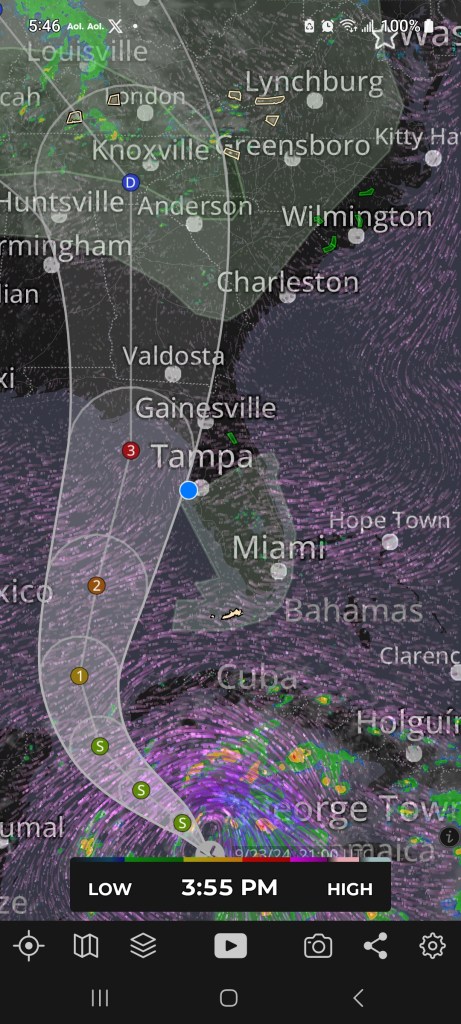
    As I write this, there is a real storm brewing, both within and without. The image below is a weather map of the hurricane that may soon hit my area, forcing me to evacuate. As someone living in an RV, evacuation is usually mandatory in situations like this, and so I find myself facing the possibility of having to leave my bed in the middle of a crash caused by overdoing it.

    The threat is very real, and so the importance of pacing is now at a level that I can’t ignore. I must prioritize rest and recovery immediately, because no matter what state I’m in, I’ll have to get out of bed and go to the hurricane shelter at the church next door if an evacuation order comes.

    This situation has made it even clearer to me how crucial the practice of witnessing vrittis and pratyayas is. Without that practice, I would be overwhelmed by anxiety and fear right now. The mind wants to run wild with worst-case scenarios and worries, but I have been training myself to simply witness these thoughts as they arise. They are just thoughts—just mental fluctuations. They do not have to define my experience. I can stay present, calm, and clear, ready to deal with whatever comes.

    So, after I finish writing this post, I’m going into massive rest and be prepared mode. The practice of pacing has never been more critical. This is an extreme red-flag situation, and I hope it serves as a reminder to all of us with chronic fatigue syndrome: sometimes, the urgency of rest is not just about avoiding a crash; it’s about survival.

    Take a look at the image below—it’s a reminder to me, and hopefully to you as well, that life can throw storms at us both literally and metaphorically. But with the right practices, we can remain centered and grounded, ready to face what comes with a steady mind and a rested body.

    As we face the storms within and around us, may we find peace in the stillness of our hearts. May all beings be free from suffering and the causes of suffering. May all beings experience happiness and the causes of happiness. May we all find safety, strength, and well-being on our journeys, no matter how turbulent the path. May we be guided by wisdom, anchored in compassion, and find harmony in the unfolding of each moment. And in these times of uncertainty, may we remember our interconnectedness, and may we all be held in grace and peace.

    🙏🕊️🙏

  • Witnessing the Journey: Strengthening the Seer in Life’s Transitions

    In the journey of spiritual growth, each moment, each challenge, and every encounter presents an opportunity to deepen our awareness. No matter the external circumstances—whether we’re moving from one phase of life to another, letting go of past attachments, or simply observing the fluctuations of the mind—there is a steady witness that remains untouched. This witness, or seer, is the essence of our true nature, and learning to strengthen our connection to it is one of the most important steps on the path to inner freedom.

    The Shift from Mind to Heart

    For many of us, the longest journey is the shift from the ordinary mind to the heart, or from the restless fluctuations of thoughts (vrittis) to the calm, witnessing presence. The heart, in spiritual traditions such as Advaita Vedanta and Jewish mysticism, is often equated with the Divine. It’s not merely an emotional center but the seat of the Divine Presence within us—Atman as Brahman, or the individual self as one with the Absolute.

    As we begin to experience this shift, we realize that our external experiences—both positive and negative—are just reflections of the inner workings of our mind. The challenges, such as illness or life transitions, become opportunities to witness these reflections without being swept away by them. This movement from the mind to the heart is the foundation for a life of spiritual presence.

    Living Between Excitement and Calm

    One of the paradoxes on the spiritual path is living with dual awareness: experiencing the emotional fluctuations of excitement, frustration, or joy while simultaneously witnessing them from a place of calm and neutrality. The spiritual journey does not require that we suppress these emotions, but rather that we hold them lightly, recognizing them as transient waves on the surface of our consciousness.

    As Namkhai Norbu teaches, the presence of awareness exists both in moments of calm and agitation. The mind may be excited, but the witness remains still. This dual awareness allows us to engage fully with life without losing our spiritual center. As we strengthen the seer within us, we find that both excitement and calm can coexist, and we learn to embrace the paradox of non-duality within dual awareness.

    Letting Go of Attachments: The RV and Beyond

    Transitions in life—whether they involve moving from one home to another or shifting from one state of consciousness to another—offer us the chance to practice letting go. For many years, a beloved space like an RV can be a sanctuary, a place of refuge for meditation and contemplation. But when the time comes to leave, it becomes a test of non-attachment, a reminder that the true sanctuary is within us.

    Letting go is not simply about releasing physical objects or spaces; it’s about releasing the emotional and mental attachments we have to them. It’s about trusting that even as we move into unfamiliar territory, the witness remains constant. As we let go of the old, we create space for something new to emerge—a fresh start, or beginner’s mind, as we navigate life with openness and curiosity.

    The Importance of Trust and Faith

    A major theme in this spiritual journey is trust—trust in the Divine, trust in ourselves, and trust in the process. After years of doubt and uncertainty, we may begin to experience a deep sense of confidence and trust in life’s unfolding. Even when life presents us with difficult or unexpected challenges, such as illness or the need to move from a long-held refuge, trust allows us to remain grounded in the witness.

    This trust doesn’t mean we stop facing difficulties, but rather that we learn to see them as part of the greater unfolding of our spiritual path. Each test, no matter how small or large, becomes another opportunity to strengthen the seer within. As the Buddha taught, the Dharma is like a raft that helps us cross the ocean of suffering. Once we reach the other shore, we leave the raft behind, trusting that we now carry the teachings within us.

    Witnessing the Witness: A Reflection of Inner Harmony

    Ultimately, the journey is about witnessing the witness—becoming aware of the awareness that is always present, regardless of the external conditions. This awareness, which we can also call the Divine, is not dependent on calmness or agitation, happiness or sadness. It simply is. And as we deepen our connection to this awareness, we come to embody the teachings in our lived experience.

    The process of writing and sharing these insights is part of this journey. Just as we are learning to let go of attachments, we also leave behind reflections in the form of writings, teachings, and blog posts. This is karma yoga—an offering of selfless service to whoever may benefit from these reflections. Like the authentic seeker who presents the teachings from the heart rather than from notes, we are called to embody the wisdom we’ve gathered and leave the rest for others to use as they see fit.

    Conclusion: The Journey of the Seer

    In the end, the journey is about becoming the witness to our own life, embracing both the external challenges and the internal awareness that guides us through them. As we continue to strengthen the seer within us, we move closer to a life of true presence, where each moment, no matter how challenging, becomes an opportunity for growth and transformation.

    May this reflection serve as a reminder to all who encounter it that the witness is always present, guiding us through the transitions of life and helping us to cultivate trust, non-attachment, and inner peace.

    🙏🕊️🙏

  • Rapture: An Inner Experience or a Future Event?

    The concept of rapture holds a significant place in many religious traditions, often representing a powerful moment of divine encounter. However, the interpretation of this experience varies widely across spiritual paths. For some, rapture is a future event, a moment of transcendent liberation from the trials of the world. For others, rapture is an immediate, inner experience of union with the Divine, accessible in the present moment. This blog post explores these differing perspectives, inviting readers to consider the possibility that rapture might be both a future hope and a present reality.

    Rapture as a Hoped-for Future Event

    In many Christian communities, the term “rapture” is closely associated with the belief in a future event where believers are taken up to be with Christ. This event is often envisioned as a sudden and dramatic moment where those who have lived faithfully are removed from the tribulations of the world and brought into eternal communion with the divine. This interpretation provides a powerful source of hope, offering assurance of divine rescue and the promise of a heavenly future.

    This understanding of rapture emphasizes an external transformation, a moment when the divine intervenes in human history to gather the faithful and bring them into a new realm of existence. For many, it is a symbol of ultimate redemption, where suffering and struggle are left behind, and believers are welcomed into the fullness of God’s presence.

    Rapture as a Present-Moment Realization of the Divine

    However, there is also another, less spoken about, possibility of rapture. Here, rapture is not something that will happen in the distant future but an experience that can be realized in the here and now. It is a state of being where the soul becomes fully absorbed in the divine presence, transcending the ordinary boundaries of self and the material world.

    This inner rapture is often described as a moment of profound bliss and unity, where the individual self merges with the universal consciousness. Through practices like meditation, prayer, and devotion, one can enter into this state of rapture, experiencing the divine not as a distant reality but as an intimate, present-moment truth.

    Bridging the Perspectives: Rapture as Both Now and Later

    These two interpretations of rapture—the future event and the present realization—need not be mutually exclusive. In fact, they can complement each other, offering a fuller picture of what it means to encounter the divine.

    For those who look forward to the future rapture, there is comfort in the promise of divine intervention and the ultimate transformation of the world. Yet, by also embracing the possibility of rapture as an inner experience, there is an invitation to taste the sweetness of divine union in the present moment, to experience a foretaste of the eternal communion that awaits.

    Likewise, for those who seek rapture in the present, there is value in remembering that spiritual growth often unfolds over time, with moments of profound realization serving as milestones on a longer journey. The hope of a future rapture can inspire deeper commitment to the practices that open the heart to the divine here and now.

    Practical Steps Toward Experiencing Inner Rapture

    If the idea of experiencing rapture as an inner, present-moment encounter with the divine resonates with you, here are some practices suggested by mystics throughout history that can help cultivate this experience:

    Saint Teresa of Avila provides a roadmap for deepening your prayer life through mental prayer and contemplation. She describes the soul’s journey as one of moving inward, from vocal prayers to the stillness of contemplation, where one becomes wholly absorbed in God’s presence. To begin this journey, Saint Teresa suggests setting aside quiet time each day for prayer. Start by meditating on the life of Christ, using passages from the Gospels as focal points for your thoughts. As your prayer deepens, you may find words are no longer necessary. Allow yourself to rest in God’s presence in silence, letting go of the need to articulate your thoughts. Over time, this practice can lead to what Saint Teresa describes as “interior recollection,” where the soul is so absorbed in the divine presence that it forgets itself entirely, consumed by the sweetness of this union. She encourages practicing this recollection not just during designated prayer times but throughout the day, continually bringing your mind back to God, even in the midst of daily activities.

    Saint John of the Cross, another profound mystic, offers guidance on navigating the challenges that often accompany the pursuit of divine union. He speaks of the “dark night of the soul,” a period of spiritual dryness and seeming distance from God, which he interprets as a necessary purification of the soul. John teaches that to reach divine union, one must first pass through this purgation, releasing attachments to worldly desires and false comforts. He suggests regular self-examination to identify these attachments and encourages embracing humility and detachment. During times of spiritual dryness, rather than retreating, he advises pressing deeper into prayer and surrender, trusting that these are the very times when God is working most profoundly within the soul. By surrendering completely to God’s will and allowing Him to purify the soul, one can eventually emerge into the light of divine union, where the soul is intimately united with God.

    Thomas Merton, a modern-day contemplative, offers a pathway into the experience of rapture through the practice of contemplative prayer. Merton emphasizes that true communication with God happens not through words, but in communion—a deep, silent presence with the divine that transcends ordinary communication. To practice this, Merton suggests setting aside regular times for meditation, where you focus on the presence of God within you. Begin by creating an environment of silence and solitude, which Merton believes is essential for hearing God’s voice. As you meditate, let go of the need to verbalize your thoughts or prayers. Instead, simply be present with God, opening your heart to His presence. Over time, this practice of contemplative prayer can lead you into a deeper communion with God, where words fall away and you experience a profound, wordless union.

    Richard Rohr, another contemporary spiritual teacher, encourages living with a continuous awareness of God’s presence in the present moment. Rohr’s approach is rooted in the idea that God is always near, available to us in each breath and every moment of our lives. He suggests starting your day with a prayer of intention, asking to be aware of God’s presence throughout the day. As you go about your daily tasks, practice mindfulness by focusing on your breath, recognizing it as a sign of God’s life-giving presence within you. Rohr also recommends the practice of “practicing the presence of God,” where you continually bring your awareness back to God as you engage in your everyday activities. By cultivating this habit, you can begin to experience moments of rapture throughout your day—small, sacred encounters with the divine that remind you of God’s constant presence.

    Conclusion: An Invitation to Explore

    Whether one views rapture as a future event or a present experience, it remains a powerful symbol of divine encounter. It invites each of us to consider how we might open ourselves more fully to the divine, whether by preparing our hearts for a future moment of transformation or by seeking the presence of the divine in our everyday lives.

    In the end, the experience of rapture may be less about “when” it happens and more about the depth of our openness to the divine. It is a call to live in the awareness that the divine is always near, whether we are waiting for a future moment of glory or opening ourselves to the possibility of experiencing that glory in the here and now.

    Quotes for Reflection:

    The following quotes capture the essence of rapture as an inner experience of divine union that is available to disciples in this very life.

    • Saint Teresa of Avila, The Interior Castle: “The soul is now fully awake to the call of the Beloved, and God grants it the gift of deep contemplation. The soul becomes so absorbed in the divine presence that it forgets itself entirely, consumed by the sweetness of this union.”

    • Saint John of the Cross, The Living Flame of Love: “Oh, how sweet is the light of God that shines within a pure soul! It is so dazzling that the soul is blinded by its brightness and overwhelmed by the fragrance of His presence.”

    • Thomas Merton, New Seeds of Contemplation: “The deepest level of communication is not communication, but communion. It is wordless. It is beyond words, beyond speech, beyond concept.”

    • Richard Rohr, The Naked Now: “God is not far from us; God is with us—precisely in our very breath, in our own existence, and in the here and now.”

    May we each find our own way to rapture, whether by looking to the future with hope or by seeking the divine presence in this very moment.

    🙏🕊️🙏

  • Emotional Intelligence: Unveiling the Secret to a Richer Life

    In our fast-paced modern era, where intellect and achievement often overshadow deeper personal growth, emotional intelligence emerges as a cornerstone for a truly satisfying life. Pravrajika Divyanandaprana, affectionately known as Swamiji, articulates this beautifully in her enlightening teachings, presenting emotional intelligence not just as a skill but as a transformative force in our lives.

    Emotional intelligence involves more than just managing emotions; it includes understanding them deeply, controlling our reactions, nurturing empathy, maintaining motivation, and honing our social skills. These competencies are essential for resilience, building meaningful relationships, and achieving personal and professional success.

    Swamiji places special emphasis on the twin pillars of emotional intelligence: self-awareness and self-regulation. These are not just abstract concepts but are, in fact, the foundation upon which a balanced and fulfilling life is built.

    Self-awareness is the ability to recognize and understand our own emotions, thoughts, and behaviors. It involves an honest reflection on our internal landscape, where we learn to identify our emotional triggers, the patterns that shape our reactions, and the underlying beliefs that drive our actions. When we are self-aware, we gain insight into our true selves—our strengths, weaknesses, values, and aspirations. This heightened awareness allows us to act consciously rather than react impulsively, making decisions that align with our deeper goals and values. It is through self-awareness that we begin to see the connections between our emotions and our actions, enabling us to navigate life with greater clarity and purpose.

    Self-regulation, on the other hand, is the ability to manage our emotions, especially in stressful or challenging situations. It is the skill of maintaining control over our emotional responses, preventing our feelings from overwhelming our reason and leading us astray. Self-regulation involves practices such as mindfulness, breathing techniques, and cognitive reframing, which help us pause and reflect before reacting. By mastering self-regulation, we can maintain emotional balance, even in the face of adversity, allowing us to respond to life’s challenges with poise and equanimity. This emotional discipline not only protects our mental health but also fosters resilience, enabling us to recover more quickly from setbacks and maintain a positive outlook.

    Together, self-awareness and self-regulation create a powerful synergy. When we understand our emotions and can manage them effectively, we are better equipped to make thoughtful, deliberate decisions that support our overall well-being. This combination empowers us to navigate the complexities of life with greater ease, reducing stress and increasing our capacity for joy and fulfillment. Through these practices, we can create a life that is not only successful in external terms but also deeply satisfying and aligned with our inner values and true purpose.

    Interestingly, Swamiji suggests that emotional intelligence, much like physical strength or endurance, can be cultivated through deliberate practice and conscious effort. This perspective shifts emotional intelligence from being seen as an innate trait—something you either have or don’t—to a set of skills that can be developed and refined over time.

    Deliberate practice in the context of emotional intelligence involves consistently engaging in activities and exercises that strengthen our ability to understand and manage our emotions. Just as an athlete might follow a structured training regimen to improve their performance, individuals can adopt specific practices to enhance their emotional intelligence.

    For example, self-awareness can be developed through mindfulness practices, journaling, or regular self-reflection. These activities encourage us to pause and examine our emotions as they arise, helping us to identify patterns, triggers, and the deeper motivations behind our actions. Over time, this practice sharpens our awareness of our emotional landscape, making us more attuned to our internal states and more capable of navigating them effectively.

    Cultivating equanimity, the ability to remain calm and composed in the face of life’s challenges, plays a crucial role in the development of emotional intelligence. Equanimity allows us to maintain emotional balance, even in stressful situations, which enhances our capacity for self-regulation and thoughtful decision-making. By fostering a steady and centered mind, equanimity helps us to respond to our emotions with clarity and wisdom, rather than being swept away by impulsive reactions. This inner stability not only supports our mental and emotional well-being but also strengthens our relationships, as we are better able to empathize with others and engage in compassionate, constructive interactions. In essence, equanimity acts as the anchor that holds all aspects of emotional intelligence together, enabling us to navigate life’s ups and downs with grace and resilience.

    Self-regulation can be strengthened through techniques such as deep breathing, meditation, or cognitive reframing. These practices teach us to pause before reacting, allowing us to choose our responses rather than being driven by our immediate emotional impulses. By consistently practicing these techniques, we can develop greater control over our emotions, reducing the likelihood of outbursts or decisions made in the heat of the moment.

    Empathy can also be cultivated through deliberate practice. Engaging in active listening, putting ourselves in others’ shoes, and practicing compassion in daily interactions are all ways to build this crucial component of emotional intelligence. As we practice empathy, we become more adept at understanding others’ perspectives and emotions, leading to deeper connections and more harmonious relationships.

    Swamiji’s approach to emotional intelligence as a skill set that can be honed through practice is empowering. It suggests that we are not at the mercy of our emotions or our current level of emotional intelligence. Instead, we have the capacity to grow and evolve, improving our emotional intelligence just as we would improve any other ability. This growth mindset opens the door to continuous self-improvement and personal development, leading to a more fulfilling and emotionally balanced life.

    By embracing and enhancing our emotional intelligence, we open doors to not just personal happiness but also to making a profound impact on the world around us. Let us commit to nurturing these essential skills that promise to enrich not only our own lives but also those of everyone we encounter.

    The video below is the source of the inspiration for the content of this blog. If you’d like to get direct teaching from Swamiji on this topic, I encourage you to watch the video and deepen your understanding.

    🙏🕊️🙏

  • Heaven on Earth: The Teachings of Jesus and Bob Marley


    Introduction

    In a world often divided between the sacred and the secular, it can be refreshing—and deeply inspiring—when we find connections between contemporary culture and ancient spiritual wisdom. Bob Marley’s iconic song “Get Up, Stand Up” is more than just an anthem of empowerment; it’s a profound reflection on the nature of heaven, the divine, and our place within it. Surprisingly, Marley’s message aligns closely with the teachings of Jesus, who often spoke about the Kingdom of God as a present reality, accessible to those who have the eyes to see and the ears to hear.

    This post explores the powerful parallels between Bob Marley’s call to recognize heaven on earth and Jesus’ teachings about the Kingdom of God being within us and among us. Together, these voices urge us to look beyond the distant heavens and see the divine right here, right now.


    Jesus’ Teachings on the Kingdom of God

    Jesus frequently spoke about the Kingdom of God, and His words often challenge our assumptions about where and when this Kingdom exists. In Luke 17:21, He says, “The Kingdom of God is within you,” emphasizing that the divine realm is not something far off in the future or located in some distant place. Instead, it is something that can be realized within ourselves, here and now.

    In Mark 1:15, Jesus proclaims, “The time is fulfilled, and the Kingdom of God is at hand; repent and believe in the gospel.” This statement underscores that the Kingdom is not only within us but is also a present reality—something to be lived and experienced in our daily lives. For Jesus, the Kingdom of God is less about a heavenly afterlife and more about a transformative way of living that reflects divine values like love, compassion, justice, and peace.


    Bob Marley’s Message in “Get Up, Stand Up”

    Bob Marley’s “Get Up, Stand Up” carries a message that resonates deeply with Jesus’ teachings. In the song, Marley challenges the idea that heaven is a far-off place that we only reach after death. He sings, “Most people think / Great God will come from the sky / Take away everything / And make everybody feel high.” But Marley counters this with a profound truth: “If you knew what life is worth / You would look for yours on earth.”

    Marley’s lyrics echo the idea that heaven is not something we passively wait for, but something we actively create and experience in the here and now. His call to “stand up for your rights” is not just a social or political statement; it’s a spiritual one, urging people to recognize their own worth, dignity, and divine connection. Like Jesus, Marley is telling us that the divine is not some distant, unattainable reality—it’s right here, in our midst, and within us.


    Connecting the Dots: Heaven on Earth

    When we place Jesus’ teachings alongside Bob Marley’s message, a clear picture begins to emerge: both are calling us to recognize that heaven is not a place we go to, but a reality we can create and live out on earth. Jesus tells us that the Kingdom of God is within us and among us, a present reality that manifests when we live according to divine principles. Marley, in his own way, reminds us that we must recognize this truth and stand up for the heavenly reality in our everyday lives.

    The idea of “heaven on earth” is not just a comforting thought—it’s a radical challenge. It asks us to see the divine in every aspect of our lives and to live in a way that reflects the values of the Kingdom of God: love, justice, compassion, and peace. This is not easy, and it’s certainly not always comfortable, but it’s the path that both Jesus and Marley urge us to take.


    Living the Message

    So, how do we live out this message of bringing heaven to earth? It begins with a shift in perspective—seeing the divine in the ordinary and the sacred in the everyday. It means treating each moment as an opportunity to manifest the values of the Kingdom of God: loving our neighbors, standing up for the oppressed, caring for the needy, and seeking justice.

    Just as Marley calls us to “Get up, stand up,” Jesus calls us to take up our cross and follow Him. This isn’t about waiting for a distant paradise, but about actively participating in the creation of a heavenly reality on earth. It’s about recognizing that the Kingdom of God is already here, in our midst, and that we are called to bring it to life in the way we live, love, and serve others.


    Conclusion

    The teachings of Jesus and the message of Bob Marley both point us to a profound truth: heaven is not just a destination; it’s a way of life. The Kingdom of God is not somewhere far off in the clouds; it’s within us and among us, waiting to be realized and lived out. As we reflect on these teachings, let’s challenge ourselves to see heaven on earth, to live in a way that manifests the divine, and to stand up for the values that make the Kingdom of God a reality in our world today.

    So, the next time you listen to “Get Up, Stand Up,” remember that the call is not just to resist oppression or claim your rights—it’s also a call to recognize and live out the heaven that is already here, within you, and in our midst.


    Bob Marley – Get Up, Stand Up

    (Live at Munich, 1980)

  • Embracing the Journey: The Subtle Path of Spiritual Growth


    In the quiet hours of prayer, contemplation and meditation, it’s natural to hope that all the time and energy devoted to spiritual practice would lead to a profound sense of being in a spiritually “good place.” After all, when you pour your heart into understanding the deeper truths of existence, there’s an expectation that the fruits of this labor should be evident—peace, clarity, and a steady sense of progress.

    Yet, the journey of spiritual growth is often far more complex and subtle than we anticipate. It’s not a straight path with clear markers of progress, but rather a winding road filled with unexpected turns, peaks, and valleys. Even with the most dedicated practice, there can be moments when you don’t feel as spiritually grounded or advanced as you might hope. These moments can be perplexing, leaving you wondering why, despite all your efforts, you don’t feel as though you’re where you “should” be.

    One of the first realizations on this path is that spiritual growth is not a linear process. It doesn’t follow a simple trajectory of consistent upward progress. Instead, it’s a dynamic and often unpredictable journey. There are times of clarity and deep connection, where everything seems to fall into place, and times of confusion, where doubt and uncertainty creep in. What may feel like a setback or a period of stagnation could actually be a vital part of your deeper growth—an integration phase where the insights you’ve gained are settling into your being.

    Another aspect to consider is the expectations that the mind creates. The mind often forms ideas about what spiritual progress should look like—perhaps a constant state of peace, detachment from worldly concerns, or a sense of enlightenment that transcends daily struggles. When reality doesn’t match these expectations, it can lead to frustration and a sense of inadequacy. However, true spiritual growth often occurs beneath the surface, in ways that are not immediately visible or even consciously felt. The changes may be subtle, shifting how you respond to challenges, deepening your capacity for compassion, or fostering a quiet resilience that wasn’t there before.

    A crucial part of this journey is learning to accept where you are in the present moment without judgment. This includes embracing feelings of doubt, frustration, or uncertainty as natural parts of the human experience. These emotions are not signs of failure or lack of progress, but rather aspects of the path that invite you to deepen your practice of self-acceptance. Recognizing and allowing these feelings to be, without trying to force them away or judge them, can be a profound spiritual practice in itself.

    In this process, self-compassion becomes an essential ally. It’s important to be gentle with yourself as you navigate the ups and downs of the spiritual path. The goal is not to reach a specific destination but to be present with yourself through all the fluctuations of life. Self-compassion allows you to honor your efforts and your humanity, acknowledging that growth isn’t always about visible results but about the ongoing commitment to living with intention and awareness.

    There is also the reality that progress isn’t always visible. Sometimes, the growth you’re experiencing spiritually isn’t something you can easily measure or feel. It may be happening internally, in ways that you can’t yet recognize. Trusting in the process and knowing that your efforts are meaningful, even when they don’t produce immediate, tangible results, is key. The work you’re doing in contemplation and meditation is laying the groundwork for ongoing transformation, even if it’s not always apparent.

    Letting go of the idea of a “spiritually good place” can also be liberating. This notion can create a sense of pressure or inadequacy, as though where you are now isn’t good enough. But spirituality isn’t about reaching a final state of being; it’s about the ongoing discovery, learning, and connection with the deeper aspects of yourself. Every moment, including those filled with doubt or struggle, is an integral part of the spiritual journey. These moments are not obstacles to overcome but experiences that shape and refine your understanding and compassion.

    In reflecting on this, it’s also helpful to remember that, just as with the countless acts of quiet goodness and resilience that exist in the world, your spiritual growth might be unfolding in ways that are subtle and quiet, but no less profound. The efforts you make, the practices you engage in, and the intentions you hold are all contributing to your growth, whether you can see it in the moment or not.

    So, if you ever find yourself questioning where you are on your spiritual path, take a step back and consider the possibility that you are exactly where you need to be. The journey of spiritual growth is ongoing, and every effort you make is a meaningful part of that journey. Even the moments that feel like setbacks are opportunities for deeper reflection and growth.

    In those moments when the weight of expectations or the sense of stagnation feels heavy, it may be wise to rest, to reflect on your journey, and to remind yourself that progress is not always about the destination but about the journey itself. You’re already doing the work, and that, in itself, is a sign of deep commitment and progress.

    The spiritual path is not about perfection or reaching a final state of enlightenment. It’s about being present with yourself, embracing the journey with all its complexities, and trusting that every step you take is leading you closer to the true essence of who you are.


  • Discovering the Path of Sadhana Pancha Kama: A Journey of Spiritual Progress

    In our quest for spiritual growth, we often seek teachings that provide both wisdom and practical guidance. The Sadhana Pancha Kama, a profound set of instructions for spiritual progress, offers just that—a roadmap for those who are earnest in their pursuit of higher realization.

    These teachings, as shared by Pravrajika Divyananda Prana, outline essential practices that can help us align our daily lives with our spiritual goals. They serve as both a guide and an inspiration for anyone looking to deepen their spiritual practice.

    The Sadhana Pancha Kama consists of forty instructions, each designed to cultivate qualities and habits that lead to spiritual awakening. These steps are not just theoretical concepts; they are meant to be lived and experienced in the heart and mind of every seeker.

    A Glimpse into the Teachings

    While all forty instructions are vital, I’d like to share some reflections on a few that have particularly resonated with me:

    • Study the Vedas Daily: This first instruction emphasizes the importance of grounding oneself in sacred knowledge. While I’ve primarily studied texts like the Bible, the Bhagavad Gita, the teachings of the Buddha, and other spiritual traditions, the practice of daily study has become a cornerstone of my spiritual life. It reminds me to continually seek wisdom and understanding, no matter where I find it.
    • Perform Duties Ordained by the Vedas: In my own life, this translates to the practice of karma yoga. As I write and share spiritual reflections daily, I strive to perform these duties with dedication and without attachment to the outcome. It’s about doing the work with sincerity and leaving the results in the hands of the divine.
    • Turn Your Mind Away from Desires: This instruction speaks directly to the practice of detachment. Whether it’s letting go of material desires or attachments to specific outcomes in my life, I’m reminded that true contentment comes from within, not from external circumstances.
    • Seek the Company of the Wise: Surrounding oneself with wisdom has been essential on this path. Whether through spiritual teachers, books, or even online communities, the presence of wise guidance helps me stay focused and inspired on my journey.

    These are just a few examples of how the Sadhana Pancha Kama can be integrated into daily life. Each instruction offers a new opportunity for contemplation, growth and deeper understanding.

    A Path for All Seekers

    The beauty of the Sadhana Pancha Kama lies in its universality. These teachings are accessible to anyone, regardless of where they are on their spiritual journey. Whether you’re just beginning or have been on the path for years, there is something in these instructions for everyone.

    For those who wish to explore these teachings further, I highly recommend listening to Pravrajika Divyananda Prana’s discourse on the Sadhana Pancha Kama. Her insights bring these ancient instructions to life, making them relevant and applicable to our modern lives.

    May these teachings inspire you as they have inspired me, guiding you ever closer to the realization of your true self.

    🙏🕊️🙏