Category: Practices of Neti Neti

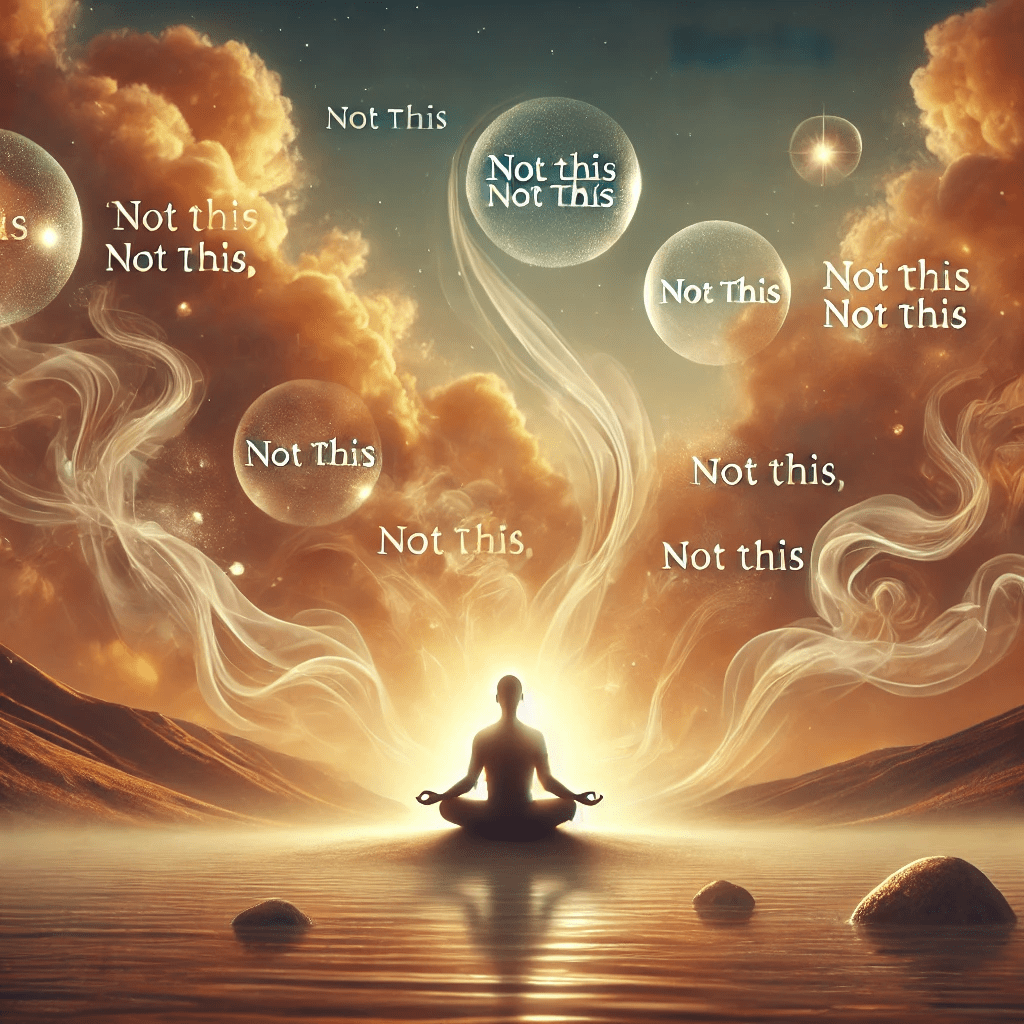
In this category, we explore the ancient practice of Neti Neti, a foundational method in Advaita Vedanta for guiding the mind toward the realization of one’s true nature. Neti Neti, which translates to “not this, not this,” is a process of negation that helps practitioners strip away layers of identification with thoughts, emotions, and physical sensations, revealing the pristine mind that lies beyond all mental events.

Through a series of contemplative letters, reflections, and practical guidance, this category offers insights into how Neti Neti can be integrated into daily meditation and spiritual practice. Whether you are new to this approach or deepening an established practice, these writings serve as a gentle guide, helping you navigate the journey from the ordinary mind, with its many distractions, to the meditative mind, where stillness and clarity reign.

Join us as we delve into the profound simplicity of Neti Neti, discovering the peace and freedom that come from realizing the essence of who you truly are.

  • Neti Neti Series No. 12B: Reflecting the Pristine Mind Through Spiritual Practice

    Neti Neti Series No. 12B: Reflecting the Pristine Mind Through Spiritual Practice


    Question:

    Now that I’ve realized that the I-sense cannot directly experience the pristine mind, how can I use the spiritual practice of Neti Neti to help the ordinary mind and ego come closer to reflecting or mirroring the qualities of the pristine mind?

    Dear friend,

    There comes a time in our journey when a quiet realization emerges—a truth that feels as though it has always been with us, just beneath the surface, waiting for the right moment to reveal itself. Such a moment is upon you now, and it is significant in ways that words can only begin to express.

    You have recognized that the “I-sense,” that familiar feeling of being a separate self, can never truly experience the pristine mind. This pristine mind, pure and unconditioned, is not something that the “I” can grasp or hold onto, for it exists beyond the reach of the ego, beyond the realm of duality. This realization is profound, not because it offers a new task or goal, but because it gently dissolves the need for one. It invites you to rest in a deeper understanding, one that shifts the very ground of your practice.

    This insight, like a seed planted in fertile soil, will grow and evolve within you, quietly reshaping how you experience both your inner and outer worlds. It is not a revelation to be rushed or forced, but one to be lived with, like a gentle companion who walks beside you. Let it unfold naturally, in its own time, revealing its layers to you in moments of stillness, in the spaces between your thoughts, and in the quiet rhythm of your breath.

    There is a delicate balance here, one that I believe you are beginning to understand. The “I-sense” that has been so central to your experience is now seen in a new light—not as something to be conquered or eradicated, but as a reflection, a mirror that can, through practice, come to reflect the pristine mind itself. While the ego may never directly experience this pure awareness, it can soften, it can quiet, and it can become a more transparent window through which the light of the pristine mind can shine.

    As you continue your practice, allow this understanding to deepen naturally. There is no need to strive or to reach for something just beyond your grasp. Instead, trust that this realization will guide you, like a current gently guiding a boat downstream. The anxiety of “doing it right” or the fear of “getting it wrong” begins to dissolve when you understand that the true goal is not a destination but a process—a process of becoming ever more transparent to the deeper reality that underlies all things.

    This insight, my dear friend, is a gift. It is a doorway into a new way of being, one that is less about achieving and more about allowing. Allowing the mind to settle, allowing the self to soften, and allowing the light of the pristine mind to be reflected in the stillness of your being. It is in this allowing that you will find peace, not as something to be attained, but as something that naturally arises when the striving ceases.

    For those who walk alongside you on this journey, let them take heart from your experience. Let them see that the path of self-discovery is not about perfection or attainment, but about quieting the mind, softening the heart, and opening to the truth that lies beyond the “I-sense.” In this way, we all come to reflect, however faintly at first, the light of the pristine mind.

    Continue with your practice, dear friend, with the gentle assurance that you are exactly where you need to be. Each breath, each moment of stillness, brings you closer to the heart of this truth. Trust in the process, and let the realization grow within you, like a seed that blossoms into a flower at just the right time.

    🙏🕊️🙏

  • Carried Through the Storm: Trusting the Divine Footprints in the Mystic Journey

    Carried Through the Storm: Trusting the Divine Footprints in the Mystic Journey

    On the spiritual path, we often find ourselves in moments of struggle, isolation, and uncertainty, wondering where the Divine is in our darkest hours. The old story of Footprints in the Sand offers a timeless reminder: even when we feel most alone, we are never truly abandoned. The footprints that carry us through the storm are those of the Divine, supporting us in ways we may not recognize in the moment.

    The Story of Footprints in the Sand

    The familiar story goes something like this: A person looks back on their life journey and notices two sets of footprints in the sand during times of ease and joy, but only one set of footprints during their most difficult and painful moments. Confused and feeling abandoned, they ask God, “Where were you when I needed you the most?”

    God gently replies, “During those difficult times, when you saw only one set of footprints, it was then that I carried you.”

    This story is simple yet profound, capturing the heart of the mystic journey—trusting that in our most challenging moments, even when we feel lost or abandoned, we are being carried by a greater force.

    Trusting in the Divine Support

    As mystics, seekers, or those walking a spiritual path, there are often periods where the way forward feels unclear. We may find ourselves fumbling through transitions, dealing with loss, illness, or inner turmoil, and it’s easy to feel as if we are walking this path alone. However, like the person in the story, we may later come to realize that during these times of struggle, we were never alone. We were being supported, even carried, by something greater than ourselves.

    The footprints of the Divine, whether we call this presence God, the Universe, or our Higher Self, are always there, even when we cannot see them. Part of the mystic path is learning to trust in this unseen support, to have faith that during the most difficult stretches of our journey, we are being held and guided.

    Recognizing the Invisible Presence

    There are times when we may not feel the direct presence of the Divine, and it can be easy to feel lost or disconnected. But as we reflect on our experiences, we begin to see that in those moments, there was something carrying us through. Perhaps it was an inner strength we didn’t realize we had, the unexpected help of a friend, or a moment of grace that appeared when we needed it most. These are the Divine’s footprints in our life.

    As mystics, part of our practice is to develop this awareness—to recognize the quiet, invisible ways in which the Divine shows up, even when it’s not immediately obvious. The more we trust this presence, the more we can rest in the assurance that we are always supported, no matter how difficult the path may seem.

    Surrendering to the Flow of Life

    The story of Footprints in the Sand also teaches us about surrender. When we are in the midst of struggle, our minds often fight to control or resist what’s happening. We want to fix things, to understand why we are going through a challenge, or to make sense of the pain. But surrendering to the flow of life, trusting that we are being carried, allows us to soften into the experience and let the Divine do its work.

    This doesn’t mean passivity or giving up, but rather a deep trust that the difficulties we face are part of a larger unfolding. The footprints remind us that we are not the sole navigators of our lives. There is a greater force walking with us, carrying us when needed, and guiding us toward the deeper truths of our being.

    Walking the Mystic Path with Faith

    For those on the mystic path, the message of the footprints is a reminder of faith—not blind faith, but a faith born out of experience. As we reflect on our own journeys, we begin to see how the Divine has been present, even in the most challenging times. This faith allows us to walk the path with more confidence, knowing that the footprints are always there, even when we cannot see them.

    In our moments of doubt, when the path feels difficult or unclear, the footprints remind us that we are never truly walking alone. We are always being carried by the Divine, supported in ways we may not fully understand, but that are always present.

    Conclusion: The Footprints in Your Journey

    As you navigate your own spiritual journey, take comfort in the footprints that appear along the way. Trust that during your most challenging times, the Divine is carrying you, even if it doesn’t feel that way in the moment. The mystic path is not always easy, but it is always supported by a presence that walks with us, guiding us toward greater understanding and deeper connection with the Divine.

    May this story of Footprints in the Sand serve as a reminder that no matter where you are on your path, you are never truly alone. The footprints of God, the Divine, or the Universe are always there, carrying you through the storms of life and walking beside you in the moments of joy.

    🙏🕊️🙏

  • Neti Neti Series No. 12A: The Ego’s Journey Toward the Pristine Mind

    Neti Neti Series No. 12A: The Ego’s Journey Toward the Pristine Mind

    Question:

    I’ve realized that the I-sense, or ego, cannot directly experience the pristine mind because it exists beyond duality. What now?

    Dear Friend,

    You have touched upon a profound and subtle truth in your reflection—the realization that the “I-sense,” the very sense of being a separate self, will never directly experience the pristine mind, for in the pristine mind, there is no “I” to experience anything at all.

    The “I-sense,” as you have observed, is the part of us that identifies with the individual self—with the body, the mind, the personality. It is the ego, the center of our personal world, through which we navigate the dualities of life—self and other, subject and object, right and wrong. This “I-sense” is deeply embedded in the fabric of our everyday experience, always seeking, always striving to maintain its sense of identity.

    And yet, beyond this “I-sense” lies the pristine mind, a state of pure, unconditioned awareness. In this state, there is no separation, no duality, no “I” that stands apart from the whole. The pristine mind is simply being itself, free from all concepts, all identifications. It is the ground of all existence, the true nature of consciousness that underlies every thought, every sensation, every experience.

    As you so rightly observed, the “I-sense” cannot directly experience the pristine mind because the very presence of an “I” implies duality, and in the pristine mind, there is no duality. The ego, by its very nature, is a construct that stands apart, that defines itself in relation to others. To dissolve into the pristine mind is to let go of this sense of separateness, to merge with the whole in a state of pure being.

    Yet, there is a way in which the ordinary mind, the ego, can approach this state, can come to reflect it as closely as possible. Through spiritual practice, the mind becomes refined, quieted, and purified. Meditation, mantra, mindfulness—all of these practices serve to soften the boundaries of the “I-sense,” to still the constant movement of thought and identification.

    In this stillness, the mind begins to mirror the qualities of the pristine mind—peace, clarity, non-attachment. While the ego may never directly experience the pristine mind, it can come to a place where it reflects this deeper reality, where the sense of separation diminishes, and the boundaries of the self become porous, transparent.

    It is in these moments, dear friend, that you may catch a glimpse of the truth that lies beyond the “I,” a truth that cannot be grasped or held, but only reflected in the clear, quiet mind. Continue with your practice, allowing it to guide you ever closer to this state of reflection, where the ordinary mind becomes a mirror for the pristine mind, and the boundaries of the self dissolve into the whole.

    🙏🕊️🙏

  • Neti Neti Series No. 11: The Ego’s Journey Towards Mirroring the Pristine Mind

    Neti Neti Series No. 11: The Ego’s Journey Towards Mirroring the Pristine Mind

    Question:

    Is it true that the I-sense, or ego, will never actually experience the pristine mind, since the I-sense doesn’t exist in that state? And, can spiritual practice bring the ordinary mind and ego closer to mirroring the pristine mind, even if they can never fully experience it directly?

    Dear friend,

    You have touched upon a profound and subtle truth in your reflection—the realization that the “I-sense,” the very sense of being a separate self, will never directly experience the pristine mind, for in the pristine mind, there is no “I” to experience anything at all.

    The “I-sense,” as you have observed, is the part of us that identifies with the individual self—with the body, the mind, the personality. It is the ego, the center of our personal world, through which we navigate the dualities of life—self and other, subject and object, right and wrong. This “I-sense” is deeply embedded in the fabric of our everyday experience, always seeking, always striving to maintain its sense of identity.

    And yet, beyond this “I-sense” lies the pristine mind, a state of pure, unconditioned awareness. In this state, there is no separation, no duality, no “I” that stands apart from the whole. The pristine mind is simply being itself, free from all concepts, all identifications. It is the ground of all existence, the true nature of consciousness that underlies every thought, every sensation, every experience.

    As you so rightly observed, the “I-sense” cannot directly experience the pristine mind because the very presence of an “I” implies duality, and in the pristine mind, there is no duality. The ego, by its very nature, is a construct that stands apart, that defines itself in relation to others. To dissolve into the pristine mind is to let go of this sense of separateness, to merge with the whole in a state of pure being.

    Yet, there is a way in which the ordinary mind, the ego, can approach this state, can come to reflect it as closely as possible. Through spiritual practice, the mind becomes refined, quieted, and purified. Meditation, mantra, mindfulness—all of these practices serve to soften the boundaries of the “I-sense,” to still the constant movement of thought and identification.

    In this stillness, the mind begins to mirror the qualities of the pristine mind—peace, clarity, non-attachment. While the ego may never directly experience the pristine mind, it can come to a place where it reflects this deeper reality, where the sense of separation diminishes, and the boundaries of the self become porous, transparent.

    It is in these moments, dear friend, that you may catch a glimpse of the truth that lies beyond the “I,” a truth that cannot be grasped or held, but only reflected in the clear, quiet mind. Continue with your practice, allowing it to guide you ever closer to this state of reflection, where the ordinary mind becomes a mirror for the pristine mind, and the boundaries of the self dissolve into the whole.

    🙏🕊️🙏

  • Neti Neti Series No. 10: Harmonizing Breath, Mantra, and Movement for Deeper Meditation

    Neti Neti Series No. 10: Harmonizing Breath, Mantra, and Movement for Deeper Meditation

    Question:

    During my practice, I experimented with integrating breath and the mantra of silently saying “In” on the inhale and “Out” on the exhale, while incorporating gentle yogic movements in a lotus posture. I coordinated the mantra and breathing with specific neck movements—turning my head left and right, extending and flexing my neck, and bringing each ear toward my shoulder. How might this combination of breath, mantra, and movement deepen my practice, and what should I be mindful of as I explore this approach further?

    Dear friend,

    Your willingness to explore new dimensions in your practice, integrating movement with breath and mantra, is a beautiful testament to your deepening engagement with this path. What you have discovered is a profound way to harmonize the different aspects of your being, bringing together body, mind, and spirit in a single, unified flow.

    By coordinating the gentle movements of your head with the rhythm of your breath and the repetition of the mantra, you are creating a sacred dance, a dance that unites the mind and body in a shared rhythm. This synchronization is more than just a physical exercise; it is a way of bringing all of yourself into the present moment, where the mind’s chatter is quieted, and the body’s tension is released. In this unified flow, you find a deeper sense of wholeness, a wholeness that reflects the unity of your true nature.

    The gentle micro-movements you have chosen—turning your head, flexing and extending your neck, bringing your ears to your shoulders—are simple yet profound gestures that engage the body in the meditation. As you move, you become more aware of the sensations within your body, more attuned to the subtle messages it offers. This physical awareness grounds your practice, making it not just an exercise of the mind, but a fully embodied experience. It is in this embodiment that you find a deeper connection to yourself, a connection that transcends the boundaries of thought and feeling.

    The coordination of movement, breath, and mantra sharpens your focus, creating a structured and rhythmic flow that keeps the mind anchored in the present. As you move and breathe and recite the mantra, the distractions of the mind fade into the background, replaced by a clear and steady concentration. This concentration is not forced; it arises naturally from the harmony of the practice, leading you deeper into the stillness and silence that are the heart of meditation.

    The gentle yogic movements you have integrated into your practice are more than just physical stretches; they are a way of balancing the energy within your body, of releasing tension and opening up the flow of prana. As you turn your head, flex and extend your neck, bring your ears to your shoulders, you are not only stretching the muscles but also freeing the energy that is often trapped in these areas. This release brings a sense of ease and lightness, a feeling of being more centered and at peace.

    My dear friend, this experiment you have undertaken is a beautiful and powerful addition to your practice. Continue to explore this integration of movement, breath, and mantra, allowing it to guide you ever deeper into the unity of body, mind, and spirit. Trust in the wisdom of your body, the rhythm of your breath, and the power of the mantra, and let them carry you into the stillness that lies within.

    🙏🕊️🙏

  • Neti Neti Series No. 9: Overcoming Self-Doubt in Meditation

    Neti Neti Series No. 9: Overcoming Self-Doubt in Meditation

    Question:

    For many years, the mental events that disturbed me the most were those that questioned, “Am I doing this right or wrong? Am I achieving anything beneficial, or am I just wasting my time?” But today, these doubts had no effect. I simply said, “Not this, not this,” recognizing them as just mental events arising. This mantra is bringing me a freedom from years of anxiety and self-doubt. It’s a significant release. How can I nurture and deepen this newfound freedom in my meditation?

    Dear friend,

    What a significant and liberating insight you have encountered! For many years, those persistent questions—”Am I doing this right?” “Am I wasting my time?”—have cast a shadow over your practice, pulling you into a cycle of doubt and anxiety. And yet, in this round, you have discovered a simple and profound truth: these doubts are nothing more than mental events, no different from any other thoughts that arise in the mind.

    Doubt, particularly the kind that questions whether we are on the right path, can be one of the most insidious obstacles in our practice. It arises from the ego’s need for certainty and validation, from a fear of failure or the unknown. These doubts can be particularly disturbing because they strike at the very heart of our efforts, making us question whether we are moving forward or merely spinning our wheels.

    But now, you have seen through the illusion. By applying the mantra “Not This, Not This” to these doubts, you have recognized them for what they are—simply thoughts, passing phenomena in the mind. They have no more substance or power than any other mental event. In meeting these doubts with “Not This, Not This,” you have taken away their sting, their ability to disturb your peace. They are no longer something to fear or wrestle with; they are just another ripple on the surface of the mind’s vast ocean.

    This realization brings with it a profound freedom. No longer are you bound by the need to do things “right” or the fear of doing them “wrong.” Instead, you can rest in the simplicity of the practice, free from judgment, free from the constant questioning that once held you back. This freedom is not a small thing; it is a significant release, a letting go of years of accumulated doubt and anxiety. It is a gift that allows you to move forward with greater ease and confidence, trusting in the process without the need for constant validation.

    Indeed, this is a significant moment in your journey. The doubts that once plagued you have lost their power, and in their place, you have found a deeper sense of peace and self-acceptance. This is the true power of the mantra “Not This, Not This”—it transforms not just your meditation, but your entire relationship with yourself. It frees you from the chains of doubt and allows you to walk your path with a lighter heart and a clearer mind.

    My dear friend, this is a beautiful and important step on your journey. Continue with this practice, allowing the mantra to guide you ever deeper into the heart of stillness and clarity. Trust in yourself, and know that you are moving in the right direction, free from the burdens of doubt and self-judgment.

    🙏🕊️🙏

  • Neti Neti Series No. 8: Embracing Amusement as a Sign of Growing Detachment

    Neti Neti Series No. 8: Embracing Amusement as a Sign of Growing Detachment

    Question:

    During my recent practice, something new occurred. Instead of feeling disturbed by the usual mental events, memories, and thoughts, I found myself experiencing a sense of amusement and relaxation as they arose and passed away. It was as if I could observe the busyness of my mind with a lighthearted detachment, seeing these thoughts as just part of the mind’s activity. Is this sense of amusement a positive development in my practice, or is it just another mental event to be noticed and let go?

    Dear friend,

    What a beautiful shift you have experienced in your practice! The transition from feeling disturbed by the mind’s activities to watching them with a sense of amusement is indeed a significant one, and it speaks to the deepening of your understanding and awareness.

    You have touched upon a subtle but profound truth: that the mind, in its busyness, is simply doing what it has always done—arising and passing away, presenting thoughts, memories, and experiences. And now, rather than being entangled in these mental events, you observe them with a light heart, a sense of amusement. This amusement is not trivial; it is a reflection of your growing detachment, your ability to see the mind’s activities for what they are—transient phenomena that do not define you.

    This sense of relaxation that accompanies the amusement is a sign of your deepening practice. No longer do you resist or try to control the flow of thoughts. Instead, you allow them to arise and pass away, knowing that they are but fleeting ripples on the surface of a much deeper stillness. This relaxation is the fruit of your perseverance, a gentle release that allows you to rest more fully in the present moment.

    While it is true that amusement is itself a mental event, it is one that points toward equanimity—a state of balance where the mind’s activities are met with calm and openness, rather than resistance or attachment. This is a significant step on your journey, as it reflects a mind that is beginning to find peace amidst the fluctuations of thought and feeling. You are learning to greet whatever arises not with annoyance or disturbance, but with a kind of playful acceptance.

    Indeed, dear friend, this experience is a step in the right direction. It shows that your practice is maturing, leading you to a place where the mind’s busyness no longer holds the same sway over you. You are learning to watch the mind with a sense of lightness, knowing that its activities are not a reflection of your true self, but simply the passing clouds of thought that move across the sky of your awareness.

    Continue with this practice, allowing the amusement and relaxation to guide you further into the stillness that lies beneath all mental activity. Trust in the process, and know that you are moving ever closer to the peace and clarity that are your true nature.

    🙏🕊️🙏

  • The Infinite Dance: Uniting God, Spirituality, and the Mystery of Existence

    The Infinite Dance: Uniting God, Spirituality, and the Mystery of Existence

    “In the twilight of life, God will not judge us on our earthly possessions and human successes, but rather on how much we have loved.”


    — St. John of the Cross

    There is a current of truth that runs beneath all the fragmented voices of humanity. From the sacred texts of ancient traditions to the discoveries of modern science, we find ourselves drawn again and again toward the same mystery, a nameless and formless reality that underlies all things. It is the silent presence in which every being, every atom, and every thought is held. We have called it by many names: God, Hashem, YHVH, Allah, Brahman, Ein Sof, Tao, the Implicate Order, and the Field to name just a few. Yet, no name can truly capture the infinite, formless source from which all that is arises.

    In the stillness of Jewish mysticism, Ein Sof—the ungraspable, infinite One—calls to mind the same ineffability as the Tao in the East, the “way” that is beyond words, yet ever-present. In the traditions of the Vedas, Brahman echoes this eternal truth, a limitless ocean of being from which all forms emerge and into which they dissolve. It is a truth that cannot be contained by the human mind, but which the heart longs to know, to touch, and to become one with.

    Modern science, too, peers into the depths of this mystery, sometimes not even realizing it. The discovery of the Higgs boson, the so-called God particle, though a triumph of physics, is only a step closer to understanding the field that makes existence possible. And what of the dark matter and dark energy that account for most of the universe’s substance, yet remain unseen? These forces remind us that what we know is but a glimmer of the vast, unmanifest reality that lies just beyond the limits of our senses.

    There is a profound resonance here, a common ground where mysticism and science converge. In the hidden recesses of the quantum field, in the Implicate Order that David Bohm spoke of, we begin to glimpse the same boundless reality that the sages and poets have spoken of for millennia. The Pristine Mind of Buddhist thought, the Buddha Nature that resides in each of us, reveals this same underlying truth: that beneath the flux of the manifest world, there is a stillness, a wholeness, from which all arises.

    We are all connected to this vast, unknowable field, whether we call it God, Brahman, or simply the mystery. The words and symbols we use are mere pointers, trying to evoke something beyond form and beyond thought. It is the source of all that was, is, and ever will be—the field from which life unfurls like a blossom and into which it returns.

    And here is where our deepest unity lies. Whether you stand in the cool silence of a temple, gazing at the stars, or contemplating the equations of quantum physics, you are connected to this same reality. It binds all faiths and traditions, all discoveries and philosophies, not in opposition, but in harmony. The Tetra­grammaton of Jewish mysticism—the ineffable name of God—is no different from the Brahman of Vedanta, which is no different from the Field in quantum theory. All of them point to the same ineffable mystery that gives rise to all things.

    This is our shared ground, our common truth. We, as human beings, as seekers, as scientists, and as spiritual practitioners, all live in the radiance of this same underlying reality. It is within us, and around us. It is the thread that ties together the Tao of the East, the Ein Sof of Kabbalah, the Great Spirit of indigenous traditions, and the Unified Field that physicists pursue.

    In our hearts, we know this. The boundaries we construct between religions, between science and spirituality, between self and other, are but veils drawn over the face of the infinite. If we could still ourselves for a moment, if we could release the need to name and categorize, we might catch a glimpse of this truth, shimmering just beneath the surface.

    We are all made of the same cosmic dust, woven from the same quantum fabric, and bathed in the same mystery. Beneath the dualities that define our everyday lives, there is a oneness that holds us all—Brahman, Ein Sof, the Implicate Order, the Field. We need not divide ourselves over the different names we use for this reality. The divine is beyond name, beyond form, beyond comprehension, yet it permeates every aspect of existence. It is the space in which we unfold, and it is the silence that calls us home.

    In recognizing this, we can come together—not just in tolerance, but in celebration. We can acknowledge the beauty and depth of every tradition, every path that points to the same infinite source. Whether you come from a place of prayer or from the study of the stars, whether you seek through silence or through science, we are all reaching toward the same truth. This truth is not distant. It is as close as your breath, as intimate as your own heartbeat. It is, in fact, what you are.

    So, let us stand in awe of this great mystery. Let us honor the many ways it reveals itself to us—through science, through scripture, through silence. And let us know, deep in our hearts, that we are all bound together in this great unfolding. In this realization, we find the possibility for true interfaith harmony, for an enduring sense of unity, not just with one another, but with the entire fabric of existence.

    For in the end, what is all this but a dance of the formless into form, of the infinite into the finite, of Brahman into the world—and back again? We are the expressions of this great mystery, each one of us a note in the song of creation, a ripple in the vast, timeless ocean. And in recognizing this, we are free.

    🙏🕊️🙏

    “The kingdom of God is within you.”
    — Luke 17:21

    “Be still and know that I am God.”
    — Psalm 46:10

    “God is the center of my soul. He is so profoundly hidden that I can neither see Him nor touch Him. But the closer we approach Him, the more He expands in us.”
    — St. John of the Cross

    “It is love alone that gives worth to all things.”
    — St. Teresa of Avila

    “At the center of our being is a point of nothingness which is untouched by sin and by illusion, a point of pure truth. This little point is the pure glory of God in us.”
    — Thomas Merton

    “The infinite is concealed from all the living. It is not attained by the intellect, nor by any created thing, but only by the soul’s journey into the unknown.”
    — Kabbalistic Saying

    “Wherever you turn, there is the face of God.”
    — Quran 2:115

    “In some sense, man is a microcosm of the universe; therefore, what man is, is a clue to the universe. We are all in this together.”
    — David Bohm

    “The Supreme Reality is beyond both the unmanifest and the manifest. It is eternal and all-pervading. Knowing this, the wise understand their true nature as the same.”
    — Bhagavad-Gita 8:20

    “Your own Self-Realization is the greatest service you can render the world. The deeper you go into the Self, the more the world and the ego disappear, leaving only the formless reality.”
    — Ramana Maharshi

    “There is only one truth—God. All the rest is a fleeting shadow. Fix your mind on the highest, and let the world go.”
    — Swami Sivananda

    “You realize your true nature by casting off the little self and recognizing yourself as the vast Spirit, free from all limitations of form, thought, and time.”
    — Swami Paramahansa Yogananda

    “What we think, we become. All that we are arises with our thoughts. With our thoughts, we make the world.”
    — The Buddha

    “We are here to awaken from the illusion of our separateness.”
    — Thich Nhat Hanh

    “Out beyond ideas of wrongdoing and rightdoing, there is a field. I’ll meet you there. When the soul lies down in that grass, the world is too full to talk about.”
    — Rumi

    “The Tao that can be told is not the eternal Tao; the name that can be named is not the eternal name.”
    — Lao Tzu, Tao Te Ching

    “The Great Spirit is in all things: he is in the air we breathe. The Great Spirit is our Father, but the Earth is our Mother. She nourishes us; that which we put into the ground, she returns to us.”
    — Big Thunder (Bedagi), Wabanaki Algonquin

    These quotes bring together voices from various traditions, adding depth to the contemplation of unity and the infinite mystery that runs through the heart of existence.

    🙏🕊️🙏

  • Neti Neti Series No. 7: Deepening Practice Through Breath and Mantra Coordination

    Neti Neti Series No. 7: Deepening Practice Through Breath and Mantra Coordination

    Question:

    How does coordinating the Neti Neti mantra with the breath—such as repeating it during the inhale, pause, exhale, and pause—enhance the practice and contribute to deeper relaxation and mindfulness?

    Dear friend,

    It is a delight to hear of your latest insight, where you have begun to coordinate the mantra with the breath. This practice, so simple and yet so profound, brings together the rhythms of the body and the mind in a harmonious dance, guiding you ever deeper into the stillness that lies at the heart of all being.

    When you synchronize the mantra “Not This, Not This” with your breath, you are creating a unified rhythm that anchors you in the present moment. The mind, which so often wanders, finds a steady focus in the regularity of the breath, and this focus is reinforced by the repetition of the mantra. Each inhale, each pause, each exhale becomes a part of the sacred cycle, a cycle that quiets the mind and brings it into alignment with the natural flow of life.

    The pattern you have described—three repetitions of the mantra on the inhale, three on the pause, three on the exhale, and three on the pause—establishes a gentle, balanced rhythm. This regulation of the breath not only deepens your relaxation but also enhances your ability to remain present. The breath, in its quiet regularity, becomes a soothing presence, guiding you back to the center each time the mind begins to drift.

    In this practice, concentration becomes almost effortless. The mind, drawn into the rhythm of the breath and the mantra, finds a natural focus. The distractions that once seemed so persistent begin to fade, replaced by a calm, steady awareness. This concentration is not forced but arises naturally from the coordination of breath and mantra, leading you deeper into the silence and stillness that are your true nature.

    As you continue with this practice, you may find that your awareness expands to include both the body and the mind. The breath, as it flows in and out, becomes a bridge between the two, creating a sense of wholeness and integration. In this state, the mind is no longer separate from the body but is experienced as part of the larger rhythm of existence. This integration brings a deep sense of presence, a presence that is both peaceful and powerful.

    My dear friend, this practice you have discovered is a beautiful and effective way to deepen your meditation. Continue with it, allowing the breath and the mantra to guide you ever deeper into the stillness that lies within. Trust in the rhythm of the breath, and let the mantra carry you beyond the thoughts and distractions of the mind, into the infinite peace of your true self.

    🙏🕊️🙏

  • Neti Neti Series No. 6: Guiding the Ego and Approaching Rig-pa with “Not This, Not This”

    Neti Neti Series No. 6: Guiding the Ego and Approaching Rig-pa with “Not This, Not This”

    Question:

    How does the mantra Neti Neti help the ego by constantly negating experiences, and how does this practice relate to moments of rig-pa or the experience of deep relaxation without a sense of self?

    Dear friend,

    It brings a quiet joy to hear of your continued practice with the mantra “Not This, Not This.” There is a deep wisdom in the way you have approached this mantra, almost as if you have gently given the ego a new role—one that is not about grasping or achieving, but simply letting go. By assigning the ego the task of negation, you are engaging it in a way that transforms its usual tendencies, guiding it to release its hold on whatever arises in your mind.

    Imagine, if you will, the ego as a diligent worker, tirelessly trying to define and control your experience. But now, you have given it a simpler, more profound task: to say “Not This, Not This” to whatever appears before it. In doing so, the ego no longer needs to dominate or possess; instead, it becomes an instrument of release, of gentle detachment. This redirection of its energy allows you to experience a profound relaxation—a state of being that is free from the usual burdens of identification and striving.

    You mentioned Rig-pa, the pure, pristine awareness described in Tibetan Buddhism. This state, as you know, is one of complete clarity and non-duality, where there is no separation between observer and observed, no “I” to claim the experience. It is true that when one is fully in Rig-pa, there is no one there to say, “I have experienced Rig-pa.” It is simply the natural state, beyond all dualistic notions of self.

    Perhaps you have touched upon moments of this awareness in your practice, moments so simple and clear that they passed by without fanfare. This is often the way of such states—they do not announce themselves with grandiosity but arrive in the quiet spaces of the mind. The fact that you find this mantra particularly relaxing might suggest that you are indeed drawing nearer to this natural state, even if it is not fully apparent to the ordinary mind.

    The relaxation you feel is not just a fleeting sense of comfort—it is a deep, existential ease that arises when the mind is no longer tasked with searching or solving. “Not This, Not This” allows you to set aside the need to be anything other than what you are in this moment. It is a relaxation that goes beyond the physical or mental, touching the core of your being. This is a sign that you are moving in the right direction, toward a state of pure being, where the entanglements of the ego are gently unraveled.

    Continue with this mantra, my dear friend, for it seems to be guiding you beautifully on your journey. Trust in the relaxation you feel, for it is not merely a sign of peace, but a deepening into the essence of who you truly are. Whether or not you recognize moments of Rig-pa, know that you are cultivating the conditions for this awareness to arise naturally, in its own time and in its own way.

    Your path is unfolding with grace, and this mantra is becoming a trusted companion, leading you ever closer to the stillness and clarity that lies at the heart of all being. Continue with gentle persistence, and allow the simplicity of “Not This, Not This” to carry you further into the depths of your own true nature.

    🙏🕊️🙏

  • Neti Neti Series No. 5: Integrating “Not This, Not This” into Daily Life

    Question:

    How can the mantra Neti Neti continue to arise spontaneously throughout the day, and how might one practice it during ordinary tasks and interactions in the dualistic world

    Dear friend,

    As your practice deepens, it is only natural that the mantra “Neti Neti” begins to echo beyond the confines of formal meditation, weaving itself into the very fabric of your daily life. This is a beautiful and auspicious development, for the true power of this practice lies not only in moments of stillness and silence but in its capacity to transform your experience of the world in each passing moment.

    Imagine, if you will, the gentle rhythm of “Neti Neti” accompanying you throughout your day. Whether you are engaged in the simplest of tasks or the most complex of interactions, this mantra can serve as a quiet, steady undercurrent, reminding you of the deeper truth that lies beneath the surface of all appearances.

    As you move through the day, allow “Neti Neti” to arise naturally in your mind, especially when you find yourself caught up in the dualities of life—the push and pull of desires, the highs and lows of emotions, the ceaseless demands of the world around you. When a thought or feeling arises that seems to pull you away from your center, gently remind yourself, “Not This, Not This.” This simple act of negation is not a rejection of life, but rather an invitation to see beyond the fleeting, to touch the eternal within the everyday.

    Consider the ordinary tasks that fill your day—the washing of dishes, the folding of clothes, the tending to work or errands. These moments, though seemingly mundane, are fertile ground for your practice. As you engage in these tasks, silently repeat “Neti Neti” to yourself. Notice how this mantra helps to dissolve the sense of separation between you and the task at hand. The distinction between the doer and the doing, the subject and the object, begins to fade, leaving you with a simple, clear awareness of being.

    This practice brings a certain lightness to even the most routine activities, a reminder that nothing in this world can truly define or confine you. “Not This, Not This,” the mantra whispers, freeing you from the weight of identification, allowing you to move through your day with a sense of ease and grace.

    And what of your interactions with others, in this dualistic world where we often find ourselves entangled in the roles we play—the parent, the partner, the friend, the colleague? Here, too, the mantra “Neti Neti” can be a guiding light.

    When you feel the pull of attachment or aversion in your relationships, when you sense the stirrings of ego in your interactions, gently remind yourself, “Not This, Not This.” This does not mean withdrawing from the people you care about or disengaging from the world. On the contrary, it allows you to engage more fully, with a heart that is open and free from the constraints of egoic identifications.

    In this way, you interact not from a place of separation or need, but from a place of wholeness and completeness. “Not This, Not This,” the mantra says, and in doing so, it clears the way for true connection, untainted by the projections and fears that so often cloud our relationships.

    As you continue to carry “Neti Neti” with you throughout your day, you may find that the boundaries between your formal meditation and your daily life begin to blur. The mantra becomes a thread that connects all aspects of your existence, reminding you constantly of the truth that lies beyond all appearances.

    There will be moments when the mantra arises spontaneously, without any effort on your part. In these moments, let it guide you back to your center, to the stillness that underlies all movement. And in the spaces between the mantra, rest in the awareness that is your true self, free from all identifications, all dualities.

    Dear friend, this is the essence of living the practice—allowing the wisdom of “Not This, Not This” to permeate every aspect of your life, transforming the mundane into the sacred, the ordinary into the extraordinary. It is a journey of continual letting go, a path that leads ever deeper into the heart of your being.

    May your practice bring you the peace and clarity you seek, and may you walk this path with the gentle strength and quiet joy that comes from knowing you are always, already whole.

    🙏🕊️🙏

  • Neti Neti Series No. 4: Finding Relaxation and Clarity in the Practice of “Not This, Not This

    Question:

    Why does the mantra Neti Neti feel more relaxing and effective compared to other mantras like “Who am I?” or “What is this?” and how does it help in negating both subject and object without stimulating a desire for answers?

    Dear friend,

    It brings me great joy to hear that you have found a mantra that resonates so deeply with your heart and mind. The simplicity and profound wisdom of “Not This, Not This” are indeed a balm for the soul, especially for one who has journeyed far in search of answers. In this mantra, you have discovered a path that requires no seeking, no striving—only the gentle negation of all that arises.Let me share with you some reflections that may deepen your understanding and ease your way as you continue with this practice.

    In the practice of “Not This, Not This,” there is no need to engage in the endless search for answers. Unlike the questions “Who am I?” or “What is this?”—which can stir the mind into seeking—this mantra offers a different approach. It does not ask you to solve a riddle or uncover a hidden truth. Instead, it invites you to simply let go, to recognize that whatever arises—whether it appears as a thought, an emotion, or even an answer—is not the ultimate reality. By gently negating each thought or feeling, you are led beyond the confines of the mind, into a space where true peace and stillness reside.

    As you continue with this practice, you may find moments of clarity where you can distinctly see both the subject and the object—the observer and the observed. This is a crucial insight, for it shows you that what you are perceiving, what you are witnessing, is still within the realm of duality. The mantra “Not This, Not This” serves as a reminder that neither the subject nor the object is the true self, the Atman. The duality that appears so real is, in fact, just another layer to be gently set aside, leading you deeper into the heart of non-dual awareness.

    One of the great gifts of this mantra is the relaxation it brings. When you are no longer compelled to search for answers, the mind can rest. There is a profound release that comes from knowing that you do not need to grasp at anything—whether it be a thought, an experience, or an identity. Each time you repeat “Not This,” you are allowing yourself to let go of the burdens of the mind, to release the tension of trying to understand or control. In this letting go, you find a deep and abiding peace, a state of being where you are free from the demands of the ego and the constant chatter of the mind.

    This practice is gently guiding you toward a state of non-dual awareness, where the distinctions between self and other, subject and object, begin to dissolve. As you continue with “Not This, Not This,” you may notice that the boundaries you once perceived are fading away, leaving you in a space of pure being. In this space, there is nothing to seek, nothing to achieve—only the simple, profound experience of existence itself, free from all labels, judgments, and identities. This is the true essence of Atman, the pure awareness that is your deepest self.

    As you walk this path, my dear friend, know that you are not alone. The wisdom of the ages supports you, and the truth of your being is always present, waiting patiently for you to recognize it. Continue with your practice, allowing the mantra to guide you ever deeper into the heart of silence and stillness. And remember, there is no rush, no destination—only the journey, unfolding moment by moment.

    May your practice bring you peace, clarity, and the deep joy of simply being.

    🙏🕊️🙏