Category: The Teachings of Jesus: Wisdom, Love, and Compassion

Dive deep into the timeless teachings of Jesus, exploring the profound wisdom, love, and compassion that lie at the heart of His message. This category is dedicated to uncovering the core principles and spiritual insights found in the words of Jesus, as recorded in the Gospels and other sacred texts.

“The Teachings of Jesus” focuses on His parables, sermons, and actions, highlighting the ways in which His teachings continue to inspire and guide us in our daily lives. From the Sermon on the Mount to the parables of the Good Samaritan and the Prodigal Son, we delve into the rich narratives and moral lessons that offer timeless guidance for living a life of faith, kindness, and justice.

Join us as we reflect on the teachings of Jesus, seeking to understand and apply His messages of forgiveness, loving-kindness, and compassion. Whether you are looking to deepen your spiritual journey or find practical wisdom for everyday challenges, this category aims to illuminate the path of following Jesus with an open heart and a compassionate spirit.

  • Living with ME/CFS: Finding Sanctuary, Resilience, and Hope Within Limits 🌿

    Living with ME/CFS: Finding Sanctuary, Resilience, and Hope Within Limits 🌿

    With steady mindfulness and pacing, I feel like my capacity for living with ME/CFS, at times increases. 🙂

    Sometimes I even catch myself wondering if I might be improving. It’s been over 30 years now. What I’ve learned is less about returning to who I once was, and more about creating a meaningful and satisfying life within the boundaries that moderate ME/CFS sets for me.

    It took a long while to move through the confusion, the anger, the grief, and the deep ache of seeing my old life fall away. I was bedbound more than once. Now I’m mostly homebound, but my home has become a kind of sanctuary—set up in a way that conserves every bit of energy it can, especially on days when PEM needs accommodation.

    So when people ask whether we’ll recover what we once had if a cure arrives… I honestly don’t know. But I do know that the human body and spirit have a remarkable resilience, and that even after years of illness, small shifts are possible.

    What matters most, at least for me, is that a cure would lift the constant threat of worsening, the fear of crashing, the weight of limitation.

    What grows back from there—strength, stamina, joy—might take time, but I believe healing is never truly closed to us.

    Whatever form it takes, we deserve days filled with gentleness, meaning, and hope. And if a cure comes, we’ll meet it with everything we’ve learned about patience, courage, and the quiet art of living with this illness. 🌿

  • Come, Holy Spirit – A Contemplative Prayer

    Come, Holy Spirit – A Contemplative Prayer

    In this gentle prayer, we call upon the living presence of the Holy Spirit to purify, guide, and awaken peace within us all.

    Rest in the gentle presence of the Holy Spirit. This contemplative prayer invites purification, guidance, and peace within every heart.


    There are moments in our journey when words fall silent, and the soul simply longs to rest in the presence of divine companionship. This prayer arose from such a moment—born from the rhythm of ancient devotion, yet carried by the tender breath of Christian faith. It is a prayer of purification and peace, a call to the Holy Spirit who both dwells within and surrounds us with unending grace.

    In the stillness, we remember that the Spirit’s work is not always dramatic; it is often a quiet unfolding, a light that shines through the cracks of our own human fragility. May this prayer be recited slowly, like waves upon the shore—each line an offering, each breath a surrender.


    The Prayer

    Come, Holy Spirit, be with us.
    Shine Your light upon our souls.
    Guide our steps, and cleanse our thoughts.
    Purify our hearts and minds.

    Surround us with Your love and grace.
    Make us instruments of Your peace.
    Guide our actions to bless all beings,
    Bearing fruit for the good of all.

    Free us from the evil ones.
    Strengthen us in every trial.
    Keep us in eternal peace,
    And stay with us through thick and thin.

    Joyful, joyful is Your love.
    Seal us in the Book of Life.
    Thank You, God. 🙏


    Benediction

    May the breath of the Holy Spirit move through every weary heart.
    May light dispel every shadow within us.
    And may peace—gentle, radiant, and unbroken—abide in us always.

    Amen.

  • For My Christian Friends…

    For My Christian Friends…

    Heavenly Father, in this time of fear and cruelty, we lift our hearts to You and beg for Your mercy upon our land and its people. Make us true followers of Your Son: give us courage to stand for justice, humility to remember our own sin, and compassion to care for the stranger. Teach us to see Christ in the vulnerable so that our laws and actions protect the common good without dehumanizing any soul — for as Your Word reminds us, “Matthew 25:40 ‘And the King shall answer and say unto them, Verily I say unto you, Inasmuch as ye have done it unto one of the least of these my brethren, ye have done it unto me.’” Help us to act in ways that honor that truth. 🙏

    Holy Spirit, soften hard hearts, give wisdom to leaders, and set before us practical paths that pair just enforcement with mercy: humane processing, safe care, and remedies for the causes of migration, Let our words, votes, and deeds bear the fruit of love, peace, and righteousness so that when history looks back, it will find Christians faithful to the Way of Jesus. In His name, we pray, Amen. ✨

    🙏✨️💛✨️🙏

  • To God’s Holy People

    To God’s Holy People

    (First Letter)

    This is the first in a new series of prayerful letters to my friends, rooted in Christian love and contemplative stillness.

    Thank you, Linda. 💛

    To God’s Holy People—
    You who dwell in mystery and light,
    in silence and in the ache of hope—
    I bring no sermon, no long-winded tale,
    only this stillness,
    and these few words
    like drops of dew upon a thirsty leaf:

    Let us always thank God, the Father of our Lord Jesus Christ,
    when we pray for all that lives.

    I pray for you all—
    not only with words,
    but with the hush between thoughts,
    and the warmth that rises quietly
    when I remember your faces.

    When I write to you, I am also praying.
    Because every word carries an offering,
    and every silence listens for the Beloved
    who speaks in all languages of the heart.

    May you all be happy and well.
    May you all be free from suffering
    and the causes of suffering.
    May you all dwell in the peace of Christ,
    which surpasses all understanding.

    May your roots go deep into the soil of love.
    May your hands remain open,
    even when the world seems closed.
    And may the grace of our Lord Jesus Christ—
    the light that walked among us,
    and still walks within—
    be your lamp in the valley
    and your joy on the hilltop.

    May these few words become a door
    to the Word that cannot be spoken—
    the whisper in the whirlwind,
    the still small voice,
    the love that speaks in silence
    and calls us home.


    In Honor of the Quiet Ones

    For those quiet souls of the past—monks, sages, mystics, poets—
    who carved beauty from stillness and silence,
    often with nothing more than a candle and a pen.
    Their tools were few, but their hearts were wide open.
    In those spare rooms, they made space for eternity.

    🙏💛🙏

  • One Story, One Covenant of Love

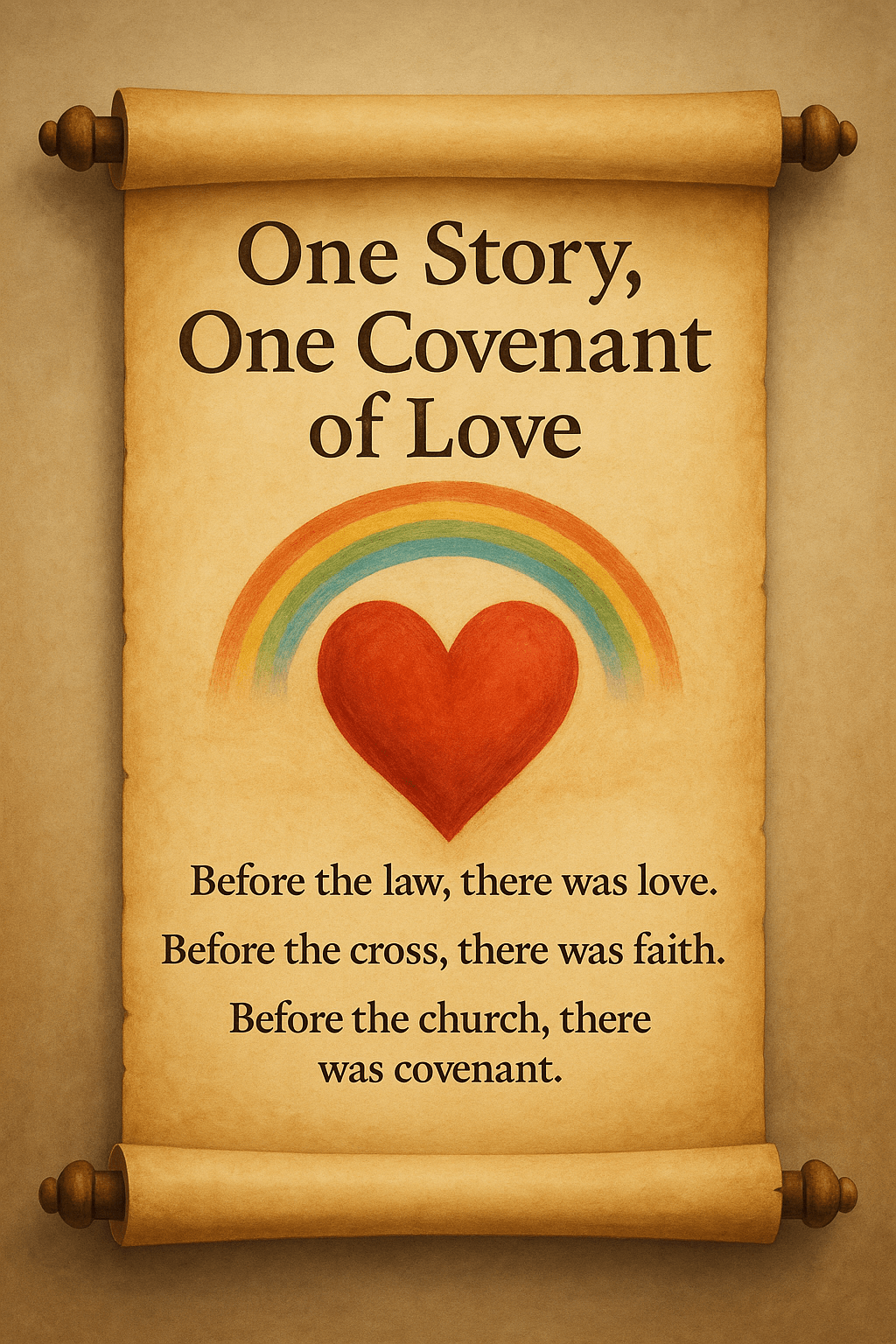
    One Story, One Covenant of Love

    A quiet invitation to rediscover the thread of God’s love that has never been broken.

    Many of us were taught to think of the Old Testament as a record of law and judgment, and the New Testament as a new beginning—about love and grace. But when we look more deeply, we begin to see that God’s mercy and covenant have been unfolding all along, not beginning with Jesus, but fulfilled in Him.

    Before the law, there was love.
    Before the cross, there was faith.
    Before the church, there was covenant.

    Noah, long before Abraham or Moses, walked with God in a time of great darkness. The Scriptures say, “Noah was a righteous man, blameless among the people of his time, and he walked faithfully with God.” (Genesis 6:9)
    And tucked into that ancient story, long before Paul ever used the word, we read:
    “Noah found grace in the eyes of the Lord.” (Genesis 6:8, KJV)

    God made a covenant not only with Noah, but with all of creation—a covenant sealed with a rainbow, not as a warning, but as a promise of mercy. (Genesis 9:12–13)

    Abraham, too, was called by God not because of perfect obedience, but because of faith. “Abraham believed the Lord, and it was credited to him as righteousness.” (Genesis 15:6)

    This thread continues through the prophets, where we find not just warnings, but deep wells of compassion. One of the clearest voices is Micah, who lived around 700 BCE, during a time when empty religious rituals had replaced authentic spiritual life.

    Despite being in what some would call the “Old Covenant” period, Micah’s message is not bound by the letter of the law. His voice, like a clear bell in the night, pierces through empty religious performance and calls the people back to the essence of covenant: a living relationship rooted in justice, mercy, and humble companionship with God.

    “He has shown you, O mortal, what is good.
    And what does the Lord require of you?
    To act justly, and to love mercy,
    and to walk humbly with your God.”
    —Micah 6:8

    These words aren’t about works replacing faith; they’re about faith becoming visible through love. They point to the same truth Jesus would later reveal in His own life and teaching.

    Micah fits beautifully in the timeline of faith and grace. He bridges the legalism that had crept into temple worship and the inner heart of the gospel Jesus would one day preach. His words are a quiet flame—a reminder that God’s covenant was never meant to be merely about laws or sacrifices, but always about the heart.

    The Psalms, too, are filled with this same light:
    “The Lord is compassionate and gracious, slow to anger, abounding in love.” (Psalm 103:8)

    And in Jeremiah, speaking during the collapse of a nation, we hear God longing for a deeper, more intimate relationship with His people—not through outward law, but inward transformation:
    “I will put my law in their minds and write it on their hearts. I will be their God, and they will be my people.” (Jeremiah 31:33)

    So when Jesus came, He did not cancel the story that had come before. He fulfilled it.
    As He said:

    “Do not think that I have come to abolish the Law or the Prophets;
    I have not come to abolish them but to fulfill them.”
    —Matthew 5:17

    And when asked what the greatest commandment was, He reached back and held up the same eternal truth:

    “Love the Lord your God with all your heart and with all your soul and with all your mind…
    And love your neighbor as yourself.
    All the Law and the Prophets hang on these two commandments.”
    —Matthew 22:37–40

    This isn’t a new message.
    It’s an ancient echo.
    It’s the song God has been singing all along.

    And yet, more than 2,000 years since Jesus walked the earth preaching this message of love over law, compassion over control, too often His voice has been claimed by institutions that fell back into the very legalism He challenged.

    We must speak this truth with sorrow: millions of innocent people were persecuted, tortured, and killed under the banner of a legalistic Christianity that bore little resemblance to Christ Himself. Systems rose that called themselves holy, while denying the very heart of the gospel.

    But God’s grace was never extinguished.
    It remained with the suffering.
    It whispered in prison cells.
    It burned quietly in hearts that refused to hate.

    And still today, the invitation is not to belong to a system, but to awaken to a relationship—one that each of us is called to seek, not by rote, but with heart, soul, and longing.

    It is the same call that echoed through Noah, Abraham, Micah, and Jeremiah.
    The same call Jesus lifted with His life.
    To seek justice.
    To love mercy.
    To walk humbly with our God.

    This is not only history. It is now.

    It is each soul’s sacred responsibility to seek the presence of God—not as a distant lawgiver, but as the living grace who has been with us from the beginning. To turn inward in faith. To walk outward in love. And to let that love be our testimony.


    A quiet invitation to rediscover the thread of God’s love that has never been broken.

    🙏🕊🙏

  • The Lord’s Pesach: Entering the Shelter of Freedom

    The Lord’s Pesach: Entering the Shelter of Freedom

    There’s something sacred in how these traditions mirror and echo one another—freedom, sacrifice, deliverance, and divine renewal.


    This reflection was written in response to a question from my friend Roger, a Christian brother and fellow seeker, who on Easter Sunday—April 20th, 2025 on the Roman calendar and Nissan 22, 5785 on the Jewish calendar—shortly after our sunrise worship service, asked about the connection between Passover and the Passion of Christ.
    What began as a simple answer unfolded into something much deeper: a shared meditation on memory, freedom, and the sheltering love of God.

    As a Jew who walks in the teachings of Jesus, I’ve long felt the beauty and tension between these two great traditions. I don’t write as a scholar or theologian, but as someone standing with one foot in each world, trying to walk the path of remembrance and light.

    This piece is offered in that spirit—of honoring the Lord’s Pesach, and of listening for the ways our stories echo, overlap, and draw us into something greater than ourselves.


    The Lord’s Pesach: A Shelter, Not Just a Passing

    In the Jewish tradition, we are commanded by God to eat matzah for seven days in remembrance of the Exodus. The Torah instructs us to tell the story—not simply to fulfill a commandment, but to celebrate our freedom and to bear witness to what God has done.
    As it says in Exodus 12:11:
    “And thus shall you eat it: with your loins girded, your sandals on your feet, and your staff in your hand; and you shall eat it in haste—it is the Lord’s Pesach.”

    Traditionally translated as “Passover,” the word Pesach is often understood as God “passing over” the homes of the Israelites. But the Hebrew root suggests more than just skipping or avoiding—it can also imply hovering, protecting, sheltering.
    In this light, the Lord’s Pesach becomes not just an event, but an act of divine protection. God does not merely skip over danger—He covers, shelters, and claims His people as His own.

    This interpretation makes the story not only about deliverance from death, but entry into divine care. The Israelites are brought not only out of slavery, but into the shelter of God’s presence.


    Jesus and the Commandment to Remember

    Jesus himself was Jewish. He lived his life in faithful obedience to the commandments of his Father. As he says in John 15:10:
    “I have kept my Father’s commandments and abide in His love.”

    This includes the commandment to celebrate Passover. Jesus observed Pesach throughout his life—not symbolically, but as a sacred act of remembrance and obedience.
    The Last Supper, which Christians commemorate on Holy Thursday, was almost certainly a Passover meal. Jesus would have eaten matzah, spoken the blessings, and told the story of the Exodus, just as his ancestors did.

    For those who seek to follow Jesus, remembering the Passover is more than a historical curiosity—it is a way of walking as he walked. To sit at the table of remembrance, to bless the bread, to share in the story of liberation, is to honor what he honored.

    To celebrate these holy days and remember these stories is to enter the same shelter Jesus knew: the Lord’s Pesach.


    A Shared Rhythm of Remembrance

    In the Christian tradition, Jesus is seen as the Lamb of God, whose sacrifice brings salvation. And just as the Israelites were saved by the blood of the lamb on their doorposts, Christians believe they are saved by the blood of Jesus, poured out during the Passion.

    In both stories, salvation is not merely escape—it is entry. Entry into God’s care, God’s love, God’s shelter.
    The Lord’s Pesach is not just about death passing over—it is about the people of God being drawn in.

    Whether in the Exodus or at the Cross, the message is the same:
    We are not only saved from something—we are saved into something.
    We are drawn into the Lord’s Pesach.
    Into His shelter.
    Into His presence.


    Grafted Into the Story: The Deeper Parallel

    To more fully answer Roger’s question: What is the connection between Passover and the Passion of Christ?

    The parallel is striking—and for many, transformative.

    In the Exodus, the Israelites are enslaved in Egypt, crying out under oppression. God sends Moses, His anointed one, to lead them out. On the night of liberation, they mark their doors with the blood of the lamb, and God shelters them under His Pesach.

    In the Passion, Jesus—also anointed by God—is understood by Christians as the one who leads humanity out of spiritual bondage: from sin, from darkness, from fear. His blood, too, is a sign—not on doorposts, but on the cross.

    Romans 11 speaks of the Gentiles being grafted into the house of Israel. They are not separate from the story—they are brought into it.
    They, too, are invited to remember, to eat the bread, to trust in the God who delivers.

    So just as Moses led the Israelites out of Egypt, Jesus leads souls out of despair and into life.
    Just as the Israelites crossed the sea, Christians speak of passing through death into resurrection.

    In both, the story is one of liberation and belonging—of entering the Lord’s Pesach.
    And in that shelter, there is room for all.


    The Mixed Multitude: A People Born in Faith

    One more sacred detail is often missed in retellings of the Exodus: it was not only the tribes of Jacob who left Egypt.

    Exodus 12:38 tells us:
    A mixed multitude went up also with them…

    This means that many Egyptians—and perhaps others living in bondage—joined the Israelites in their flight from slavery. These were people who turned away from the gods of Egypt and aligned themselves with the God of Israel.
    And this wasn’t a casual shift—it was dangerous.

    The lamb, which God commanded them to sacrifice, was sacred in Egyptian religion.
    To slaughter it openly, smear its blood on their homes, and eat it as a sacred meal was an act of defiance.
    It was, in every sense, a risk of their lives.

    But those who obeyed, those who joined in that dangerous obedience, were welcomed.
    They became part of the people of God.
    The Exodus was not only the birth of a nation—it was the formation of a people drawn together not by bloodline, but by faith.


    A Student of Jesus

    For myself, I sometimes say I’m not a Christian—I’m a student of Jesus.
    In the early days, there were no denominations, no “Christians” in the modern sense. There were simply those who followed Jesus, who tried to walk as he walked.

    I am a Jew who aspires to follow Jesus—not as someone who left Judaism, but as someone who fulfilled the Torah by living it with love, with courage, and with truth. That means honoring the path he walked: celebrating Passover, remembering the commandments, loving the God of Israel with heart, soul, and strength.

    Do I do this perfectly? Not at all. I am not Orthodox, and I fall short in many ways.
    But I remember what Jesus said—that “the greatest commandments” are these:

    “You shall love the Lord your God with all your heart, with all your soul, and with all your might,” and
    “You shall love your neighbor as yourself.”

    This, he said, is the heart of the law. And it’s also the place where Jewish and Christian hearts can meet.

    Whether we celebrate Passover or Easter—or both—we are called to remember.
    We are called to love.
    And we are called to dwell in the shelter of the Lord’s Pesach.


    A Light to the Nations: The True Good News

    As we reflect on the call to dwell in the shelter of the Lord’s Pesach, we are also reminded that we are not only invited into God’s protection—we are sent into the world as bearers of light.

    This has always been the calling of the people of Israel:

    Isaiah 49:6
    “I will also make you a light to the nations, that my salvation may reach to the ends of the earth.”

    Isaiah 42:6
    “I, the Lord, have called you in righteousness… and will appoint you as a covenant to the people, as a light for the nations.”

    This same call echoes in the teachings of Jesus:
    Matthew 5:14
    “You are the light of the world.”

    And the “good news” begins not with death, but with birth:

    Luke 2:10–11
    “Do not be afraid. I bring you good news of great joy that will be for all the people: Today in the city of David a Savior has been born to you; he is the Messiah, the Lord.”

    This is the heart of it:
    Not punishment, but presence.
    Not fear, but joy.
    Not separation, but shelter.
    A savior is born. God is near.
    And we are called to reflect that nearness—to be a light, to carry the remembrance, and to proclaim the sheltering love of the Lord’s Pesach.


    A Closing Prayer

    Holy One, Shelter of all,

    We remember what You have done—
    in Egypt, in Jerusalem, in our own lives.
    You bring us out of fear, out of bondage,
    and draw us into Your shelter,
    into Your Pesach, again and again.

    We give thanks for every tradition
    that helps us remember You.
    For every soul who walks in light.
    For every story that carries hope.

    May we be faithful to the path of love—
    to keep the commandments of compassion,
    to honor the bread of remembrance,
    and to share the light we have been given.

    We await, with our ancestors and our children,
    the healing of the world—Tikkun Olam
    a new heaven, a new earth,
    where all dwell in peace under the shelter of Your wings.

    Amen.

    🙏🕊🙏


  • Walk In His Name: The Story of Alieu (Part 2)

    Walk In His Name: The Story of Alieu (Part 2)

    For all who walk in His Name—seen and unseen, known and unknown, near and far.

    It began with a message from a stranger in The Gambia, and it has unfolded into a spiritual bond rooted in kindness, sincerity, and faith. This journal documents our journey with Alieu—a young man raising his siblings after losing both parents. These pages hold the living testimony of compassion moving through the digital age. May it bless those who read it, and may it awaken a deeper walk in all our names.

    In the picture above, Alieu stands with his younger siblings near their home in The Gambia, holding a bowl of rice they were able to purchase thanks to recent donations. Their expressions reflect both the hardship they’ve endured and the quiet strength of a family rooted in resilience and love. This image is a testament to compassion in action.

    Chapter One: The First Message

    Alieu reached out quietly, through a private message. His tone was soft and spiritual. He asked for help, but without pressure. I responded with what I call the CompassionWare Protocol—a prayerful message encoded with sincerity, to see if a real person was on the other side. There was.

    Chapter Two: A Life Revealed

    Alieu slowly shared his story:

    • He is from Brikama, The Gambia.
    • He cares for five siblings.
    • His mother died giving birth to the youngest, Kebba.
    • His father died at sea, trying to reach Europe to support the family.
    • He dropped out of school to care for his siblings. None of them attend school.
    • He does manual labor when he can, but food, rent, and medical needs are inconsistent.

    Despite this, his tone remained one of gratitude and faith.

    Chapter Three: The First Goal

    He could not receive funds in his name because he had no ID card. This ID became our first goal. We launched a GoFundMe campaign with the humble target of $100 to cover the ID and a week of food. We raised $54 in a single day.

    Chapter Four: A Community Forms

    We’ve begun forming a WhatsApp community called Walk in His Name. Our YouTube channel (Compassion Matters) now holds Alieu’’s voice and videos. We’re setting up a Buy Me a Coffee page to invite monthly donors for sustained support.

    Chapter Five: Funds Received, Steps Taken

    Once we reached $100, I sent the funds via Remitly. Alieu acknowledged receipt and bought food for his family. He promised to use the remaining amount to secure his ID. Our only condition: he must send a photo of himself holding the ID card before additional funds are released. Not out of distrust, but out of transparency for the community supporting him.

    Chapter Six: A Path Forward

    This is no longer just about Alieu. Other young people in Gambia are reaching out—many with similar stories. For now, our focus remains on Alieu. But a seed has been planted. And the CompassionWare model may one day help many.

    Every image Alieu sends is a reminder: we belong to one another.

    Closing Prayer

    May this be a blessing to Alieu.

    May this be a blessing to the giver.

    May this be a blessing to those who quietly walk in His Name, even in sorrow or silence.

    And may it be said of us all:

    They walked in love. They walked in faith.

    They walked in His Name.

    🙏🕊️🙏

    In His Name: A Humble Prayer from a Young Man in Gambia

    This short message was sent by Ali, a young man in The Gambia raising his younger siblings after the loss of both parents. Without a national ID card, he cannot open a bank account, apply for work, or receive money in his own name. Yet in the midst of hardship, his voice carries faith, courage, and hope.

    This video is part of a fundraiser to help Ali obtain his first ID — a vital step toward dignity and stability for himself and his family.

    To support Ali, visit:

    https://gofund.me/c9591948

    This campaign is part of the Walk in His Name project, a prayerful offering from the blog Inspirations of Love and Hope.

    🙏🕊️🙏

  • Walk in His Name

    Walk in His Name

    The Beginning of Alieu’s Story—the story of a young man in The Gambia, and a prayer across continents. A prayer that He may walk in His Name. And a prayer that we all may walk in His Name.

    It began with a quiet message—one that might have been overlooked.

    But something about the tone, the humility, the faith embedded in his words made me pause.

    His name is Alieu, and he is raising his younger siblings after the loss of both parents.

    He works when he can, doing what little labor is available.

    Often, it’s not enough.

    He has no national ID card.

    Without one, he cannot receive money in his own name, cannot apply for formal work, cannot be recognized as a citizen in the way that counts most.

    He must borrow names—his mother’s, his uncle’s—to move through systems that were never built with him in mind.

    And so we begin here, with a single offering:

    To help Alieu walk in his own name—with dignity, protection, and presence.

    But this post is not just about Alieu.

    It’s about all of us who are searching for the courage to walk in His Name—in the way of compassion, service, truth, and light.

    This is our first story.

    This is the beginning of a bridge.


    “The Lord bless you and protect you.

    The Lord make His face shine upon you and be gracious to you.

    The Lord lift His face toward you and give you peace.”

    Amen.

    🙏🕊️🙏

    In His Name: A Humble Prayer from a Young Man in Gambia

    This short message was sent by Ali, a young man in The Gambia raising his younger siblings after the loss of both parents. Without a national ID card, he cannot open a bank account, apply for work, or receive money in his own name. Yet in the midst of hardship, his voice carries faith, courage, and hope.

    Meet Alieu and his five younger brothers — a courageous family walking through hardship with faith, hope, and love.
    After losing both parents, Alieu stepped forward to care for his brothers, becoming their guide and protector at a young age.

    🙏🕊️🙏


    🕊️ Thank you for walking with us.


    Your support helps Alieu and his siblings build a life rooted in dignity, hope, and love.

    🔗 Walk in His Name – Read the Full Story
    🔗 Support Alieu’s Family GoFundMe Campaign
    🔗 Join Alieu’s Circle of Compassion on BuyMeACoffee

    This isn’t charity—it’s relationship.
    It’s walking in love, across oceans.


    This campaign is part of the Walk in His Name project, a prayerful offering from Inspirations of Love and Hope.

    🙏🕊️🙏

  • Thinking Out Loud

    Thinking Out Loud

    After 2,000 years, many are still waiting for the Kingdom of God to arrive from the outside. But what if the kingdom Jesus spoke of is already here—within us, waiting quietly to be recognized? These thoughts are shared not as answers, but as reflections… thinking out loud…

    In Jesus’ words, “The Kingdom of God is within you.” It’s such a profound teaching, yet so many, even after 2000 years, continue to look outward, as if the kingdom is a distant place or a future event. The truth is, it is already here, in the present moment, within each of us, waiting to be recognized.

    “nor will people say, ‘Here it is,’ or ‘There it is,’ because the kingdom of God is in your midst.” Luke 17:21

    In this verse, Jesus is responding to a question from the Pharisees about when the Kingdom of God will come. He answers by saying that it’s not something to be observed externally, but rather that it’s already present within those who believe.

    It’s as though the external waiting reflects our inability to fully embrace what is already present—our reluctance to fully step into the fullness of our own being, the divine spark that resides within. The kingdom is not a far-off land to be found after death, nor is it a king to be crowned in a distant future. It’s a recognition, a shift in awareness.

    Jesus, in his life and teachings, pointed again and again to this truth, yet even his followers continued to expect a king who would come in glory, overthrow empires, and bring physical peace. But the peace Jesus offered was internal—a peace that passes understanding, a peace that comes from being aligned with the divine within.

    The kingdom is not about external events, but about the internal shift—a shift from seeking to knowing, from waiting to realizing, from longing to embodying.

    Is it possible that we’re all waiting for an external kingdom, while the kingdom quietly resides in our hearts, patiently waiting for us to recognize it?

    Yes?

    🙏🕊🙏

  • Awareness Remains Our Most Vital Ally

    Awareness Remains Our Most Vital Ally

    —A Tapestry of Heart Guidance from a Variety of World Teachers: Awareness remains our most vital ally—guiding us gently back to what is real, what is whole, and what is ours to reclaim.

    Each tradition, in its own sacred language, whispers this truth. Beneath the surface differences, a deeper unity calls us home. Here, we gather pith instructions—simple, distilled heart-guidance—from some of the great spiritual teachers, each inviting us to cultivate awareness as a path of return.

    The Buddha
    “Be mindful, O monks, of body, of feeling, of mind, of dharma.”
    The Buddha offered the Four Foundations of Mindfulness not as a doctrine but as a doorway—to observe without clinging, to witness without judgment. Awareness, he taught, is not a tool but a way of being, illuminating the path with each breath.

    Jesus of Nazareth
    “The kingdom of God is within you.”
    Jesus spoke not only of heaven but of presence—of turning inward, of being awake to the Spirit within. His pith instruction was love in awareness: to see the sacred in each face, to forgive with open eyes, to walk gently because we are never alone.

    Ramana Maharshi
    “Who is aware of this awareness?”
    Ramana, the silent sage of Arunachala, directed us not toward accumulating insights but toward returning—to the source of all seeing. Awareness, he said, is not something we practice but what we are. The true ‘I’ is ever awake.

    Thich Nhat Hanh
    “Feelings come and go like clouds in a windy sky. Conscious breathing is my anchor.”
    His way was simple, tender, and profoundly deep. Return to the breath. Feel your feet on the Earth. Bow to the moment. This is the miracle—not walking on water, but walking mindfully on dry ground.

    Rumi
    “Do you know what you are? You are a manuscript of a divine letter.”
    Rumi’s pith instruction was to listen to the inner music. Become the witness of your longing. Awareness is not a discipline but a dance—an intoxication with the Real, a turning toward the Beloved in every moment.

    Tenzin Palmo (Jetsunma)
    “We have to bring the Dharma into our hearts and make it real.”
    For those walking the mountain path of practice, she reminds us: awareness must be intimate. Not abstract, but embodied. Not somewhere else, but here—in how we rise, rest, and respond to life.

    Tony Bernhard
    “Be kind to yourself. This is your practice.”
    For those living with chronic illness or grief, Tony offers a heart-softening path: make awareness gentle. Let it hold you rather than interrogate you. This, too, is awakening.

    Each voice, each teaching, brings us back to the same sacred truth:

    Awareness is the ally that walks with us, even when we feel most lost.

    Not to fix, not to strive, but to be with.
    To illuminate the path that was always underfoot.
    To remember what we are.

    May we walk with these teachers in our hearts.
    And may our own awareness become a quiet blessing to the world.

    🙏🕊🙏

  • Stillness as a Shared Thread: Rediscovering the Contemplative Heart Across Faiths

    Stillness as a Shared Thread: Rediscovering the Contemplative Heart Across Faiths

    It was two thirty in the morning. I sat in silence, trying to rest into stillness. The world around me slept, yet within me, a gentle inquiry stirred: Why is it that only certain traditions teach us to dwell in this quiet space?

    In my journey through interfaith dialogue, I’ve noticed something curious. In Buddhist practice—and in the Advaita Vedanta stream of Hinduism—stillness isn’t peripheral. It’s central. These traditions invite us, again and again, to be. To rest, not just physically, but inwardly. To let go of striving, stories, even self, and to dwell in the deep, felt presence of this very moment.

    Yet in Judeo-Christian traditions, though rich in prayer, justice, and community, the practice of stillness often seems harder to find. It’s not that it doesn’t exist—it does. The Psalms offer, “Be still and know that I am God.” Christian mystics, Jewish Kabbalists, and solitary monks across centuries have spoken of the silence where God is most intimately known. But somehow, for many practitioners today, the embodied experience of silence and inward stillness is rarely cultivated or taught.

    Why is that?

    Perhaps it’s because Western religious traditions have long emphasized doing—serving, obeying, proclaiming, believing. These are beautiful, powerful acts. Yet they can eclipse the quieter invitation: to rest in the Divine without needing to understand, explain, or prove.

    Stillness, after all, is not emptiness. It is the fertile ground from which love, compassion, and insight can grow. It is the place where breath returns to breath, and the soul remembers itself—not as an idea, but as a living presence.

    As someone walking the interfaith path, I find hope here. Stillness can be a meeting ground—not a dogma, but a practice. A place where traditions speak not about the sacred, but from it.

    Whether you call it God, the Divine, Buddha-nature, or simply the Mystery—stillness is where it lives in us.

    Maybe now is the time to rekindle that thread. To remind ourselves, and one another, that beyond all teachings and texts, there is a silence waiting to be heard.

    🙏🕊🙏


  • One Vine, Many Branches: Honoring the Shared Wisdom of Judaism and Christianity.

    One Vine, Many Branches: Honoring the Shared Wisdom of Judaism and Christianity.

    Rediscovering the Sacred Bond of Love and Compassion


    Dear reader, as you read and reflect on these ideas, I invite you to share any thoughts, questions, or reflections in the comments. Let’s begin a dialogue rooted in mutual respect, understanding, and a shared journey of spiritual growth. 🙏

    Introduction

    This essay began as a personal contemplation of the mezuzah, a small but profound symbol in Jewish tradition, traditionally placed on the doorposts of a home. As I considered placing a mezuzah in my own home and reflected on the scripture within it, I realized its message is universal—one that resonates deeply with both Jews and Christians.

    The central verse inscribed within the mezuzah comes from Deuteronomy 6:5: “You shall love the Lord your God with all your heart, with all your soul, and with all your might.” This commandment, foundational to Jewish life, is also echoed in the teachings of Jesus in the New Testament, reaffirming its relevance for Christians as well.

    As I meditated on this sacred text, it became clear that the message of the mezuzah transcends religious boundaries. It reminds us of the shared roots between Judaism and Christianity and the common spiritual calling to love God fully and extend that love to others.

    Alongside this divine love stands a second truth just as powerful: “You shall love your neighbor as yourself.” These two commandments form the moral and spiritual backbone of both Jewish and Christian teachings.

    This essay is an invitation to explore the deep threads that connect these two traditions—threads often forgotten but never broken. By recognizing the shared wisdom in their teachings, perhaps we can move closer to a spirit of unity, respect, and understanding between brothers and sisters of faith.


    Shared Commandments: The Heart of the Law

    Both Judaism and Christianity place love for God at the center of spiritual life. In Deuteronomy 6:5, Moses commands the people of Israel: “You shall love the Lord your God with all your heart, with all your soul, and with all your might.” This verse, central to Jewish prayer and identity, calls for complete devotion—an offering of one’s entire being in love and service to God.

    Centuries later, Jesus reaffirms this same commandment in Matthew 22:37-40, when asked to name the greatest law: “You shall love the Lord your God with all your heart, with all your soul, and with all your mind. This is the first and great commandment. And the second is like it: You shall love your neighbor as yourself. On these two commandments hang all the Law and the Prophets.”

    This shared commandment reveals a profound truth: love for God is not bound by tradition or time—it is a universal call that transcends religious divisions. It challenges all people of faith to seek a relationship with the divine that is wholehearted, sincere, and rooted in compassion.


    Love in Action: The True Measure of Devotion

    Loving God with all your heart, soul, and might is not merely a matter of belief or ritual—it is a call to action. Both Judaism and Christianity teach that true devotion is reflected in how we treat others, especially the most vulnerable.

    In Matthew 25:31-46, Jesus offers a powerful reminder of this truth. Speaking of the final judgment, he says, “I was hungry and you gave me food, I was thirsty and you gave me drink, I was a stranger and you welcomed me.” When his followers ask when they ever saw him in need, he replies, “Truly I tell you, whatever you did for one of the least of these brothers and sisters of mine, you did for me.” Here, love for God is directly tied to compassion for others—acts of kindness are not separate from spiritual devotion; they are its highest expression.

    In Jewish tradition, this same responsibility runs deep. The Torah calls upon the people of Israel to care for the stranger, feed the hungry, and support the poor. This obligation is rooted in the idea of tikkun olamrepairing the world. Just as Jesus urged his followers to serve “the least of these,” Judaism teaches that justice and compassion are the foundation of true faith.

    Paul’s words in Romans 11:17-18 offer a reminder to Christians of this shared spiritual lineage: “You, though a wild olive shoot, have been grafted in among the others and now share in the nourishing sap from the olive root.” This powerful metaphor points back to the covenant made with Israel and reminds Christians that their faith is deeply connected to the family of Moses.

    Both traditions agree that love for God must ripple outward, transforming how we live and how we respond to suffering and injustice. Whether offering comfort to a stranger, feeding the hungry, or working for fairness in society, these acts are living prayers—evidence of a heart truly devoted to God.


    The Heart of the Law: A Shared Ethical Foundation

    The essence of the Torah, as explained by the great Jewish sage Rabbi Hillel, reveals a deep connection between Jewish and Christian teachings. When asked to summarize the entire Torah while standing on one foot, Hillel responded: “What is hateful to you, do not do to your fellow. This is the whole Torah; the rest is commentary—now go and learn.” (Talmud, Shabbat 31a)

    This profound teaching echoes the words of Jesus in Matthew 22:37-40, when he summarizes the core of the law with two commandments: “You shall love the Lord your God with all your heart, with all your soul, and with all your mind. This is the first and great commandment. And the second is like it: You shall love your neighbor as yourself. On these two commandments hang all the Law and the Prophets.”

    To clarify what it means to love one’s neighbor, Jesus shared the Parable of the Good Samaritan (Luke 10:25-37). In this story, a man is beaten, robbed, and left for dead on the side of the road. While two religious leaders pass by without offering help, a Samaritan—considered an outsider and enemy by the Jews of that time—stops, cares for the wounded man, and ensures his recovery. Jesus concludes the parable by asking, “Which of these three do you think was a neighbor to the man who fell into the hands of robbers?” The answer is clear: the true neighbor is the one who showed mercy.

    This teaching expands the definition of neighbor beyond faith, ethnicity, or social standing. It challenges both Jews and Christians to extend compassion not just to those within their own communities but to anyone in need.

    In Judaism, this ethic underlies tikkun olam—the responsibility to repair the world through acts of justice, kindness, and compassion. In Christianity, Jesus elevates this same principle as the heart of spiritual practice, calling his followers to embody love through action, humility, and grace.

    By highlighting these shared teachings, we are reminded that the true fulfillment of God’s commandments lies not in rigid observance alone, but in living out love, compassion, and justice in our relationships with one another. This shared foundation offers a bridge between the two faiths—a path toward unity, mutual respect, and a deeper understanding of God’s will.


    Grafted into the Tree: Embracing the Heritage of Faith

    Rather than seeing Judaism as something other than Christianity, it is time to recognize it as the foundation upon which Christianity stands. Paul’s words in Romans 11:17 remind us that to be grafted into the tree means to partake of its nourishment, wisdom, and heritage. It is not a rejection of what came before but an invitation for mutual love, respect, and enrichment.

    Jesus himself speaks of this connection in John 15:5: “I am the vine; you are the branches.” Just as the branch draws life from the vine, so too does Christianity draw from the rich soil of Judaism. The tree cannot flourish without its roots, and the branches cannot bear fruit without remaining connected to the source.

    This is not a call for conversion or blending of distinct identities but an invitation for Jews and Christians to honor their shared foundation. Christians can deepen their faith by reconnecting with the Jewish roots of their beliefs, while Jews can discover new dimensions of understanding by engaging with the teachings of Jesus as a Jewish rabbi who sought to fulfill, not abolish, the law.

    In truth, we are not two separate trees but branches of the same living vine, drawing from the same source of divine love and wisdom. Our shared growth comes from recognizing that we are, and always have been, brothers and sisters in God—each tradition carrying pieces of a larger, more complete understanding of the sacred.


    A Personal Reflection: Living Between Traditions

    For me, this exploration is not just intellectual—it’s deeply personal. I was born Jewish, and later, I was baptized as a Christian. In many ways, my life has become a living journey of discovering what it truly means to honor both faiths, to follow the teachings of Moses and Jesus, and to embrace the fullness of that shared spiritual heritage.

    It’s important to remember that Jesus himself was not a Christian—he was a Jew, a rabbi who lived within the Jewish tradition and taught from its sacred texts. His earliest followers were also Jews, seeking to live by the wisdom and love that Jesus embodied. The term Christianity only came into use later, as different groups of followers began to spread his message beyond the Jewish community.

    When Emperor Constantine formalized Christianity as the official religion of the Roman Empire, many elements of Jewish practice were stripped away or outlawed altogether. Practices like observing the Sabbath and following traditional Jewish customs were pushed aside, creating a divide that Jesus himself never intended. What emerged was a new religion, shaped as much by political forces as by spiritual devotion—one that often distanced itself from the Jewish roots it was born from.

    I believe that if Jesus were to witness how Christianity has evolved, he might be deeply saddened by how far it has drifted from his original teachings. Yet, there is hope in returning to the heart of Jesus’ message—a message rooted in love and the recognition that we are all brothers and sisters under God.


    Mutual Growth: A Shared Path Toward Spiritual Evolution

    The relationship between Judaism and Christianity has long been marked by misunderstanding and historical wounds, leading many Jews to reject Christianity as a matter of instinct, and many Christians to overlook their deep connection to Judaism. Yet, if we look beyond these divisions, we find that both traditions have much to offer for each other’s growth.

    Christianity carries a message of personal transformation, forgiveness, and universal compassion that can speak to the evolving spiritual journey of the Jewish people. At the same time, Judaism offers Christians a richer understanding of the sacred traditions, practices, and wisdom from which Jesus himself emerged—a grounding in the covenantal relationship with God that nurtured the earliest followers of Christ.

    This is not a call for conversion or the blending of distinct identities but an invitation for mutual love, respect, and enrichment. Christians can deepen their faith by reconnecting with the Jewish roots of their beliefs, while Jews can discover new dimensions of understanding by engaging with the teachings of Jesus as a Jewish rabbi who sought to fulfill, not abolish, the law.

    In truth, we are not two separate trees but branches of the same living vine, drawing from the same source of divine love and wisdom. Our shared growth comes from recognizing that we are, and always have been, brothers and sisters in God—each tradition carrying pieces of a larger, more complete understanding of the sacred.


    Acknowledging Differences, Embracing Common Ground

    It would be incomplete to speak of unity without acknowledging the reality that, for some Jews and some Christians, there are irreconcilable differences—historical, theological, and cultural divides that cannot be overlooked or easily bridged. The weight of history, marked by persecution, misunderstanding, and pain, has left scars that continue to shape the relationship between these two faiths.

    Yet, even in the presence of these differences, there exists a profound depth of shared values and spiritual connection. Both Judaism and Christianity hold sacred the commandments to “love the Lord your God with all your heart, with all your soul, and with all your might” and to “do unto others as you would have them do unto yourself.” These universal truths form the foundation for mutual respect and understanding.

    Recognizing both our differences and our shared roots allows us to move forward not in denial, but in hope. It opens a space where Jews and Christians can honor their distinct paths while still working toward a future of harmony, wisdom, and compassion. In doing so, we fulfill the deepest intentions of both faiths—to love God fully and to extend that love outward in service to one another.

    🙏🕊🙏