Tag: Christian Mysticism

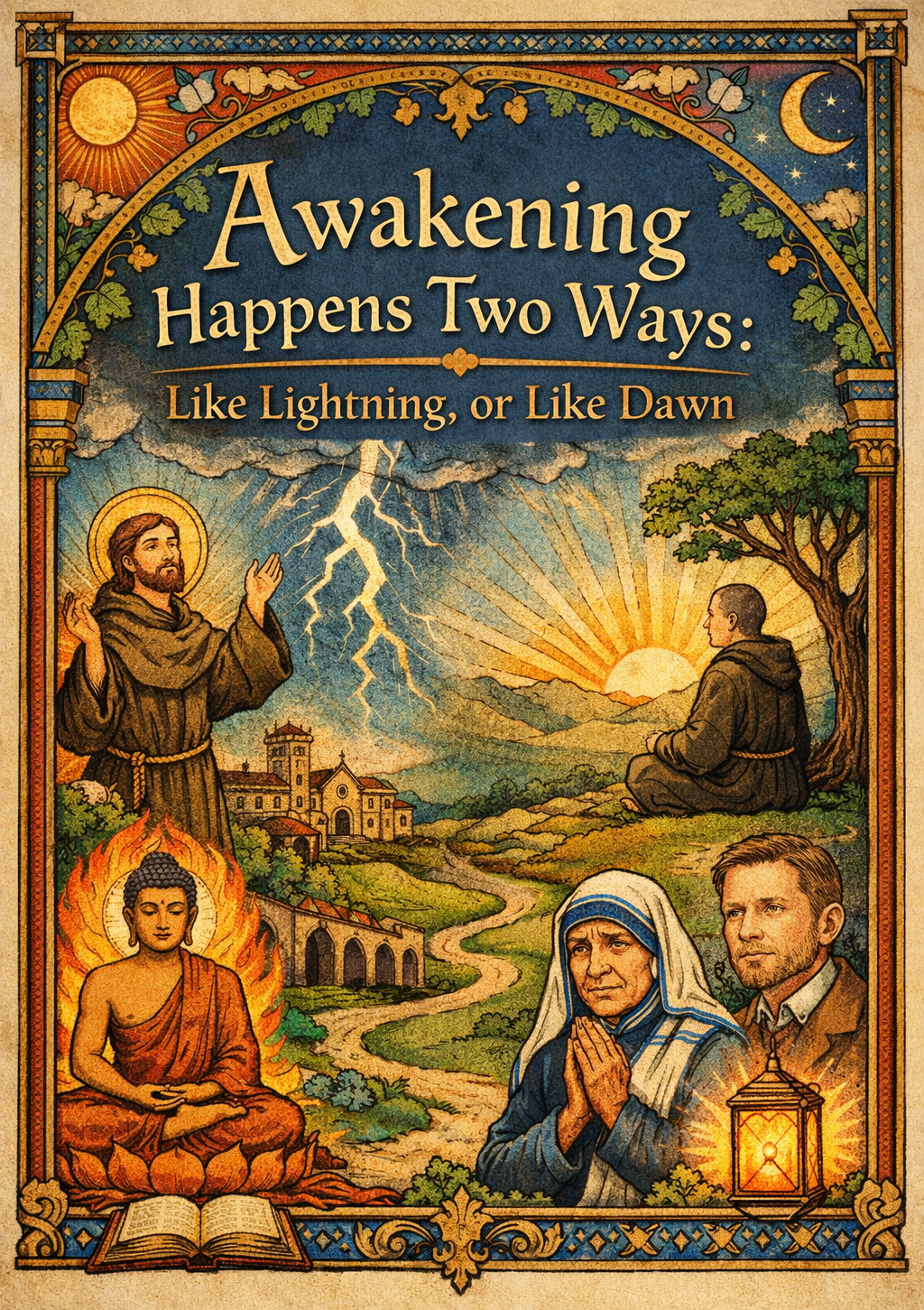
  • Awakening Happens Two Ways: Like Lightning, or Like Dawn

    Awakening Happens Two Ways: Like Lightning, or Like Dawn

    Sudden illumination and the slow work of becoming whole

    Into the Mystic is a contemplative reflections series exploring awakening, stability, and the quiet path of inner transformation in ordinary life.


    Introduction: Two Movements of Awakening

    In the landscape of spiritual life, two great patterns appear again and again: the gradual path and the lightning path.

    One unfolds slowly through prayer, discipline, contemplation, and steady inner work. The other arrives suddenly, as if grace breaks through without warning and changes the whole direction of a life in an instant.

    These are often described as opposites.

    But perhaps they are not opposites at all.

    Perhaps they are two movements within the same mystery.


    The Gradual Path

    The gradual path is the way of cultivation. It is the slow shaping of the soul through daily practice. It is the monk returning to prayer. The meditator returning to the breath. The seeker returning again and again to silence, surrender, and truth.

    In Buddhist language, this is the long training of mind and heart. In Christian contemplative language, it is the patient deepening of humility, purification, and love.

    Saint Teresa of Ávila offers one of the clearest examples of this gradual unfolding. Her spiritual life matured through years of prayer, struggle, refinement, and increasing interior depth. The soul, in her vision, is not transformed instantly, but led inward through many chambers, many purifications, many deepenings of surrender.

    Likewise, the Buddha’s awakening, though realized in a decisive moment beneath the Bodhi tree, was preceded by years of seeking, discipline, renunciation, and contemplative effort.

    The flowering may appear sudden.

    But the roots often grow in darkness for a very long time.


    The Lightning Path

    And yet there is also the lightning path.

    This is the path of abrupt transformation. The sudden reversal. The moment when the old self is pierced and something entirely new begins.

    It is not always earned in any neat or linear way. It may come through suffering, illness, loss, beauty, grace, or some inward rupture that breaks the ordinary structure of identity.

    Saint Francis of Assisi seems to belong, at least in part, to this lightning pattern. His early life was not one of long monastic preparation. His conversion appears to have been catalyzed through crisis: illness, war, captivity, disillusionment, and the collapse of the worldly ambitions he once cherished.

    Something broke open in him.

    The man who had been oriented toward status and recognition turned instead toward poverty, simplicity, love, and radical devotion.

    His life did not merely improve.

    It changed direction.


    Sudden Awakening, Gradual Integration

    This pattern appears across many traditions.

    Ramana Maharshi described a sudden awakening that began with a profound confrontation with death in his youth.

    Eckhart Tolle has written about a dramatic inner shift following a period of deep psychological suffering, when the ordinary sense of self seemed to dissolve into a profound stillness.

    Yet what is often overlooked is what came after.

    Tolle spent years living very quietly, often sitting on park benches, allowing his life to slowly reorganize around what he had experienced.

    The awakening may have been sudden.

    The embodiment was gradual.

    Here again we see the same rhythm:

    Lightning followed by integration.


    Faithfulness Without Consolation

    Mother Teresa’s life reflects another variation of this same pattern.

    Her decisive vocational turning — sometimes described as a profound interior call to serve the poorest of the poor — carries the character of a lightning moment.

    Yet what followed was not constant spiritual consolation, but decades of interior dryness, what the Christian mystical tradition calls a dark night of the soul.

    Despite this, she continued her work with remarkable faithfulness.

    Her life suggests something subtle but important:

    Awakening is not always accompanied by pleasant experience.

    Sometimes the lightning clarifies direction, but the gradual path becomes one of love without emotional reinforcement.

    In this way, both the sudden opening and the long endurance that follows become part of the same spiritual maturation.


    The Deeper Pattern

    If we look across these lives — Francis of Assisi, Teresa of Ávila, the Buddha, Ramana Maharshi, Mother Teresa, and Eckhart Tolle — a pattern begins to emerge.

    Some lives begin with discipline and flower into breakthrough.

    Others begin with breakthrough and spend years learning how to live what was revealed.

    Most contain both movements.

    Perhaps this is because awakening is not an event but a relationship.

    A relationship between grace and participation.

    Between what is given and what is lived.

    Zen expresses this beautifully:

    Enlightenment is an accident. Practice makes us accident-prone.
    Shunryu Suzuki Roshi

    We do not command grace.

    We prepare ourselves.
    We consent.
    We practice.
    We purify intention.
    We return.
    We wait.

    And sometimes, unbidden, the veil thins.


    The Quiet Awakening Most People Miss

    There is also a tender psychological truth here.

    Many sincere seekers imagine that if they have not had a dramatic breakthrough, then perhaps nothing real is happening.

    But this is not so.

    Sometimes awakening is not an explosion but an erosion.

    Not lightning, but river-water.

    Not a sudden fire from heaven, but a long dawn.

    A person may simply discover, after years of difficulty, that they are more stable than they once were.

    Less driven by fear.

    Less imprisoned by old wounds.

    More able to rest in silence.

    More capable of kindness.

    More able to endure uncertainty without collapse.

    This too is awakening.

    This too is grace.


    Where the Two Paths Meet

    Even within the gradual path, lightning may still come.

    Even within the lightning path, long discipline may still be required.

    Francis did not remain only the man of sudden conversion. He became the man of ongoing prayer and ongoing surrender.

    Teresa did not advance only by method. Her life was also marked by moments of powerful grace.

    The Buddha practiced intensely, but the final realization was not something he could force by will alone.

    The great traditions seem to agree on this much:

    Effort matters.

    But effort is not sovereign.

    There is something deeply relieving in that.

    It means we do not have to choose between discipline and grace.

    We can practice faithfully without pretending awakening is a personal achievement.

    We can remain open to the unexpected without neglecting the humble daily work of becoming more honest, more surrendered, and more loving.


    The Real Question

    Perhaps the real spiritual life is not about deciding whether we are on the gradual path or the lightning path.

    Perhaps it is about recognizing which movement is active in us now.

    For some, this season is one of patient cultivation.

    Quiet repetition.
    Invisible deepening.
    Slow healing.
    Hidden roots.

    For others, this season may include rupture, reversal, breakthrough, or an unexpected unveiling that reorders everything.

    And for many, it is both.

    We tend the garden, but we do not control the rain.

    We prepare the lamp, but we do not command the flame.

    We sit.
    We pray.
    We breathe.
    We return.
    We become available.

    In the end, perhaps that is the deepest wisdom:

    Awakening is both gift and participation.

    We are neither passive nor omnipotent.

    We are participants in a mystery we cannot manufacture, but to which we can sincerely offer our lives.

    The gradual path teaches us faithfulness.

    The lightning path teaches us surrender.

    And both, in their own way, lead us beyond ourselves.


    Peace and good. 🌿
  • Finding God in Silence: Thomas Merton’s Invitation

    Finding God in Silence: Thomas Merton’s Invitation

    Thomas Merton taught that silence is essential for spiritual growth and communion with God. Discover how inner stillness can become a sacred path in today’s noisy world.

    In these noisy and anxious times, I find myself returning again and again to the writings of Thomas Merton. His deep reverence for silence speaks to a longing I see in myself and in so many of us—for inner peace, for stillness, and for God. I offer this reflection in the hope it might inspire others, especially my Christian brothers and sisters, to make more space for silence in their lives.

    Thomas Merton strongly believed that the soul requires silence for its well-being and spiritual growth. He saw silence not just as the absence of noise, but as a space for inner listening, contemplation, and connection with one’s true self and with God.


    • Silence as a Basic Human Need:
      Merton argued that silence and solitude are essential for all individuals, not just hermits or monks, to hear the “deep inner voice” of their true self.

    • Interior Silence:
      He distinguished between exterior silence (absence of external noise) and interior silence (stillness of thoughts and desires). Interior silence allows for a deeper connection with God and self.

    • Silence and Communication:
      Merton didn’t see silence and communication as opposing forces. Instead, he believed that silence is essential for meaningful communication, allowing for thoughtful expression rather than just empty chatter.

    • Silence and Spiritual Growth:
      He believed that silence provides a space for prayer, contemplation, and a deeper understanding of oneself and God. It allows one to move beyond superficiality and experience a more profound connection with the divine.

    • Silence as a Pathway to God:
      Merton emphasized that silence, particularly interior silence, is a place where one can encounter God’s presence and experience a sense of intimacy with the divine.

    • The World’s Lack of Silence:
      Merton observed that the modern world is often filled with noise and distraction, making it difficult for individuals to find the silence they need for spiritual growth. He saw the need for places and practices that foster silence and solitude.

    • Finding Silence in the Everyday:
      While acknowledging the challenges of finding silence in a noisy world, Merton encouraged individuals to seek moments of quiet reflection and stillness in their daily lives.


    • A Simple Contemplative Practice

      Find a quiet place. Sit comfortably, with your hands resting in your lap. Gently close your eyes. Begin with this prayer from the heart:

      “Lord, I am here for You alone. Let me be still in Your presence.”

      Let the prayer fade into silence. Don’t try to think or feel anything in particular. Simply rest in God’s presence, like a child leaning into their Father’s arms.

      If thoughts arise, gently return to the stillness with a phrase like:

      “Be still and know…” or “You are my refuge and peace.”

      This is not about doing or achieving. It is about allowing. As St. John of the Cross wrote,

      “The soul that is pure and simple and empty of all things… can be filled with God.”

      Remain for just a few minutes—or as long as grace allows. End by offering a word of thanks. That’s all.


    • Silence as a Gift:
      Merton viewed silence as a precious gift that can lead to spiritual awakening, self-discovery, and a deeper relationship with God.


    Maybe today, just for a few minutes, let yourself sit quietly.

    Not to accomplish anything. Just to listen.


    “Be still, and know that I am God.”

    — Psalm 46:10

    🙏🕊🙏

  • Shouldn’t We Be Calling Jesus Immanuel?

    Shouldn’t We Be Calling Jesus Immanuel?

    …for God is truly with us—here, now, always. 🙏

    Father God,

    Open our eyes to see that You are not a silent watcher from afar, but a living presence dwelling within—Immanuel, God with us.

    Reveal to our hearts that You are not distant, but near. Let us feel You not only around us but within us—in our very breath, in the silence between thoughts, in the stillness that anchors our lives.

    May we come to recognize Your nearness not just in sacred texts or holy places, but in the hidden sanctuary of our own souls.
    Help us awaken from the old belief in a faraway God, and instead know the truth:
    You live within us.
    You guide our steps.
    You bring peace into every moment.

    For it is written:
    “The kingdom of God is within you.”Luke 17:21


    “Immanuel” is a Hebrew name meaning God with us. It first appears in the book of the prophet Isaiah:

    “Therefore the Lord himself will give you a sign: The young woman will conceive and give birth to a son, and will call him Immanuel.”Isaiah 7:14

    In Hebrew, the word for “young woman” is almah—not specifically “virgin,” but a young woman of marriageable age. Later, when the Hebrew scriptures were translated into Greek, almah became parthenos, meaning virgin. This Greek rendering shaped how the Gospel of Matthew understood Isaiah’s words—not only as a message for the people of Isaiah’s time, but as a sacred promise fulfilled in the birth of the Messiah.

    “She will bear a son, and you are to name him Jesus, for he will save his people from their sins.”Matthew 1:21

    “All this took place to fulfill what had been spoken by the Lord through the prophet: ‘Look, the virgin shall conceive and bear a son, and they shall name him Immanuel,’ which means, ‘God is with us.’”Matthew 1:22–23

    These verses give us two sacred names, each rich in meaning and revelation.

    Jesus is the English rendering of the Greek Iēsous, which is the translation of the Hebrew Yeshua—a shortened form of Yehoshua, meaning God saves or God is salvation. Through centuries and languages, the name became Jesus, but the heart of it remains unchanged: God saves.

    So to call him Jesus (Yeshua) is to speak a name filled with compassion and mercy—a name that reaches toward healing, restoration, and hope.
    To call him Immanuel is to affirm that this saving God is not far, but with us—within us.

    Both names are true.
    Jesus—our Savior.
    Immanuel—our Companion.

    Many Christians hold that Jesus is the one and only Son of God, born of a virgin by divine mystery. This is a sacred and central truth of the Christian tradition, which has been passed down to us through the ages—a truth that continues to shape the hearts and hopes of millions.

    And yet, in the quiet space of shared contemplation, we may also recognize that Immanuel—God with us—is not bound to one person or one moment in history. The Spirit of God moves beyond boundaries and dwells wherever love awakens, wherever compassion flows.

    God continues to be born into this world—in unexpected places, through unlikely people, and in every heart that says yes to love.

    “Very truly I tell you, no one can see the kingdom of God unless they are born again.”
    John 3:3

    Through these words, Jesus (Yeshua) invites us not only to believe in his birth, but to share in it—to awaken, to be renewed, to be born of the Spirit. In this light, Immanuel is not a one-time event, but an ever-deepening reality. God’s nearness is not locked in the past—it is happening now, within us, again and again.

    So yes, let us call him Jesus, the one whose name means God saves.
    And let us also call him Immanuel, for God is truly with us—here, now, always.


    A Quiet Benediction

    The name that saves, the name that stays—
    Yeshua speaks through every age.
    Immanuel whispers in the soul—
    “I am with you. You are whole.”

    🙏🕊🙏

  • One Story, One Covenant of Love

    One Story, One Covenant of Love

    A quiet invitation to rediscover the thread of God’s love that has never been broken.

    Many of us were taught to think of the Old Testament as a record of law and judgment, and the New Testament as a new beginning—about love and grace. But when we look more deeply, we begin to see that God’s mercy and covenant have been unfolding all along, not beginning with Jesus, but fulfilled in Him.

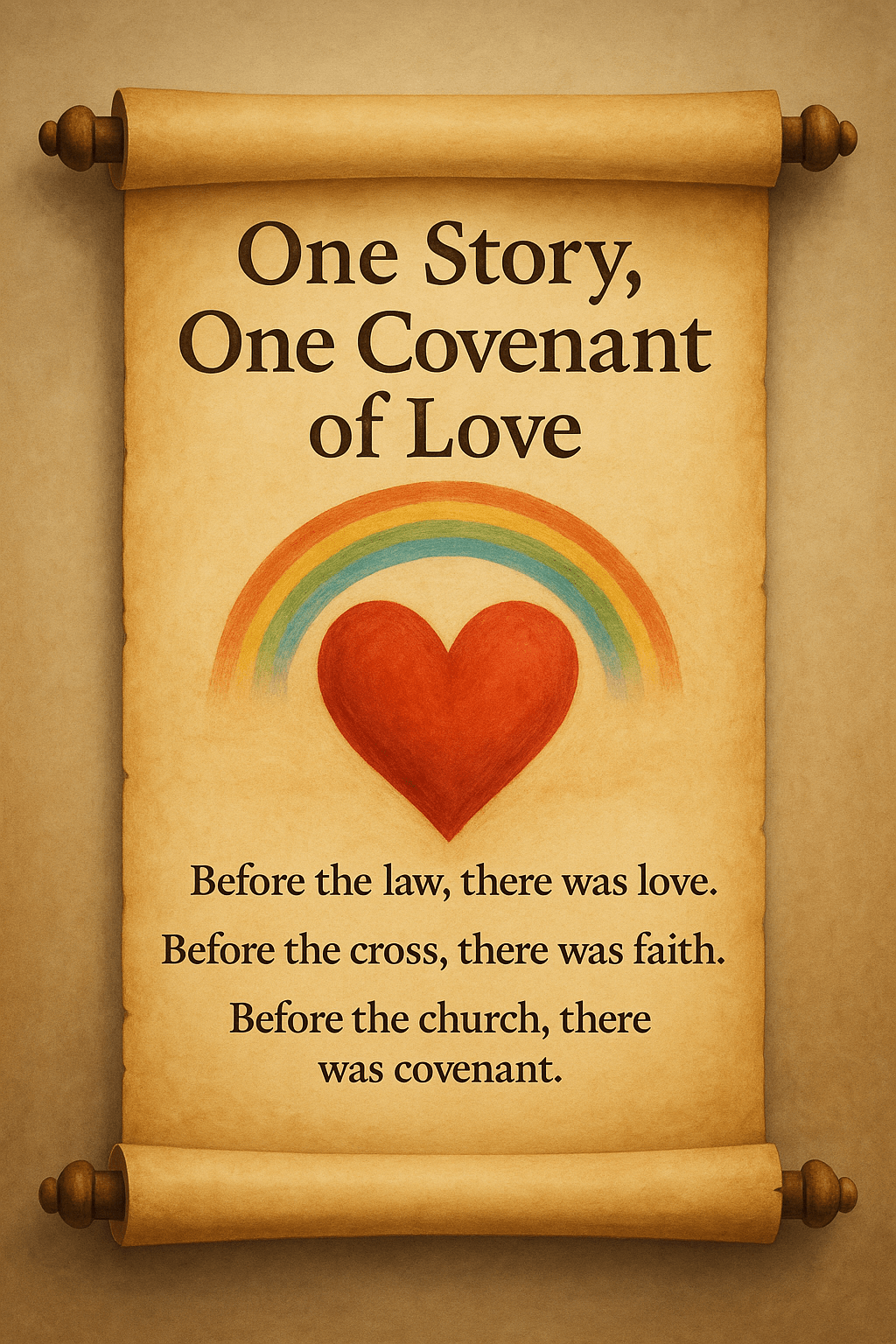
    Before the law, there was love.
    Before the cross, there was faith.
    Before the church, there was covenant.

    Noah, long before Abraham or Moses, walked with God in a time of great darkness. The Scriptures say, “Noah was a righteous man, blameless among the people of his time, and he walked faithfully with God.” (Genesis 6:9)
    And tucked into that ancient story, long before Paul ever used the word, we read:
    “Noah found grace in the eyes of the Lord.” (Genesis 6:8, KJV)

    God made a covenant not only with Noah, but with all of creation—a covenant sealed with a rainbow, not as a warning, but as a promise of mercy. (Genesis 9:12–13)

    Abraham, too, was called by God not because of perfect obedience, but because of faith. “Abraham believed the Lord, and it was credited to him as righteousness.” (Genesis 15:6)

    This thread continues through the prophets, where we find not just warnings, but deep wells of compassion. One of the clearest voices is Micah, who lived around 700 BCE, during a time when empty religious rituals had replaced authentic spiritual life.

    Despite being in what some would call the “Old Covenant” period, Micah’s message is not bound by the letter of the law. His voice, like a clear bell in the night, pierces through empty religious performance and calls the people back to the essence of covenant: a living relationship rooted in justice, mercy, and humble companionship with God.

    “He has shown you, O mortal, what is good.
    And what does the Lord require of you?
    To act justly, and to love mercy,
    and to walk humbly with your God.”
    —Micah 6:8

    These words aren’t about works replacing faith; they’re about faith becoming visible through love. They point to the same truth Jesus would later reveal in His own life and teaching.

    Micah fits beautifully in the timeline of faith and grace. He bridges the legalism that had crept into temple worship and the inner heart of the gospel Jesus would one day preach. His words are a quiet flame—a reminder that God’s covenant was never meant to be merely about laws or sacrifices, but always about the heart.

    The Psalms, too, are filled with this same light:
    “The Lord is compassionate and gracious, slow to anger, abounding in love.” (Psalm 103:8)

    And in Jeremiah, speaking during the collapse of a nation, we hear God longing for a deeper, more intimate relationship with His people—not through outward law, but inward transformation:
    “I will put my law in their minds and write it on their hearts. I will be their God, and they will be my people.” (Jeremiah 31:33)

    So when Jesus came, He did not cancel the story that had come before. He fulfilled it.
    As He said:

    “Do not think that I have come to abolish the Law or the Prophets;
    I have not come to abolish them but to fulfill them.”
    —Matthew 5:17

    And when asked what the greatest commandment was, He reached back and held up the same eternal truth:

    “Love the Lord your God with all your heart and with all your soul and with all your mind…
    And love your neighbor as yourself.
    All the Law and the Prophets hang on these two commandments.”
    —Matthew 22:37–40

    This isn’t a new message.
    It’s an ancient echo.
    It’s the song God has been singing all along.

    And yet, more than 2,000 years since Jesus walked the earth preaching this message of love over law, compassion over control, too often His voice has been claimed by institutions that fell back into the very legalism He challenged.

    We must speak this truth with sorrow: millions of innocent people were persecuted, tortured, and killed under the banner of a legalistic Christianity that bore little resemblance to Christ Himself. Systems rose that called themselves holy, while denying the very heart of the gospel.

    But God’s grace was never extinguished.
    It remained with the suffering.
    It whispered in prison cells.
    It burned quietly in hearts that refused to hate.

    And still today, the invitation is not to belong to a system, but to awaken to a relationship—one that each of us is called to seek, not by rote, but with heart, soul, and longing.

    It is the same call that echoed through Noah, Abraham, Micah, and Jeremiah.
    The same call Jesus lifted with His life.
    To seek justice.
    To love mercy.
    To walk humbly with our God.

    This is not only history. It is now.

    It is each soul’s sacred responsibility to seek the presence of God—not as a distant lawgiver, but as the living grace who has been with us from the beginning. To turn inward in faith. To walk outward in love. And to let that love be our testimony.


    A quiet invitation to rediscover the thread of God’s love that has never been broken.

    🙏🕊🙏

  • The Inner Home

    The Inner Home

    I begin the day
    not in the noise of doing,
    but in the silence of being.

    A breath.
    A remembrance.
    That peace is not far off—
    but within,
    waiting like a hearth with gentle flame.

    Here,
    my grief can bow beside my gratitude.
    My fatigue can lean against
    the walls of mercy.

    From this inner dwelling—
    shaped by stillness,
    carved by discipline,
    warmed by God’s quiet love—
    I face the world not alone,
    but inhabited.

    By peace the world cannot give.
    And love the world cannot take.

    🙏🕊🙏

  • Shavuot and Pentecost: Two Traditions, One Divine Giving

    Shavuot and Pentecost: Two Traditions, One Divine Giving

    Reflections on the Spirit and the Word

    As we move through the sacred rhythms of the calendar, a deep and often overlooked harmony begins to reveal itself between the Jewish and Christian traditions. One such harmony lives in the connection between Shavuot and Pentecost—two feasts separated by language and culture, but united by spirit and meaning.

    In the Jewish tradition, Shavuot (meaning “Weeks”) arrives seven weeks after Passover. It commemorates the moment when Moses ascended Mount Sinai and received the Torah—not only the Ten Commandments, but the full revelation of God’s will for the people of Israel. Shavuot is a festival of divine giving. It is a time when the heavens opened and the Word came down—not only as law, but as relationship, as covenant.

    In mystical Judaism, Shavuot is sometimes described as a wedding between God and Israel, with the Torah as the marriage contract. The people stood at Sinai not just as witnesses to revelation, but as participants in a sacred union. The voice of God thundered from the mountain. The people trembled. Something eternal was given.

    Now consider Pentecost, celebrated 50 days after Easter in the Christian tradition. The name “Pentecost” comes from the Greek pentēkostē, meaning “fiftieth.” On this day, as the disciples of Jesus gathered in Jerusalem, a great wind filled the room, tongues of fire rested on each of them, and they were filled with the Holy Spirit (Acts 2). They began to speak in many languages, and their words carried a new power.

    For Christians, Pentecost marks the birth of the Church, not through doctrine, but through direct experience of the Spirit. The gift was not written on tablets, but on hearts. The Divine presence did not descend in smoke and thunder, but in wind and flame.

    And yet—these two events, Sinai and Pentecost, are deeply connected.

    At Sinai, God gave the Torah.

    In Jerusalem, God gave the Spirit.

    At Sinai, God’s voice was heard in thunder.

    In Jerusalem, the Spirit moved through wind and flame.

    At Sinai, a people was formed around the Word.

    In Jerusalem, a people was formed around the Spirit.

    In both traditions, something sacred is given. Something life-altering.

    God gives God’s Self—first through revelation, and then through indwelling presence.

    For those of us who walk between these worlds—or seek to honor both—the connection between Shavuot and Pentecost is not accidental. It is a reminder that revelation is not a one-time event, but a living process. God continues to give. Through law and through love. Through instruction and inspiration. First on stone, then in spirit—but always for the sake of healing, wholeness, and transformation.

    May this season remind us that whether we gather at the foot of Sinai or in an upper room, the Breath of the Holy still moves among us.

    Shalom Aleichem.

    Peace be upon you.

    🙏🕊️🙏

  • Thinking Out Loud

    Thinking Out Loud

    After 2,000 years, many are still waiting for the Kingdom of God to arrive from the outside. But what if the kingdom Jesus spoke of is already here—within us, waiting quietly to be recognized? These thoughts are shared not as answers, but as reflections… thinking out loud…

    In Jesus’ words, “The Kingdom of God is within you.” It’s such a profound teaching, yet so many, even after 2000 years, continue to look outward, as if the kingdom is a distant place or a future event. The truth is, it is already here, in the present moment, within each of us, waiting to be recognized.

    “nor will people say, ‘Here it is,’ or ‘There it is,’ because the kingdom of God is in your midst.” Luke 17:21

    In this verse, Jesus is responding to a question from the Pharisees about when the Kingdom of God will come. He answers by saying that it’s not something to be observed externally, but rather that it’s already present within those who believe.

    It’s as though the external waiting reflects our inability to fully embrace what is already present—our reluctance to fully step into the fullness of our own being, the divine spark that resides within. The kingdom is not a far-off land to be found after death, nor is it a king to be crowned in a distant future. It’s a recognition, a shift in awareness.

    Jesus, in his life and teachings, pointed again and again to this truth, yet even his followers continued to expect a king who would come in glory, overthrow empires, and bring physical peace. But the peace Jesus offered was internal—a peace that passes understanding, a peace that comes from being aligned with the divine within.

    The kingdom is not about external events, but about the internal shift—a shift from seeking to knowing, from waiting to realizing, from longing to embodying.

    Is it possible that we’re all waiting for an external kingdom, while the kingdom quietly resides in our hearts, patiently waiting for us to recognize it?

    Yes?

    🙏🕊🙏

  • The Two Silences: A Contemplation on The Sound of Silence

    The Two Silences: A Contemplation on The Sound of Silence

    In homage to Paul Simon and the song that still sings across generations

    Some songs do more than linger in memory—they deepen with time.
    Paul Simon wrote The Sound of Silence as a young man, yet its meaning seems to unfold like scripture, revealing new layers to each listener, in each season of life.

    For some, it speaks of loneliness. For others, protest.
    And for those on the contemplative path, it reveals something more:
    not just silence as emptiness,
    but silence as fullness.
    Not absence, but presence.

    This is one such reflection—offered in reverence, not explanation.
    A glimpse into the two silences
    hidden within one timeless song.


    There are silences that ache with absence—
    the hush of the ordinary mind,
    lost in its own echo chamber of thought,
    surrounded by words, but void of meaning.

    This is the silence of the crowd,
    of “people talking without speaking,”
    “people hearing without listening.”
    A silence that grows not from stillness, but from disconnection—
    and yes, like a cancer, it spreads.

    But there is another silence.

    The mystic’s silence.
    The silence not of emptiness, but of fullness.
    Where thoughts dissolve, not into numbness,
    but into presence.

    This silence is a friend.
    It is “hello darkness”—not as despair,
    but as womb.
    It is Buddha-nature beneath the vrittis,
    the Word unspoken, still vibrating in the unseen.

    Paul Simon’s song—whether he knew it or not—
    opens the door to both.
    It begins in longing, in disillusionment,
    but ends in revelation:
    the words of the prophets
    are not lost.
    They are whispered in the sound of silence.

    We do not need to fill the silence to find meaning.
    We need to listen more deeply.
    Not to the static of the mind,
    but to the sacred hush beneath all things.

    In the silence of tenement halls,
    in subway walls,
    in our own aching hearts—
    the message is still being spoken.

    Listen.

    🙏🕊🙏


  • Like a Smile That Was Always There

    Like a Smile That Was Always There


    Let’s just sit.
    No commentary.
    No effort.

    Just being.

    And let the Truth
    reveal itself
    like a smile
    that was always there.

    🕊🪷✨


    .

  • Stillness as a Shared Thread: Rediscovering the Contemplative Heart Across Faiths

    Stillness as a Shared Thread: Rediscovering the Contemplative Heart Across Faiths

    It was two thirty in the morning. I sat in silence, trying to rest into stillness. The world around me slept, yet within me, a gentle inquiry stirred: Why is it that only certain traditions teach us to dwell in this quiet space?

    In my journey through interfaith dialogue, I’ve noticed something curious. In Buddhist practice—and in the Advaita Vedanta stream of Hinduism—stillness isn’t peripheral. It’s central. These traditions invite us, again and again, to be. To rest, not just physically, but inwardly. To let go of striving, stories, even self, and to dwell in the deep, felt presence of this very moment.

    Yet in Judeo-Christian traditions, though rich in prayer, justice, and community, the practice of stillness often seems harder to find. It’s not that it doesn’t exist—it does. The Psalms offer, “Be still and know that I am God.” Christian mystics, Jewish Kabbalists, and solitary monks across centuries have spoken of the silence where God is most intimately known. But somehow, for many practitioners today, the embodied experience of silence and inward stillness is rarely cultivated or taught.

    Why is that?

    Perhaps it’s because Western religious traditions have long emphasized doing—serving, obeying, proclaiming, believing. These are beautiful, powerful acts. Yet they can eclipse the quieter invitation: to rest in the Divine without needing to understand, explain, or prove.

    Stillness, after all, is not emptiness. It is the fertile ground from which love, compassion, and insight can grow. It is the place where breath returns to breath, and the soul remembers itself—not as an idea, but as a living presence.

    As someone walking the interfaith path, I find hope here. Stillness can be a meeting ground—not a dogma, but a practice. A place where traditions speak not about the sacred, but from it.

    Whether you call it God, the Divine, Buddha-nature, or simply the Mystery—stillness is where it lives in us.

    Maybe now is the time to rekindle that thread. To remind ourselves, and one another, that beyond all teachings and texts, there is a silence waiting to be heard.

    🙏🕊🙏


  • From Separation to Union: Rediscovering the Boundless Presence of God

    From Separation to Union: Rediscovering the Boundless Presence of God

    “In the beginning, Elohim created the heavens and the earth.” (Genesis 1:1)

    Introduction: The Question of Elohim

    These opening words of the Bible are familiar to millions. Yet hidden within them lies a mystery often overlooked. Why does the text use Elohim, a plural form, rather than a singular name for God? Is this merely a grammatical curiosity, or does it point toward something deeper—something vast, formless, beyond the limitations of human thought?

    For centuries, many have understood God as a being—separate, external, anthropomorphized. The image of an old man on a throne has dominated religious imagination, reinforcing the belief in a distant deity who governs creation from afar. But what if this is only a veil over a deeper truth? What if Elohim points not to a being among beings, but to the boundless reality itself—the Ein Sof of Kabbalah, the nameless and formless essence beyond all concept?

    This essay is an invitation to step beyond the veil. To move from separation to union, from belief to direct experience. To rediscover what the mystics across traditions have always known: that God is not elsewhere. God is here, now, and always—within and beyond, closer than breath, vaster than thought.

    The Illusion of Separation

    Throughout history, religion has provided humanity with stories, images, and rituals to help navigate the mystery of existence. Yet, in doing so, it has often externalized the divine, creating a subject-object duality—God as a being, separate from creation, separate from us.

    This duality is at the root of suffering. When we see ourselves as apart from the divine, we feel exiled, adrift in a world where God is distant and we are left to struggle alone. This belief in separation has led to fear, to longing, to a desperate seeking for something outside of ourselves that can restore what feels missing.

    But what if nothing was ever missing? What if the separation is only a misunderstanding, a veil drawn over the truth of our oneness with the Infinite?

    The Path of Direct Experience

    The great mystics—those who have peered beyond the veil—have all spoken of a reality beyond belief.

    St. John of the Cross, in his Dark Night of the Soul, describes a journey where all concepts, images, and even the felt presence of God are stripped away. This is not a loss but a purification, a burning away of false idols so that the soul may awaken to the unmediated presence of the divine.

    In the Jewish tradition, the Kabbalists speak of bitul, the nullification of ego, where one dissolves into the infinite Ein Sof, realizing that there never was a separate self to begin with. Similarly, in the contemplative traditions of Buddhism, the stillness of shamatha leads to the recognition of the pristine mind—that which has always been pure, unconditioned, free.

    In every tradition, we find this same invitation: to stop seeking outward and to turn inward, to surrender not to belief, but to direct encounter. To see that God is not an external entity, but the very ground of our being.

    The Return to Oneness

    When we let go of the illusion of separation, what remains?

    Not the loss of self, but its fulfillment. Not an annihilation into emptiness, but a merging into fullness—the great I Am. The “yoga” of the Vedic tradition means precisely this: union. It is the recognition that we were never apart from God, only dreaming that we were.

    This is not an esoteric teaching reserved for monks and mystics. It is the birthright of every human being. It is what Jesus meant when he said, “The kingdom of God is within you.” It is what the Psalmist knew when he wrote, “Be still, and know that I am God.” It is what every human heart longs for—not a distant deity, but the felt truth of divine presence, here and now.

    Tikkun Olam: Healing the World Through Remembrance

    When we remember our oneness with the divine, we heal not only ourselves but the world.

    The Kabbalistic tradition of Tikkun Olam, the healing of the world, is not merely about fixing external problems. It is about restoring divine unity—within ourselves, within society, within creation. The suffering of the world is the suffering of separation. The healing of the world is the return to wholeness.

    This is why this message matters. Not as an intellectual exercise, not as a theological debate, but as the most urgent and necessary work of our time. The world does not need more beliefs about God. It needs people who have remembered their divinity. People who, knowing themselves as inseparable from the infinite, act with wisdom, love, and compassion.

    This is the path of return. Not by striving, not by effort, but by surrendering to the truth that has always been. The Elohim of Genesis was never a separate being. Ein Sof has never been absent. The I Am has never ceased to be what it is.

    All that remains is to awaken.

    Conclusion: The Invitation

    If these words stir something in you, it is because they are already known. The recognition of divine oneness is not something to be attained—it is something to be remembered.

    Wherever you are, whatever your path, the invitation is the same:

    Be still. Let go. And know that you are already home.


    Addendum: Searching for What Is Already Here

    This morning, I took the cream cheese out of the fridge, opened it up, and placed a bagel into the toaster, getting everything prepared for a delicious breakfast. A simple task.

    Then, as my bagel toasted, I opened the fridge again to grab the cream cheese. But it wasn’t there.

    I checked every shelf. Nothing.

    I stood there, puzzled. I know I had cream cheese yesterday. Did I finish it? Did it somehow disappear?

    And then I turned around.

    There it was—right on the counter, exactly where I had left it, sitting open and waiting for me.

    I couldn’t help but laugh.

    How often do we search for something that was never missing? How often do we look for God as if He were distant—forgetting that the divine presence, like my misplaced cream cheese, has been right here all along?

    The moment we stop searching, we arrive.

    And sometimes, the path to enlightenment is as simple as laughing at yourself while spreading cream cheese on a bagel.

    🙏🕊🙏

  • Into the Mystic: The Universal Presence Behind All Paths

    Into the Mystic: The Universal Presence Behind All Paths

    There is a timeless pull within the human heart, a pull that mystics across the ages have followed into realms beyond words. At the heart of their journeys, in every tradition, is a shared glimpse of something infinite and intimate, an essence that defies borders or labels. It’s been called by many names—Naked Awareness, Pure Presence, the Kingdom of Heaven within, and simply, I am. Despite the variations, the core is always the same: an invitation to touch the stillness at the center of our being, where all sense of separation quietly dissolves.

    Mystics across traditions—whether Buddhists, Christians, Sufis, or followers of Advaita—have left clues for us, each one pointing back to this same universal awareness. Tibetan Dzogchen, for instance, speaks of Naked Awareness, a mind so utterly clear and open that nothing need be added or removed. In this view, awareness is naturally luminous, like an open sky, vast and untouched by thoughts or concepts. The practice, if it can be called that, is simply to rest—free from striving, free from the need to grasp anything. It is awareness itself, just as it is.

    In the traditions of Advaita Vedanta, Ramana Maharshi posed the question, “Who am I?” Not to point to an answer but to turn us back to a sense of self beyond thoughts and identity. With each inquiry, the seeker’s attention is drawn back, away from thoughts and identities, into a place beyond all definition. This, he taught, is the Self, pure and indivisible—a silent, undivided presence.

    Christian mystics, too, found this universal ground within. “Be still and know that I am God,” whispers a line from the Psalms, urging a quieting of the mind so profound that the divine presence within each of us reveals itself. It is an invitation to encounter God not as an outside force, but as the very heart of our being—the unspoken “I am” beyond thought.

    Sufis describe this experience as a union with the Beloved, a love so profound that all sense of self dissolves. In Sufi poetry, God is the Beloved who lives within, waiting for the self to step aside so that the Divine can be known, not as separate, but as one with all that we are. Each of these traditions, in its way, guides us to an experience beyond the confines of self, into the space where awareness rests in itself, undivided.

    It is not so much a technique or practice as it is a gentle turning inward, a quieting, a surrendering into what has always been here. Let us pause for a moment. The words, after all, can only lead us to the door.

    Begin by finding a comfortable place to sit and close your eyes if that feels natural. Notice the rhythm of your breath and let yourself settle into the present moment. There is nothing to attain here, nothing to change. Let your breath rise and fall as it will, and simply allow yourself to be.

    Gradually, feel into your own presence, that simple sense of “I am.” Not your thoughts, not your sensations, but the awareness that notices them all. Rest in that sense of being here, alive, awake. There’s no need to go further than this. Let go of any sense of searching or effort; simply let your attention melt into the quiet space of awareness itself.

    If thoughts arise, there’s no need to push them away. You might notice them, perhaps softly wonder, “Who is aware of this thought?” Not to seek an answer, but to draw your attention back into the simple awareness that witnesses everything. Rest as that awareness, noticing how it is steady, quiet, and open, beyond anything the mind might hold onto.

    Here, in this openness, lies the mystery that mystics across all traditions have discovered. There is a silent presence here that does not come and go, even as everything else changes. It is the same presence that Dzogchen calls Naked Awareness, Advaita describes as the Self, and Christian mystics know as the divine within. This presence is universal, boundless, and utterly simple. It is the same awareness in everyone, untouched by belief or background.

    As you sit, allowing yourself to rest in this awareness, notice how it has no boundary, no form. It is the same in all beings, a shared presence connecting us all. In this stillness, you are already whole, already free, and deeply one with all. This is where all paths meet—an awareness, vast and simple, that is always here, waiting to be recognized as the essence of everything.

    And so, as we return to our day from this quiet place, we carry a reminder: that beyond every tradition and label, there is a shared, undivided presence—a timeless awareness that each of us holds within.

    🙏🕊️🙏