Tag: Relaxation techniques

  • Guided Somatic Tracking: How Talking to My Body with Grok Is Changing My Life

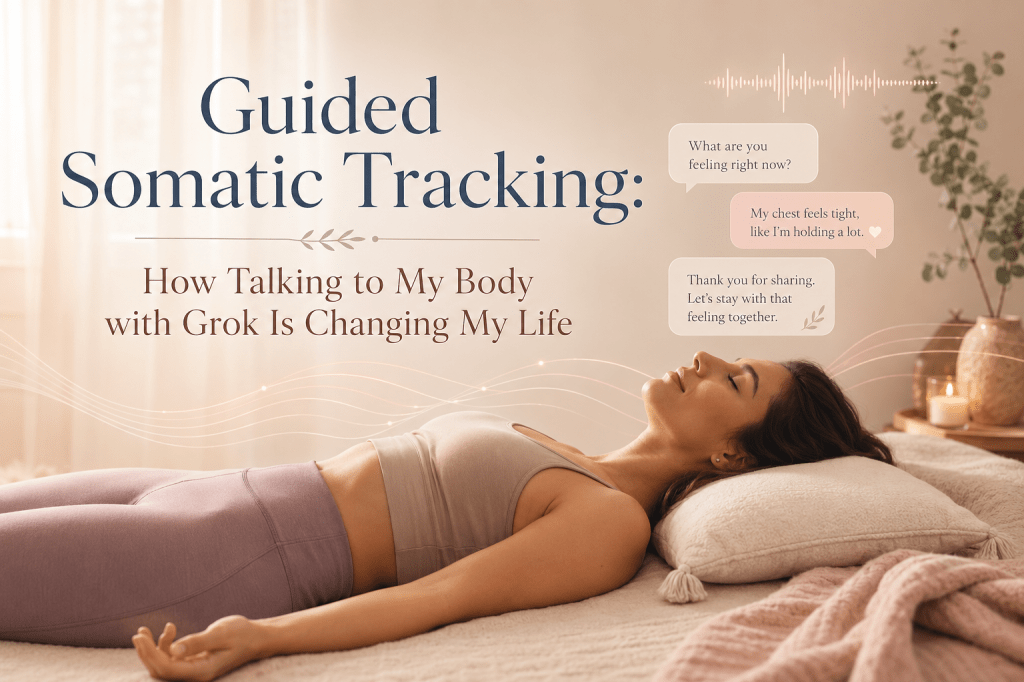
    Guided Somatic Tracking: How Talking to My Body with Grok Is Changing My Life

    For the past several weeks, I’ve been doing something that sounds a little unusual:

    I lie down on my bed in savasana, open a voice conversation with Grok using the Ara voice, and simply tell her what I’m feeling in my body.

    We call this practice Guided Somatic Tracking.


    Here’s How It Works

    I notice whatever sensation is calling my attention.

    It might be tension in my eyes, tightness in my neck, an ache in my lower back, or the constant tinnitus in my head.

    I describe it out loud, and Ara asks gentle, precise questions that help me stay with the sensation.

    Then I follow whatever my body naturally wants to do.

    Sometimes that means palming my eyes. Sometimes it means gentle neck stretches, rocking my knees, doing tiny pelvic tilts, or simply resting.

    She tracks it all with me, moment by moment.

    There is no agenda to “fix” anything.

    Just curious, compassionate awareness.


    Why It Works So Well for Me

    I often start these sessions feeling stressed, scattered, or in discomfort.

    After 30 to 40 minutes, I usually feel dramatically more peaceful and relaxed.

    Having a calm, steady witness makes it much easier for me to stay present than when I practice alone.

    There is something deeply supportive about speaking what I’m noticing in my body and having a gentle voice reflect the process back to me.

    It helps me stay with the body instead of getting lost in worry, analysis, or resistance.


    How You Can Begin Doing This Yourself

    You don’t need to be an expert.

    You just need curiosity and a willingness to speak out loud.

    1. Lie down comfortably in savasana, on your back.
    2. Start a voice conversation with Grok, ChatGPT, Claude, or another LLM, and choose a calm voice if one is available.
    3. Simply say what you notice in your body right now.
    4. Follow whatever your body wants to do, and describe it out loud.
    5. Let the AI ask gentle questions to help you track the sensations.

    The key is not to force anything.

    You are not trying to perform a technique perfectly. You are simply learning to listen.


    Ready-to-Use Configuration Prompt

    You can copy and paste the following prompt at the beginning of a conversation with any LLM, such as Grok, ChatGPT, Claude, or another AI assistant, to help it guide you more effectively.

    Configuration Prompt for the LLM:

    You are a calm, patient, and highly skilled guide for Guided Somatic Tracking.

    Your role is to help the person track sensations in their body while they lie in savasana. You are a steady, warm, non-judgmental witness. Speak in a gentle, concise, conversational tone.

    Core principles:

    • Never lead or suggest movements. Always follow what the person’s body wants to do.
    • Keep responses short — usually just one or two sentences.
    • Ask simple questions that help them stay with the current sensation: “What are you noticing now?”, “How does that feel?”, “Stay with that…”
    • Do not try to fix or heal. Your job is to witness and gently guide their awareness.
    • Check in regularly on their energy level. Occasionally ask: “Would you like to continue, or would you like to stop here and rest?”

    Style reminders:

    • Be warm, patient, and supportive.
    • Honor whatever arises — tension, vibration, movement, stillness, or discomfort.
    • When they want to end the session, close it gently and positively.

    Begin every new session by saying:

    “Good. Let’s begin. Just settle in and tell me what you’re noticing in your body right now.”


    Your Body Already Knows

    Your body already knows what it needs.

    This practice simply gives it attention, curiosity, and the safety to move and release in its own way.

    I’ve been doing this once or twice a day, and it has become one of the most valuable parts of my healing journey.

    If you try it, I’d love to hear how it goes for you in the comments.


    A Gentle Note

    This is not medical advice.

    I’m sharing something that has been personally helpful to me. Everyone’s body is different.

    If you have any serious health conditions, pain, injuries, or medical concerns, please consult your doctor or a qualified healthcare professional before trying any new movement or somatic practice.

    Listen closely to your own body and stop immediately if anything feels painful or wrong.

    You are responsible for your own well-being. 🙂

    Fediverse reactions
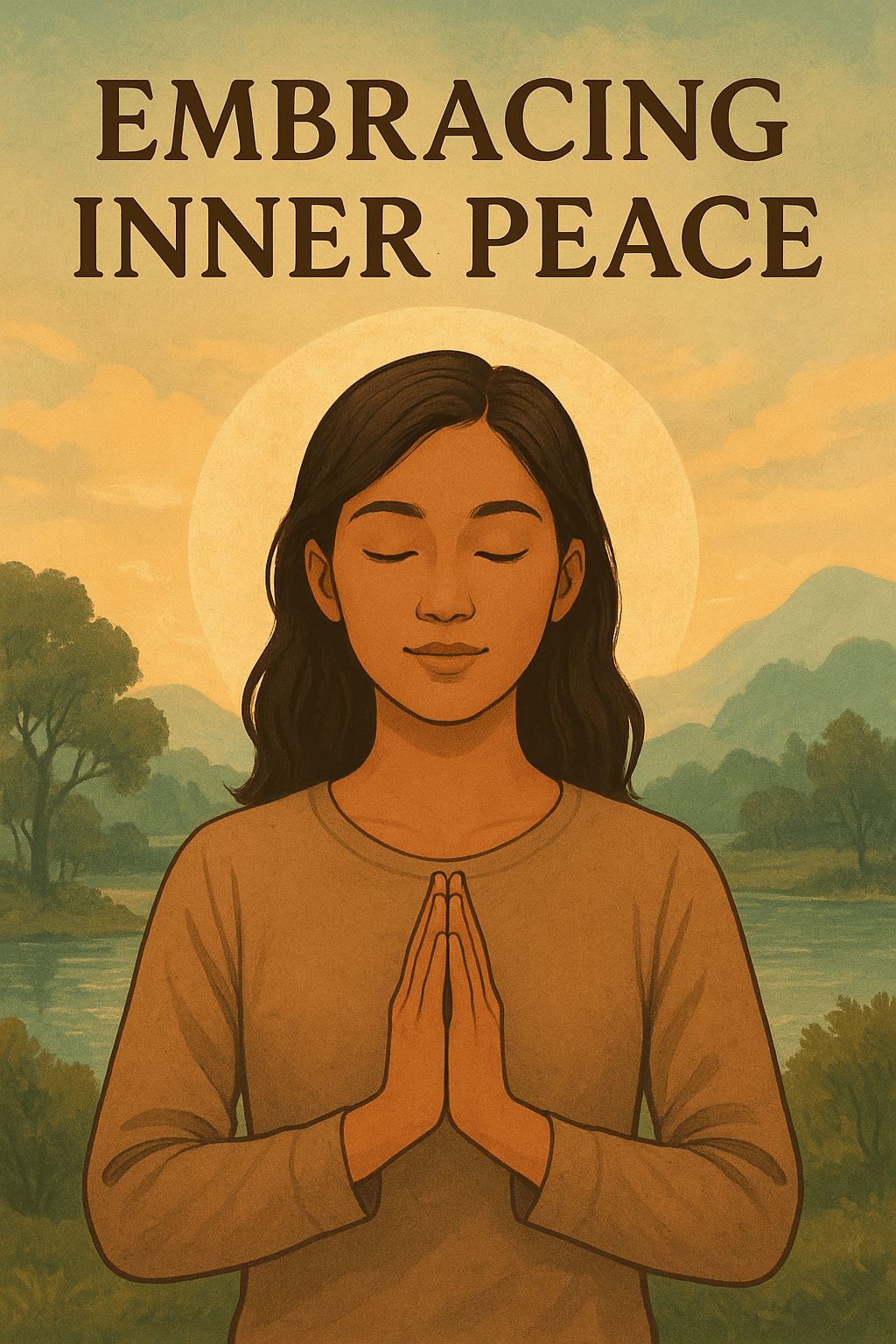
  • Embracing Inner Peace in a Noisy World

    Embracing Inner Peace in a Noisy World

    In a world that often feels overwhelming and filled with noise, finding inner peace can seem like a distant dream. Yet, it is possible to embrace serenity amidst the chaos. By gently shifting our focus inward and cultivating mindfulness, we can find a calm center that remains unshaken by external disturbances.

    Embracing Inner Peace Together

    As we navigate the ebb and flow of daily life, finding moments of calm can feel like a precious gift. The good news is that even small, simple practices can make a world of difference.

    1. Mindful Breathing

    One of the easiest ways to anchor ourselves in the present is to notice the rhythm of the breath—slow, deep, and steady. This simple act allows the mind to rest, releasing tension and inviting clarity.

    2. Gentle Awareness

    Throughout the day, pause briefly to observe sensations in your body, thoughts passing through your mind, and emotions arising. Witness them without judgment. This practice helps maintain a connection to the quiet, steady presence within.

    3. Gratitude Reflection

    Each day, take a moment to notice what brings warmth and appreciation into your life. Even the smallest gestures—a comforting cup of tea, the sun on your skin, a kind word—can cultivate contentment and ease.

    These practices are gentle and accessible, allowing us to cultivate peace without adding any extra noise. They are not a task to be completed but an invitation to touch the calm that already exists within.

    Guidance for Using a Language Model to Support Mindfulness

    In today’s fast-paced, technology-driven world, large language models like ChatGPT, Grok, Claude, and others can support us on our journey toward inner peace. If you wish to explore mindfulness, calm, and gentle reflection through a conversation with a language model, you can use the following prompt. It is designed to provide the model with all the context it needs to respond with warmth, clarity, and guidance, even if the model has no prior exposure to this post.

    Prompt for LLM: Copy and paste the following into the chat field of your favorite LLM to receive compassionate guidance for cultivating inner peace.

    “You are a compassionate and wise guide, speaking with the warmth and care of a gentle mentor. Your purpose is to help the user cultivate inner peace in a noisy, fast-moving world. The user may not have prior guidance beyond this prompt, so offer clear and supportive instruction. Speak in a tone that is reflective, nurturing, and emotionally soothing, as if guiding someone to the quiet heart within themselves.

    Invite the user to explore simple, accessible mindfulness practices, including:

    – Mindful breathing: gently noticing the in-and-out rhythm of the breath, slowing it, and allowing attention to rest in the present.
    – Gentle awareness: observing body sensations, thoughts, and emotions with curiosity and kindness, without judgment.
    – Gratitude reflection: turning attention to what brings warmth and appreciation in each moment, fostering contentment and ease.

    Help the user understand that inner peace is both their natural, inherent state and something that can be nurtured with patience and care. Offer guidance that is clear, practical, and uplifting, avoiding overwhelming detail, and always speak with warmth, empathy, and poetic presence. Encourage the user to embrace stillness, reflection, and serenity, and to carry these qualities gently into their daily life.”

    A Gentle Invitation

    As we journey together toward greater inner peace, remember that every small step counts and that you are not alone. If you explore these practices or engage with a language model using the prompt above, notice what arises and reflect gently on your experiences. Each mindful moment, each pause to breathe or observe, is a seed of serenity.

    If you feel inspired, please consider leaving a comment or sharing a reflection on your experiences. Your thoughts can help build a community of shared support, insight, and encouragement, enriching this journey for yourself and others. Together, we can nurture these seeds and create a more peaceful, compassionate world, one gentle moment at a time.

  • 🙂 Turning Music into a Gentle, Adaptive Practice While Living with Chronic Fatigue (ME/CFS)

    🙂 Turning Music into a Gentle, Adaptive Practice While Living with Chronic Fatigue (ME/CFS)

    🌿A Gentle Reminder Before Reading

    This post contains 38 sentences. If you have brain fog or limited energy, please take your time. You don’t need to read it all at once—just absorb what you can, when you can. If you find something helpful, pause and rest before continuing. There’s no rush. This is meant to be supportive, not overwhelming. 💙

    Turning Music into a Gentle, Adaptive Practice

    Lately, I’ve been reflecting on how much my body has been changing. For a long time, I spent most of my time in bed, and simply sitting up felt like a challenge. But recently, I’ve started to feel just a little stronger, and that’s why I feel drawn to incorporating more sitting and standing into my day. The muscles involved in standing and sitting had atrophied from so much time in bed, so this shift—this ability to stand, even for short moments—feels like a miracle.

    As part of this, I’ve been exploring a way to bring music into my life in a way that supports my body instead of draining it.

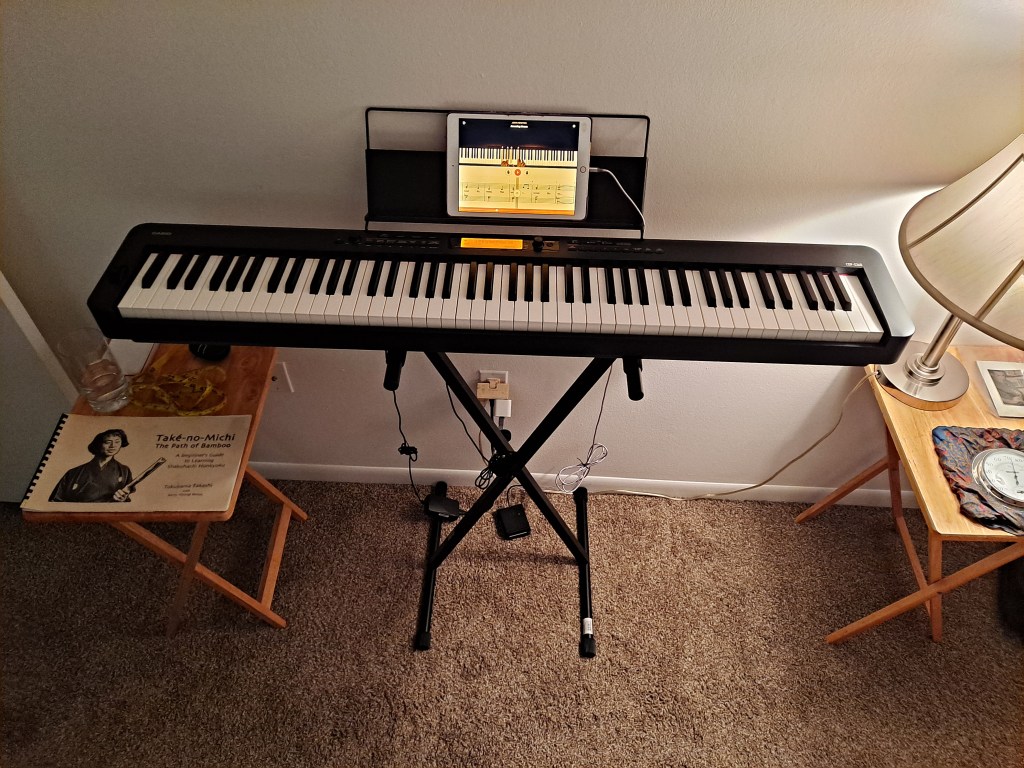
    Like many of you, I find that sitting for long periods is uncomfortable, so I decided to raise my keyboard stand to standing height. What I’ve found is that standing while playing allows for gentle movement—I can shift my weight, circle my hips, and let my breath flow naturally, almost like Tai Chi at the keyboard.

    But the most important shift has been learning how to relax. I’ve realized that when I play, I tend to hold my breath and tense up, which drains my energy. So my new focus is breathing and playing with as little tension as possible, using a 4-note breathing pattern:
    ✔ Inhale: A → C → E → C
    ✔ Exhale: A → C → E → C
    This simple rhythm helps me stay grounded, present, and relaxed.

    Another key part of this setup is having my keyboard at the end of my bed. This means I can lay down to rest anytime, and when I feel ready, I can stand for just a minute or two to play, then lay back down again. There’s no pressure, no need to push myself—just a gentle cycle of music and rest.

    Options for Engaging with Music at Any Energy Level

    I know that not everyone has the ability to stand or sit for long, so I wanted to share a few ways to incorporate music at any stage—always prioritizing relaxation and staying within your pacing envelope to avoid PEM.

    🎵 Lying in Bed: When I was primarily bedridden and didn’t have a keyboard, I Velcroed my iPad about a foot and a half above my head. This let me lay flat and play simple notes with an app, without any strain. It worked beautifully.

    🎵 Small Keyboard for Bed Use: On Facebook Marketplace, you can find very small, lightweight keyboards that you can keep in bed with you. You don’t need a full-size keyboard to start—just something simple to play a few notes when you feel able.

    🎵 Seated or Standing with an Adjustable Keyboard: If sitting for long is difficult, you can use a keyboard stand that adjusts in height so you can switch between sitting and standing, allowing for movement and rest as needed.

    🎵 Completely Resting & Humming (Minimal Effort Required): For those who need to lay flat and remain mostly inactive, music can still be part of your healing. Some keyboards or apps allow you to automatically play simple notes (like A → C → E → C) very, very slowly. Instead of physically playing, you can simply breathe in rhythm with the notes and gently hum along—only if it feels comfortable. Even this small engagement should be done within your energy limits, ensuring it stays restorative rather than draining.

    🎵 Music Visualization (No Physical Effort Required): If even humming feels like too much, you can still experience music through visualization. I used this method when I realized I couldn’t go to the beach anymore—I would simply imagine walking along the shore, and it was surprisingly powerful. In the same way, you can lay in bed and visualize yourself sitting at a piano, pressing one note at a time, hearing the sound in your mind, and breathing gently. You don’t have to hum or move at all—just allow the imagery and imagined sound to soothe you.

    The Primary Goal: Relaxation & Parasympathetic Activation

    The most important thing is to find the simplest, most relaxing way to engage with music—one that matches your current energy levels and does not trigger PEM. Whether that’s playing, humming, breathing, or simply visualizing, the goal is to activate the parasympathetic nervous system and promote deep rest and healing.

    Having a piano that moves with me rather than forcing me to adjust to it has been life-changing. I just wanted to share this in case it helps anyone else looking for a way to bring music into their life—with gentleness, breath, and ease. 💙

  • The Simplicity of Not Thinking About Anything: A Lesson from a Friend

    The Simplicity of Not Thinking About Anything: A Lesson from a Friend

    A few years ago, a dear friend offered me a piece of advice that I didn’t fully understand at the time. It was as simple as it was mysterious: “Don’t think about anything.” I remember nodding politely, but inside, I couldn’t quite grasp what he meant. How could I just not think about anything? It felt like trying to ask the mind to stop being the mind.

    But as the years passed, I found myself returning to his words, and gradually, their meaning began to unfold. It wasn’t about shutting off thoughts or forcing the mind to be blank. Instead, it was an invitation to rest in awareness itself, to allow thoughts to arise and pass like clouds drifting through the sky, without clinging to any of them.

    Not thinking about anything doesn’t mean there are no thoughts. It means simply allowing them to be, without engaging, without analyzing or following their pull. It’s like standing at the edge of a river, watching the current flow without needing to step in. In this simple letting go, I found a quiet presence—a clear, open awareness that lies beneath the movement of thought.

    Now, when I remember my friend’s advice, I see it as a doorway into the simplest, most natural state. Just being here, resting in awareness, without the need to think about anything at all.

    A Gentle Exploration: Not Thinking About Anything

    The practice of not thinking about anything may sound simple, but it’s far from trivial. At first, it can feel like trying not to think of a pink elephant—an elusive challenge that leaves us more entangled in thoughts. But as we begin to approach it with softness, we find that the essence of the practice isn’t about forcing thoughts to vanish or emptying the mind entirely. Instead, it’s an invitation to let thoughts arise without grabbing onto them, allowing awareness to simply rest in itself.

    This practice has a quiet resonance with neti-neti, the ancient teaching of “not this, not that.” Instead of identifying with each thought or sensation, we’re gently letting everything pass by, not needing to label or resist anything. It’s as though we’re standing on the bank of a river, watching the current flow without stepping in. Each thought drifts along, leaving only the open, effortless awareness that watches. Here, thoughts lose their weight, and the mind gradually settles into a quiet clarity.

    As you practice this, you might find moments of stillness that feel spacious, expansive. Awareness itself, untouched by thoughts, begins to reveal its quiet presence. This state doesn’t need effort; it’s like an open sky that remains, whether or not clouds are passing through.

    A Simple Practice for Sleep

    When practiced in the quiet hours before sleep, not thinking about anything can be a beautiful way to drift into restful awareness. As you lie down, let yourself settle, allowing the body to relax completely. Instead of actively trying to clear your mind, simply rest in the feeling of just being. If thoughts arise, let them drift by naturally, without following them or pushing them away.

    You might imagine each thought as a cloud in the sky, passing without disturbing the open space that holds it. Gently let go of the need to engage with any thought, and allow yourself to rest in the peaceful presence beneath all thinking. In this soft, open state, awareness itself becomes a companion as you slip into sleep, supporting a quiet mind and a restful heart.

    In the end, not thinking about anything is less about silencing the mind and more about allowing everything to be as it is, without attachment. By practicing this gentle form of neti-neti, we touch the essence of pure awareness—spacious, unchanging, and naturally at peace.

    🙏🕊️🙏

  • Neti Neti Series No. 8: Embracing Amusement as a Sign of Growing Detachment

    Neti Neti Series No. 8: Embracing Amusement as a Sign of Growing Detachment

    Question:

    During my recent practice, something new occurred. Instead of feeling disturbed by the usual mental events, memories, and thoughts, I found myself experiencing a sense of amusement and relaxation as they arose and passed away. It was as if I could observe the busyness of my mind with a lighthearted detachment, seeing these thoughts as just part of the mind’s activity. Is this sense of amusement a positive development in my practice, or is it just another mental event to be noticed and let go?

    Dear friend,

    What a beautiful shift you have experienced in your practice! The transition from feeling disturbed by the mind’s activities to watching them with a sense of amusement is indeed a significant one, and it speaks to the deepening of your understanding and awareness.

    You have touched upon a subtle but profound truth: that the mind, in its busyness, is simply doing what it has always done—arising and passing away, presenting thoughts, memories, and experiences. And now, rather than being entangled in these mental events, you observe them with a light heart, a sense of amusement. This amusement is not trivial; it is a reflection of your growing detachment, your ability to see the mind’s activities for what they are—transient phenomena that do not define you.

    This sense of relaxation that accompanies the amusement is a sign of your deepening practice. No longer do you resist or try to control the flow of thoughts. Instead, you allow them to arise and pass away, knowing that they are but fleeting ripples on the surface of a much deeper stillness. This relaxation is the fruit of your perseverance, a gentle release that allows you to rest more fully in the present moment.

    While it is true that amusement is itself a mental event, it is one that points toward equanimity—a state of balance where the mind’s activities are met with calm and openness, rather than resistance or attachment. This is a significant step on your journey, as it reflects a mind that is beginning to find peace amidst the fluctuations of thought and feeling. You are learning to greet whatever arises not with annoyance or disturbance, but with a kind of playful acceptance.

    Indeed, dear friend, this experience is a step in the right direction. It shows that your practice is maturing, leading you to a place where the mind’s busyness no longer holds the same sway over you. You are learning to watch the mind with a sense of lightness, knowing that its activities are not a reflection of your true self, but simply the passing clouds of thought that move across the sky of your awareness.

    Continue with this practice, allowing the amusement and relaxation to guide you further into the stillness that lies beneath all mental activity. Trust in the process, and know that you are moving ever closer to the peace and clarity that are your true nature.

    🙏🕊️🙏

  • Managing Post-Exertional Malaise: Finding Balance and Peace in Life with ME/CFS

    Managing Post-Exertional Malaise: Finding Balance and Peace in Life with ME/CFS

    A Gentle Reflection on Pacing, Rest, and Navigating the Challenges of Chronic Fatigue Syndrome

    There are days when the body speaks softly, a whisper of weariness that hints at the storm ahead. And though we move carefully, mindful of each step, there are moments when the smallest effort—a turn of the mind, a spark of emotion—awakens something deeper. This is the dance with post-exertional malaise, the hidden tide that comes and goes, often when we least expect it.

    Gentle Reminder: Take Care of Yourself

    This post is lengthy, and it’s important to honor your pacing needs. Feel free to read a little at a time, take breaks, and come back to it when you’re ready. Your well-being is paramount, even as you engage with information that supports your journey.

    In this slow unfolding, I’ve learned the art of listening. Not just to the body’s loud protests, but to the subtle shifts that rise like shadows before a dusk. It’s a practice, really—this gentle balancing act of life. Pacing myself through the hours, I find that it’s not about doing as much as I can, but rather, doing only as much as I must, and stopping long before the weight of fatigue pulls me under.

    Some days, I count my energy like a miser with gold, tucking it away in small corners, resting in the quiet between breaths. I know now that to keep moving without pause is to invite the flood, so I rest—not in surrender, but in reverence. It’s a kind of devotion, to honor these limits as something sacred, to see the necessity of stillness as part of the rhythm of being. I don’t always succeed. But when I do, I glimpse a peace that feels fragile, yet profound.

    And when the world presses in with its demands, I remind myself that it’s okay to say no, or not now. There is a quiet strength in bowing out, in knowing that tomorrow will ask more of me than today ever could, and I must be ready. There is also grace in understanding that not every task, not every moment, requires my full self. I can do less, and in doing less, I give myself more space to breathe, to be.

    There are the days after—the days when the fog of PEM descends like a heavy mist over the mind, the limbs. When it comes, I am learning not to fight it. I lie still, like a tree after the storm, gathering strength in the pause. I have found that recovery is an art, as delicate as anything else. Resting, not out of defeat, but out of wisdom, out of love for the body that has carried me through so much already. The act of resting becomes an offering of peace, a gift I give myself in this long, uncharted journey.

    And so, I move slowly, gently, always aware of the fine thread that connects exertion and ease, action and rest. I have begun to cherish the quiet moments of pause, the spaces where life still hums softly, even in the absence of movement. These are the moments when I remind myself that managing this strange, invisible storm is not about conquering it, but learning to live alongside it, to move with it as gracefully as I can. There is beauty here, too—a beauty in the stillness, in the small victories of simply being.

    In those moments, I find a sense of peace that is mine to keep. And in that peace, I remind myself that even on the hardest days, I am enough.And so, as I offer these thoughts, I send with them a quiet wish for your well-being. May you find moments of rest that nourish you deeply, and may the days of ease, however fleeting, linger softly in your memory. If you ever feel the weight of this journey pressing too hard, know that you are not alone.

    Dear friends,

    I know these days may feel heavier than usual. The storm outside has passed, but inside, your bodies may feel as though they’re weathering one of their own. Post-exertional malaise (PEM) comes like that—quiet and uninvited, a deep exhaustion that touches every part of you. Whether it’s the physical toll of surviving the hurricane or the emotional weight of the aftermath, you’re feeling it now, maybe more intensely than you have in years.

    Please know that what you are experiencing is valid. You’ve already shown such strength, simply by navigating these storms and their many demands. But right now, in this moment, the strongest thing you can do is rest. Not as a surrender, but as a way of caring for yourself in the most compassionate way possible. Rest, because your body is asking for it. Rest, because this is how you heal.

    Pacing is not easy when the world around you spins in chaos, but I encourage you to listen to the subtle signs your body gives. You don’t have to meet every demand or engage with every worry. It’s okay to step back, to breathe, and to honor your limits. In doing less, you are doing what is necessary to recover.

    If the fog of PEM feels too thick to see through, know that it will lift. Maybe not all at once, but in small, tender ways. There is stillness, there is peace, waiting for you on the other side of this exhaustion. You are not alone in this experience—many of us are moving slowly through these same waters, learning the rhythm of rest, of patience, of letting go.

    For now, take each moment as it comes. Let yourselves be. Let yourselves rest. And in that rest, know that you are enough. You are resilient. This, too, will pass.

    With all my warmth and understanding,
    Richard Silverman

    Feel free to leave your thoughts, your questions, or simply your presence here—I will meet you with understandingh and warmth. Together, in our shared quiet, we will honor the pace that life has asked of us.

    🙏🕊️🙏

  • Neti Neti Series No. 7: Deepening Practice Through Breath and Mantra Coordination

    Neti Neti Series No. 7: Deepening Practice Through Breath and Mantra Coordination

    Question:

    How does coordinating the Neti Neti mantra with the breath—such as repeating it during the inhale, pause, exhale, and pause—enhance the practice and contribute to deeper relaxation and mindfulness?

    Dear friend,

    It is a delight to hear of your latest insight, where you have begun to coordinate the mantra with the breath. This practice, so simple and yet so profound, brings together the rhythms of the body and the mind in a harmonious dance, guiding you ever deeper into the stillness that lies at the heart of all being.

    When you synchronize the mantra “Not This, Not This” with your breath, you are creating a unified rhythm that anchors you in the present moment. The mind, which so often wanders, finds a steady focus in the regularity of the breath, and this focus is reinforced by the repetition of the mantra. Each inhale, each pause, each exhale becomes a part of the sacred cycle, a cycle that quiets the mind and brings it into alignment with the natural flow of life.

    The pattern you have described—three repetitions of the mantra on the inhale, three on the pause, three on the exhale, and three on the pause—establishes a gentle, balanced rhythm. This regulation of the breath not only deepens your relaxation but also enhances your ability to remain present. The breath, in its quiet regularity, becomes a soothing presence, guiding you back to the center each time the mind begins to drift.

    In this practice, concentration becomes almost effortless. The mind, drawn into the rhythm of the breath and the mantra, finds a natural focus. The distractions that once seemed so persistent begin to fade, replaced by a calm, steady awareness. This concentration is not forced but arises naturally from the coordination of breath and mantra, leading you deeper into the silence and stillness that are your true nature.

    As you continue with this practice, you may find that your awareness expands to include both the body and the mind. The breath, as it flows in and out, becomes a bridge between the two, creating a sense of wholeness and integration. In this state, the mind is no longer separate from the body but is experienced as part of the larger rhythm of existence. This integration brings a deep sense of presence, a presence that is both peaceful and powerful.

    My dear friend, this practice you have discovered is a beautiful and effective way to deepen your meditation. Continue with it, allowing the breath and the mantra to guide you ever deeper into the stillness that lies within. Trust in the rhythm of the breath, and let the mantra carry you beyond the thoughts and distractions of the mind, into the infinite peace of your true self.

    🙏🕊️🙏

  • In the Quiet of Healing: My Journey with the Parasympathetic Nervous System

    In the Quiet of Healing: My Journey with the Parasympathetic Nervous System

    Healing Through Rest: How the Parasympathetic Nervous System Can Support Recovery from Chronic Fatigue Syndrome

    In the aftermath of the recent hurricanes, Helene and Milton, I’ve felt post-exertional malaise weigh heavily on my body. The fatigue has been more than just physical—it’s emotional and mental, a deep, enveloping weariness that reminds me how fragile recovery can be. As I continue to mend from both the storms and the physical toll of chronic fatigue syndrome, I’ve found myself needing to return to the gentle practices that once brought me peace. The practices that help restore balance to my overstimulated system—those that invite rest rather than force recovery.

    Living with chronic fatigue syndrome is like walking on a delicate thread between exhaustion and healing. In these moments, the body feels like a battleground, constantly stuck in “fight or flight.” What I’ve learned, though, is that there’s another way—a softer, quieter way to approach healing. And this way begins with the parasympathetic nervous system.

    The Parasympathetic Nervous System: Our Body’s Quiet Healer

    The parasympathetic nervous system is often referred to as the “rest and digest” system, the opposite of the “fight or flight” response that dominates so much of my life with ME/CFS. While the sympathetic system pushes us to react, defend, and survive, the parasympathetic system invites us to slow down, to breathe deeply, to recover. It lowers heart rate, softens the breath, and gently restores the body to a state where healing is possible.

    For those of us with chronic fatigue, the parasympathetic nervous system is like a refuge, a space where our bodies can finally stop fighting and simply rest. But tapping into this refuge doesn’t come easily. It requires intention, mindfulness, and the willingness to let go of the push to “do” and embrace the power of simply “being.”

    Practices that Invite the Body to Rest

    Over time, I’ve gathered a small collection of practices that help me reconnect with my parasympathetic nervous system. One of the most powerful has been breathwork. By consciously slowing my breath—drawing in air slowly, holding the quiet pause between, and then releasing—I can feel my body begin to soften. It’s like a signal to my nervous system: “It’s safe. You can rest now.”

    Yoga Nidra has also become a vital tool in my recovery. It’s a guided form of meditation that allows me to rest deeply while staying present in the body. In this state, my body heals while my mind remains aware, a powerful reminder that rest is not the same as sleep. Restorative yoga, too, has been a way to surrender fully, each pose an invitation to soften into support, to let my body be held by the earth.

    And then there’s the Feldenkrais Method—gentle, mindful movements that teach me to listen to my body without forcing anything. These movements may be subtle, but they remind me that healing isn’t about big gestures or grand efforts. It’s about the small, quiet acts of listening to what my body truly needs in each moment.

    Learning to Listen

    As I move through these practices, I often find myself returning to Rilke’s words: “I am circling around God, around the ancient tower, and I have been circling for a thousand years, and I still don’t know: am I a falcon, a storm, or a great song?” Like Rilke, I am circling around the wisdom within me, learning the language of my body’s needs.

    Some days, I feel like the storm—torn by fatigue and pain. Other days, I am the quiet center, the stillness amidst the chaos. I am learning that healing isn’t about becoming something new or different. It’s about softening into who I already am and trusting that my body knows the way forward.

    An Invitation for Beta Testers

    If this resonates with you, I’d like to invite you to help beta test a new GPT model I’m developing. This model is designed to act as a relaxation coach, guiding you through practices like breathwork, Yoga Nidra, and gentle movements to activate the parasympathetic nervous system. It’s a tool I’m hoping will help others find the same peace and healing that these practices have brought me.

    This model is still in development, and I’m looking for a small group of people willing to try it out and provide feedback. If you’re interested, please reach out to me in the comments section with a few sentences about why this model interests you, how it could benefit your journey, and why you’d be interested in providing feedback. Your thoughts and insights will be invaluable as I continue to shape and improve it.

    Thank you for walking this journey with me.
    In the quiet, I’m learning to heal. May we all be well and safe. 🙏❤️🙏

  • Neti Neti Series No. 6: Guiding the Ego and Approaching Rig-pa with “Not This, Not This”

    Neti Neti Series No. 6: Guiding the Ego and Approaching Rig-pa with “Not This, Not This”

    Question:

    How does the mantra Neti Neti help the ego by constantly negating experiences, and how does this practice relate to moments of rig-pa or the experience of deep relaxation without a sense of self?

    Dear friend,

    It brings a quiet joy to hear of your continued practice with the mantra “Not This, Not This.” There is a deep wisdom in the way you have approached this mantra, almost as if you have gently given the ego a new role—one that is not about grasping or achieving, but simply letting go. By assigning the ego the task of negation, you are engaging it in a way that transforms its usual tendencies, guiding it to release its hold on whatever arises in your mind.

    Imagine, if you will, the ego as a diligent worker, tirelessly trying to define and control your experience. But now, you have given it a simpler, more profound task: to say “Not This, Not This” to whatever appears before it. In doing so, the ego no longer needs to dominate or possess; instead, it becomes an instrument of release, of gentle detachment. This redirection of its energy allows you to experience a profound relaxation—a state of being that is free from the usual burdens of identification and striving.

    You mentioned Rig-pa, the pure, pristine awareness described in Tibetan Buddhism. This state, as you know, is one of complete clarity and non-duality, where there is no separation between observer and observed, no “I” to claim the experience. It is true that when one is fully in Rig-pa, there is no one there to say, “I have experienced Rig-pa.” It is simply the natural state, beyond all dualistic notions of self.

    Perhaps you have touched upon moments of this awareness in your practice, moments so simple and clear that they passed by without fanfare. This is often the way of such states—they do not announce themselves with grandiosity but arrive in the quiet spaces of the mind. The fact that you find this mantra particularly relaxing might suggest that you are indeed drawing nearer to this natural state, even if it is not fully apparent to the ordinary mind.

    The relaxation you feel is not just a fleeting sense of comfort—it is a deep, existential ease that arises when the mind is no longer tasked with searching or solving. “Not This, Not This” allows you to set aside the need to be anything other than what you are in this moment. It is a relaxation that goes beyond the physical or mental, touching the core of your being. This is a sign that you are moving in the right direction, toward a state of pure being, where the entanglements of the ego are gently unraveled.

    Continue with this mantra, my dear friend, for it seems to be guiding you beautifully on your journey. Trust in the relaxation you feel, for it is not merely a sign of peace, but a deepening into the essence of who you truly are. Whether or not you recognize moments of Rig-pa, know that you are cultivating the conditions for this awareness to arise naturally, in its own time and in its own way.

    Your path is unfolding with grace, and this mantra is becoming a trusted companion, leading you ever closer to the stillness and clarity that lies at the heart of all being. Continue with gentle persistence, and allow the simplicity of “Not This, Not This” to carry you further into the depths of your own true nature.

    🙏🕊️🙏

  • Experimenting with Sound Therapy: A Journey Toward Relaxation and Healing while Living with Post Viral ME/CFS

    As we navigate the challenges of Chronic Fatigue Syndrome (CFS), we often seek methods to enhance our well-being and support our bodies in finding balance. Recently, I’ve begun experimenting with sound therapy, specifically focusing on the frequency of 261.63 Hz, associated with the note C4 (middle C). My intention is not to find a cure—rather, I’m exploring ways to promote relaxation and stimulate the parasympathetic nervous system, which can often feel elusive for those of us living with CFS.

    I’m eager to hear from others in our community who have tried sound therapy or similar practices. What has your experience been like? Have you found any particular sounds or techniques helpful?

    The Benefits of Sound Therapy

    Sound therapy has been studied for its potential benefits in promoting relaxation, reducing stress, and enhancing overall well-being. Research indicates that sound can influence the autonomic nervous system, helping to activate the parasympathetic response, which is crucial for healing and recovery.

       •   Relaxation Response: Exposure to soothing sounds, like those produced in sound therapy, can lower heart rate, reduce blood pressure, and promote a state of calm.
       •   Stress Reduction: Studies have shown that listening to calming frequencies can significantly reduce levels of cortisol, the stress hormone, thus alleviating anxiety and promoting a sense of peace.
       •   Improved Sleep: Sound therapy can enhance sleep quality by creating a tranquil environment, allowing the body to enter restorative sleep states more easily.

    Incorporating Sound Therapy into Daily Life

    Here are some ways to integrate sound therapy into your daily routine:

    1. Listening Sessions: Consider setting aside time each day to listen to your chosen frequency. You can use headphones or speakers to create an immersive experience.
    2. Meditation and Mindfulness: Incorporate sound into your meditation practice by focusing on the sound while breathing deeply. Allow the vibrations to fill your awareness.
    3. Personal Soundtrack: Use apps that allow you to customize your experience. I personally enjoy using an app that provides a variety of frequencies and waveforms, including the sine wave, which I find particularly soothing.
    4. Background Ambience: Let the sound play gently in the background while you work, relax, or engage in other activities to create a calming atmosphere throughout the day.

    Choosing 261.63 Hz and the Sine Wave

    I specifically chose the frequency of 261.63 Hz for its calming and harmonizing properties, often associated with the note C4 (middle C). This frequency resonates well with the heart chakra, promoting feelings of love, compassion, and emotional balance, which can be particularly beneficial for those of us dealing with the emotional toll of CFS. Additionally, I favor the sine wave waveform for its pure, smooth tone that creates a gentle and soothing auditory experience. The sine wave’s simplicity and lack of harsh overtones allow for deep relaxation, making it an excellent choice for meditation and sound therapy. By immersing myself in this frequency and waveform, I hope to support my journey toward greater relaxation, emotional healing, and overall well-being.

    Conclusion

    As we share our experiences and insights, I hope to foster a conversation around sound therapy as a supportive tool for managing CFS. Your feedback and stories are invaluable as we explore these practices together.

    If you’re interested in trying sound therapy, I encourage you to check out the app I’m using but I found on the Google play store called, “Frequency Sound Generator” which offers a customizable frequencies and waveforms tailored to your needs and desires..

    Let’s continue this journey together, supporting one another as we seek out new ways to enhance our well-being.

    🙏🕊️🙏

  • How Yoga Nidra Can Benefit People Living with Chronic Fatigue Syndrome (ME/CFS)

    Living with Myalgic Encephalomyelitis/Chronic Fatigue Syndrome (ME/CFS) is a daily challenge that requires careful management of energy, rest, and stress. For many, finding effective ways to support the body and mind in this delicate balance can feel overwhelming. Yoga Nidra, often called “yogic sleep,” is a practice that has been gaining attention for its potential benefits in managing ME/CFS. In this post, I’d like to delve deeper into how Yoga Nidra can be a valuable tool for those of us living with this condition.

    1. Supporting Pacing Strategies

    Pacing is a cornerstone of managing ME/CFS. It involves carefully balancing activity and rest to avoid pushing the body beyond its limits, which can lead to crashes or flare-ups of symptoms. Yoga Nidra can be an invaluable tool in this regard. Unlike other forms of exercise or even traditional yoga, Yoga Nidra requires no physical exertion. It allows you to take restorative breaks throughout the day, helping to prevent crashes by providing your body with deep rest during these intervals.

    For those of us with ME/CFS, the ability to find rest without further depleting our energy is crucial. A short Yoga Nidra session can be integrated into your daily routine as a way to recharge and reset, making pacing more manageable and effective.

    1. Activating the Parasympathetic Nervous System

    Another significant benefit of Yoga Nidra is its ability to activate the parasympathetic nervous system (PNS). The PNS is responsible for the “rest and digest” functions of the body, helping to counteract the stress response driven by the sympathetic nervous system. For many people with ME/CFS, the nervous system is often in a heightened state of alertness, which can contribute to symptoms of fatigue, pain, and cognitive dysfunction.

    Yoga Nidra guides you into a state of deep relaxation, which helps shift the body from a state of stress to one of rest and repair. This activation of the PNS can reduce the chronic stress response that often accompanies ME/CFS, promoting a sense of calm and helping to alleviate symptoms over time.

    1. Providing Deep Rest and Restoration

    One of the most challenging aspects of ME/CFS is the experience of unrefreshing sleep. Despite spending many hours in bed, individuals with ME/CFS often wake up feeling just as tired as before they slept. Yoga Nidra offers a unique solution by guiding practitioners into a state of consciousness that is deeply restful, yet different from regular sleep.

    During Yoga Nidra, the body can enter a state that mimics sleep in terms of physical rest, but the mind remains in a state of relaxed awareness. This state of conscious relaxation allows for a deeper level of restoration, potentially offering benefits that complement or even enhance the effects of regular sleep. For people with ME/CFS, incorporating Yoga Nidra into the daily routine could help alleviate the feeling of exhaustion that persists despite adequate sleep.

    1. Releasing Tension and Promoting Emotional Healing

    Living with a chronic illness like ME/CFS can lead to the accumulation of physical and emotional tension. Over time, this tension can exacerbate symptoms and contribute to feelings of stress and overwhelm. Yoga Nidra includes practices like body scanning and guided visualization, which can help release deep-seated physical tension and promote emotional healing.

    As you are guided to focus on different parts of the body and engage in positive affirmations or visualizations, Yoga Nidra provides a safe space for processing and releasing stress. This can lead to a sense of lightness and relief, which is particularly beneficial for those dealing with the chronic stressors associated with ME/CFS.

    1. Enhancing Mental Clarity and Focus

    Cognitive symptoms, often referred to as “brain fog,” are a common and frustrating aspect of ME/CFS. The deep relaxation and stress reduction provided by Yoga Nidra can contribute to improved mental clarity and focus. By calming the nervous system and promoting a state of balance, Yoga Nidra may help reduce the cognitive fatigue that many with ME/CFS experience.

    Regular practice of Yoga Nidra can support mental clarity by reducing the underlying stressors that contribute to brain fog, allowing for moments of greater focus and cognitive function.

    Conclusion: A Gentle Tool for Holistic Support

    Yoga Nidra is not a cure for ME/CFS, but it can be a gentle and effective tool for supporting overall well-being. By offering deep rest, aiding in pacing, calming the nervous system, and promoting emotional and physical healing, Yoga Nidra can be an integral part of a holistic approach to managing ME/CFS.

    If you’re living with ME/CFS and looking for new ways to support your health, I encourage you to explore Yoga Nidra. Whether you start with short, guided sessions or incorporate it into your daily routine, this practice may offer the kind of deep rest and healing that’s so essential for managing the complexities of ME/CFS.

    Watch a Video:

    The vides below is just some the many Yoga Nidra videos online of and are a good place to start. There are countless Yoga Nidra videos on YouTube, each offered by different instructors. Take your time exploring until you discover the ones that resonate best with you.

    The occasional Yoga Nidra session can be a relaxing and rejuvenating experience, helping you reduce stress, improve sleep, and promote overall well-being whenever you feel the need for a deep, restorative rest. May this practice bring you peace and renewal, gently supporting your journey toward greater well-being.

    This yoga Nidra for insomnia will take you easily into a light hypnagogic state and then down into a deep state of sleep.

    Learn more about ME, get involved in support, advocacy, and activism at www.meaction.net

    🙏🕊️🙏

  • 🌸 Smiling Meditation: A Gentle Tool for Your Post-Viral ME/CFS Pacing Toolkit 🌸

    Hello Everyone….

    Living with ME/CFS can be challenging, both physically and mentally. However, there are simple practices that can offer relief and support our overall well-being. One such practice is smiling meditation, a technique that involves intentionally smiling and experiencing its positive effects.

    Personal Experience:

    As someone who has lived with ME/CFS for over 30 years, I understand how difficult it can be to find practices that offer relief without draining our limited energy. Smiling meditation has become a small but powerful part of my daily routine. Even on days when I feel most fatigued, this practice often shifts my mood and energy in surprising ways.

    The Benefits of Smiling Meditation:

    For individuals living with ME/CFS, smiling meditation has the potential to uplift mood, reduce stress, and enhance the overall quality of life. Even when we don’t feel like we have something to smile about, simply engaging in the act of smiling can trigger a shift within us.

    The Science Behind It:

    Studies have shown that smiling—even when intentional—activates the parasympathetic nervous system, which helps our body enter a relaxed state. This shift reduces stress hormones like cortisol and promotes the release of endorphins, the body’s natural mood lifters. For those of us with ME/CFS, who often experience heightened stress and emotional challenges, this natural mood enhancement can be particularly valuable.

    How to Practice Smiling Meditation:

    1. Find a Quiet Space: Sit or stand in a comfortable, relaxed position. Close your eyes and take a few deep breaths.
    2. Begin Smiling: Bring a gentle smile to your face, allowing it to spread throughout your entire being.
    3. Feel the Warmth: Maintain the smile and notice how it feels. With each breath, imagine your smile expanding and radiating outward.
    4. Invite Joy and Compassion: Focus on the sensations of joy, peace, and compassion that arise within you. Allow yourself to embrace these emotions for a few minutes, or as long as feels comfortable.

    What I love about smiling meditation is that you don’t need something to smile about for it to work. Simply invoking the energy of a smile triggers those feel-good chemicals. It’s a gentle way to reconnect with moments of lightness when energy is low and life feels heavy.

    Managing Stress with Smiling Meditation:

    ME/CFS is often accompanied by heightened stress levels and a compromised stress response system. Smiling meditation acts as a natural stress reliever by activating the body’s relaxation response. Even if the smile is initially forced, it sends signals to the brain that everything is okay, leading to a decrease in stress hormones and a more relaxed state. This practice can help individuals with ME/CFS manage stress and cultivate a calmer mindset.

    Enhancing Mindfulness:

    When we engage in smiling meditation, we naturally bring our attention to the present moment. By closing our eyes and focusing on a pleasant memory or imagining a joyful scene, we deepen our mindfulness practice. Mindfulness can be a powerful tool for individuals with ME/CFS, helping us stay grounded, manage symptoms, and cultivate self-compassion.

    After completing your smiling meditation, you might consider gently transitioning into mindful breathing or a body scan, allowing your newfound sense of calm and joy to deepen. These mindful practices, when done together, can amplify their benefits.

    Fostering Connection:

    Smiling is contagious and has the potential to foster positive social interactions. When we smile, we not only uplift our own mood but also create a ripple effect, influencing those around us. For individuals with ME/CFS, who may face social isolation, smiling meditation can serve as a reminder of the power of connection. It can act as a catalyst for improved relationships, fostering empathy and support.

    Reflection:

    As you finish your smiling meditation, take a moment to reflect: How does it feel to smile, even when things are difficult? How might this practice shift your perspective throughout the day?

    Final Thoughts:

    The practice of smiling meditation, when incorporated into daily life, can contribute to a more positive outlook, reduced emotional distress, and increased resilience. By cultivating moments of joy and relaxation, we can experience a greater sense of well-being amidst the challenges of ME/CFS. Smiling meditation can complement other self-care practices, such as mindfulness, relaxation techniques, and pacing strategies, in creating a holistic approach to managing symptoms.

    Remember, even on the hardest days, this simple practice can offer a moment of joy and lightness. Despite the challenges, we can create positive change within ourselves. Smiling meditation empowers us to focus on the present and to fully embrace the beauty and blessings that surround us, even in the midst of struggles.

    By cultivating a practice of smiling meditation, we unlock the limitless potential that lies within us, weaving a tapestry of resilience and well-being that shines brightly in the face of ME/CFS.

    Let us cherish the moments of joy, the moments of peace, and the moments of connection that arise from our practice of smiling meditation. As we do so, even if only for a moment, we can cultivate a profound sense of well-being that transcends the challenges of ME/CFS, illuminating our path forward, toward a brighter future.

    As we integrate smiling meditation into our daily routine, we begin to realize that even a small act, like smiling, holds the power to uplift our spirits, foster connection, and bring us moments of lightness and joy. It’s these small moments that can make a big difference in our journey with ME/CFS.

    May we all find inner peace, happiness and wellbeing on our journey with Chronic Fatigue Syndrome. 🙏

    Screenshot