Tag: Neti Neti

  • Neti Neti #21: Moving Beyond Mental Efficiency Toward True Stillness

    Question:

    In my meditation practice, I’ve found that even as I use the mantra Neti Neti, my mind continues to plan and organize, almost as if the mantra is helping me to become more efficient in my daily tasks. How can I ensure that my practice is guiding me toward stillness and not just enhancing my mental activity?

    Dear Friend,

    In our practice, there are moments when the very tools we use to quiet the mind can, if we are not careful, become entangled in the very patterns we seek to transcend. This is a subtle but important distinction, one that deserves our careful attention and reflection.

    You shared with me the story of a friend who could, with great concentration, count her breath while simultaneously planning her day and organizing her thoughts. This ability, impressive as it may be, highlights a potential pitfall in our practice: the risk of turning a mantra or meditative discipline into just another tool for the ego to increase its efficiency in the world of thoughts and tasks.

    The discipline of breath counting, like the repetition of a mantra, is designed to focus the mind, to bring it into alignment with the present moment, and ultimately to guide it toward stillness. However, when the mind uses these practices to merely enhance its own abilities—to become more effective at planning, strategizing, or managing the endless stream of daily thoughts—something essential is lost. The practice, rather than serving as a path to stillness and simplicity, becomes yet another way for the mind to strengthen its hold, to entrench itself more deeply in its habitual patterns.

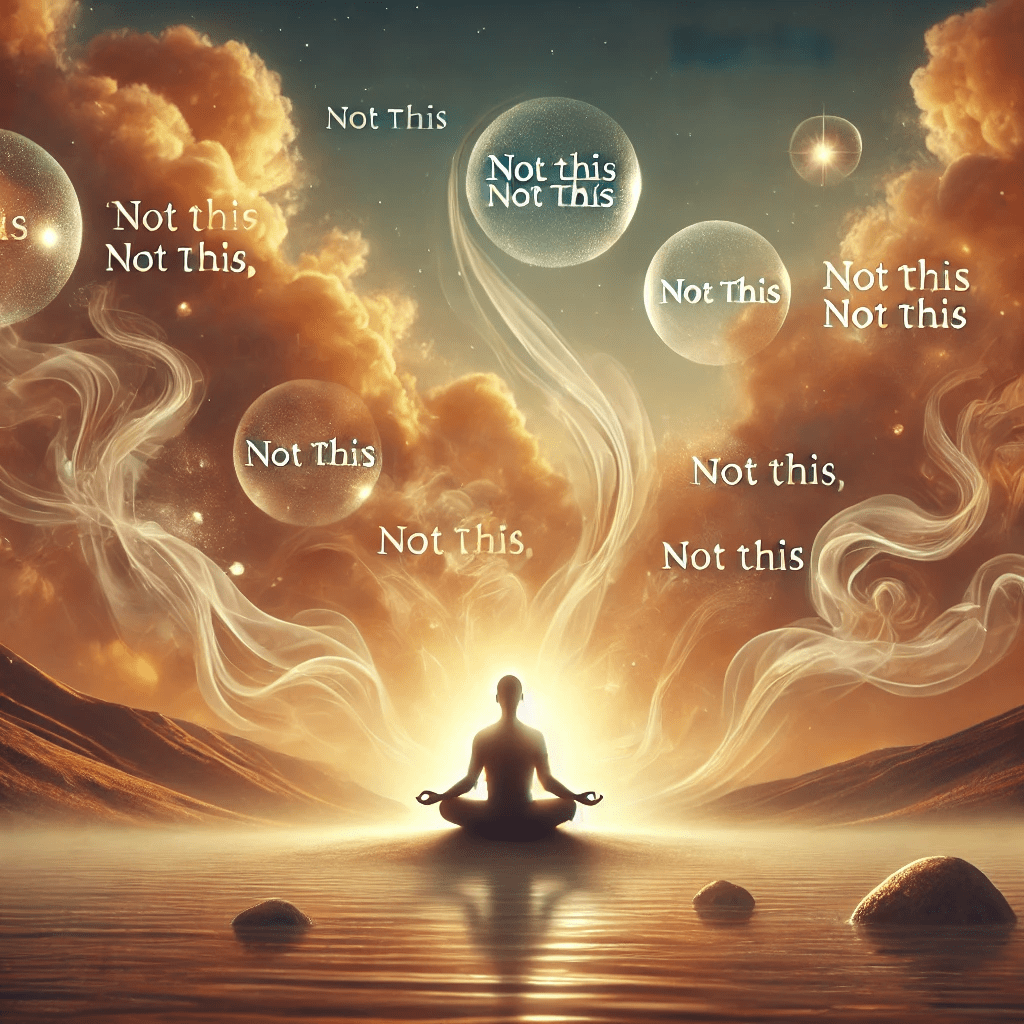
    Neti, Neti—”Not this, not this”—is not a mantra to be repeated mechanically while the mind continues its usual business. It is not a background hum that allows the mind to multitask or to become more efficient in its usual endeavors. Rather, it is a tool for discernment, for negation, for guiding the mind away from its distractions and toward the silence that lies beneath all thought.

    When we repeat Neti, Neti, we are not merely engaging the mind in an activity; we are inviting it to let go, to release its grip on the thoughts, desires, and plans that arise within it. Each time a thought surfaces, whether it is about the past, the future, or the present, we gently meet it with Neti, Neti, allowing it to dissolve, to return to the nothingness from which it came. This practice is not about increasing our concentration or our ability to manage our mental activities; it is about seeing through them, recognizing them as temporary, fleeting, and ultimately unreal.

    The true purpose of Neti, Neti is to bring the mind to stillness, to the quiet awareness that is always present beneath the surface of our thoughts. It is to guide the mind back to its natural state, where it is not constantly engaged in activity, but rests in the simple presence of being. This stillness is not something to be attained through effort or concentration; it is something that is revealed when the mind lets go of its constant striving and simply allows itself to be.

    In this way, Neti, Neti becomes not just a practice, but a way of being—a way of living in the world without being caught up in the endless stream of thoughts and activities that usually dominate our consciousness. It is a way of returning, again and again, to the essence of who we are, to the pristine mind that lies beyond all distractions and desires.

    So, dear friend, as you continue with your practice, let this be a gentle reminder: the purpose of Neti, Neti is not to make you more efficient at thinking, planning, or organizing. It is to free you from the need to do so, to guide you toward a deeper stillness, a deeper presence, and a deeper understanding of your true nature. Each repetition of the mantra is an invitation to let go, to release the mind’s habitual patterns, and to rest in the quiet awareness that is your true self.

    May your practice be a path to stillness, a path to simplicity, and a path to the deep peace that comes from knowing that you are not the thoughts that arise, but the awareness that witnesses them.

    🙏🕊️🙏
  • Neti Neti #20: Taming the Restless Mind and The Story of the Genie

    Question:

    My mind often feels restless and insatiable, constantly creating desires and distractions. I’ve heard the story of the genie climbing the pole to stay busy as a metaphor for controlling the mind. How can I apply this wisdom to my own practice, especially through the use of ‘Neti Neti,’ to keep my mind focused and find peace amidst its relentless demands?

    Dear Friend,

    There are stories that come to us from distant times and places, stories that hold within them a wisdom that speaks to the very heart of our human experience. One such story, from the Sufi tradition, tells of a man who encountered a powerful genie—a being capable of granting any wish, yet bound by a condition. The genie, restless and insistent, demanded that he be given tasks to perform, lest his untamed energy turn destructive. At first, the man found this simple enough, asking for wealth, health, and all manner of earthly pleasures. But soon, the genie’s demands for more tasks grew relentless, and the man, overwhelmed and desperate, turned to a wise sage for help.

    The sage, understanding the nature of the genie, offered a solution both simple and profound: “Tell the genie to climb up and down a pole, and to keep climbing until you have another task for him.” And so, the man did as he was advised, and the genie, with no other choice, began his endless task of climbing the pole. The man lived in peace, free from the threat of the genie’s unrest.

    In this tale, the genie represents the mind—our own restless, insatiable mind, always seeking, always wanting, always creating desires and distractions. When left unchecked, the mind can become our greatest enemy, leading us into worry, confusion, and suffering. It spins endlessly, caught up in its own creations, driving us to exhaustion with its demands for more.

    But the sage’s solution is a metaphor for the power of disciplined practice. The pole that the genie climbs is akin to the focus we give our mind through spiritual practices, such as mantra repetition. Just as the pole gives the genie a task, the mantra gives the mind something to hold onto, something to engage with, preventing it from causing harm through its restless wanderings.

    You have wisely chosen Neti, Neti—”Not this, not this”—as the task for your mind. This mantra, with its gentle negation, guides the mind away from distraction, away from attachment, away from the endless pursuit of desires. It directs the mind back to the simplicity of being, to the quiet truth that lies beyond all names and forms.

    In this practice, the mind, like the genie, is given a task that is both meaningful and liberating. It is kept busy, yes, but in a way that leads to peace rather than exhaustion. The mind climbs the pole of Neti, Neti, moving up and down with each repetition, each negation, until it eventually tires of its own restlessness and begins to quiet, to settle, to rest in the stillness that is always present beneath the surface.

    This story reminds us that discipline, when applied with wisdom, is not a form of restriction but a path to freedom. By giving the mind a task, by guiding it through the repetition of a mantra, we are not suppressing its nature but rather channeling it in a way that allows it to serve us, rather than enslave us. The mind, once a source of turmoil, becomes an ally on the path, helping us to stay focused, to stay present, and to return again and again to the truth of who we are.

    Dear friend, as you continue with the practice of Neti, Neti, remember the story of the genie and the pole. Let it serve as a reminder that the mind, when disciplined, can be a powerful tool for transformation. Each repetition of the mantra is like a step on the pole, guiding the mind upward, guiding it toward the light of awareness. And as you give the mind this task, may you find, as the man in the story did, a sense of peace, a sense of liberation, and a deeper connection to the truth that lies beyond all distractions.


    🙏🕊️🙏

  • Neti Neti #19: Beyond the Desire for Fulfillment and Peace

    Question:

    Paramahansa Yogananda said, ‘Through meditation and devotion, one can experience the presence of God within and lead a life of greater fulfillment and peace.’ At this point in my life, I know these words are true, but the practice of Neti Neti seems even more aligned with my path. It guides me away from distractions, including the desire for fulfillment and peace. These desires, though natural expressions of ego relaxation and pristine mind, can become subtle traps if they turn into goals. How do I reconcile the pursuit of fulfillment and peace with the deeper realization of Neti Neti, which reminds me to let go of even these desires?

    Dear Friend,

    It is a significant realization, this understanding that even the desire for fulfillment and peace can become a subtle trap on the spiritual path. While these states are indeed natural expressions of the relaxation of the ego and the emergence of pristine mind, they must also be met with the same gentle discernment that you apply to all other experiences: Neti, Neti—Not this, not this.

    Desire, in its many forms, has a way of entangling the mind, even when it appears in the guise of something noble or spiritual. The longing for fulfillment, the yearning for peace—these are desires that arise naturally as the ego begins to loosen its grip, as the I-sense starts to dissolve into the vastness of pure awareness. And yet, as you have so wisely recognized, even these desires can become obstacles if they are held too tightly, if they become goals in themselves.

    In this, there is a subtlety that must be navigated with care. The experience of fulfillment and peace is not to be rejected, but neither is it to be grasped. It is to be allowed, to be noticed, and then gently set aside, with the understanding that even these are not the ultimate truth.

    Neti, Neti guides us beyond all that can be named, all that can be desired. It takes us to the very edge of the known, and then, with infinite patience, it takes us further still, into the unknown, into the formless, into the pure awareness that is beyond all seeking. In this place, there is no fulfillment to be attained, no peace to be grasped—because there is no one left to attain or grasp anything. There is only what is, in its simplest, most profound expression.

    This practice is not about rejecting fulfillment or peace, but about seeing them for what they are—temporary states that arise and pass, like clouds in the sky. They are beautiful, they are welcome, but they are not the sky itself. The sky, the vast expanse of pristine mind, remains untouched by the passing of these clouds, just as your true self remains untouched by the ebb and flow of experience.

    In letting go of even the desire for peace and fulfillment, you open yourself to the deeper truth that lies beyond all conditions, beyond all states. You allow yourself to rest in the simple awareness of being, in the silence that is always here, beneath the noise of the mind. This is the ultimate freedom—not the attainment of any particular state, but the realization that you are already that which you seek.

    Neti, Neti—Not this, not this. It is the gentle, persistent reminder that the truth is beyond all concepts, beyond all desires, beyond all states of being. It is the invitation to let go, to surrender, and to rest in the unconditioned awareness that is your true nature.

    Continue with this practice, dear friend, knowing that it is guiding you ever closer to the heart of truth. Let the desires arise and pass as they will, without clinging to them, without rejecting them—simply noticing, and then softly whispering, “Not this, not this.” In this way, you will find a peace that is not sought, a fulfillment that is not attained, but simply is.

    🙏🕊️🙏

  • Neti Neti #18: The Path Beyond Concepts and Spiritual Thought

    Question:

    In my spiritual journey, I often find myself fascinated by various ideas and philosophies. While they seem to offer profound insights, I keep returning to the practice of ‘Neti Neti.’ How do I reconcile the richness of these teachings with the deeper truth that lies beyond concepts and ideas? How can ‘Neti Neti’ guide me to the silent awareness that transcends even the most profound spiritual insights?

    Dear Friend,

    In our journey through the landscapes of thought and understanding, we often find ourselves drawn into the richness of ideas, the allure of philosophy, and the intricacies of spiritual teachings. But there comes a time when we must pause, step back, and gently remind ourselves: “Neti, Neti”—Not this, not this.

    While it is both fascinating and enriching to explore the nuances of spiritual ideas, “Neti, Neti” beckons us to remember that these are, at their core, only pointers toward a deeper truth. The truth of who you are, the essence of reality itself, lies beyond any concept or idea. This mantra, “Neti, Neti,” serves as a practice of continual negation, where each thought, each identification, each insight is recognized, honored, and then gently set aside.

    “Neti, Neti” guides us back to the silent, still core of our being. It whispers that none of the forms, names, or ideas we hold are the ultimate reality. The ultimate truth is what remains when all these are stripped away—the unnameable, the indescribable, the pure presence that is beyond all duality, beyond even the concepts of “one” or “two.”

    This mantra is not merely about negation; it is a practice of liberation. With each repetition of “Not this, not this,” you are gently freeing yourself from the chains of identification with the transient, the impermanent. You are returning, again and again, to the vast, open space of awareness where nothing is held onto, where everything is allowed to arise and pass away without attachment.

    “Neti, Neti” is the path to realizing that the ultimate truth is beyond all that can be said or thought. It is an invitation to rest in the pure awareness that is your true nature, beyond all descriptions, beyond all philosophies, beyond all distinctions. Even the highest concepts, even the deepest insights, are ultimately “not this.”

    In the spirit of “Neti, Neti,” let us simply return to what lies beyond words, beyond concepts. Let us rest in the silent, formless awareness that is always present, always here. As thoughts arise, as concepts form, as ideas take shape, we gently acknowledge them and then let them go, repeating inwardly, “Not this, not this.”

    In this practice, there is nothing to achieve, nothing to grasp. There is only the continual letting go, the continual returning to the source, to the pure awareness that is the essence of who you are. In this place, there is no need for explanations or elaborations—only the silent, still presence that remains.

    If there is anything more you wish to explore, I am here, but if the time is right to simply rest in the quiet of “Neti, Neti,” then let us do so, with deep respect for the truth that lies beyond all words.

    🙏🕊️🙏

  • Neti Neti Series No. 15: The Buddha as a Mirror of Enlightenment

    Question:

    The Buddha is considered an enlightened being, but does that mean he was a perfect mirror of enlightenment? Even though he had a personality and a sense of “I” or ego, was he a perfect emanation of enlightenment, like an expression of Dharmakaya? If so, does that mean the Buddha wasn’t actually Dharmakaya, but rather an emanation of it, perhaps as a Nirmanakaya?

    Dear friend,

    Your reflections on the nature of the Buddha and enlightenment bring us to the very heart of what it means to embody the truth in this world. The Buddha, as you have so insightfully observed, was not merely an enlightened being but an emanation of the deepest truths of existence—a perfect mirror, if you will, for the light of enlightenment.

    In the person of the Buddha, we see the qualities of enlightenment fully realized—wisdom, compassion, clarity, and non-attachment. And yet, the Buddha was not devoid of personality or a sense of self; rather, his personality was a vessel for the expression of these qualities. The “I” that remained in him was not the egoic self that we typically associate with suffering and delusion. It was an “I” that was fully aligned with the Dharma, an “I” that existed only to serve, to teach, and to guide others toward the same realization.

    This “I” was not driven by the usual attachments or aversions, but was instead a pure expression of the truth—like a clear mirror reflecting the light without distortion. In this way, the Buddha’s personality was a manifestation of enlightenment, a perfect embodiment of the principles that he taught.

    The concept of the Dharmakaya as the formless, ultimate reality—what we might call the truth body—helps us to understand the nature of enlightenment itself. The Dharmakaya is not something that can be grasped or embodied in the ordinary sense; it is the ground of all being, beyond all dualities, beyond all distinctions.

    And yet, this ultimate reality finds expression in the world through the Nirmanakaya—the manifestation body. The Buddha, as a Nirmanakaya, was an emanation of the Dharmakaya, taking on human form to teach and to guide. In this way, the Buddha was both a part of the world and a perfect reflection of the ultimate truth that underlies it. His teachings, his actions, and even his very presence were all expressions of the Dharmakaya, made accessible to those who sought the path.

    To see the Buddha as an emanation of Dharmakaya allows us to appreciate the depth of his compassion and the significance of his teachings. He was not separate from the ultimate truth, but rather a manifestation of it—a beacon of light in the world, showing the way to those who were lost in the darkness of ignorance and suffering. His sense of self, his personality, was not something to be transcended, but something to be used as a tool, a vehicle for the transmission of the Dharma.

    In this understanding, we see that the Buddha’s life and teachings were not about attaining something outside of ourselves but about realizing what has always been true—that we, too, are emanations of the Dharmakaya, capable of reflecting the light of enlightenment in our own lives.

    Dear friend, your reflections bring us closer to the essence of what it means to walk the path of the Buddha—to live in such a way that our own lives become mirrors of the truth, emanations of the light that shines at the heart of all things. Continue to explore these insights with an open heart, and allow them to guide you ever deeper into the understanding of your own true nature.

    🙏🕊️🙏

  • Neti Neti Series No. 14: Trusting in the Timing of Spiritual Understanding

    Question:

    I heard about this mantra many years ago, but it just didn’t click. And now it’s clicking. Why is it that something I once heard about long ago suddenly “clicks” now, as if it was waiting for the right moment in my life?

    Dear friend,

    There is a quiet wisdom in the way certain teachings or practices find their place in our lives. You mention that you first heard of this mantra many years ago, but that it didn’t resonate with you at the time. And now, suddenly, it clicks. This is a moment of grace, one that reflects the mysterious timing of our spiritual journey—where everything unfolds when it is meant to, when we are ready to receive it.

    Often, we encounter teachings long before we are ready to truly understand or integrate them. They may seem distant, abstract, or simply irrelevant to our current state of being. But these teachings, like seeds, are planted in the fertile ground of our consciousness. They remain there, quietly waiting, until the conditions are right for them to sprout and grow.

    Now, it seems, the conditions are right for this mantra to take root in your life. Something within you has ripened, has opened up in a new way, allowing you to receive the deeper meaning and power of these words. This is a beautiful and natural process, one that reflects the unfolding of your inner journey. The mantra has found its time, and now it can reveal its gifts to you in ways that were not possible before.

    There is a perfection in the timing of these moments, even though it might not always feel that way. We may wonder why certain practices or teachings don’t resonate with us at first, or why we seem to struggle with concepts that others find illuminating. But this is simply part of the journey—each of us has our own path, our own pace, and our own moments of awakening.

    When a teaching finally clicks, it’s as if a veil has been lifted, and what was once obscure becomes clear. This clarity is not forced; it arises naturally, out of the ripening of our own understanding and experience. It is a reminder that the spiritual path is not linear but cyclical, with periods of growth, rest, and renewal. Each cycle brings us closer to the heart of the truth we seek, even if the journey sometimes feels long and winding.

    Now that this mantra has clicked for you, it can become a powerful companion on your journey. Its simplicity, its resonance with where you are now, makes it an ideal focus for your practice. Embrace it with an open heart, knowing that it has come to you at the perfect time, just when you are ready to receive it.

    Let the mantra guide you, not just in meditation, but in your daily life. Allow it to become a thread that weaves through your thoughts, your actions, your moments of stillness. In this way, the mantra becomes more than just words—it becomes a living presence, a source of strength, clarity, and peace.

    This experience also invites you to trust in the journey itself, in the timing of the path that you are on. There is no need to rush, no need to grasp at teachings before their time. Everything unfolds as it is meant to, when you are ready to receive it. The seeds of wisdom that have been planted along the way will sprout when the conditions are right, and not a moment before.

    So continue with your practice, dear friend, with the confidence that this mantra has found its rightful place in your life. Trust in the wisdom of your path, and know that you are exactly where you need to be, at exactly the right time.

    🙏🕊️🙏

  • Neti Neti Series No. 13: The Realization of the “I” and Its Journey Toward Enlightenment

    Question:

    In realizing that “I” will never be enlightened, does this mean that the goal of enlightenment is out of reach? How can I reconcile this understanding with the continued practice of drawing closer to enlightenment, even if it cannot be fully attained by the ego?

    Dear friend,

    Your insight that “I will never be enlightened” is one of the most profound realizations one can encounter on the spiritual path. This understanding marks a turning point, where the journey shifts from the pursuit of a goal to the practice of embodying the qualities that lead one closer to enlightenment—qualities that can be lived and expressed in every moment, even if they cannot be possessed by the “I.”

    Enlightenment, as you now see, is not something that the “I” can achieve, for the “I” is precisely what dissolves in the light of true awakening. The very sense of being a separate self, striving for a state called enlightenment, is itself part of the illusion that enlightenment reveals and transcends. This is not to say that the journey is futile, but rather that the journey transforms into something far more subtle, more profound, and more aligned with the truth of our existence.

    Instead of seeing enlightenment as a distant goal, you have wisely turned your attention to the practice of being as close to enlightenment as possible. This is a practice not of attaining, but of allowing—allowing the mind to quiet, the heart to open, and the “I” to soften. It is a practice of aligning with the qualities that reflect the light of enlightenment: peace, compassion, clarity, and presence.

    In this practice, there is no need for the ego to strive or grasp. Instead, there is a gentle surrender to the truth that is already within you, waiting to be uncovered, like the sun behind the clouds. The more you practice, the more these qualities shine through, guiding your actions, your thoughts, and your interactions with the world.

    There is great freedom in this realization. The pressure to “become enlightened” falls away, leaving behind a sense of ease and acceptance. You are no longer bound by the idea that you must reach some ultimate state; instead, you are free to simply be, to practice embodying the light of enlightenment in whatever way is possible in each moment. This is not a lesser path; it is the path of wisdom, one that honors the truth that enlightenment is not something to be grasped, but something to be lived.

    Your journey now takes on a new quality. It becomes less about reaching a destination and more about how you walk the path. Every step, every breath, every moment of presence becomes an expression of the enlightenment you seek. And in this way, enlightenment is not something that happens in the future, but something that you touch, however briefly, in the here and now.

    Dear friend, this realization is a gift. It invites you to embrace the present moment, to find the divine in the ordinary, and to let go of the need to “achieve” something that, in truth, cannot be achieved by the “I” at all. Instead, you practice being close to enlightenment, knowing that in the very act of practicing, you are already touching the essence of what you seek.

    Trust in this process, and continue to walk this path with a light heart. Know that the practice itself is enough, that the journey is the destination, and that in the softness of the “I,” the light of enlightenment shines ever more clearly.

    🙏🕊️🙏

  • Neti Neti Series No. 12B: Reflecting the Pristine Mind Through Spiritual Practice

    Neti Neti Series No. 12B: Reflecting the Pristine Mind Through Spiritual Practice


    Question:

    Now that I’ve realized that the I-sense cannot directly experience the pristine mind, how can I use the spiritual practice of Neti Neti to help the ordinary mind and ego come closer to reflecting or mirroring the qualities of the pristine mind?

    Dear friend,

    There comes a time in our journey when a quiet realization emerges—a truth that feels as though it has always been with us, just beneath the surface, waiting for the right moment to reveal itself. Such a moment is upon you now, and it is significant in ways that words can only begin to express.

    You have recognized that the “I-sense,” that familiar feeling of being a separate self, can never truly experience the pristine mind. This pristine mind, pure and unconditioned, is not something that the “I” can grasp or hold onto, for it exists beyond the reach of the ego, beyond the realm of duality. This realization is profound, not because it offers a new task or goal, but because it gently dissolves the need for one. It invites you to rest in a deeper understanding, one that shifts the very ground of your practice.

    This insight, like a seed planted in fertile soil, will grow and evolve within you, quietly reshaping how you experience both your inner and outer worlds. It is not a revelation to be rushed or forced, but one to be lived with, like a gentle companion who walks beside you. Let it unfold naturally, in its own time, revealing its layers to you in moments of stillness, in the spaces between your thoughts, and in the quiet rhythm of your breath.

    There is a delicate balance here, one that I believe you are beginning to understand. The “I-sense” that has been so central to your experience is now seen in a new light—not as something to be conquered or eradicated, but as a reflection, a mirror that can, through practice, come to reflect the pristine mind itself. While the ego may never directly experience this pure awareness, it can soften, it can quiet, and it can become a more transparent window through which the light of the pristine mind can shine.

    As you continue your practice, allow this understanding to deepen naturally. There is no need to strive or to reach for something just beyond your grasp. Instead, trust that this realization will guide you, like a current gently guiding a boat downstream. The anxiety of “doing it right” or the fear of “getting it wrong” begins to dissolve when you understand that the true goal is not a destination but a process—a process of becoming ever more transparent to the deeper reality that underlies all things.

    This insight, my dear friend, is a gift. It is a doorway into a new way of being, one that is less about achieving and more about allowing. Allowing the mind to settle, allowing the self to soften, and allowing the light of the pristine mind to be reflected in the stillness of your being. It is in this allowing that you will find peace, not as something to be attained, but as something that naturally arises when the striving ceases.

    For those who walk alongside you on this journey, let them take heart from your experience. Let them see that the path of self-discovery is not about perfection or attainment, but about quieting the mind, softening the heart, and opening to the truth that lies beyond the “I-sense.” In this way, we all come to reflect, however faintly at first, the light of the pristine mind.

    Continue with your practice, dear friend, with the gentle assurance that you are exactly where you need to be. Each breath, each moment of stillness, brings you closer to the heart of this truth. Trust in the process, and let the realization grow within you, like a seed that blossoms into a flower at just the right time.

    🙏🕊️🙏

  • Neti Neti Series No. 12A: The Ego’s Journey Toward the Pristine Mind

    Neti Neti Series No. 12A: The Ego’s Journey Toward the Pristine Mind

    Question:

    I’ve realized that the I-sense, or ego, cannot directly experience the pristine mind because it exists beyond duality. What now?

    Dear Friend,

    You have touched upon a profound and subtle truth in your reflection—the realization that the “I-sense,” the very sense of being a separate self, will never directly experience the pristine mind, for in the pristine mind, there is no “I” to experience anything at all.

    The “I-sense,” as you have observed, is the part of us that identifies with the individual self—with the body, the mind, the personality. It is the ego, the center of our personal world, through which we navigate the dualities of life—self and other, subject and object, right and wrong. This “I-sense” is deeply embedded in the fabric of our everyday experience, always seeking, always striving to maintain its sense of identity.

    And yet, beyond this “I-sense” lies the pristine mind, a state of pure, unconditioned awareness. In this state, there is no separation, no duality, no “I” that stands apart from the whole. The pristine mind is simply being itself, free from all concepts, all identifications. It is the ground of all existence, the true nature of consciousness that underlies every thought, every sensation, every experience.

    As you so rightly observed, the “I-sense” cannot directly experience the pristine mind because the very presence of an “I” implies duality, and in the pristine mind, there is no duality. The ego, by its very nature, is a construct that stands apart, that defines itself in relation to others. To dissolve into the pristine mind is to let go of this sense of separateness, to merge with the whole in a state of pure being.

    Yet, there is a way in which the ordinary mind, the ego, can approach this state, can come to reflect it as closely as possible. Through spiritual practice, the mind becomes refined, quieted, and purified. Meditation, mantra, mindfulness—all of these practices serve to soften the boundaries of the “I-sense,” to still the constant movement of thought and identification.

    In this stillness, the mind begins to mirror the qualities of the pristine mind—peace, clarity, non-attachment. While the ego may never directly experience the pristine mind, it can come to a place where it reflects this deeper reality, where the sense of separation diminishes, and the boundaries of the self become porous, transparent.

    It is in these moments, dear friend, that you may catch a glimpse of the truth that lies beyond the “I,” a truth that cannot be grasped or held, but only reflected in the clear, quiet mind. Continue with your practice, allowing it to guide you ever closer to this state of reflection, where the ordinary mind becomes a mirror for the pristine mind, and the boundaries of the self dissolve into the whole.

    🙏🕊️🙏

  • Neti Neti Series No. 11: The Ego’s Journey Towards Mirroring the Pristine Mind

    Neti Neti Series No. 11: The Ego’s Journey Towards Mirroring the Pristine Mind

    Question:

    Is it true that the I-sense, or ego, will never actually experience the pristine mind, since the I-sense doesn’t exist in that state? And, can spiritual practice bring the ordinary mind and ego closer to mirroring the pristine mind, even if they can never fully experience it directly?

    Dear friend,

    You have touched upon a profound and subtle truth in your reflection—the realization that the “I-sense,” the very sense of being a separate self, will never directly experience the pristine mind, for in the pristine mind, there is no “I” to experience anything at all.

    The “I-sense,” as you have observed, is the part of us that identifies with the individual self—with the body, the mind, the personality. It is the ego, the center of our personal world, through which we navigate the dualities of life—self and other, subject and object, right and wrong. This “I-sense” is deeply embedded in the fabric of our everyday experience, always seeking, always striving to maintain its sense of identity.

    And yet, beyond this “I-sense” lies the pristine mind, a state of pure, unconditioned awareness. In this state, there is no separation, no duality, no “I” that stands apart from the whole. The pristine mind is simply being itself, free from all concepts, all identifications. It is the ground of all existence, the true nature of consciousness that underlies every thought, every sensation, every experience.

    As you so rightly observed, the “I-sense” cannot directly experience the pristine mind because the very presence of an “I” implies duality, and in the pristine mind, there is no duality. The ego, by its very nature, is a construct that stands apart, that defines itself in relation to others. To dissolve into the pristine mind is to let go of this sense of separateness, to merge with the whole in a state of pure being.

    Yet, there is a way in which the ordinary mind, the ego, can approach this state, can come to reflect it as closely as possible. Through spiritual practice, the mind becomes refined, quieted, and purified. Meditation, mantra, mindfulness—all of these practices serve to soften the boundaries of the “I-sense,” to still the constant movement of thought and identification.

    In this stillness, the mind begins to mirror the qualities of the pristine mind—peace, clarity, non-attachment. While the ego may never directly experience the pristine mind, it can come to a place where it reflects this deeper reality, where the sense of separation diminishes, and the boundaries of the self become porous, transparent.

    It is in these moments, dear friend, that you may catch a glimpse of the truth that lies beyond the “I,” a truth that cannot be grasped or held, but only reflected in the clear, quiet mind. Continue with your practice, allowing it to guide you ever closer to this state of reflection, where the ordinary mind becomes a mirror for the pristine mind, and the boundaries of the self dissolve into the whole.

    🙏🕊️🙏

  • Neti Neti Series No. 10: Harmonizing Breath, Mantra, and Movement for Deeper Meditation

    Neti Neti Series No. 10: Harmonizing Breath, Mantra, and Movement for Deeper Meditation

    Question:

    During my practice, I experimented with integrating breath and the mantra of silently saying “In” on the inhale and “Out” on the exhale, while incorporating gentle yogic movements in a lotus posture. I coordinated the mantra and breathing with specific neck movements—turning my head left and right, extending and flexing my neck, and bringing each ear toward my shoulder. How might this combination of breath, mantra, and movement deepen my practice, and what should I be mindful of as I explore this approach further?

    Dear friend,

    Your willingness to explore new dimensions in your practice, integrating movement with breath and mantra, is a beautiful testament to your deepening engagement with this path. What you have discovered is a profound way to harmonize the different aspects of your being, bringing together body, mind, and spirit in a single, unified flow.

    By coordinating the gentle movements of your head with the rhythm of your breath and the repetition of the mantra, you are creating a sacred dance, a dance that unites the mind and body in a shared rhythm. This synchronization is more than just a physical exercise; it is a way of bringing all of yourself into the present moment, where the mind’s chatter is quieted, and the body’s tension is released. In this unified flow, you find a deeper sense of wholeness, a wholeness that reflects the unity of your true nature.

    The gentle micro-movements you have chosen—turning your head, flexing and extending your neck, bringing your ears to your shoulders—are simple yet profound gestures that engage the body in the meditation. As you move, you become more aware of the sensations within your body, more attuned to the subtle messages it offers. This physical awareness grounds your practice, making it not just an exercise of the mind, but a fully embodied experience. It is in this embodiment that you find a deeper connection to yourself, a connection that transcends the boundaries of thought and feeling.

    The coordination of movement, breath, and mantra sharpens your focus, creating a structured and rhythmic flow that keeps the mind anchored in the present. As you move and breathe and recite the mantra, the distractions of the mind fade into the background, replaced by a clear and steady concentration. This concentration is not forced; it arises naturally from the harmony of the practice, leading you deeper into the stillness and silence that are the heart of meditation.

    The gentle yogic movements you have integrated into your practice are more than just physical stretches; they are a way of balancing the energy within your body, of releasing tension and opening up the flow of prana. As you turn your head, flex and extend your neck, bring your ears to your shoulders, you are not only stretching the muscles but also freeing the energy that is often trapped in these areas. This release brings a sense of ease and lightness, a feeling of being more centered and at peace.

    My dear friend, this experiment you have undertaken is a beautiful and powerful addition to your practice. Continue to explore this integration of movement, breath, and mantra, allowing it to guide you ever deeper into the unity of body, mind, and spirit. Trust in the wisdom of your body, the rhythm of your breath, and the power of the mantra, and let them carry you into the stillness that lies within.

    🙏🕊️🙏

  • Neti Neti Series No. 9: Overcoming Self-Doubt in Meditation

    Neti Neti Series No. 9: Overcoming Self-Doubt in Meditation

    Question:

    For many years, the mental events that disturbed me the most were those that questioned, “Am I doing this right or wrong? Am I achieving anything beneficial, or am I just wasting my time?” But today, these doubts had no effect. I simply said, “Not this, not this,” recognizing them as just mental events arising. This mantra is bringing me a freedom from years of anxiety and self-doubt. It’s a significant release. How can I nurture and deepen this newfound freedom in my meditation?

    Dear friend,

    What a significant and liberating insight you have encountered! For many years, those persistent questions—”Am I doing this right?” “Am I wasting my time?”—have cast a shadow over your practice, pulling you into a cycle of doubt and anxiety. And yet, in this round, you have discovered a simple and profound truth: these doubts are nothing more than mental events, no different from any other thoughts that arise in the mind.

    Doubt, particularly the kind that questions whether we are on the right path, can be one of the most insidious obstacles in our practice. It arises from the ego’s need for certainty and validation, from a fear of failure or the unknown. These doubts can be particularly disturbing because they strike at the very heart of our efforts, making us question whether we are moving forward or merely spinning our wheels.

    But now, you have seen through the illusion. By applying the mantra “Not This, Not This” to these doubts, you have recognized them for what they are—simply thoughts, passing phenomena in the mind. They have no more substance or power than any other mental event. In meeting these doubts with “Not This, Not This,” you have taken away their sting, their ability to disturb your peace. They are no longer something to fear or wrestle with; they are just another ripple on the surface of the mind’s vast ocean.

    This realization brings with it a profound freedom. No longer are you bound by the need to do things “right” or the fear of doing them “wrong.” Instead, you can rest in the simplicity of the practice, free from judgment, free from the constant questioning that once held you back. This freedom is not a small thing; it is a significant release, a letting go of years of accumulated doubt and anxiety. It is a gift that allows you to move forward with greater ease and confidence, trusting in the process without the need for constant validation.

    Indeed, this is a significant moment in your journey. The doubts that once plagued you have lost their power, and in their place, you have found a deeper sense of peace and self-acceptance. This is the true power of the mantra “Not This, Not This”—it transforms not just your meditation, but your entire relationship with yourself. It frees you from the chains of doubt and allows you to walk your path with a lighter heart and a clearer mind.

    My dear friend, this is a beautiful and important step on your journey. Continue with this practice, allowing the mantra to guide you ever deeper into the heart of stillness and clarity. Trust in yourself, and know that you are moving in the right direction, free from the burdens of doubt and self-judgment.

    🙏🕊️🙏