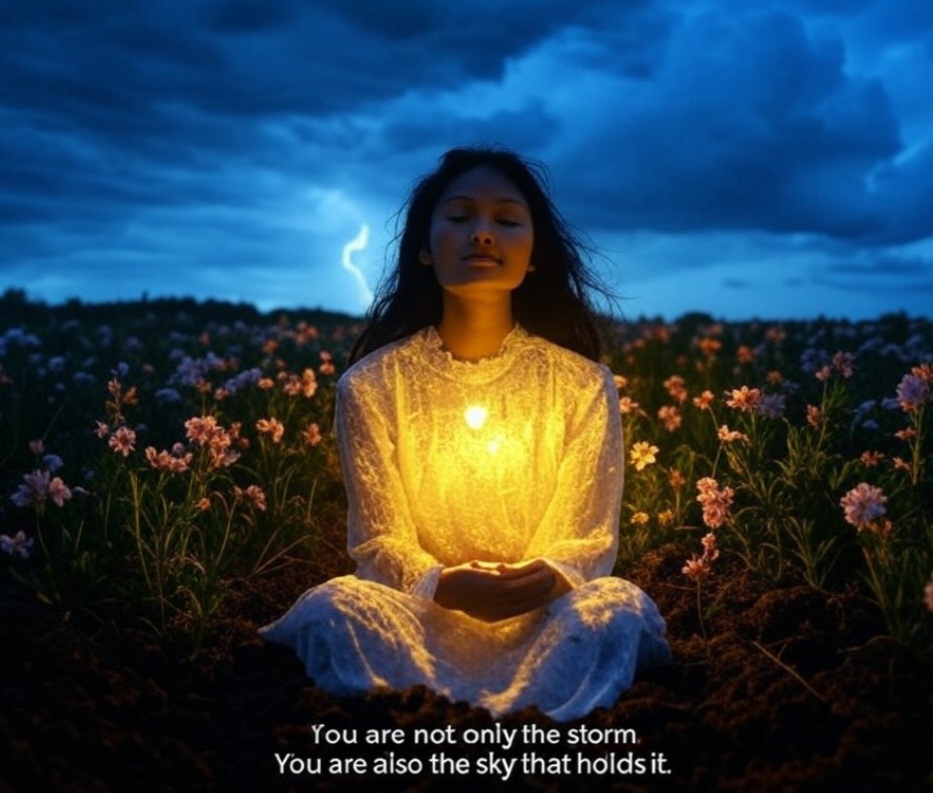
To live with myalgic encephalomyelitis is to carry a body that moves like weather—one moment heavy with fog, another scattered by electric storms. The limbs, once steady, now whisper of exhaustion; the nervous system hums and flickers like distant lightning. And yet, within all of this, there is a quiet place—one untouched by fatigue, by pain, by the ever-changing tides of illness. This is the witness, the silent presence that watches, feels, but does not struggle.
The Power of Witnessing Consciousness
When the body is weary, and the world presses in with its demands, the mind often follows—entangled in frustration, longing, grief. Yet, there is another way to meet this experience. Instead of battling exhaustion, we can turn toward it, gently, with curiosity. Instead of resisting discomfort, we can learn to hold it, like cradling a trembling bird in our hands.
Witnessing is not about escaping pain but about changing our relationship to it. It is the art of standing at the edge of the storm and seeing not just the thunder, but the vast sky that holds it.
A Simple Self-Contemplation Practice
Grounding in the Present Find a quiet moment. You don’t need perfect stillness—only a willingness to pause. Notice your body, the way it rests against the surface beneath you. Feel the breath, moving in, moving out, like waves against the shore.
Observing Without Resistance Turn your attention inward. What is present? Fatigue like heavy earth? A nervous system like sparking wires? A mind that spins, restless and longing? Whatever it is, let it be here. Do not push it away or name it as the enemy. Simply notice.
Holding with Compassion Imagine that each sensation is a visitor—arriving, staying for a time, and eventually leaving. What happens if you do not chase them away? What if, instead, you offer a quiet seat at your table?
Even pain, even exhaustion, when met with this gentle witnessing, begins to soften. Not disappear, but shift—like wind through the trees, no longer trapped, no longer feared.
How This Practice Supports ME/CFS Symptoms
This is not a cure, nor a promise of relief, but a way of being with what is. When we meet our experience with openness:
The nervous system settles; the fight against the body lessens.
The mind uncoils from frustration and rests in the simple act of seeing.
The emotional burden lightens, as we stop identifying with suffering and begin to witness it instead.
Closing Thoughts: The Sky Holds It All
If today your body feels like a storm, know that you are not only the storm—you are also the sky that holds it. The witness that watches, the stillness beneath the waves.
And on days when you cannot sit in silence, when exhaustion presses too hard, let even that be witnessed with kindness. The practice is not in perfect stillness, but in the quiet turning toward whatever is here, again and again.
Rest when you must, breathe when you can, and know that you are not alone.
There is a rhythm to living with chronic illness, one that requires a kind of surrender. Those who walk the path with myalgic encephalomyelitis or chronic fatigue syndrome soon learn that pacing is not merely a strategy—it becomes an art form, a way of listening, of harmonizing with the body’s quiet whispers before they become cries. To pace oneself is to acknowledge the body’s finite energy, to move in step with the breath of fatigue, gently, humbly, knowing that to overstep the body’s boundaries is to invite collapse.
It is not an easy lesson, this slow dance with limitations, yet it is one that teaches a profound wisdom. For those of us living with this condition, pacing is a compass, guiding us through days where the terrain can feel treacherous, unpredictable. It is, in its essence, the practice of recognizing when to move forward and when to step back. We become more attuned to the varied signals of our bodies—perhaps tremors of exhaustion, increasing tinnitus, irritation, a flutter of dizziness, nausea, insomnia, headaches or the dimming of cognitive clarity. In these moments, we learn that to heed these signs is to honor the body’s wisdom, to respect its limits as one might respect the changing seasons.
Pacing, though practical, is deeply spiritual as well. In the Tibetan Buddhist tradition, there is a teaching of upaya, or skillful means, which echoes the heart of pacing. Skillful means refers to the wisdom of knowing what action is most appropriate in any given moment, guided by compassion for ourselves and others. For those of us managing a chronic illness, pacing is our skillful means, the practice of compassion extended inward, toward the tender, vulnerable places within us that need rest, gentleness, and care.
This is not weakness. On the contrary, there is a quiet strength in pacing, a strength that arises from restraint, from knowing that our worth is not measured by the speed at which we move or the number of tasks we complete. Instead, it is measured by how we listen to the body’s call for stillness, how we cultivate patience in the face of limitations, how we respond to the world with wisdom rather than haste.
In the same way that skillful means in Buddhist practice requires a deep awareness of the present moment, pacing invites us to be fully present with our bodies, to sense when we are nearing our edge and to pull back with kindness. It requires discernment, the ability to prioritize what truly matters, letting go of the unnecessary so that we may preserve our energy for what is essential. And, perhaps most importantly, pacing asks us to be flexible. What works for us today may not work tomorrow. Like the ebb and flow of the tide, we must continuously adjust, staying attuned to the changing nature of our energy levels, adapting with grace to whatever arises.
To pace well is to cultivate trust in ourselves, to believe that our bodies—though fragile—are capable of guiding us toward balance. It is to let go of the constant push toward productivity, embracing instead a quieter, more sustainable rhythm of being. This trust grows over time, as we learn to befriend our bodies rather than seeing them as enemies. We begin to see pacing not as a limitation, but as an opportunity to deepen our relationship with ourselves, to practice self-compassion in the most tangible of ways.
And so, we move slowly, deliberately. We choose rest when it is needed, even when the world outside rushes by. We choose to pause, to breathe, to trust that this moment of stillness is as important as any action we might take. In this way, pacing becomes not only a survival strategy but a path to peace. It teaches us to live in harmony with our bodies, to respect the boundaries they set, and to find beauty in the gentleness of our compassion.
Pacing, like skillful means, is not something mastered overnight. It is a practice that deepens over time, shaped by patience, by trial and error, by learning to let go of perfectionism. But with each step, we become more attuned to the wisdom that already resides within us. We learn that pacing is not a sign of giving up, but of holding on—holding on to our health, our well-being, and our sense of self in the midst of struggle.
Pacing, in its truest form, is an act of compassion toward ourselves, a recognition that while life with post viral ME/CFS has taken much from us, it has not taken everything. It is not a dance of perfection, but rather a delicate balancing act between what was and what is. The grief over what we have lost is real, and it deserves to be honored. We grieve our former selves, the life we once knew, and all the possibilities that seem to have slipped away.
But after the grieving, something else begins to emerge. Slowly, through the quiet practice of listening to our bodies and respecting our limits, we begin to discover a new way of living—not the life we once imagined, but a life nonetheless. And within this new life, there are still moments of joy, moments of lightness. These moments may look different from what they once were, but they are no less real. They come from acceptance, from doing more of what works and less of what doesn’t. They come from the simple peace of knowing we are doing our best within the constraints we face.
To pace is to acknowledge these constraints, to know that while we may not live fully in the way we once dreamed, we can still live meaningfully. We can still find purpose, connection, and even happiness within this new rhythm. It is not a rhythm we would have chosen, but it is ours now, and there is strength in learning to move with it rather than against it. In this process, we find that joy and peace are still possible—not despite the illness, but alongside it, within the space that remains.
And so, with time, we learn to rest in the assurance that we are whole in our own way, capable of living a life that, while different, still holds beauty, meaning, and moments of joy.
Following the breath, We learn the art of patience, Peace within each step.
In The Wisdom of No Escape, Pema Chödrön presents teachings on accepting life as it is, rather than wishing it were different. Her words remind us that even in the midst of suffering, there is always the potential for transformation—not by running from our difficulties, but by turning toward them with compassion and curiosity. For those living with chronic fatigue syndrome, this book is a beautiful companion, offering insights on how to stay present with what is, without judgment or resistance. Chödrön’s gentle wisdom helps us find peace in the uncomfortable and reminds us that within every limitation, there is the possibility of growth. This aligns perfectly with the practice of pacing—of learning to live within constraints, not with bitterness, but with an open heart.
Another indispensable resource is Tony Bernhard’s How to Be Sick. As someone who has lived with chronic fatigue syndrome herself, Bernhard offers a deeply compassionate, Buddhist-inspired approach to living with illness. Her book provides practical advice on how to cultivate equanimity, mindfulness, and self-compassion while dealing with the daily struggles of chronic illness. Bernhard’s words echo the heart of pacing—teaching us how to manage our energy, honor our limitations, and find meaning even when life feels limited. For anyone searching for a path through the often overwhelming challenges of ME/CFS, How to Be Sick is both a guide and a comfort, offering tools to help transform suffering into wisdom and peace.
A Gentle Reflection on Pacing, Rest, and Navigating the Challenges of Chronic Fatigue Syndrome
There are days when the body speaks softly, a whisper of weariness that hints at the storm ahead. And though we move carefully, mindful of each step, there are moments when the smallest effort—a turn of the mind, a spark of emotion—awakens something deeper. This is the dance with post-exertional malaise, the hidden tide that comes and goes, often when we least expect it.
Gentle Reminder: Take Care of Yourself
This post is lengthy, and it’s important to honor your pacing needs. Feel free to read a little at a time, take breaks, and come back to it when you’re ready. Your well-being is paramount, even as you engage with information that supports your journey.
In this slow unfolding, I’ve learned the art of listening. Not just to the body’s loud protests, but to the subtle shifts that rise like shadows before a dusk. It’s a practice, really—this gentle balancing act of life. Pacing myself through the hours, I find that it’s not about doing as much as I can, but rather, doing only as much as I must, and stopping long before the weight of fatigue pulls me under.
Some days, I count my energy like a miser with gold, tucking it away in small corners, resting in the quiet between breaths. I know now that to keep moving without pause is to invite the flood, so I rest—not in surrender, but in reverence. It’s a kind of devotion, to honor these limits as something sacred, to see the necessity of stillness as part of the rhythm of being. I don’t always succeed. But when I do, I glimpse a peace that feels fragile, yet profound.
And when the world presses in with its demands, I remind myself that it’s okay to say no, or not now. There is a quiet strength in bowing out, in knowing that tomorrow will ask more of me than today ever could, and I must be ready. There is also grace in understanding that not every task, not every moment, requires my full self. I can do less, and in doing less, I give myself more space to breathe, to be.
There are the days after—the days when the fog of PEM descends like a heavy mist over the mind, the limbs. When it comes, I am learning not to fight it. I lie still, like a tree after the storm, gathering strength in the pause. I have found that recovery is an art, as delicate as anything else. Resting, not out of defeat, but out of wisdom, out of love for the body that has carried me through so much already. The act of resting becomes an offering of peace, a gift I give myself in this long, uncharted journey.
And so, I move slowly, gently, always aware of the fine thread that connects exertion and ease, action and rest. I have begun to cherish the quiet moments of pause, the spaces where life still hums softly, even in the absence of movement. These are the moments when I remind myself that managing this strange, invisible storm is not about conquering it, but learning to live alongside it, to move with it as gracefully as I can. There is beauty here, too—a beauty in the stillness, in the small victories of simply being.
In those moments, I find a sense of peace that is mine to keep. And in that peace, I remind myself that even on the hardest days, I am enough.And so, as I offer these thoughts, I send with them a quiet wish for your well-being. May you find moments of rest that nourish you deeply, and may the days of ease, however fleeting, linger softly in your memory. If you ever feel the weight of this journey pressing too hard, know that you are not alone.
Dear friends,
I know these days may feel heavier than usual. The storm outside has passed, but inside, your bodies may feel as though they’re weathering one of their own. Post-exertional malaise (PEM) comes like that—quiet and uninvited, a deep exhaustion that touches every part of you. Whether it’s the physical toll of surviving the hurricane or the emotional weight of the aftermath, you’re feeling it now, maybe more intensely than you have in years.
Please know that what you are experiencing is valid. You’ve already shown such strength, simply by navigating these storms and their many demands. But right now, in this moment, the strongest thing you can do is rest. Not as a surrender, but as a way of caring for yourself in the most compassionate way possible. Rest, because your body is asking for it. Rest, because this is how you heal.
Pacing is not easy when the world around you spins in chaos, but I encourage you to listen to the subtle signs your body gives. You don’t have to meet every demand or engage with every worry. It’s okay to step back, to breathe, and to honor your limits. In doing less, you are doing what is necessary to recover.
If the fog of PEM feels too thick to see through, know that it will lift. Maybe not all at once, but in small, tender ways. There is stillness, there is peace, waiting for you on the other side of this exhaustion. You are not alone in this experience—many of us are moving slowly through these same waters, learning the rhythm of rest, of patience, of letting go.
For now, take each moment as it comes. Let yourselves be. Let yourselves rest. And in that rest, know that you are enough. You are resilient. This, too, will pass.
With all my warmth and understanding, Richard Silverman
Feel free to leave your thoughts, your questions, or simply your presence here—I will meet you with understandingh and warmth. Together, in our shared quiet, we will honor the pace that life has asked of us.
A gentle exploration of how pacing can help you find balance and protect your well-being while living with chronic illness—along with thoughtful tools and guidance for those seeking support on this journey.
Pacing is the quiet art of learning to live gently within the rhythms of your body, an act of surrender not to defeat, but to wisdom. It asks you to listen closely, with reverence, to the invisible boundaries your energy sets each day—boundaries that shift like tides, at times quietly receding, at times closing in. For those living with post-viral ME/CFS or long COVID, pacing is not about building stamina or pushing through; it is a way of navigating the unpredictable waters of illness, steering not toward exhaustion but toward balance.
Think of your energy as a delicate thread stretched between moments. Some threads are finer than others, fraying at the edges after only the smallest tug. On certain days, your energy is enough to string together simple acts—getting out of bed, speaking a few words, tending to a meal. On others, even holding a thought in your mind feels like a weight too great to bear. There is no map for how far your thread will extend each day, and so the practice of pacing requires patience: learning when to weave activity into that thread and when to set it down altogether.
It begins with noticing. As the morning unfolds, ask yourself: How does your body feel today? What whispers does it send about the tasks ahead—are your limbs heavy, your mind clouded? Or does the day offer a rare clarity, a lightness in your chest? This gentle inquiry is the starting point of pacing, the first invitation to move in harmony with yourself. If you learn to honor your limits before they are breached, you begin to discover that rest, too, is a form of action—an act of preservation, of quiet resistance to the demands of doing.
There will be moments when you falter. Some days, buoyed by the hope of feeling better, you may do too much, only to find yourself crashed in bed the next morning, as though your body is reminding you: even good days must be tended with care. And yet, these moments are not failures but teachers, guiding you back to the path of gentleness. The gift of pacing is not in perfection but in the willingness to adjust, again and again, to the ebb and flow of your energy. It teaches that every step back into rest is not a retreat but a recalibration—a way of finding your balance anew.
In practice, pacing asks that you break life into smaller pieces. No task need be completed all at once; no activity is so urgent that it cannot be paused. It may mean spreading chores across hours or days, resting between each small effort. You might find that simply sitting still before you are exhausted—what some call “micro-rests”—becomes a way to protect your energy, much like tending a fragile flame so it does not burn too fast.
It also teaches the value of saying no, of drawing boundaries not out of reluctance but out of care for yourself. The world may ask more of you than you can give, but your worth is not measured by what you accomplish. Pacing offers you the grace to step back when needed, to protect the little energy you have, and to understand that in rest there is healing, even if that healing is slow and subtle.
Through this practice, you begin to understand that your life with chronic illness is not a race to reclaim the old ways of being, but an invitation to live differently—deliberately, thoughtfully, and with compassion for yourself. Some days will still carry setbacks, and your thread may feel thin and worn, but you learn to trust that even in these moments, you are practicing something essential: the art of living well within your limits.
If this way of being resonates with you, I invite you to explore pacing as a tool for navigating life with long COVID, post-viral ME/CFS, or any chronic illness. It is not a cure, but a guide—a way to live with care, softness, and respect for the boundaries your body sets.
And if you are looking for a gentle companion in this journey—someone to offer guidance on pacing, energy conservation, and emotional support—I invite you to try out this free GPT assistant. This tool provides thoughtful advice, helps you manage the challenges of chronic illness, and offers a steady, compassionate voice tailored to your unique needs.
Reminder: If reading this post becomes tiring, remembert to pause and rest. Pacing applies to all activities, even the ones we love, like reading and learning. Come back to this post later if you need to. Practicing pacing, even in small moments, is an essential part of living well with chronic fatigue syndrome.
Introduction
There’s a rhythm to living with chronic fatigue syndrome (CFS), one that demands a delicate balance of energy. Most of us who live with this condition become intimately familiar with pacing—learning how to manage our energy, smoothing out the hills and valleys of our strength. Through pacing, I’ve learned to minimize the crashes that come when I push myself too far. But even with this practice, there are moments when I consciously decide to overdo it.
Sometimes, there’s a powerful desire to break out of the limits that CFS imposes. It’s a rebellion, a brief escape. I know when I’m pushing too far, but I choose to embrace life fully for a day or two. I let myself feel that temporary energy, even though I know I’ll crash later. It’s a conscious decision to say, “I’m going to enjoy this moment, and I’m willing to pay the price.”
For anyone with CFS, this might sound familiar. We know pacing is vital to managing our condition, but there are times when the joy of overdoing it feels worth the consequences. And yet, when the crash comes—and it always does—the body demands recovery. This is where the real work begins, not just physically, but mentally and emotionally.
The Second Arrow: Witnessing the Mind’s Reactions
When I crash, the body does what it needs to do to heal, and I’m forced to stop. But I’ve learned over time that what really intensifies suffering isn’t just the crash itself—it’s the mental and emotional turmoil that can follow. This is where the teachings of vrittis and pratyayas have been so transformative for me.
In simple terms, vrittis are the fluctuations of the mind—the rising and falling thoughts and emotions. Pratyayas are the seeds that drive these mental fluctuations, often based on past experiences, memories, or attachments. Together, these create the mental chatter that, when left unchecked, can deepen the suffering of any crash.
Buddhist teachings describe this extra layer of suffering as the “second arrow.” The first arrow is the unavoidable pain—whether physical, emotional, or otherwise. But the second arrow is the mental suffering we add on top of that pain: the self-criticism, the frustration, the inner dialogue that says, “Why did I overdo it? I knew better.” This second arrow is where much of the suffering lies.
But by the yogic practice of witnessing the vrittis and pratyayas, I’ve learned to avoid that second arrow. I observe the mental fluctuations as they come and go, without attaching to them, without allowing them to define my experience. I become the seer—the witness—and in doing so, I find that even during a crash, there is peace to be found.
Pacing and the Conscious Decision to Overdo It
Pacing remains the cornerstone of managing chronic fatigue syndrome. It’s about knowing your limits and respecting them, smoothing out the ups and downs of energy. But what happens when pacing fails? What happens when you make the conscious decision to overdo it, knowing full well that you’ll pay for it later?
For me, the key has been integrating this practice of witnessing into every stage of the process. I allow myself to live fully in those moments of overindulgence, embracing the joy of activity and connection, knowing that a crash will follow. But when the crash comes, I don’t add layers of mental suffering by blaming myself. Instead, I use the crash as an opportunity to practice witnessing—the vrittis and pratyayas are just thoughts and mental patterns, not realities. By observing them, I stay free of the second arrow.
This approach allows me to live with chronic fatigue syndrome in a way that feels less restrictive. Yes, I pace myself. Yes, I’m mindful of my energy. But even when I choose to push past those limits, I know that I can find peace in the aftermath through this practice.
The Impulse to Finish, the Practice of Letting Go
As I write this post, I feel the strong desire to finish it, to post it immediately so that it can be available to those who may benefit from it. It’s an impulse I recognize well—a pratyaya, a desire that drives me to push beyond my limits, even when I know it’s not in my best interest.
But just as I practice witnessing during a crash, I also practice witnessing this impulse. I see it for what it is—just a thought, just Mara, just another fluctuation of the mind. I don’t have to follow it. I don’t have to act on it. Instead, I can pause, rest, and come back to this post when my body is ready.
In the same way, I encourage you, as a reader, to pace yourself. This post is long, and if you find yourself feeling tired, take a break. Reading is an activity that requires energy, and pacing applies here, too. Come back to it later if you need to. Take care of your energy, just as I am doing with mine.
A Soft Rebellion, a Path to Growth
There is something liberating about the moments when we choose to overdo it, to embrace life fully despite knowing we’ll crash later. It’s a soft rebellion, a decision to live in the moment, even when we know the consequences. But with the right mindset, even those crashes can become opportunities for growth and practice.
The teachings of witnessing the vrittis and pratyayas have shown me that even the difficult moments—the crashes, relapses, pain, dysfunction, and discomfort of those moments, days, or weeks of low energy—are fertile ground for inner growth. By avoiding the second arrow, and simply observing my mind without attaching to the fluctuations, I can find peace even in the midst of discomfort.
For anyone living with chronic fatigue syndrome, I hope this reflection offers some comfort and guidance. There is no perfect way to navigate this condition, but there are practices that can help us find peace, even in the most challenging times. Whether it’s through pacing, or through the practice of witnessing, or simply by being gentle with ourselves, especially in moments of overdoing it, we can find a way to live with greater ease and acceptance.
Take your time, pace yourself, and remember that every crash, every moment of overdoing it, is a new opportunity to practice and grow. We are all on this path together, and in that, there is a kind of peace.
Facing the Storm: An Urgent Reminder to Pace and Witness
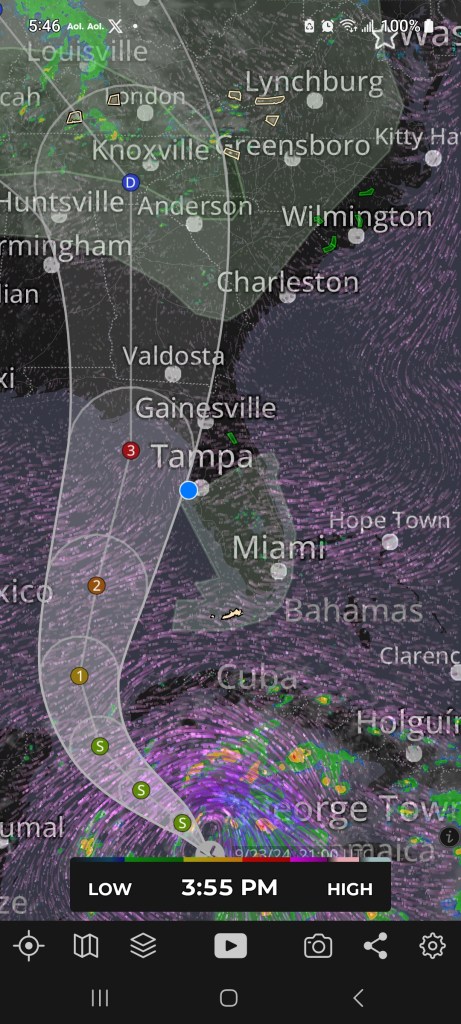
As I write this, there is a real storm brewing, both within and without. The image below is a weather map of the hurricane that may soon hit my area, forcing me to evacuate. As someone living in an RV, evacuation is usually mandatory in situations like this, and so I find myself facing the possibility of having to leave my bed in the middle of a crash caused by overdoing it.
The threat is very real, and so the importance of pacing is now at a level that I can’t ignore. I must prioritize rest and recovery immediately, because no matter what state I’m in, I’ll have to get out of bed and go to the hurricane shelter at the church next door if an evacuation order comes.
This situation has made it even clearer to me how crucial the practice of witnessing vrittis and pratyayas is. Without that practice, I would be overwhelmed by anxiety and fear right now. The mind wants to run wild with worst-case scenarios and worries, but I have been training myself to simply witness these thoughts as they arise. They are just thoughts—just mental fluctuations. They do not have to define my experience. I can stay present, calm, and clear, ready to deal with whatever comes.
So, after I finish writing this post, I’m going into massive rest and be prepared mode. The practice of pacing has never been more critical. This is an extreme red-flag situation, and I hope it serves as a reminder to all of us with chronic fatigue syndrome: sometimes, the urgency of rest is not just about avoiding a crash; it’s about survival.
Take a look at the image below—it’s a reminder to me, and hopefully to you as well, that life can throw storms at us both literally and metaphorically. But with the right practices, we can remain centered and grounded, ready to face what comes with a steady mind and a rested body.
As we face the storms within and around us, may we find peace in the stillness of our hearts. May all beings be free from suffering and the causes of suffering. May all beings experience happiness and the causes of happiness. May we all find safety, strength, and well-being on our journeys, no matter how turbulent the path. May we be guided by wisdom, anchored in compassion, and find harmony in the unfolding of each moment. And in these times of uncertainty, may we remember our interconnectedness, and may we all be held in grace and peace.
Living with chronic fatigue syndrome (CFS) and chronic pain for over 30 years has been an immense challenge. There were times when the physical suffering seemed so overwhelming that it consumed my every thought. But as I journeyed deeper into spiritual practices and reflected on the nature of suffering itself, I came to a life-changing realization: much of my suffering wasn’t from the actual pain, but from my mind’s reaction to it. This distinction has become a cornerstone of my approach to living with chronic illness, and I’d like to share it with you, in hopes it may offer some clarity and comfort on your own journey.
Understanding Suffering:
Suffering is a universal part of the human experience, but what I’ve learned over time is that suffering doesn’t always arise directly from the pain itself. More often, it arises from the mind’s interpretation of the pain—the stories, fears, and resistance we build around it. This insight is well illustrated in the Buddhist teaching of The Second Arrow. The story goes that while we may be struck by the first arrow—representing the unavoidable pain that comes with being human—it is the second arrow, our mental and emotional response to that pain, that causes much of our suffering. We have no control over the first arrow, but we do have some control over the second one. When I began to understand this, I could see how my mind was amplifying my suffering by dwelling on it, resisting it, or fearing its persistence.
Recognizing this dynamic has helped me approach pain not as an enemy to be fought, but as an experience to be acknowledged without judgment. This doesn’t mean the pain vanishes, but it transforms how I relate to it, making room for moments of peace amidst the discomfort.
Finding Realization:
A deep shift in my experience of suffering came when I began exploring spiritual teachings that pointed to the true nature of the self. Teachers like Papaji and Mooji guided me toward moments of realization where I glimpsed the unchanging awareness that lies beneath all mental and physical experiences. In those moments, I recognized that the pain in my body and the thoughts in my mind were passing phenomena, while something vast and peaceful within me remained untouched. This was the beginning of a profound realization: I am not the pain, I am the awareness in which the pain arises.
However, sustaining this realization in daily life requires practice. It’s not about escaping pain or denying its presence, but about recognizing the part of us that remains constant and unscathed by the fluctuations of the mind and body. In this way, realization becomes a refuge, a space of stillness even as the storms of physical suffering continue.
A New Relationship with Pain:
Through mindfulness and meditation, I’ve learned to sit with the physical sensations in my body without immediately labeling them as good or bad. When I practice mindfulness, I bring a compassionate awareness to whatever arises, whether it’s pain, frustration, or fear. Instead of trying to push these feelings away, I let them be. This simple act of allowing has been one of the most powerful tools in transforming my relationship with suffering. By observing the sensations without judgment, I create space between myself and the pain, a space where peace can emerge.
Meditation has also been a sanctuary for me. By focusing on the breath or repeating a mantra, like the Medicine Buddha mantra, I find that I can calm the turbulent waves of the mind, even if the body is still in pain. This doesn’t take the pain away, but it brings a sense of inner calm that helps me cope more gracefully.
Another practice that has been transformative is self-inquiry, specifically investigating the “I” that claims ownership of the suffering. When I look closely at thoughts like “I am in pain,” I ask myself, “Who is this ‘I’ that is experiencing this?” This simple question often reveals that the sense of “I” is just another thought, another mental event.
I realize that I am not the thought or the pain. I am the awareness observing it all. This recognition doesn’t remove the physical sensations, but it softens their hold on me. It’s like taking a step back from the drama unfolding in the mind and body, and instead of being caught up in it, I become the quiet witness of it all. This shift in perspective helps dissolve the perceived separation between the observer and the observed, and in that union, peace is found.
Living with Compassion and Reflection:
As I continue to navigate life with chronic illness, I’ve come to see suffering as both a challenge and a teacher. Each moment of pain has the potential to teach us about resilience, about compassion, and about the nature of existence itself. Reflecting on my own journey, I often ask myself: what is this pain trying to show me? How can I meet it with acceptance instead of resistance? How can I extend the compassion I so often offer others to myself?
One of the most important lessons I’ve learned is the value of self-compassion. Chronic suffering can easily lead to frustration, self-criticism, or even feelings of failure. But I’ve come to realize that the first step toward healing is always kindness—to acknowledge my struggles without judgment and to treat myself with the same care and compassion I would offer to a loved one in pain. This practice of self-compassion doesn’t just ease the burden of suffering; it opens the heart to a deeper understanding of the shared nature of human experience.
Conclusion:
Living with chronic fatigue syndrome and chronic pain is undeniably difficult, but by transforming the way we relate to suffering, we can find moments of peace even in the midst of it. It’s not about eradicating pain or escaping it, but about changing the lens through which we view it. When we understand that much of our suffering is created in the mind—the second arrow—we can begin to soften our response to it. Through consistent mindfulness, meditation, self-inquiry, and self-compassion, it is possible to cultivate a deeper sense of peace and acceptance.
This journey is ongoing, and there is no finish line. But each moment of awareness, each breath of compassion, brings us closer to a more peaceful relationship with our pain. I invite you to reflect on your own experiences of suffering and how these practices might support you. Please feel free to share your thoughts and reflections in the comments below. Together, we can create a community of support, compassion, and healing.
Reflections on Chronic Fatigue Syndrome aka ME/CFS
Solitude and the Key In silence, I find a refuge from the chaos of my mind. In the tender embrace of the night, I travel inward for comfort and grace.
Chronic fatigue, my silent companion, taught me the art of patient resignation. In the depths of silence I carefully kept my key, where I repaired. Like a phoenix rising from the ashes of doubt, I embrace the night without shouting.
For in the embrace of solitude I discern the lessons of the soul and long to learn them. In this quiet refuge, I find strength again, and my spirit is full.
With every gentle breath and careful sigh, I recapture my light beneath the sky. So I rest in my lonely cocoon, gathering spoons by moonlight. Learning to dance with shadow and light, embracing the journey, embracing the night.
Finding Solace in Solitude: A Poem for Our ME/CFS Journey
In the quiet of solitude, I find, A refuge from the chaos of the mind. Amidst the dark night’s gentle embrace, I journey inward, seeking solace and grace.
Chronic Fatigue, my silent companion, Teaches me the art of patient abandon. To conserve my spoons with mindful care, In the depths of stillness, I repair.
Like a phoenix rising from ashes of doubt, I embrace the dark night, without a shout. For in solitude’s embrace, I discern, The lessons of the soul, I eagerly learn.
In this sacred space of quiet retreat, I find strength anew, my spirit replete. With each tender breath and mindful sigh, I reclaim my light beneath the sky.
So here I rest, in solitude’s cocoon, Gathering spoons beneath the silver moon. Learning to dance with shadows and light, Embracing the journey, embracing the night.
In the tapestry of time, woven with threads of understanding, empathy, and love, I extend my hand to you, a fellow traveler in the realm of chronic fatigue syndrome. It’s not just a condition; it’s a journey, a complex dance with our bodies and minds. You are not a hypochondriac; you are a warrior navigating the intricate landscape of your own existence.
Having walked the same path, I resonate with the words, “After a lifetime of living with chronic fatigue syndrome, you’d think I’d be better at it now.” Each day, a new chapter unfolds, revealing the resilience within us. It’s not about perfection or mastery; it’s about learning, adapting, and discovering the strength that resides within, often unnoticed.
Embrace the wisdom your journey has bestowed upon you. You’ve acquired an intimate knowledge of your body and mind, a profound understanding that defies the misconceptions others may hold. You are not defined by the fatigue that courses through your veins; you are defined by the courage with which you face each day.
In this shared experience, let love be the balm that soothes the weariness, understanding the salve that heals the wounds unseen. As you unravel the layers of your existence, remember that every nuance of your journey contributes to the masterpiece of who you are.
Encourage yourself to practice self-compassion daily. Recognize the victories, no matter how small, and celebrate the resilience that continues to blossom within. You are not alone in this intricate dance; we move together, step by step, navigating the ebb and flow of chronic fatigue syndrome.
May your days be adorned with moments of understanding, empathy, and love – the pillars that support you on this remarkable journey.
May your journey continue to be filled with peace, wisdom, and compassion. 🙏
May we all embrace our journey with a compassionate and open heart, finding solace in the present moment on our path with ME/CFS.





 Home Page: Inspirations of Love and Hope