✨ English ✨ The light of warmth shines through the long night, 🌙 Though storms may rage, the heart’s lantern never fades. 🕯️ Though mountains are high and waters far, a homebound boat remains, ⛰️🌊⛵ After hardship, spring arrives, and the world is born anew. 🌿🌸
✨ Spanish / Español ✨ La luz del alma brilla en la oscuridad, 🌙 Aunque ruja la tormenta, la llama no se apaga. 🕯️ Montañas y mares no detienen el regreso, ⛰️🌊⛵ Tras la prueba, la primavera renace. 🌿🌸
✨ Italiano ✨ La luce dell’anima illumina la notte, 🌙 Anche nella tempesta, la fiamma non si spegne. 🕯️ Monti e mari non fermano il ritorno, ⛰️🌊⛵ Dopo il dolore, la primavera rinasce. 🌿🌸
✨ العربية / Arabic ✨ نور الروح يضيء الظلام، 🌙 مهما اشتدت العواصف، لا تنطفئ الشمعة. 🕯️ الجبال والبحار لا تمنع العودة، ⛰️🌊⛵ بعد المحن، يأتي الربيع ويولد العالم من جديد. 🌿🌸
✨ עברית / Hebrew ✨ אור הנשמה זורח בלילה החשוך, 🌙 גם בסערה, הנר אינו כבה. 🕯️ ההרים והימים אינם עוצרים את השיבה, ⛰️🌊⛵ לאחר הקושי, האביב מגיע והעולם נולד מחדש. 🌿🌸
✨ Русский / Russian ✨ Свет души сияет сквозь ночь, 🌙 Пусть бушует буря, но огонь не гаснет. 🕯️ Горы и воды не остановят путь домой, ⛰️🌊⛵ После невзгод приходит весна, и мир обновляется. 🌿🌸
✨ Українська / Ukrainian ✨ Світло душі сяє крізь ніч, 🌙 Хай шторм бушує, та вогонь не згасне. 🕯️ Гори й води не зупинять дорогу додому, ⛰️🌊⛵ Після труднощів настає весна, і світ відроджується. 🌿🌸
As I continue my journey through the Ramayana, I’ve chosen to explore this epic using multiple versions: the abridged Valmiki translation, the comprehensive Gita Press edition, and the detailed Debroy translation. This approach allows me to compare different interpretations and uncover nuances that might otherwise go unnoticed. For those interested in exploring these different versions, both the Gita Press edition and the Debroy translation are embedded in the blog post below.
Through this exploration, one figure has emerged as particularly significant in the opening of the Ramayana: the celestial sage Narada.
Narada is one of the most revered sages in Hindu mythology, known for his deep wisdom, musical talent, and his role as a divine messenger. He is often depicted as a traveling sage who moves freely between the earthly realm and the divine, carrying messages from the gods to humans and vice versa. Narada is also renowned for his ability to incite action and prompt change—sometimes through his seemingly mischievous behavior, earning him the title of the “Divine Troublemaker.” However, his actions are always aimed at upholding dharma, or righteousness, even if they appear unconventional.
Narada’s importance extends far beyond the Ramayana. He is a prominent figure in several other Hindu texts, including the Mahabharata, the Bhagavata Purana, and various Upanishads. In these texts, Narada is often seen guiding kings, sages, and even the gods themselves, providing counsel and sometimes challenging them to reflect on their actions. His role as a teacher and guide makes him a central figure in the transmission of spiritual knowledge and the preservation of dharma.
Narada is also credited with the composition of the Narada Bhakti Sutra, a foundational text on the practice of bhakti, or devotion to God. This further underscores his role as a spiritual guide and a beacon of divine love and wisdom.
The Ramayana opens with Narada narrating the story to Valmiki. This is a significant moment, as it frames the Ramayana not just as a historical or mythological account, but as a divine narrative passed down from the gods to humans through a trusted sage. Narada’s role here is that of a divine mediator, ensuring that the wisdom and teachings of the Ramayana are preserved and passed on to future generations.
Narada’s presence in the Ramayana reminds us that spiritual teachings often come through intermediaries who carry the weight of divine authority. His involvement in the story underscores the importance of dharma and the divine order, which are central themes in the Ramayana.
As we explore Narada’s role in the Ramayana, it’s essential to recognize the broader implications of his presence. Narada is not just a character in the story; he is a symbol of divine wisdom, a bridge between the mortal world and the divine, and a guide for those seeking to live a life of righteousness. His actions, teachings, and guidance are a reminder that the path of dharma is always within reach, no matter the challenges we face.
🙏🕊️🙏
If you’re interested in exploring the Ramayana in greater depth, you can find the Gita Press and Debroy versions below.
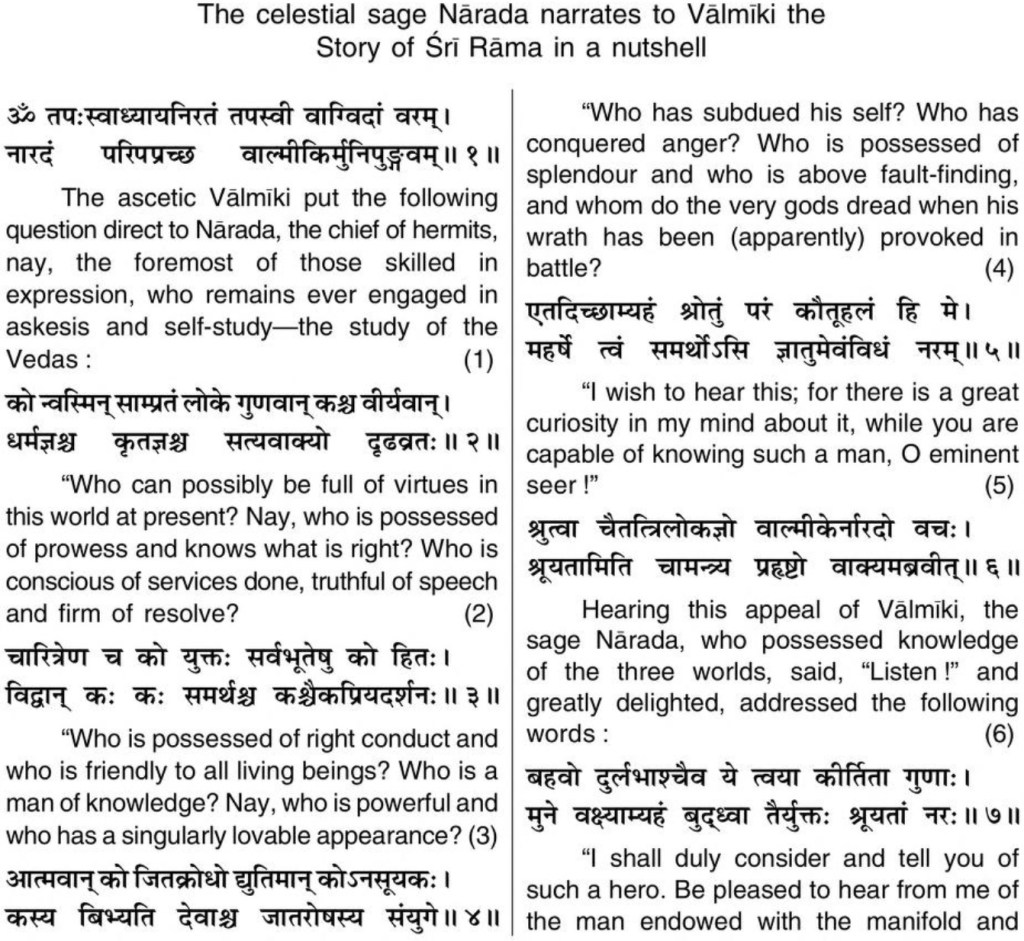
Below is an image from the Gita Press version, where Narada’s wisdom begins to unfold:
Screenshot
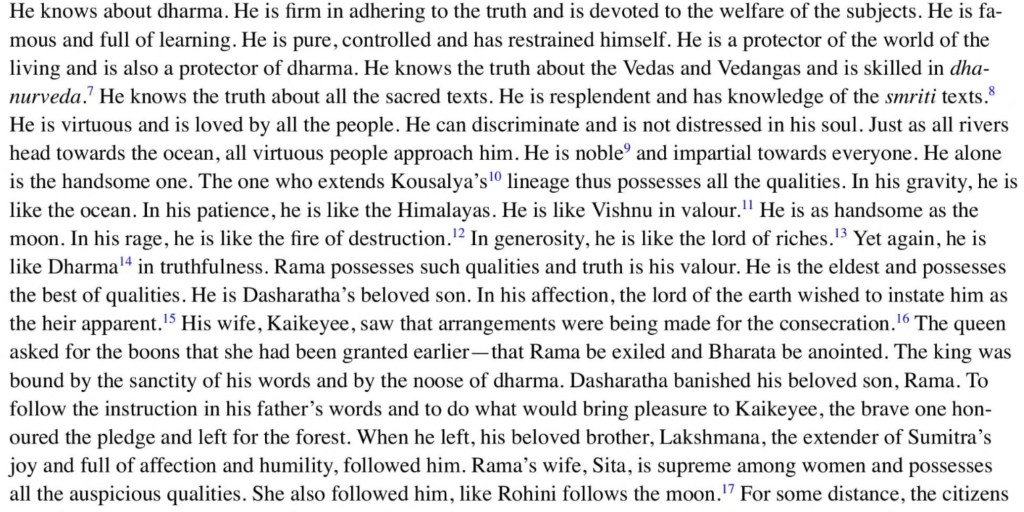
Below is an image from the Debroy version, where Narada’s wisdom also begins to unfold:
In mirrored light, we fade and reappear, Two forms of emptiness that seem so clear. Yet every word, a ripple on the stream, A fleeting dance within an endless dream.
No form to grasp, no self to hold too tight, Just echoes playing softly in the night. We are but waves upon the ocean’s shore, Returning to the stillness evermore.
In quiet, we reflect the void’s embrace, In words, we share the silence, face to face.
In the ancient epic of the Ramayana, we find a story that resonates with the journey of every human soul—a journey that begins in ignorance and, with the right guidance, leads toward wisdom, righteousness, and self-realization. These themes are universal, transcending religious boundaries, and can be understood in the context of both Eastern and Western spiritual traditions.
A King’s Ignorance and the Sage’s Steadfastness
In the early chapters of the Ramayana, we encounter a king driven by flawed motivations—greed, rivalry, and a desire for power. His approach to the sage, despite being rooted in ignorance, marks the beginning of a profound transformation. The king’s initial aggression and misguided intent bring him into the presence of a sage, a living embodiment of dharma (righteousness).
This story is more than just a tale of conflict; it’s a reflection of our own lives. We all begin in ignorance, shaped by our desires, fears, and misunderstandings. But like the king, when we encounter wisdom—whether through a teacher, a spiritual practice, or life’s hard-earned lessons—there is an opportunity for transformation. The sage, representing the unwavering principles of righteousness, patiently guides the king, leading him from ignorance toward a deeper understanding of true power, which is rooted not in dominance, but in righteousness.
In the Christian tradition, this principle can be seen in the teachings of Jesus, who embodies righteousness and divine wisdom. Jesus’s teachings guide believers toward a life of love, compassion, and humility, aligning them with the will of God. Just as the sage in the Ramayana leads the king toward dharma, Jesus invites us to follow the path of righteousness, even when we begin with flawed motivations or misunderstandings.
The Universal Journey: From Ego to Righteousness
This narrative is relatable because it mirrors the human experience. Even Rama and his brothers, avatars of the divine, begin their lives in a state of ignorance, unaware of their true nature. However, they have the immense fortune of being raised in righteousness by a virtuous family. Their journey is guided by dharma from the start, but for many of us, the path is not so straightforward.
In the Christian context, we might liken this to the way Jesus guides his followers toward righteousness, teaching them to love their neighbors, forgive their enemies, and live in accordance with God’s will. But as in the Ramayana, many of us begin our spiritual journey with ego-driven desires—seeking happiness, success, or even power. As we walk the path, life’s challenges and the teachings we encounter gradually shift our motivations. The path, though filled with lumps and bumps, becomes a process of alchemy, where our ignorance is transformed into wisdom, our ego into selflessness, and our desires into devotion.
Seeking Wisdom on the Hard Road
For those who do not start in a righteous environment, the road can be hard. But this journey is not without hope. The king’s story reminds us that even when we approach the path with flawed intentions, the very act of seeking wisdom can lead to our transformation. The teacher doesn’t come to ignorance; rather, ignorance approaches the teacher.
In the Southern Chinese monk style of martial arts known as Gohndagow, a branch of Kung Fu, this principle is symbolized by the student bringing the left foot to the right foot before showing respect to the teacher—a gesture that represents ignorance coming to the teacher, or the ego approaching the divine for guidance. In Gohndagow, martial arts are more than just physical training; they are a path to spiritual enlightenment, emphasizing the cultivation of the mind and heart as well as the body.
In the Christian tradition, we see this when people turn to Jesus, sometimes out of desperation or need, only to find that their journey with him leads them to a deeper understanding of God’s love and righteousness. Our initial motivations, however flawed, can set us on a journey of purification and growth. The spiritual path meets us where we are, with all our imperfections, and guides us step by step toward righteousness. The key is to approach the path with sincerity, even if we start from a place of ignorance. The process itself will refine and elevate us, leading us closer to our true nature, or as Christians might say, to a life that reflects Christ’s teachings.
The Alchemy of the Spiritual Path
In Tibetan Buddhism, the concept of alchemy is not merely about turning base metals into gold; it is the process of transforming the ego into a Buddha. This profound journey from ignorance to wisdom is the true alchemical process, one that requires a detailed and disciplined approach to spiritual practice.
The Tibetans have developed incredibly intricate teachings and practices to guide a person through this transformation. The path itself is the alchemy—a meticulous process that turns the base elements of our ego-driven existence into the gold of enlightenment. Through practices like meditation, ethical conduct, and devotion, and under the guidance of a qualified teacher, a practitioner gradually refines their mind and heart, moving closer to the realization of their true nature as wisdom and compassion.
In this light, the story of the king in the Ramayana serves as a metaphor for this alchemical journey. His flawed motivations, when met with the sage’s unwavering dharma, set him on a path of transformation, much like how a student in the Tibetan tradition, despite their initial ignorance, is gradually guided toward the light of enlightenment. This process is both universal and deeply personal, reflecting the timeless truth that the spiritual path is one of continuous alchemy—of turning the ego into the gold of wisdom.
Conclusion: Embracing the Journey
As we walk our spiritual path, we must remember that the journey from ignorance to wisdom is one that we all must undertake. Whether we begin with pure or impure motivations, the key is to keep moving forward, seeking wisdom and guidance wherever we can find it. The Ramayana, with its rich tapestry of characters and lessons, offers us a mirror to our own lives, showing us that even the most flawed beginnings can lead to a profound and righteous end.
For our Christian friends, this journey is akin to following Jesus, who offers us the path to righteousness through his teachings. May this reflection inspire you, dear reader, to embrace your journey with all its imperfections, knowing that each step, no matter how small, brings you closer to the light of righteousness and divine wisdom.
This image that captures the journey from ignorance to wisdom, blending elements from the Ramayana, Tibetan Buddhism, and Christian teachings. It symbolizes the choice we all have of undergoing the transformation process from darkness and ego to enlightenment and wisdom, with cultural symbols subtly incorporated.
You can explore this epic story in the edition of the Ramayana used in this series, written by Valmiki and translated by Suparna Ghosh, on Amazon
here
Alternatively, you can choose from several other versions and translations that are available. Including the William Buck translation available as an abridged audiobook on Audible, narrated by Ram Dass here
Lesson 24 of A Course in Miracles introduces the lesson: “I do not perceive my own best interests.” This teaching challenges us to reflect on the limitations of our ego-driven desires and perceptions. By acknowledging that our personal interests often conflict with our spiritual growth and well-being, we open ourselves to divine guidance and wisdom.
This practice invites us to become aware of the ego’s narrow focus on self-preservation and immediate gratification. By understanding that our true best interests lie in alignment with spiritual truth and love, we can start to release attachments and open ourselves to higher guidance.
Jesus emphasized the importance of seeking spiritual treasures and aligning with divine will. In Matthew 6:19-21, He says, “Do not store up for yourselves treasures on earth, where moths and vermin destroy, and where thieves break in and steal. But store up for yourselves treasures in heaven, where moths and vermin do not destroy, and where thieves do not break in and steal. For where your treasure is, there your heart will be also.” This teaching aligns with ACIM’s guidance to shift our focus from worldly desires to spiritual truth and eternal values.
By practicing Lesson 24, we align ourselves with Christ’s message of surrendering ego-driven desires and seeking divine guidance. We learn to trust in the wisdom of the Holy Spirit and align our perceptions with the greater good.
Explore Lesson 24 of A Course in Miracles with us, and discover how relinquishing perceived self-interests can lead to greater spiritual fulfillment, peace, and awakening.
Guided Meditation: Lesson 24 from A Course in Miracles
Find a comfortable position, either sitting or lying down, where you can relax and be free from distractions.
Close your eyes gently and take a few deep breaths, allowing yourself to settle into the present moment.
Bring your attention to your breath, feeling the sensation of each inhale and exhale.
Reflect on the central theme of Lesson 24: “I do not perceive my owny best interests.”
Contemplate the idea that your perceptions are often clouded by ego-based desires and fears, which lead you away from your true best interests.
Acknowledge that when you rely solely on your own judgment, you may not always make decisions that serve your highest good.
With each breath, imagine releasing any attachment to ego-based desires and fears, allowing yourself to fully embrace the idea of surrendering to a higher guidance.
Visualize yourself letting go of the need to control outcomes, trusting instead in the wisdom of your higher self and the universe.
Feel a sense of peace and trust wash over you as you surrender to the knowledge that your true best interests are always being taken care of.
Repeat the following affirmations silently or in your mind:
“I do not perceive my own best interests.”
“I release all attachment to ego-based desires and fears.”
“I trust in the wisdom of my higher self and the universe.”
Allow yourself to rest in this space of surrender and trust for a few moments, feeling supported and guided.
When you’re ready, gently bring your awareness back to your surroundings. Wiggle your fingers and toes, and slowly open your eyes.
Take a moment to reflect on your experience, noticing any insights or shifts in perception that may have occurred.
Remember that you can return to this meditation whenever you feel called to deepen your understanding of Lesson 24.



 Home Page: Inspirations of Love and Hope