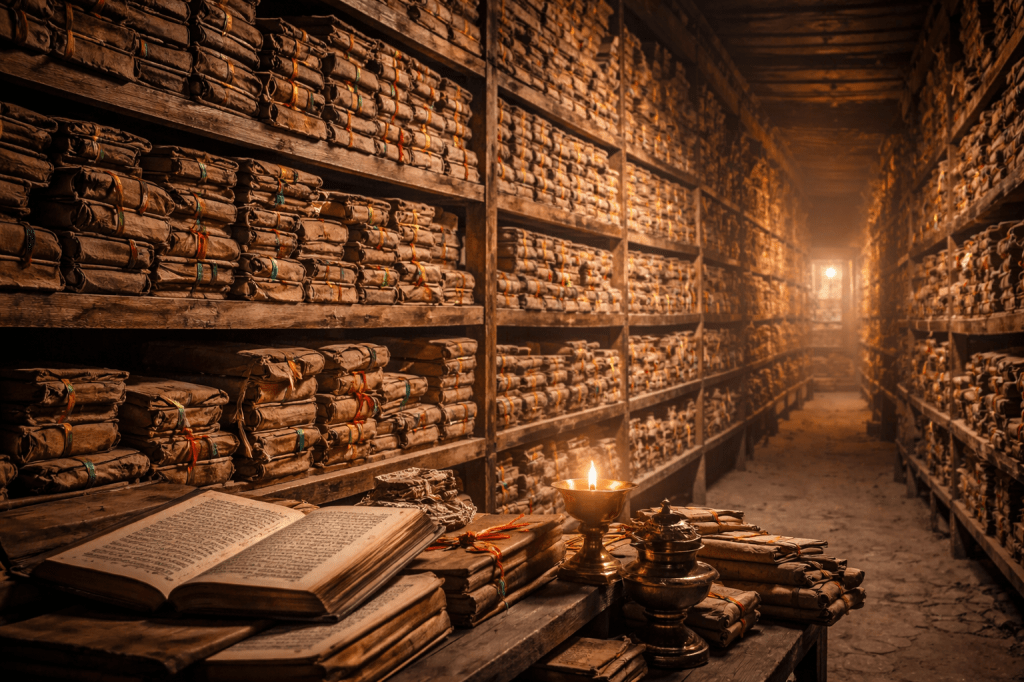
Within Sakya Monastery, a hidden wall of manuscripts—reportedly containing over 84,000 texts—was brought to light in 2003, revealing centuries of preserved scholarship and spiritual transmission.
Across the centuries, there are voices that still speak with startling clarity. This brief portrait of Rongtön Sheja Kunrik (14th Century) opens a window into the great monastic universities of Tibet, where scholarship, meditation, and compassion were woven into a single path. By revisiting the lives preserved in ancient namthar archives, we are reminded that wisdom is not lost to time. It waits patiently in these luminous biographies, offering insight into disciplined study, fearless inquiry, and the union of intellect and realization. For readers seeking depth, continuity, and the steady flame of transmitted understanding, this life story invites us to listen again.
Rongtön Sheja Kunrik was born in the region of Rong (Central Tibet) in the female Fire-Hare year (1367). From childhood, his mind turned naturally toward the Dharma. He entered monastic life early, receiving novice vows and beginning rigorous study under masters of the Sakya and other lineages.
At Sangphu Neutok, one of the great centers of learning, he immersed himself in the profound treatises on Prajñāpāramitā, logic, vinaya, and abhidharma, astonishing his teachers with his clarity and depth.
Mastery and Scholarship
By his early twenties, he had already mastered the major Indian and Tibetan commentaries. He received the name Shakya Gyaltsen and later the fuller title Sheja Kunrik (“All-Knowing Knower of Phenomena”).
His scholarship was vast—he commented on nearly all the major works of the sutras and shastras, often composing lucid explanations that clarified difficult points for students across traditions.
Founding Nalendra Monastery
At about the age of sixty-nine, recognizing the impermanence of conditioned things, he founded Nalendra Monastery near Lhasa.
There he gathered disciples and transmitted teachings with boundless compassion, emphasizing direct insight into emptiness, loving-kindness, and the union of study and practice.
His approach was remarkably inclusive. He respected and drew from Kadam, Kagyu, and other traditions without partiality.
Final Years and Legacy
He lived to the age of eighty-three, passing in 1449. He left behind a legacy of writings that continue to illuminate minds. His disciples, including the great Shakya Chokden, carried his wisdom forward like a steady flame in the wind.
The Traditional Namthar Style
When told in the traditional namthar (spiritual biography) style, such a life story begins with prayers of homage, wondrous signs at birth, early renunciation, meetings with gurus, receiving empowerments and transmissions, profound realizations, teaching activities, and finally a peaceful passing amid miraculous signs—all woven together to inspire faith and diligence in the listener.


Feel free to leave a comment below.