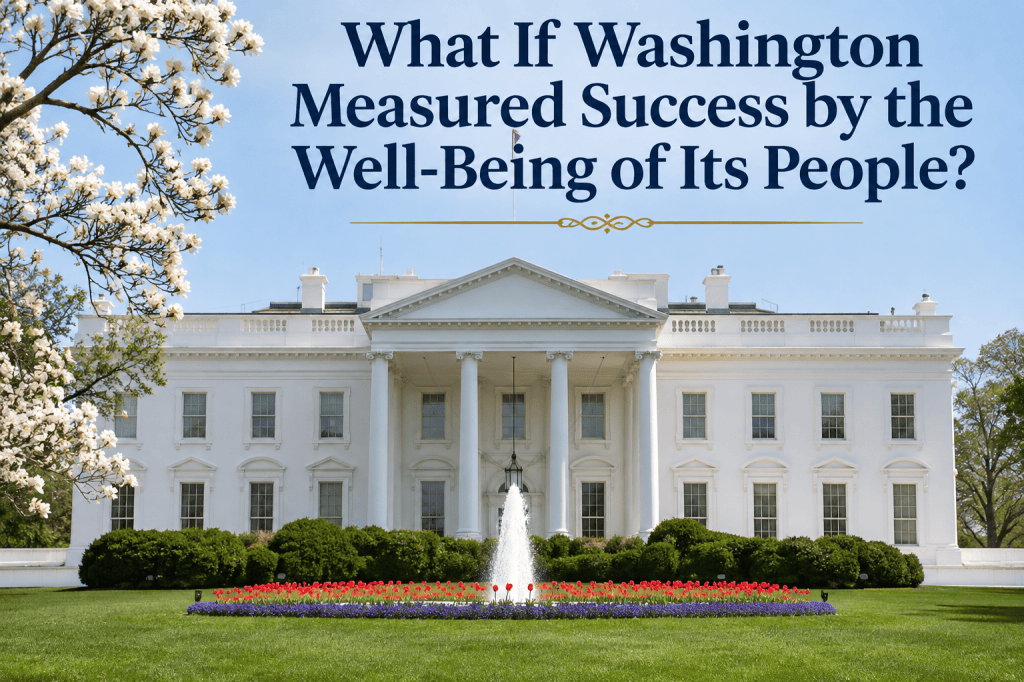
What might become possible if the success of government were measured less by the defeat of political opponents and more by the well-being of the people it serves?
The midterm elections are over. A new Congress will take office in January. And millions of Americans are still waiting for something more tangible than political victory.
They are waiting for their lives to become a little easier.
For groceries they can afford. Housing they can maintain. Medical care they can obtain without financial ruin. Communities where their children can grow up safely. And a government capable of addressing problems rather than continually becoming consumed by political conflict.
What if the next two years became an extraordinary experiment in public service?
Not an experiment in surrendering principles or pretending disagreements don’t exist. An experiment in discovering how much good could be accomplished when elected officials remembered that their responsibilities extend beyond defeating their opponents.
What Could This Government Accomplish Together?
Imagine the president and congressional leaders beginning with a simple question:
What can we accomplish together that will genuinely improve the lives of the American people?
They might begin with affordability.
Housing costs place enormous pressure on families, older Americans, and young people hoping to establish independent lives. Could lawmakers identify practical steps that increase housing availability while respecting local circumstances and fiscal realities?
Health care offers another opportunity.
Could Congress and the administration identify areas where patients, medical professionals, insurers, and policymakers share common concerns? Could they reduce unnecessary administrative burdens, improve access to essential care, or make the costs of treatment and medication more transparent?
And what about the everyday cost of living?
Rather than simply assigning blame for high prices, policymakers could examine the factors contributing to household expenses and pursue measures supported by credible evidence.
What about infrastructure, education, disaster preparedness, and responsible stewardship of public resources?
These are not exclusively Democratic or Republican concerns. They are concerns that affect people in every congressional district, regardless of how they voted.
Some proposals would succeed. Others might fail. But a government willing to evaluate results and correct its mistakes could make meaningful progress.
Perhaps the first achievement would be something surprisingly simple: establishing a shared commitment to solving identifiable problems, even when there is disagreement about how best to solve them.
Accountability Without Political Warfare
Cooperation does not mean abandoning constitutional responsibilities.
Congress must retain its authority to investigate credible wrongdoing, oversee federal agencies, examine public spending, and hold officials accountable.
The judiciary must remain independent, deciding cases according to law rather than political preference.
And the executive branch must faithfully carry out its constitutional responsibilities.
These checks and balances are not obstacles to good government. They are among the safeguards that make responsible government possible.
But there is a meaningful distinction between oversight conducted to protect the public interest and political conflict pursued primarily for partisan advantage.
The same standards should apply regardless of which party holds power.
An investigation should have a legitimate purpose, a credible factual foundation, and procedures that respect the rights of everyone involved.
A legislative disagreement should be examined on its merits.
And when elected officials find common ground, cooperation should not become something they must apologize for.
Accountability and collaboration are not opposites.
A government can hold its members accountable while remaining committed to the work of improving people’s lives.
What If We Measured What Matters?
Imagine a government that regularly reported its progress in terms ordinary people could understand.
Not merely how many bills were introduced, how many hearings were held, or how many political victories were claimed.
But whether people were actually better off.
Are more families able to afford stable housing?
Are patients receiving necessary medical care?
Are communities becoming safer?
Are public resources being used responsibly?
Are citizens receiving timely, effective service from the agencies responsible for helping them?
Are opportunities expanding for children, working families, older Americans, and people living with disabilities?
These questions do not belong to one political party.
They belong to the people.
Of course, government cannot control every factor affecting these outcomes. Economic conditions, technological developments, international events, and decisions made by businesses, communities, and individuals all play important roles.
That makes honest measurement even more important.
Public officials should be willing to distinguish what their policies actually accomplished from what they merely hoped to accomplish.
Success should be supported by evidence, not declared through political advertising.
And when a policy fails, acknowledging that failure should be understood as an opportunity for correction rather than an admission that cooperation itself was a mistake.
Imagine a political culture in which changing course in response to credible evidence became a sign of responsible leadership.
The Opportunity Before Us
No election produces a government in which everyone agrees.
That was never the purpose of constitutional democracy.
The separation of powers, competing political perspectives, and independent courts reflect an understanding that concentrated authority requires limits.
Yet those limits need not prevent constructive cooperation.
The president can work with Congress on legislation. Members of opposing parties can negotiate workable agreements. Congressional committees can conduct meaningful oversight. Courts can uphold constitutional boundaries without becoming participants in partisan campaigns.
Each institution can fulfill its own responsibilities while respecting the responsibilities of the others.
And citizens can insist on accountability without demanding perpetual confrontation.
There will be times when principled disagreement is necessary. There may be investigations that are essential, legislation that deserves to be defeated, and constitutional disputes that require judicial resolution.
Responsible government does not mean avoiding those conflicts.
It means remembering why those powers exist and exercising them in service of the public.
There is another possibility worth considering.
What if political leaders discovered that cooperation itself could strengthen public confidence?
Not because Americans suddenly agreed on everything, but because they could see their representatives addressing shared concerns with seriousness, honesty, and a willingness to listen.
A Republican might recognize the value of a proposal introduced by a Democrat.
A Democrat might acknowledge a legitimate concern raised by a Republican.
A president might sign legislation developed through meaningful bipartisan negotiation.
And the public might begin to see political disagreement not merely as a struggle for dominance, but as a process capable of producing better decisions.
None of these possibilities requires anyone to abandon their convictions.
They require the willingness to recognize that no political party possesses a monopoly on wisdom.
What Will We Have to Show for These Two Years?
When Americans look back on this period, what will they remember?
Another succession of accusations, investigations, political confrontations, and competing declarations of victory?
Or a period when elected officials, despite profound disagreements, found ways to address some of the problems affecting everyday life?
We cannot know how much cooperation will be possible.
Some disagreements are fundamental. Some constitutional conflicts cannot responsibly be avoided. Some proposals will deserve opposition regardless of who introduces them.
But we can ask our public servants to approach the opportunities before them seriously.
To pursue practical solutions.
To protect constitutional principles.
To investigate wrongdoing when evidence warrants it.
To recognize worthwhile proposals regardless of their political origins.
To acknowledge mistakes and correct them.
And to measure success not simply by what happens in Washington, but by what happens in the lives of the people Washington is meant to serve.
Perhaps that is the question worth carrying forward after every election:
What might become possible if the success of government were measured less by the defeat of political opponents and more by the well-being of the people it serves?
The election has determined who will exercise power.
What remains to be seen is how that power will be used.
And perhaps the most meaningful political victory would be one that the American people could share, regardless of which candidates they supported.
The CompassionWare Press explores public life through truth, wisdom, loving-kindness, and compassion. We follow evidence wherever it leads, without allegiance to a political party.
Election context: The Associated Press projected Democratic control of both chambers following the November 3, 2026 midterm elections. Official certification follows election-night projections.
About the Author
Richard Silverman is an independent writer and the founder of CompassionWare Press. Drawing on decades of contemplative practice and lived experience with chronic illness, he explores how truth, wisdom, loving-kindness, and compassion can help us meet the challenges of public life.
Support independent, compassionate journalism: If you value this work, you are welcome to offer a voluntary contribution through PayPal. Our articles remain freely available to everyone. Thank you for reading.


Feel free to leave a comment below.