Inspired by Chapter 1.4 of the DeBroy Translation of the Ramayana
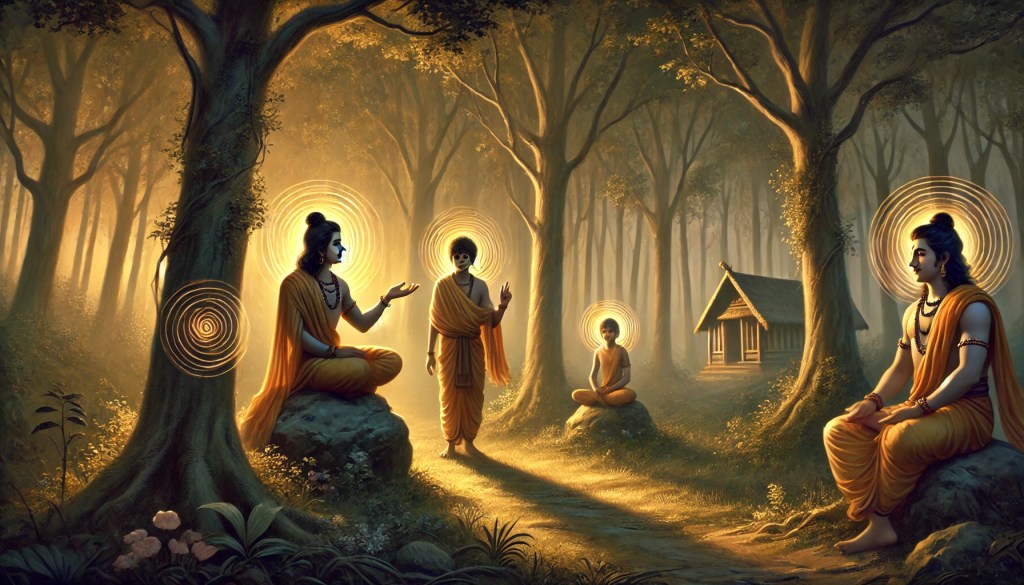
When reading ancient texts, one often encounters moments that seem to defy the logic of modern storytelling. One such moment came to me while reading Chapter 1.4 of Bibek Debroy’s translation of Valmiki’s Ramayana. In this passage, something quite strange happens: Rama, the hero of the Ramayana, listens to the story of his own life, recounted in beautiful song by two ascetics, Kusha and Lava—who, unbeknownst to him, are his own sons. I found myself both fascinated and confused. Why would the central character of this grand epic sit back and listen to his own tale, seemingly unaware of his role in it? How could this be?
At first glance, it seems almost like a paradox: the one who lived the events is now hearing about them as though they were ancient history. What could this mean? I couldn’t shake off the oddness of the moment, but as I reflected more deeply on the passage, I realized that there’s something profoundly spiritual and poetic at work here.
A Meta-Narrative and the Power of Storytelling
This moment in Chapter 1.4 introduces a unique dimension where the Ramayana folds in on itself, becoming both a story and an experience for its own characters. We, as readers, witness Rama being drawn into the retelling of his life, just as sages, brahmins, and laypeople of that era are captivated by the story. In this curious turn, Rama—the central figure of the narrative—is, for the moment, merely an audience member, listening to his own history as if hearing it for the first time.
On one level, this reflects the power of oral storytelling in ancient India, where the telling and retelling of epics like the Ramayana were central to cultural and spiritual life. The story is not merely history but a living tradition, recited to evoke wonder, devotion, and moral reflection. For Rama to hear his own story is a symbolic acknowledgment that this tale is larger than any one person—even the hero himself. The Ramayana transcends its historical events, becoming a divine narrative, filled with universal truths about dharma (righteousness), sacrifice, and devotion.
Kusha and Lava: The Storytellers and the Story
Adding to the layers of intrigue, the two ascetics who sing the Ramayana to Rama are his own sons, Kusha and Lava, though neither they nor Rama realize this at the time. Raised in Valmiki’s hermitage, Kusha and Lava learned the Ramayana directly from the sage and became its first storytellers. As sons of Rama, they are natural inheritors of the tale, yet the irony of the scene is that they chant this story to their own father, without the familial bond being revealed.
This speaks to the epic’s larger themes of identity and destiny. In the world of the Ramayana, characters are often bound by dharma and divine will, which transcend personal awareness. Rama himself, as an avatar of Vishnu, is bound to play out his role in the cosmic order. The fact that he listens with rapt attention to the story of his life shows that even divine figures are subject to the profound, transformative power of the stories they inhabit.
The Divine Nature of the Story
This scene highlights another key aspect of the Ramayana: the cyclical and timeless nature of the epic. In Hindu cosmology, time is often viewed as non-linear, with past, present, and future all interwoven in ways that are difficult for human minds to grasp. The Ramayana exists in this non-linear realm. It is a divine account, a mirror of cosmic truths. Rama’s role in the Ramayana is not just that of a king living through his personal trials but also a divine figure participating in an eternal drama of dharma.
When Kusha and Lava sing to Rama, they do so with perfect rhythm, melody, and tone, emphasizing the divine nature of the Ramayana itself. The text is not just a story to be told but an act of worship, sung in a way that mirrors celestial music. As they chant the tale, they embody the principles of devotion and truth that the Ramayana seeks to impart to its audience.
Rama as Listener
For me, the most profound aspect of this scene is Rama’s response. Though he lived these events, he listens to them as though they are new, becoming deeply immersed in the retelling. This suggests something powerful about the nature of memory, self-reflection, and storytelling. It’s as though Rama is being reminded of his own purpose, hearing his life’s journey unfold not from the inside but as an external observer. Even he, the hero of the epic, is subject to the transformative power of the narrative.
This can be seen as a reflection on the power of stories to teach and remind us of deeper truths about ourselves, even if we are the ones who lived through the experiences. The Ramayana is not just for others—it is for Rama too. It’s a reminder that no one, not even an avatar of Vishnu, is exempt from the lessons of dharma.
Conclusion: The Timeless Tale for All
This scene of Rama listening to his own story sung by Kusha and Lava offers us a profound reflection on the cyclical nature of time, the transformative power of storytelling, and the way in which even divine figures are humbled by the truth of dharma. The Ramayana, in this moment, transcends the simple bounds of history or narrative. It becomes an eternal truth that even its protagonist must hear, acknowledge, and reflect upon.
For those who have not yet read this passage, I encourage you to do so.
Here is the link to Chapter 1.4 of Bibek Debroy’s translation of the Ramayana, where this extraordinary event unfolds.
🙏🕊️🙏
 Home Page: Inspirations of Love and Hope
Thank you 🙏