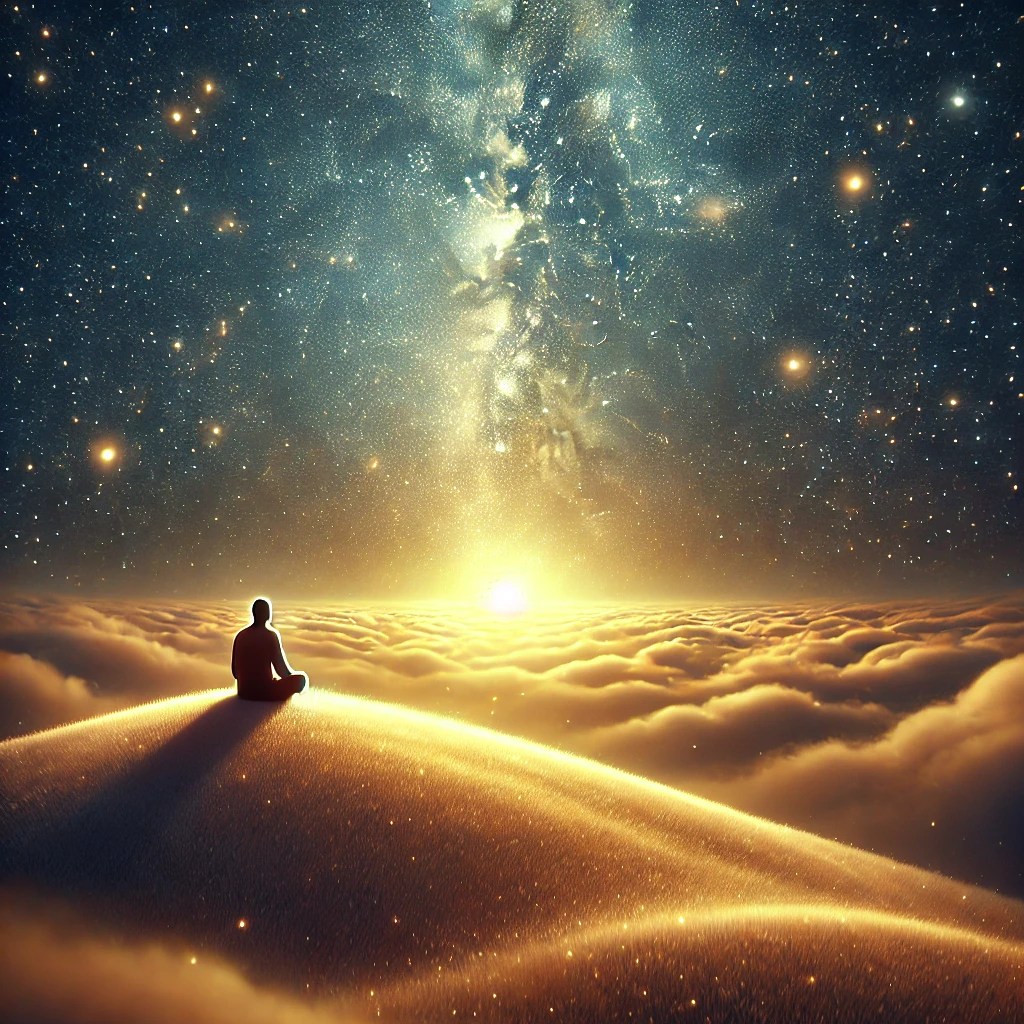
There is a voice that calls from deep within, faint yet steady, whispering to you through the silence of your heart: “The kingdom of God is within you.” You hear it in the stillness of the dawn, in the quiet moments when the world falls away. This voice is not far from you—it is not hidden in the heavens nor buried beneath the earth. It lives in the very breath you take, in the still center of your being, inviting you to “Be still and know that I am God.”
How often we search outside ourselves, looking for the divine in places far from our own hearts. But God, the essence of all that is, has always been nearer than we can imagine. “God is the center of my soul,” wrote St. John of the Cross, and in that hidden center, as we approach the divine, we find that it expands within us, like an infinite wellspring of love and truth. And what is this love? As St. Teresa of Avila tells us, “It is love alone that gives worth to all things.”
You, too, are the bearer of this love, this infinite truth that resides within the deepest chambers of your soul. “At the center of our being is a point of nothingness,” Thomas Merton reminds us, untouched by the noise of the world, pure and sacred, a place where you and the divine are one. In that sacred space, the distractions of life fall away, and we see ourselves as we truly are—not bound by illusion or time, but free, radiant, and eternal.
Just as this sacred center resides within each of us, the mystics of many traditions remind us that the divine is not something that can be grasped by the mind alone. “The infinite is concealed from all the living,” say the mystics of Kabbalah. It is not something to be dissected, understood, or named. It can only be known through the soul’s journey into the unknown, through the deep, unnameable mystery of existence. It is the same mystery that “wherever you turn, there is the face of God.” The divine pervades all things, from the rising sun to the faces of strangers on the street, from the endless stars to the quiet rustling of leaves in the wind.
In this profound unity, “man is a microcosm of the universe,” as David Bohm said. What we are, what we become, reflects the very nature of the cosmos itself. We are not separate; we are threads in the vast fabric of existence, each one of us a clue to the whole, each one a reflection of the infinite. “The Supreme Reality is beyond both the unmanifest and the manifest,” the Bhagavad-Gita tells us. It is the eternal and all-pervading essence of life, the unnamable source from which we arise and to which we will one day return.
To recognize this truth is to realize, as Ramana Maharshi said, that “Your own Self-Realization is the greatest service you can render the world.” Only through the shedding of the ego, the dissolution of the false self, can we see the formless reality of who we truly are—nameless, timeless, and infinite. This formless reality is the space between thoughts, the silence in which everything arises and fades—eternal, yet present within every moment, like the quiet breath of the universe itself. “There is only one truth—God,” Swami Sivananda wrote, reminding us that everything else, all the fleeting shadows of the world, are but temporary.
This realization of our true nature, this casting off of the little self, allows us to “recognize yourself as the vast Spirit,” in the words of Swami Paramahansa Yogananda. Beyond all limitations of form and thought, we are the boundless Spirit, free and ever-expansive. What is this freedom but the awakening to the truth of what has always been? The Buddha tells us, “What we think, we become.” Our thoughts shape our world, but beyond thought lies the ultimate realization of unity—of the one truth that binds all.
We are not separate. We have never been. “We are here to awaken from the illusion of our separateness,” Thich Nhat Hanh gently reminds us. Our divisions, our dualities, are but veils that obscure the deeper truth of our oneness. Beyond the illusions of duality—right and wrong, self and other—lies a greater reality. As Rumi said, “Out beyond ideas of wrongdoing and rightdoing, there is a field. I’ll meet you there.” In that field, where duality dissolves, we awaken to the truth of who we really are—expressions of the infinite, woven together in the fabric of existence.
This journey into the infinite is not a process of adding to ourselves, but of shedding the illusions that have kept us from recognizing the divine within. It is a return to the essence of our being, where we find, as Lao Tzu so profoundly reminds us, “The Tao that can be told is not the eternal Tao.” The eternal truth, the infinite source, cannot be grasped by the mind; it can only be realized in the stillness of the heart.
In this awakening, we are free. Free from the illusions of separation, free to live in the truth of our unity with all that is. As we return to this realization, we find, as St. John of the Cross said, “To reach satisfaction in all, desire its possession in nothing.” The journey is one of surrender, of letting go of all that is not real, to rest in the infinite, eternal love that is our true nature.
This is the call that has always been with us, whispering through the silence of our hearts. It is not just a call—it is the very essence of life, the truth that lies at the core of all existence, waiting for us to embrace it. To awaken to the infinite is to recognize ourselves as the vast, boundless Spirit, and to live in the truth of our oneness with all that exists.
🙏🕊️🙏
 Home Page: Inspirations of Love and Hope
Thank you 🙏