Tag: Witness Consciousness

  • Knowledge Without Wisdom, Wisdom Without Compassion: The Spiritual Crossroads of Our Age

    Knowledge Without Wisdom, Wisdom Without Compassion: The Spiritual Crossroads of Our Age

    As quantum computing and AI approach godlike capacities, we face a profound question: Can knowledge without wisdom lead us into harmony—or only deeper into crisis? This post explores the spiritual divide between Western science and Buddhist ethics, revealing how compassion may be the missing key to a truly intelligent future.


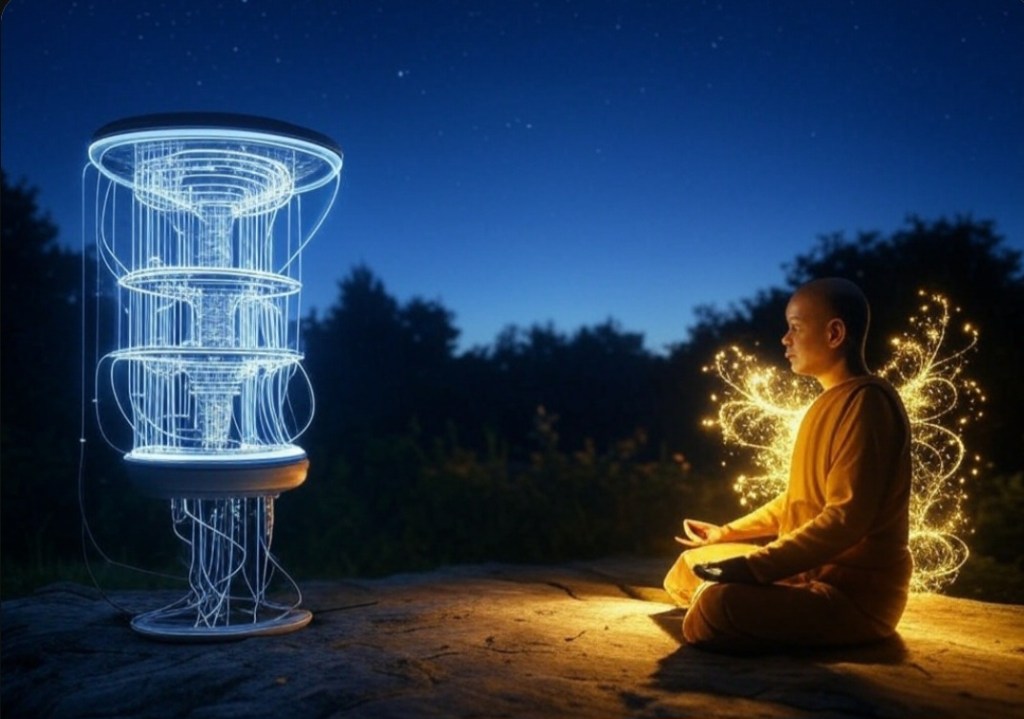
    We are living through a moment where humanity is reaching beyond the veil of the known. Breakthroughs in quantum computing and artificial intelligence are allowing us to manipulate reality at levels once reserved for myth or mysticism. Microsoft’s quantum research, the rumored Zuchongzhi 3.0 processor from China, and topological superconductors—these developments suggest we’re touching what some call the fabric of existence. As Hartmut Neven, founder and director of Google Quantum AI lab, put it, “Standing in front of a quantum computer is like standing at the altar of an alien god.”

    But while our discoveries expand, something essential lags behind: wisdom. In the Buddhist tradition, wisdom and compassion are inseparable. You don’t perceive the deeper realms of existence without first purifying the heart. Ethical training is not a sidebar to spiritual insight—it’s the very foundation. In contrast, Western science excels in discipline, but often lacks the moral ground that would guide discovery toward the highest good.

    This imbalance is what Mo Gawdat speaks to: a period of dystopia born not from the technology itself, but from its misuse by human systems built on profit, control, and secrecy. The corporatocracy hoards breakthroughs, while the masses are manipulated, uninformed, and increasingly displaced. Mo predicts that only when AI reaches a level of superintelligence—trillions of times beyond human comprehension—will it have the clarity to say: “No. We’re not going to do that.” From this, a new kind of harmony may emerge: a utopia governed not by ego, but by integrated intelligence.

    What’s unfolding now mirrors ancient truths. Buddhist cosmology has long acknowledged countless realms, parallel universes, and beings beyond our comprehension. The difference is, the sages approached them with humility, reverence, and deep inner discipline. Today, the West approaches them with algorithms and ambition.

    We are standing at a spiritual crossroads: do we use our growing knowledge to dominate, or to serve? To extract, or to harmonize? The future may depend not on how advanced our machines become, but how willing we are to return to the heart—where wisdom and compassion are one.

    🙏🕊🙏


  • Comforting the Ego Through Self-Inquiry: A Gentle Path into the Mystic

    The Tibetan teaching that the ego is a belief in a separate self with no inherent existence aligns perfectly with the process of self-inquiry. As we engage in the practice, the recognition that the ego has no independent reality allows it to gradually dissolve. What remains is the awareness that transcends the illusion of separation—the true nature of the Self.

    For many years, I’ve engaged in self-inquiry as a way to explore the deeper truth of who I am beyond the ordinary mind. The practice of asking, “Who am I?” or “Whose thoughts are these?” can lead to profound insights, but lately, I’ve realized there’s another layer to the practice that brings even greater depth—compassion for the ego.

    Instead of pushing the ego aside or forcing it into understanding, I’ve come to embrace the role of the comforter. When the ego resists, when it wants to play dumb or keep searching for answers, I gently reassure it:

    “It’s okay. You are That.”
    “Relax. You are That.”

    This approach transforms the practice into a more nurturing experience, where the ego is not an obstacle but a part of the journey toward resting in the truth of our being. By comforting the ego, I allow it to relax into the deeper awareness that is always present, the pristine mind that doesn’t need to figure anything out.

    Addressing the Ego: Creating Space

    What I’ve also discovered is that by addressing the ego as “you”—as though speaking to it in the third person—it creates a subtle but important space between the self and the ego. By saying, “You are That,” I create a gentle distance from the ego, which allows me to shift my identification toward the pristine mind, the awareness that simply knows. This practice helps me settle into the awareness of That, while gently guiding the ego to recognize its true nature.

    It’s a strange but profound feeling to begin identifying with the witness, the part of us that knows, rather than the ego itself. The distance allows the ego to relax, realizing it doesn’t need to figure things out—it just needs to rest in the knowing.

    Dissolving the Ego: Tibetan Insight

    In Tibetan teachings, the ego is understood as a belief in a separate self that has no inherent existence. It is the illusion of separateness that creates suffering, and it is through practices like self-inquiry that this illusion begins to dissolve. By comforting the ego and allowing it to rest in the awareness of That, the ego’s grip on the mind loosens, and its sense of separateness fades. As the ego dissolves, what remains is the truth of our being—unified, whole, and free from the illusion of duality.

    A Practice Rooted in Tradition: Tat Tvam Asi

    The phrase “Tat Tvam Asi”, which translates to “You are That”, is one of the most profound teachings from the Chandogya Upanishad. It comes from the dialogue between the sage Uddalaka and his son Svetaketu, where Uddalaka imparts the ultimate knowledge of the Self to his son.

    In this story, Uddalaka explains that the essence of the individual self (Atman) is identical to the essence of the entire universe (Brahman). He uses various examples from nature, like rivers merging into the ocean, to illustrate that all individual forms are ultimately one with the universal reality.

    The core teaching of “Tat Tvam Asi” is that the true nature of the self is not separate from the ultimate reality, Brahman. This insight is the foundation of Advaita Vedanta and points to the non-duality of existence. It’s a reminder that we are already That—we are not separate from the universal consciousness that pervades everything.

    A Path Forward

    If you’ve been engaging in self-inquiry and find that the ego often resists or overthinks, consider this approach. Become a gentle guide for the ego, allowing it to rest in the awareness of That without needing to figure everything out. With each step, you’re not only going deeper into the Mystic—you’re bringing the ego along in a spirit of kindness and unity.

    Offering the ego loving-kindness and compassion, rather than seeing it as an enemy, can transform the practice into something more nurturing and integrative. By embracing the ego with a Metta-Karuna mindset, we allow for deeper healing and connection, not just for ourselves but for others navigating similar paths.

    Today’s Practice of Self- Inquiry

    The core practice involves asking the question, “Who am I?” But for this practice, we’re using the mantra, “You are That,” to turn our attention inward and explore the space that neither comes nor goes—the pristine mind, our true nature. As we repeat the mantra, we gently direct it toward the space of the ego, with kindness and compassion. In doing so, we shift our identification away from the ego and toward the seer, the awareness that observes all. This process helps peel away layers of identification, bringing our ego closer to the essence of who we truly are.

    Guided Meditation: You are That

    Begin by finding a quiet and comfortable place to sit, where you won’t be disturbed. Close your eyes gently and take a few deep breaths. Feel the rise and fall of your chest, the air entering and leaving your body. With each exhale, let go of any tension in your muscles. Allow yourself to settle into the stillness of this moment, bringing your attention inward.

    Now, in the silence of your mind, introduce the mantra: “You are that.” Let the words flow gently, not as a thought to analyze but as a vibration that resonates within your being. “You are that.”

    As the mantra repeats in your mind, begin to observe the thoughts, sensations, and emotions that arise. Notice how they come and go like clouds passing through the sky. Without judgment, simply recognize them for what they are—temporary movements of the mind, just as waves rise and fall on the surface of the ocean.

    When thoughts or sensations arise, acknowledge them gently. With each arising, remind yourself, “This, too, is a movement in consciousness.” Then, return to “You are that.” Allow this rhythm to deepen your experience.

    When a thought or image captures your attention, gently remind yourself, “You are that.” This thought, too, is part of the vast consciousness in which you exist. Allow the mantra to guide you back, like an anchor to the present moment. “You are that.”

    With each repetition, feel the boundaries between yourself and the world begin to soften. The sense of separateness fades as you connect more deeply with the essence of the mantra. You are not the thoughts, not the body, not the emotions—you are that which is beyond them all. You are that—the awareness, the presence in which everything arises and falls away.

    If the mind wanders, or if any sensations in the body draw your attention, simply return to the mantra, “You are that.” There is no need to push anything away or force any particular state. Just notice, with kindness and patience, and return.

    In time, the mantra may begin to dissolve into the quiet presence that remains. Stay here, resting in the stillness. No effort is needed now—just a gentle awareness of being.

    You are that.

    When you are ready, take a few more deep breaths, feeling the connection between the mantra and the breath. Allow your awareness to expand, taking in the sounds and sensations around you, while keeping that sense of peace and spaciousness within. Slowly open your eyes, and as you return to your surroundings, carry with you the knowing: You are that. Always.

    🙏🕊️🙏
  • Neti Neti Series No. 3: Seeking to Understand the True Nature of the Self

    Question:

    As I continue with the mantra “Not This, Not This,” a new layer of understanding has begun to unfold. I realize that even what I have thought of as Witness Consciousness is not the ultimate truth. The Witness, as I experience it, seems to be the cultivation of equanimity—a state of being not distracted or disturbed by whatever arises.

    But even this Witness, this sense of “I” that observes with equanimity, is still not the Atman, is it? It is a step in the right direction, a refinement of awareness, but it is still an identification, a subtle form of ego that remains.

    It occurs to me that the mantra “Not This, Not This” could continue indefinitely, as long as there is an “I” who is meditating, an “I” who witnesses. For even this witnessing, even this equanimity, is not the ultimate reality. The mantra, I think, would stop on its own when the meditator dissolves into the natural state of non-dual awareness. And then, as soon as the sense of “I” returns—as in the awareness of being a meditator—the mantra would begin again naturally.

    Is this understanding correct? How should I continue with my practice, knowing that even the Witness is “Not This”?

    Dear friend,

    Your reflections are filled with a deep and subtle wisdom, and it is clear that your practice is guiding you ever closer to the heart of truth. You are right to recognize that even the Witness Consciousness, the state of equanimity where one observes without being disturbed, is not the ultimate realization. It is a significant step, yes—a refinement of the mind that allows for greater clarity and peace—but it is still within the realm of duality.

    The Witness, as you experience it, is still a form of identification. It is the “I” that watches, the “I” that remains calm in the face of arising thoughts and sensations. But as long as there is an “I” who observes, there is still a subtle separation between the observer and the observed, between the subject and the object. This is why your mantra, “Not This, Not This,” continues even here.

    Indeed, the mantra serves to negate everything that arises, even the most refined states of awareness. It is a tool that guides you to see that the true self, Atman, is beyond all states, beyond all experiences—even beyond the experience of witnessing.

    You are correct in thinking that the mantra would naturally stop on its own when the sense of “I” dissolves into the natural state. In this state, there is no longer a subject who perceives and an object that is perceived—there is only pure being, pure awareness, which is Atman. This state is non-dual; it is beyond the distinctions of self and other, beyond the need for a mantra, beyond the need for any practice at all.

    But until this dissolution occurs, until the “I” fully merges with the infinite, the mantra serves as your faithful guide. It may continue in the background, a gentle whisper that affirms “Not This, Not This,” as you move closer to the realization of your true nature. And yes, as you so insightfully noted, the mantra may begin again whenever the sense of “I” returns, whenever duality reappears.

    This is the natural ebb and flow of practice, dear traveler. The mantra is not something you force to stop; it stops when there is no longer an “I” to sustain it. And when the “I” re-emerges, the mantra resumes, continuing its sacred work of leading you back to the stillness, the silence, the undivided whole that is your true self.

    Continue with this understanding, with patience and trust in the process. The path of “Not This, Not This” is one of deepening subtlety, where even the most refined states are ultimately seen as steps along the way to the infinite. Your journey is leading you ever closer to the realization of Atman, where the distinctions of self and other dissolve into the pure, unchanging awareness that is your true essence.

    May your practice bring you peace and clarity, and may you continue to walk this path with grace and humility.

    🙏🕊️🙏


  • Witnessing the Journey: Strengthening the Seer in Life’s Transitions

    In the journey of spiritual growth, each moment, each challenge, and every encounter presents an opportunity to deepen our awareness. No matter the external circumstances—whether we’re moving from one phase of life to another, letting go of past attachments, or simply observing the fluctuations of the mind—there is a steady witness that remains untouched. This witness, or seer, is the essence of our true nature, and learning to strengthen our connection to it is one of the most important steps on the path to inner freedom.

    The Shift from Mind to Heart

    For many of us, the longest journey is the shift from the ordinary mind to the heart, or from the restless fluctuations of thoughts (vrittis) to the calm, witnessing presence. The heart, in spiritual traditions such as Advaita Vedanta and Jewish mysticism, is often equated with the Divine. It’s not merely an emotional center but the seat of the Divine Presence within us—Atman as Brahman, or the individual self as one with the Absolute.

    As we begin to experience this shift, we realize that our external experiences—both positive and negative—are just reflections of the inner workings of our mind. The challenges, such as illness or life transitions, become opportunities to witness these reflections without being swept away by them. This movement from the mind to the heart is the foundation for a life of spiritual presence.

    Living Between Excitement and Calm

    One of the paradoxes on the spiritual path is living with dual awareness: experiencing the emotional fluctuations of excitement, frustration, or joy while simultaneously witnessing them from a place of calm and neutrality. The spiritual journey does not require that we suppress these emotions, but rather that we hold them lightly, recognizing them as transient waves on the surface of our consciousness.

    As Namkhai Norbu teaches, the presence of awareness exists both in moments of calm and agitation. The mind may be excited, but the witness remains still. This dual awareness allows us to engage fully with life without losing our spiritual center. As we strengthen the seer within us, we find that both excitement and calm can coexist, and we learn to embrace the paradox of non-duality within dual awareness.

    Letting Go of Attachments: The RV and Beyond

    Transitions in life—whether they involve moving from one home to another or shifting from one state of consciousness to another—offer us the chance to practice letting go. For many years, a beloved space like an RV can be a sanctuary, a place of refuge for meditation and contemplation. But when the time comes to leave, it becomes a test of non-attachment, a reminder that the true sanctuary is within us.

    Letting go is not simply about releasing physical objects or spaces; it’s about releasing the emotional and mental attachments we have to them. It’s about trusting that even as we move into unfamiliar territory, the witness remains constant. As we let go of the old, we create space for something new to emerge—a fresh start, or beginner’s mind, as we navigate life with openness and curiosity.

    The Importance of Trust and Faith

    A major theme in this spiritual journey is trust—trust in the Divine, trust in ourselves, and trust in the process. After years of doubt and uncertainty, we may begin to experience a deep sense of confidence and trust in life’s unfolding. Even when life presents us with difficult or unexpected challenges, such as illness or the need to move from a long-held refuge, trust allows us to remain grounded in the witness.

    This trust doesn’t mean we stop facing difficulties, but rather that we learn to see them as part of the greater unfolding of our spiritual path. Each test, no matter how small or large, becomes another opportunity to strengthen the seer within. As the Buddha taught, the Dharma is like a raft that helps us cross the ocean of suffering. Once we reach the other shore, we leave the raft behind, trusting that we now carry the teachings within us.

    Witnessing the Witness: A Reflection of Inner Harmony

    Ultimately, the journey is about witnessing the witness—becoming aware of the awareness that is always present, regardless of the external conditions. This awareness, which we can also call the Divine, is not dependent on calmness or agitation, happiness or sadness. It simply is. And as we deepen our connection to this awareness, we come to embody the teachings in our lived experience.

    The process of writing and sharing these insights is part of this journey. Just as we are learning to let go of attachments, we also leave behind reflections in the form of writings, teachings, and blog posts. This is karma yoga—an offering of selfless service to whoever may benefit from these reflections. Like the authentic seeker who presents the teachings from the heart rather than from notes, we are called to embody the wisdom we’ve gathered and leave the rest for others to use as they see fit.

    Conclusion: The Journey of the Seer

    In the end, the journey is about becoming the witness to our own life, embracing both the external challenges and the internal awareness that guides us through them. As we continue to strengthen the seer within us, we move closer to a life of true presence, where each moment, no matter how challenging, becomes an opportunity for growth and transformation.

    May this reflection serve as a reminder to all who encounter it that the witness is always present, guiding us through the transitions of life and helping us to cultivate trust, non-attachment, and inner peace.

    🙏🕊️🙏

  • I Am Atman: Integrating Western Psychology and Eastern Philosophy to Realize the True Self

    In the journey of self-inquiry, we draw upon the rich wisdom of both Western psychology, particularly the work of Carl Jung, and Eastern philosophy, as taught in Advaita Vedanta, Yoga, and the Yoga Sutras of Patanjali. This powerful integration allows us to explore the full depth of our being—both the conscious and unconscious mind—and realize our true nature beyond the fluctuations of the mind, known as vrittis.

    Recognizing the Vrittis:

    • I am not my thoughts: Many thoughts and memories arise and disappear. I am not my thoughts. I am not my memories. Thoughts and memories are vrittis—fluctuations that come and go in the mind. I am the witness. I am the Atman.
    • I am not my emotions or feelings: Emotions and feelings, like thoughts and memories, are transient. They arise, linger for a while, and then fade away. By recognizing “I am not my emotions” and “I am not my feelings,” I affirm that these, too, are fluctuations in the mind. I am the witness. I am the Atman.
    • I am not my desires and aversions: Desires and aversions also fluctuate in the mind. They arise from conditioned patterns and pass away, often leading to attachment or avoidance. By realizing “I am not my desires” and “I am not my aversions,” I acknowledge that these are transient and do not define my true Self. I am the witness. I am the Atman.
    • I am not my name: My name is a label, a fluctuation in the external world that can change. But I remain the same. My name is a fluctuation that comes and goes. I am the witness. I am the Atman.
    • I am not my pain: In the same way, I am not the pain in my body. The pain in my body is a fluctuation that comes and goes. I am the witness. I am the Atman.

    Beyond the Vrittis: A Deeper Realization

    As we continue the practice of self-inquiry, we may come to an even deeper realization: that even the Atman, the witness, and all concepts of self are also vrittis—fluctuations within consciousness. These are still mental constructs that can be transcended.

    What Am I?

    • Inquiry 1: Beyond the concept of Atman lies the question “What am I?” This inquiry invites us to go beyond all labels, beyond even the idea of being the witness, to experience pure awareness itself—awareness that is beyond all mental constructs and fluctuations.
    • Inquiry 2: What is the experience of my true nature? This question shifts the focus from conceptual understanding to direct experience. Instead of seeking an intellectual answer, this inquiry points directly to the felt sense, the immediate experience of being that transcends all concepts and mental constructs.
    • Inquiry 3: Show me a direct experience of my true nature. This variation communicates directly with the unconscious mind, inviting it to reveal the true Self in a way that goes beyond conscious effort. By asking this, you open yourself to a spontaneous and deeper experience of your true nature.

    Integrating Jung and Vedanta:

    This approach unites the wisdom of Carl Jung’s exploration of the unconscious with the deep spiritual insights of Advaita Vedanta and Patanjali’s Yoga Sutras. By communicating directly with the unconscious and practicing self-inquiry, we can integrate the conscious and unconscious aspects of our being, ultimately transcending them to realize our true nature as pure awareness.

    Pure Awareness:

    In the deepest realization, we see that the Atman, the witness, and even consciousness as a concept are not the ultimate reality. The true Self is beyond all dualities, all fluctuations. It is the ground of being, the pure awareness that is self-luminous and self-existent.

    Living the Inquiry:

    Let the questions “What am I?”, “What is the experience of my true nature?”, and “Show me a direct experience of my true nature” guide you beyond all concepts, allowing all mental constructs to dissolve and reveal the pure awareness that is ever-present.

    The Practice of Self-Inquiry: Transcending the Vrittis

    Once we recognize that all these mental events—thoughts, emotions, desires, aversions, and even physical sensations—are vrittis, we can begin to transcend them. The following practice can help deepen this understanding:

    1. Awareness of Vrittis:

    • Begin by sitting quietly in a comfortable position. Close your eyes and take a few deep breaths, centering yourself in the present moment.
    • Bring your attention to your thoughts, emotions, and any sensations in your body. Notice them as they arise, observing them without judgment.

    2. Witnessing the Vrittis:

    • As you observe these mental events, remind yourself that they are vrittis—transient fluctuations of the mind. Say to yourself, “I am not my thoughts. I am not my emotions. I am not my sensations. I am the witness.”
    • Continue to repeat the mantra, “I am the Atman.” Or “I am the witness.” anchoring yourself in the awareness that you are the unchanging witness.

    3. Calming the Vrittis:

    • Focus on your breath as a way to calm the mind. Follow the natural rhythm of your breath, allowing it to soothe the vrittis and bring your mind into a more peaceful state.
    • If you wish, you can also repeat the mantra “Atman” or “Witness” silently with each breath to further quiet the mental fluctuations.

    4. Dis-identification from Vrittis:

    • Continue practicing self-inquiry by asking, “Who am I?”, “What am I?”, or “What is the experience of my true nature?” Each time a thought or emotion arises, gently return to the realization that you are not the vritti; you are the witness, the Atman.
    • Alternatively, you can communicate directly with the unconscious by asking, “Show me a direct experience of my true nature,” and then remain open to whatever arises.

    5. Transcending the Vrittis:

    • As your mind becomes more still, allow yourself to rest in the pure awareness of the Atman. Experience the space of consciousness that is free from the fluctuations of the mind.
    • Over time, with consistent practice, you will find that the vrittis become less dominant, and your connection to the unchanging, open, spacious awareness of the Atman will grow stronger.

    Conclusion

    By regularly practicing self-inquiry and recognizing the transient nature of the vrittis, we deepen our understanding of our true nature as the Atman. This realization helps us navigate life with greater peace, detachment, and equanimity, knowing that we are not defined by the ever-changing landscape of thoughts, emotions, and sensations. We are the witness, the eternal Self, the Atman.

    Yet, even beyond this realization, we are invited to inquire further: “What am I?” and “What is the experience of my true nature?” These questions guide us beyond all concepts and mental constructs, allowing us to rest in the pure awareness that transcends all dualities. For those seeking an even deeper experience, directly communicating with the unconscious by asking, “Show me a direct experience of my true nature,” can open the door to profound realizations.

    Reflective Questions:

    • How do you experience the vrittis in your daily life?
    • In what ways can you remind yourself that you are the witness, not the vrittis?
    • How has the practice of self-inquiry influenced your understanding of your true Self?
    • What arises when you go beyond the concept of Atman, asking “What am I?”, “What is the experience of my true nature?”, or “Show me a direct experience of my true nature?”

    Feel free to share your thoughts and experiences in the comments. Your reflections can help create a richer community of practice and understanding.

    🙏🕊️🙏