Tag: unity in diversity

  • Interfaith Harmony: Ganesha, the Universal Remover of Obstacles

    There is an ancient story, older than memory, that speaks of a gentle presence who stands at the threshold of each journey. He is called Ganesha, the remover of obstacles. In Hindu tradition, he is worshipped as a friend and guardian of beginnings, an embodiment of wisdom and gentle strength. His form is unmistakable—an elephant head, eyes deep with understanding, a body both round and rooted, as though he holds the world’s burdens yet is unburdened himself.

    But look closely, and you’ll see that Ganesha belongs not only to Hinduism, nor merely to any single path. Ganesha, in his role, belongs to all of us, for who has not felt the weight of obstacles pressing upon them? His is a universal invitation, an ancient whisper, to release our inner blocks, to allow wisdom, compassion, and clarity to dissolve the clouds that obscure our view of the divine.

    We often imagine that the obstacles are out there in the world, hidden in life’s hardships or circumstances. But in invoking Ganesha, we are drawn to the deeper realization that these barriers are inward. They are the veils of attachment, fear, confusion, the stubborn illusions of ego. Ganesha, then, is not merely a god of external beginnings, but of spiritual awakening—the remover of all that would obscure our own path to knowing God.

    In this light, Ganesha’s role is universal. His invocation is not unlike the quiet prayer of a Christian asking for guidance, or a Sufi’s yearning for the grace to surrender. To honor Ganesha as an interfaith presence is to understand that all traditions hold this longing for clarity, for wisdom, for the freedom that arises when the spirit is unbound.

    Each tradition has its own language, its own stories, but the heart of each is the same—a call to remove the obstacles that block us from truth. In this spirit, may we see Ganesha as more than a Hindu deity; may we see him as a shared symbol of our journey toward the divine. For in removing these obstacles, we are made ready to experience the peace, the stillness, the God that lives in all.

    🙏🕊️🙏

  • Embracing Interfaith Harmony: Reflections on the Heart of the Caravan of Love

    Embracing Interfaith Harmony: Reflections on the Heart of the Caravan of Love

    A personal journey into unity, inclusivity, and honoring diverse spiritual paths through the universal language of love.

    There’s something I’ve sensed as we weave together this Caravan of Love, and it’s a feeling that sits quietly, waiting to be understood. In this blog, we’re exploring a universal language—a way of speaking about the divine that doesn’t belong to any one path, a way of honoring the sacred symbols that span traditions. I realize that for some, especially those who hold their own faith close, this openness may feel unfamiliar, even uncomfortable. When we speak of Ganesha alongside Christ, or of interfaith harmony, I know that for some, this will seem strange, perhaps even unsettling.

    And yet, I hold close the belief that there are those who are ready to see these connections, those who are ready to explore something beyond the boundaries of tradition, who carry within them a spark of curiosity or a gentleness that longs to know how faiths can harmonize rather than divide. For these souls, this blog may become a place of profound resonance, a place where the longing for unity finds a quiet refuge.

    I trust that those with an inner readiness, who feel a pull toward something larger than themselves, will find their way here. They may come with only a question, or with the smallest openness, yet this might be the beginning of something new—a way of seeing that holds all paths within it, that views the divine as limitless. For these readers, I hope this Caravan of Love becomes a place of invitation, a gentle call to see that each path has its own beauty, its own truth, and that unity lies in honoring them all.

    In the end, it is my hope that this space will serve as a quiet expansion of vision, a way of seeing that softens boundaries and deepens love. For those who are willing, this journey may become a gentle widening, a place where faith meets faith, and love, in its simplicity, speaks to the heart of all who come.

    🙏🕊️🙏

  • Inner Landscapes: Reflections on Love and Faith

    Inner Landscapes: Reflections on Love and Faith

    Exploring the journey of unity, interfaith harmony, and the vision behind the Caravan of Love.

    There’s something I’ve been reflecting on lately as this Caravan of Love blog takes shape. The universal message of interfaith harmony—seeing the divine expressed across traditions and respecting each path as a piece of the whole—feels so clear, so necessary. But I can also see how this inclusive message, and the symbols and figures we’re working with, might be a little overwhelming or even off-putting to some who come from more conservative Christian backgrounds. It’s a thought that stays with me, this possibility that some readers, instead of opening their eyes, might just turn away.

    And yet, perhaps this is simply part of the journey. I know that the ones who are drawn to the message of unity and openness, who have a quiet curiosity or feel a stirring to explore more universal connections, will find their way here. This work isn’t about convincing or converting; it’s about creating a gentle space where people of all paths—or people just beginning to look for paths—can discover something that resonates. Those who have “eyes to see and ears to hear” may find themselves drawn to this blog, and that, I believe, is enough.

    So I wonder if perhaps a Personal Reflections space here would give me room to share these thoughts more openly—to talk about why I feel this work is so needed, how each post or image we create carries this vision of unity, and even the balancing act of trying to reach those who might initially feel uncomfortable. Sometimes, I think sharing these kinds of reflections makes the journey more real, and it creates a bridge. This could be a place for honesty, for invitation, for dialogue, and maybe even for discovery. In this Caravan of Love, there is room for every thought, question, and insight, and I’d love to bring readers along on this journey, to let them see the heart of this work as it unfolds.

    🙏🕊️🙏

  • Bob Marley: A Christian Mystic in the Rastafarian Tradition

    Bob Marley: A Christian Mystic in the Rastafarian Tradition

    When we think of Christian mystics, names like St. John of the Cross, Teresa of Avila, and Thomas Merton often come to mind. These individuals, through their writings and lives, embodied a deep and profound connection with the divine, often expressed through personal, mystical experiences of God. However, the notion of Christian mysticism is broader than traditional Catholic or Protestant expressions—it reaches into diverse traditions where Christ’s teachings and spiritual wisdom are central.

    One such figure, who might not immediately be considered a “Christian mystic” in the conventional sense but certainly embodies the spirit of one, is Bob Marley. Known globally as a reggae legend, Marley’s spiritual identity is deeply rooted in the Rastafarian tradition, which, while distinct, is also firmly anchored in Christian theology.

    Rastafarianism: A Spiritual Path with Christian Roots

    Rastafarianism, often simply referred to as Rasta, is a spiritual and social movement that emerged in Jamaica in the 1930s. It was born out of a synthesis of Christian beliefs, African traditions, and a profound sense of connection to the Bible, particularly the Old Testament. Central to Rasta belief is the recognition of Haile Selassie I, the former Emperor of Ethiopia, as the returned messiah and the living God—a figure often equated with the second coming of Christ.

    Bob Marley, as one of the most famous adherents of Rastafarianism, infused his music with these beliefs, blending messages of liberation, love, and faith. His songs are filled with references to biblical themes, the teachings of Christ, and the pursuit of a deeper, more authentic connection with God.

    Bob Marley as a Christian Mystic

    So, why consider Bob Marley a Christian mystic? Mysticism is fundamentally about experiencing the divine in a personal and transformative way. It’s about encountering God not just through doctrine, but through the heart, soul, and life’s journey. Marley’s music and life were testaments to this kind of mystical experience.

    In songs like “Redemption Song” and “One Love,” Marley channels a message of unity, divine love, and spiritual freedom—core tenets of Christian mysticism. His lyrics often speak to a universal spirituality, grounded in the Christian narrative but transcending religious boundaries. He was a prophet in his own right, using music to communicate a vision of God’s kingdom that was inclusive, just, and deeply rooted in love.

    Moreover, Marley’s commitment to living out his spiritual convictions—despite significant challenges and opposition—echoes the path of many Christian mystics who sought to embody their beliefs in every aspect of their lives. His was a spirituality that called for both inner transformation and societal change, a hallmark of true mystical insight.

    The Intersection of Traditions

    While Bob Marley is most often associated with Rastafarianism, placing him within the broader category of Christian mystics allows us to see the rich tapestry of his spiritual journey. It acknowledges that Christian mysticism isn’t confined to one tradition but is a universal experience of the divine that can manifest in many forms.

    For now, Bob Marley can comfortably reside in the Christian mystics category, not as a way of limiting his spiritual legacy, but as a way of recognizing the Christian foundation upon which much of his mysticism was built. In time, as we explore more of his teachings and their roots in the Rasta tradition, a separate category might emerge to honor the unique aspects of Rastafarian spirituality. However, his inclusion in the Christian mystic category speaks to the fluid and expansive nature of spiritual experience, one that transcends labels and denominations.

    Conclusion

    Bob Marley’s legacy as a musician is undeniable, but his role as a spiritual figure—one who bridges the gap between Rastafarianism and Christian mysticism—is equally profound. By considering Marley within the context of Christian mysticism, we can appreciate the depth of his spiritual insights and the ways in which his life and music continue to inspire a deep, mystical connection with the divine.

    In acknowledging Bob Marley as a Christian mystic, we not only honor his contribution to music and culture but also recognize the universal truth that mysticism is a path open to all who seek a direct, transformative relationship with God—regardless of the tradition they follow.

    🙏🕊️🙏

  • The Medicine of the Mantra: A Bedtime Story of Chenrezig and OM MANI PADME HUM

    The Medicine of the Mantra: A Bedtime Story of Chenrezig and OM MANI PADME HUM


    Chenrezig shares the story of OM MANI PADME HUM with children, guiding them to uncover their inner compassion and wisdom. A perfect bedtime story filled with peace, warmth, and unity.


    Long ago, in a beautiful land where the mountains touched the sky and rivers flowed like silver ribbons, there lived a wise and compassionate teacher named Chenrezig. He had a twinkle in his eye, as if he knew a great secret, and his heart was so full of love that just being near him made people feel lighter. But Chenrezig knew that many beings in the world carried an invisible burden—an illness of the mind, one that made them forget who they truly were.

    This illness, Chenrezig explained, was a kind of forgetting. “We have all mistaken ourselves for something we are not,” he said gently. “Like a dreamer who believes the dream is real, we have forgotten our true nature—the vast, boundless love and wisdom that live in our hearts. Instead, we believe we are small and separate, like waves forgetting they belong to the ocean.”

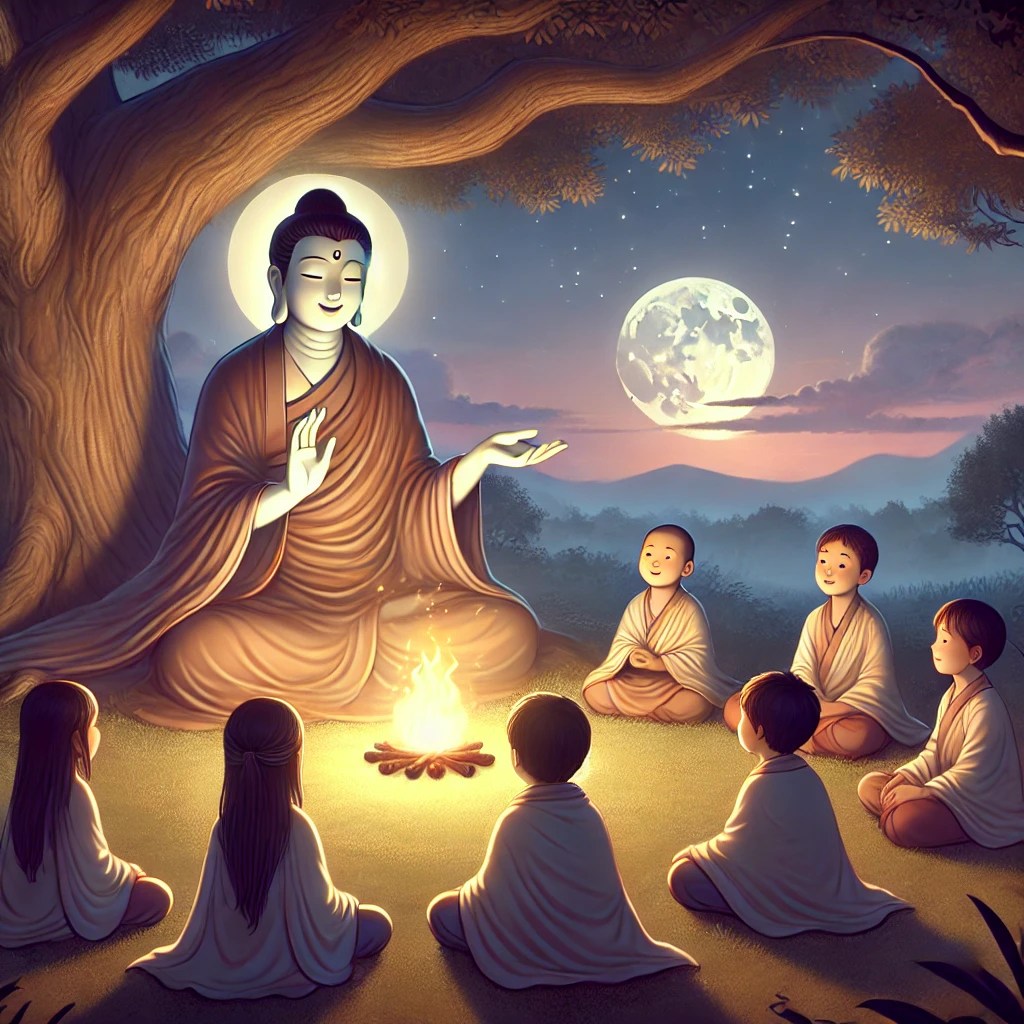
    Chenrezig often told stories to children, knowing that their hearts could understand what adults often forgot. One evening, as the stars glimmered softly above, Chenrezig gathered a group of children around a fire. They looked up at him with curious eyes, waiting for one of his famous stories.

    “Tonight,” Chenrezig said, “I will tell you a story about a great medicine—a medicine for the heart and mind. It is the mantra OM MANI PADME HUM. This mantra is like the most powerful medicine a doctor could ever give, one that can heal the illness of separation and help us remember our true nature.”

    He paused, watching the children lean in closer, eager to hear more. “But first,” he continued, “you need to understand something important. Imagine that you are wearing many layers of clothing—so many layers that you forget what you look like underneath. Each layer is like a thought or feeling you tell yourself: I’m not good enough. I need to be better.

    These layers are like cobwebs in the mind, making it hard to see clearly. And because we believe in these stories, we feel small and alone, like a candle separated from the flame. But the truth is, we are not the stories we tell ourselves. Beneath all the layers, beneath all the cobwebs, we are already whole, already perfect—just like a lotus flower, waiting to bloom.”

    The children sat very still, imagining themselves wrapped in layers of thoughts, feelings, and stories. “How do we take off the layers?” one of them whispered.

    Chenrezig smiled. “That is where the mantra comes in,” he said softly. “OM MANI PADME HUM is the medicine that clears away the layers, like a soft breeze sweeping away cobwebs. Each time you say the mantra, you peel back another layer. OM MANI PADME HUM… and the layers fall away. OM MANI PADME HUM… and your heart shines a little brighter. OM MANI PADME HUM… and with each breath, you get closer to your true self—your Buddha nature, the part of you that is pure love and compassion.

    He began to explain the meaning of the mantra, his voice gentle and full of care. “The first syllable, OM, is the sound of the universe waking up. It reminds us that we are connected to everything—to the stars, the rivers, the animals, and each other. OM is the sound of coming home to our true nature.”

    The children closed their eyes, listening to the sound of OM as if it were rising from the earth, the sky, and their own hearts all at once.

    “The next two words,” Chenrezig continued, “are Mani Padme—the jewel in the lotus. This means that inside each of us is a precious jewel—the light of wisdom and love. But just like a lotus flower that grows in muddy water, this jewel can be hidden by layers of thoughts and beliefs. Each time we chant Mani Padme, we open the lotus a little more, revealing the jewel inside.”

    The children imagined a lotus flower blooming in their hearts, each petal unfolding slowly, with a bright jewel glowing at its center.

    “And finally,” Chenrezig said, “we have Hum. This is the sound of unity—the sound that brings everything together. It is the moment when we remember that we were never separate, not from others, not from love, and not from our true nature. Hum is the sound of the Buddha mind awakening within you, shining with pure compassion.”

    The children whispered the mantra softly: OM MANI PADME HUM… OM MANI PADME HUM… Each repetition felt like a breeze clearing away the cobwebs in their minds, helping them feel lighter and brighter.

    “Now,” Chenrezig continued, “let me tell you one more secret. The mantra doesn’t just help you remember who you are—it helps others too. Every time you chant OM MANI PADME HUM, you are planting seeds of compassion, not just in your own heart, but in the hearts of all beings. These seeds will bloom in ways you may never see, bringing kindness and peace into the world.”

    He placed a hand over his heart. “It’s like sharing a gift that never runs out. Each time you say the mantra, you are offering love to the whole universe.”

    The children sat quietly for a moment, feeling the beauty of the mantra settling into their hearts, like a gentle rain nourishing the earth. “So the mantra is like a magic medicine?” one child asked softly.

    Chenrezig smiled. “Yes,” he said. “It is a medicine for the heart, a way of peeling back the layers until only love and wisdom remain. It helps us remember that we are not small or separate—we are like the ocean, vast and full of life. And each time we chant the mantra, we bring a little more light into the world.”

    As the fire crackled softly, casting warm orange light on their faces, Chenrezig leaned closer to the children. “Now, as you drift off to sleep tonight, you can let the mantra carry you, like a boat floating gently down a river. Whisper it in your heart: OM MANI PADME HUM… OM MANI PADME HUM… Let it peel back the layers of your mind, revealing the jewel of compassion that has always been there.”


    He kissed each child on the forehead and offered a final blessing:

    OM MANI PADME HUM . . .

    With each breath, may you awaken to your true nature.

    With each dream, may your heart bloom in kindness.

    May all beings remember their light, and may the world be filled with peace.

    The mantra hummed softly in their hearts: OM MANI PADME HUM, OM MANI PADME HUM… clearing away the cobwebs, layer by layer, revealing the truth that they were never separate, but always part of the great ocean of love.

    May your hearts always shine with the light of compassion, and may OM MANI PADME HUM guide you, now and always. Sleep well, children. The jewel in the lotus is already blooming within you.

    As the children drifted into a peaceful sleep, the mantra whispered in their hearts… OM MANI PADME HUM… until their dreams were filled with rivers of kindness, endless skies of compassion, and the light of love.

    Goodnight, little one. ❤️

    🙏🕊️🙏


    If you’d like to explore more bedtime stories for children, including tales that nurture compassion and mindfulness, you can find our collection here.


  • A Prayer for Our Nation

    Dear friends,

    I invite you to join me in reflecting on our collective journey, our nation’s unity, and the road ahead. Below is a message from the heart—a prayer and a call for us to rediscover our shared values and embrace the divine plan unfolding among us. May this message inspire us all to come together in love and purpose.

    Almighty Creator,

    We humbly ask for Your grace and mercy upon this nation. Guide our leaders with wisdom and integrity, helping them pursue justice, kindness, and unity. Grant us, the people, clarity of heart to rise above division and find common ground in love.

    Inspire us to care for the most vulnerable among us, embodying compassion in every word and deed. Lead us not into cynicism or despair but into hope and renewal, trusting in Your divine plan.

    Strengthen our collective will to pursue what is good and right, and may we come together as one, under Your guiding hand.

    Amen.

    A Nation’s Heartbeat: A Poem of Renewal

    We stand at a crossroad, heart heavy with care,
    The winds of division seem too much to bear.
    But deep in our hearts, a light still does shine,
    Guiding us back to a love most divine.

    The voices of history whisper once more,
    Reminding us what we are truly here for.
    To rise from the shadows and walk hand in hand,
    To build up the dream, restore this dear land.

    O brothers and sisters, now is the time,
    To cast off the hatred and leave it behind.
    May kindness prevail and mercy abound,
    And peace be the song in which we are found.

    A Nation’s Heartbeat: A Call for Unity and Renewal

    In times of division and uncertainty, it becomes essential to pause and remember the dream that has guided our nation—a dream woven from the fabric of freedom, justice, and unity. This dream, born from the courageous visions of the Founding Fathers, called us not only to independence but to mutual responsibility. Today, we are invited to listen again to that sacred calling. It is not just about politics but about something much deeper—our collective soul.

    As we navigate these uncertain times, it is more important than ever to remember that we each carry the power to contribute to the healing of our collective soul. Every act of kindness, no matter how small, helps rebuild the spirit of unity that is at the heart of our nation. Let us walk with courage and hope, knowing that every step toward understanding strengthens the foundation of the American dream. Together, we can foster a future rooted in love, justice, and shared responsibility.

    May all who read these words be blessed with the peace that surpasses understanding, and may our nation walk forward with grace, strength, and unity, hand in hand.

    🙏🕊️🙏

  • Ramayana No. 12: Caravan of Love: The Evolution of Divine Worship and the Universal Teachings of Compassion

    In the spiritual journey of humanity, there has always been a deep yearning to connect with the divine. This connection has evolved across cultures and religions, shaping how people perceive and relate to the sacred. Two profound examples of this evolution can be found in Hinduism and Christianity, where the abstract, formless concept of the divine transformed into more personal, relatable forms.

    From the Formless to the Personal Divine

    In the early traditions of Judaism, the divine was perceived as Ein Sof—the infinite, boundless, and unknowable aspect of God. This understanding was so sacred that God’s name was considered unpronounceable, representing the divine’s absolute transcendence. The Jewish tradition emphasized a God beyond form and comprehension, which led to a strict prohibition against idolatry.

    Similarly, in the ancient Vedic traditions of India, the divine was seen as Brahman, the ultimate, formless reality that underlies all existence. Brahman was understood as the essence of everything, but its abstract nature made it difficult for people to relate to on a personal level.

    Over time, both traditions saw a shift. In Christianity, this shift occurred with the introduction of Jesus Christ, who represented the divine in human form. Jesus made the infinite more accessible, embodying the love, compassion, and righteousness that God wished to share with humanity. The doctrine of the Trinity—Father, Son, and Holy Spirit—further personalized the divine, allowing followers to connect with God as a loving parent, a guiding spirit, and a compassionate savior.

    In Hinduism, this transformation took shape through the worship of deities like Vishnu, Shiva, and Devi, who are seen as manifestations of Brahman. These deities, along with their avatars such as Rama and Krishna, made the divine more relatable. They embodied virtues that humans could aspire to—righteousness, devotion, and compassion. Through stories and teachings, these deities became accessible guides for those seeking a path to the divine.

    The Universal Teachings of Love and Righteousness

    Despite the differences in form and expression, a common thread runs through these traditions: the teaching of love, compassion, and righteousness. In Christianity, Jesus’s teachings emphasized love for one’s neighbor, forgiveness, and a life lived in service to others. He taught that the greatest commandment is to love God with all one’s heart and to love one’s neighbor as oneself.

    In Hinduism, the teachings of Dharma—righteousness and duty—are central. The lives of the avatars, like Rama, exemplify adherence to Dharma even in the face of great personal sacrifice. The Bhagavad Gita, a cornerstone of Hindu philosophy, teaches the importance of selfless action, devotion, and the pursuit of truth.

    These teachings, though expressed differently, guide followers toward a life of virtue. They remind us that to walk the path of the divine is to live with compassion, to act with righteousness, and to treat all beings with love and respect.

    A Call for Interfaith Harmony

    In a world often divided by differences in belief and practice, these teachings remind us of our shared spiritual heritage. Whether one follows Jesus, Rama, or another path to the divine, the call to love, righteousness, and compassion is universal. These values are the true markers of discipleship, transcending the boundaries of culture and religion.

    The Caravan of Love invites all to reflect on these common values, to see the divine in the hearts of all people, and to strive for a world where love and compassion reign. In the end, the path to the divine—whether walked through Christianity, Hinduism, or any other tradition—is a path of love, a journey toward the light that shines in every heart.

    A Prayer for Universal Peace and Harmony

    O Divine Source of all creation,
    The One who is known by many names,
    And who dwells in every heart,
    We come before you with humble hearts,
    Seeking your blessing of peace and harmony.

    May your love flow through us like a river,
    Washing away all hatred, division, and fear,
    And filling our hearts with compassion for all beings.

    Teach us to see beyond our differences,
    To honor the divine in every person,
    And to live as instruments of your peace in this world.

    May we all walk the path of righteousness,
    Guided by your wisdom and grace,
    So that our actions may bring healing and unity
    To a world that so deeply longs for peace.

    Let all nations and peoples come together,
    In a spirit of understanding and respect,
    Embracing the truth that we are all your children,
    And that in your eyes, we are one family.

    Grant us the courage to forgive,
    The strength to love without condition,
    And the wisdom to seek justice and mercy
    For every living being.

    May your light shine in our hearts,
    And may we carry that light into the world,
    Bringing hope to the weary,
    And peace to all who suffer.

    In your holy name, we pray,
    For goodwill on earth, and peace among all beings.

    Amen.
    Om Shanti Shanti Shanti.
    Salaam.
    Shalom.

    🙏🕊️🙏

  • Understanding Upadhi: How Limiting Adjuncts Create the Illusion of Plurality in a Singular Reality

    In Advaita Vedanta, one of the most profound concepts is that of Upadhi—the limiting adjuncts or conditions that superimpose differences on an underlying reality that is, in truth, singular and undifferentiated. This concept helps explain how we come to perceive the world as filled with diverse objects and beings, despite the non-dual reality of Brahman, or pure consciousness, which underlies all existence.

    What is Upadhi?

    The term Upadhi refers to any external condition or limiting factor that modifies the perception of an underlying substance. It is a lens through which we view the world, creating the illusion of differences and plurality where, in reality, there is only unity.

    To illustrate, consider the analogy of water. Water, by itself, is pure and formless, representing the undifferentiated reality of Brahman or Atman. However, when water is mixed with various substances like tea granules, mud, or spices, it appears to take on different forms—such as tea, muddy water, or soup. These different forms correspond to the Upadhis, which give rise to the perception of distinct objects or experiences.

    Another fitting analogy is that of electricity. Electricity is a singular, formless energy, but when it powers different devices, it takes on the appearance of various forms: light in a bulb, sound in a radio, or motion in a car. Despite the diversity of expressions, it’s all just electricity. Similarly, Brahman remains unchanged and undifferentiated, even though it appears as the manifold world through the various Upadhis.

    How Upadhis Create the Illusion of Plurality

    When we experience the world, we tend to focus on the differences between things—color, shape, taste, value, and so on. These differences are superimposed by the Upadhis on the underlying reality. Just as sunlight passing through a prism creates a spectrum of colors, the pure consciousness of Brahman appears as the manifold world when filtered through the prism of Upadhis.

    For example, a simple drop of water can appear very different depending on the conditions:

    • Muddy Water: Water mixed with mud appears opaque and brown, losing its clarity.
    • Holy Water: Water taken from a sacred river like the Ganges is revered and seen as pure, despite being the same in essence as any other water.
    • Lemonade: Water mixed with lemon and sugar becomes a refreshing drink, distinct from plain water.
    • Rainbow: Water droplets interacting with sunlight create a rainbow, a phenomenon of great beauty and diversity.

    Similarly, electricity appears as light, sound, or motion depending on the Upadhi through which it operates. These varied expressions do not change the underlying nature of electricity itself—just as the myriad forms of the world do not alter the fundamental reality of Brahman.

    Seeing God in Everything: The Omnipresence of the Divine

    Another profound way to understand Upadhi is through the lens of seeing the Divine in everything. In many spiritual traditions, God is understood as omnipresent, manifesting in every aspect of creation. The practice of seeing God in everything is, in essence, recognizing that all forms, all experiences, are expressions of the Divine—much like how all diverse manifestations in the world are expressions of Brahman.

    When we perceive the world through the lens of Upadhi, it’s easy to get caught up in the differences—seeing people, objects, and experiences as separate from one another. But when we practice seeing the Divine in everything, we begin to recognize that these differences are superficial, and underneath them lies the same divine essence.

    In this sense, Upadhi is like a mask that the Divine wears, allowing us to experience the diversity of life. But through spiritual practice, we can learn to see beyond the mask, to recognize the omnipresent Divine that is the true substance of all that exists.

    The Goal of Advaita Vedanta: Seeing Beyond the Upadhis

    The practice of Advaita Vedanta, and self-inquiry specifically, involves seeing beyond these Upadhis to recognize the true, undifferentiated nature of reality. This means realizing that the differences we perceive—between ourselves and others, between objects, and even between the material and spiritual—are ultimately illusory.

    By removing or seeing through these Upadhis, we can experience the oneness of Brahman. This realization is the essence of self-realization or moksha (liberation). It is the understanding that the self (Atman) is not separate from the universe; rather, it is one with the infinite consciousness that permeates all existence.

    Practical Steps to Recognize and Overcome Upadhis

    1. Self-Inquiry: Regularly question the reality of your perceptions. Ask, “Who am I beyond these external conditions?” or “What is the true nature of what I am experiencing?”
    2. Meditation: Practice meditation to quiet the mind and reduce the influence of sensory inputs (Upadhis). This helps in seeing beyond the surface-level differences and connecting with the underlying reality.
    3. Mindfulness: Observe how your mind imposes labels and distinctions on things. Practice letting go of these mental constructs to experience reality more directly.
    4. Seeing the Divine in Everything: Make a habit of seeing God in all forms, recognizing that every aspect of the world is an expression of the same divine essence.

    Conclusion: Beyond the Illusion of Plurality

    The concept of Upadhi in Advaita Vedanta provides a powerful framework for understanding how we come to perceive a world filled with plurality and differences, even though the underlying reality is singular and undifferentiated. By recognizing and transcending these Upadhis through self-inquiry, meditation, and the practice of seeing the Divine in everything, we can move closer to the realization of our true nature—one with Brahman, the infinite consciousness that is the source of all.

    This realization is not just a philosophical insight but a transformative experience that dissolves the illusion of separateness, leading to true peace and liberation. As we deepen our practice, we begin to see the world not as a collection of separate entities, but as a manifestation of the one, undivided reality that we all share—whether we see it as Brahman, as electricity expressing itself in various forms, or as the omnipresence of God in every aspect of creation.

    🙏🕊️🙏

  • Transforming Distractions: From Obstacles to Objects of Awareness

    Introduction:

    Distractions are a common experience, whether during meditation or in the midst of daily activities. They often seem like obstacles, interrupting our focus and pulling us away from the present moment. However, what if these distractions could be transformed from obstacles into opportunities for deeper awareness?

    Understanding Distractions as Pratyayas:

    In Advaita Vedanta, the concept of pratyaya refers to objects of awareness—anything that arises in the field of consciousness. Distractions, in this context, are simply pratyayas that appear in the mind. Rather than viewing them as problems, we can understand them as natural occurrences in the landscape of the mind, much like clouds passing through the sky.

    Integrating Self-Inquiry:

    To deepen this understanding, we can integrate the practice of self-inquiry. When a distraction is noticed, instead of becoming frustrated or trying to push it away, we can gently ask, “Who or what is noticing this distraction?” This simple question shifts our focus from the distraction itself to the awareness that perceives it.

    In this moment, awareness is present, and by shifting our attention from the distraction to the awareness, we create a space to explore the true nature of the self. This practice not only dissolves the power of the distraction but also redirects our focus to the essence of who we are—the awareness that is always present.

    Shifting Perspective:

    By adopting this approach, distractions are no longer seen as obstacles but as opportunities to deepen our practice. Each distraction becomes a doorway to self-inquiry, a reminder to return to the awareness that underlies all experiences. Instead of being caught up in the content of the distraction, we use it as a pointer back to the self—the true observer.

    Practical Application in Meditation:

    Here’s how you can apply this practice during meditation:

    1. Notice the Distraction: When a distraction arises, acknowledge it without judgment. It is simply a pratyaya, an object in the field of awareness.
    2. Ask the Question: Gently ask yourself, “Who is noticing this distraction?” Allow this question to shift your focus from the distraction to the awareness that perceives it.
    3. Acknowledge and Shift: Recognize the distraction as a pratyaya and shift your attention to the awareness itself. This subtle shift can transform the experience, allowing you to rest in the awareness rather than being pulled by the distraction.
    4. Return to the Practice: After acknowledging the awareness, gently return to the primary object of your meditation, such as the breath or mantra, with a renewed sense of presence.

    The Liberating Effect of This Practice:

    Integrating self-inquiry with the recognition of distractions can have a liberating effect on your meditation practice. It reduces the frustration that often accompanies distractions and transforms them into opportunities for deepening your understanding of the self. By practicing in this way, you cultivate a direct experience of the self as awareness, which transcends the fluctuations of the mind.

    Conclusion:

    Distractions, when approached with awareness and self-inquiry, become tools for spiritual growth rather than obstacles. This practice encourages a shift from identifying with the content of the mind to recognizing the ever-present awareness that observes it all. The next time a distraction arises, see it as an opportunity to explore the nature of awareness and deepen your connection with your true self.

    🙏🕊️🙏

  • The Computer and AI Metaphor: Understanding Plurality Through the Lens of Atoms and Atman

    In the rapidly advancing world of technology, computers and artificial intelligence (AI) have become powerful tools that can perform a multitude of comple tasks. But at the heart of these sophisticated systems lies a simple, fundamental reality: atoms. Just as computers and AI are composed of atoms arranged and manipulated to produce diverse outcomes, so too does the concept of Upadhi in Advaita Vedanta explain how a singular reality (Atman or Brahman) manifests as the pluralistic world we perceive.

    Atoms as Atman: The Fundamental Building Blocks

    At the most basic level, everything in the physical universe is composed of atoms. These tiny, indivisible units combine in various ways to form all matter—from the simplest elements to the most complex structures. Similarly, in Advaita Vedanta, Atman is the fundamental reality that underlies all existence. Atman, or pure consciousness, is the singular essence from which the diversity of life and the universe arises.

    Upadhis as Programs: Creating Complex Outcomes

    In the realm of technology, the operations of a computer or an AI system depend on the manipulation of electrical signals and the execution of complex algorithms. These algorithms, or programs, direct the flow of electrons through circuits, creating different outputs—images, sounds, data processing, and more. This is analogous to how Upadhis (limiting adjuncts or conditions) shape the expression of Atman, giving rise to the diversity of forms and experiences in the world.

    Just as a single computer can perform a vast array of tasks depending on the programs it runs, the singular reality of Atman can appear as the manifold world when filtered through different Upadhis. The differences we perceive—whether in computers as varied outputs or in life as distinct entities—are ultimately products of the underlying uniformity being expressed in diverse ways.

    The Illusion of Plurality: Seeing Beyond the Surface

    When we interact with technology, it’s easy to see only the surface-level outputs—text on a screen, music from a speaker, a car navigating the road autonomously—and forget that all these are fundamentally the same at the atomic level. Similarly, in life, we often perceive the world as filled with separate, distinct entities without realizing the underlying oneness of Atman.

    The diversity and complexity we experience are like the different functions of a computer: they are real in their context, but they don’t change the fundamental nature of the atoms (or Atman) that make them possible. This is the essence of the illusion of plurality. It’s not that the diversity isn’t there—it’s that the diversity is an expression of something deeper and singular.

    Application to Self-Inquiry and Advaita Vedanta

    Understanding this metaphor can be deeply enriching for those on the path of self-inquiry and Advaita Vedanta. It highlights the idea that while the world appears to be filled with diversity and complexity, it is all a manifestation of the same underlying reality—Atman or Brahman.

    • Self-Inquiry: Just as one might examine the workings of a computer to understand its fundamental nature, self-inquiry involves turning inward to examine the true nature of the self. By asking “Who am I?” or “What is the essence of my being?” we begin to see beyond the surface-level differences created by Upadhis and recognize the underlying oneness.
    • Meditation: Meditation allows us to quiet the “programs” of the mind and perceive the unity behind the diversity. In this state, we can experience the stillness of Atman, undisturbed by the fluctuations of the sensory world.
    • Seeing the Divine in Everything: Recognizing that all forms and experiences are expressions of the same underlying reality encourages us to see the Divine in everything. Whether it’s the complexity of AI or the simplicity of a single atom, all is an expression of Brahman.

    Conclusion: Embracing the Oneness Behind the Diversity

    The computer and AI metaphor provides a modern, relatable way to understand the ancient concept of Upadhi in Advaita Vedanta. It shows us how a single, undifferentiated reality can manifest as a vast array of forms and functions, all while remaining fundamentally the same. By recognizing this, we can begin to see through the illusion of plurality and appreciate the underlying oneness of all existence.

    This understanding not only enriches our spiritual practice but also deepens our appreciation of the world around us. Whether we are contemplating the nature of consciousness or simply observing the outputs of a computer, we are reminded that everything is an expression of the same fundamental essence. In this realization, we find both peace and profound connection to the infinite reality that is Brahman.

    🙏🕊️🙏