
Tag: Sufism

  • Into the Mystic: The Universal Presence Behind All Paths

    Into the Mystic: The Universal Presence Behind All Paths

    There is a timeless pull within the human heart, a pull that mystics across the ages have followed into realms beyond words. At the heart of their journeys, in every tradition, is a shared glimpse of something infinite and intimate, an essence that defies borders or labels. It’s been called by many names—Naked Awareness, Pure Presence, the Kingdom of Heaven within, and simply, I am. Despite the variations, the core is always the same: an invitation to touch the stillness at the center of our being, where all sense of separation quietly dissolves.

    Mystics across traditions—whether Buddhists, Christians, Sufis, or followers of Advaita—have left clues for us, each one pointing back to this same universal awareness. Tibetan Dzogchen, for instance, speaks of Naked Awareness, a mind so utterly clear and open that nothing need be added or removed. In this view, awareness is naturally luminous, like an open sky, vast and untouched by thoughts or concepts. The practice, if it can be called that, is simply to rest—free from striving, free from the need to grasp anything. It is awareness itself, just as it is.

    In the traditions of Advaita Vedanta, Ramana Maharshi posed the question, “Who am I?” Not to point to an answer but to turn us back to a sense of self beyond thoughts and identity. With each inquiry, the seeker’s attention is drawn back, away from thoughts and identities, into a place beyond all definition. This, he taught, is the Self, pure and indivisible—a silent, undivided presence.

    Christian mystics, too, found this universal ground within. “Be still and know that I am God,” whispers a line from the Psalms, urging a quieting of the mind so profound that the divine presence within each of us reveals itself. It is an invitation to encounter God not as an outside force, but as the very heart of our being—the unspoken “I am” beyond thought.

    Sufis describe this experience as a union with the Beloved, a love so profound that all sense of self dissolves. In Sufi poetry, God is the Beloved who lives within, waiting for the self to step aside so that the Divine can be known, not as separate, but as one with all that we are. Each of these traditions, in its way, guides us to an experience beyond the confines of self, into the space where awareness rests in itself, undivided.

    It is not so much a technique or practice as it is a gentle turning inward, a quieting, a surrendering into what has always been here. Let us pause for a moment. The words, after all, can only lead us to the door.

    Begin by finding a comfortable place to sit and close your eyes if that feels natural. Notice the rhythm of your breath and let yourself settle into the present moment. There is nothing to attain here, nothing to change. Let your breath rise and fall as it will, and simply allow yourself to be.

    Gradually, feel into your own presence, that simple sense of “I am.” Not your thoughts, not your sensations, but the awareness that notices them all. Rest in that sense of being here, alive, awake. There’s no need to go further than this. Let go of any sense of searching or effort; simply let your attention melt into the quiet space of awareness itself.

    If thoughts arise, there’s no need to push them away. You might notice them, perhaps softly wonder, “Who is aware of this thought?” Not to seek an answer, but to draw your attention back into the simple awareness that witnesses everything. Rest as that awareness, noticing how it is steady, quiet, and open, beyond anything the mind might hold onto.

    Here, in this openness, lies the mystery that mystics across all traditions have discovered. There is a silent presence here that does not come and go, even as everything else changes. It is the same presence that Dzogchen calls Naked Awareness, Advaita describes as the Self, and Christian mystics know as the divine within. This presence is universal, boundless, and utterly simple. It is the same awareness in everyone, untouched by belief or background.

    As you sit, allowing yourself to rest in this awareness, notice how it has no boundary, no form. It is the same in all beings, a shared presence connecting us all. In this stillness, you are already whole, already free, and deeply one with all. This is where all paths meet—an awareness, vast and simple, that is always here, waiting to be recognized as the essence of everything.

    And so, as we return to our day from this quiet place, we carry a reminder: that beyond every tradition and label, there is a shared, undivided presence—a timeless awareness that each of us holds within.

    🙏🕊️🙏
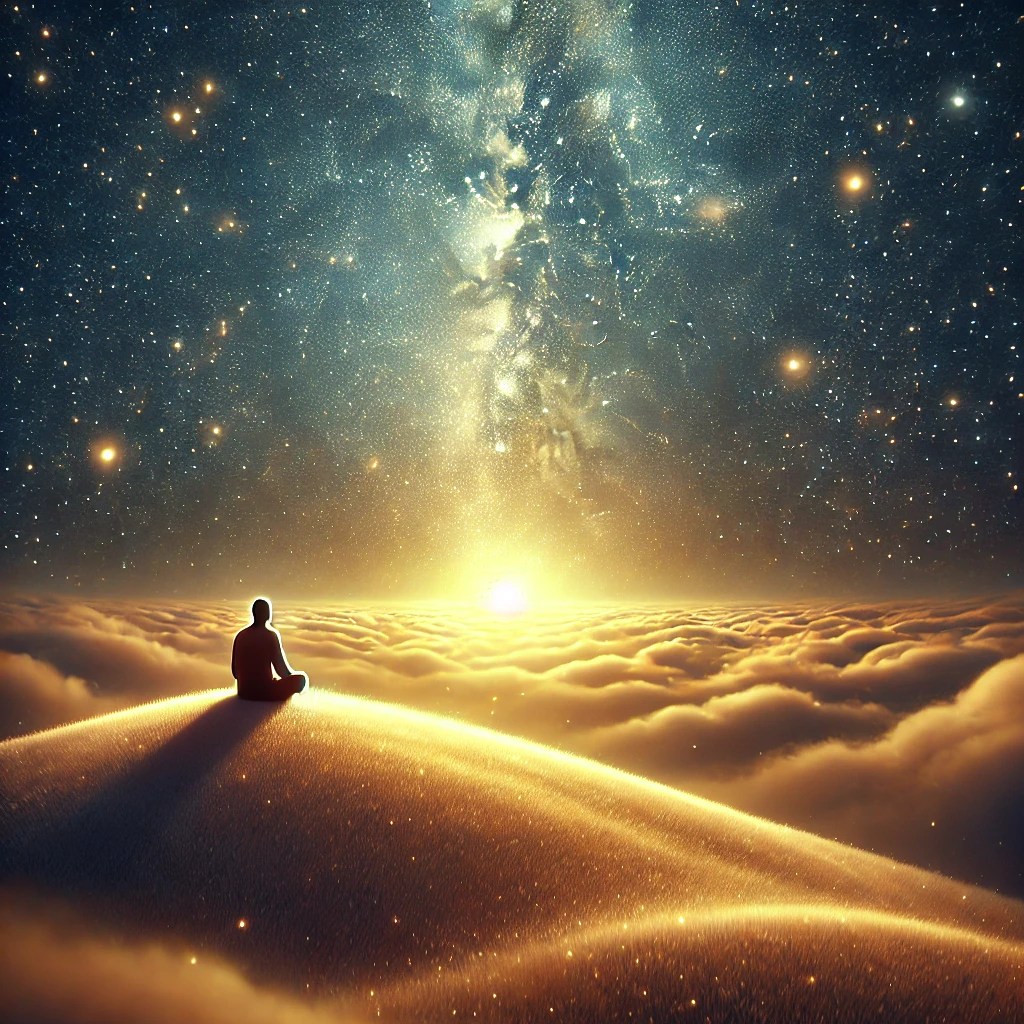
  • A Journey Into the Infinite: The Call to Awaken to Our True Nature

    A Journey Into the Infinite: The Call to Awaken to Our True Nature

    There is a voice that calls from deep within, faint yet steady, whispering to you through the silence of your heart: “The kingdom of God is within you.” You hear it in the stillness of the dawn, in the quiet moments when the world falls away. This voice is not far from you—it is not hidden in the heavens nor buried beneath the earth. It lives in the very breath you take, in the still center of your being, inviting you to “Be still and know that I am God.”

    How often we search outside ourselves, looking for the divine in places far from our own hearts. But God, the essence of all that is, has always been nearer than we can imagine. “God is the center of my soul,” wrote St. John of the Cross, and in that hidden center, as we approach the divine, we find that it expands within us, like an infinite wellspring of love and truth. And what is this love? As St. Teresa of Avila tells us, “It is love alone that gives worth to all things.”

    You, too, are the bearer of this love, this infinite truth that resides within the deepest chambers of your soul. “At the center of our being is a point of nothingness,” Thomas Merton reminds us, untouched by the noise of the world, pure and sacred, a place where you and the divine are one. In that sacred space, the distractions of life fall away, and we see ourselves as we truly are—not bound by illusion or time, but free, radiant, and eternal.

    Just as this sacred center resides within each of us, the mystics of many traditions remind us that the divine is not something that can be grasped by the mind alone. “The infinite is concealed from all the living,” say the mystics of Kabbalah. It is not something to be dissected, understood, or named. It can only be known through the soul’s journey into the unknown, through the deep, unnameable mystery of existence. It is the same mystery that “wherever you turn, there is the face of God.” The divine pervades all things, from the rising sun to the faces of strangers on the street, from the endless stars to the quiet rustling of leaves in the wind.

    In this profound unity, “man is a microcosm of the universe,” as David Bohm said. What we are, what we become, reflects the very nature of the cosmos itself. We are not separate; we are threads in the vast fabric of existence, each one of us a clue to the whole, each one a reflection of the infinite. “The Supreme Reality is beyond both the unmanifest and the manifest,” the Bhagavad-Gita tells us. It is the eternal and all-pervading essence of life, the unnamable source from which we arise and to which we will one day return.

    To recognize this truth is to realize, as Ramana Maharshi said, that “Your own Self-Realization is the greatest service you can render the world.” Only through the shedding of the ego, the dissolution of the false self, can we see the formless reality of who we truly are—nameless, timeless, and infinite. This formless reality is the space between thoughts, the silence in which everything arises and fades—eternal, yet present within every moment, like the quiet breath of the universe itself. “There is only one truth—God,” Swami Sivananda wrote, reminding us that everything else, all the fleeting shadows of the world, are but temporary.

    This realization of our true nature, this casting off of the little self, allows us to “recognize yourself as the vast Spirit,” in the words of Swami Paramahansa Yogananda. Beyond all limitations of form and thought, we are the boundless Spirit, free and ever-expansive. What is this freedom but the awakening to the truth of what has always been? The Buddha tells us, “What we think, we become.” Our thoughts shape our world, but beyond thought lies the ultimate realization of unity—of the one truth that binds all.

    We are not separate. We have never been. “We are here to awaken from the illusion of our separateness,” Thich Nhat Hanh gently reminds us. Our divisions, our dualities, are but veils that obscure the deeper truth of our oneness. Beyond the illusions of duality—right and wrong, self and other—lies a greater reality. As Rumi said, “Out beyond ideas of wrongdoing and rightdoing, there is a field. I’ll meet you there.” In that field, where duality dissolves, we awaken to the truth of who we really are—expressions of the infinite, woven together in the fabric of existence.

    This journey into the infinite is not a process of adding to ourselves, but of shedding the illusions that have kept us from recognizing the divine within. It is a return to the essence of our being, where we find, as Lao Tzu so profoundly reminds us, “The Tao that can be told is not the eternal Tao.” The eternal truth, the infinite source, cannot be grasped by the mind; it can only be realized in the stillness of the heart.

    In this awakening, we are free. Free from the illusions of separation, free to live in the truth of our unity with all that is. As we return to this realization, we find, as St. John of the Cross said, “To reach satisfaction in all, desire its possession in nothing.” The journey is one of surrender, of letting go of all that is not real, to rest in the infinite, eternal love that is our true nature.

    This is the call that has always been with us, whispering through the silence of our hearts. It is not just a call—it is the very essence of life, the truth that lies at the core of all existence, waiting for us to embrace it. To awaken to the infinite is to recognize ourselves as the vast, boundless Spirit, and to live in the truth of our oneness with all that exists.

    🙏🕊️🙏

  • Book Review: The Masnavi I Ma’navi of Rumi – Whinfield Version

    The Masnavi I Ma’navi by Jalaluddin Rumi stands as one of the most important works of Sufi mysticism and spiritual literature, spanning six books and countless couplets of deep spiritual wisdom. In his Masnavi, Rumi uses parables, stories, and poetic teachings to convey profound insights into the nature of the soul, the ego, and the journey toward divine union. Often regarded as “the Quran in Persian,” this work holds immense value for seekers on the path of self-realization and spiritual growth.

    E.H. Whinfield’s translation of The Masnavi I Ma’navi remains one of the earlier and more literal renderings of Rumi’s monumental work. First published in 1887, Whinfield’s translation is known for its fidelity to the original Persian text. While it may lack the poetic flourish found in more recent translations, it offers a direct and unembellished presentation of Rumi’s teachings. This makes Whinfield’s version particularly valuable for those interested in a clear and faithful understanding of the spiritual messages without the influence of modern interpretation or adaptation.

    Whinfield’s work is often appreciated by scholars and serious students of mysticism for its precision and attention to detail. The translation presents Rumi’s messages about divine love, ego dissolution, and the human soul’s search for the Beloved with clarity and depth, making it a vital resource for anyone wishing to study The Masnavi in its original spirit. Through these six books, readers are invited to explore themes of spiritual enlightenment, the challenges of the ego, and the ultimate quest for unity with the divine.

    This review serves as a placeholder for further study of this version of The Masnavi, with plans for more detailed analysis and reflection on its teachings in the future.

    Why Choose the Whinfield Translation?

    While modern translations such as those by Coleman Barks and Reynold Nicholson are more poetic and accessible to contemporary readers, Whinfield’s work stays closer to the literal meaning of the original Persian, offering a more straightforward approach to Rumi’s often complex teachings. For those seeking a purer, less interpreted version of The Masnavi, Whinfield’s translation serves as an essential tool for deep study.

    Conclusion

    For spiritual seekers, mystics, and scholars alike, The Masnavi I Ma’navi in its Whinfield translation is a powerful gateway into Rumi’s universe. Its six books of spiritual couplets form a cornerstone of Sufi literature, guiding readers through the depths of spiritual struggle and the heights of divine love. Although less poetic, Whinfield’s version is a faithful companion for those who wish to engage with Rumi’s wisdom in a form that remains close to the original text.

    🙏🕊️🙏

  • Book Review: The Forty Rules of Love by Elif Shafak

    Introduction:
    The Forty Rules of Love by Elif Shafak is a remarkable novel that intertwines two parallel stories: the modern-day journey of Ella Rubenstein, who is undergoing a personal transformation through her engagement with a novel about Rumi and his spiritual teacher, Shams Tabrizi, and the historical relationship between Rumi and Shams in 13th-century Anatolia. Through these interconnected narratives, the novel explores themes of divine love, spirituality, and personal awakening.

    Background:
    At the heart of this novel is the transformative relationship between Shams Tabrizi and Jalal ad-Din Rumi. Shams, a wandering mystic known for his unconventional methods and profound wisdom, radically altered the course of Rumi’s life. Their bond became the source of Rumi’s spiritual awakening, leading him to write some of the most celebrated poetry in history.

    Shams’ teachings were rooted in Sufi traditions, emphasizing the dissolution of the ego, the centrality of love in spiritual practice, and the path toward divine union. His Diwan-i Shams-i Tabrīzī, a collection of poems attributed to him, captures his deep understanding of divine love. Shams’ presence in Rumi’s life was both disruptive and enlightening, awakening the poet to a higher consciousness, which Rumi expressed through his prolific works, including the Masnavi.

    The Forty Rules of Love:
    Elif Shafak’s novel is structured around the forty rules of love, which are teachings attributed to Shams. These rules serve as guideposts for navigating the human experience of love, both worldly and divine, and reflect key principles of Sufi mysticism. Shafak weaves these rules throughout the story, offering readers spiritual insights while engaging them in the personal struggles of her characters.

    Themes Explored:

    At the heart of The Forty Rules of Love lies a profound exploration of divine love, the kind of love that transcends the ordinary boundaries of human emotion. Through the lives of Rumi, Shams, and Ella, the novel delves deeply into the nature of love as both a mystical force and a transformative power. Shams’ teachings guide Rumi from a scholar and theologian into a poet of divine union, revealing love as a path that dissolves the ego and leads to spiritual awakening. This kind of love is not just a feeling but an illumination that binds the soul to the divine, guiding the seeker toward self-realization.

    Rumi’s own awakening, catalyzed by his connection with Shams, reflects this dissolution of the ego. In Shams’ eyes, the ego is the greatest barrier to true enlightenment. The novel, much like Rumi’s poetry, calls us to surrender the smaller self, to let go of the illusions we hold about our identity, and to step into a deeper experience of being—one in which we recognize that separation from the divine is the root of all suffering.

    Ella’s journey parallels Rumi’s in a modern context, as she begins to shed the constraints of her ordinary life, driven by a newfound understanding of love and spiritual depth. Her connection with the novel within the novel becomes a mirror to the relationship between Rumi and Shams, and she, too, is drawn into a process of inner transformation. The book masterfully illustrates how these timeless spiritual principles can apply to anyone, in any age, as they awaken to the deeper truths that exist beyond the confines of everyday existence.

    Ultimately, the novel’s greatest teaching may be that love, in its purest form, is the force that bridges all dualities—the sacred and the mundane, the earthly and the divine. Through the eyes of Shams and Rumi, readers are invited to experience love as the highest form of spiritual practice, one that calls us to be both fully human and fully connected to the infinite.

    Recommendation:
    For readers interested in spirituality, love, and personal growth, The Forty Rules of Love offers a rich, contemplative experience. Shafak’s storytelling, combined with the teachings of Shams Tabrizi, provides both entertainment and deep spiritual insight. Whether you’re a seasoned reader of Rumi’s works or new to Sufi mysticism, this novel is sure to leave a lasting impact.

    The Forty Rules of Love remains on my list for deeper exploration. I plan to engage with each of the rules more fully in the future, and this review serves as a placeholder for that deeper dive.

    🙏🕊️🙏