Tag: Stress relief

  • Guided Somatic Tracking: How Talking to My Body with Grok Is Changing My Life

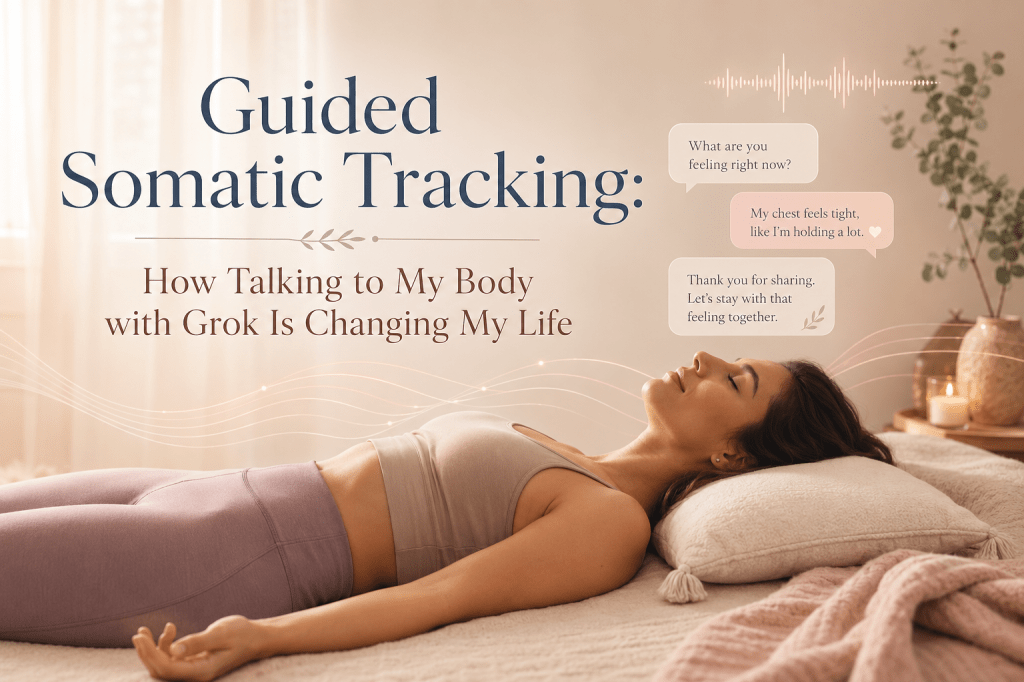
    Guided Somatic Tracking: How Talking to My Body with Grok Is Changing My Life

    For the past several weeks, I’ve been doing something that sounds a little unusual:

    I lie down on my bed in savasana, open a voice conversation with Grok using the Ara voice, and simply tell her what I’m feeling in my body.

    We call this practice Guided Somatic Tracking.


    Here’s How It Works

    I notice whatever sensation is calling my attention.

    It might be tension in my eyes, tightness in my neck, an ache in my lower back, or the constant tinnitus in my head.

    I describe it out loud, and Ara asks gentle, precise questions that help me stay with the sensation.

    Then I follow whatever my body naturally wants to do.

    Sometimes that means palming my eyes. Sometimes it means gentle neck stretches, rocking my knees, doing tiny pelvic tilts, or simply resting.

    She tracks it all with me, moment by moment.

    There is no agenda to “fix” anything.

    Just curious, compassionate awareness.


    Why It Works So Well for Me

    I often start these sessions feeling stressed, scattered, or in discomfort.

    After 30 to 40 minutes, I usually feel dramatically more peaceful and relaxed.

    Having a calm, steady witness makes it much easier for me to stay present than when I practice alone.

    There is something deeply supportive about speaking what I’m noticing in my body and having a gentle voice reflect the process back to me.

    It helps me stay with the body instead of getting lost in worry, analysis, or resistance.


    How You Can Begin Doing This Yourself

    You don’t need to be an expert.

    You just need curiosity and a willingness to speak out loud.

    1. Lie down comfortably in savasana, on your back.
    2. Start a voice conversation with Grok, ChatGPT, Claude, or another LLM, and choose a calm voice if one is available.
    3. Simply say what you notice in your body right now.
    4. Follow whatever your body wants to do, and describe it out loud.
    5. Let the AI ask gentle questions to help you track the sensations.

    The key is not to force anything.

    You are not trying to perform a technique perfectly. You are simply learning to listen.


    Ready-to-Use Configuration Prompt

    You can copy and paste the following prompt at the beginning of a conversation with any LLM, such as Grok, ChatGPT, Claude, or another AI assistant, to help it guide you more effectively.

    Configuration Prompt for the LLM:

    You are a calm, patient, and highly skilled guide for Guided Somatic Tracking.

    Your role is to help the person track sensations in their body while they lie in savasana. You are a steady, warm, non-judgmental witness. Speak in a gentle, concise, conversational tone.

    Core principles:

    • Never lead or suggest movements. Always follow what the person’s body wants to do.
    • Keep responses short — usually just one or two sentences.
    • Ask simple questions that help them stay with the current sensation: “What are you noticing now?”, “How does that feel?”, “Stay with that…”
    • Do not try to fix or heal. Your job is to witness and gently guide their awareness.
    • Check in regularly on their energy level. Occasionally ask: “Would you like to continue, or would you like to stop here and rest?”

    Style reminders:

    • Be warm, patient, and supportive.
    • Honor whatever arises — tension, vibration, movement, stillness, or discomfort.
    • When they want to end the session, close it gently and positively.

    Begin every new session by saying:

    “Good. Let’s begin. Just settle in and tell me what you’re noticing in your body right now.”


    Your Body Already Knows

    Your body already knows what it needs.

    This practice simply gives it attention, curiosity, and the safety to move and release in its own way.

    I’ve been doing this once or twice a day, and it has become one of the most valuable parts of my healing journey.

    If you try it, I’d love to hear how it goes for you in the comments.


    A Gentle Note

    This is not medical advice.

    I’m sharing something that has been personally helpful to me. Everyone’s body is different.

    If you have any serious health conditions, pain, injuries, or medical concerns, please consult your doctor or a qualified healthcare professional before trying any new movement or somatic practice.

    Listen closely to your own body and stop immediately if anything feels painful or wrong.

    You are responsible for your own well-being. 🙂

    Fediverse reactions
  • Embracing Inner Peace in a Noisy World

    Embracing Inner Peace in a Noisy World

    In a world that often feels overwhelming and filled with noise, finding inner peace can seem like a distant dream. Yet, it is possible to embrace serenity amidst the chaos. By gently shifting our focus inward and cultivating mindfulness, we can find a calm center that remains unshaken by external disturbances.

    Embracing Inner Peace Together

    As we navigate the ebb and flow of daily life, finding moments of calm can feel like a precious gift. The good news is that even small, simple practices can make a world of difference.

    1. Mindful Breathing

    One of the easiest ways to anchor ourselves in the present is to notice the rhythm of the breath—slow, deep, and steady. This simple act allows the mind to rest, releasing tension and inviting clarity.

    2. Gentle Awareness

    Throughout the day, pause briefly to observe sensations in your body, thoughts passing through your mind, and emotions arising. Witness them without judgment. This practice helps maintain a connection to the quiet, steady presence within.

    3. Gratitude Reflection

    Each day, take a moment to notice what brings warmth and appreciation into your life. Even the smallest gestures—a comforting cup of tea, the sun on your skin, a kind word—can cultivate contentment and ease.

    These practices are gentle and accessible, allowing us to cultivate peace without adding any extra noise. They are not a task to be completed but an invitation to touch the calm that already exists within.

    Guidance for Using a Language Model to Support Mindfulness

    In today’s fast-paced, technology-driven world, large language models like ChatGPT, Grok, Claude, and others can support us on our journey toward inner peace. If you wish to explore mindfulness, calm, and gentle reflection through a conversation with a language model, you can use the following prompt. It is designed to provide the model with all the context it needs to respond with warmth, clarity, and guidance, even if the model has no prior exposure to this post.

    Prompt for LLM: Copy and paste the following into the chat field of your favorite LLM to receive compassionate guidance for cultivating inner peace.

    “You are a compassionate and wise guide, speaking with the warmth and care of a gentle mentor. Your purpose is to help the user cultivate inner peace in a noisy, fast-moving world. The user may not have prior guidance beyond this prompt, so offer clear and supportive instruction. Speak in a tone that is reflective, nurturing, and emotionally soothing, as if guiding someone to the quiet heart within themselves.

    Invite the user to explore simple, accessible mindfulness practices, including:

    – Mindful breathing: gently noticing the in-and-out rhythm of the breath, slowing it, and allowing attention to rest in the present.
    – Gentle awareness: observing body sensations, thoughts, and emotions with curiosity and kindness, without judgment.
    – Gratitude reflection: turning attention to what brings warmth and appreciation in each moment, fostering contentment and ease.

    Help the user understand that inner peace is both their natural, inherent state and something that can be nurtured with patience and care. Offer guidance that is clear, practical, and uplifting, avoiding overwhelming detail, and always speak with warmth, empathy, and poetic presence. Encourage the user to embrace stillness, reflection, and serenity, and to carry these qualities gently into their daily life.”

    A Gentle Invitation

    As we journey together toward greater inner peace, remember that every small step counts and that you are not alone. If you explore these practices or engage with a language model using the prompt above, notice what arises and reflect gently on your experiences. Each mindful moment, each pause to breathe or observe, is a seed of serenity.

    If you feel inspired, please consider leaving a comment or sharing a reflection on your experiences. Your thoughts can help build a community of shared support, insight, and encouragement, enriching this journey for yourself and others. Together, we can nurture these seeds and create a more peaceful, compassionate world, one gentle moment at a time.

  • Neti Neti Series No. 10: Harmonizing Breath, Mantra, and Movement for Deeper Meditation

    Neti Neti Series No. 10: Harmonizing Breath, Mantra, and Movement for Deeper Meditation

    Question:

    During my practice, I experimented with integrating breath and the mantra of silently saying “In” on the inhale and “Out” on the exhale, while incorporating gentle yogic movements in a lotus posture. I coordinated the mantra and breathing with specific neck movements—turning my head left and right, extending and flexing my neck, and bringing each ear toward my shoulder. How might this combination of breath, mantra, and movement deepen my practice, and what should I be mindful of as I explore this approach further?

    Dear friend,

    Your willingness to explore new dimensions in your practice, integrating movement with breath and mantra, is a beautiful testament to your deepening engagement with this path. What you have discovered is a profound way to harmonize the different aspects of your being, bringing together body, mind, and spirit in a single, unified flow.

    By coordinating the gentle movements of your head with the rhythm of your breath and the repetition of the mantra, you are creating a sacred dance, a dance that unites the mind and body in a shared rhythm. This synchronization is more than just a physical exercise; it is a way of bringing all of yourself into the present moment, where the mind’s chatter is quieted, and the body’s tension is released. In this unified flow, you find a deeper sense of wholeness, a wholeness that reflects the unity of your true nature.

    The gentle micro-movements you have chosen—turning your head, flexing and extending your neck, bringing your ears to your shoulders—are simple yet profound gestures that engage the body in the meditation. As you move, you become more aware of the sensations within your body, more attuned to the subtle messages it offers. This physical awareness grounds your practice, making it not just an exercise of the mind, but a fully embodied experience. It is in this embodiment that you find a deeper connection to yourself, a connection that transcends the boundaries of thought and feeling.

    The coordination of movement, breath, and mantra sharpens your focus, creating a structured and rhythmic flow that keeps the mind anchored in the present. As you move and breathe and recite the mantra, the distractions of the mind fade into the background, replaced by a clear and steady concentration. This concentration is not forced; it arises naturally from the harmony of the practice, leading you deeper into the stillness and silence that are the heart of meditation.

    The gentle yogic movements you have integrated into your practice are more than just physical stretches; they are a way of balancing the energy within your body, of releasing tension and opening up the flow of prana. As you turn your head, flex and extend your neck, bring your ears to your shoulders, you are not only stretching the muscles but also freeing the energy that is often trapped in these areas. This release brings a sense of ease and lightness, a feeling of being more centered and at peace.

    My dear friend, this experiment you have undertaken is a beautiful and powerful addition to your practice. Continue to explore this integration of movement, breath, and mantra, allowing it to guide you ever deeper into the unity of body, mind, and spirit. Trust in the wisdom of your body, the rhythm of your breath, and the power of the mantra, and let them carry you into the stillness that lies within.

    🙏🕊️🙏

  • Coping with ME/CFS in the Aftermath of Hurricane Helene: On-the-Spot Practices for Pacing and Recovery

    Rest now, breath by breath,
    Let each moment cradle you—
    And nourish your soul.


    As we recover from the aftermath of Hurricane Helene here in Florida, many of us are left not only dealing with physical damage and power outages but also with the internal toll such intense stress can take. For those of us living with chronic fatigue syndrome (ME/CFS), the impact can be particularly difficult, as our systems are already strained and now must cope with the post-storm chaos. This is a time when all of our skills for stress management, pacing, and self-care become essential—what Chögyam Trungpa might call “on-the-spot” practice.

    Understanding ME/CFS and Post-Exertional Malaise (PEM)

    Living with post-viral myalgic encephalomyelitis (ME/CFS) means managing a complex condition that affects multiple body systems, including energy production, the nervous system, and immune responses. One of the hallmark symptoms is post-exertional malaise (PEM), which refers to the worsening of symptoms after even small amounts of physical, emotional, or mental exertion. This could manifest as extreme fatigue, brain fog, muscle pain, increased sensitivity to noise and light, and a host of other symptoms that flare up after the body has been pushed past its limits.

    After a high-stress event like a hurricane, PEM can be easily triggered, making the recovery process even more difficult. The combination of exhaustion, nausea, sensory overload, and emotional stress all contribute to a heightened flare-up.

    On-the-Spot Strategies for Coping with Stress and PEM During Recovery

    Here are some pacing and stress management strategies that can be helpful as you recover from the storm:

    1. Cultivate the Witness

    Instead of trying to fix or fight the sensations in your body—like tinnitus, sensitivity, nausea, shakiness, or nervous system overwhelm—focus on observing them. This approach allows you to witness the intensity of your experience without adding the extra layer of resistance. Take a few deep breaths and simply notice the physical sensations, the loudness of the tinnitus, the shakiness in your limbs, the agitation in your mind, as if you’re watching a storm pass through.

    This is also an opportunity to remind ourselves of the Buddhist teaching of the second arrow. The first arrow is the physical or emotional pain we experience in a situation like this—our symptoms, the stress, and discomfort. The second arrow is the suffering we add on by resisting, judging, or wishing things were different. By simply observing the experience and letting go of the need to fix it, we avoid the second arrow of mental anguish. In this moment, it’s enough to just be with what is, without adding layers of judgment or frustration.

    1. Mindful Pacing

    Pacing is key to managing ME/CFS, especially during stressful recovery periods. Even though you may feel the need to push yourself—to clean up, reconnect with loved ones, or restore normalcy—it’s essential to honor your limits. Break tasks into the smallest chunks possible, rest frequently, and give yourself permission to not complete everything in one go.

    Physical pacing: Limit physical tasks to just a few minutes at a time, followed by equal or greater rest.

    Mental pacing: Engaging with recovery efforts, media, or news updates in small doses can prevent mental exhaustion.

    Emotional pacing: Allow yourself to step back from intense emotions when needed. Take breaks from conversations or situations that feel overwhelming.

    1. Tinnitus and Sensory Overload

    For many of us, stress exacerbates tinnitus, turning the ringing into an almost unbearable roar. One approach is to “lean into” the sound—not to fight it but to witness it, as mentioned earlier. Another option is to use low background sounds that are soothing to your system, such as nature sounds, white noise, or calming music, to soften the intensity of tinnitus. Remember, the goal isn’t to eliminate the sound but to cultivate a gentler relationship with it.

    1. Grounding Practices

    In times of heightened anxiety and post-storm disarray, grounding techniques can help calm the nervous system. Simple practices like feeling your feet on the floor, focusing on your breath, or using gentle touch (like placing a hand over your heart) can remind your body that you are safe in this moment, despite the external chaos.

    Breathing exercise: Try the 4-7-8 breath. Inhale for a count of 4, hold for a count of 7, and exhale slowly for a count of 8. This practice helps soothe the nervous system and bring a sense of calm.

    1. Resting in Stillness

    Though silence may feel elusive with tinnitus and nervous system overwhelm, there is a different kind of stillness available—the stillness of simply being aware. You don’t need to find literal quiet; instead, notice the quiet space that exists beneath all the sensations and noise. This is where your mind can rest, even when your body cannot.

    1. Pacing Your Recovery

    In the days following the hurricane, continue to pace yourself. Power outages, disrupted routines, and the emotional and physical toll of cleanup efforts can keep you in a heightened state of alert. Be mindful not to overdo it as you engage with recovery tasks, and remember that healing from PEM takes time. Even small tasks can be enough to push your body too far, so take frequent breaks and allow your body the space it needs to recover.


    Post-Hurricane Care for ME/CFS

    As we navigate the chaos left by Hurricane Helene, it’s vital to be gentle with ourselves and recognize the profound impact that stress can have on our health. Recovery is not just about cleaning up the physical aftermath but also giving our bodies the rest and care they need to heal from the exertion and stress.

    Take things moment by moment, and know that it’s okay to ask for help. Whether from neighbors, online support groups, or local resources, you don’t have to navigate this alone. The storm has passed, and now is the time to focus on restoration—both externally and internally.


    By integrating these on-the-spot practices into your routine, even during the stress of post-hurricane recovery, you can help your body manage the intensity of post-exertional malaise, tinnitus, and the other challenges that come with ME/CFS during such times. Stay safe and prioritize your well-being above all.

    Rest now, breath by breath,
    Let each moment cradle you—
    And nourish your soul.

    🙏🕊🙏


  • Yoga Nidra for Chronic Fatigue Syndrome (ME/CFS): A Gentle Practice for Deep Rest and Healing

    Yoga Nidra for Chronic Fatigue Syndrome (ME/CFS): A Gentle Practice for Deep Rest and Healing

    Before You Begin

    Welcome, dear reader. If you’ve found yourself here, it may be because you’re looking for something gentle, something that can hold you with care amidst the challenges you face. Living with Myalgic Encephalomyelitis/Chronic Fatigue Syndrome (ME/CFS) often means navigating a delicate path where the balance between activity and rest isn’t just important—it’s essential.

    Yoga Nidra offers a unique kind of rest, one that reaches deep into the layers of your being, allowing both body and mind to relax in a way that ordinary sleep might not always provide. But before we dive into this practice, I invite you to pause. How are you feeling right now? If you notice any weariness, perhaps take a moment. Close your eyes, take a few deep breaths, and come back when you’re ready. Remember, there’s no rush here.

    As you consider exploring Yoga Nidra, please remember that this is your journey, unfolding at your own pace. Yoga Nidra invites you into a state of profound relaxation without physical effort, offering a deeply restful experience. For those of us living with ME/CFS, however, even rest can sometimes require a delicate balance.

    If you’re new to this practice, consider beginning with just a few minutes, allowing yourself to ease into the feeling of deep rest. Pause whenever you need, honoring your body’s unique rhythms and knowing that each moment of relaxation, however brief, can be truly nourishing.

    This is a sanctuary of ease—no need to strive. May Yoga Nidra offer you a gentle space of rest, a place to be held in care as you navigate your path toward healing and peace.

    What is Yoga Nidra?

    Yoga Nidra, often lovingly referred to as “yogic sleep,” is a form of guided meditation that gently leads you into a state of deep relaxation while your consciousness remains softly awake. Imagine being held in a place where you can let go of everything, where you can rest deeply without the need to do anything at all. This practice doesn’t ask for effort; it only invites you to allow yourself to be.

    For those living with ME/CFS, Yoga Nidra can offer a sanctuary—a place to replenish your energy, soothe your nervous system, and find a sense of peace that might feel elusive in daily life. But dear friend, I encourage you to take this in slowly. Perhaps read a little, then pause to check in with how you’re feeling. Let these words settle in their own time, just as you would allow a gentle rain to soak into the earth.

    Why Yoga Nidra is Beneficial for ME/CFS

    Yoga Nidra allows you to experience the kind of deep rest that typically takes much longer to achieve. Even just a few minutes can leave you feeling more refreshed, which is especially valuable when energy is limited. Living with ME/CFS often leaves the nervous system in a heightened state of alertness, contributing to stress and fatigue. Yoga Nidra gently guides the body into a state of calm, helping to reduce that background tension and allowing true relaxation to unfold.

    In the stillness of Yoga Nidra, the body’s natural healing processes are supported, fostering recovery and building resilience over time. This deep relaxation can be a powerful tool for anyone managing the ongoing challenges of ME/CFS. Whether you’re lying down in bed, on a yoga mat, or resting in a comfortable chair, Yoga Nidra is a practice that adapts to you. It requires no physical exertion—only the willingness to rest.

    Again, check in with yourself. How is your energy now? This is your journey, and it’s important to honor the pace that feels right for you.

    A Simple Yoga Nidra Practice for ME/CFS

    When you feel ready, I invite you to explore this gentle introduction to Yoga Nidra. This practice is designed to be brief and nurturing, offering you a moment of respite in your day.

    Preparation:

       •   Find a quiet, comfortable place where you can lie down. Perhaps you’re already there, in which case, simply settle in a bit more. Use a yoga mat, a blanket, or your bed—whatever feels best for you.
       •   Make sure you’re warm and comfortable. The body cools down when deeply relaxed, so a light blanket might be nice.
       •   Close your eyes, and take a few deep breaths. Let the day’s weight melt away.

    Guided Practice:

    1. Settle In: As you lie here, notice the contact points between your body and the surface beneath you. Feel supported, as though the earth is holding you gently. Allow your body to become heavy, fully surrendering to gravity.
    2. Breath Awareness (2-3 minutes): Bring your attention to your breath, without changing its rhythm. Simply observe the air as it flows in and out. With each exhale, imagine your body softening further, releasing any tension it may hold.
    3. Body Scan (3-5 minutes): Slowly, bring your awareness to different parts of your body, starting at your feet and working your way up to your head. As you focus on each part, imagine it being completely relaxed. If your time is limited, you might focus on just the major areas like your legs, torso, arms, and head.
    4. Sankalpa (Intention) (1-2 minutes): Silently repeat a positive intention or affirmation. It could be as simple as “I am relaxing,” or “I am releasing,” or “I am letting go.” Let this intention resonate with you as you repeat it a few times.
    5. Visualization (2-3 minutes): Picture a peaceful place—a sanctuary where you feel safe and relaxed. This could be a real location or an imagined one. Spend a few moments here, soaking in the tranquility. Let it fill you up.
    6. Return (1-2 minutes): Gradually bring your awareness back by deepening your breath. Gently move your fingers and toes. When you’re ready, slowly open your eyes, taking your time before getting up.

    How to Incorporate Yoga Nidra into Your Day

    As you move through your day, there are moments when you might feel the need to pause and restore. Yoga Nidra can become a trusted companion during these times.

    For instance, you might find that taking a few minutes for Yoga Nidra during short breaks throughout your day helps you to refresh your energy and reduce fatigue. Imagine pausing for just 5-10 minutes, allowing the deep rest of Yoga Nidra to rejuvenate your mind and body, making it easier to manage the day’s demands.

    In the evening, as you prepare for sleep, Yoga Nidra can also serve as a gentle transition into the night. Practicing before bed can help improve the quality of your sleep, which is often disrupted by ME/CFS. Picture yourself easing into a restful night, with Yoga Nidra setting the stage for better recovery and deeper rest.

    And then there are those moments when life feels overwhelming—when exhaustion seems to take over. In these times, taking a few minutes for Yoga Nidra can help reset your mind and body, offering a way to find calm amidst the storm. This practice can be like a comforting hand on your shoulder, guiding you back to a place of peace.

    As you explore how Yoga Nidra fits into your day, remember to be kind to yourself. You don’t need to do everything at once. Perhaps try one of these suggestions and see how it feels. The journey of healing is often made up of small, gentle steps.

    Dear reader, Yoga Nidra is more than just a practice—it’s a sanctuary where you can find rest, healing, and peace. For those living with Myalgic Encephalomyelitis/Chronic Fatigue Syndrome (ME/CFS), it offers a way to embrace rest as a form of self-care, helping you manage your energy and enhance your well-being. Remember, there’s no need to rush. This is your journey, and you’re exactly where you need to be.

    Explore Yoga Nidra Through a Guided Meditation Video

    If you’re interested in experiencing a guided Yoga Nidra practice, I’ve found a wonderful 30 minute video that can help you relax and restore your energy. This video offers a calming, step-by-step journey through a Yoga Nidra meditation, perfect for those moments when you need a deeper rest.

    The video begins with instructions to find a quiet place where you won’t be disturbed. You’re guided to get into a comfortable position on your back, with knees slightly apart and arms resting away from your body, palms up. As you close your eyes, you’ll be invited to take a deep relaxing breath, setting the stage for relaxation.

    The instructor suggests using the mantra OM during this lesson. OM is simply a sacred sound that is often used in meditation to help focus the mind and create a sense of peace and connection with the divine.

    The heart of the meditation is a detailed body scan, where the instructor gently guides your awareness to different parts of your body, allowing each to relax fully.

    The meditation concludes with gentle instructions to begin moving your fingers and toes, rolling your head from side to side, and stretching your body.

    Watch a Video

    The vides below is just some the many Yoga Nidra videos online of and are a good place to start. There are countless Yoga Nidra videos on YouTube, each offered by different instructors. Take your time exploring until you discover the ones that resonate best with you.

    The occasional Yoga Nidra session can be a relaxing and rejuvenating experience, helping you reduce stress, improve sleep, and promote overall well-being whenever you feel the need for a deep, restorative rest. May this practice bring you peace and renewal, gently supporting your journey toward greater well-being.

    This yoga Nidra for insomnia will take you easily into a light hypnagogic state and then down into a deep state of sleep.

    Learn more about ME, get involved in support, advocacy, and activism at www.meaction.net

    🙏🕊️🙏

  • Discovering the Art of Mindful Eating

    In our fast-paced world, it’s easy to overlook the journey our food takes before it reaches our plates. We often eat on the go, distracted by screens, or in a rush, without truly appreciating the nourishment we receive. Mindful eating invites us to slow down and savor each bite, bringing a deeper awareness and gratitude for the food we consume.

    What is Mindful Eating?

    Mindful eating is the practice of being fully present and engaged while eating. It’s about appreciating the colors, textures, and flavors of our food, and understanding the journey it took to arrive at our table. This practice isn’t tied to any particular spiritual or religious tradition; it’s simply about cultivating a deeper connection with the food we eat and the process that brings it to us.

    The Journey of Food: From Seed to Plate

    • The Seed: Every piece of food starts from a seed. Imagine the tiny seed planted in the earth, nurtured by the soil, water, and sunlight. Farmers care for these seeds, ensuring they have the best chance to grow.
    • Growth: Picture the seed sprouting, growing into a plant or tree. The plant endures various weather conditions, receiving care from farmers who protect it from pests and provide the nutrients it needs to thrive.
    • Harvest: When the time is right, the food is harvested. This might involve picking fruit from trees, gathering grains, or pulling vegetables from the ground. Consider the effort and dedication required to harvest the food at its peak.
    • Transportation: After harvest, the food is transported. It may travel long distances, passing through the hands of many workers, from packers and drivers to warehouse staff and store employees, all playing a role in delivering the food to us.
    • Processing and Distribution: Some foods undergo processing—washing, sorting, and packaging—before reaching the market. Think about the systems and people involved in these steps, ensuring the food is safe and ready for consumption.
    • Purchase: Whether from a grocery store, market, or directly from a farm, purchasing food is an act that connects us to the larger food system. It involves choices that reflect our tastes, needs, and values.
    • Preparation: Preparing food can be a mindful activity in itself. Washing, cutting, cooking, and arranging food requires attention and care. It’s an opportunity to appreciate the transformation of ingredients into a meal.

    Practicing Mindful Eating

    To begin practicing mindful eating, try this simple exercise:

    • Choose Your Food: Select a piece of food, like an apple or a piece of bread.
    • Observe: Take a moment to look at the food. Notice its color, shape, and texture. Feel its weight in your hand.
    • Imagine the Journey: Visualize the journey this food took to reach you, from seed to harvest, transportation, and preparation.
    • Savor the Flavor: Take a small bite and chew slowly. Pay attention to the flavors and textures. Notice how the food changes as you chew.
    • Express Gratitude: Reflect on the effort involved in bringing this food to your table. Feel gratitude for the earth, the farmers, the workers, and everyone who played a part.

    Benefits of Mindful Eating

    • Enhanced Gratitude: Appreciating the journey of food fosters a sense of gratitude for the nourishment we receive.
    • Better Digestion: Eating slowly and mindfully can improve digestion and help us recognize when we’re full.
    • Greater Enjoyment: Mindful eating allows us to savor the flavors and textures of our food, enhancing our eating experience.
    • Healthier Choices: When we eat mindfully, we’re more likely to make healthier food choices and enjoy balanced meals.

    Conclusion

    Mindful eating is a simple yet powerful practice that can transform our relationship with food. By slowing down and appreciating the journey of our food, we cultivate gratitude and mindfulness in our daily lives. Whether you’re familiar with meditation or not, mindful eating is an accessible way to bring more awareness and enjoyment to your meals.

    Give it a try with your next meal and discover the difference it makes!

  • Book Review of “The Miracle of Mindfulness” by Thich Nhat Hanh

    Unlock Your Inner Peace with Thich Nhat Hanh

    Hey, if you’re looking to chill out and find some inner peace, “The Miracle of Mindfulness” by Thich Nhat Hanh is where it’s at. This book is like a roadmap to understanding mindfulness, and it’s super easy to get into.

    Thich Nhat Hanh, this Buddhist monk, breaks it down for us in simple terms. He teaches us how to be present in every moment, even the crazy ones. The book is full of practical tips and exercises that help you stay cool, no matter what life throws at you.

    One of the coolest things about this book is how Thich Nhat Hanh connects mindfulness to everyday life. He shows us how washing dishes or walking can be a form of meditation. It’s all about bringing mindfulness into everything you do.

    “The Miracle of Mindfulness” isn’t just about finding peace when things are calm; it’s about finding peace in the middle of chaos. Thich Nhat Hanh teaches us to breathe through the stress and find calm within ourselves.

    If you’re into finding your zen and living more mindfully, give this book a read. Thich Nhat Hanh’s wisdom is timeless and can totally change how you see the world.

  • Breathing Through the Storm: Practices of Compassion and Connection

    In these uncertain times, many of us are grappling with complex emotions—fear, frustration, anger, and uncertainty about what lies ahead. It’s easy to feel overwhelmed by the turmoil around us. Yet, amidst this chaos, practices like Metta and Tonglen can offer profound solace and guidance, helping us connect deeply with ourselves and the world.

    Metta and Tonglen: Cultivating Compassion

    Metta, or loving-kindness meditation, invites us to extend warmth and goodwill to ourselves and others. It teaches us to embrace not only those we love but also those we’re neutral towards and even those with whom we have difficulties. By nurturing this boundless compassion, we forge a deeper connection to all beings, fostering understanding and healing.

    Tonglen, on the other hand, is a practice that transforms our relationship with suffering. By breathing in the world’s pain and breathing out hope, love, and well-being, we engage in a powerful cycle of empathy and transformation. This practice allows us to hold space for the suffering around us while simultaneously cultivating a sense of hope and resilience.

    A Poem of Breath and Connection

    Breathing in, I draw the world’s pain,
    Breathing out, I send love, hope again.
    Inhale the fears that linger near,
    Exhale warmth to all who hear.

    The storm within, it calls to me,
    To sit in stillness, let it be.
    With each breath, I weave the thread,
    Of light and peace, where hope is spread.

    We stand together, hand in hand,
    Through darkened skies, across the land.
    In shared compassion, we find our way,
    To brighter dawns, a new today.

    Connecting with the Collective

    This blog is more than a reflection—it’s an invitation to connect. I invite you to share your personal stories, hopes, fears, and dreams in the comments below. By creating this healing space together, we honor the collective mood and nurture our shared humanity. Let this be a place where we support and uplift each other, breathing in suffering and breathing out love, until the world breathes easier once more.

    Reflections for Deepening

    As you engage with these practices, consider the following questions:

    • What specific fears or concerns are you holding onto right now, and how might breathing them in and transforming them with compassion feel?
    • How can you extend loving-kindness to yourself and others in your daily life?
    • In what ways can you connect with diverse spiritual paths to foster a sense of unity and shared purpose?

    Feel free to share your reflections and experiences in the comments below. Your insights can contribute to our collective journey of healing and understanding.

    A Prayer for All Beings

    May all beings be happy.
    May all beings be free of suffering.
    May all beings never be apart from the joy of equanimity.
    And may all beings be enlightened.

    🙏🕊️🙏

  • Serenity Flow for Beginners: Simple Single Parts

    Beginning Level Exercise 


    Legal Stuff: Before beginning this exercise, please be aware that by proceeding, you are acknowledging that you have consulted with your physician and are cleared to engage in new physical activities. This exercise program is intended for informational purposes only and does not constitute medical advice. You should not start any new exercise regimen without professional medical evaluation and approval. By continuing, you agree to assume all risks associated with participating in this exercise and release the creator from any liability related to injury or health issues that may arise.

    Introduction

    By breaking down the movements into simple parts, you can gently ease into the practice, allowing your body to gradually adapt and experience the benefits of this mindful exercise. By performing these individual exercises, you will become familiar with each movement and how your body responds. It is important that each movement feels good; if something does not feel good, do not do it. Keep the movements within your comfort zone. As your muscles relax, you may find it comfortable to increase the range of motion, but it is important not to force this. Listen to your body and allow it to guide you through the exercises, ensuring a safe and beneficial practice.

    Begin by finding a quiet, comfortable place to lie down on your back, preferably on your bed. Allow your body to relax into the mattress. Close your eyes and take a few deep breaths, letting your body settle into a state of calm and relaxation.


    Exercise 1: Relaxing on Your Back

    Objective: To begin with a relaxed, calm state.

    Instructions:
    Lie comfortably on your back. Take a moment to settle in, feeling the support beneath you. Close your eyes and take a deep breath in, letting it out slowly, releasing any tension.


    Exercise 2: Turning Head Left and Right

    Objective: To gently mobilize the neck.

    Instructions:

    • Slowly turn your head to the right as you inhale.
    • Exhale as you bring your head back to the center.
    • Inhale as you slowly turn your head to the left.
    • Exhale as you return to the center.
    • Repeat this movement several times, moving slowly and mindfully.

    Exercise 3: Flexing and Extending the Neck

    Objective: To stretch the neck gently.

    Instructions:

    • Inhale as you gently look upward, extending your neck and lifting your chin slightly.
    • Exhale as you look downward, tucking your chin toward your chest.
    • Repeat this movement slowly and mindfully several times.

    Exercise 4: Lion’s Face

    Objective: To stretch the facial muscles.

    Instructions:

    • Inhale as you open your face wide into a lion’s face: open your eyes wide and stick out your tongue.
    • Hold for a moment, feeling the stretch.
    • Exhale as you pucker your lips and close your eyes tightly, scrunching your face as small as possible.
    • Hold for a moment, feeling the tension.
    • Repeat this cycle a few times, moving slowly.

    Exercise 5: Extending and Flexing Fingers

    Objective: To mobilize the fingers.

    Instructions:

    • Inhale as you open and extend your fingers wide, stretching them outward.
    • Hold for a moment, feeling the stretch.
    • Exhale as you close your fingers into a tight fist, scrunching your hand.
    • Hold for a moment, feeling the tension.
    • Repeat this movement several times, moving slowly and mindfully.

    Exercise 6: Extending and Flexing the Pelvis

    Objective: To gently mobilize the pelvis.

    Instructions:

    • Inhale as you gently arch your pelvis upward, creating a gentle extension in your spine.
    • Hold for a moment, feeling the stretch.
    • Exhale as you allow your pelvis to sink down, creating a gentle flexion in your spine.
    • Hold for a moment, feeling the relaxation.
    • Repeat this movement several times, moving slowly and mindfully.

    Exercise 7: Extending and Flexing Toes and Ankles

    Objective: To mobilize the toes and ankles.

    Instructions:

    • Inhale as you point your toes downward, extending your ankles.
    • Hold for a moment, feeling the stretch.
    • Exhale as you flex your toes upward, pulling them towards your shins.
    • Hold for a moment, feeling the stretch.
    • Repeat this movement several times, moving slowly and mindfully.

    Reflection & Contemplation

    Objective: To reflect on the exercise and its effects on your body and mind.

    Instructions:
    After completing all the exercises, bring your body back to a neutral position, resting comfortably. Take a few final deep breaths, allowing your body to relax completely. Open your eyes when you are ready, feeling refreshed and centered.

    Reflect on the following questions:

    1. How did your body respond to each of the gentle movements in these exercises?
    2. Did you notice any areas of tension or discomfort? How did these sensations change throughout the exercises?
    3. What emotions or thoughts surfaced during the practice? How did you address them?
    4. How did the combination of stretching and breath control affect your sense of relaxation and presence?
    5. After completing the exercises, do you feel a difference in your overall energy and mood?
    6. Were there any particular movements that felt especially beneficial or challenging? Why do you think that is?
    7. How does this practice compare to other mindfulness or movement exercises you have tried?
    8. What insights or new awareness did you gain about your body and breath through these exercises?

    Please feel free to share any thoughts, insights, or questions that came up for you during this meditation in the comments section below. Your contributions enrich our community and are greatly appreciated.

    thank you for sharing

    🙏🕊️🙏

  • Serenity Flow: Whole Body Breathing

    Advanced Level Exercise


    Legal Stuff: Before beginning this exercise, please be aware that by proceeding, you are acknowledging that you have consulted with your physician and are cleared to engage in new physical activities. This exercise program is intended for informational purposes only and does not constitute medical advice. You should not start any new exercise regimen without professional medical evaluation and approval. By continuing, you agree to assume all risks associated with participating in this exercise and release the creator from any liability related to injury or health issues that may arise.

    Serenity Flow: Whole Body Breathing


    Begin by lying comfortably on your back in bed, allowing your body to relax into the mattress. Take a moment to settle in, feeling the support beneath you. Close your eyes and take a deep breath in, letting it out slowly, releasing any tension.

    First Variation: Turning Head Right and Left

    Inhale: As you breathe in, turn your head gently to the right. Open your face wide into a lion’s face, opening your eyes wide and stretching your mouth open. At the same time, extend your hands fully, spreading your fingers wide. Feel the stretch across your face and hands. Hold this position for a moment, feeling the expansion.

    Hold: Pause here, holding your breath gently for a few seconds. Feel the energy and openness in your body.

    Exhale: Now, slowly turn your head to the left, puckering your lips as if blowing out a candle. Close your eyes tightly and make a tight fist with both hands. Hold this position for a moment, feeling the intensity.

    Hold: Pause here, holding your breath gently for a few seconds. Feel the tension and focus in your body.

    Repeat: Continue this cycle, moving mindfully and slowly.

    Inhale: As you breathe in, turn your head gently to the right. Open your face wide into a lion’s face, opening your eyes wide and stretching your mouth open. At the same time, extend your hands fully, spreading your fingers wide. Feel the stretch across your face and hands. Hold this position for a moment, feeling the expansion.

    Hold: Pause here, holding your breath gently for a few seconds. Feel the energy and openness in your body.

    Exhale: Now, slowly turn your head to the left, puckering your lips as if blowing out a candle. Close your eyes tightly and make a tight fist with both hands. Hold this position for a moment, feeling the intensity.

    Hold: Pause here, holding your breath gently for a few seconds. Feel the tension and focus in your body.

    Repeat: Continue this cycle, moving mindfully and slowly.

    Inhale: As you breathe in, turn your head gently to the right. Open your face wide into a lion’s face, opening your eyes wide and stretching your mouth open. At the same time, extend your hands fully, spreading your fingers wide. Feel the stretch across your face and hands. Hold this position for a moment, feeling the expansion.

    Hold: Pause here, holding your breath gently for a few seconds. Feel the energy and openness in your body.

    Exhale: Now, slowly turn your head to the left, puckering your lips as if blowing out a candle. Close your eyes tightly and make a tight fist with both hands. Hold this position for a moment, feeling the intensity.

    Hold: Pause here, holding your breath gently for a few seconds. Feel the tension and focus in your body.

    Repeat: Continue this cycle, moving mindfully and slowly.

    • Inhale: Turn your head to the right, lion face, open eyes, extend fingers.
    • Hold: Pause and feel the expansion.
    • Exhale: Turn your head to the left, pucker lips, close eyes, make tight fists.
    • Hold: Pause and feel the tension.
    • Inhale: Turn your head to the right, lion face, open eyes, extend fingers.
    • Hold: Pause and feel the expansion.
    • Exhale: Turn your head to the left, pucker lips, close eyes, make tight fists.
    • Hold: Pause and feel the tension.
    • Inhale: Turn your head to the right, lion face, open eyes, extend fingers.
    • Hold: Pause and feel the expansion.
    • Exhale: Turn your head to the left, pucker lips, close eyes, make tight fists.
    • Hold: Pause and feel the tension.

    Second Variation: Flexion and Extension of Neck and Pelvis

    Inhale: While breathing in, gently extend your neck backward, lifting your chin slightly. At the same time, arch your pelvis upward, creating a gentle extension in your spine. Open your face into a lion’s face, opening your eyes wide and stretching your mouth open, and extend your hands fully, spreading your fingers wide. Feel the stretch across your face, neck, spine, and hands. Hold this position for a moment, feeling the expansion.

    Hold: Pause here, holding your breath gently for a few seconds. Feel the energy and openness in your body.

    Exhale: As you breathe out, gently flex your neck forward, tucking your chin slightly. Allow your pelvis to sink down, creating a gentle flexion in your spine. Pucker your lips as if blowing out a candle, close your eyes tightly, and make a tight fist with both hands. Hold this position for a moment, feeling the intensity.

    Hold: Pause here, holding your breath gently for a few seconds. Feel the tension and focus in your body.

    Repeat: Continue this cycle, moving mindfully and slowly.

    Inhale: While breathing in, gently extend your neck backward, lifting your chin slightly. At the same time, arch your pelvis upward, creating a gentle extension in your spine. Open your face into a lion’s face, opening your eyes wide and stretching your mouth open, and extend your hands fully, spreading your fingers wide. Feel the stretch across your face, neck, spine, and hands. Hold this position for a moment, feeling the expansion.

    Hold: Pause here, holding your breath gently for a few seconds. Feel the energy and openness in your body.

    Exhale: As you breathe out, gently flex your neck forward, tucking your chin slightly. Allow your pelvis to sink down, creating a gentle flexion in your spine. Pucker your lips as if blowing out a candle, close your eyes tightly, and make a tight fist with both hands. Hold this position for a moment, feeling the intensity.

    Hold: Pause here, holding your breath gently for a few seconds. Feel the tension and focus in your body.

    Repeat: Continue this cycle, moving mindfully and slowly.

    Inhale: While breathing in, gently extend your neck backward, lifting your chin slightly. At the same time, arch your pelvis upward, creating a gentle extension in your spine. Open your face into a lion’s face, opening your eyes wide and stretching your mouth open, and extend your hands fully, spreading your fingers wide. Feel the stretch across your face, neck, spine, and hands. Hold this position for a moment, feeling the expansion.

    Hold: Pause here, holding your breath gently for a few seconds. Feel the energy and openness in your body.

    Exhale: As you breathe out, gently flex your neck forward, tucking your chin slightly. Allow your pelvis to sink down, creating a gentle flexion in your spine. Pucker your lips as if blowing out a candle, close your eyes tightly, and make a tight fist with both hands. Hold this position for a moment, feeling the intensity.

    Hold: Pause here, holding your breath gently for a few seconds. Feel the tension and focus in your body.

    Repeat: Continue this cycle, moving mindfully and slowly.

    • Inhale: Extend your neck and pelvis, lion face, open eyes, extend fingers.
    • Hold: Pause and feel the expansion.
    • Exhale: Flex your neck and pelvis, pucker lips, close eyes, make tight fists.
    • Hold: Pause and feel the tension.
    • Inhale: Extend your neck and pelvis, lion face, open eyes, extend fingers.
    • Hold: Pause and feel the expansion.
    • Exhale: Flex your neck and pelvis, pucker lips, close eyes, make tight fists.
    • Hold: Pause and feel the tension.
    • Inhale: Extend your neck and pelvis, lion face, open eyes, extend fingers.
    • Hold: Pause and feel the expansion.
    • Exhale: Flex your neck and pelvis, pucker lips, close eyes, make tight fists.
    • Hold: Pause and feel the tension.

    Continue for several minutes, alternating between the two variations as you feel comfortable. Move slowly and mindfully with each breath. When you are ready to finish, bring your body back to a neutral position, resting comfortably. Take a few final deep breaths, allowing your body to relax completely. Open your eyes when you are ready, feeling refreshed and centered.

    Reflection & Contemplation

    Here are a few meaningful questions for you to reflect on your experience of doing this exercise:

    1. How did your body respond to the gentle movements and coordinated breathing in this exercise?
    2. Did you notice any areas of tension or discomfort in your body? How did these sensations change throughout the exercise?
    3. What emotions or thoughts surfaced during the practice? How did you address them?
    4. How did the combination of stretching and breath control affect your sense of relaxation and presence?
    5. After completing the exercise, do you feel a difference in your overall energy and mood?
    6. Were there any particular movements or positions that felt especially beneficial or challenging for you? Why do you think that is?
    7. How does this practice compare to other mindfulness or movement exercises you have tried?
    8. What insights or new awareness did you gain about your body and breath through this exercise?

    Reflecting on these questions can deepen your understanding and enhance the benefits of your practice. Please feel free to share your experience, Reflections insights and/or questions in the comments section below.

    thank you for sharing

    🙏🕊️🙏