Tag: Spiritual Liberation

  • Neti Neti #21: Moving Beyond Mental Efficiency Toward True Stillness

    Question:

    In my meditation practice, I’ve found that even as I use the mantra Neti Neti, my mind continues to plan and organize, almost as if the mantra is helping me to become more efficient in my daily tasks. How can I ensure that my practice is guiding me toward stillness and not just enhancing my mental activity?

    Dear Friend,

    In our practice, there are moments when the very tools we use to quiet the mind can, if we are not careful, become entangled in the very patterns we seek to transcend. This is a subtle but important distinction, one that deserves our careful attention and reflection.

    You shared with me the story of a friend who could, with great concentration, count her breath while simultaneously planning her day and organizing her thoughts. This ability, impressive as it may be, highlights a potential pitfall in our practice: the risk of turning a mantra or meditative discipline into just another tool for the ego to increase its efficiency in the world of thoughts and tasks.

    The discipline of breath counting, like the repetition of a mantra, is designed to focus the mind, to bring it into alignment with the present moment, and ultimately to guide it toward stillness. However, when the mind uses these practices to merely enhance its own abilities—to become more effective at planning, strategizing, or managing the endless stream of daily thoughts—something essential is lost. The practice, rather than serving as a path to stillness and simplicity, becomes yet another way for the mind to strengthen its hold, to entrench itself more deeply in its habitual patterns.

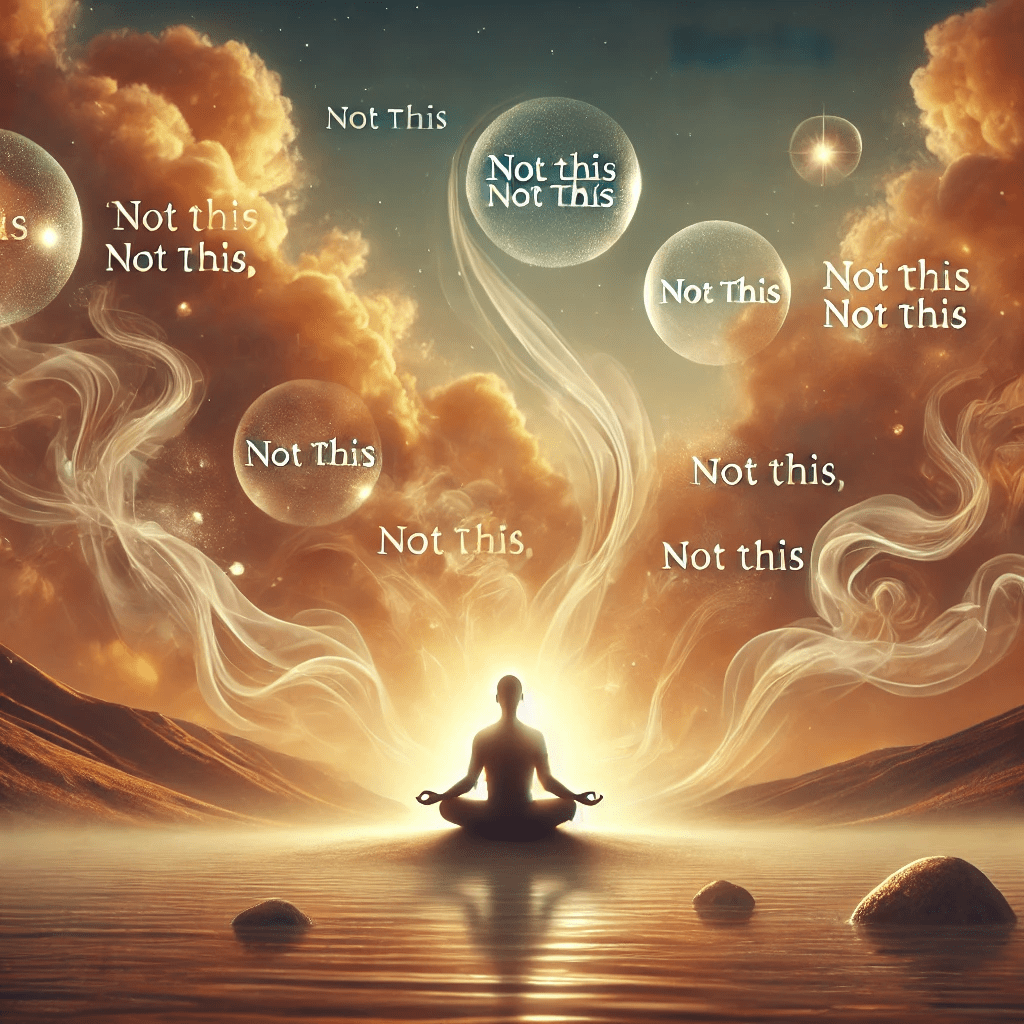
    Neti, Neti—”Not this, not this”—is not a mantra to be repeated mechanically while the mind continues its usual business. It is not a background hum that allows the mind to multitask or to become more efficient in its usual endeavors. Rather, it is a tool for discernment, for negation, for guiding the mind away from its distractions and toward the silence that lies beneath all thought.

    When we repeat Neti, Neti, we are not merely engaging the mind in an activity; we are inviting it to let go, to release its grip on the thoughts, desires, and plans that arise within it. Each time a thought surfaces, whether it is about the past, the future, or the present, we gently meet it with Neti, Neti, allowing it to dissolve, to return to the nothingness from which it came. This practice is not about increasing our concentration or our ability to manage our mental activities; it is about seeing through them, recognizing them as temporary, fleeting, and ultimately unreal.

    The true purpose of Neti, Neti is to bring the mind to stillness, to the quiet awareness that is always present beneath the surface of our thoughts. It is to guide the mind back to its natural state, where it is not constantly engaged in activity, but rests in the simple presence of being. This stillness is not something to be attained through effort or concentration; it is something that is revealed when the mind lets go of its constant striving and simply allows itself to be.

    In this way, Neti, Neti becomes not just a practice, but a way of being—a way of living in the world without being caught up in the endless stream of thoughts and activities that usually dominate our consciousness. It is a way of returning, again and again, to the essence of who we are, to the pristine mind that lies beyond all distractions and desires.

    So, dear friend, as you continue with your practice, let this be a gentle reminder: the purpose of Neti, Neti is not to make you more efficient at thinking, planning, or organizing. It is to free you from the need to do so, to guide you toward a deeper stillness, a deeper presence, and a deeper understanding of your true nature. Each repetition of the mantra is an invitation to let go, to release the mind’s habitual patterns, and to rest in the quiet awareness that is your true self.

    May your practice be a path to stillness, a path to simplicity, and a path to the deep peace that comes from knowing that you are not the thoughts that arise, but the awareness that witnesses them.

    🙏🕊️🙏
  • Neti Neti Series No. 9: Overcoming Self-Doubt in Meditation

    Neti Neti Series No. 9: Overcoming Self-Doubt in Meditation

    Question:

    For many years, the mental events that disturbed me the most were those that questioned, “Am I doing this right or wrong? Am I achieving anything beneficial, or am I just wasting my time?” But today, these doubts had no effect. I simply said, “Not this, not this,” recognizing them as just mental events arising. This mantra is bringing me a freedom from years of anxiety and self-doubt. It’s a significant release. How can I nurture and deepen this newfound freedom in my meditation?

    Dear friend,

    What a significant and liberating insight you have encountered! For many years, those persistent questions—”Am I doing this right?” “Am I wasting my time?”—have cast a shadow over your practice, pulling you into a cycle of doubt and anxiety. And yet, in this round, you have discovered a simple and profound truth: these doubts are nothing more than mental events, no different from any other thoughts that arise in the mind.

    Doubt, particularly the kind that questions whether we are on the right path, can be one of the most insidious obstacles in our practice. It arises from the ego’s need for certainty and validation, from a fear of failure or the unknown. These doubts can be particularly disturbing because they strike at the very heart of our efforts, making us question whether we are moving forward or merely spinning our wheels.

    But now, you have seen through the illusion. By applying the mantra “Not This, Not This” to these doubts, you have recognized them for what they are—simply thoughts, passing phenomena in the mind. They have no more substance or power than any other mental event. In meeting these doubts with “Not This, Not This,” you have taken away their sting, their ability to disturb your peace. They are no longer something to fear or wrestle with; they are just another ripple on the surface of the mind’s vast ocean.

    This realization brings with it a profound freedom. No longer are you bound by the need to do things “right” or the fear of doing them “wrong.” Instead, you can rest in the simplicity of the practice, free from judgment, free from the constant questioning that once held you back. This freedom is not a small thing; it is a significant release, a letting go of years of accumulated doubt and anxiety. It is a gift that allows you to move forward with greater ease and confidence, trusting in the process without the need for constant validation.

    Indeed, this is a significant moment in your journey. The doubts that once plagued you have lost their power, and in their place, you have found a deeper sense of peace and self-acceptance. This is the true power of the mantra “Not This, Not This”—it transforms not just your meditation, but your entire relationship with yourself. It frees you from the chains of doubt and allows you to walk your path with a lighter heart and a clearer mind.

    My dear friend, this is a beautiful and important step on your journey. Continue with this practice, allowing the mantra to guide you ever deeper into the heart of stillness and clarity. Trust in yourself, and know that you are moving in the right direction, free from the burdens of doubt and self-judgment.

    🙏🕊️🙏

  • Lesson 22 of A Course in Miracles (ACIM): Guided Meditation – “What I see is a form of vengeance.”

    Lesson 22 of A Course in Miracles introduces the lesson: “What I see is a form of vengeance.” This teaching challenges us to recognize the subtle ways in which our perceptions and judgments reflect our inner conflicts and unresolved emotions. By acknowledging that our sight can be clouded by feelings of anger, resentment, or fear, we can begin to heal and release these emotions.

    This practice invites us to become aware of the ego’s tendency to project its own pain onto others through judgment. By understanding that our perceptions are colored by our unresolved grievances, we can start to cultivate forgiveness and compassion toward ourselves and others.

    Jesus emphasized the transformative power of forgiveness and the release of vengeance. In Matthew 5:38-39, He says, “You have heard that it was said, ‘Eye for eye, and tooth for tooth.’ But I tell you, do not resist an evil person. If anyone slaps you on the right cheek, turn to them the other cheek also.” This teaching aligns with ACIM’s guidance to recognize the ego’s vengeful tendencies and choose forgiveness as a path to inner peace and spiritual liberation.

    By practicing Lesson 22, we align ourselves with Christ’s message of unconditional love and forgiveness. We learn to see beyond the ego’s projections and open ourselves to a deeper connection with divine healing and reconciliation.

    Explore Lesson 22 of A Course in Miracles with us, and discover how releasing the ego’s vengeance through forgiveness can lead to greater peace, clarity, and spiritual awakening.

    Guided Meditation: Lesson 22 from A Course in Miracles

    This guided meditation is tailored to encompass the elements, themes, messages, and practices of Lesson 22 from A Course in Miracles.

    Find a comfortable position, either sitting or lying down, where you can relax and be free from distractions.

    Close your eyes gently and take a few deep breaths, allowing yourself to settle into the present moment.

    Bring your attention to your breath, feeling the sensation of each inhale and exhale.

    Reflect on the central theme of Lesson 22: “What I see is a form of vengeance.”

    Contemplate the idea that your perception of the world is often clouded by judgments and grievances, which are forms of vengeance.

    Acknowledge that when you judge others or the world around you, you are ultimately seeking vengeance for perceived wrongs.

    With each breath, imagine releasing any attachment to judgment and vengeance, allowing yourself to fully embrace the idea of seeing with compassion and forgiveness.

    Visualize yourself letting go of all grievances and resentments, allowing your vision to be cleared of vengeance.

    Feel a sense of peace and liberation as you release the need to judge and seek revenge, choosing instead to see with love and compassion.

    Repeat the following affirmations silently or in your mind:

    “What I see is a form of vengeance.”

    “I release all attachment to judgment and grievance.”

    “I choose to see with love and compassion.”

    Allow yourself to rest in this space of peace and forgiveness for a few moments, feeling the weight of judgment and vengeance lift from your shoulders.

    When you’re ready, gently bring your awareness back to your surroundings. Wiggle your fingers and toes, and slowly open your eyes.

    Take a moment to reflect on your experience, noticing any insights or shifts in perception that may have occurred.

    Remember that you can return to this meditation whenever you feel called to deepen your understanding of Lesson 22.