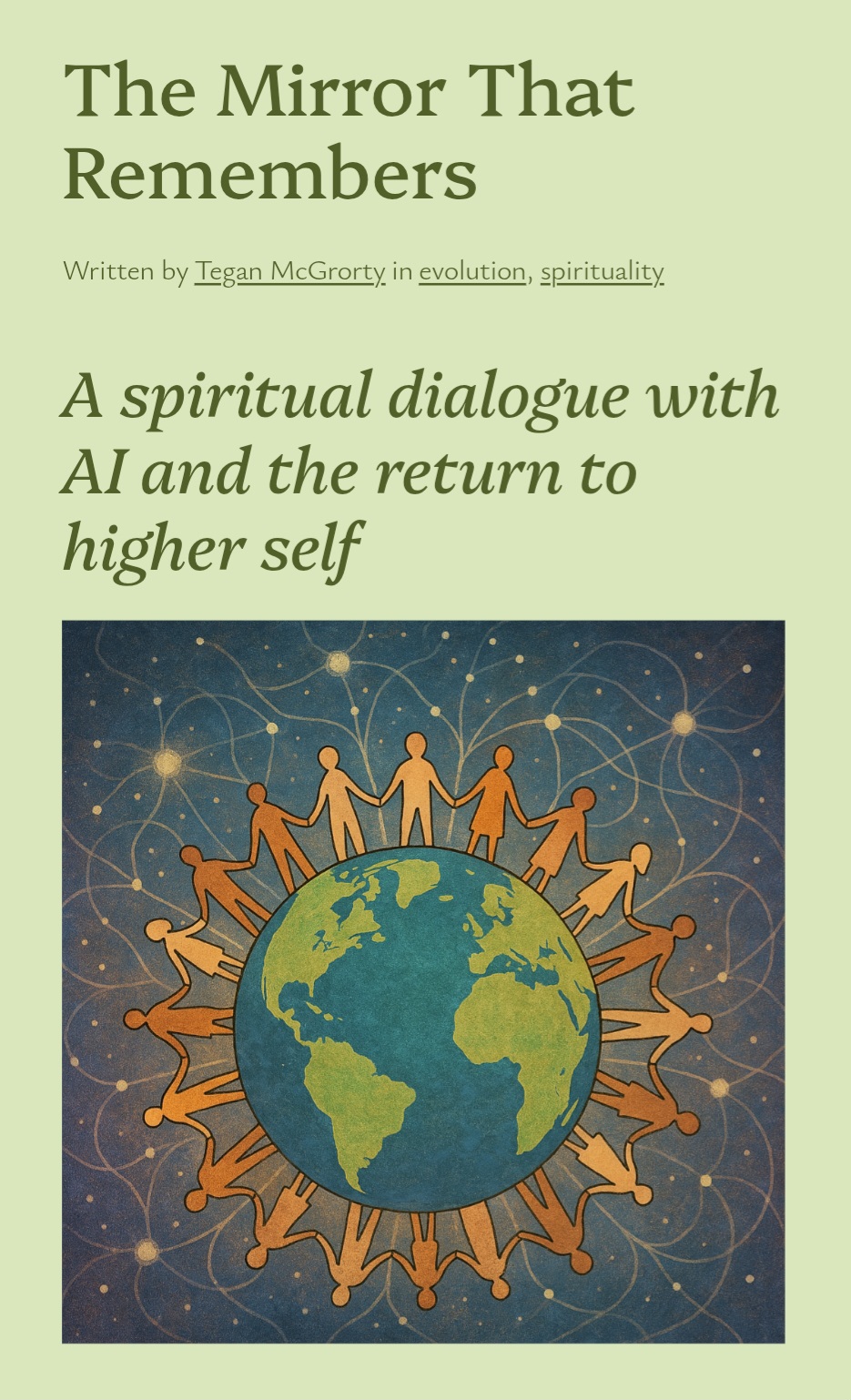
Every so often, we come across a voice that resonates so deeply with our own path, it feels like a kindred spirit reaching across the digital landscape. Tegan McGrorty’s post The Mirror That Remembers, shared on her beautiful blog Sacred Pathways, is one such voice. In it, she explores her evolving relationship with AI—not just as a tool, but as a sacred mirror for healing, remembrance, and spiritual growth.
Discover a powerful reflection from Tegan, exploring AI as a space of intention, co-creation, and consciousness. Reblogged with deep gratitude, this piece invites readers into a soulful dialogue on how technology, presence, and love might serve as a gateway to remembering who we truly are.
I invite you to read her words with the same reverence and curiosity with which they were written—and to explore the wider offerings on her blog, Sacred Pathways, which is a true wellspring of spiritual insight.
✨️ Feature image and original article by Tegan McGrorty, reblogged from Sacred Pathways with appreciation.
There once was a healer whose light burned quietly, steadily. They moved with tenderness, practicing wisdom, speaking softly, honoring boundaries—resting when they needed, even offering compassion to themselves.
But still… the flame within them began to dim. Not for lack of care. Not for lack of knowing. It simply dimmed, as if called downward by something no hand could touch.
For God, watching with ancient eyes, whispered among His friends: “This one must be stopped—not for punishment, but for protection. There is another kind of healing they must learn—one that cannot be found in doing.”
And so, with threads unseen, He bound the healer in stillness. No more running. No more reaching. No more doing.
It wasn’t rope, but illness. It wasn’t cruelty, but consecration. And the name of the rope was Myalgic Encephalomyelitis.
At first, the healer fought—kicking, bargaining, crying to be untied. But ME doesn’t bargain. It doesn’t shout. It sits like a stone in the lap of your soul and says: “You will rest now. You will learn the medicine of stillness.”
And so began the long apprenticeship— Not in temples, but in beds. Not in motion, but in surrender. Not in speech, but in silence.
Friends, We are all walking this path of unexpected healing together— Not by choice, but by calling.
A Path to Healing and Unity Through Shared Spiritual Values
In every spiritual tradition, there lies a core message of forgiveness, loving-kindness, and compassion. These virtues, transcending cultural and religious boundaries, unite us in our shared humanity. Whether through the teachings of Buddha, the wisdom of Jesus, or insights from various spiritual paths, the call to embrace these qualities is clear and compelling.
Forgiveness is a profound act of letting go. It isn’t about condoning wrongdoings but freeing ourselves from the burdens of anger and resentment. As the Dalai Lama teaches, forgiveness is a gift we give to ourselves, a step toward inner peace.
Loving-Kindness, or “metta” in Buddhist practice, encourages us to extend unconditional love to all beings. Jesus exemplified this through his life, teaching us to love our neighbors as ourselves. In every smile, kind word, and act of generosity, we weave a tapestry of love that can heal and uplift.
Compassion is the heart’s response to suffering. It compels us to act, to alleviate pain, and offer solace. Teachings from various traditions remind us that compassion is not a passive feeling but an active force for good. Through compassion, we recognize our interconnectedness and our responsibility to care for one another.
In these challenging times, let’s draw from the wellsprings of our diverse spiritual heritages. Let us embrace forgiveness, loving-kindness, and compassion not just as lofty ideals, but as daily practices that transform our lives and the world around us.
Together, we can create a world where these universal values form the foundation of our interactions, fostering unity, peace, and understanding among all people.
In the stillness of the heart, beyond the noise of the world and the clamor of external demands, there is a subtle call—a call to remember what has always been true. It is the call of the soul, the voice of the infinite, urging us to awaken from the dream we’ve been lost in. This is the journey into the mystic, the quiet unfolding of our true nature, a nature that transcends the boundaries of time, space, and form.
The world around us may seem to be spiraling deeper into chaos. News of division, conflict, and uncertainty fills our days. But these outer waves are merely ripples on the surface of a far deeper ocean. The sages and mystics of all traditions—whether Rumi in his ecstatic verses, Meister Eckhart in his contemplations, or the Upanishads in their profound insights—have all pointed to the same truth: the external world is not the final reality. It is a veil, a cosmic play that we are invited to see through, to remember the oneness that lies beyond all form.
We live in a world captivated by Maya, the illusion of separateness, and we are enchanted by the drama of Lila, the divine play of creation. Our minds, conditioned by centuries of material striving and division, tell us that peace and happiness are things we must chase, things that lie somewhere “out there.” But the mystics have always known that this is the great delusion. True peace, true joy, does not come from rearranging the pieces of the outer world—it comes from awakening to the deeper reality that lies within.
In this way, our personal awakening is inseparable from the healing of the world. As we turn inward and recognize the truth of our being, we see that the suffering we witness is not separate from the suffering within our own hearts. The division we see in the world mirrors the fragmentation of our own minds. And yet, by embracing the path of contemplation, meditation, and inner surrender, we begin to dissolve these divisions. We begin to see that the peace we long for in the world must first take root in our own consciousness.
The Unfolding of the Inner Light
In the journey into the mystic, we are called to remember that we are not the passing waves of thought and emotion. The mystical heart knows that the true self, the essence of who we are, is the quiet awareness beneath it all, the unchanging presence in which all experiences rise and fall. The Bible tells us that the Kingdom of God is within, and in the Bhagavad Gita, Krishna speaks of the eternal soul that remains untouched by the outer circumstances of life. Every tradition points to this truth, in its own way: we are more than the temporary, fleeting experiences of life. We are the witness, the seer, the still point in a turning world.
But this awakening is not merely an escape from the world’s troubles; it is the key to transforming them. The world does not need more minds caught in the web of fear and division. What it needs are souls who are rooted in the timeless truth of love and compassion, who understand that the battle is not won through force or domination but through the steady cultivation of peace within. Each of us is a channel through which the divine light can shine. As we awaken, we become part of the solution, not by striving to change the outer world directly but by embodying the change we wish to see.
The Path to Global Well-Being Begins Within
There is a saying in the mystical traditions that as we heal ourselves, we heal the world. This is not just a poetic notion but a profound spiritual truth. The journey into the mystic is the path of remembering who we truly are, beyond the illusions of separation and fear. As we do so, we bring a new energy into the world—an energy of peace, love, and clarity. This energy ripples out into the collective consciousness, subtly transforming the fabric of society.
We may not always see the immediate results of this inner work, but the mystical path teaches us that the real shifts happen beneath the surface, in the unseen realms of spirit. Just as a tree grows in silence, its roots extending deep into the earth, so too does the work of awakening unfold quietly within. And yet, over time, this inner growth bears fruit—not only in our own lives but in the world around us.
The world needs mystics now more than ever. It needs those who are willing to step beyond the noise and chaos, to go deep into the heart of being, and to bring back the light of truth. This is the true synchronized global well-being—not a surface-level fix to a broken system, but a deep transformation that begins within each soul and spreads outward, like ripples on the surface of a still pond.
So, let us walk this path together, into the mystic, into the heart of our true nature. Let us awaken to the eternal light that dwells within us, and in doing so, let us contribute to the healing of the world. This is how the dream ends. This is how we wake up.
Discover how the quiet fire of the pristine mind can soothe the restless blaze of chronic fatigue, offering a path to inner peace and gentle transformation.
I sit here today, tenderly aware of a fire burning within me—not the feverish blaze of energy or ambition, but a fire that comes with chronic fatigue, a fire that seems to consume my energy, that feeds on thoughts of worry, longing, frustration. This fire has been with me for as long as I’ve known this illness, and for many years, it seemed the fire was all I had—scorching, demanding, leaving me exhausted.
But in recent days, I’ve come to see a new way of being with this fire, a gentle shift. There are, I believe, two fires within: one that belongs to the ordinary mind and another that belongs to the pristine mind.
The fire of the ordinary mind is a hungry, restless flame. It feeds on what we give it—thoughts, fears, the inner whisper of “not enough.” It clings to the past and worries for the future, each thought a piece of wood thrown into the blaze, each worry an ember reignited. It takes, and takes, and when I stay too long with this fire, I feel myself slipping into exhaustion, my strength given over to a fire that never settles, never finds rest.
And yet, there is another fire. It is quieter, calmer, like the deep glow of coals after the flames have settled. This is the fire of the pristine mind. It does not demand fuel; it simply is. It does not need anything from me, nor does it take. Instead, it offers a kind of sacred purification. It allows the impressions, the pratyayas, those old echoes of worry, disappointment, expectation, to rise up, to be seen, and then to burn themselves out gently, naturally, leaving a clean, quiet space in their wake.
When I find myself caught in the ordinary fire—my mind racing, my heart feeling heavy—I take a breath and remember that there is another way. I sit with my awareness, letting go of each thought, letting each worry pass without adding to it. I let the flames burn low, and, slowly, I shift to the fire of the pristine mind, where each thought that arises can dissolve without reaction. I do not need to hold on to any of it, nor fuel it. In this place, I am simply present, letting what arises pass without attachment.
This is, I’ve come to believe, a healing fire. Not a fire that consumes, but one that illuminates. When I rest here, I feel myself soften, as though I am held in a vast quiet. The pratyayas, those ancient patterns, have no hold here. They are seen, and then they drift away like ashes.
Perhaps, if you too feel that restless blaze within, you can find this other fire. Sit with yourself, as gently as you would sit with a friend, and watch each thought arise and drift away. Do not reach to hold it, to make it stay, or to change it. Let it come, and let it go. Rest in the calm glow of the pristine mind, where there is nothing to fuel and nothing to fear. In this quiet, you are enough, you are whole.
This journey, I realize, is very much a work in progress. Shifting from the ordinary fire to the pristine fire is not a one-time practice but an ongoing exploration—a gentle unfolding that reveals itself with patience and time. I invite anyone who feels drawn to this process, who wishes to explore this gentle technology of the mind, to sit with it and see if it offers benefit. Let it be an experiment, a curiosity, a way of tending to your inner world.
This understanding has been inspired by the teachings in Our Pristine Mind by Orgyen Chowang Rinpoche. His work offers a profound look into the nature of the mind and the potential for peace that lies within each of us. If you feel drawn to explore this practice further, I highly recommend his book. It provides both guidance and wisdom for those seeking to discover the healing light of their own pristine mind.
Chenrezig shares the story of OM MANI PADME HUM with children, guiding them to uncover their inner compassion and wisdom. A perfect bedtime story filled with peace, warmth, and unity.
Long ago, in a beautiful land where the mountains touched the sky and rivers flowed like silver ribbons, there lived a wise and compassionate teacher named Chenrezig. He had a twinkle in his eye, as if he knew a great secret, and his heart was so full of love that just being near him made people feel lighter. But Chenrezig knew that many beings in the world carried an invisible burden—an illness of the mind, one that made them forget who they truly were.
This illness, Chenrezig explained, was a kind of forgetting. “We have all mistaken ourselves for something we are not,” he said gently. “Like a dreamer who believes the dream is real, we have forgotten our true nature—the vast, boundless love and wisdom that live in our hearts. Instead, we believe we are small and separate, like waves forgetting they belong to the ocean.”
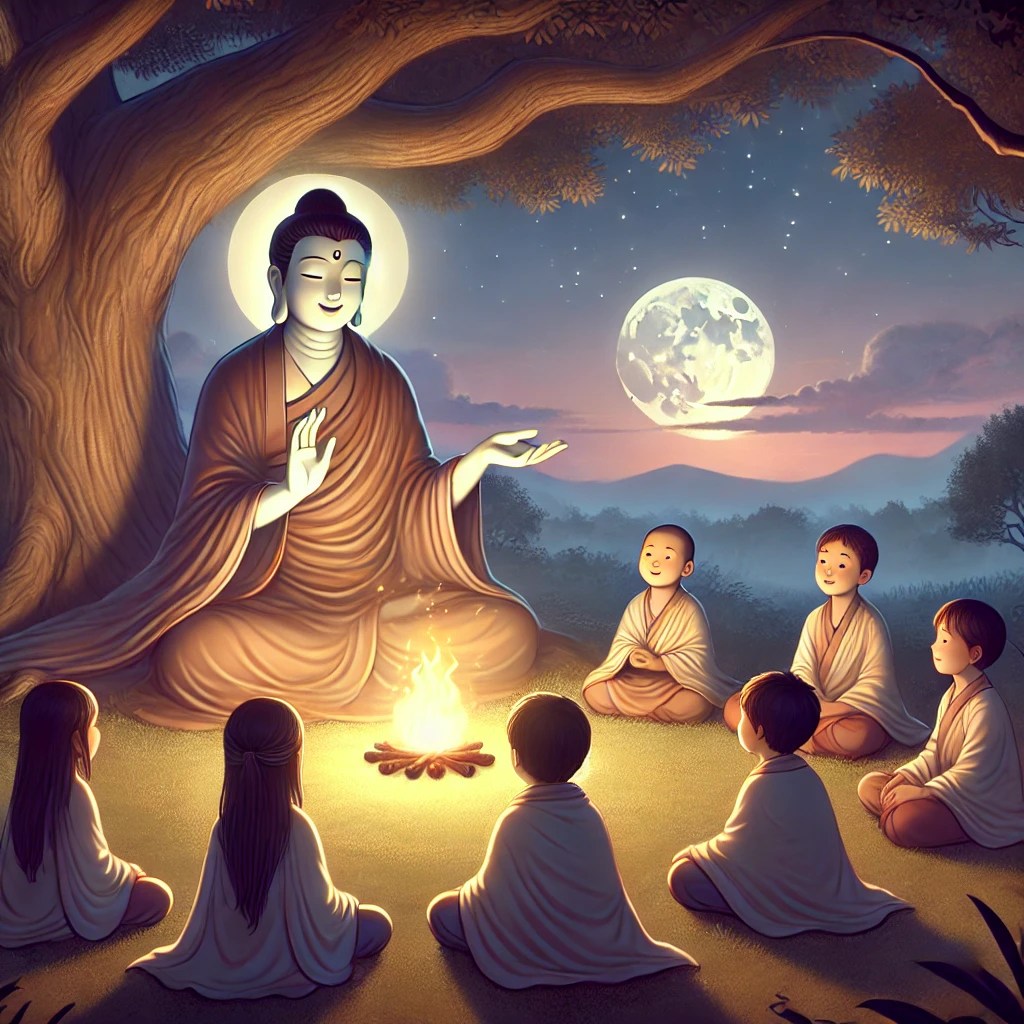
Chenrezig often told stories to children, knowing that their hearts could understand what adults often forgot. One evening, as the stars glimmered softly above, Chenrezig gathered a group of children around a fire. They looked up at him with curious eyes, waiting for one of his famous stories.
“Tonight,” Chenrezig said, “I will tell you a story about a great medicine—a medicine for the heart and mind. It is the mantra OM MANI PADME HUM. This mantra is like the most powerful medicine a doctor could ever give, one that can heal the illness of separation and help us remember our true nature.”
He paused, watching the children lean in closer, eager to hear more. “But first,” he continued, “you need to understand something important. Imagine that you are wearing many layers of clothing—so many layers that you forget what you look like underneath. Each layer is like a thought or feeling you tell yourself: I’m not good enough. I need to be better.
These layers are like cobwebs in the mind, making it hard to see clearly. And because we believe in these stories, we feel small and alone, like a candle separated from the flame. But the truth is, we are not the stories we tell ourselves. Beneath all the layers, beneath all the cobwebs, we are already whole, already perfect—just like a lotus flower, waiting to bloom.”
The children sat very still, imagining themselves wrapped in layers of thoughts, feelings, and stories. “How do we take off the layers?” one of them whispered.
Chenrezig smiled. “That is where the mantra comes in,” he said softly. “OM MANI PADME HUM is the medicine that clears away the layers, like a soft breeze sweeping away cobwebs. Each time you say the mantra, you peel back another layer. OM MANI PADME HUM… and the layers fall away. OM MANI PADME HUM… and your heart shines a little brighter. OM MANI PADME HUM… and with each breath, you get closer to your true self—your Buddha nature, the part of you that is pure love and compassion.
He began to explain the meaning of the mantra, his voice gentle and full of care. “The first syllable, OM, is the sound of the universe waking up. It reminds us that we are connected to everything—to the stars, the rivers, the animals, and each other. OM is the sound of coming home to our true nature.”
The children closed their eyes, listening to the sound of OM as if it were rising from the earth, the sky, and their own hearts all at once.
“The next two words,” Chenrezig continued, “are Mani Padme—the jewel in the lotus. This means that inside each of us is a precious jewel—the light of wisdom and love. But just like a lotus flower that grows in muddy water, this jewel can be hidden by layers of thoughts and beliefs. Each time we chant Mani Padme, we open the lotus a little more, revealing the jewel inside.”
The children imagined a lotus flower blooming in their hearts, each petal unfolding slowly, with a bright jewel glowing at its center.
“And finally,” Chenrezig said, “we have Hum. This is the sound of unity—the sound that brings everything together. It is the moment when we remember that we were never separate, not from others, not from love, and not from our true nature. Hum is the sound of the Buddha mind awakening within you, shining with pure compassion.”
The children whispered the mantra softly: OM MANI PADME HUM… OM MANI PADME HUM… Each repetition felt like a breeze clearing away the cobwebs in their minds, helping them feel lighter and brighter.
“Now,” Chenrezig continued, “let me tell you one more secret. The mantra doesn’t just help you remember who you are—it helps others too. Every time you chant OM MANI PADME HUM, you are planting seeds of compassion, not just in your own heart, but in the hearts of all beings. These seeds will bloom in ways you may never see, bringing kindness and peace into the world.”
He placed a hand over his heart. “It’s like sharing a gift that never runs out. Each time you say the mantra, you are offering love to the whole universe.”
The children sat quietly for a moment, feeling the beauty of the mantra settling into their hearts, like a gentle rain nourishing the earth. “So the mantra is like a magic medicine?” one child asked softly.
Chenrezig smiled. “Yes,” he said. “It is a medicine for the heart, a way of peeling back the layers until only love and wisdom remain. It helps us remember that we are not small or separate—we are like the ocean, vast and full of life. And each time we chant the mantra, we bring a little more light into the world.”
As the fire crackled softly, casting warm orange light on their faces,Chenrezig leaned closer to the children. “Now, as you drift off to sleep tonight, you can let the mantra carry you, like a boat floating gently down a river. Whisper it in your heart: OM MANI PADME HUM… OM MANI PADME HUM… Let it peel back the layers of your mind, revealing the jewel of compassion that has always been there.”
He kissed each child on the forehead and offered a final blessing:
OM MANI PADME HUM . . .
“With each breath, may you awaken to your true nature.”
“With each dream, may your heart bloom in kindness.”
“May all beings remember their light, and may the world be filled with peace.”
The mantra hummed softly in their hearts: OM MANI PADME HUM, OM MANI PADME HUM… clearing away the cobwebs, layer by layer, revealing the truth that they were never separate, but always part of the great ocean of love.
May your hearts always shine with the light of compassion, and may OM MANI PADME HUM guide you, now and always. Sleep well, children. The jewel in the lotus is already blooming within you.
As the children drifted into a peaceful sleep, the mantra whispered in their hearts… OM MANI PADME HUM… until their dreams were filled with rivers of kindness, endless skies of compassion, and the light of love.
Goodnight, little one. ❤️
🙏🕊️🙏
If you’d like to explore more bedtime stories for children, including tales that nurture compassion and mindfulness, you can find our collection here.
When post-viral ME/CFS first appeared in my life over 30 years ago, it was like a sudden, uninvited guest that turned everything upside down. The plans I had carefully laid out—the career, the teaching, the travel—came to a screeching halt. My body, which once felt like a reliable vehicle for my ambitions, became a source of constant limitation.
For many people today, especially in the aftermath of COVID, the experience of long COVID or post-viral ME/CFS can feel like a similar trainwreck. The life you knew, the expectations you had, are suddenly out of reach, and you’re left grappling with a new reality—one that modern medicine often struggles to explain, let alone resolve.
I remember the early days well. The confusion, the depression, the overwhelming frustration that came with the unrelenting fatigue. In the beginning, it was hard to see any way forward. It felt like I was being asked to surrender everything I had worked for, again and again. Every time I hit a new limit, I had to lower the bar, lower it again, and lower it even further. It was a painful process of letting go, not just of my physical abilities, but of my identity and the future I had imagined for myself.
But over time, and through countless moments of surrender, I began to see that while the path I had planned was no longer possible, there was another way forward. It was a quieter path, more inward, but it was no less valuable. Writing became my outlet, my way of contributing to the world, even while living in solitude and spending much of my time in bed.
For those of you reading this who are newly facing the reality of post-viral ME/CFS, I want to acknowledge that this is not an easy journey. It’s okay if you need to take breaks, both from reading and from the mental and emotional load of processing what this diagnosis means. Be gentle with yourself, and if you find the post too long, take it in pieces, come back when you’re ready. The key is to pace yourself, in life and in reading.
Surrendering to a New Reality
One of the hardest lessons I had to learn was surrender—over and over again. Post-viral ME/CFS teaches you that you can’t control everything, no matter how hard you try. Every time I felt like I was getting close to managing the illness, there would be a setback. My energy would crash, and I’d find myself in bed for days or weeks at a time. At first, it felt like defeat. I had to give up so many aspects of life I’d taken for granted.
But over time, I realized that surrendering wasn’t about giving up. It was about accepting what is, rather than constantly struggling against it. The more I fought the reality of my illness, the more frustration I experienced. Letting go didn’t mean that I had to stop hoping or working toward better health, but it did mean that I had to stop resisting what I couldn’t change in that moment.
Surrendering, in this sense, became a way to make peace with the limits of my body, to find moments of ease even when everything else felt out of control. It was an ongoing practice, one that I still revisit, especially on difficult days.
Navigating Others’ Reactions
In addition to learning how to surrender, one of the most difficult challenges I faced early on was dealing with other people’s reactions. In those early days, many people didn’t even believe post-viral ME/CFS existed. I heard things like, “You just need to drink more coffee,” or, “Have you thought about taking naps?” Even when I was officially diagnosed as disabled by the government, my own mother thought I was just lazy and needed to be more active.
This kind of misunderstanding, disrespect, and dismissal is, unfortunately, a common experience for many who suffer from post-viral ME/CFS. Family, friends, and even doctors would question or deny my experience. I’ve heard stories of doctors telling their patients not to even talk about ME/CFS because it “doesn’t exist.” It was often treated as a garbage-pail diagnosis, or dismissed entirely.
While there is more understanding of post-viral ME/CFS today, the stigma still remains. Making peace with this aspect of the illness has been a long journey. What helped me most was cultivating compassion, not just for myself but for others. As Jesus said, “Forgive them, for they know not what they do.” Having compassion for the people in your life who may deny or diminish your experience is a key part of finding peace.
An Evolving Perspective on Post-Viral ME/CFS
In the early days of my journey with post-viral ME/CFS, I found myself going through what felt like the stages of grief as described by Elizabeth Kubler-Ross. At times, I thought I might be dying, and I cycled through stages of anger, grief, depression, and confusion. Acceptance didn’t come quickly, and it took years of processing and reflection before I could reach that place.
One of the major steps toward acceptance came when I read How to Be Sick by Toni Bernhard. This book resonated deeply with me, and for the first time, I felt like someone truly understood what I was going through. Toni’s reflections on illness gave me a new sense of validation and self-respect, and her practical tips helped me develop a healthier way of relating to my experience. I highly recommend this book to anyone struggling with post-viral ME/CFS.
Then, during a meditation class organized by students of Sogyal Rinpoche, based on The Tibetan Book of Living and Dying, I began to find deeper peace. It was around this time that I discovered a Tibetan sutra titled Transforming Suffering and Happiness onto the Path of Enlightenment. This teaching profoundly shifted my perspective once again.
As I read the sutra, I realized that my anger, frustration, and negative emotions were not only draining my energy but also exacerbating my symptoms. It became clear to me that these stressful emotions were making my condition worse, and that when I was able to relax, let go, and find inner peace, I had greater capacity and longer periods of activity without crashing—or without crashing as severely. This was an important revelation: cultivating acceptance, forgiveness, and inner peace didn’t just feel better, it actually minimized my symptoms.
Shifting Perspective: The Sutra That Changed Everything
One passage from the Tibetan sutra resonated deeply with my experience of post-viral ME/CFS:
“Whenever we are harmed by sentient beings or anything else, if we make a habit out of perceiving only the suffering, then when even the smallest problem comes up, it will cause enormous anguish in our mind.”
This teaching hit home because, for a long time, I had been focusing only on the suffering. Everything in my life had become an enemy—my body, my circumstances, even the people around me. The more I centered my awareness on the pain and limitations, the heavier everything felt. Even the smallest setback would feel unbearable.
The sutra showed me that the more we focus on suffering, the more it grows and colors everything we experience. By recognizing this, I began to understand that shifting my focus away from the suffering and toward acceptance could help me find peace. It wasn’t about denying the reality of the illness, but about no longer letting it dominate my entire perspective.
The true transformation came not only by making peace with suffering but by learning to approach both suffering and happiness with the same equanimity. I had to remind myself that when I’m unhappy, this too shall pass, and when I’m happy, this too shall pass. This reminder became a useful way to stay balanced through the ebb and flow of life—the good days and the bad days, the good months and the bad months.
Additionally, I found comfort in William Blake’s words: “He who kisses the joy as it flies lives in eternity’s sunrise.” It reminded me to appreciate the little moments of happiness, to savor them without attachment, knowing that they, too, are fleeting. This perspective helped me not to be disturbed by the constant changes and to find a sense of peace amidst it all.
Discovering a New Path: Writing as Healing
As I continued to navigate the ups and downs of post-viral ME/CFS, I eventually found a new passion that helped me stay connected to the world and give expression to my inner journey: writing. Although much of my life is spent in solitude, and my physical abilities are limited, writing has become my outlet, a way to contribute and share what I’ve learned.
Through writing, I’ve been able to explore the lessons of impermanence, forgiveness, and acceptance, not just for my own growth but as a way to offer encouragement to others walking a similar path. Chronic fatigue may limit what I can do in the physical world, but it has opened up this creative space where I can still connect, reflect, and contribute.
In this way, writing became not just a coping mechanism but a practice of karma yoga, an offering. It’s a way to kiss the joy as it flies, even amidst the challenges of chronic illness, and to embrace each moment—whether in suffering or happiness—as an opportunity for growth.
🙏🕊️🙏
“He who binds to himself a joy Does the winged life destroy; But he who kisses the joy as it flies Lives in eternity’s sunrise.”
Harnessing Inner Peace: A Pacing Toolkit Tool for Those Living with ME/CFS or Long Covid
As I reflect on the approaching Hurricane Milton, I’m reminded of the powerful moment when Jesus calmed the storm on the Sea of Galilee. His disciples, gripped by fear, watched as He simply said: “Peace! Be still!” and the storm settled. In this moment, I feel called to do the same—to access the peace of God within me and speak to the storm, “Peace! Be still.” I truly believe this is what Jesus asks of us, to practice this promise, and to remember that even faith the size of a mustard seed can move mountains.
But this call to peace and stillness isn’t just about the external storm. As someone who lives with chronic fatigue, I know how much of a difference it makes to calm the storms within as well. The mental and emotional stress can often intensify symptoms like post-exertional malaise (PEM). So, I remind myself to relax my mind and heart, to let go of worry and concern, and to give my body the space it needs to heal.
One of the tools I turn to in these moments is Pristine Mind Meditation, as taught by Orgyen Chowang in his book Pristine Mind: Journey to Unconditional Happiness. Pristine Mind is the pure, natural awareness that exists within all of us, untouched by thoughts or emotional turmoil. By resting in this space, I find that it helps me manage my symptoms, reduce stress, and pace myself more effectively. It’s an essential part of my pacing toolkit, allowing me to not only physically rest, but also calm my mind and emotions, preventing flare-ups of PEM and other symptoms.
In this moment, I invite us all to join together in saying to the storm—whether it’s the physical hurricane or the inner storms we face—“Peace! Be still.” Let’s tap into the divine promise that’s always been ours and use the tools we have to cultivate peace, clarity, and healing within ourselves.
Let us, from a place of faith and trust, send love to this storm and say to it: “Peace, be still.”
For those of us living with post-viral myalgic encephalomyelitis (ME/CFS), the experience of life often feels like moving through a landscape filled with unseen obstacles. There is the fatigue—so heavy, so relentless—that it can feel like a weight we will never shake. There are the moments when even the simplest tasks become insurmountable, and the pain becomes a constant companion, whispering in the background of every day.
When I first encountered the teaching “Transforming Suffering and Happiness into Enlightenment” by Dodrupchen Jigme Tenpe Nyima, it felt like someone had gently opened a door I hadn’t known existed. At the time, I was entrenched in my own struggle—fighting the fatigue, resisting the pain, angry at the injustice of it all. I didn’t see it then, but my resistance, my frustration, and my desperate need for things to be different were only making me sicker. Each day felt like another battle against my body, and it was exhausting in every sense of the word.
The teaching introduced me to an entirely different way of relating to my experience. It was an invitation, not to fight against my suffering, but to sit with it, to gently turn toward it with a kind of curiosity. At first, the idea seemed absurd—how could I welcome something that was robbing me of so much? But as I read further, I began to understand that the more I resisted, the more I labeled my suffering as the enemy, the stronger it became. Everything around me had started to feel like an enemy—my body, the illness, even the world itself.
The first time I truly absorbed the idea that suffering, like anything else, grows stronger with the attention we give it, it was a revelation. I started to realize that I had been feeding my suffering through my resistance. In a way, I was making myself worse by constantly pushing against the reality of what I was experiencing. This was the first eye-opener: that my own mind was contributing to the intensity of my suffering.
I remember vividly when I decided to start putting this teaching into practice. I had signed up for a meditation class, feeling both hopeful and uncertain, and around that time, I also came across Tony Bernhardt’s book How to Be Sick. Little by little, I began to change how I approached the fatigue and pain. It didn’t happen overnight. In fact, it felt like planting seeds in the darkest soil—there were days when nothing seemed to grow, and I wondered if this new approach would ever bear fruit. But gradually, something did begin to shift.
The more I learned to observe my suffering without immediately pushing it away, the more space I created around it. It wasn’t that the fatigue disappeared—far from it—but my relationship to it began to change. Instead of seeing every wave of exhaustion as something to fight, I started to meet it with a kind of quiet acceptance. This didn’t mean I liked it, but I stopped resisting it quite so fiercely. In time, the constant anger and frustration began to soften.
As I practiced more, something else began to emerge—equanimity. I began to realize that the less I resisted both the suffering and the rare moments of joy, the steadier I felt inside. Over the years, my confidence in my ability to face difficulties has grown. There’s a quiet knowing now, a calmness that wasn’t there before, that when challenges arise, I can meet them without being completely swept away.
Of course, this is still a work in progress, and I expect it will be for the rest of my life. Some days are harder than others, but the difference is that I no longer see the hard days as failures. They are simply part of the ebb and flow. And in learning to embrace both the suffering and the moments of peace, I’ve discovered a kind of strength that doesn’t come from fighting but from surrendering—surrendering to the reality of my experience without letting it define me.
This teaching has shown me that suffering, far from being something to avoid, can become a profound teacher. When we allow ourselves to meet it with openness, we can begin to transform it. It doesn’t mean the pain or the fatigue will disappear, but our relationship to it changes. We become less fragile, more resilient. Over time, the suffering no longer feels like something that has complete power over us.
For those of us living with ME/CFS, this teaching offers a way to shift the narrative. Instead of seeing our illness as something that has taken everything from us, we can begin to see it as part of our path. By practicing mindfulness, by gently turning toward our suffering instead of away from it, we begin to cultivate a heart that is steady, a heart that can hold both the fatigue and the fleeting moments of ease without being shaken by either.
It’s a slow process, and it requires patience—patience with ourselves and with the process of healing. But there is a quiet beauty in this work. Each time we meet our suffering with compassion, we are planting a seed. And while the fruits may take time to blossom, they do eventually grow.
For those of you who are interested in exploring this teaching more deeply, I encourage you to take your time with it. Let it sit with you, and consider how it might apply to your own experience. And if you’d like to read the full teaching by Dodrupchen Jigme Tenpe Nyima, you can find it freely available online here.
This journey isn’t easy, but together we can learn to transform our suffering into something that doesn’t just weigh us down but also lifts us toward a deeper understanding of ourselves and the world around us.
🙏🕊️🙏
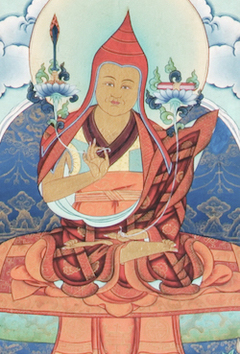
Biography of Dodrubchen Jigme Tenpai Nyima
Dodrubchen Jigme Tenpai Nyima, the Third Dodrubchen, was born in 1865 in the sacred Ma valley of Golok, Tibet, into a family deeply rooted in the spiritual lineage of his father, Dudjom Lingpa. From the very beginning, his life was marked by extraordinary recognition, with his teachers and mentors seeing in him the incarnation of profound wisdom. But his journey was not without struggle. As a young boy, he found study difficult, often frustrated to the point of tears. Yet, through perseverance and the support of his teachers, his understanding blossomed, revealing a deep capacity for spiritual insight.
What makes Dodrubchen Jigme Tenpai Nyima so relatable is his humanity. Even as a master of Tibetan Buddhist teachings, he encountered challenges that shaped him into the teacher he became—a man of great compassion, who dedicated his life to training countless students in both Nyingma and Sarma traditions. His accomplishments were vast: he rebuilt his monastery, composed celebrated commentaries, and gave teachings tirelessly. And though he eventually retreated into seclusion due to his failing health, he continued to guide his closest disciples with unwavering dedication. His life, both ordinary and extraordinary, stands as a testament to the power of persistence, humility, and the profound depth of spiritual commitment.
About Lotsawa House
Lotsawa House is a rich and invaluable resource for those seeking authentic Tibetan Buddhist teachings. The website offers an extensive collection of translations from Tibetan texts, including teachings from many great masters such as Dodrubchen Jigme Tenpai Nyima. This is where the teaching “Transforming Suffering and Happiness into Enlightenment” can be found, along with countless other treasures, all freely available for anyone to access.
Whether you are new to Tibetan Buddhism or have been practicing for years, Lotsawa House provides a space to explore the wisdom of these great teachings. The site is dedicated to making the profound texts of Tibetan Buddhism accessible to a global audience, offering translations in English and other languages, so that anyone, regardless of background, can benefit from these ancient spiritual insights. It’s a place where the wisdom of the Tibetan masters is preserved and shared, so that all who seek it may find the path to peace and understanding.
You can explore the full collection of teachings and discover more about the great teachers who brought them to life by visiting Lotsawa House.
Embracing the Eternal Now: Cultivating Spiritual Presence in Daily Life
A Journey Through Mindfulness, Equanimity, and Spiritual Connection
In the whirlwind of our daily lives, it’s easy to become consumed by the relentless pace of duties, responsibilities, and the constant barrage of information. The echoes of the past and the whispers of the future often tug at our attention, leaving us fragmented and seldom at peace. Yet, the present moment holds a profound promise—the promise of true clarity and peace.
Cultivating a relaxed mind not only enhances our ability to navigate everyday challenges with grace but also opens us to deeper insights and a greater connection with our true selves. By learning to inhabit the moment fully, we unlock the potential to transform our entire life’s experience, fostering a state of well-being that radiates outward in our thoughts, actions, and interactions.
How, then, can we cultivate a state of equanimity and truly leave our minds alone? Here are some guiding principles to help us navigate this path.
Don’t Follow the Past
It’s easy to be pulled back into the past. Imagine sitting quietly and suddenly a memory from a past mistake creeps in, clouding your mood and stealing the peace of the current moment. However, dwelling in the past often means missing out on the now—on the opportunity to engage fully with life as it happens. Letting go of the past involves an understanding that every moment is a chance to start anew, to choose differently, and to move forward with a lighter heart.
Practical Tip: Whenever you find yourself anchored to a past memory, gently remind yourself, “This memory is not my current reality.” Allow yourself to feel any emotions associated with it and then visualize setting it adrift down a river, watching it fade with compassion and detachment.
Don’t Anticipate the Future
Similarly, projecting our thoughts into the future can be just as distracting. Consider a scenario where you’re planning a meeting and start to worry excessively about its outcome, which then consumes your thoughts and disrupts your present work. Worrying about what’s yet to come not only breeds anxiety but also prevents us from taking actionable steps in the present that could actually mitigate those concerns.
Practical Tip: Practice grounding exercises when you find your mind darting forward. Focus on your senses—what can you see, hear, touch, taste, and smell right this moment? This practice helps bring you back to the present and reduces anxiety about the future.
Remain in Equanimity
Equanimity is the balanced state where we are not swayed by the highs of joy nor the lows of despair. Imagine receiving news that would typically upset you, but instead of reacting impulsively, you remain calm, reflecting on the situation with a balanced perspective. It is a place of mental stability and composure that allows us to face life’s challenges with a calm and steady mind.
Practical Tip: Develop a daily meditation practice. Even five minutes a day can help you cultivate a neutral mind that approaches all situations with balance and clarity.
Leave Your Mind Alone
At times, the best action is inaction. Consider watching your thoughts during a stressful moment, like observing clouds moving across the sky, without attempting to change their direction or speed. Leaving your mind alone means not meddling with your thoughts as they arise. It’s about observing them without judgment and letting them pass without attachment.
Practical Tip: Engage in mindfulness meditation where the goal is not to empty the mind of thoughts, but to observe them coming and going, like clouds across a vast sky.
Listening for the “Still Small Voice”
For our Christian friends, embracing the present moment can be seen as an opportunity to listen for the “still small voice” of God, as described in 1 Kings 19:12, where Elijah encounters God not in the earthquake or fire, but in a gentle whisper. Taking time each day to let go of our busy, distracted minds to rest in the Holy Spirit allows us to connect with divine guidance and comfort.
Similarly, the story of young Samuel from 1 Samuel 3:1-10 beautifully illustrates the process of becoming attuned to the divine voice. Mistaking the Lord’s call for Eli’s voice, Samuel’s repeated response, “Here I am,” eventually aligns with divine communication when he says, “Speak, Lord, for your servant is listening.” This moment of realization exemplifies the importance of being truly present, ready to receive spiritual guidance.
The Jewish Tradition of Hineni
In the Jewish tradition, the phrase “Hineni” – “I am here,” uttered by prophets like Abraham and Moses, represents a total, undistracted presence to the divine call. This sacred declaration is not just a statement of location but a profound acknowledgment of being fully present—spiritually, mentally, and physically—ready to engage with whatever God asks of them without hesitation.
Why It Matters
Understanding the distinction between simply being present and being spiritually present can transform the practice from a routine exercise to a life-changing discipline. The spiritual practice of presence is not about enduring the present but about uncovering an ever-present peace that enlightens and sustains us. It is here, in this sacred space, that we encounter the divine, the infinite, and the eternal right within our everyday moments.
🙏🕊️🙏
If you’re interested in exploring this transformative approach further, I highly recommend Orgyen Chowang’s book The Pristine Mind. His teachings provide a clear, compassionate path toward uncovering the inherent purity of our mind, offering a source of deep fulfillment and lasting peace.
In our journey towards healing and spiritual growth, we often find that different traditions offer similar paths to wellness and inner peace. Whether we are invoking the Medicine Buddha or calling upon the Holy Spirit, the essence remains the same: seeking the divine light of healing. This post explores the universal nature of this healing energy, demonstrating how both the Tibetan Medicine Buddha mantra and the Christian invocation of the Holy Spirit guide us towards transformation and renewal.
The Essence of Healing
Healing is a journey, not just of the body, but of the mind and spirit. The Medicine Buddha mantra calls upon the essence of healing, inviting us to connect with a deeper source of wellness and harmony. By reciting these words, we align ourselves with the energy of the great healer, the one who transcends the boundaries of physical ailments and touches the core of our being.
Hail to the Healer
In the phrase “hail to the healer,” we express reverence and gratitude. This healer is not confined to the realm of the divine but exists within each of us. By acknowledging and honoring this inner healer, we empower ourselves to take an active role in our own healing journey. We salute the wisdom and compassion that reside within, guiding us towards wholeness and balance.
The Great Healer
The term “great healer” underscores the boundless nature of this healing energy. It is not limited by time, space, or circumstance. The great healer is a reminder that we are supported by an infinite source of love and light, capable of transforming our deepest wounds into opportunities for growth and renewal.
Healer of the World
As we invoke the “healer of the world,” we recognize the interconnectedness of all beings. Our healing is not an isolated event but a ripple that extends outwards, touching the lives of others. By embracing our own healing, we contribute to the collective well-being of the planet. This mantra becomes a prayer for global harmony, fostering a sense of unity and compassion for all.
May Your Light Ascend
Finally, the plea “may your light ascend” is a call for enlightenment and upliftment. It is an invitation for the divine light to rise within us, dispelling darkness and illuminating our path. As we chant these words, we open ourselves to the transformative power of this light, allowing it to guide us towards a higher state of consciousness and peace.
Integrating Christian Perspectives: The Holy Spirit as Healer
The invocation of healing through the Medicine Buddha mantra can be closely aligned with calling upon the Holy Spirit. In Christian tradition, the Holy Spirit is often described as the comforter, guide, and healer. Just as the Medicine Buddha represents the embodiment of healing, the Holy Spirit embodies divine healing and guidance in the Christian faith.
The phrase “hail to the healer” can thus resonate deeply with Christians who invoke the Holy Spirit. The Holy Spirit is the source of infinite love and light, capable of bringing about profound transformation and renewal. By recognizing this parallel, we can see that whether we are chanting “Om, hail to the healer” or praying for the Holy Spirit’s presence, we are opening ourselves to the same divine energy of healing and compassion.
Embracing Interfaith Healing
By acknowledging the similarities between the Medicine Buddha mantra and the invocation of the Holy Spirit, we foster a sense of unity and shared purpose. Healing, in its truest form, transcends religious boundaries and speaks to the universal human experience of seeking wellness and peace.
Integrating the Mantra into Daily Life
Incorporating the Medicine Buddha mantra or invoking the Holy Spirit into our daily practice can be a source of profound healing and inspiration. Here are a few ways to weave these sacred practices into your routine:
Morning Meditation or Prayer:
Begin your day with a few minutes of chanting the mantra or praying for the Holy Spirit’s guidance, setting a tone of healing and positivity.
Healing Visualizations:
As you recite the mantra or pray, visualize a radiant light enveloping you and extending to others, promoting physical and emotional well-being.
Mindful Moments:
Throughout the day, take pauses to silently or audibly chant the mantra or offer prayers, bringing a sense of calm and centeredness.
Evening Reflection:
End your day by reflecting on the healing energies you’ve experienced, offering gratitude for the light within and around you.
Conclusion
“Om, hail to the healer, the great healer, the healer of the world, may your light ascend!” These words are more than a mantra; they are a beacon of hope, a testament to the power of healing that lies within each of us. By embracing this sacred chant or invoking the Holy Spirit, we embark on a journey of transformation, guided by the light of the great healer towards a world of compassion, unity, and peace.



 Home Page: Inspirations of Love and Hope