Tag: spiritual growth

  • The Quiet Art of Pacing: Living with ME CFS

    The Quiet Art of Pacing: Living with ME CFS

    There is a kind of life that moves beneath the surface of what others might call living—a life that hums in the pauses, in the spaces where action halts and breath lingers. For those of us with Myalgic Encephalomyelitis/Chronic Fatigue Syndrome (ME CFS), life unfolds not in grand gestures but in the delicate negotiation between movement and stillness, between doing and being.

    It is a life measured in moments of energy so fleeting and precious that they slip through our fingers like water if we are not careful. And so, we learn to hold them gently. We learn the art of pacing—a quiet, intricate dance with the body, the mind, and time itself.


    Listening to the Whisper Beneath the Noise

    At first, pacing may seem like a restriction, a bridle holding you back from the gallop of life. But in time, if you listen closely—no, not just listen, but feel—you realize it is not a prison but a kind of language your body speaks. A whisper beneath the noise.

    There is a moment, just before the crash comes, when the body begins to murmur. A soft weight behind the eyes, a flicker of thought that stumbles, a breath that feels heavier than the last. These are the early signals, the body’s gentle plea: pause.

    It is in this space, between the whisper and the roar, that pacing lives.


    The Shape of a Day, Redrawn

    Pacing is not about doing less; it’s about doing differently. It is the re-imagining of time, the reshaping of how a day unfolds. Where once you might have filled your hours with tasks and plans, now you learn to weave rest into the rhythm of your day, like threads of gold through ordinary cloth.

    You might wash the dishes, but not all at once. You pause midway, let the water cool on your hands, and sit quietly, letting your breath find its rhythm again. You might write an email, but only after resting first, and you’ll rest again afterward—because even thinking, even hoping, takes energy you no longer have in abundance.


    Finding Rest in Unexpected Places

    And rest—ah, rest is not always what the world thinks it is. Rest is not just lying in bed, staring at the ceiling while the mind races ahead of the body’s capacity. Rest can be the soft drift of music filling the room, or the slow tracing of light as it moves across the wall in the late afternoon. Rest can be found in the spaces between thoughts, in the warmth of a cup of tea held in still hands.

    Rest becomes an art of presence, of being where you are without pushing against the boundaries of what is possible today.


    The Creative Dance of Energy

    Some days, you find new ways to move within these limits, like an artist working within the edges of a canvas. You might use technology as a bridge—a voice-activated assistant that changes the song when you’re too tired to lift a finger, or a reminder app that gently nudges you when it’s time to pause.

    You might practice the delicate balance of task rotation: a bit of writing, then a moment watching the sky; folding laundry, but only after you’ve closed your eyes for a while. You discover the gift of delegation, the quiet courage in asking for help, and the grace in receiving it.

    Some days, even the lightest touch of movement—a stretch, a breath, the soft turning of your neck toward the window—feels like enough. And it is.


    The Emotional Currents Beneath It All

    But there is more than the body to tend to. There is the heart, too, learning to live with the grief of lost abilities. There are days when you long for the world you once knew, for the ease of spontaneity, for the thoughtless rush of energy that now feels like a distant memory.

    Yet, in the slowing down, in the careful pacing, you may find something unexpected: a deeper presence, a richer noticing of life’s quiet details. The way the morning light catches in the folds of your blanket. The softness in the voice of a friend who understands. The tender resilience that blooms in the space where struggle meets acceptance.


    Living Within, and Beyond, the Limits

    Pacing is not a giving up. It is a learning to live differently. It is an intimate conversation with yourself, a deep knowing of what you can do and when to stop. It’s about honoring the ebb and flow of your energy, like tides that you no longer fight but learn to move with.

    And in this dance, in this art of balancing effort and ease, you find that life still holds beauty—not in spite of the limits but sometimes because of them. The smallest joys become treasures, and the quiet moments shimmer with meaning.

    Because even within the narrowest confines, life finds a way to bloom.


    🙏🕊🙏
  • Can you help me rest in awareness and discover inner-peace?

    Can you help me rest in awareness and discover inner-peace?

    Yes. Take a moment to settle, feeling the body where it is. Let your attention gently turn inward. Notice any sensations in the body, any thoughts passing through the mind, or emotions present right now. Just observe them, without trying to change or control anything.

    Now, quietly ask yourself: Who is aware of these sensations, these thoughts, these emotions?

    Don’t look for an answer in words. Let the question open a quiet space within you. Rest in that still, silent awareness—the place from which everything arises and into which everything fades.

    Stay with this gentle noticing, and see what naturally unfolds.

    InnerPeace

    Self-inquiry

    LoveAndRespect

    Compassion

    🙏🕊🙏

  • A Refuge That’s Never Truly Out of Reach

    A Refuge That’s Never Truly Out of Reach

    For those of us living with chronic fatigue syndrome (ME/CFS), finding peace can often feel like an elusive dream. The body aches, the mind fogs, and even the simple act of resting can feel like a challenge.

    But beneath the surface of our struggles—beneath the exhaustion, frustration, and the endless cycle of unfinished stories—there is a refuge that has never left us. A place within that remains untouched, waiting patiently to be noticed.

    Across traditions, this inner sanctuary is described in many ways. In Christianity, it is the peace that passeth understanding, the quiet presence of the Holy Spirit that calms the heart. In Buddhism, it is our Buddha nature, the still, pristine mind that shines beneath our thoughts. In Jewish practice, Shabbat offers a sacred pause from the world’s demands, a time to rest in the presence of the I AM. Whether through Vipassana’s gentle observation, Samatha’s calming focus, or the surrender of “Let go and let God,” the invitation is the same: to rest in the peace that is always there, even if just for a moment.

    But here’s the truth that many of us don’t expect—when we set the intention to relax, to find that peace, it’s common for our minds to do the exact opposite. The very moment we try to slow down, all the unsettled thoughts, worries, and frustrations rise to the surface. It’s like sitting down to meditate and suddenly realizing just how noisy the mind really is. For those of us with ME/CFS, this can feel especially overwhelming. Our bodies are already weighed down by fatigue, and now our minds seem unwilling to give us the rest we crave.

    But this isn’t a sign of failure—it’s part of the process. Just as clouds drift across the sky without altering the vastness behind them, our thoughts come and go without touching the deeper peace within us. The key is not to fight these thoughts, not to grow frustrated or discouraged, but to witness them with gentle curiosity. To let them rise and fall, trusting that underneath the noise, the stillness remains.

    This practice takes more than just patience—it requires self-compassion. We have to be kind to ourselves, especially when the mind feels restless or when peace feels far away. Forgiveness becomes a part of the journey: forgiving ourselves for not feeling better, for being frustrated, for wishing things were different. And most of all, it requires surrender. To let go of the need to control how or when peace arrives, and to trust that it will reveal itself in its own time.

    Over the past month, I’ve faced one challenge after another—the sale of my RV, packing up a home that had been my refuge for over 30 years, and the physical demands of moving into a new apartment. Each step of the process required me to push beyond my body’s natural limits, triggering post-exertional malaise. There were moments I had to override the signals of fatigue just to get through the next task, knowing full well the cost it would bring later. And yet, I approached it as mindfully as I could, listening when possible, resting when needed, and trusting that I would eventually return to the gentle rhythm of proper pacing.

    Now, as I settle into this new space, I look forward to reclaiming that mindful practice of pacing—of finding the balance between effort and rest, between doing and simply being. Even though my body is still recovering, I know that the peace I’m seeking is not dependent on my circumstances. It’s always there, beneath the surface, waiting for me to slow down, to breathe, and to notice.

    And so, I offer this to you—whether you live with ME/CFS, face chronic challenges, or are simply navigating the complexities of life. The path to peace isn’t always smooth, and the mind may resist at first. But beneath the noise, the frustration, and the exhaustion, there is a refuge that has never left you. It’s not something you have to create or chase—it’s already there, waiting to be noticed.

    Let go. Be kind to yourself. Trust the process.

    And when you least expect it, that peace—the one that passeth understanding, that shines with the light of your Buddha nature, that whispers with the breath of the Holy Spirit—will rise to meet you.

    Because the truth is, that refuge is never truly out of reach.

    🙏🕊🙏

  • Blessings honoring the interconnectedness of all life:

    Blessings honoring the interconnectedness of all life:

    May you feel at ease today, in body and mind,
    Flowing naturally with the unfolding Tao.
    May the winds be gentle, the clouds at peace,
    And with each day, may wellness arise.

    Spanish / Español

    Que hoy sientas paz en cuerpo y mente,
    Fluyendo con el Tao en su danza infinita.
    Que los vientos sean suaves, las nubes en calma,
    Y con cada día, la dicha te acompañe.

    Italian / Italiano

    Che tu possa sentirti in pace oggi, nel corpo e nella mente,
    Scorrendo naturalmente con il fluire del Tao.
    Che i venti siano dolci, le nuvole serene,
    E che ogni giorno porti benessere.

    Chinese / 中文

    愿你今日身心安,
    随顺大道自流转。
    风轻云淡无忧虑,
    日日安然福自来。

    Japanese / 日本語

    今日、心も体も安らかでありますように、
    自然と道(タオ)の流れに身を任せて。
    風は穏やかに、雲は静かに、
    毎日が平和と幸せで満ちますように。

    Arabic / العربية

    أتمنى لك راحة البال والجسد اليوم،
    متناغمًا مع تدفق الطاو الطبيعي.
    لتكن الرياح لطيفة، والسحب في سلام،
    ومع كل يوم، ليزهر الهدوء والرفاهية.

    Hebrew / עברית

    שיהיה לך שקט ושלווה בגוף ובנפש היום,
    זורם בטבעיות עם התפתחות הטאו.
    שהרוחות יהיו עדינות והעננים שלווים,
    ועם כל יום, תצמח רווחה וברכה.

    Russian / Русский

    Пусть сегодня твое тело и разум будут в покое,
    Теча естественно вместе с раскрывающимся Дао.
    Пусть ветер будет мягким, облака спокойными,
    И с каждым днем пусть благополучие возрастает.

    Ukrainian / Українська

    Нехай сьогодні твоє тіло йo розум будуть у спокої,
    Течучи природно разом із розкриттям Дао.
    Нехай вітер буде лагідним, а хмари спокійними,
    І з кожним днем нехай зростає благополуччя.

    Native American (Lakota / Lakȟótiyapi)

    Lél uŋči makȟóčhe kiŋ ičháǧapi, ni én čhaŋtéwašteya waŋká yo.
    Čháŋ šíč’iya, maȟpíya wašté.
    Tatȟáŋka yuhá waštélaka,
    Lé wíyukčaŋ kiŋ, tȟawášte ye.

    (Here on Grandmother Earth, may you stand with a good heart.
    May the trees be strong, and the clouds be kind.
    Buffalo watches over you with love,
    And this day brings you peace.)

    🙏🕊🙏

  • Cultivating the Witness: A Gentle Approach to Living with Myalgic Encephalomyelitis: The Body as a Landscape of Storm and Stillness 🙏

    Cultivating the Witness: A Gentle Approach to Living with Myalgic Encephalomyelitis: The Body as a Landscape of Storm and Stillness 🙏

    To live with myalgic encephalomyelitis is to carry a body that moves like weather—one moment heavy with fog, another scattered by electric storms. The limbs, once steady, now whisper of exhaustion; the nervous system hums and flickers like distant lightning. And yet, within all of this, there is a quiet place—one untouched by fatigue, by pain, by the ever-changing tides of illness. This is the witness, the silent presence that watches, feels, but does not struggle.

    The Power of Witnessing Consciousness

    When the body is weary, and the world presses in with its demands, the mind often follows—entangled in frustration, longing, grief. Yet, there is another way to meet this experience. Instead of battling exhaustion, we can turn toward it, gently, with curiosity. Instead of resisting discomfort, we can learn to hold it, like cradling a trembling bird in our hands.

    Witnessing is not about escaping pain but about changing our relationship to it. It is the art of standing at the edge of the storm and seeing not just the thunder, but the vast sky that holds it.

    A Simple Self-Contemplation Practice

    1. Grounding in the Present
      Find a quiet moment. You don’t need perfect stillness—only a willingness to pause. Notice your body, the way it rests against the surface beneath you. Feel the breath, moving in, moving out, like waves against the shore.
    2. Observing Without Resistance
      Turn your attention inward. What is present? Fatigue like heavy earth? A nervous system like sparking wires? A mind that spins, restless and longing? Whatever it is, let it be here. Do not push it away or name it as the enemy. Simply notice.
    3. Holding with Compassion
      Imagine that each sensation is a visitor—arriving, staying for a time, and eventually leaving. What happens if you do not chase them away? What if, instead, you offer a quiet seat at your table?

    Even pain, even exhaustion, when met with this gentle witnessing, begins to soften. Not disappear, but shift—like wind through the trees, no longer trapped, no longer feared.

    How This Practice Supports ME/CFS Symptoms

    This is not a cure, nor a promise of relief, but a way of being with what is. When we meet our experience with openness:

    The nervous system settles; the fight against the body lessens.

    The mind uncoils from frustration and rests in the simple act of seeing.

    The emotional burden lightens, as we stop identifying with suffering and begin to witness it instead.

    Closing Thoughts: The Sky Holds It All

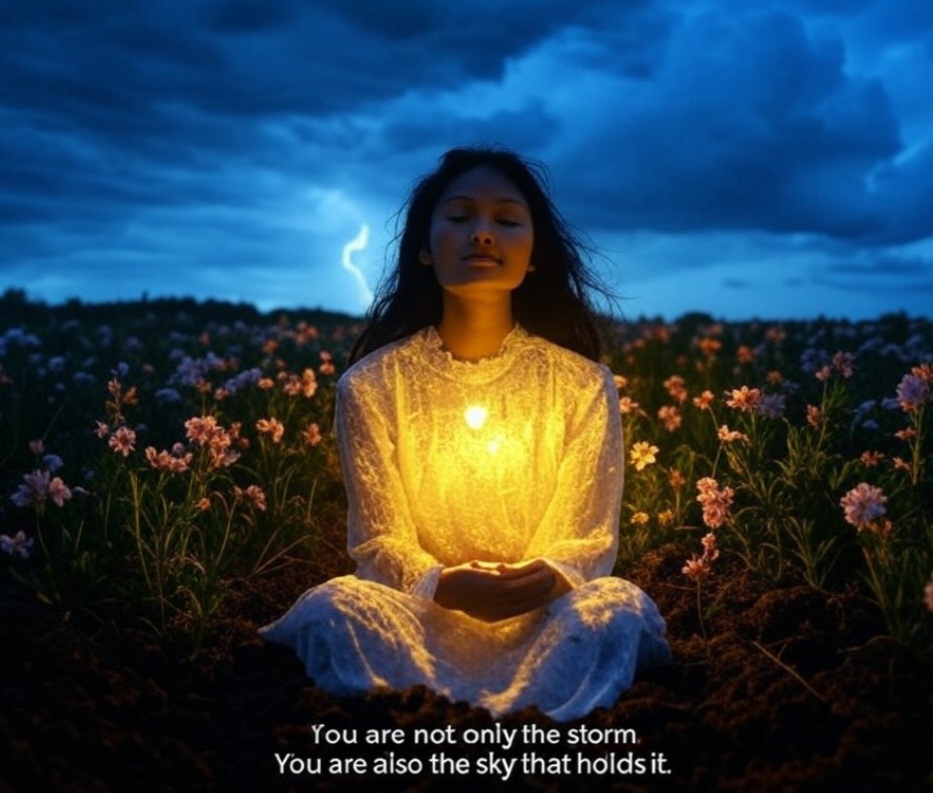
    If today your body feels like a storm, know that you are not only the storm—you are also the sky that holds it. The witness that watches, the stillness beneath the waves.

    And on days when you cannot sit in silence, when exhaustion presses too hard, let even that be witnessed with kindness. The practice is not in perfect stillness, but in the quiet turning toward whatever is here, again and again.

    Rest when you must, breathe when you can, and know that you are not alone.

    🙏🕊🙏

  • The Sky Within

    The Sky Within

    Rest, my mind, like the vast, open sky,
    Where clouds of thought drift freely by.
    No need to chase, no need to cling,
    All dissolves in the spacious knowing.

    The light of awareness shines so clear,
    Its essence untouched by hope or fear.
    Mountains may rise, rivers may flow,
    But the sky remains, steady and whole.

    Look within—there is nothing to find,
    Yet the treasures abound in the unbound mind.
    No path to walk, no goal to see,
    For you are already infinite and free.

    Let the waves of life crash and play,
    The ocean beneath does not sway.
    Rest, my being, in your natural state,
    For in this moment, you hold all fate.

    🙏🕊🙏

  • Kapalabhati Pranayama: The Shining Forehead Breath

    Kapalabhati Pranayama: The Shining Forehead Breath


    Dear Friend,

    There is a practice in yoga known as Kapalabhati, the “Shining Forehead Breath.” The very name carries with it a sense of poetry and mystery. “Kapala” means forehead, and “Bhati” means light or radiance. Together, they evoke an image of clarity, brightness, and inner illumination. This is no mere exercise but an invitation to cleanse not only the breath but also the mind and spirit, polishing the very space from which insight and intuition arise.

    In ancient times, practitioners likened this breath to polishing a mirror so that it might reflect the light of the divine. Each exhalation sweeps away impurities, and each inhalation invites the brilliance of life itself. To engage in this practice is to embark on a journey into your own radiant stillness.

    Here is how you may begin:

    1. Find Your Seat: Sit comfortably, with your spine straight and your hands resting gently on your knees. Feel the earth beneath you, steady and supportive.
    2. Breathe to Center Yourself: Take 5–7 slow, deep breaths. Let these breaths settle your thoughts and prepare you for the journey ahead.
    3. Engage the Shining Breath:
      • Take a full, deep inhale to begin.
      • Begin a series of sharp, active exhalations through your nose, allowing the inhalations to come naturally and passively.
      • Focus on the rhythm, like the steady beat of a drum, as your abdominal muscles contract with each exhalation.
      Start with 20–30 breaths per round, letting the breath carry you into its natural rhythm.
    4. Pause and Hold: At the end of the round, take a deep inhale. Hold the breath for a moment, feeling the stillness that arises, as if the universe itself has paused with you.
    5. Return to Natural Breathing: Exhale gently and let your breath return to its natural flow. Rest here, simply observing the quiet within.

    This is the essence of Kapalabhati. It is not about striving or achieving but about clearing away what obscures the light already present within you.

    As you continue to practice, you may notice the effects: a sharper mind, a lighter body, and a heart more attuned to the subtle rhythms of life. The breath becomes not just a function but a bridge—connecting you to the luminous self that watches over all.

    In the modern world, where distractions abound and our minds are pulled in countless directions, Kapalabhati offers a sanctuary. It invites you to return to simplicity, to the purity of breath, and to the stillness that holds all things. In this way, it is both a practice for the moment and a gift to carry with you into all moments.

    Dedication of Merit

    At the conclusion of this practice, let us dedicate whatever merit has arisen for the benefit of all sentient beings:

    May whatever merit has been accumulated in this practice flow outward, boundless and unending, for the benefit of all sentient beings.

    May all beings be free from suffering and the causes of suffering.

    May all beings experience happiness and the causes of happiness.

    May all beings awaken to enlightenment and the causes of enlightenment.

    May this moment of intention ripple through the universe, bringing peace, harmony, and light to all.

    Namo Buddhaya, Namo Dharmaya, Namo Sanghaya.

    I leave you with this reflection: Each breath you take is an opportunity to renew, to let go, and to shine. May this practice bring you clarity, lightness, and peace. And may it remind you of the brilliance that has always been yours.

    🙏🕊🙏


  • In misunderstanding, there’s an opportunity for growth, and in drama, a chance for peace.

    In misunderstanding, there’s an opportunity for growth, and in drama, a chance for peace.

    Human life is a continuous dance of clarity and confusion, harmony, and discord. It’s the nature of being human to navigate this ebb and flow, constantly seeking meaning, understanding, and connection. This is why practices like contemplation are so vital—they offer a way to touch something timeless and unchanging amidst the drama of existence. They remind us that even in misunderstanding, there’s an opportunity for growth, and in drama, a chance for peace.

    🙏🕊🙏

  • Into the Mystic: Curiosity as the Pathway to Pure Awareness

    This morning’s contemplative practice felt like stepping into a new realm, where meditation falls away and contemplation unfolds in its place. It was not something I forced or sought after, but rather a quiet surrender into what was already there, waiting to be noticed.

    As I lay in stillness, curious pratyayas of sensation and thought began to arise—small flickers of tension in the body, fleeting memories, echoes of past emotions. Yet, there was no need to hold on to them, nor push them away. Instead, curiosity became the guiding force, allowing me to rest gently in the awareness of what is. This curiosity was not the kind that seeks answers, but rather the kind that simply observes without interference—a curiosity that watches, without wanting or resisting.

    Namkhai Norbu, in his teachings on Dzogchen, speaks of resting in the natural state, which is not something we attain but something we return to. This state of pure awareness is our birthright, and through practices like sky-gazing, we are reminded of its boundless nature. It is spacious, free of judgment, and untouched by the fluctuations of the mind.

    In the stillness of this morning’s practice, I realized how much the mind wants to grasp, to make meaning, or to categorize each sensation or thought that arises. But when we remain in curiosity, those tendencies dissolve. The pratyayas come and go like clouds passing through the sky, and we remain as the observer of it all.

    St. John of the Cross describes this process as the soul’s purification—moving through the dark night, not by pushing through it, but by allowing it to unfold naturally. In this unfolding, even the act of surrender becomes effortless. We simply rest in the awareness of being, trusting that the Divine is doing its quiet work in us, without our interference.

    This morning’s practice reminded me that contemplation is not something we achieve; it is something we allow. When curiosity is present, we move away from striving for an experience and simply witness what is. And in that witnessing, the doorway to pure awareness opens, effortlessly.

    As we continue this contemplative journey, may we lean into the practice of curiosity, allowing it to gently lead us into the spaciousness of pure awareness. In this space, we discover that everything we seek has always been within us, waiting to be uncovered.

    🙏🕊️🙏

  • The Mysterious Force of Grace 🕊

    The Mysterious Force of Grace 🕊

    We are called to make our best effort, yet there are moments when something greater lifts us beyond our own abilities. Like an eagle, we can only fly to the capacity of our wings, but on occasion, we soar beyond them. Our desire and effort to connect with God open the door for Divine Grace to take us where we can not go on our own. This interplay between effort and grace reminds us that while we are called to give our all, it’s the mysterious force of grace that allows us to go beyond what we thought possible. It’s a humbling and inspiring truth, one that calls us to act, but also to surrender. In this partnership of effort and grace, we glimpse the transformative power of divine love, leading us closer to God’s will.

    🙏🕊🙏

  • The Art of Perfection: Nothing to Add, Nothing to Take Away

    The Art of Perfection: Nothing to Add, Nothing to Take Away

    Western and Eastern philosophies each offer unique perspectives on perfection. The Western view says, “Perfection is when there’s nothing left to add.” In contrast, the Eastern view says, “Perfection is when there’s nothing left to take away.”

    Both ideas guide us toward simplicity and balance, but the Eastern approach invites us to strip away all that is unnecessary, leaving only the pure essence of what is.

    This perspective is deeply resonant with the practice of sitting at the door of the Cloud of Unknowing. There’s no need to strive, to add meaning, or to make anything happen. The perfection lies in just being—letting go of everything extra until you’re left with the quiet stillness of presence.

    This is a reminder that life’s perfection isn’t about accumulation but about letting go. Rest in what remains when there’s nothing left to take away.

    🙏🕊🙏

  • Into the Mystic: Embracing Impermanence, Resting in Awareness

    As I sit here in my yard, under the shade of tall trees and a sky so vast, I am reminded of the gentle teachings of impermanence. The pratyayas, those rising and falling sensations, memories, and thoughts, have once again surfaced, but they do not hold the weight they once did. Instead, there is a soft awareness that everything is already changing, and that in the grand scheme of time, everything is already gone.

    I look over at my RV, which has been a sanctuary for me for so many years. Soon, this land will become something else, transformed into a clubhouse. And yet, in this moment, I am filled with deep appreciation for what has been, for the unconscious and conscious years spent on this blessed earth. The impermanence of it all doesn’t bring sadness, but rather a profound gratitude for having lived through it, both mindfully and unmindfully.

    Namkhai Norbu’s sky-gazing practice teaches us to rest in the awareness of what is, without grasping or rejecting. In these moments of contemplation, I’m reminded that sky-gazing isn’t about observing the physical sky but allowing the mind to open into its own natural spaciousness. The practice reflects what is already within—clear, vast, and untouched by the clouds of thought.

    As pratyayas of impermanence arise, they are met not with resistance but with curiosity. Curiosity has become my companion on this contemplative path, gently guiding me to rest in awareness without the need for answers or conclusions. There is no longer a push for meaning, only the quiet observation of the present moment unfolding, just as it is.

    In this state of being, I can feel both the impermanence of the physical world and the abiding stillness of awareness. It is a paradox, and yet it is also the simplest truth: everything changes, and yet awareness remains the same.

    The teachings of St. John of the Cross, Ramana Maharshi, and Namkhai Norbu all point to this truth in their own ways. We move through life, through our spiritual practices, sometimes seeking, sometimes grasping for deeper experiences. But there comes a moment when we simply stop, when we rest in the spaciousness that has always been there. It is not a state we attain; it is a state we remember.

    As I continue this practice, I feel a deep gratitude, not just for the present moment, but for all that has been and all that will come. And in this gratitude, the pratyayas seem to soften, leaving behind the quiet awareness that is always there, patiently waiting for us to return.

    🙏🕊️🙏