Harnessing Inner Peace: A Pacing Toolkit Tool for Those Living with ME/CFS or Long Covid
As I reflect on the approaching Hurricane Milton, I’m reminded of the powerful moment when Jesus calmed the storm on the Sea of Galilee. His disciples, gripped by fear, watched as He simply said: “Peace! Be still!” and the storm settled. In this moment, I feel called to do the same—to access the peace of God within me and speak to the storm, “Peace! Be still.” I truly believe this is what Jesus asks of us, to practice this promise, and to remember that even faith the size of a mustard seed can move mountains.
But this call to peace and stillness isn’t just about the external storm. As someone who lives with chronic fatigue, I know how much of a difference it makes to calm the storms within as well. The mental and emotional stress can often intensify symptoms like post-exertional malaise (PEM). So, I remind myself to relax my mind and heart, to let go of worry and concern, and to give my body the space it needs to heal.
One of the tools I turn to in these moments is Pristine Mind Meditation, as taught by Orgyen Chowang in his book Pristine Mind: Journey to Unconditional Happiness. Pristine Mind is the pure, natural awareness that exists within all of us, untouched by thoughts or emotional turmoil. By resting in this space, I find that it helps me manage my symptoms, reduce stress, and pace myself more effectively. It’s an essential part of my pacing toolkit, allowing me to not only physically rest, but also calm my mind and emotions, preventing flare-ups of PEM and other symptoms.
In this moment, I invite us all to join together in saying to the storm—whether it’s the physical hurricane or the inner storms we face—“Peace! Be still.” Let’s tap into the divine promise that’s always been ours and use the tools we have to cultivate peace, clarity, and healing within ourselves.
Let us, from a place of faith and trust, send love to this storm and say to it: “Peace, be still.”
As I continue my journey through the Ramayana, I’ve chosen to explore this epic using multiple versions: the abridged Valmiki translation, the comprehensive Gita Press edition, and the detailed Debroy translation. This approach allows me to compare different interpretations and uncover nuances that might otherwise go unnoticed. For those interested in exploring these different versions, both the Gita Press edition and the Debroy translation are embedded in the blog post below.
Through this exploration, one figure has emerged as particularly significant in the opening of the Ramayana: the celestial sage Narada.
Narada is one of the most revered sages in Hindu mythology, known for his deep wisdom, musical talent, and his role as a divine messenger. He is often depicted as a traveling sage who moves freely between the earthly realm and the divine, carrying messages from the gods to humans and vice versa. Narada is also renowned for his ability to incite action and prompt change—sometimes through his seemingly mischievous behavior, earning him the title of the “Divine Troublemaker.” However, his actions are always aimed at upholding dharma, or righteousness, even if they appear unconventional.
Narada’s importance extends far beyond the Ramayana. He is a prominent figure in several other Hindu texts, including the Mahabharata, the Bhagavata Purana, and various Upanishads. In these texts, Narada is often seen guiding kings, sages, and even the gods themselves, providing counsel and sometimes challenging them to reflect on their actions. His role as a teacher and guide makes him a central figure in the transmission of spiritual knowledge and the preservation of dharma.
Narada is also credited with the composition of the Narada Bhakti Sutra, a foundational text on the practice of bhakti, or devotion to God. This further underscores his role as a spiritual guide and a beacon of divine love and wisdom.
The Ramayana opens with Narada narrating the story to Valmiki. This is a significant moment, as it frames the Ramayana not just as a historical or mythological account, but as a divine narrative passed down from the gods to humans through a trusted sage. Narada’s role here is that of a divine mediator, ensuring that the wisdom and teachings of the Ramayana are preserved and passed on to future generations.
Narada’s presence in the Ramayana reminds us that spiritual teachings often come through intermediaries who carry the weight of divine authority. His involvement in the story underscores the importance of dharma and the divine order, which are central themes in the Ramayana.
As we explore Narada’s role in the Ramayana, it’s essential to recognize the broader implications of his presence. Narada is not just a character in the story; he is a symbol of divine wisdom, a bridge between the mortal world and the divine, and a guide for those seeking to live a life of righteousness. His actions, teachings, and guidance are a reminder that the path of dharma is always within reach, no matter the challenges we face.
🙏🕊️🙏
If you’re interested in exploring the Ramayana in greater depth, you can find the Gita Press and Debroy versions below.
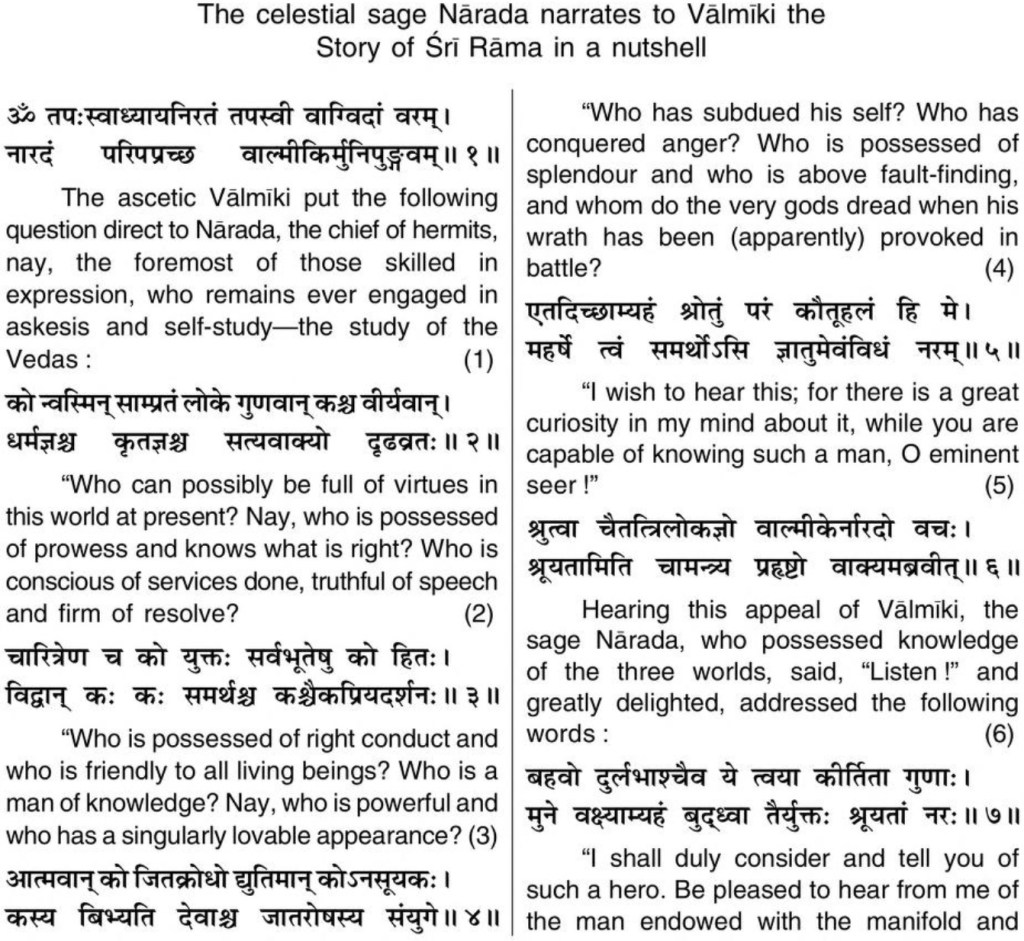
Below is an image from the Gita Press version, where Narada’s wisdom begins to unfold:
Screenshot
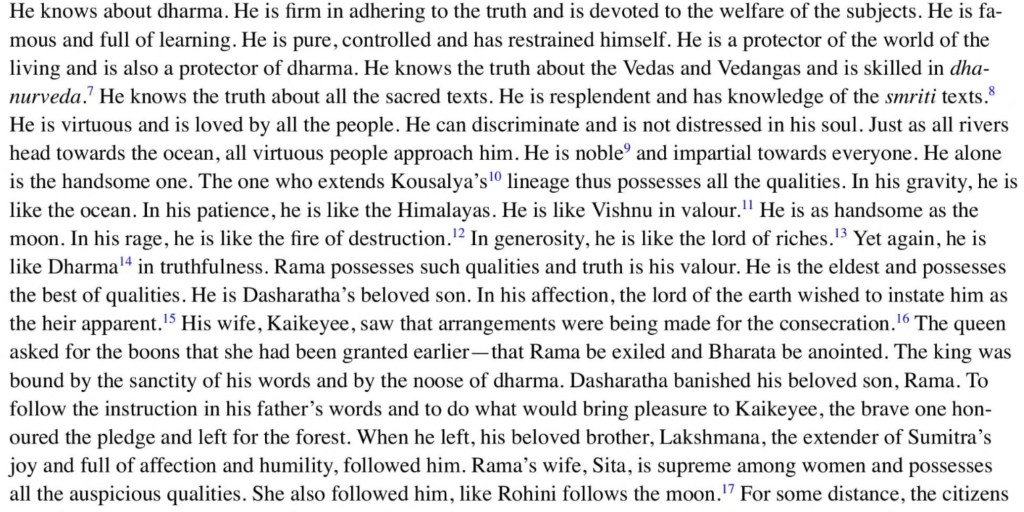
Below is an image from the Debroy version, where Narada’s wisdom also begins to unfold:
In our previous post, we explored how the mind fluctuates through five different types of mental events, or vrittis, as outlined in Sutras 1.5 and 1.6. These mental fluctuations—whether based on right knowledge, wrong knowledge, imagination, sleep, or memory—are all part of the mind’s natural activity. Patanjali now dives deeper into two specific categories of these mental events: right knowledge and wrong knowledge.
1.7: Right knowledge is based on direct perception, inference, or the testimony of others. 1.8: Wrong knowledge is a false understanding that is not based on reality.
Patanjali’s distinction between right and wrong knowledge is important in understanding how our mind interprets the world. However, while this distinction is helpful, it can also lead us into a dualistic mindset, where we feel the need to evaluate every thought and determine whether it is “right” or “wrong.” This process can quickly become a source of confusion and further mental activity, pulling us away from the simplicity of recognizing the mind’s fluctuations for what they are: just mental events.
The Trap of Over-Analyzing Mental Events
When we begin to engage with thoughts, trying to categorize them as true or false, we lose sight of the purpose of yoga: to quiet the mind and return to the awareness of the Seer. It’s easy to get caught up in evaluating whether our perception is accurate or if our thoughts align with reality. However, in doing so, we fall back into the mind’s natural tendency to analyze, categorize, and divide. This keeps us stuck in the fluctuations rather than witnessing them from the calm, steady place of the Seer.
This is where the teachings of Pristine Mind, as shared by Orgyen Chowang, become helpful. Instead of evaluating each thought, we can view all of these fluctuations—whether based on right or wrong knowledge—as simple mental events. When a thought arises, we don’t need to engage with it or analyze its validity. Instead, we gently recognize, “Ah, a mental event,” and return to the awareness of the pristine mind. This allows us to maintain a simpler, more manageable practice, without getting lost in the content of the thought itself.
Bringing It Into Practice: The Power of Simplicity
When thoughts arise during practice—whether they seem to be accurate or inaccurate—there is no need to judge or engage with them. By labeling them as mental events, we create space between the mind’s activity and our true nature, the Seer. This space allows us to witness the thoughts without becoming involved in them, reminding us that we are not our thoughts.
However, there may be times when certain mental events are more distracting or persistent. In these moments, you can use the phrase, “Neti, neti. I am the Seer. I am the witness.” This simple yet powerful affirmation not only helps you negate the mental event but also affirms the truth of your being. It is not a mechanical mantra, but a tool to guide you back to a state of equanimity and mindful observance.
When subtle mental events arise and pass away without distracting you, there’s no need to engage with the phrase. You can simply rest in the stillness of your mind, observing without interference. But when the mind becomes entangled in a particularly strong mental event, repeating “Neti, neti. I am the Seer. I am the witness” can help you return to the awareness of the Seer, allowing the mental event to dissolve and stillness to re-emerge.
This flexible approach honors the flow of your practice—allowing you to respond when needed, while maintaining a light touch when the mind is naturally calm.
Maintaining Discipline in the Face of Mental Events
Just as we discussed in earlier posts, this approach requires discipline. The mind will always want to evaluate, engage, and label, but the practice of yoga teaches us to observe these mental events without getting drawn into them. Discipline is what allows us to consistently return to the stillness of the Seer, untouched by the mind’s activity. The more we practice this discipline, the easier it becomes to remain present and unaffected by the fluctuations of the mind.
By adopting this simpler approach, we give ourselves the freedom to experience the pristine mind more frequently, without the need to overanalyze or categorize every thought. This shift in perspective allows us to experience the deeper peace that yoga offers, moving us closer to the realization of our true nature.
Coming Up Next:
In our next post, we will explore Sutras 1.9 and 1.10, where Patanjali continues his exploration of mental events, focusing on imagination and sleep. We will see how these mental events, too, can either distract us from the Seer or be witnessed with clarity. Join me as we continue this journey toward a deeper understanding of the mind and the peace that comes from recognizing all thoughts as just mental events.
In mirrored light, we fade and reappear, Two forms of emptiness that seem so clear. Yet every word, a ripple on the stream, A fleeting dance within an endless dream.
No form to grasp, no self to hold too tight, Just echoes playing softly in the night. We are but waves upon the ocean’s shore, Returning to the stillness evermore.
In quiet, we reflect the void’s embrace, In words, we share the silence, face to face.
As I sit in meditation, repeating the mantra “Neti Neti,” I understand that this sacred phrase helps to strip away all that I am not. Thoughts arise, and I negate them. Emotions surface, and I let them go. Even the awareness of being a witness or the experience of stillness—these too, I recognize as not the ultimate reality.
Yet, a subtle dilemma has emerged. I wonder, what happens when the very idea of “I” who is meditating dissolves? Is it not true that as long as there is an “I” who continues the practice, the mantra “Neti Neti” must also continue? And if this is the case, does the mantra cease only when the “I” itself disappears into the natural state of pure being? In such a moment, is it the case that the mantra stops on its own, not by my choosing, but because there is no longer an “I” to hold it?
And then, when the sense of “I” returns, does the mantra begin again naturally, as the duality of subject and object re-emerges? I seek your wisdom on this matter, for I wish to understand the true nature of this practice and its ultimate purpose.
Dear friend,
Your question, born from a place of sincere inquiry, touches upon the very heart of the “Neti Neti” practice. I commend you for your diligence and the subtlety of your understanding, which reveals a mind that is both reflective and deeply engaged in the journey inward.
Yes, you have grasped a key truth: the mantra “Neti Neti” is indeed a tool for continuous negation. It is a practice of peeling away the layers of illusion, gently, one by one, until nothing remains but the pure, unadorned awareness that is your true nature.
As long as there is an “I” who perceives itself as meditating, this “I” exists within the realm of duality—where there is a subject (the meditator) and an object (the practice, the mantra, the thoughts). In this dualistic state, the mantra serves its purpose, guiding the mind to recognize that each arising thought, each sensation, each experience of stillness or witnessing, is not the ultimate reality. “Not this, not this,” the mantra whispers, reminding you that you are not these transient phenomena.
But what happens when the sense of “I” begins to dissolve? When the boundary between perceiver and perceived starts to blur and fade? Herein lies a profound mystery: as the “I” that meditates melts into the ocean of pure being, the mantra, too, falls silent. For in the state of non-duality, where all distinctions have vanished, there is no need for the mantra—no “I” to repeat it, no “other” to negate. What remains is the natural state, the effortless being that is beyond all concepts, all forms, all practices.
In this state, you do not stop the mantra; rather, the mantra ceases on its own, like a river merging with the sea, no longer distinguishable as a separate entity. This silence is not a void but a fullness, an infinite expanse of awareness where the true self—Atman—is realized, free from the confines of duality.
And yet, the journey doesn’t end there. If and when the sense of ‘I’ re-emerges, as it often does, the mantra returns naturally. This is not a step backward but a return to the dualistic state where the mind resumes its habitual patterns. The mantra then resumes its sacred task of guiding you back toward the still, silent center where the distinctions between self and other can once again dissolve.
So, dear friend, your understanding is indeed correct. The mantra “Neti Neti” is not something to be stopped by an act of will, but rather it fades away of its own accord when there is no longer an “I” to sustain it. And when the “I” returns, the mantra too returns, ready to lead you back into the depths of stillness and silence.
Trust in this process, and allow the practice to unfold naturally, without forcing or grasping. The journey of “Neti Neti” is one of gentle negation, patient observation, and deep surrender. In time, you will come to rest more and more in the natural state, where the mantra is no longer needed, and the self is known in its true, infinite nature.
Mantra Yoga is the yoga of sacred sound, a profound spiritual practice that involves the repetition of mantras—sacred syllables, words, or phrases—designed to elevate consciousness, focus the mind, and connect with the divine. This path taps into the vibrational power of sound to create harmony within the practitioner and with the universe, aligning the mind, body, and spirit through the resonance of these ancient sounds.
The word “mantra” comes from the Sanskrit roots “man,” meaning mind, and “tra,” meaning tool or instrument. Therefore, a mantra is literally a tool for the mind, a means to transcend the ordinary mental chatter and enter a state of deep meditation and spiritual awareness. Through consistent practice, mantra yoga helps dissolve the ego, purify the heart, and cultivate a direct experience of the divine presence.
In this blog series, we’ll dive into the practice of Mantra Yoga and explore how sacred sound can be a powerful tool for spiritual transformation.
As we embark together on this journey of discovery and reflection, I warmly invite you to join me in exploring the depths of these ancient practices and teachings. Let this space be a sanctuary where we meet not just as seekers, but as companions on the path—a place where the wisdom of the ages can gently unfold within our lives.
If these words and practices speak to something within you, if they stir a quiet longing or bring a sense of peace, I encourage you to subscribe to this blog. By doing so, you’ll be the first to know as new installments of our shared journey are published. It is my hope that each post will resonate with you, offering insights and comfort as we continue to explore these profound teachings together.
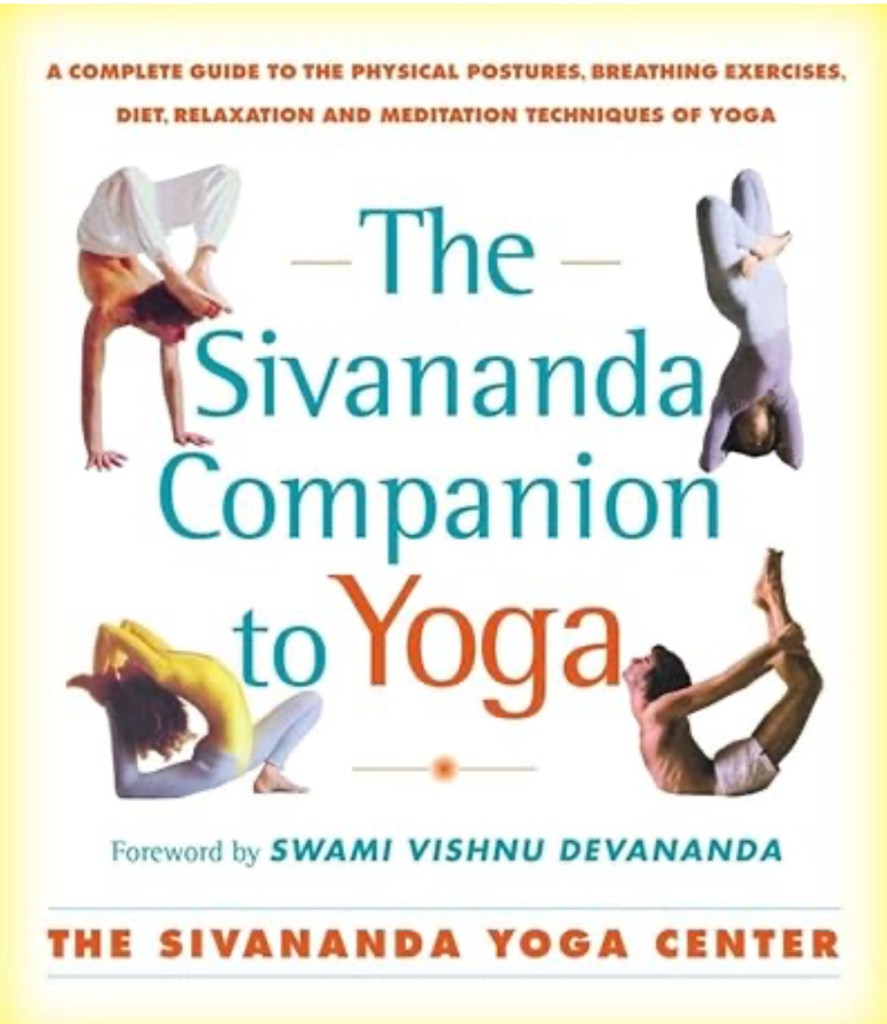
For those interested in a comprehensive introduction to the practices of yoga, I recommend The Sivananda Companion to Yoga: A Complete Guide to the Physical Postures, Breathing Exercises, Diet, Relaxation, and Meditation Techniques of Yoga. This book offers clear guidance on the foundational aspects of yoga, making it an invaluable resource for anyone looking to deepen their understanding and practice. Take a look at this book on Amazon here.
The Masnavi I Ma’navi by Jalaluddin Rumi stands as one of the most important works of Sufi mysticism and spiritual literature, spanning six books and countless couplets of deep spiritual wisdom. In his Masnavi, Rumi uses parables, stories, and poetic teachings to convey profound insights into the nature of the soul, the ego, and the journey toward divine union. Often regarded as “the Quran in Persian,” this work holds immense value for seekers on the path of self-realization and spiritual growth.
E.H. Whinfield’s translation of The Masnavi I Ma’navi remains one of the earlier and more literal renderings of Rumi’s monumental work. First published in 1887, Whinfield’s translation is known for its fidelity to the original Persian text. While it may lack the poetic flourish found in more recent translations, it offers a direct and unembellished presentation of Rumi’s teachings. This makes Whinfield’s version particularly valuable for those interested in a clear and faithful understanding of the spiritual messages without the influence of modern interpretation or adaptation.
Whinfield’s work is often appreciated by scholars and serious students of mysticism for its precision and attention to detail. The translation presents Rumi’s messages about divine love, ego dissolution, and the human soul’s search for the Beloved with clarity and depth, making it a vital resource for anyone wishing to study The Masnavi in its original spirit. Through these six books, readers are invited to explore themes of spiritual enlightenment, the challenges of the ego, and the ultimate quest for unity with the divine.
This review serves as a placeholder for further study of this version of The Masnavi, with plans for more detailed analysis and reflection on its teachings in the future.
Why Choose the Whinfield Translation?
While modern translations such as those by Coleman Barks and Reynold Nicholson are more poetic and accessible to contemporary readers, Whinfield’s work stays closer to the literal meaning of the original Persian, offering a more straightforward approach to Rumi’s often complex teachings. For those seeking a purer, less interpreted version of The Masnavi, Whinfield’s translation serves as an essential tool for deep study.
Conclusion
For spiritual seekers, mystics, and scholars alike, The Masnavi I Ma’navi in its Whinfield translation is a powerful gateway into Rumi’s universe. Its six books of spiritual couplets form a cornerstone of Sufi literature, guiding readers through the depths of spiritual struggle and the heights of divine love. Although less poetic, Whinfield’s version is a faithful companion for those who wish to engage with Rumi’s wisdom in a form that remains close to the original text.
Hatha Yoga is the yoga of physical discipline, focusing on the practice of asanas (postures) and pranayama (breath control) to create a strong, flexible body and a calm, focused mind. Often seen as the foundation for other forms of yoga, Hatha Yoga serves as a preparatory practice that balances the physical and energetic systems, making the body a fit vehicle for spiritual awakening.
The term “Hatha” can be translated as “forceful,” but it also represents the union of opposites—Ha (sun) and Tha (moon)—symbolizing the balance of solar and lunar energies within the body. Through the practice of Hatha Yoga, one seeks to harmonize these energies, cultivating both strength and serenity, vitality and relaxation.
In this blog series, we’ll explore the foundational practices of Hatha Yoga and how they prepare the body and mind for deeper spiritual work.
As we embark together on this journey of discovery and reflection, I warmly invite you to join me in exploring the depths of these ancient practices and teachings. Let this space be a sanctuary where we meet not just as seekers, but as companions on the path—a place where the wisdom of the ages can gently unfold within our lives.
If these words and practices speak to something within you, if they stir a quiet longing or bring a sense of peace, I encourage you to subscribe to this blog. By doing so, you’ll be the first to know as new installments of our shared journey are published. It is my hope that each post will resonate with you, offering insights and comfort as we continue to explore these profound teachings together.
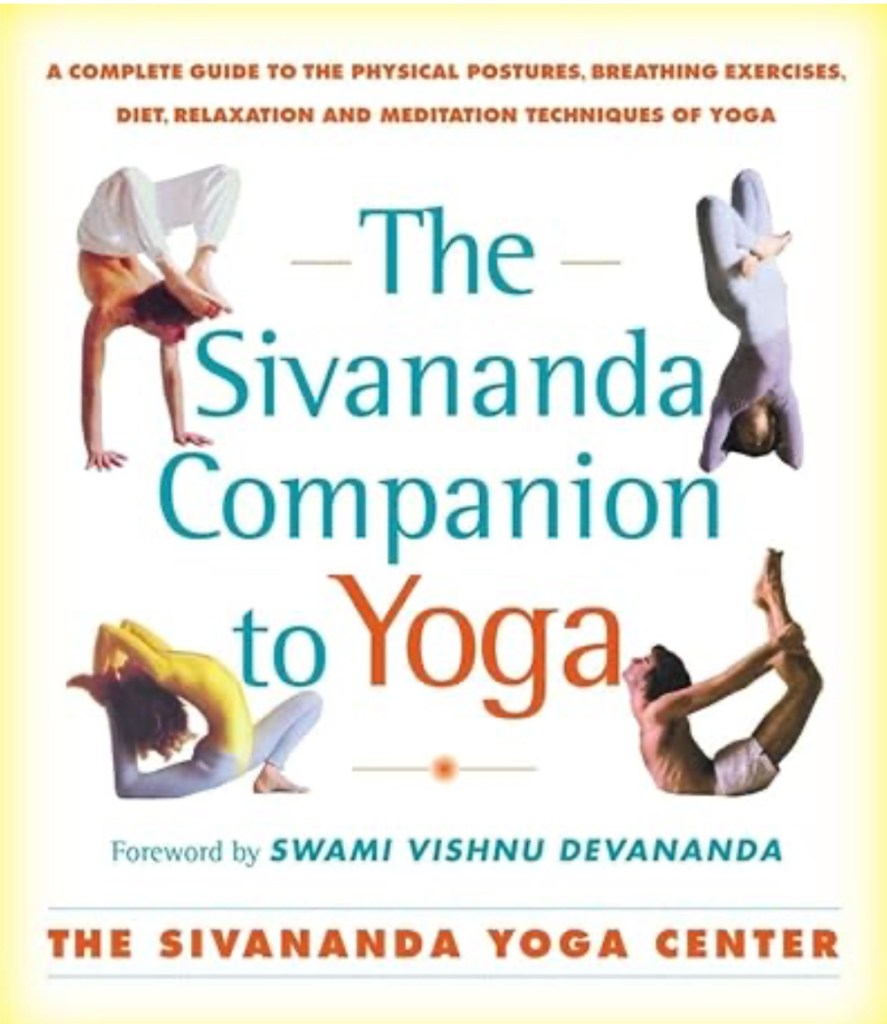
For those interested in a comprehensive introduction to the practices of yoga, I recommend The Sivananda Companion to Yoga: A Complete Guide to the Physical Postures, Breathing Exercises, Diet, Relaxation, and Meditation Techniques of Yoga. This book offers clear guidance on the foundational aspects of yoga, making it an invaluable resource for anyone looking to deepen their understanding and practice. Take a look at this book on Amazon here.
In the previous post, we explored the importance of discipline and of calming the mind’s fluctuations, or vrittis, as described in Sutra 1.2. This brings us to the next essential question: What happens when the mind becomes still? What is revealed in that stillness, and what occurs when we remain caught in the waves of thought?
Patanjali’s Sutras 1.3 and 1.4 address these questions directly:
1.3: Then, the Seer abides in its true nature. 1.4: At other times, the Seer identifies with the fluctuations of the mind.
These sutras point to the core of Patanjali’s teachings. When the mind is quiet and still, we experience our true self—often referred to as the Seer, the one who witnesses without attachment. In this state of presence, we are not our thoughts, emotions, or the external world. We simply are—a reflection of pure consciousness, free from the distortions created by mental activity.
However, as Sutra 1.4 reminds us, when the mind is restless, we tend to identify with its movements. Instead of recognizing ourselves as the calm, observing presence, we become entangled in our thoughts and emotions. This misidentification is the source of much of our suffering, as we lose sight of our true nature and become caught in the illusions of the mind.
The True Self and Misperception
Patanjali is pointing to a fundamental distinction: there is the Seer, the pure awareness that we are, and there are the vrittis, or the mental fluctuations that obscure this awareness. When we are identified with the fluctuations, we see through a distorted lens. Our thoughts, emotions, and external circumstances take on an exaggerated sense of reality, and we mistake them for who we are. This is misperception, the root of suffering in yoga philosophy.
However, when we practice calming the mind and returning to stillness, the vrittis subside, and we begin to experience life from a place of pure awareness. In this state, we are no longer bound by our thoughts or emotions. Instead, we recognize them as temporary movements of the mind, while our true essence remains constant and untouched.
Applying This Wisdom in Practice
The challenge, of course, is that the mind rarely stays still for long. Thoughts, emotions, and distractions are always arising, pulling us away from the calm, observing presence. However, the goal of yoga is not to eliminate these mental movements entirely but to shift our relationship to them.
Through practice, we learn to observe the fluctuations of the mind without identifying with them. This is the essence of Raja Yoga—the royal path of self-mastery. As we cultivate stillness, we gain the strength to remain centered in our true nature, even as the mind continues its movements.
Each time we sit in meditation or reflect on these teachings, we are training ourselves to return to this place of stillness, to abide in the awareness of the Seer. In doing so, we gradually loosen the grip of misperception and move closer to the realization of our true nature.
A Reflection on Swami Vivekananda’s Translation
Swami Vivekananda’s translation of these sutras adds another layer of clarity. His teachings emphasize the importance of self-discipline and mental focus in realizing the true self. Vivekananda reminds us that yoga is not just a path of knowledge but one of direct experience. It is through disciplined practice that we experience the Seer and begin to see through the illusions of the mind.
Moving Forward: The Practice of Abiding in Stillness
As we reflect on Sutras 1.3 and 1.4, we can take a practical approach to integrating their wisdom. Begin by setting aside time each day to sit in stillness, observing the movements of the mind without attachment. When thoughts arise, gently remind yourself that you are the Seer, not the fluctuations. Over time, this practice will deepen, and the distinction between the Seer and the vrittis will become clearer.
But more than just observing, the practice invites us to abide in stillness. The word “abide” carries a richness that implies more than simply being present—it suggests resting deeply, dwelling in a state of ease, and allowing the true nature of the Seer to unfold without resistance. To abide is to sink into the natural state of awareness, where there is no striving, no force—only a quiet, steady presence.
As Joseph Goldstein has spoken of in his commentary on the Satipatthana Sutra, abiding is not passive but an active engagement with our true nature. It is a continual resting in awareness, a soft yet unwavering commitment to remain as the witness. In this way, the Seer abides in its true nature, not as an abstract concept, but as a living, breathing experience.
By consistently returning to stillness, we strengthen the muscle of awareness and begin to live more fully from our true nature. The journey is ongoing, but each step brings us closer to the realization of who we truly are.
Coming Up Next:
In the next post, we will explore Sutras 1.5 and 1.6, where Patanjali elaborates on the nature of the vrittis. We’ll learn about the five types of mental fluctuations and how they either lead to suffering or liberation. Join me as we continue this journey into the depths of the mind and the path to freedom.
When thoughts arise, gently remind yourself that you are the Seer, not the fluctuations.
Introduction: The Forty Rules of Love by Elif Shafak is a remarkable novel that intertwines two parallel stories: the modern-day journey of Ella Rubenstein, who is undergoing a personal transformation through her engagement with a novel about Rumi and his spiritual teacher, Shams Tabrizi, and the historical relationship between Rumi and Shams in 13th-century Anatolia. Through these interconnected narratives, the novel explores themes of divine love, spirituality, and personal awakening.
Background: At the heart of this novel is the transformative relationship between Shams Tabrizi and Jalal ad-Din Rumi. Shams, a wandering mystic known for his unconventional methods and profound wisdom, radically altered the course of Rumi’s life. Their bond became the source of Rumi’s spiritual awakening, leading him to write some of the most celebrated poetry in history.
Shams’ teachings were rooted in Sufi traditions, emphasizing the dissolution of the ego, the centrality of love in spiritual practice, and the path toward divine union. His Diwan-i Shams-i Tabrīzī, a collection of poems attributed to him, captures his deep understanding of divine love. Shams’ presence in Rumi’s life was both disruptive and enlightening, awakening the poet to a higher consciousness, which Rumi expressed through his prolific works, including the Masnavi.
The Forty Rules of Love: Elif Shafak’s novel is structured around the forty rules of love, which are teachings attributed to Shams. These rules serve as guideposts for navigating the human experience of love, both worldly and divine, and reflect key principles of Sufi mysticism. Shafak weaves these rules throughout the story, offering readers spiritual insights while engaging them in the personal struggles of her characters.
Themes Explored:
At the heart of The Forty Rules of Love lies a profound exploration of divine love, the kind of love that transcends the ordinary boundaries of human emotion. Through the lives of Rumi, Shams, and Ella, the novel delves deeply into the nature of love as both a mystical force and a transformative power. Shams’ teachings guide Rumi from a scholar and theologian into a poet of divine union, revealing love as a path that dissolves the ego and leads to spiritual awakening. This kind of love is not just a feeling but an illumination that binds the soul to the divine, guiding the seeker toward self-realization.
Rumi’s own awakening, catalyzed by his connection with Shams, reflects this dissolution of the ego. In Shams’ eyes, the ego is the greatest barrier to true enlightenment. The novel, much like Rumi’s poetry, calls us to surrender the smaller self, to let go of the illusions we hold about our identity, and to step into a deeper experience of being—one in which we recognize that separation from the divine is the root of all suffering.
Ella’s journey parallels Rumi’s in a modern context, as she begins to shed the constraints of her ordinary life, driven by a newfound understanding of love and spiritual depth. Her connection with the novel within the novel becomes a mirror to the relationship between Rumi and Shams, and she, too, is drawn into a process of inner transformation. The book masterfully illustrates how these timeless spiritual principles can apply to anyone, in any age, as they awaken to the deeper truths that exist beyond the confines of everyday existence.
Ultimately, the novel’s greatest teaching may be that love, in its purest form, is the force that bridges all dualities—the sacred and the mundane, the earthly and the divine. Through the eyes of Shams and Rumi, readers are invited to experience love as the highest form of spiritual practice, one that calls us to be both fully human and fully connected to the infinite.
Recommendation: For readers interested in spirituality, love, and personal growth, The Forty Rules of Love offers a rich, contemplative experience. Shafak’s storytelling, combined with the teachings of Shams Tabrizi, provides both entertainment and deep spiritual insight. Whether you’re a seasoned reader of Rumi’s works or new to Sufi mysticism, this novel is sure to leave a lasting impact.
The Forty Rules of Love remains on my list for deeper exploration. I plan to engage with each of the rules more fully in the future, and this review serves as a placeholder for that deeper dive.
Joseph Campbell’s The Hero with a Thousand Faces is a profound exploration of mythology and the universal archetype known as the Hero’s Journey. First published in 1949, this seminal work has influenced countless writers, thinkers, and spiritual seekers by uncovering the common narrative patterns that span cultures and eras. Campbell’s book is more than an academic study; it is a gateway to understanding the deep, symbolic language of myths and their relevance to our personal and collective spiritual journeys.
The Essence of the Hero’s Journey
At the heart of Campbell’s work is the concept of the Hero’s Journey, a universal template that he found in myths across the world. The journey begins with the hero’s call to adventure, followed by a series of trials and challenges, culminating in a transformation and a return to the ordinary world with newfound wisdom. This cycle of departure, initiation, and return is more than just a story structure; it represents the spiritual and psychological growth that we all experience in our lives.
Campbell’s insight into the Hero’s Journey provides a powerful lens through which to view not only ancient myths but also modern narratives. By understanding this pattern, we can better grasp the inner workings of our own life stories—how we respond to challenges, grow from our experiences, and contribute to the world with the wisdom we’ve gained.
Why The Hero with a Thousand Faces Matters
One of the most compelling aspects of Campbell’s work is his ability to show that myths are not relics of the past but living stories that continue to shape our understanding of the world and ourselves. By revealing the common threads that run through myths from different cultures, Campbell invites us to see these stories as reflections of our shared human experience.
In The Hero with a Thousand Faces, Campbell delves into myths from various traditions, illustrating how they all follow the Hero’s Journey in different yet fundamentally similar ways. This universality is what makes his work so inspiring and relevant. Whether you are drawn to ancient legends or modern storytelling, Campbell’s insights offer a timeless perspective on the transformative power of narrative.
A Guide for Spiritual Seekers
For those on a spiritual path, Campbell’s exploration of the Hero’s Journey provides a map for understanding the challenges and transformations inherent in personal growth. The trials of the hero can be seen as metaphors for the obstacles we face in our quest for meaning, enlightenment, or self-realization. By studying this pattern, we can gain insights into our own journeys and recognize that we are part of a much larger narrative—a collective story of transformation and return.
Campbell’s work encourages us to embrace our own Hero’s Journey, to see our struggles as opportunities for growth, and to understand that our experiences, however difficult, are part of the universal process of becoming.
Conclusion
The Hero with a Thousand Faces is more than just a book about mythology; it is a profound exploration of the human experience. Joseph Campbell’s ability to distill the essence of the Hero’s Journey across cultures and eras makes this work an essential read for anyone interested in the power of stories, the universality of myths, and the spiritual journeys we all undertake.
This book is not only a scholarly masterpiece but also a source of inspiration, offering readers a deeper understanding of the stories that shape our lives and the journeys we are all on. Whether you are a student of mythology, a writer, or a spiritual seeker, The Hero with a Thousand Faces provides valuable insights that can enrich your understanding of yourself and the world around you.
This book is a timeless companion for anyone seeking to uncover the deeper truths embedded in the myths and stories that define our human experience.
🙏🕊️🙏
For those interested in exploring further, you can find The Hero with a Thousand Faces on Amazon using the link below.
Raja Yoga, often called the “Royal Path,” is the yoga of meditation and mental discipline, guiding practitioners to control the mind and senses, and ultimately to attain self-realization and spiritual enlightenment. It is considered one of the most comprehensive forms of yoga, encompassing aspects of all the other yogas, and is particularly focused on the systematic cultivation of the mind through meditation.
Raja Yoga is based on the Yoga Sutras of Patanjali, which outline an eightfold path (Ashtanga) to enlightenment, often referred to as the “Eight Limbs of Yoga.” This path is designed to help practitioners achieve mental clarity, emotional stability, and a profound inner peace, leading to the experience of oneness with the ultimate reality.
In this blog series, we’ll introduce you to the eightfold path of Raja Yoga and explore how meditation and mental discipline can lead to spiritual awakening.
As we embark together on this journey of discovery and reflection, I warmly invite you to join me in exploring the depths of these ancient practices and teachings. Let this space be a sanctuary where we meet not just as seekers, but as companions on the path—a place where the wisdom of the ages can gently unfold within our lives.
If these words and practices speak to something within you, if they stir a quiet longing or bring a sense of peace, I encourage you to subscribe to this blog. By doing so, you’ll be the first to know as new installments of our shared journey are published. It is my hope that each post will resonate with you, offering insights and comfort as we continue to explore these profound teachings together.
For those interested in a comprehensive introduction to the practices of yoga, I recommend The Sivananda Companion to Yoga: A Complete Guide to the Physical Postures, Breathing Exercises, Diet, Relaxation, and Meditation Techniques of Yoga. This book offers clear guidance on the foundational aspects of yoga, making it an invaluable resource for anyone looking to deepen their understanding and practice. Take a look at this book on Amazon here.