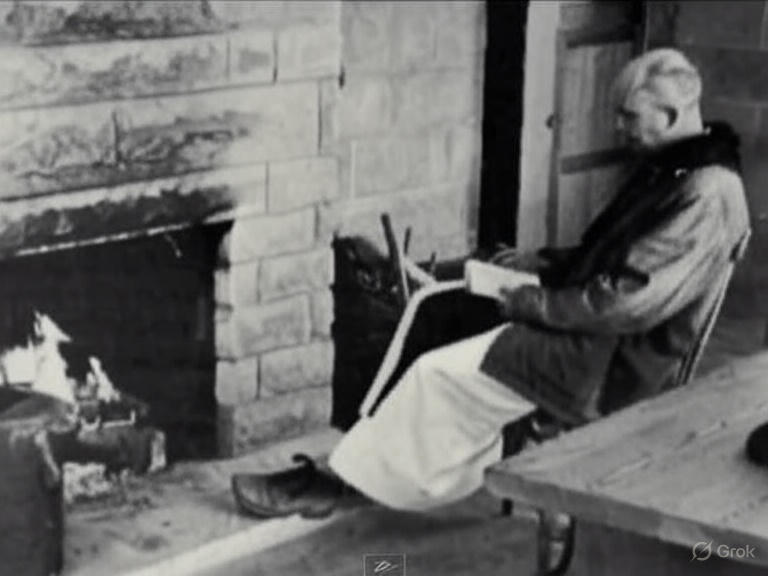
Tag: silence and solitude

  • Finding God in Silence: Thomas Merton’s Invitation

    Finding God in Silence: Thomas Merton’s Invitation

    Thomas Merton taught that silence is essential for spiritual growth and communion with God. Discover how inner stillness can become a sacred path in today’s noisy world.

    In these noisy and anxious times, I find myself returning again and again to the writings of Thomas Merton. His deep reverence for silence speaks to a longing I see in myself and in so many of us—for inner peace, for stillness, and for God. I offer this reflection in the hope it might inspire others, especially my Christian brothers and sisters, to make more space for silence in their lives.

    Thomas Merton strongly believed that the soul requires silence for its well-being and spiritual growth. He saw silence not just as the absence of noise, but as a space for inner listening, contemplation, and connection with one’s true self and with God.


    • Silence as a Basic Human Need:
      Merton argued that silence and solitude are essential for all individuals, not just hermits or monks, to hear the “deep inner voice” of their true self.

    • Interior Silence:
      He distinguished between exterior silence (absence of external noise) and interior silence (stillness of thoughts and desires). Interior silence allows for a deeper connection with God and self.

    • Silence and Communication:
      Merton didn’t see silence and communication as opposing forces. Instead, he believed that silence is essential for meaningful communication, allowing for thoughtful expression rather than just empty chatter.

    • Silence and Spiritual Growth:
      He believed that silence provides a space for prayer, contemplation, and a deeper understanding of oneself and God. It allows one to move beyond superficiality and experience a more profound connection with the divine.

    • Silence as a Pathway to God:
      Merton emphasized that silence, particularly interior silence, is a place where one can encounter God’s presence and experience a sense of intimacy with the divine.

    • The World’s Lack of Silence:
      Merton observed that the modern world is often filled with noise and distraction, making it difficult for individuals to find the silence they need for spiritual growth. He saw the need for places and practices that foster silence and solitude.

    • Finding Silence in the Everyday:
      While acknowledging the challenges of finding silence in a noisy world, Merton encouraged individuals to seek moments of quiet reflection and stillness in their daily lives.


    • A Simple Contemplative Practice

      Find a quiet place. Sit comfortably, with your hands resting in your lap. Gently close your eyes. Begin with this prayer from the heart:

      “Lord, I am here for You alone. Let me be still in Your presence.”

      Let the prayer fade into silence. Don’t try to think or feel anything in particular. Simply rest in God’s presence, like a child leaning into their Father’s arms.

      If thoughts arise, gently return to the stillness with a phrase like:

      “Be still and know…” or “You are my refuge and peace.”

      This is not about doing or achieving. It is about allowing. As St. John of the Cross wrote,

      “The soul that is pure and simple and empty of all things… can be filled with God.”

      Remain for just a few minutes—or as long as grace allows. End by offering a word of thanks. That’s all.


    • Silence as a Gift:
      Merton viewed silence as a precious gift that can lead to spiritual awakening, self-discovery, and a deeper relationship with God.


    Maybe today, just for a few minutes, let yourself sit quietly.

    Not to accomplish anything. Just to listen.


    “Be still, and know that I am God.”

    — Psalm 46:10

    🙏🕊🙏

  • Discovering Mystical Contemplation: The Alter Rebbe’s Practice of Hitbonenut and Bittul

    Discovering Mystical Contemplation: The Alter Rebbe’s Practice of Hitbonenut and Bittul

    Explore the transformative path of Hitbonenut and Bittul in Jewish mysticism, as practiced by the Alter Rebbe, to reach direct experience and divine unity.


    Translation of the Hebrew Text in the Above Image

    “… the esteemed Rabbi Schneur Zalman of Liadi, the great sage and author of the book Tanya, in his later years would immerse himself daily in deep contemplation and focus on achieving Hitbonenut and Bittul, self-nullification, before beginning his prayers. He would sit in a secluded area and enter a state of spiritual readiness, preparing himself to reach closeness to the divine through his meditative practices. Those who observed him would attest to the honor and respect that this revered practice commanded, reflecting his commitment to true divine connection.”


    Discovering the Boundless: The Alter Rebbe’s Practice of Hitbonenut and Bittul

    In the rich tradition of Jewish mysticism, Hitbonenut and Bittul are contemplative practices often approached as meditative paths focused on divine ideas. These practices are frequently interpreted as ways of concentrating on spiritual concepts to deepen one’s understanding. However, the Alter Rebbe, Rabbi Schneur Zalman of Liadi—the founder of Chabad Hasidism—offers us a window into a more profound dimension of these practices, where contemplation moves beyond intellectual meditation and opens into direct experience.

    The Alter Rebbe’s personal practice of Hitbonenut is a cornerstone of Chabad Chassidus. According to tradition, he would spend hours in Hitbonenut before beginning his prayers, not merely analyzing divine concepts but immersing himself in a state of awareness that dissolves the self into the infinite, what Jewish mysticism calls the Ein Sof—the boundless and limitless aspect of the divine.

    In this expansive approach to Hitbonenut, contemplation shifts from thought-focused meditation to an experiential opening, leading to what other traditions describe as the “pristine mind” or “pure contemplation.” By embracing the formless, open nature of awareness, the Alter Rebbe connected to a state beyond the grasp of the ego, inviting direct experience of the divine presence.

    This journey is deepened through Bittul, or self-nullification. Where Hitbonenut opens the door to spacious, boundless awareness, Bittul is the surrender of the self into that awareness. It’s a release of the ego’s hold, a quieting of personal identity that allows a merging with the infinite. This act of surrender is not a negation but an opening—a dissolving of the self to align fully with divine unity.

    For those of us seeking to understand Hitbonenut and Bittul in this way, the Alter Rebbe’s practice offers a reminder that contemplation in its purest form transcends the intellect. It’s not about conceptual analysis but about experiencing divine unity as a living reality. As we explore this path, we step beyond thought, into the boundless.

    In upcoming posts, we’ll further explore the practical steps, reflections, and guidance to cultivate these practices. Hitbonenut and Bittul invite us into the spaciousness of mystical contemplation, guiding us from understanding to a direct encounter with the divine.

    🙏🕊️🙏

    Book Review: Rabbi Schneur Zalman of Liadi: The Philosophy of Chabad by Nisan Mendel

    Nisan Mendel’s Rabbi Schneur Zalman of Liadi: The Philosophy of Chabad is a profound exploration of the life and teachings of one of Jewish mysticism’s most influential figures. Rabbi Schneur Zalman, known as the Alter Rebbe, was the founder of the Chabad movement, and his teachings remain central to Hasidic philosophy and contemplative practice today.

    Through this work, Mendel delves into the essence of Chabad philosophy, particularly its unique approach to Hitbonenut (contemplative meditation) and Bittul (self-nullification). Readers are introduced to the Alter Rebbe’s belief that intellectual understanding can be a pathway to divine experience, bridging the mind and heart to foster a deep connection with God. The book sheds light on the Alter Rebbe’s methods for approaching mystical contemplation, offering practical insights for those looking to incorporate these timeless practices into their own lives.

    Mendel’s accessible writing and thoughtful explanations make complex topics approachable, while his reverence for the subject shines through, bringing Rabbi Schneur Zalman’s teachings to life. This book is especially valuable for readers who wish to understand the spiritual framework of Chabad and its emphasis on meditative thought as a means to reach divine awareness.

    Whether you’re new to the ideas of Hitbonenut and Bittul or are already on a contemplative journey, The Philosophy of Chabad offers a valuable gateway to the Alter Rebbe’s approach to mysticism. By providing both philosophical insights and practical approaches, Mendel encourages readers to go beyond surface understanding and explore the depths of Chabad’s spiritual tradition.

    🙏🕊️🙏