Tag: psychological healing

  • Swimming Past the Alligator

    Swimming Past the Alligator

    Dreams, healing, and the long work of becoming whole

    This morning I remembered a small piece of a dream.

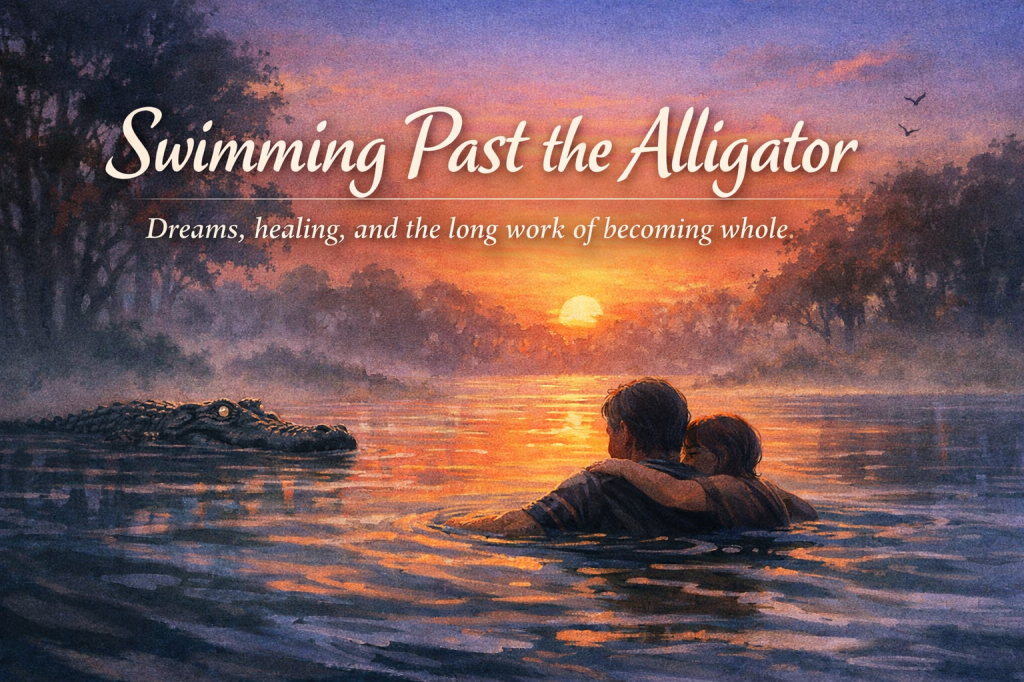
    I was swimming in water, and there was an alligator nearby.

    Instead of panicking, I simply swam past it.

    I remember making an aggressive sound—not from fear, but from protection. I was not alone. There was a child with me, and I felt responsible for their safety.

    Later I remembered another fragment: in another dream, I was offering gentle spiritual guidance to a young person.

    These were only fragments.

    But sometimes fragments are enough.

    Because sometimes a dream does not come to entertain us.
    Sometimes it comes to show us something we could not see before.


    The dreams we have when we are young

    When I was very young—single digit years—I had frequent nightmares. In those dreams I was being chased or threatened by monsters. I never confronted them. I always ran.

    There was fear.
    There was helplessness.
    There was no sense of power.

    Eventually those nightmares stopped.

    But something else remained.

    What followed was not nightmares, but something quieter and harder to name: a long period of adult life marked by insecurity, lack of confidence, and the feeling of not quite fitting into the world.

    The monsters had left my sleep.

    But their shadows remained in my waking life.

    Many people know this experience. Trauma does not always continue as dramatic nightmares. Sometimes it continues as hesitation. As self-doubt. As the quiet feeling of being different or unsafe without knowing exactly why.

    And sometimes this can last decades.


    A word I did not understand for thirty years

    When I was in my thirties I first encountered a psychological word:

    Individuation.

    Carl Jung used this word to describe the lifelong process of becoming whole — integrating the wounded parts of ourselves, the fearful parts, the hidden parts, and the strong parts into one living person.

    For thirty years I did not really understand what that meant.

    Then recently something changed.

    Not because I studied more.
    Not because I forced insight.

    But because life had slowly done its work.

    And then came the dream.

    Instead of running from the monster, I was swimming calmly past it.

    Instead of being threatened, I was protecting.

    Instead of being the frightened child, I had become the guardian of a child.

    That is when I began to understand what individuation might actually mean.

    Not perfection.

    Not becoming fearless.

    But becoming someone who can remain present in the water even when the alligator is still there.


    What the alligator might mean

    Jung often suggested that dangerous animals in dreams may represent powerful emotional forces or parts of ourselves we once feared.

    If water represents the emotional or unconscious life, then swimming might represent learning to move through our own feelings instead of being overwhelmed by them.

    And the alligator?

    Perhaps it represents something we once thought would destroy us.

    A memory.
    A fear.
    A past wound.
    A shadow.

    But here is the important part:

    In the dream, the alligator did not disappear.

    Healing did not mean the danger was erased.

    Healing meant I was no longer powerless in its presence.

    That is a very different kind of freedom.


    A change many people never notice

    One of the most important changes in healing is not that fear disappears.

    It is that our relationship to fear changes.

    As children, many of us could only run. Our nervous systems were not ready to do anything else.

    But over years—sometimes many years—something can slowly develop:

    Inner resources
    Perspective
    Compassion
    Stability
    Understanding

    And sometimes one day we notice something surprising:

    We are no longer running.

    We are still in the water.

    But we are not drowning.


    The child in the dream

    Perhaps the most meaningful part of the dream was not the alligator.

    It was the child.

    In the dream I was protecting a child. Not a boy or a girl. Just a child.

    Many psychological traditions would say this child may represent the vulnerable part of ourselves we once were.

    The part that did not feel safe.
    The part that needed protection.

    And perhaps healing is not about becoming invulnerable.

    Perhaps healing is about becoming the person who can finally protect that inner child.

    Not by fighting monsters.
    Not by denying fear.

    But by staying present.


    Nightmares across a lifetime

    Not everyone has nightmares only in childhood. Some people carry them into adulthood. Some begin having them later in life. Some veterans carry dreams of war for decades. Some people carry dreams shaped by loss, illness, or trauma.

    And this deserves to be said gently and clearly:

    Having nightmares does not mean you are weak.

    It often means your nervous system is still trying to make sense of what was too much to process at the time.

    Sometimes healing does not mean the dreams stop immediately.

    Sometimes healing means we slowly become less afraid of what they are showing us.


    A different way to think about difficult dreams

    Instead of asking:

    Why am I having this dream?

    Sometimes a more compassionate question might be:

    How has my relationship to fear changed?

    Or even:

    Am I still running, or am I learning to stay?

    Because sometimes progress is not dramatic.

    Sometimes progress is simply this:

    You are still in the water.
    And you are calmer than before.


    What healing sometimes looks like

    Healing is rarely a straight path.

    Sometimes it looks like therapy.
    Sometimes meditation.
    Sometimes prayer.
    Sometimes long conversations.
    Sometimes simply surviving long enough for the nervous system to learn safety.

    And sometimes, unexpectedly, healing looks like a dream that quietly says:

    You are not who you used to be.


    A closing reflection

    If I were to turn this dream into a simple contemplative question, it might be this:

    What in my life once terrified me that I can now face with a little more calm?

    Or even more gently:

    Where have I already grown stronger than I realize?

    Sometimes we do not see our own healing because it happened slowly.

    But sometimes a dream reminds us.

    Not with fireworks.

    Just with an image:

    You are in the water.
    The danger is still there.
    But you are no longer alone.

    And you are no longer afraid in the same way.

    May all beings find safety.
    May all beings find healing.
    May all beings discover their own quiet strength.

  • The Role of Shadow Work in Spiritual Growth

    In the journey of spiritual growth, one often encounters the need to explore the depths of the self, including the parts that may be hidden or uncomfortable to face. This exploration, known as shadow work, is essential for both psychological healing and spiritual growth. By understanding and integrating these shadow aspects, we move toward a more complete and authentic sense of self.

    Understanding the Shadow

    The concept of the shadow originates from the work of Carl Jung, who described it as the unconscious part of the personality that the conscious mind tends to reject or ignore. These are aspects of ourselves—our fears, desires, and impulses—that we may find uncomfortable or unacceptable. However, the shadow is not limited to what we consider “negative” or “bad.” It also includes latent strengths and positive qualities that have been disowned due to societal or personal conditioning.

    Importantly, the shadow is a specific part of the broader unconscious mind. While the shadow consists of the aspects of ourselves that we have repressed or rejected, the unconscious encompasses much more. The unconscious is the vast, all-encompassing reservoir that includes everything outside of our conscious awareness—both positive and negative, known and unknown. This includes not only disowned aspects of ourselves (the shadow) but also latent talents, creativity, and profound wisdom that we may not yet be aware of.

    The unconscious mind is like a vast repository of knowledge and potential, waiting to be accessed. In contrast, the shadow represents the darker, hidden aspects of the unconscious—those parts of ourselves that we don’t like to acknowledge or have actively pushed away, though it can also include disowned positive qualities.

    Recognizing these shadow aspects allows us to reclaim parts of ourselves that have been disowned or have simply been undiscovered, leading to a more balanced and authentic existence. Embracing the shadow is not just about facing our fears but also about uncovering and integrating the hidden gems within us, fostering a richer, more complete understanding of who we truly are.

    A Cautionary Note on Shadow Work

    While shadow work can be a powerful tool for personal growth and self-awareness, it’s important to approach it with care, especially if you have a history of trauma or intense emotional difficulties. The process of bringing repressed or unconscious aspects of the self into awareness can sometimes evoke strong reactions. For some, this may be manageable and lead to healing. For others, it could feel overwhelming or re-traumatizing.

    If you find that engaging in shadow work brings up intense emotions, distressing memories, or feelings of being overwhelmed, it may be wise to seek support. This could mean talking to a trusted friend or family member, or working with a therapist who can guide you through the process in a safe and supportive environment. Remember, shadow work is not about pushing yourself beyond your limits, but about gently exploring the parts of yourself that are ready to come into the light of awareness.

    Taking these precautions ensures that your journey into shadow work is as safe and constructive as possible, allowing you to integrate these aspects of yourself in a way that promotes healing and growth.

    Processing the Shadow with Forgiveness, Loving-Kindness, and Compassion

    As you begin to uncover and integrate the shadow, it’s natural to encounter discomfort or resistance. These reactions are a part of the process, signaling that you are touching on something important. To support yourself during this journey, it’s essential to cultivate forgiveness, loving-kindness, and compassion—both for yourself and others.

    1. Forgiveness: Understand that the parts of yourself that reside in the shadow were often placed there as a protective mechanism. They were rejected or repressed because, at some point, it felt safer to do so. Forgive yourself for these past decisions, recognizing that you were doing the best you could at the time. Practicing self-forgiveness creates space for healing and reintegration.
    2. Loving-Kindness Meditation: Engage in loving-kindness (Metta) meditation to foster a sense of warmth and compassion toward yourself. Begin by sending loving-kindness to yourself, saying phrases like, “May I be safe, may I be happy, may I be healthy, may I live with ease.” As you progress, extend these feelings toward others, including those who may trigger shadow aspects. This practice helps to soften the heart and create an environment of acceptance.
    3. Compassion: Approach your shadow with gentle curiosity rather than harsh judgment. Recognize that these aspects are part of the human experience and that everyone has a shadow. By meeting these parts of yourself with compassion, you begin to dissolve the barriers of shame and fear that keep the shadow hidden. Compassion allows for a deeper understanding and integration of these elements into your conscious life.

    As you work through your shadow, these tools will help you stay grounded and kind to yourself. Remember that shadow work is not about perfection but about embracing your whole self. By processing these elements with forgiveness, loving-kindness, and compassion, you pave the way for deeper healing and a more authentic, peaceful life.

    Practical Shadow Work

    Engaging in shadow work requires a willingness to face the less comfortable aspects of ourselves with honesty and courage. This process is not about eradicating the shadow but about bringing it into the light of awareness so that it can be integrated into our conscious experience. Here are some practical steps to begin the process:

    1. Journaling: Write freely about your thoughts, feelings, and reactions to daily events. Pay attention to recurring themes, emotional triggers, and patterns that may point to shadow aspects. Reflect on situations where you felt a strong emotional response—what might they reveal about hidden parts of yourself?
    2. Meditation: Use meditation to observe your thoughts and emotions without judgment. As you sit in stillness, allow whatever arises to come into your awareness. Notice any resistance or discomfort, and explore what these feelings might be connected to in your subconscious.
    3. Reflection: Spend time contemplating your reactions and behaviors in relationships and interactions. Are there qualities in others that you strongly dislike or admire? These can be clues to your own shadow, reflecting traits you may be denying in yourself.
    4. Dream Analysis: Dreams are a direct window into the unconscious. Keep a dream journal and look for recurring symbols, themes, or figures. Analyzing these elements can help you uncover hidden aspects of your psyche.

    By incorporating these practices into your routine, you can gradually bring the shadow into consciousness, where it can be understood, accepted, and integrated. Shadow work is an ongoing process that deepens over time, leading to a more balanced and authentic sense of self.

    Integrating the Shadow

    The goal of shadow work is not to eliminate the shadow but to integrate it into your conscious awareness. Integration involves accepting your shadow without judgment, recognizing that these aspects are part of the human experience. By doing so, you transform what was once a source of inner conflict into a source of strength and insight.

    When the shadow is integrated, it becomes a wellspring of creativity, energy, and authenticity. You may find that you have greater compassion for yourself and others, less reactivity in challenging situations, and an increased sense of inner peace. The process of integration allows you to embrace all parts of who you are, leading to a more complete and harmonious sense of self.

    By integrating the shadow, you move closer to wholeness. This wholeness is not about perfection but about being fully present with all aspects of yourself, both light and dark. It’s about recognizing that every part of you has value and contributes to the richness of your life experience.

    🙏🕊️🙏