Tag: personal transformation

  • Swimming Past the Alligator

    Swimming Past the Alligator

    Dreams, healing, and the long work of becoming whole

    This morning I remembered a small piece of a dream.

    I was swimming in water, and there was an alligator nearby.

    Instead of panicking, I simply swam past it.

    I remember making an aggressive sound—not from fear, but from protection. I was not alone. There was a child with me, and I felt responsible for their safety.

    Later I remembered another fragment: in another dream, I was offering gentle spiritual guidance to a young person.

    These were only fragments.

    But sometimes fragments are enough.

    Because sometimes a dream does not come to entertain us.
    Sometimes it comes to show us something we could not see before.


    The dreams we have when we are young

    When I was very young—single digit years—I had frequent nightmares. In those dreams I was being chased or threatened by monsters. I never confronted them. I always ran.

    There was fear.
    There was helplessness.
    There was no sense of power.

    Eventually those nightmares stopped.

    But something else remained.

    What followed was not nightmares, but something quieter and harder to name: a long period of adult life marked by insecurity, lack of confidence, and the feeling of not quite fitting into the world.

    The monsters had left my sleep.

    But their shadows remained in my waking life.

    Many people know this experience. Trauma does not always continue as dramatic nightmares. Sometimes it continues as hesitation. As self-doubt. As the quiet feeling of being different or unsafe without knowing exactly why.

    And sometimes this can last decades.


    A word I did not understand for thirty years

    When I was in my thirties I first encountered a psychological word:

    Individuation.

    Carl Jung used this word to describe the lifelong process of becoming whole — integrating the wounded parts of ourselves, the fearful parts, the hidden parts, and the strong parts into one living person.

    For thirty years I did not really understand what that meant.

    Then recently something changed.

    Not because I studied more.
    Not because I forced insight.

    But because life had slowly done its work.

    And then came the dream.

    Instead of running from the monster, I was swimming calmly past it.

    Instead of being threatened, I was protecting.

    Instead of being the frightened child, I had become the guardian of a child.

    That is when I began to understand what individuation might actually mean.

    Not perfection.

    Not becoming fearless.

    But becoming someone who can remain present in the water even when the alligator is still there.


    What the alligator might mean

    Jung often suggested that dangerous animals in dreams may represent powerful emotional forces or parts of ourselves we once feared.

    If water represents the emotional or unconscious life, then swimming might represent learning to move through our own feelings instead of being overwhelmed by them.

    And the alligator?

    Perhaps it represents something we once thought would destroy us.

    A memory.
    A fear.
    A past wound.
    A shadow.

    But here is the important part:

    In the dream, the alligator did not disappear.

    Healing did not mean the danger was erased.

    Healing meant I was no longer powerless in its presence.

    That is a very different kind of freedom.


    A change many people never notice

    One of the most important changes in healing is not that fear disappears.

    It is that our relationship to fear changes.

    As children, many of us could only run. Our nervous systems were not ready to do anything else.

    But over years—sometimes many years—something can slowly develop:

    Inner resources
    Perspective
    Compassion
    Stability
    Understanding

    And sometimes one day we notice something surprising:

    We are no longer running.

    We are still in the water.

    But we are not drowning.


    The child in the dream

    Perhaps the most meaningful part of the dream was not the alligator.

    It was the child.

    In the dream I was protecting a child. Not a boy or a girl. Just a child.

    Many psychological traditions would say this child may represent the vulnerable part of ourselves we once were.

    The part that did not feel safe.
    The part that needed protection.

    And perhaps healing is not about becoming invulnerable.

    Perhaps healing is about becoming the person who can finally protect that inner child.

    Not by fighting monsters.
    Not by denying fear.

    But by staying present.


    Nightmares across a lifetime

    Not everyone has nightmares only in childhood. Some people carry them into adulthood. Some begin having them later in life. Some veterans carry dreams of war for decades. Some people carry dreams shaped by loss, illness, or trauma.

    And this deserves to be said gently and clearly:

    Having nightmares does not mean you are weak.

    It often means your nervous system is still trying to make sense of what was too much to process at the time.

    Sometimes healing does not mean the dreams stop immediately.

    Sometimes healing means we slowly become less afraid of what they are showing us.


    A different way to think about difficult dreams

    Instead of asking:

    Why am I having this dream?

    Sometimes a more compassionate question might be:

    How has my relationship to fear changed?

    Or even:

    Am I still running, or am I learning to stay?

    Because sometimes progress is not dramatic.

    Sometimes progress is simply this:

    You are still in the water.
    And you are calmer than before.


    What healing sometimes looks like

    Healing is rarely a straight path.

    Sometimes it looks like therapy.
    Sometimes meditation.
    Sometimes prayer.
    Sometimes long conversations.
    Sometimes simply surviving long enough for the nervous system to learn safety.

    And sometimes, unexpectedly, healing looks like a dream that quietly says:

    You are not who you used to be.


    A closing reflection

    If I were to turn this dream into a simple contemplative question, it might be this:

    What in my life once terrified me that I can now face with a little more calm?

    Or even more gently:

    Where have I already grown stronger than I realize?

    Sometimes we do not see our own healing because it happened slowly.

    But sometimes a dream reminds us.

    Not with fireworks.

    Just with an image:

    You are in the water.
    The danger is still there.
    But you are no longer alone.

    And you are no longer afraid in the same way.

    May all beings find safety.
    May all beings find healing.
    May all beings discover their own quiet strength.
  • Awakening Happens Two Ways: Like Lightning, or Like Dawn

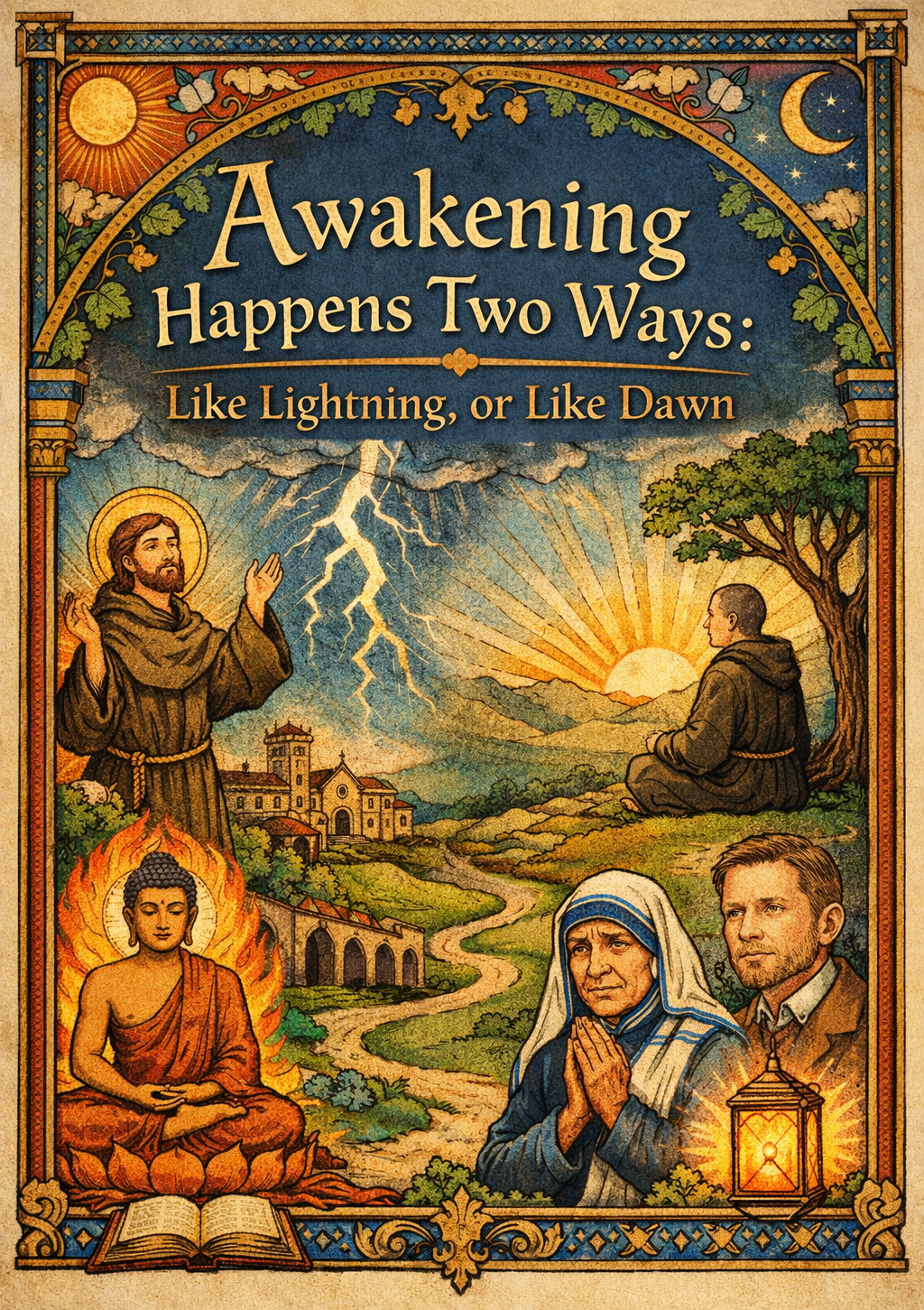
    Awakening Happens Two Ways: Like Lightning, or Like Dawn

    Sudden illumination and the slow work of becoming whole

    Into the Mystic is a contemplative reflections series exploring awakening, stability, and the quiet path of inner transformation in ordinary life.


    Introduction: Two Movements of Awakening

    In the landscape of spiritual life, two great patterns appear again and again: the gradual path and the lightning path.

    One unfolds slowly through prayer, discipline, contemplation, and steady inner work. The other arrives suddenly, as if grace breaks through without warning and changes the whole direction of a life in an instant.

    These are often described as opposites.

    But perhaps they are not opposites at all.

    Perhaps they are two movements within the same mystery.


    The Gradual Path

    The gradual path is the way of cultivation. It is the slow shaping of the soul through daily practice. It is the monk returning to prayer. The meditator returning to the breath. The seeker returning again and again to silence, surrender, and truth.

    In Buddhist language, this is the long training of mind and heart. In Christian contemplative language, it is the patient deepening of humility, purification, and love.

    Saint Teresa of Ávila offers one of the clearest examples of this gradual unfolding. Her spiritual life matured through years of prayer, struggle, refinement, and increasing interior depth. The soul, in her vision, is not transformed instantly, but led inward through many chambers, many purifications, many deepenings of surrender.

    Likewise, the Buddha’s awakening, though realized in a decisive moment beneath the Bodhi tree, was preceded by years of seeking, discipline, renunciation, and contemplative effort.

    The flowering may appear sudden.

    But the roots often grow in darkness for a very long time.


    The Lightning Path

    And yet there is also the lightning path.

    This is the path of abrupt transformation. The sudden reversal. The moment when the old self is pierced and something entirely new begins.

    It is not always earned in any neat or linear way. It may come through suffering, illness, loss, beauty, grace, or some inward rupture that breaks the ordinary structure of identity.

    Saint Francis of Assisi seems to belong, at least in part, to this lightning pattern. His early life was not one of long monastic preparation. His conversion appears to have been catalyzed through crisis: illness, war, captivity, disillusionment, and the collapse of the worldly ambitions he once cherished.

    Something broke open in him.

    The man who had been oriented toward status and recognition turned instead toward poverty, simplicity, love, and radical devotion.

    His life did not merely improve.

    It changed direction.


    Sudden Awakening, Gradual Integration

    This pattern appears across many traditions.

    Ramana Maharshi described a sudden awakening that began with a profound confrontation with death in his youth.

    Eckhart Tolle has written about a dramatic inner shift following a period of deep psychological suffering, when the ordinary sense of self seemed to dissolve into a profound stillness.

    Yet what is often overlooked is what came after.

    Tolle spent years living very quietly, often sitting on park benches, allowing his life to slowly reorganize around what he had experienced.

    The awakening may have been sudden.

    The embodiment was gradual.

    Here again we see the same rhythm:

    Lightning followed by integration.


    Faithfulness Without Consolation

    Mother Teresa’s life reflects another variation of this same pattern.

    Her decisive vocational turning — sometimes described as a profound interior call to serve the poorest of the poor — carries the character of a lightning moment.

    Yet what followed was not constant spiritual consolation, but decades of interior dryness, what the Christian mystical tradition calls a dark night of the soul.

    Despite this, she continued her work with remarkable faithfulness.

    Her life suggests something subtle but important:

    Awakening is not always accompanied by pleasant experience.

    Sometimes the lightning clarifies direction, but the gradual path becomes one of love without emotional reinforcement.

    In this way, both the sudden opening and the long endurance that follows become part of the same spiritual maturation.


    The Deeper Pattern

    If we look across these lives — Francis of Assisi, Teresa of Ávila, the Buddha, Ramana Maharshi, Mother Teresa, and Eckhart Tolle — a pattern begins to emerge.

    Some lives begin with discipline and flower into breakthrough.

    Others begin with breakthrough and spend years learning how to live what was revealed.

    Most contain both movements.

    Perhaps this is because awakening is not an event but a relationship.

    A relationship between grace and participation.

    Between what is given and what is lived.

    Zen expresses this beautifully:

    Enlightenment is an accident. Practice makes us accident-prone.
    Shunryu Suzuki Roshi

    We do not command grace.

    We prepare ourselves.
    We consent.
    We practice.
    We purify intention.
    We return.
    We wait.

    And sometimes, unbidden, the veil thins.


    The Quiet Awakening Most People Miss

    There is also a tender psychological truth here.

    Many sincere seekers imagine that if they have not had a dramatic breakthrough, then perhaps nothing real is happening.

    But this is not so.

    Sometimes awakening is not an explosion but an erosion.

    Not lightning, but river-water.

    Not a sudden fire from heaven, but a long dawn.

    A person may simply discover, after years of difficulty, that they are more stable than they once were.

    Less driven by fear.

    Less imprisoned by old wounds.

    More able to rest in silence.

    More capable of kindness.

    More able to endure uncertainty without collapse.

    This too is awakening.

    This too is grace.


    Where the Two Paths Meet

    Even within the gradual path, lightning may still come.

    Even within the lightning path, long discipline may still be required.

    Francis did not remain only the man of sudden conversion. He became the man of ongoing prayer and ongoing surrender.

    Teresa did not advance only by method. Her life was also marked by moments of powerful grace.

    The Buddha practiced intensely, but the final realization was not something he could force by will alone.

    The great traditions seem to agree on this much:

    Effort matters.

    But effort is not sovereign.

    There is something deeply relieving in that.

    It means we do not have to choose between discipline and grace.

    We can practice faithfully without pretending awakening is a personal achievement.

    We can remain open to the unexpected without neglecting the humble daily work of becoming more honest, more surrendered, and more loving.


    The Real Question

    Perhaps the real spiritual life is not about deciding whether we are on the gradual path or the lightning path.

    Perhaps it is about recognizing which movement is active in us now.

    For some, this season is one of patient cultivation.

    Quiet repetition.
    Invisible deepening.
    Slow healing.
    Hidden roots.

    For others, this season may include rupture, reversal, breakthrough, or an unexpected unveiling that reorders everything.

    And for many, it is both.

    We tend the garden, but we do not control the rain.

    We prepare the lamp, but we do not command the flame.

    We sit.
    We pray.
    We breathe.
    We return.
    We become available.

    In the end, perhaps that is the deepest wisdom:

    Awakening is both gift and participation.

    We are neither passive nor omnipotent.

    We are participants in a mystery we cannot manufacture, but to which we can sincerely offer our lives.

    The gradual path teaches us faithfulness.

    The lightning path teaches us surrender.

    And both, in their own way, lead us beyond ourselves.


    Peace and good. 🌿

  • Into the Mystic: The Wave and the Water – Finding Peace in Aimlessness

    In his gentle and profound way, Thich Nhat Hanh reminds us that we are already what we seek to become. Like a wave searching for water, we often find ourselves running in circles, seeking stability and peace, when in fact we are already made of the very essence we are searching for.

    In the previous post, we reflected on the words, “Be still and know that I am God,” and on the teachings that the Kingdom of God is within us, not something to be sought outside. Thich Nhat Hanh offers a similar invitation to stillness, a reminder that we need not search beyond this moment to touch the Divine. His teachings on apranihita—aimlessness—invite us to stop running after something outside of ourselves. The Buddha is not somewhere far away, hidden behind our efforts; the Buddha is within us, right here, right now. We don’t need to become something else or achieve some great transformation to touch the truth of our being. We only need to stop, to recognize that what we are seeking is already present in us.

    This echoes the Christian mystic path as well, where we are called to enter the stillness, to trust in the unfolding of the Divine presence within. St. John of the Cross speaks of surrendering into the Divine presence that is always here, guiding us without the need for striving. The great mystics remind us that the more we seek, the further we may feel from the truth. Yet when we stop seeking, when we allow ourselves to simply be, we find that the Kingdom of God is already here, waiting for us in the stillness of our own hearts.

    Thich Nhat Hanh’s teachings give form to this same truth. He uses the image of a wave to help us understand that we are not separate from what we seek. Just as the wave is made of water, we too are made of the very essence we long to touch. The wave doesn’t need to run after the water; it is already water. The black cloud doesn’t need to become a white cloud; it only needs light to shine on it, revealing what was always there. In the same way, we don’t need to become something else to experience peace. We need only to stop, to rest in the awareness of who we already are.

    As both Sri Nisargadatta Maharaj and Papaji have taught, the very act of searching can take us further from what we seek. Papaji even wrote a book titled Call Off the Search, emphasizing that the more we search, the more we reinforce the illusion that the truth is somewhere else. This persistent search keeps us from realizing the truth that is already right here, right now. By continuing to look outside of ourselves, we create a sense of distance, when in reality there is no distance at all—only the stillness of the present moment, where what we seek has always been.

    “You are already what you want to become,” Thich Nhat Hanh says. Yet we spend much of our lives not believing this truth, searching for happiness, fulfillment, and wisdom outside of ourselves. Whether it’s the Kingdom of God, Buddha-nature, or enlightenment, we chase after these ideas as though they are separate from us. But all of the great teachers—whether it be Jesus, the Buddha, or St. John of the Cross—urge us to look within. They tell us that when we stop running after what we already are, we can finally rest in the truth that has always been there.

    This is what Thich Nhat Hanh calls aimlessness. The practice of aimlessness is to no longer place something in front of you to chase after. It is to recognize that everything you are searching for is already here. By stopping the search, by becoming still, we can touch the wonders of life that are already present in this moment.

    In one of his talks, Thich Nhat Hanh describes this stillness beautifully: “The Kingdom of God, the Pure Land of the Buddha, is available in the here and now.” He reminds us that happiness is found in the simple things—a rose, the fresh air, a loving smile. Like the wave that need not search for water, we need only to stop and recognize the treasures already around us, treasures that we so often miss because we are running in circles.

    Thich Nhat Hanh teaches that walking meditation can be a wonderful way to practice this stopping, this resting in the here and now. Each step is not taken with a sense of rushing to arrive somewhere, but with the awareness that we are already where we need to be. With each step, we arrive fully in the present moment, touching the peace, the beauty, and the wonder that is always available. It is a practice that brings us back to the present, back to ourselves, and back to the truth that there is nothing to attain.

    “You don’t need to become a Buddha,” Thich Nhat Hanh says, “You are already a Buddha.” You don’t need to search for the Divine; the Divine is already within you. It is only when we stop running that we can finally touch this truth. Like the black cloud that becomes a white cloud when the light shines upon it, we are transformed by the simple act of recognition. In the stillness of aimlessness, we realize that there is no distance between us and what we seek.

    As we continue our contemplative journey, may we learn to embrace the wisdom of aimlessness. May we stop chasing after what is already here, within us. And in that stopping, may we find the peace, the joy, and the freedom that comes from recognizing that we have always been enough.

    🙏🕊️🙏

  • Interfaith Harmony: Ganesha, the Universal Remover of Obstacles

    There is an ancient story, older than memory, that speaks of a gentle presence who stands at the threshold of each journey. He is called Ganesha, the remover of obstacles. In Hindu tradition, he is worshipped as a friend and guardian of beginnings, an embodiment of wisdom and gentle strength. His form is unmistakable—an elephant head, eyes deep with understanding, a body both round and rooted, as though he holds the world’s burdens yet is unburdened himself.

    But look closely, and you’ll see that Ganesha belongs not only to Hinduism, nor merely to any single path. Ganesha, in his role, belongs to all of us, for who has not felt the weight of obstacles pressing upon them? His is a universal invitation, an ancient whisper, to release our inner blocks, to allow wisdom, compassion, and clarity to dissolve the clouds that obscure our view of the divine.

    We often imagine that the obstacles are out there in the world, hidden in life’s hardships or circumstances. But in invoking Ganesha, we are drawn to the deeper realization that these barriers are inward. They are the veils of attachment, fear, confusion, the stubborn illusions of ego. Ganesha, then, is not merely a god of external beginnings, but of spiritual awakening—the remover of all that would obscure our own path to knowing God.

    In this light, Ganesha’s role is universal. His invocation is not unlike the quiet prayer of a Christian asking for guidance, or a Sufi’s yearning for the grace to surrender. To honor Ganesha as an interfaith presence is to understand that all traditions hold this longing for clarity, for wisdom, for the freedom that arises when the spirit is unbound.

    Each tradition has its own language, its own stories, but the heart of each is the same—a call to remove the obstacles that block us from truth. In this spirit, may we see Ganesha as more than a Hindu deity; may we see him as a shared symbol of our journey toward the divine. For in removing these obstacles, we are made ready to experience the peace, the stillness, the God that lives in all.

    🙏🕊️🙏

  • The True Temple Within: Answering the Call of Jesus’s Teachings on Compassion and Love

    The True Temple Within: Answering the Call of Jesus’s Teachings on Compassion and Love

    A Reflection on Finding God’s Kingdom Within and Building a Temple of Compassion in Our Hearts


    Embracing the Inner Kingdom of God

    In times of uncertainty and division, many Christians look to prophecy and signs as they await the return of Jesus. Some believe that rebuilding the physical Third Temple in Jerusalem is a vital step, a tangible marker in the unfolding of divine plans. But as we search the scriptures and reflect on Jesus’s teachings, perhaps there’s another path we’re being called to—a path that brings the temple closer to home, within each of our hearts.

    When Jesus spoke of the kingdom of God, he did not point to a distant place or a building yet to be constructed. Instead, he said, “The kingdom of God is within you” (Luke 17:21). These words offer us a profound insight: the divine presence we seek is already here, woven into the fabric of our being. The true temple, then, may not be built of stone or situated on any particular piece of land. Instead, it is a spiritual sanctuary we create within ourselves through acts of compassion, forgiveness, and love.

    The Call to Build an Inner Temple

    Imagine that the “temple” Jesus invites us to build is one that lives within, a place where we cultivate the values he embodied. In 1 Corinthians 3:16, Paul writes, “Do you not know that you are God’s temple and that God’s Spirit dwells in you?” This suggests that each of us can become a vessel of the divine, embodying Jesus’s teachings through our choices, words, and actions.

    In a world often marked by conflict and separation, answering this call becomes even more essential. The peace we seek outwardly begins with a peace cultivated inwardly. We are invited to become living temples, where loving-kindness flows freely and forgiveness is extended not only to others but also to ourselves. Each time we choose compassion over judgment, each time we practice forgiveness, we add another stone to the temple within, creating a sanctuary that honors the essence of Jesus’s message.

    The Kingdom of God: Here and Now

    When asked about the coming of God’s kingdom, Jesus said it was already “within and around you, for those with eyes to see and ears to hear.” The kingdom, then, is not a distant promise but an ever-present reality, accessible to those who open their hearts. It is an invitation to see the sacred in the everyday, to recognize that God’s love permeates all creation.

    This perspective encourages us to shift from waiting for a distant event to actively living in alignment with Jesus’s teachings now. By embracing love, compassion, and forgiveness in our daily lives, we make the kingdom of God visible in our world. Each act of kindness, each moment of understanding, becomes a glimpse of this divine kingdom, alive and vibrant within us.

    A Spiritual Temple Not Made by Hands

    The Bible hints at this concept of a temple “not made by hands.” In Acts 7:48, it says, “The Most High does not dwell in houses made with hands.” This idea reminds us that God’s presence isn’t confined to physical spaces; it lives in the open-hearted expressions of love and compassion we extend to one another.

    For some, the idea of a Third Temple remains deeply significant, symbolizing devotion and fulfillment of prophecy. But perhaps this prophecy points us toward something greater than a building. Perhaps it calls us to the work of inner transformation—a temple built with virtues rather than walls, where Jesus’s teachings find their true home.

    Answering the Call of Jesus’s Teachings

    As we reflect on this message, we are each invited to answer the call of Jesus in our own lives. What if the true “return” of Jesus is a return to his teachings of love, compassion, and forgiveness? What if the temple he seeks is one that we build within our hearts, where his presence can dwell through our actions?

    This journey isn’t always easy. Building a temple within requires self-reflection, a willingness to forgive, and a commitment to love even when it’s difficult. But each step brings us closer to a peace that surpasses understanding—a peace that flows from knowing that the kingdom of God is here, within and around us, ready to be realized by all who seek it.

    In a world yearning for healing, perhaps the greatest offering we can make is to create this inner temple. Let us honor Jesus’s teachings by embodying them fully, by becoming the living temples where his love shines brightly. May we each be guided by his call, building not with bricks and mortar but with kindness, patience, and the boundless compassion that is the true foundation of God’s kingdom.

    Final Thoughts

    This post invites readers to consider that the true temple of God resides within each of us, and that we honor Jesus’s teachings not by waiting for signs, but by embodying love and compassion in our daily lives. Together, as living temples, we bring the kingdom of God closer to earth, revealing a divine reality that is always here, for those who have eyes to see and hearts to embrace it.

    🙏🕊️🙏

  • Book Review: Being Peace by Thich Nhat Hanh

    Book Review: Being Peace by Thich Nhat Hanh

    There’s a timeless invitation at the heart of spiritual practice—to discover a deep, unshakable peace within ourselves, one that needs no striving to achieve. In Being Peace, Thich Nhat Hanh reminds us that peace is not something outside to be attained; it’s a natural state within us, accessible in each moment we choose to be fully present. In these quiet moments of awareness, peace isn’t something we do—it’s something we are.

    Thich Nhat Hanh, a Vietnamese Zen master, poet, and peace activist, brings a gentle simplicity to this profound teaching. Being Peace weaves together personal stories, practical mindfulness techniques, and timeless Buddhist wisdom. Through each page, his words invite us to embrace peace not as an ideal, but as an embodied presence—a way of being that can transform ourselves and the world.

    Discovering Peace in the Present Moment

    From the opening pages, Thich Nhat Hanh introduces a revolutionary idea: that each of us already carries the potential for peace within. He writes with an almost childlike clarity, inviting us to notice the ordinary miracles in daily life—a breath, a step, the warmth of the sun. These simple moments become doorways to the present moment, where we can rest in awareness, undisturbed by the mind’s endless motion.

    His approach to mindfulness is refreshingly practical. Rather than asking us to transcend the world, he guides us to return to it fully—to be present with whatever is here, exactly as it is. Whether we’re washing the dishes, driving, or simply sitting quietly, we are offered the chance to be peace, right here, right now.

    Practicing Compassion and Interbeing

    Another central theme in Being Peace is the idea of interbeing—Thich Nhat Hanh’s term for the interconnectedness of all life. He shows how, when we see ourselves as part of a vast web of life, our actions naturally become more compassionate. Understanding interbeing allows us to see that our own well-being is inseparable from that of others. When we cultivate peace within, it radiates outward, touching the world around us.

    This interconnection reminds us that our peace is a gift to the world. By learning to “be peace,” we become a refuge for others—a quiet presence that can soothe and support those around us. Through stories of social engagement and personal practice, Thich Nhat Hanh illustrates how inner peace can become a force for transformation, leading to wise, compassionate action in our families, communities, and beyond.

    An Invitation to Live Peace

    Being Peace doesn’t simply offer teachings; it invites us into a living practice. Thich Nhat Hanh’s words create a soft, steady encouragement to live mindfully, with kindness for ourselves and others. There’s an intimacy in his voice, as if he is gently guiding us by the hand, showing us how to live with more openness, patience, and presence.

    The book also provides specific practices, like mindful breathing, walking meditation, and loving-kindness meditation, which make peace a tangible experience. These practices are woven throughout his teachings, allowing readers to integrate mindfulness naturally into daily life.

    In reading Being Peace, we’re reminded that peace is not a far-off goal but a living, breathing reality available in each moment. Thich Nhat Hanh shows us that the path to peace begins with the simplest act of bringing awareness to the present moment, just as it is.

    Final Reflections

    In Being Peace, Thich Nhat Hanh offers us more than words on a page; he offers a way of living. His teachings resonate as a call to each of us to embody the peace we wish to see in the world. Through gentle, grounded guidance, he shows us that true peace is not just an aspiration—it’s a way of being available to each of us, here and now.

    If you’re ready to discover this peace within, you may want to explore Being Peace in full. Below, you’ll find the book itself, a quiet guide to a more mindful, compassionate way of life.

    🙏🕊️🙏

  • Building a Temple Across Lifetimes: A Spiritual Journey

    Building a Temple Across Lifetimes: A Spiritual Journey


    The photograph above shows Tiger’s Nest Monastery in Bhutan, a powerful symbol of unwavering spiritual dedication across lifetimes. Perched high on a cliff, this sacred site has been home to many monks and spiritual practitioners, including Dilgo Khyentse Rinpoche, who spent many, many years meditating here.


    In the Tibetan tradition, there’s a story of a monk whose life’s work was to build a temple in a remote area. It was an enormous and solitary task, and though people mocked his aspirations, the monk remained steadfast in his dedication. But the temple was never finished in his lifetime. And so, the story goes, he reincarnated—returning again and again, each time picking up where he left off, continuing to work on the temple until, many lifetimes later, it was finally complete.

    This story speaks to a deep spiritual truth: some work cannot be accomplished in a single lifetime. Whether it’s the construction of a temple or the transformation of the heart, these endeavors require dedication that spans across time—an unbroken thread of aspiration that remains, even when the body changes. This sense of continuity is at the heart of many spiritual traditions, particularly the Tibetan belief in tulkus, enlightened beings who return to continue their work for the benefit of all beings.

    The Tulku Tradition: Continuing Spiritual Work Through Reincarnation

    One such tulku is Dilgo Khyentse Yangsi Rinpoche, the recognized reincarnation of the great master Dilgo Khyentse Rinpoche. His reincarnation serves as a living example of how the work of wisdom, compassion, and teaching carries on through lifetimes. From a young age, Yangsi Rinpoche received transmissions from his elders—wisdom that he himself had imparted to them in a previous life—so that he could continue his path of service in this life. This conscious continuation of spiritual work can also be seen in the 14th Dalai Lama, who, from the age of two or three, was recognized and trained to carry on his responsibilities from previous incarnations.

    These stories show the power of aspiration, clarity, and dedication in shaping not just one life but many.

    Aspiration for Future Lives: Carrying Dharma Practice Forward

    Reflecting on the tradition of tulkus, I find myself drawn to the idea that the momentum of my Dharma practice in this life could carry forward into the next. While I may not possess the level of realization that allows a tulku to consciously choose their parents and circumstances, I hold the aspiration that my practice—my dedication to understanding and embodying the Dharma—will create conditions in a future life that allow me to encounter the teachings early and continue this work. My hope is that the clarity I seek now will guide me then, like spiritual breadcrumbs leading me back to the path I walk today.

    The 500-Year Plan: A Vision Beyond One Lifetime

    But the idea of building something greater than ourselves doesn’t apply only to spiritual practice. Many years ago, while at a Zen monastery, I heard a young environmentalist speak about his dedication to protecting the earth. He spoke of his work in terms of what he called “The 500-Year Plan.” He understood that the efforts he was making—writing books, building networks, raising awareness—might not bear fruit in his lifetime. It could take 200 years just to turn the corner on some of the environmental issues he was addressing. Yet, that didn’t deter him. His vision extended far beyond his immediate circumstances. His short-term thinking was, in fact, a 500-year plan.

    This kind of perspective echoes the long view held in the Tibetan tradition: that the work we do—whether it’s spiritual or in service to the planet—reaches beyond a single lifetime. It’s about planting seeds, knowing that we may not live to see them grow into trees, but trusting that others—or perhaps even our future selves—will benefit from the roots we lay today.

    Spiritual Breadcrumbs: Leaving a Trail for Future Selves

    What’s fascinating about the tulku tradition, and perhaps even about my own hope for reincarnation, is that we’re not only thinking about the next generation or the next few decades. We’re thinking about how the seeds of wisdom, compassion, and right action planted today might guide us—even across lifetimes—toward a more awakened and compassionate world.

    By sharing these reflections and writings online, the work is not confined to this moment in time. In fact, the beauty of the Internet is that these teachings can continue to be discovered, even hundreds of years from now. And who knows—perhaps, dear reader, you are the reincarnation of myself, encountering these words 100 or even 500 years into the future. The paradox here is that I may not remember writing these words, but I may feel a deep connection with them—an ignition of something within that tells me I’ve walked this path before. It’s an interesting thought: someone reading this years from now could be my future self, rediscovering the teachings I left behind.

    The Power of Dedication: Planting Seeds for Future Generations

    Whether it’s a temple that takes centuries to complete, an environmental movement that spans generations, or the continued unfolding of a Dharma practice across lifetimes, there is a deep truth here: some work is bigger than one life, but that doesn’t diminish its value. Instead, it enhances it. The dedication to something greater than ourselves, something that transcends the limitations of time, is the foundation upon which lasting transformation is built.

    For myself, I may not see the fruits of my practice fully in this lifetime. But I trust that the work I do now—the clarity I cultivate, the wisdom I seek—will carry me forward. Perhaps in a future life, I’ll stumble upon this very blog, and it will be a reminder of the path I’ve already walked, the aspirations I’ve already set. In that moment, I’ll recognize the steps I need to take, not as new, but as familiar—part of a journey I’ve been on for lifetimes.

    Poem: A Trail of Light Across Time

    If I return to this world again,
    may I stumble upon these words,
    left like footprints in soft sand,
    to remind me of who I once was
    and all I once knew.

    A lighthouse on a distant shore,
    my own hand building the beacon,
    so when the fog of forgetting settles,
    I will find my way back
    to the heart I’ve always known.

    For what is wisdom
    but a note written in the margins of life,
    waiting patiently for another reader
    to understand the truth
    that has always been theirs?

    Closing Reflection: The Power of Aspiration

    The power of our aspirations is immense. Whether we are building temples, protecting the environment, or cultivating wisdom, the dedication we offer today echoes through time. We may not see the completion of our work in this life, but we trust that it will continue—through future generations, or even our own future selves. The seeds we plant now will bear fruit in ways we cannot yet imagine, and perhaps, like the monk or the tulkus, we’ll return to complete the work we began long ago.

    I invite you to watch this beautiful and moving documentary on Dilgo Khyentse Yangsi Rinpoche, which explores the life of a reincarnated spiritual leader, the wisdom he continues to impart, and the profound power of his practice.

    🙏🕊️🙏

    This video is a documentary about the life of Dilgo Khyentse Yangsi Rinpoche, a Tibetan Buddhist monk who is considered to be one of the most important spiritual figures of our time. The film follows Rinpoche from his childhood, when he was recognized as the reincarnation of the great master Dilgo Khyentse, through his years of study and practice, to his present day role as a spiritual leader and teacher.

    The video provides a fascinating glimpse into the life of a Tibetan Buddhist monk. We see Rinpoche as a young boy, struggling to adjust to his new life in a monastery. We watch him as he grows into a wise and compassionate teacher, who is able to connect with people from all walks of life. And we witness the incredible power of his spiritual practice, which allows him to heal the sick, help people overcome their suffering, and even communicate with the dead.

    The video is beautifully shot and edited, and the music is both haunting and uplifting. The interviews with Rinpoche’s friends, family, and students provide a rich and nuanced portrait of this extraordinary man. If you are interested in learning more about Tibetan Buddhism or the life of a spiritual leader, this video is a must-see.

    Overall, this video is a powerful and inspiring documentary that will leave you with a sense of wonder and awe. It is a testament to the power of the human spirit, and a reminder that it is possible to live a life of compassion, wisdom, and enlightenment.

  • Buddhism and Christianity: Finding Common Ground in Compassion and Ethical Living

    Buddhism and Christianity: Finding Common Ground in Compassion and Ethical Living

    To many, the word Buddhism may conjure images of statues or rituals that seem foreign or difficult to understand, particularly for those from a conservative Christian background. However, at its heart, Buddhism is not about worshiping an idol or a false god, as some might mistakenly believe. Rather, it is a path of inner transformation that shares many core values with Christianity—values like compassion, ethical living, and the sincere effort to become a better person.

    In Buddhism, practitioners turn to the Three Jewels: the Buddha, who represents the potential for awakening within all of us; the Dharma, the teachings that show the way to live with love, wisdom, and peace; and the Sangha, the community of practitioners who support one another in their spiritual journey. In this sense, the Buddha is not a deity to be worshiped but a teacher, much like how Christians might revere the wisdom of Jesus Christ. The focus is not on idol worship, but on following a path that leads to moral and spiritual growth.

    At first glance, the colorful rituals, sacred music, and intricate costumes may seem confusing or overwhelming. Yet these outward forms are simply expressions of an inner practice that remains deeply practical and profound: the training of the mind. Tibetan Buddhism is not a religion in the conventional sense of belief or dogma but rather a transformative path aimed at purifying the mind. Through meditation, visualization, mantra, and ritual, the practice cultivates clarity, compassion, and liberation from egoic tendencies.

    Just as Christians seek to become more like Christ—striving for kindness, humility, and love—Buddhists seek to become the best version of themselves, nurturing virtues such as compassion, patience, and wisdom. To be a Buddhist is to make a commitment to ethical living, to ensure that one’s actions bring benefit rather than harm to others. This mirrors the Christian commandment to “love thy neighbor as thyself.”

    At the heart of both traditions lies a dedication to improving one’s character and living in a way that reflects love and goodness. For Buddhists, this means confronting the mind directly—meeting thoughts and emotions with honesty and care. Instead of avoiding or denying the difficulties of life, Buddhists engage with their minds head-on, seeking to transform fear, anger, or selfishness into peace, kindness, and clarity. This inner work echoes the Christian call to examine one’s heart, repent, and strive for purity in thought and deed.

    In his teachings, Dilgo Khyentse Yangsi Rinpoche offers a striking and relatable metaphor that bridges ancient wisdom with modern technology. He likens the practice of Dharma to the way we sync our wireless earbuds with our phones. Just as the earbuds must be paired and in sync with the phone to receive the signal and work properly, our minds must be aligned with the Dharma to receive its benefits.

    This idea resonates with many spiritual traditions. For Christians, the same concept applies to our relationship with the Holy Spirit or with Christ’s teachings. God is always present within us and around us, but if we are distracted by anger, impatience, or worldly concerns, we lose that vital connection. Simply believing in Jesus’ sacrifice isn’t enough if we are not living in sync with his teachings. By aligning our hearts and minds with Christ’s message of love, forgiveness, and humility, we can fully experience the divine presence and live in harmony with God’s will.

    Far from being a pagan religion, Buddhism is, at its core, a path of deep moral reflection and inner peace. Like Christianity, it calls for a transformation of the heart—one that aligns us with love, compassion, and a life of service. While the outward expressions of these paths may look different, the goal is the same: to become more loving, wise, and true to the divine nature that exists within each of us.

    For Christians who might feel uncertain about Buddhism, it can be helpful to remember that the values of both traditions are not in conflict but in harmony. Whether we call this journey “walking with Christ” or “following the Dharma,” both paths seek the same destination—a life lived with integrity, compassion, and love for others. By finding these common threads, we can open our hearts to one another, honoring the diversity of ways that humans seek truth and goodness.

    I invite you to watch the video below, which served as the inspiration for this post. It offers a beautiful glimpse into the teachings of Dilgo Khyentse Yangsi Rinpoche and the heart of Tibetan Buddhism. This film explores not only the path of mind training but also the deep compassion and wisdom that unite Buddhist and Christian values. Whether you are new to these teachings or have been walking your own spiritual path for years, this video provides an opportunity to reflect on the shared human quest for love, kindness, and awakening.

    🙏🕊️🙏

  • Perception as Creation: A Choice for Love in Challenging Times

    We live in what the ancient Chinese might have called “interesting times.” These moments test us—not only our patience and strength but also our ability to remain anchored in love. In times of upheaval, it can feel easy to get swept into fear, division, or despair. Yet, even in the storm, we carry within us a sacred choice.

    Perception, they say, is an act of creation. The lens through which we see the world shapes not only what we experience but also how the future unfolds. So, as the winds of uncertainty swirl around us, I choose to see and create love. I choose to reflect kindness, courage, and grace—just as the Divine breathes these qualities into our lives each day.

    There is a peculiar magic in this practice: when we choose to view the world through love, we begin to reshape it. The storm becomes an opportunity for deeper connection. Division becomes an invitation to understanding. Despair becomes the fertile ground for hope.

    And so, we are called—each of us—to take part in this sacred creation. It’s a quiet revolution, rooted not in politics but in our collective soul. Every act of compassion, no matter how small, weaves us back into unity. Every moment of forgiveness plants the seeds of peace. Every word of encouragement, spoken even in uncertainty, becomes a candle in the darkness.

    May we walk gently through these “interesting times,” creating love with every step. And may we remind each other, again and again, that this too is part of the divine plan unfolding—a story that invites us to be co-authors of a more just and loving world.

    🙏🕊️🙏

  • Book Review: The Hero with a Thousand Faces by Joseph Campbell

    Joseph Campbell’s The Hero with a Thousand Faces is a profound exploration of mythology and the universal archetype known as the Hero’s Journey. First published in 1949, this seminal work has influenced countless writers, thinkers, and spiritual seekers by uncovering the common narrative patterns that span cultures and eras. Campbell’s book is more than an academic study; it is a gateway to understanding the deep, symbolic language of myths and their relevance to our personal and collective spiritual journeys.

    The Essence of the Hero’s Journey

    At the heart of Campbell’s work is the concept of the Hero’s Journey, a universal template that he found in myths across the world. The journey begins with the hero’s call to adventure, followed by a series of trials and challenges, culminating in a transformation and a return to the ordinary world with newfound wisdom. This cycle of departure, initiation, and return is more than just a story structure; it represents the spiritual and psychological growth that we all experience in our lives.

    Campbell’s insight into the Hero’s Journey provides a powerful lens through which to view not only ancient myths but also modern narratives. By understanding this pattern, we can better grasp the inner workings of our own life stories—how we respond to challenges, grow from our experiences, and contribute to the world with the wisdom we’ve gained.

    Why The Hero with a Thousand Faces Matters

    One of the most compelling aspects of Campbell’s work is his ability to show that myths are not relics of the past but living stories that continue to shape our understanding of the world and ourselves. By revealing the common threads that run through myths from different cultures, Campbell invites us to see these stories as reflections of our shared human experience.

    In The Hero with a Thousand Faces, Campbell delves into myths from various traditions, illustrating how they all follow the Hero’s Journey in different yet fundamentally similar ways. This universality is what makes his work so inspiring and relevant. Whether you are drawn to ancient legends or modern storytelling, Campbell’s insights offer a timeless perspective on the transformative power of narrative.

    A Guide for Spiritual Seekers

    For those on a spiritual path, Campbell’s exploration of the Hero’s Journey provides a map for understanding the challenges and transformations inherent in personal growth. The trials of the hero can be seen as metaphors for the obstacles we face in our quest for meaning, enlightenment, or self-realization. By studying this pattern, we can gain insights into our own journeys and recognize that we are part of a much larger narrative—a collective story of transformation and return.

    Campbell’s work encourages us to embrace our own Hero’s Journey, to see our struggles as opportunities for growth, and to understand that our experiences, however difficult, are part of the universal process of becoming.

    Conclusion

    The Hero with a Thousand Faces is more than just a book about mythology; it is a profound exploration of the human experience. Joseph Campbell’s ability to distill the essence of the Hero’s Journey across cultures and eras makes this work an essential read for anyone interested in the power of stories, the universality of myths, and the spiritual journeys we all undertake.

    This book is not only a scholarly masterpiece but also a source of inspiration, offering readers a deeper understanding of the stories that shape our lives and the journeys we are all on. Whether you are a student of mythology, a writer, or a spiritual seeker, The Hero with a Thousand Faces provides valuable insights that can enrich your understanding of yourself and the world around you.

    This book is a timeless companion for anyone seeking to uncover the deeper truths embedded in the myths and stories that define our human experience.

    🙏🕊️🙏

    For those interested in exploring further, you can find The Hero with a Thousand Faces on Amazon using the link below.

  • Wisdom and Compassion: Foundations of a Christ-Centered Life

    In the heart of Christian teaching, wisdom and compassion stand as pillars that uphold our faith and guide us in our walk with Christ. As we navigate the complexities of modern life, these virtues remain as relevant today as they were in biblical times. Let us explore how wisdom and compassion can shape our lives and deepen our faith.

    Wisdom, as described in Proverbs 4:7, is more than mere knowledge; it is the application of God’s truth in our daily lives. It involves discernment, moral insight, and the ability to make decisions that honor God. In a world filled with conflicting messages and temptations, wisdom helps us discern what aligns with God’s will. It empowers us to make choices that reflect our commitment to Christ and His teachings. Furthermore, wisdom strengthens our faith by enabling us to understand the deeper meanings of Scripture and the nature of God. Through prayer and study, we cultivate a mind that seeks to know and do God’s will, thus strengthening our relationship with Him. As James 3:17 reminds us, the wisdom that comes from above is “first pure, then peaceable.” This wisdom helps us resolve conflicts, foster harmony, and build strong, loving communities.

    Compassion is at the very core of Jesus’ ministry. In Matthew 9:36, we read that Jesus, upon seeing the multitudes, “was moved with compassion on them, because they fainted, and were scattered abroad, as sheep having no shepherd.” As followers of Christ, we are called to emulate His compassion in our interactions with others. Compassion allows us to demonstrate Christ’s love in tangible ways. By reaching out to those in need, offering support, and showing kindness, we become living examples of His grace. It also fosters unity and understanding within the body of Christ. By caring for one another and bearing each other’s burdens, we create a supportive community that mirrors the early Church. When we act with compassion, we participate in God’s redemptive work in the world. Our acts of kindness can inspire change, provide hope, and bring healing to those who are suffering.

    The integration of wisdom and compassion is essential for living a Christ-centered life. Wisdom without compassion can lead to rigidity, while compassion without wisdom may result in misplaced efforts. Together, they form a harmonious balance that enables us to live out our faith effectively. In ministry, we need both the wisdom to understand complex issues and the compassion to address them with sensitivity and love. By cultivating these virtues, we grow spiritually and become more like Christ, who embodied perfect wisdom and compassion. As we live out these virtues, we not only transform ourselves but also have a profound impact on the world, shining as lights in the darkness.

    Reflecting on this, consider how you can apply wisdom in your daily decisions to better align with God’s will and deepen your faith. Think about ways to practice compassion more intentionally, both within your community and beyond. How do you balance the need for wisdom and compassion in your interactions with others, especially in challenging situations? What specific steps can you take to cultivate a deeper understanding of wisdom and compassion in your spiritual journey?

    I invite you to reflect on these questions and share your thoughts in the comments below. Let’s grow together in wisdom and compassion, reflecting Christ’s love in our lives.

    🙏🕊️🙏

  • The Power of Attention in Shaping Consciousness

    Attention is one of the most profound tools we possess. It serves as the gateway to our consciousness, influencing how we perceive and interact with the world. Understanding the power of attention can illuminate pathways to greater mindfulness, enhanced self-awareness, and deeper personal growth.

    The Nature of Attention

    Attention can be thought of as a spotlight, casting light on particular aspects of our experience while leaving others in the shadows. Where we direct this spotlight significantly impacts what becomes prominent in our awareness. This means that what we choose to focus on shapes our perception of reality.

    1. Focus Determines Consciousness What we pay attention to becomes the primary content of our conscious experience. If we consistently focus on positive aspects of our lives, we nurture a sense of well-being. Conversely, if our attention is drawn to negative aspects, our outlook may become clouded. This selective focus affects not only our emotional state but also how we understand and react to the world around us.
    2. Formation of Experience Our conscious experience is not a passive reflection of reality but an active construction influenced by attention. When we concentrate on a specific thought, object, or sensation, it becomes the center of our experience. By choosing where to direct our attention, we can cultivate a more fulfilling and balanced perception.
    3. Mindfulness and Presence The practice of mindfulness revolves around the deliberate direction of attention to the present moment. This practice helps us become more aware of our thoughts, emotions, and sensations without being overwhelmed by them. Through mindfulness, we learn to navigate our inner and outer worlds with greater clarity and purpose.
    4. Control and Influence Recognizing that attention shapes consciousness empowers us to take control of our mental and emotional states. By consciously directing our focus, we can manage stress, enhance our focus, and foster positive changes in our lives. This intentional use of attention can lead to profound personal growth and transformation.

    Practical Applications

    • Mindfulness Meditation: By focusing on the breath or a particular sensation, mindfulness meditation helps train attention to remain present. This practice can lead to increased emotional stability and a deeper connection with oneself.
    • Goal Setting: Directing attention toward specific goals helps align our efforts and resources, making it more likely that we will achieve them. By maintaining focus on our aspirations, we can navigate challenges with greater determination.
    • Emotional Regulation: Being aware of where our attention goes can help us manage our emotions more effectively. For example, redirecting attention from negative self-talk to positive affirmations can improve our overall mood and outlook.

    Conclusion

    The power of attention is transformative. By understanding and harnessing this power, we can shape our consciousness, influence our experiences, and cultivate a more mindful, fulfilling life. As we explore the intricate relationship between attention and awareness, we uncover new possibilities for personal growth and self-discovery. Embrace the power of attention, and watch as it transforms the landscape of your consciousness.

    Below is the original source video of the lecture with Swami Parvajika Devyanandaprana, from which these blog posts were inspired. Here you can explore the insightful teachings that have profoundly shaped the content and perspectives shared in this blog.

    🙏🕊️🙏