Tag: pacing with ME/CFS

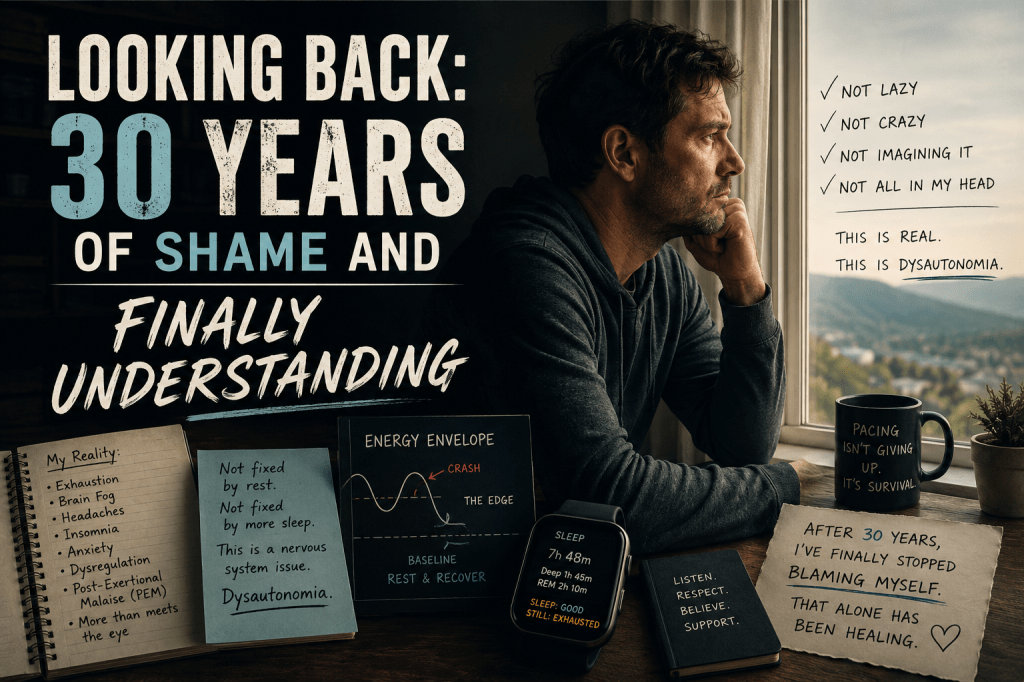
  • Looking Back: 30 Years of Shame and Finally Understanding My Experience

    Looking Back: 30 Years of Shame and Finally Understanding My Experience

    I’ve lived with this illness for over 30 years, and for most of that time I was ashamed of it.

    Doctors kept telling me it was all in my head.

    They said I was depressed, anxious, or that I just didn’t want to work hard enough. They usually prescribed antidepressants and anti-anxiety medications, claiming these drugs would fix me. While the medication may have helped my emotional state somewhat, it did nothing to fix the physical symptoms.

    Thankfully, I eventually stopped letting them gaslight me into taking more and different medications.

    Every time I tried to explain how my body would completely crash after doing normal things, I was met with skepticism or pity.

    So I started doubting myself.

    I felt weak.
    I felt crazy.
    I carried a lot of shame for something I couldn’t control.

    The fatigue and exhaustion that comes with this illness is crushing.

    It’s not normal tiredness. It’s a deep, heavy exhaustion that sleep doesn’t fix. Even the smallest activities can leave me completely wiped out for days.

    My sleep tracker consistently shows that I get adequate deep sleep and REM sleep, yet I still wake up exhausted. That helped me understand something important:

    The problem isn’t simply how much I sleep.

    It’s that my dysautonomia prevents the sleep from being restorative.

    In the early years, the emotional side of it felt a lot like PMS — that same sudden emotional dysregulation, irritability, and feeling completely off — except instead of happening once a month, it could hit at any time.

    Only recently have I finally understood what’s really happening.

    What I have is dysautonomia.

    My autonomic nervous system doesn’t regulate properly anymore.

    That’s why I can suddenly feel freezing cold in a warm room. That’s why I’m much more comfortable lying down than sitting or standing. And that’s why even mild activity can make my whole system short-circuit — suddenly bringing on intense brain fog, overwhelming exhaustion, headaches, insomnia, anxiety, and sometimes depression all at once.

    ME/CFS always felt like an incomplete label to me.

    Yes, I crash after exertion.
    Yes, sleep doesn’t fix it.
    Yes, my body has never functioned the way people expect it to.

    But understanding it as dysautonomia finally explains the day-to-day reality of living in a body whose nervous system breaks down so easily.

    The only thing that actually helps is pacing — staying within my energy envelope.

    I try to live as close to the edge as I can, but carefully. Migraines and tinnitus have become warning signs for me. If I respect those early signals, I can often avoid triggering insomnia, which is far worse than a regular crash and completely throws me off balance.

    After 30 years, I’ve finally stopped blaming myself.

    That alone has been healing.

    I’m sharing this journal entry in case it gives someone else a little more language for their own experience.

    And for family members, friends, and doctors: please know that when we keep turning down invitations, or seem withdrawn, or disappear for long stretches of time, it’s not because we don’t want to be around you.

    Our energy is extremely limited.

    We have to be very careful to avoid crashes.

    Even now, I keep a little journal between doctor visits so I can clearly communicate what I’ve been experiencing. If you’re struggling to explain this illness during appointments, writing things down and bringing it with you can be incredibly helpful.

    Sometimes understanding does not cure the body.

    But it can begin to release the shame.

    And after so many years of being misunderstood, that matters.

  • When the Body Speaks: A Letter on ME/CFS and Forgiveness

    When the Body Speaks: A Letter on ME/CFS and Forgiveness

    Today, I felt it coming—a noxious wave rising from deep within. A bright, warning orange sliding straight into red, and before long, a full-blown crash. The heaviness in my limbs like wet sand, my mind fogged and thick. The weight of having done too much, more than my body could tolerate, more than it could carry.

    I knew this would happen. I overrode my limits packing, moving into a new apartment, settling in when my body was already whispering, slow down. But I kept going. And now, here I am.

    This morning, in a PEM-crazed state of mind, I did something else I knew wasn’t wise—I ate an entire loaf of bread. I reached for it like it might offer some relief, some fleeting comfort, slice by slice until it was all gone. But now I just feel worse: bloated, sick, heavy in a way that no food could fix. And of course, the familiar wave of guilt followed: Why did I do that? I can’t believe I did that. I know this pattern—how PEM twists my mind, makes cravings louder, decision-making foggier. And yet, here I am again.

    But here’s the thing. This doesn’t mean I’ve lost my way. It doesn’t mean I’ve failed. It just means I’m human—living in a body that doesn’t follow predictable rules. A body that sometimes rebels, sometimes collapses under the weight of what life demands.

    At some point, reason kicks back in. The first step, as always, is acceptance. Not resignation, but a soft compassion: This is where I am right now. It’s uncomfortable, yes. It’s frustrating, absolutely. But fighting it only adds another layer of exhaustion. So finally, after feeling terrible—and feeling terrible about feeling terrible—I plugged in my heating pad, got into bed, and let the warmth settle over my belly. I let it offer some small comfort to my sore muscles, as I let myself be.

    I know this will pass. The intensity will soften. My body will find its rhythm again. And when it does, I’ll carry this experience with me—not as a failure, but as another piece of the story. Another reminder that healing isn’t linear, and self-compassion is the only constant I can truly lean on.

    If you’ve found yourself here too—in the middle of a crash, tangled in frustration or guilt—I hope you know you’re not alone. We all override our limits sometimes. We all make choices that don’t feel wise in hindsight. But none of that means we’re failing. It just means we’re living, doing the best we can in bodies that ask for more patience than most people can imagine.

    So here’s to resting when we need to. To forgiving ourselves when we falter. To remembering that even in the hardest moments, there is still space for gentleness.

    With warmth and understanding,

    Richard

    🙏🕊🙏

  • A Refuge That’s Never Truly Out of Reach

    A Refuge That’s Never Truly Out of Reach

    For those of us living with chronic fatigue syndrome (ME/CFS), finding peace can often feel like an elusive dream. The body aches, the mind fogs, and even the simple act of resting can feel like a challenge.

    But beneath the surface of our struggles—beneath the exhaustion, frustration, and the endless cycle of unfinished stories—there is a refuge that has never left us. A place within that remains untouched, waiting patiently to be noticed.

    Across traditions, this inner sanctuary is described in many ways. In Christianity, it is the peace that passeth understanding, the quiet presence of the Holy Spirit that calms the heart. In Buddhism, it is our Buddha nature, the still, pristine mind that shines beneath our thoughts. In Jewish practice, Shabbat offers a sacred pause from the world’s demands, a time to rest in the presence of the I AM. Whether through Vipassana’s gentle observation, Samatha’s calming focus, or the surrender of “Let go and let God,” the invitation is the same: to rest in the peace that is always there, even if just for a moment.

    But here’s the truth that many of us don’t expect—when we set the intention to relax, to find that peace, it’s common for our minds to do the exact opposite. The very moment we try to slow down, all the unsettled thoughts, worries, and frustrations rise to the surface. It’s like sitting down to meditate and suddenly realizing just how noisy the mind really is. For those of us with ME/CFS, this can feel especially overwhelming. Our bodies are already weighed down by fatigue, and now our minds seem unwilling to give us the rest we crave.

    But this isn’t a sign of failure—it’s part of the process. Just as clouds drift across the sky without altering the vastness behind them, our thoughts come and go without touching the deeper peace within us. The key is not to fight these thoughts, not to grow frustrated or discouraged, but to witness them with gentle curiosity. To let them rise and fall, trusting that underneath the noise, the stillness remains.

    This practice takes more than just patience—it requires self-compassion. We have to be kind to ourselves, especially when the mind feels restless or when peace feels far away. Forgiveness becomes a part of the journey: forgiving ourselves for not feeling better, for being frustrated, for wishing things were different. And most of all, it requires surrender. To let go of the need to control how or when peace arrives, and to trust that it will reveal itself in its own time.

    Over the past month, I’ve faced one challenge after another—the sale of my RV, packing up a home that had been my refuge for over 30 years, and the physical demands of moving into a new apartment. Each step of the process required me to push beyond my body’s natural limits, triggering post-exertional malaise. There were moments I had to override the signals of fatigue just to get through the next task, knowing full well the cost it would bring later. And yet, I approached it as mindfully as I could, listening when possible, resting when needed, and trusting that I would eventually return to the gentle rhythm of proper pacing.

    Now, as I settle into this new space, I look forward to reclaiming that mindful practice of pacing—of finding the balance between effort and rest, between doing and simply being. Even though my body is still recovering, I know that the peace I’m seeking is not dependent on my circumstances. It’s always there, beneath the surface, waiting for me to slow down, to breathe, and to notice.

    And so, I offer this to you—whether you live with ME/CFS, face chronic challenges, or are simply navigating the complexities of life. The path to peace isn’t always smooth, and the mind may resist at first. But beneath the noise, the frustration, and the exhaustion, there is a refuge that has never left you. It’s not something you have to create or chase—it’s already there, waiting to be noticed.

    Let go. Be kind to yourself. Trust the process.

    And when you least expect it, that peace—the one that passeth understanding, that shines with the light of your Buddha nature, that whispers with the breath of the Holy Spirit—will rise to meet you.

    Because the truth is, that refuge is never truly out of reach.

    🙏🕊🙏

  • The Role of a Doctor: A Teacher for Post-Viral ME/CFS Patients

    Finding Compassionate and Informed Care in the Face of Chronic Fatigue Syndrome

    Living with post-viral myalgic encephalomyelitis/chronic fatigue syndrome (ME/CFS) presents unique challenges, not only in daily life but also in finding the right healthcare provider. Many of us with ME/CFS have experienced the frustration of dealing with doctors who dismiss or misunderstand our condition. What we truly need is a doctor who embodies the original meaning of the word: doctor comes from the Latin docere, meaning “to teach.” The best doctors are not just healers, but also teachers—those who are willing to learn about our condition and guide us on how to live better with it.

    The Need for a Teacher in Your Healthcare Provider

    When you’re living with a complex, often misunderstood condition like post-viral ME/CFS, your doctor’s role as a teacher becomes crucial. You’re not just looking for someone to prescribe medications—you need a partner who is willing to explore the intricacies of your symptoms and teach you how to manage them. ME/CFS can be an unpredictable illness, and we need doctors who are knowledgeable and open-minded enough to recognize this. Unfortunately, many of us have encountered physicians who were either dismissive or unaware of what chronic fatigue truly entails.

    Doctors who are lifelong learners, who are open to adapting their understanding as new research emerges, are those worth seeking. They don’t need to be ME/CFS specialists necessarily, but they must be willing to listen and learn.

    The Importance of Self-Advocacy

    Finding a doctor who meets these criteria can feel daunting. One of the hardest but most important lessons I’ve learned on my journey is the need to advocate for myself. This means recognizing that you have the right to “fire” doctors who are not serving your needs. It also means being willing to seek out new doctors, even when it’s exhausting.

    For people with post-viral ME/CFS, visiting doctors can easily trigger post-exertional malaise (PEM), and even a single appointment may be enough to cause a severe setback. This makes it all the more important to learn as much as possible about a doctor beforehand—whether through phone calls, online research, or patient reviews—to improve your chances of success and reduce the toll on your body and mind. Over the years, I’ve learned that it’s often more valuable to take my time finding the right doctor than to rush from one to another.

    Osteopathic Physicians: A More Humanistic Approach

    From my own experience, I’ve found that osteopathic physicians often approach medicine with a more holistic and humanistic philosophy. Osteopathic doctors are trained to treat the whole person, not just individual symptoms. While not all osteopaths are equally open-minded or knowledgeable about post-viral ME/CFS, in my experience, they tend to listen more carefully and offer more personalized care than their counterparts in allopathic medicine.

    The osteopathic doctor I eventually found has been a godsend. He understands my condition, respects my experiences, and helps me manage both symptoms and lifestyle adjustments. Together, we’ve worked on pacing, setting boundaries, and using a few key medications in low doses to manage symptoms. He’s more of a guide than just a prescriber, which makes all the difference.

    If you’re able to find an osteopathic doctor who truly adheres to the principles of osteopathic medicine, they may offer a much-needed, compassionate approach to managing your condition.

    The Insurance Barrier: Navigating the System

    One of the biggest challenges for ME/CFS patients is navigating the insurance system, especially when you’re restricted to certain networks. In my case, my experience with an HMO (Kaiser) was incredibly frustrating. The doctors in that system didn’t understand or take my condition seriously, which made the whole process feel like a dead end. Unfortunately, this is not uncommon when dealing with HMOs or Medicare Advantage plans that limit which doctors you can see.

    The game-changer for me came when I switched from a Medicare Advantage Plan to straight Medicare. This allowed me the flexibility to seek out doctors who would take Medicare and truly understood my condition. It wasn’t until I left Kaiser that I finally found a compassionate and knowledgeable osteopathic physician. If you’re struggling with an HMO or restricted insurance, it may be worth exploring other options that give you more control over which doctors you can see.

    Managing Post-Exertional Malaise (PEM) with Doctor Visits

    One of the hardest aspects of post-viral ME/CFS is the experience of PEM—where even minor physical or mental exertion can trigger a severe worsening of symptoms. Doctor visits, while necessary, can often cause PEM due to the stress of travel, waiting rooms, and emotional fatigue from unsatisfactory interactions with dismissive doctors. This makes it crucial to be strategic about when and how often you see doctors.

    If you have a more severe case of ME/CFS, it might be wise to pace your appointments carefully. Prioritize visits that you know will be productive. Don’t be afraid to ask your doctor to handle routine matters via telehealth or email when possible, to minimize the physical toll of in-person visits.

    In Conclusion: Trusting Your Instincts

    Ultimately, finding a good doctor for post-viral ME/CFS is about finding someone who respects you, listens, and acts as a partner in your care. Doctors should be willing to teach, learn, and adapt, especially when dealing with a condition as complex as ME/CFS. Whether through osteopathic physicians, integrative medicine, or other avenues, your goal is to find a doctor who works with you, not against you.

    This journey can take time, and there may be obstacles along the way, but don’t settle for less than the care you deserve. Trust your instincts, advocate for yourself, and remember that the right doctor is out there—they just may not be easy to find.

    🙏🕊️🙏