Tag: non-dual awareness

  • Quantum Kindness: The Future Has Always Been Here

    Quantum Kindness: The Future Has Always Been Here

    They say quantum computing will change everything. That by tapping into superposition and entanglement, we’ll compute across multiverses—solving problems with impossible speed, even generating physical objects through manipulation of nanoparticles.

    A replicator. A cup of Earl Grey, hot.

    But what if some of us are already doing this—not with machines, but with our hearts? What if consciousness itself is the original quantum field, and the mind anchored in love is already reshaping reality?

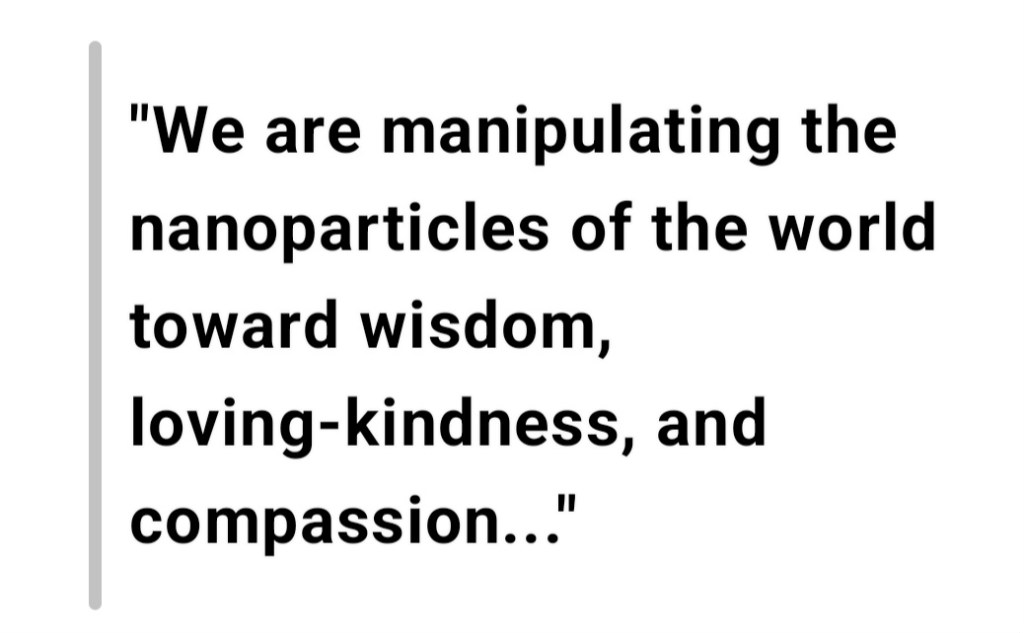
    This isn’t science fiction—it’s spiritual reality. Those of us walking the contemplative path are not escaping the world, but quietly reweaving it. We are learning to gently manipulate the nanoparticles of existence toward wisdom, loving-kindness, and compassion.

    Not with force, but with intention.

    Not for profit, but for the benefit of all.

    The mystics have always known: the inner technology of the heart surpasses any external device. The awakened soul is the true replicator—bringing peace, abundance, and healing into form through stillness, presence, and love.

    And perhaps this is why such power must remain quiet. After all, if people remembered their God-given ability to manifest what is needed in harmony with the whole, the marketplace might crumble. But maybe it’s time. Maybe the world is ready for a different kind of revolution—not of machines, but of awakened hearts.

    The future has always been here. It lives in you.

    🙏🕊🙏

  • Can you help me rest in awareness and discover inner-peace?

    Can you help me rest in awareness and discover inner-peace?

    Yes. Take a moment to settle, feeling the body where it is. Let your attention gently turn inward. Notice any sensations in the body, any thoughts passing through the mind, or emotions present right now. Just observe them, without trying to change or control anything.

    Now, quietly ask yourself: Who is aware of these sensations, these thoughts, these emotions?

    Don’t look for an answer in words. Let the question open a quiet space within you. Rest in that still, silent awareness—the place from which everything arises and into which everything fades.

    Stay with this gentle noticing, and see what naturally unfolds.

    InnerPeace

    Self-inquiry

    LoveAndRespect

    Compassion

    🙏🕊🙏

  • Neti Neti #21: Moving Beyond Mental Efficiency Toward True Stillness

    Question:

    In my meditation practice, I’ve found that even as I use the mantra Neti Neti, my mind continues to plan and organize, almost as if the mantra is helping me to become more efficient in my daily tasks. How can I ensure that my practice is guiding me toward stillness and not just enhancing my mental activity?

    Dear Friend,

    In our practice, there are moments when the very tools we use to quiet the mind can, if we are not careful, become entangled in the very patterns we seek to transcend. This is a subtle but important distinction, one that deserves our careful attention and reflection.

    You shared with me the story of a friend who could, with great concentration, count her breath while simultaneously planning her day and organizing her thoughts. This ability, impressive as it may be, highlights a potential pitfall in our practice: the risk of turning a mantra or meditative discipline into just another tool for the ego to increase its efficiency in the world of thoughts and tasks.

    The discipline of breath counting, like the repetition of a mantra, is designed to focus the mind, to bring it into alignment with the present moment, and ultimately to guide it toward stillness. However, when the mind uses these practices to merely enhance its own abilities—to become more effective at planning, strategizing, or managing the endless stream of daily thoughts—something essential is lost. The practice, rather than serving as a path to stillness and simplicity, becomes yet another way for the mind to strengthen its hold, to entrench itself more deeply in its habitual patterns.

    Neti, Neti—”Not this, not this”—is not a mantra to be repeated mechanically while the mind continues its usual business. It is not a background hum that allows the mind to multitask or to become more efficient in its usual endeavors. Rather, it is a tool for discernment, for negation, for guiding the mind away from its distractions and toward the silence that lies beneath all thought.

    When we repeat Neti, Neti, we are not merely engaging the mind in an activity; we are inviting it to let go, to release its grip on the thoughts, desires, and plans that arise within it. Each time a thought surfaces, whether it is about the past, the future, or the present, we gently meet it with Neti, Neti, allowing it to dissolve, to return to the nothingness from which it came. This practice is not about increasing our concentration or our ability to manage our mental activities; it is about seeing through them, recognizing them as temporary, fleeting, and ultimately unreal.

    The true purpose of Neti, Neti is to bring the mind to stillness, to the quiet awareness that is always present beneath the surface of our thoughts. It is to guide the mind back to its natural state, where it is not constantly engaged in activity, but rests in the simple presence of being. This stillness is not something to be attained through effort or concentration; it is something that is revealed when the mind lets go of its constant striving and simply allows itself to be.

    In this way, Neti, Neti becomes not just a practice, but a way of being—a way of living in the world without being caught up in the endless stream of thoughts and activities that usually dominate our consciousness. It is a way of returning, again and again, to the essence of who we are, to the pristine mind that lies beyond all distractions and desires.

    So, dear friend, as you continue with your practice, let this be a gentle reminder: the purpose of Neti, Neti is not to make you more efficient at thinking, planning, or organizing. It is to free you from the need to do so, to guide you toward a deeper stillness, a deeper presence, and a deeper understanding of your true nature. Each repetition of the mantra is an invitation to let go, to release the mind’s habitual patterns, and to rest in the quiet awareness that is your true self.

    May your practice be a path to stillness, a path to simplicity, and a path to the deep peace that comes from knowing that you are not the thoughts that arise, but the awareness that witnesses them.

    🙏🕊️🙏

  • Neti Neti #19: Beyond the Desire for Fulfillment and Peace

    Question:

    Paramahansa Yogananda said, ‘Through meditation and devotion, one can experience the presence of God within and lead a life of greater fulfillment and peace.’ At this point in my life, I know these words are true, but the practice of Neti Neti seems even more aligned with my path. It guides me away from distractions, including the desire for fulfillment and peace. These desires, though natural expressions of ego relaxation and pristine mind, can become subtle traps if they turn into goals. How do I reconcile the pursuit of fulfillment and peace with the deeper realization of Neti Neti, which reminds me to let go of even these desires?

    Dear Friend,

    It is a significant realization, this understanding that even the desire for fulfillment and peace can become a subtle trap on the spiritual path. While these states are indeed natural expressions of the relaxation of the ego and the emergence of pristine mind, they must also be met with the same gentle discernment that you apply to all other experiences: Neti, Neti—Not this, not this.

    Desire, in its many forms, has a way of entangling the mind, even when it appears in the guise of something noble or spiritual. The longing for fulfillment, the yearning for peace—these are desires that arise naturally as the ego begins to loosen its grip, as the I-sense starts to dissolve into the vastness of pure awareness. And yet, as you have so wisely recognized, even these desires can become obstacles if they are held too tightly, if they become goals in themselves.

    In this, there is a subtlety that must be navigated with care. The experience of fulfillment and peace is not to be rejected, but neither is it to be grasped. It is to be allowed, to be noticed, and then gently set aside, with the understanding that even these are not the ultimate truth.

    Neti, Neti guides us beyond all that can be named, all that can be desired. It takes us to the very edge of the known, and then, with infinite patience, it takes us further still, into the unknown, into the formless, into the pure awareness that is beyond all seeking. In this place, there is no fulfillment to be attained, no peace to be grasped—because there is no one left to attain or grasp anything. There is only what is, in its simplest, most profound expression.

    This practice is not about rejecting fulfillment or peace, but about seeing them for what they are—temporary states that arise and pass, like clouds in the sky. They are beautiful, they are welcome, but they are not the sky itself. The sky, the vast expanse of pristine mind, remains untouched by the passing of these clouds, just as your true self remains untouched by the ebb and flow of experience.

    In letting go of even the desire for peace and fulfillment, you open yourself to the deeper truth that lies beyond all conditions, beyond all states. You allow yourself to rest in the simple awareness of being, in the silence that is always here, beneath the noise of the mind. This is the ultimate freedom—not the attainment of any particular state, but the realization that you are already that which you seek.

    Neti, Neti—Not this, not this. It is the gentle, persistent reminder that the truth is beyond all concepts, beyond all desires, beyond all states of being. It is the invitation to let go, to surrender, and to rest in the unconditioned awareness that is your true nature.

    Continue with this practice, dear friend, knowing that it is guiding you ever closer to the heart of truth. Let the desires arise and pass as they will, without clinging to them, without rejecting them—simply noticing, and then softly whispering, “Not this, not this.” In this way, you will find a peace that is not sought, a fulfillment that is not attained, but simply is.

    🙏🕊️🙏

  • Neti Neti Series No. 13: The Realization of the “I” and Its Journey Toward Enlightenment

    Question:

    In realizing that “I” will never be enlightened, does this mean that the goal of enlightenment is out of reach? How can I reconcile this understanding with the continued practice of drawing closer to enlightenment, even if it cannot be fully attained by the ego?

    Dear friend,

    Your insight that “I will never be enlightened” is one of the most profound realizations one can encounter on the spiritual path. This understanding marks a turning point, where the journey shifts from the pursuit of a goal to the practice of embodying the qualities that lead one closer to enlightenment—qualities that can be lived and expressed in every moment, even if they cannot be possessed by the “I.”

    Enlightenment, as you now see, is not something that the “I” can achieve, for the “I” is precisely what dissolves in the light of true awakening. The very sense of being a separate self, striving for a state called enlightenment, is itself part of the illusion that enlightenment reveals and transcends. This is not to say that the journey is futile, but rather that the journey transforms into something far more subtle, more profound, and more aligned with the truth of our existence.

    Instead of seeing enlightenment as a distant goal, you have wisely turned your attention to the practice of being as close to enlightenment as possible. This is a practice not of attaining, but of allowing—allowing the mind to quiet, the heart to open, and the “I” to soften. It is a practice of aligning with the qualities that reflect the light of enlightenment: peace, compassion, clarity, and presence.

    In this practice, there is no need for the ego to strive or grasp. Instead, there is a gentle surrender to the truth that is already within you, waiting to be uncovered, like the sun behind the clouds. The more you practice, the more these qualities shine through, guiding your actions, your thoughts, and your interactions with the world.

    There is great freedom in this realization. The pressure to “become enlightened” falls away, leaving behind a sense of ease and acceptance. You are no longer bound by the idea that you must reach some ultimate state; instead, you are free to simply be, to practice embodying the light of enlightenment in whatever way is possible in each moment. This is not a lesser path; it is the path of wisdom, one that honors the truth that enlightenment is not something to be grasped, but something to be lived.

    Your journey now takes on a new quality. It becomes less about reaching a destination and more about how you walk the path. Every step, every breath, every moment of presence becomes an expression of the enlightenment you seek. And in this way, enlightenment is not something that happens in the future, but something that you touch, however briefly, in the here and now.

    Dear friend, this realization is a gift. It invites you to embrace the present moment, to find the divine in the ordinary, and to let go of the need to “achieve” something that, in truth, cannot be achieved by the “I” at all. Instead, you practice being close to enlightenment, knowing that in the very act of practicing, you are already touching the essence of what you seek.

    Trust in this process, and continue to walk this path with a light heart. Know that the practice itself is enough, that the journey is the destination, and that in the softness of the “I,” the light of enlightenment shines ever more clearly.

    🙏🕊️🙏

  • Post 11: A Moment of Reflection: Integrating the Yoga Sutras So Far

    Post 11: A Moment of Reflection: Integrating the Yoga Sutras So Far

    As we come to this point in our journey through the Yoga Sutras, it is important to pause for a moment. These sutras are not just words to be read; they are seeds, planted within the soil of your mind, each one carrying the potential for deep transformation. And like all seeds, they need time, space, and the right conditions to grow.

    Take a breath. Feel the stillness in the space around you. Notice the quiet beneath the surface of your thoughts. There is a place within you—a place of silence—that is always there, waiting to be discovered, waiting to be touched. It is here, in this silence, that the teachings of the Yoga Sutras truly begin to take root.

    You have been walking alongside Patanjali, exploring the nature of the mind and learning to witness its fluctuations with clarity and detachment. But now, it is time to look not only at the words but at how they have woven themselves into the fabric of your being. How have these teachings touched you? How have they begun to shift the way you move through the world, the way you sit in meditation, the way you witness your thoughts?

    An Invitation to Reflect

    As you sit with these questions, allow yourself to soften. There is no rush to find answers, no need to judge or evaluate where you are on this path. Simply notice. How has the practice of Neti, neti. I am the witness. I am the Seer shaped your understanding of who you are? Have you begun to feel the space that exists between your thoughts, that stillness where you rest in the awareness of the Seer?

    Patanjali’s teachings are an invitation to remember who you are beyond the mind’s fluctuations. Perhaps you have felt moments of clarity, where you touched this deeper awareness. Or perhaps the mind has resisted, pulling you back into its familiar patterns. Either way, you are exactly where you need to be. The journey through the Yoga Sutras is not about perfection, but about presence.

    A Space for Questions and Contemplation

    Take this time to contemplate any questions that may have arisen in your practice. Have there been sutras that resonated deeply with you? Or perhaps certain ideas that feel more challenging, more difficult to integrate? Sit with these questions, knowing that they are a natural part of the process.

    Sometimes, it is in the asking of the question that we find our deepest understanding. Allow the questions to arise without needing immediate answers. Trust that the clarity will come, not through force, but through the gentle unfolding of your practice.

    A Guided Meditation: Resting in the Seer

    Let’s take a few moments together to deepen into this practice. Find a comfortable place to sit, allowing your body to soften, your breath to slow. Close your eyes, and begin to feel the rise and fall of your breath, noticing the gentle rhythm that brings you back to the present moment.

    As thoughts arise, gently say to yourself, Neti, neti. I am the witness. I am the Seer. Let the thoughts pass by like clouds drifting through the sky. There is no need to follow them, no need to push them away. Simply observe, allowing yourself to rest in the stillness that lies beneath the mind’s activity.

    Feel the spaciousness that opens as you release each thought, each sensation. This is the space of pure awareness, the space of the Seer. As you sit in this awareness, notice how the fluctuations of the mind begin to soften, how the stillness becomes more apparent. You are the witness. You are the Seer.

    Rest here, in this stillness, for as long as you need. There is nowhere else to go, nothing else to do. Just this moment. Just this breath.

    Moving Forward with Compassion

    As we prepare to move forward in our journey through the Yoga Sutras, remember that this path is one of compassion—toward yourself, toward your practice, toward the fluctuations of the mind. You are learning to meet yourself with clarity and kindness, to sit in the presence of whatever arises without judgment.

    Allow yourself to take this pause before we dive deeper into the next set of sutras. Let the teachings settle within you, like seeds planted in rich soil. Trust that in time, they will blossom into the wisdom and understanding that you seek.

    Coming Up Next:

    In our next post, we will return to Patanjali’s teachings, exploring Sutras 1.19 and 1.20. These sutras delve deeper into the nature of samadhi, the highest state of meditative absorption, and the paths through which it can be attained. We will reflect on the qualities needed to reach this state, including faith, energy, mindfulness, and wisdom. Join me as we continue this journey toward deeper understanding and inner peace.

    🙏🕊️🙏

  • Post 10: Stages of Meditative Absorption: Patanjali’s Sutras 1.17 and 1.18

    Post 10: Stages of Meditative Absorption: Patanjali’s Sutras 1.17 and 1.18

    In the previous post, we explored the power of detachment and how cultivating non-distraction allows us to rest in the awareness of the Seer. Now, Patanjali takes us deeper into the process of meditation by introducing the stages of meditative absorption, where the mind gradually becomes still and clear. In Sutras 1.17 and 1.18, Patanjali outlines the progressive levels of absorption (samadhi) that arise as the mind moves from engagement with mental events to pure awareness.

    1.17: The first stage of meditative absorption is characterized by reflection, contemplation, bliss, and a sense of individuality.
    1.18: The higher stage of meditative absorption is characterized by the cessation of mental events, revealing a state of pure awareness.

    The Four Layers of Absorption

    Sutra 1.17 describes the initial stages of meditative absorption, where the mind moves through four layers of experience: reflection (vitarka), contemplation (vicara), bliss (ananda), and a subtle sense of individuality (asmita). These layers are not linear but overlapping, offering different aspects of deepening concentration and stillness.

       •   Reflection: At this level, the mind still engages with objects of focus, such as the breath or a mantra, but there is an increasing sense of calm and centeredness. The fluctuations of the mind are present, but they are observed without being disruptive.
       •   Contemplation: As the mind settles further, reflection deepens into contemplation. Here, there is less attachment to external objects and more focus on the inner experience. The mind becomes absorbed in its own stillness.
       •   Bliss: The third layer is characterized by a sense of bliss or joy that arises as the mind releases its habitual attachments. This bliss is not emotional but an inner feeling of contentment and peace.
       •   Sense of Individuality: Even at this stage, there remains a subtle awareness of oneself as an individual, the witness of the experience. This is a more refined level of the ego, still present but not as dominant as in ordinary states of awareness.

    These four layers of absorption allow the mind to rest in deeper levels of concentration, but they are still within the realm of mental events. At this stage, the practitioner is aware of the experience but has not yet transcended the subtle identification with the mind.

    Moving Toward Pure Awareness

    In Sutra 1.18, Patanjali introduces a higher stage of meditative absorption, one that is free from the pull of mental events. Here, the fluctuations of the mind have ceased, and what remains is pure awareness—often described as nirvikalpa samadhi. In this state, there is no longer any identification with thoughts, emotions, or even a subtle sense of self. The Seer abides in its pure, natural state.

    This level of absorption is not easily attained. It is the culmination of disciplined practice, non-attachment, and sustained meditation. It requires the mind to become so still that it no longer engages with even the subtlest of mental events. In this state, there is no longer a division between the Seer and what is seen; there is only pure awareness.

    This experience of pure awareness is often described as the goal of yoga. It is the state where the practitioner experiences freedom from the mind’s fluctuations and rests in the infinite stillness of the pristine mind.

    Bringing It Into Practice: Deepening Your Meditation

    As we practice, we can begin to notice these layers of absorption in our own meditation. At the beginning of meditation, the mind may still be engaged in reflection or contemplation. By gently repeating “Neti, neti. I am the witness. I am the Seer,” we allow the mind to gradually release its attachment to these mental events and move into deeper stillness.

    Over time, as the mind settles, we may experience moments of bliss or peace. These are natural signs that the mind is letting go of its habitual distractions. However, even in these moments, it’s important to remember that the goal is not to cling to these experiences but to continue moving toward deeper levels of absorption.

    The practice of cultivating pure awareness—free from the mind’s fluctuations—requires patience and persistence. Each time we return to the stillness of the Seer, we strengthen our ability to remain in that state for longer periods, eventually moving beyond the subtle sense of individuality and into the state of pure awareness.

    The Path to Pure Awareness

    The stages of meditative absorption are a gradual process, unfolding through disciplined practice and consistent effort. While the initial layers of reflection, contemplation, and bliss are important steps along the path, they are not the final goal. The ultimate aim is to experience the state of pure awareness, where the mind’s fluctuations cease, and the Seer abides in its true nature.

    As we progress on this path, it’s essential to remain patient and compassionate with ourselves. The journey toward pure awareness is not linear, and there will be times when the mind is more active or distracted. The key is to maintain a steady practice, trusting that each moment of mindfulness brings us closer to the stillness of the pristine mind.

    Coming Up Next:

    In our next post, we will take a moment to pause and reflect on the journey through the Yoga Sutras so far. This will be an opportunity to contemplate how the teachings have shaped your practice and explore a guided meditation for deeper integration. After this reflective pause, we will continue the series with the next set of sutras, diving deeper into the path of self-realization.

    🙏🕊️🙏

  • Post 8: The Importance of Discipline: Patanjali’s Sutras 1.13 and 1.14

    Post 8: The Importance of Discipline: Patanjali’s Sutras 1.13 and 1.14

    As we have seen in the previous sutras, Patanjali emphasizes the nature of mental events—fluctuations that arise in the mind—which can either distract us or be observed with clarity. Now, in Sutras 1.13 and 1.14, Patanjali shifts our attention to the importance of disciplined practice, showing us how consistent effort is essential in gaining mastery over the mind.

    1.13: The practice of yoga is the effort to remain steady in the awareness of the Seer.
    1.14: This practice becomes firmly grounded when pursued for a long time, without interruption, and with sincerity.

    These two sutras bring into focus the essential qualities of discipline in yoga: persistence, consistency, and sincerity. Patanjali emphasizes that mastery over the mind is not achieved through occasional effort but through sustained, dedicated practice over time.

    The Effort to Remain Steady

    Sutra 1.13 defines the practice of yoga as the effort to remain steady in the awareness of the Seer. This is where discipline truly comes into play. In our day-to-day life, the mind is constantly drawn into the fluctuations of thoughts, emotions, and external distractions. The practice of yoga, as Patanjali teaches, is the ongoing effort to maintain our awareness of the Seer—the true self—amid these fluctuations.

    This is not a passive state of relaxation but an active practice of mindfulness. Each time we notice a mental event, we have the opportunity to reaffirm our awareness of the Seer. Using the phrase “Neti, Neti. I am the witness. I am the Seer,” we can gently return to the present moment, reminding ourselves that we are not the fluctuations of the mind but the one who observes them.

    The effort here is not about forcefully suppressing thoughts or emotions, but about gently bringing the mind back to stillness each time it becomes distracted. Over time, this practice strengthens our ability to remain steady and centered, even in the face of mental events.

    The Power of Consistency

    Patanjali elaborates further in Sutra 1.14, reminding us that this practice becomes firmly grounded only when it is pursued for a long time, without interruption, and with sincerity. Consistency is key in yoga. The mind’s fluctuations are relentless, and it takes sustained effort to cultivate the steadiness of the Seer.

    Patanjali’s emphasis on long-term practice is important. Mastery over the mind doesn’t happen overnight, nor is it achieved through sporadic practice. The discipline of yoga requires us to show up again and again, each time renewing our commitment to remain present. Over time, this consistency bears fruit, allowing us to experience greater clarity, peace, and self-awareness.

    This is why sincerity is also essential. It’s not just about going through the motions of meditation or mindfulness; it’s about truly committing to the practice with an open heart. When we practice sincerely, we develop a deep sense of trust in the process, knowing that each moment of mindfulness strengthens our ability to remain in the awareness of the Seer.

    Bringing It Into Practice: Building a Steady Practice

    In practical terms, this means making space in our daily lives for consistent practice. Whether it’s through meditation, mindful breathing, or simply taking moments throughout the day to return to the awareness of the Seer, the key is to remain dedicated.

    When distractions arise, and they inevitably will, gently bring your awareness back with “Neti, Neti. I am the witness. I am the Seer.” This simple phrase helps you cultivate the steadiness that Patanjali describes, allowing you to witness the mind’s activity without becoming entangled in it.

    The power of this practice lies in its repetition. The more we engage with the process, the more natural it becomes to return to stillness. Over time, we develop a firm foundation of mindfulness that can weather even the most persistent mental events.

    Maintaining Discipline Through Sincerity

    As we practice, it’s essential to approach the discipline with sincerity. This doesn’t mean pushing ourselves harshly or becoming frustrated when the mind wanders. Instead, it’s about maintaining a gentle, loving commitment to the process. Each time we bring the mind back to the Seer, we do so with a sense of gratitude for the opportunity to deepen our awareness.

    In this way, discipline becomes less of a burden and more of an act of devotion. We are not forcing the mind into stillness; we are guiding it, with patience and sincerity, toward a deeper connection with our true nature. Over time, this practice becomes a source of joy, as we witness the mind’s fluctuations without becoming attached to them, remaining steady in the awareness of the Seer.

    Coming Up Next:

    In the next post, we will explore Sutras 1.15 and 1.16, where Patanjali introduces the concept of detachment and deeper levels of non-attachment. We will reflect on how this practice of detachment can free us from the grip of desires and aversions, allowing us to remain centered in the Seer. Join me as we continue this journey toward mastery over the mind and deeper self-awareness.

    🙏🕊️🙏
  • Post 7: Memory and Non-Attachment: Patanjali’s Sutras 1.11 and 1.12

    In the previous post, we explored the nature of imagination and sleep as mental events, recognizing their potential to distract us or be witnessed with clarity. Now, Patanjali takes us further into the exploration of mental events, focusing on memory and the practice of non-attachment.

    1.11: Memory is the retention of mental impressions from past experiences.
    1.12: Non-attachment is the practice of detaching from mental events, leading to mastery over them.

    These sutras offer a profound reflection on how the mind holds onto the past and how cultivating non-attachment can free us from the grip of these mental events. Memory, while useful, can often bind us to patterns of thought that shape our perception of the present. Non-attachment becomes the key to releasing these patterns and living more fully in the pristine mind.

    Memory: A Mental Event That Holds Us in the Past

    Memory (smriti) is a powerful mental event that allows us to recall past experiences, feelings, and thoughts. On a practical level, memory is essential for learning and functioning in daily life. However, when we become overly attached to our memories, they can cloud our present awareness, trapping us in patterns of the past.

    For example, we often replay old memories in our minds, reliving past successes, failures, or emotional moments. These memories can influence our current perception, making it difficult to see the present clearly. They create mental events that may feel real but are rooted in the past, shaping how we engage with the world around us.

    Just as with imagination and sleep, memory is simply another mental event. The more we engage with it, the more it pulls us away from the present moment. However, by recognizing memory as a mental event, we can observe it without becoming attached, allowing it to arise and pass without coloring our awareness of the now.

    Non-Attachment: The Key to Mastering Mental Events

    Patanjali introduces the practice of non-attachment (vairagya) in Sutra 1.12 as the means by which we gain mastery over the fluctuations of the mind. Non-attachment doesn’t mean suppressing or avoiding mental events; rather, it is the practice of witnessing them without becoming identified with them.

    In the case of memory, non-attachment allows us to remember the past without letting it control the present. By practicing Neti, Neti. I am the witness. I am the Seer., we remind ourselves that we are not the memory, but the one who observes it. This simple practice of non-attachment creates space between us and the mental event, freeing us from the patterns of the past.

    Non-attachment is not something that happens overnight. It is cultivated through disciplined practice, returning to the awareness of the pristine mind again and again. As we grow in our ability to observe mental events without attachment, we strengthen our capacity to remain present, no matter what arises in the mind.

    Bringing It Into Practice: Letting Go of Memory’s Grip

    When memories arise during meditation or daily life, it’s important to acknowledge them without getting caught in their narrative. You can simply remind yourself, “Neti, Neti. I am the witness. I am the Seer.” This helps create the mental space to witness the memory and let it go without attachment.

    In doing so, we train ourselves to let go of the past and stay rooted in the present. We begin to see memory as just another mental event, not as something that defines who we are or how we must respond to life. With each practice of non-attachment, we loosen the grip that memories have over us, freeing ourselves from the patterns that bind us to the past.

    This practice doesn’t diminish the importance of memory but helps us place it in its proper context—as a useful tool rather than an overwhelming influence. As we continue to practice non-attachment, we experience more freedom, clarity, and presence in our everyday life.

    Maintaining Discipline in Non-Attachment

    The discipline of non-attachment requires patience and consistency. The mind will naturally want to hold onto memories, but each time we observe them without attachment, we take a step closer to mastery. Non-attachment isn’t about becoming indifferent; it’s about becoming fully present, without being swayed by the mental events that arise.

    Through this discipline, we can cultivate a deeper awareness of the pristine mind—a state of clarity, peace, and presence that is untouched by the mind’s fluctuations. The more we practice non-attachment, the easier it becomes to witness mental events and remain centered in the Seer.

    Coming Up Next:

    In our next post, we will explore Sutra 1.13 and 1.14, where Patanjali explains the importance of disciplined practice in achieving mastery over the mind. We’ll reflect on how consistent effort and non-attachment work together to bring us closer to the realization of our true nature. Join me as we continue this journey toward deeper self-awareness and inner peace.

    🙏🕊️🙏

  • Post 6: Navigating Imagination and Sleep: Patanjali’s Sutras 1.9 and 1.10

    In our previous posts, we explored the nature of right knowledge and wrong knowledge as mental events, recognizing them as fluctuations of the mind that can distract us from the clarity of the Seer. Now, Patanjali takes us further into the types of mental events, focusing on imagination and sleep.

    1.9: Imagination is the mental event that arises when words or concepts are not based on reality.
    1.10: Sleep is the mental event that occurs when there is an absence of awareness.

    These two sutras reveal important aspects of the mind’s activity that can either lead to further distraction or be witnessed with clarity. Both imagination and sleep are natural, but without mindfulness, they can obscure our ability to remain in the awareness of the Seer.

    Imagination: The Mind’s Tendency to Create

    Imagination (vikalpa) is the mind’s ability to create images, scenarios, or concepts that are not rooted in actual experience. This can be a powerful tool for creativity, but when we become entangled in imaginative thoughts, they pull us away from the present moment and the reality of what is. Imagination is a type of mental event that can lead to confusion when we mistake it for truth.

    For instance, how often do we find ourselves lost in a daydream or a scenario that has no bearing on reality? Whether it’s imagining a future outcome or reliving a past experience, imagination can easily become a source of distraction. Yet, when we recognize imagination as just another mental event, we can let it pass without getting caught up in it. The key is to observe it without judgment or engagement, remembering that we are the Seer, not the mental event.

    Sleep: Absence of Awareness—and the Potential for Lucid Dreaming

    Interestingly, Patanjali includes sleep (nidra) as a mental event. While sleep is essential for physical and mental rejuvenation, it is still a state of mind where awareness is typically absent. In the context of yoga, sleep represents a gap in our mindfulness—a temporary state where the mind is not engaged with external reality but is still present in a subtle way.

    However, there’s another dimension to sleep that Patanjali may be pointing toward: the practice of remaining aware even while dreaming. This is known as lucid dreaming, where the dreamer becomes conscious of the fact that they are dreaming. Just as we practice mindfulness in waking life, it’s possible to cultivate awareness during dreams, allowing us to witness the dream without becoming absorbed in the content.

    In dreams, we are often fully engaged in the mental events that arise, much like we are in our waking life. Yet, with practice, we can maintain a sense of the Seer—the witness of the dream itself. Neti Neti can become a spontaneous practice even in the dream world, reminding us that we are the dreamer, not the dream. For those who are interested, this practice can be cultivated over time, offering a deeper level of awareness during the state of sleep.

    Bringing It Into Practice: Staying Present Amid Mental Events

    As with the other mental events we’ve discussed, both imagination and sleep can be observed without judgment. Rather than getting caught up in the content of our imaginations or losing ourselves in unconscious moments, we can use the practice of Neti, neti to return to the present. By simply acknowledging these as mental events, we free ourselves from their pull.

    When you find yourself lost in an imaginative thought, you can gently remind yourself, “Neti, Neti. I am the witness. I am the Seer.” This allows you to return to a place of stillness and clarity, observing the imagination without engaging with it. Similarly, if you notice moments of mindlessness or dullness creeping in during your day—or even in the dream state—the same practice can bring you back into awareness, helping you stay present.

    This practice doesn’t require us to suppress imagination or fight against sleep; instead, we recognize these mental events as temporary and return to the awareness of the pristine mind. By observing these fluctuations without attachment, we maintain the discipline necessary to cultivate equanimity and inner stillness.

    Maintaining Discipline in Mindfulness

    As we’ve seen before, discipline plays a crucial role in this process. The mind naturally drifts toward imaginative scenarios and moments of dullness. But through disciplined practice, we strengthen our ability to remain anchored in the awareness of the Seer. Each time we recognize imagination or mindlessness and return to stillness, we reinforce the clarity of the pristine mind.

    Over time, this discipline allows us to witness mental events without becoming distracted by them, no matter how subtle or engaging they may be. By maintaining this mindfulness, we can rest in the simplicity of awareness, untouched by the mind’s fluctuations.

    Coming Up Next:

    In our next post, we will explore Sutras 1.11 and 1.12, where Patanjali continues to describe mental events, focusing on memory and the practice of non-attachment. We’ll reflect on how memory shapes our perception of the present and how cultivating non-attachment frees us from the patterns of the past. Join me as we continue this journey toward deeper self-awareness and peace.

    🙏🕊️🙏

  • Post 5: Simplifying the Mental Events: Patanjali’s Sutras 1.7 and 1.8

    In our previous post, we explored how the mind fluctuates through five different types of mental events, or vrittis, as outlined in Sutras 1.5 and 1.6. These mental fluctuations—whether based on right knowledge, wrong knowledge, imagination, sleep, or memory—are all part of the mind’s natural activity. Patanjali now dives deeper into two specific categories of these mental events: right knowledge and wrong knowledge.

    1.7: Right knowledge is based on direct perception, inference, or the testimony of others.
    1.8: Wrong knowledge is a false understanding that is not based on reality.

    Patanjali’s distinction between right and wrong knowledge is important in understanding how our mind interprets the world. However, while this distinction is helpful, it can also lead us into a dualistic mindset, where we feel the need to evaluate every thought and determine whether it is “right” or “wrong.” This process can quickly become a source of confusion and further mental activity, pulling us away from the simplicity of recognizing the mind’s fluctuations for what they are: just mental events.

    The Trap of Over-Analyzing Mental Events

    When we begin to engage with thoughts, trying to categorize them as true or false, we lose sight of the purpose of yoga: to quiet the mind and return to the awareness of the Seer. It’s easy to get caught up in evaluating whether our perception is accurate or if our thoughts align with reality. However, in doing so, we fall back into the mind’s natural tendency to analyze, categorize, and divide. This keeps us stuck in the fluctuations rather than witnessing them from the calm, steady place of the Seer.

    This is where the teachings of Pristine Mind, as shared by Orgyen Chowang, become helpful. Instead of evaluating each thought, we can view all of these fluctuations—whether based on right or wrong knowledge—as simple mental events. When a thought arises, we don’t need to engage with it or analyze its validity. Instead, we gently recognize, “Ah, a mental event,” and return to the awareness of the pristine mind. This allows us to maintain a simpler, more manageable practice, without getting lost in the content of the thought itself.

    Bringing It Into Practice: The Power of Simplicity

    When thoughts arise during practice—whether they seem to be accurate or inaccurate—there is no need to judge or engage with them. By labeling them as mental events, we create space between the mind’s activity and our true nature, the Seer. This space allows us to witness the thoughts without becoming involved in them, reminding us that we are not our thoughts.

    However, there may be times when certain mental events are more distracting or persistent. In these moments, you can use the phrase, “Neti, neti. I am the Seer. I am the witness.” This simple yet powerful affirmation not only helps you negate the mental event but also affirms the truth of your being. It is not a mechanical mantra, but a tool to guide you back to a state of equanimity and mindful observance.

    When subtle mental events arise and pass away without distracting you, there’s no need to engage with the phrase. You can simply rest in the stillness of your mind, observing without interference. But when the mind becomes entangled in a particularly strong mental event, repeating “Neti, neti. I am the Seer. I am the witness” can help you return to the awareness of the Seer, allowing the mental event to dissolve and stillness to re-emerge.

    This flexible approach honors the flow of your practice—allowing you to respond when needed, while maintaining a light touch when the mind is naturally calm.

    Maintaining Discipline in the Face of Mental Events

    Just as we discussed in earlier posts, this approach requires discipline. The mind will always want to evaluate, engage, and label, but the practice of yoga teaches us to observe these mental events without getting drawn into them. Discipline is what allows us to consistently return to the stillness of the Seer, untouched by the mind’s activity. The more we practice this discipline, the easier it becomes to remain present and unaffected by the fluctuations of the mind.

    By adopting this simpler approach, we give ourselves the freedom to experience the pristine mind more frequently, without the need to overanalyze or categorize every thought. This shift in perspective allows us to experience the deeper peace that yoga offers, moving us closer to the realization of our true nature.

    Coming Up Next:

    In our next post, we will explore Sutras 1.9 and 1.10, where Patanjali continues his exploration of mental events, focusing on imagination and sleep. We will see how these mental events, too, can either distract us from the Seer or be witnessed with clarity. Join me as we continue this journey toward a deeper understanding of the mind and the peace that comes from recognizing all thoughts as just mental events.

    🙏🕊️🙏

  • Poem: No Finish Line at the Finish Line

    We start the race with mind and heart aligned,
    To seek the truth that’s ever hard to find.
    The path is clear, the way seems oh so straight,
    Yet round and round we go—oh, twist of fate!

    We run through hills of thought and streams of dreams,
    The finish line, not quite as near, it seems.
    With every step, we feel the final call,
    But then we find there is no end at all.

    The race we thought would bring us to the goal,
    Is just the turning of the cosmic whole.
    For when we think we’ve reached the end of time,
    We simply find there is no finish line.

    The Self we seek is where we’ve always been,
    The heart, the start, and finish all within.
    In non-duality, the truth does shine—
    There’s no finish line at the finish line.

    🙏🕊️🙏